Power Fluctuation of the Large Scale Wind Farm
is controlled Using Energy Storage Application
B. Neelamegan
1, A.Ezhil Mathy
2, M.Shanmugam
3,B.Thulasibrindha
4P.G. Student,ME (POWER SYSTEM ENGINEERING), Kingston Engineering College, vellore, India
P.G. Student,ME (POWER SYSTEM ENGINEERING), Kingston Engineering College, vellore, India
P.G. Student,ME (POWER SYSTEM ENGINEERING), Kingston Engineering College, vellore, India
Associate Professor, Department of Electrical Engineering, Kingston Engineering College, vellore, India
Abstract—This paper proposes an application of battery energy storage system to compensate the power fluctuation of
the large scale wind farm. Wind farm are having unstable output because the nature of wind is not constant, so we are having some problems like power fluctuation to control the power fluctuation we are going for energy storage device. The power fluctuation caused by the nature of wind form cause uncontrollable output characteristic may create voltage problem for electrical system. To solve those problems, we are going for the application of the large-capacity battery energy storage system (BESS).By using battery energy storage system we are having charging rates and discharging rates, charging rates is called state of charging and discharging rates is called state of discharging, by means of charging the excess power from wind farm is stored by means of discharging power from battery is given to grid for the purpose of compensation of power fluctuation. Hence by using battery as compensation of power we can able to control power fluctuation and we can get the optimal power and also uninterrupted power supply.
Index Terms—BESS, compensation, power fluctuation, wind generation, State of charging, state of discharging.
I.INTRODUCTION
Due to reduction in availability of coal and increase in cost of fuels it’s difficult to use them for electrical generation. But now the possibility of using renewable energy is increased. So we are using solar and wind energy for the power generation [2].so the renewable energy is used to generate the electrical energy which helps to reduce the pollution and prevent the ozone layer from the emission of green house emission[4]. That will prevent the ozone from the emission of green house gasses. So the renewable energy like wind and solar farm is been increased in modern days these plant increased in number this recent days.
However, nature of wind is not constant the nature of wind speed varies with different period[6]. So we can’t predict the nature of wind and also we can’t predict the demand also so the generation of power by means of for the power fluctuation. if the nature of wind varies means then the power generation also varies so this cause the damage to our electrical equipment, and due to the variation in power supply cause interrupted power supply, if the wind speed is high means power production is high, due to high power production, power produced by wind form is high so because of this power produced higher then demand. If the wind speed is low means then this cause low power generation in wind so the power generated will not equal to the demand. So due to the generation of low power will cause shut down in some region to compensate the power fluctuation or we need to go for ancillary services to compensate the problem by means of ancillary only we can able to make up the demand to prevent the user from interrupted power supply because this will cause our work to stop for particular period. So we need to overcome this problem we are going for energy storage devices like battery energy storage device.
Copyright to IJIRSET www.ijirset.com
11571 keep on working to increase the efficiency, charging rate and discharging rate. At present the efficiency of battery is increased then previous year.
This paper proposes to compensate power fluctuation in wind form, power fluctuation in wind form is done by battery energy storage.
II WIND FARM
Wind power plant is used to convert wind energy into kinetic energy and into electrical energy. Here, wind is a renewable energy which is forms from sun. In wind plant SCIG is used because for variable power speed because of variable wind speed. For that purpose of generation of large power with respect to variable wind speed which is shown in fig 1 The torque is under control if Direct Torque Control, This does not allow the generator to be overloaded. Gear box is not required with a multi-pole synchronous machine. It is difficult to maintain the stable output from the wind because speed of wind is not predictable it varies in nature, so it will create voltage problem for electrical system. fig 2 shows the energy storage battery model. To prevent electrical system we are going for energy storage.
FIG 1: SCIG model of wind turbine
FIG 2: battery model and control set
a) BATTERY ENERGY STORAGE MODEL
boost the dc from the battery and from that it is given to inverter with pulse generator. Pulse generator is used to give the pulses to for maintenance of ac, for that purpose they are used pulse generator. Then they are connected to load.
FIG 3: Boost converter.
III DISCUSSION ABOUT SIMULATION
Excess power produced in the wind is stored in the energy storage system. when the wind power is production reduces means power fluctuation and frequency problem will happened to the electrical equipments, so to prevent the electrical equipment from damage we are using energy from energy storage device to prevent damage and power fluctuation by wind power.
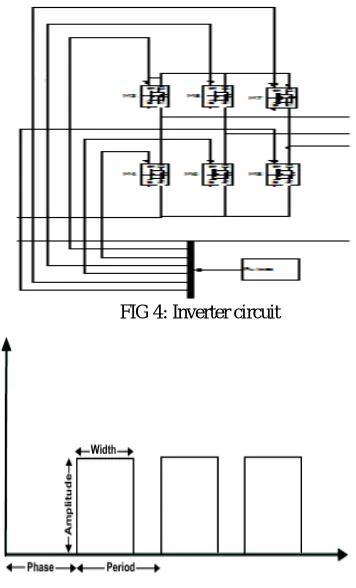
So energy from energy storage device is boost by means of boost converter and then given to the inverter circuit. Then by means of pulse generator giving pulse to the dc to generate the proper square wave to the inverter. The Pulse Generator block generates square wave pulses at regular intervals fig4. The block's waveform parameters, Amplitude, Pulse Width, Period, and Phase delay, determine the shape of the output waveform.
FIG 4: Inverter circuit
Copyright to IJIRSET www.ijirset.com
11573 In FIG 5 shows the pulse generator which is explained in detail above and FIG 6 shows wind model with squirrel cage induction generator here squirrel cage induction generator is used for variable speed induction generator because wind speed is not predictable. For that purpose only we are going for SCIG.
FIG 6: SCIG MODEL
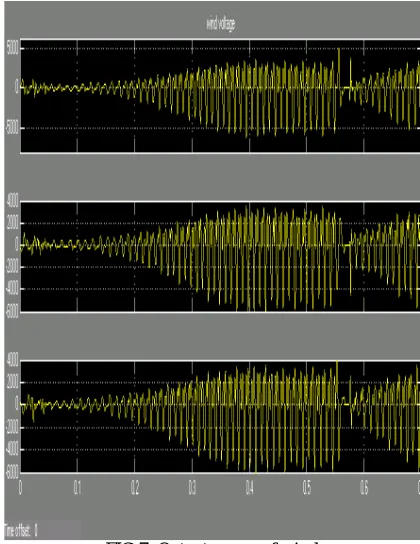
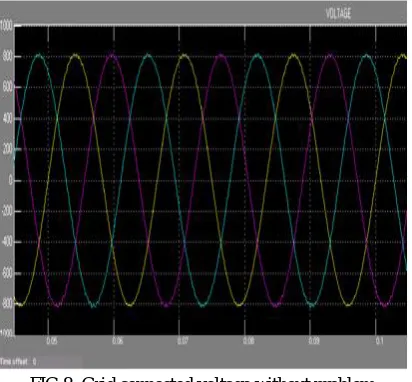
Fig 7 is the output power of the wind for our wind model and fig 8 and fig 9 shows the output of grid connected voltage and grid connected power
FIG 8: Grid connected voltage without problem
FIG 9: Grid connected output power
IV CONCLUSION
The power produced by the wind is not predictable so we going energy storage device like battery energy storage device. By means of energy storage device like battery which helps our electrical system to prevent from voltage problem and power fluctuation. This voltage problem and power fluctuation will cause problem in electrical equipments.
REFERENCES
[1] P. J. Luicks, E. D. Delarue, andW. D. D’haeseleer, “Effect of the generation mix on wind power introduction,” IET Renew. Power Gener., vol. 3, no. 3, pp. 267–278, 2009.
[2] W. Li and J. Géza, “Comparison of energy storage system technologies and configurations in a wind farm,” in Proc. Power Electronics Specialists Conf. (PESC 2007), Jun. 2007, pp. 1280–1285.
[3] F. Bouffard and F. D. Galiana, “Stochastic security for operations plannings with significant wind power generation,” IEEE Trans. Power Syst., vol. 23, no. 2, pp. 306–316, 2008.
[4] J. E. Bridges, “Wind power energy storage for in situ shale oil recovery with minimal co2 emissions,” IEEE Trans. Energy Convers., vol. 22, no. 1, pp. 103–109, 2007.
Copyright to IJIRSET www.ijirset.com
11575 [7] J. Lee, S. Jeong, Y. H. Han, and B. J. Park, “Concept of cold energy storage for superconducting flywheel energy storage system,” IEEE Trans. Appl. Supercond., vol. 21, no. 3, pt. 2, pp. 2221–2224, 2011.
[8] J.-P. Lee, N.-H. Jeong, Y.-H. Han, S.-C. Han, S. Jung, B.-J. Park, and T.-H. Sung, “Assessment of the energy loss for SFES with rotational core type PMSM/G,” IEEE Trans. Appl. Supercond., vol. 19, no. 3, pt.2, pp. 2087–2090, 2009.
[2] M. E. Baran, S. Teleke, L. Anderson, A. Q. Huang, S. Bhattacharya, and S. Atcitty, “STATCOM with energy storage for smoothing intermittent wind farm power,” in Proc. Power and Energy Soc. General Meeting—Conv. and Delivery of Elect. Energy in the 21st Century, Jul.2008, pp. 1–6. [3] C. Abbey, K. Strunz, and G. Joós, “A knowledge-based approach for control of two-level energy storage for wind energy systems,” IEEE Trans. Energy Convers., vol. 24, no. 2, pp. 539–547, Jun. 2009.
[4] G. Koshimizu, T. Nanahara, K. Yoshimoto,H. Hasuike, and T. Shibata,“Subaru project: Application of energy storage for stabilizaion of wind power in power systems,” in Proc. EAS 2005 Annu. Meeting Conf. Energy Storage Assoc., Toronto, Canada, 2005.
[5] K. Yoshimoto, T. Nanahara, and G. Koshimizu, “New control method for regulating state-of-charge of a battery in hybrid wind power/battery energy storage system,” in Proc. IEEE Power Syst. Conf. and Exposition,2006, pp. 1244–1251.
[6] F. Zhou, G. Joos, C. Abbey, L. Jiao, and B. T. Ooi, “Use of large capacity SMES to improve the power quality and stability of wind farms,” in Proc. IEEE Power Eng. Soc. General Meeting, Jun. 2004, pp. 2025–2030.
[7] R. Cardenas, R. Pena, G. Asher, and J. Clare, “Power smoothing in wind generation systems using a sensorless vector controlled induction machine driving a flywheel,” IEEE Trans. Energy Convers., vol. 19, no. 1, pp. 206–216, Mar. 2004.