Copyright 8 1995 by the Genetics Society of America
Environmental Programming
of
Heritable Epigenetic Changes
in
Paramutant
r-gene Expression Using Temperature
and
Light
at a
Specific Stage
of
Early Development
in
Maize Seedlings
Bernard
C.Mikula
Defiance College, Defiance, Ohio 43512 Manuscript received April 21, 1994 Accepted for publication May 12, 1995
ABSTRACT
Different heritable expression-states were programmed into R alleles from R/R-lst heterozygotes under different temperature conditions applied during a developmental period in which flowering is induced. At maturity, R-allele expressions in test crosses of male gametes derived from R/R-lst seedlings raised 15 days in 32" and continuous light conditions differed significantly from those of sib seedlings raised for 15 days in 22" and continuous light conditions and shifted to six 12-hr light-dark cycles, days 16-21. This experiment provides the first evidence in higher organisms that environmental conditions, applied at a specific stage of development cause a heritable change in a specific allele expression. My earlier evidence required a statistical analysis for demonstrating heritable change; I present photographic evidence of this environmental effect on four R alleles.
P
ARAMUTATION (BRINK 1956) provides a sensitive genetic system where heritable quantitative varia- tion in the expression of a single gene can be followed from generation to generation. BRINK showed that when the R allele (dark kernel pigmentation) is made heterozygous with its allele, R-st (stippled pigment pat- tern), the R allele produces significantly less pigment after removal from a heterozygote with R-st. The change in R-allele expression is heritable; furthermore, all Ralleles (100%) upon removal from this R/R-st heterozy- gous combination are changed, and the change is di- rected at the R locus only. Later studies (MIKULA 1961; MCWHIRTER and BRINK 1962; COOPER 1964; STYLES and BRINK 1966) showed that if the R allele was maintained with R-st alleles for several generations, paramutation of the R allele was additive. This additive effect on the R
allele was followed in male gametes for five generations (STYLES and BRINK 1966). FEDOROFF (1989), while
studying the ontogenetic expression of the transposon Spm (SupP-essm-Mutatm), reported evidence that an in- active Spm, by association over several generations with an active Spm, can become progressively more active. The R alleles and cryptic Spm elements in maize repre- sent genetic systems whose phenotypes can be incre- mentally programmed by previous association with other genetic elements during development (FEDOROFF
and BANKS 1988).
Paramutation (BRINK et aL 1968; DOONER et al. 1991) was considered to be the result of changes accumulated in the R gene throughout somatic development. C o o PER (1964) and SASTRY et al. (1965) reported variation in paramutation from gametes sampled from different tassel branches reflected a mosaicism developmentally
Genetics 140 1379-1387 (August, 1995)
controlled before or during tassel differentiation. I re- ported in a previous paper (MIKULA 1967) that when R is exposed to a paramutagenic allele (R-st), the envi- ronmental conditions can promote significant heritable change in R-allele expression. R alleles from plants that as seedlings were raised at 21" and LL conditions (con- tinuous light) during the third and fourth week of seed- ling development, when compared in testcross progeny, conditioned significantly less pigment in test crosses at maturity than Ralleles of plants matured from seedlings grown at the same temperature in LD (12-hr lightdark cycles) conditions for this same period. The identifica- tion of a critical developmental period leading to changes in R expression suggested that experimental control of paramutation was possible. Three other o b servations reinforced this inference: the level of para- mutation could be correlated with the number of LD .kycles in the third week of seedling development; pre- liminary tests showed a polarity of paramutant R allele expression in which early pollen samples from the u p per branches of single tassels showed more paramuta- tion than samples taken from lower branches of the same tassel; and incremental changes in paramutant R expression from generation to generation (MIKULA 1961) showed that small changes in the level of paramu- tation could be detected and amplified from generation to generation.
1380 B. C. Mikula
quired for tassel determination; could the level of para- mutation be correlated with programmed environmen- tal conditions applied in early seedling development; could paramutation be inhibited or driven toward the completely colorless level; when during early develop- ment is the seedling most responsive to environmental variables of temperature and light; and could the level of paramutation in four new R accessions be correlated with environmental conditions administered to young seedlings?
MATERIALS AND METHODS
Seed stocks: Environmental programming strategy for the first 3 weeks of seedling development was based on work with the Rand R-st alleles in inbred W22 background provided by
JERRY KERMICLE, University of Wisconsin. The effect of the environment on paramutant R-allele expression, first re- ported in inbred W22 (MIKULA 1967), required a statistical analysis for its evaluation. In an effort to find more responsive R alleles, new R allele accessions that had not undergone a high degree of inbreeding and selection were screened for dark kernel pigment expression. The four new R-g alleles from New Mexico and Arizona, 221, 229, Z1, 269, supplied by Native Seeds/SEARCH, Tucson, A Z , are reported as GI, G3, G4, and G5, respectively in this document. The new R-g accessions condition, in r/r/R endosperm, a uniformly dark pigmentation, comparable to that of the W22 R-r gene. All four R-g lines were crossed to a R-kt (light stipple with few very fine spots) known to cause intermediate levels of paramu- tation of the R allele. For convenience, the R-g genes will be referred to simply as R, eliminating the lower case designa- tion,-g, signifjmg lack of plant color. The R-kt allele, in W22 background, was supplied by the Maize Genetics Coop., Uni- versity of Illinois.
Growth chamber conditions: Seeds from single ears of the R/R-kt heterozygotes, representing the four different R al- leles, were germinated on white, moist facial tissue pads in stainless steel, glasscovered pans. Continuous light was s u p plied by 14 200-W VHO cool white fluorescent tubes supple- mented by 12 60-W incandescent bulbs. In 3 or 4 days, when coleoptiles were large enough to handle safely, seedlings were transplanted to soil conditions in plastic pots. Seedlings were started 50-60 cm distant from the light source and grew to- ward the light for the remaining 2- or %week periods they were held in the controlled environment conditions. Average light intensiq during this early stage of seedling development was 35 W/m
.
Dark conditions were obtained by placing the seedlings into light-tight boxes. For each environmental treat- ment, eight seedlings were used. Under continuous light con- ditions, after 14 days at 22" or 7 days earlier at the higher temperature, 32", seedings developed necrotic conditions in youngest leaf tips. The deterioration of youngest leaves pro- gressed with time, especially at the higher temperature and was reminiscent of calcium deficiency symptoms. Most plants survived this stress and recovered after dark treatment.Field operations: Seedlings were transferred to the field at the end of the growth chamber treatments. At maturity, plants that were subjected to different environmental conditions as seedlings were mated to r / r (W22 X W23) females grown under field conditions. Test-crossed ears were evaluated on the basis of their kernel pigmentation. Pollinations were per- formed by sampling pollen over 7 days; the test crosses from the last pollen sample (of each plant) were used for the photo- graphs.
Scoring procedures: A sample of 50 kernels from each test- cross ear was scored by matching each kernel against a set of standard kernels ranging from 0 (colorless) to 20 (completely pigmented). Pooled means and standard deviations for each environmental treatment are reported in Figure 6.
RESULTS
Extensive preliminary testing showed no tassels were initiated in inbred W22 under LL conditions. This made it possible to determine the number of LD cycles essential for tassel initiation. Tassel initiation was deter- mined 1 week after LD treatments, however plants re- mained in the inhibitory LL conditions until six to eight plants could be assayed for the presence of tassel pri- mordia. The presence of tassel primordia was deter- mined by dissecting away the leaves surrounding the terminal meristem, under magnification. The presence of an elongated terminal meristem and the presence of branch primordia were observed when tassel initia- tion had taken place. Figure l shows that tassels could be induced with six LD cycles applied days 16-21 at 22" or a week earlier with only four LD cycles applied days 11 - 15 at 26". The results in Figure 1 , based on the presence or absence of tassel primordia in seedlings of the W22 inbred for each combination of environmental conditions, provided a model system that made it possi- ble to test whether paramutation could be influenced by combinations of temperature and light variables a p plied at a time seedlings were undergoing the transition from vegetative to floral phase of meristematic activity. The testcross ears of RR-lst heterozygotes of alleles
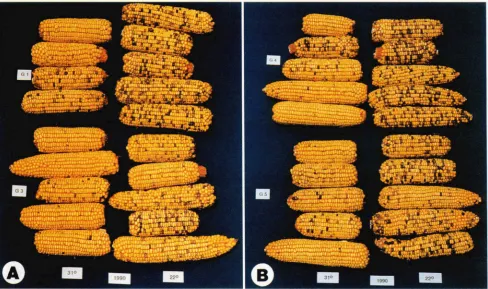
G1, G3, G 4 , and G5, in Figure 2, A and B, show that a difference in the amount of pigment for all four new
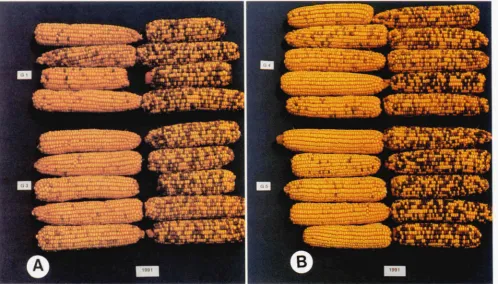
R alleles can be observed in response to early environ- mental conditions. Seedlings raised in 31" LL condi- tions for the first 3 weeks in the left column of both photographs show kernels with less pigment than those raised in 22" LD conditions during the same period. The paramutagenic allele, R-lst, present in half of the kernels on each ear, has a phenotype too light to be visible in the photographs; thus, it is possible to com- pare, visually, the environmental contribution to the paramutation of the R alleles. R / r seeds representing median pigment values from each of the columns of testcross ears pictured in Figure 2, A and B, were planted directly in the field in 1991. The differences observed in the test crosses of the treated generation, 1990, were carried over in the test crosses of 1991, Fig- ure 3, A and B, with no further environmental treat- ments.
Programmed Heritable Change 1381
Number of UgM-Dark Cycles Required for T W Indudon of Inked W22
PartA22O
Age of Seedling. (in bye) Durlng L:D Cycle0
14 15 16 17 18 19 20 21 22 23 24 25 26 27 28
6 cycles 3
-3 3-3 -3CYCks
6 cycles
...
Part 826 O
Age of Seediinga (In b y e ) During L:D Cycb
8 9 10 11 12 13 14 15 16 17
6 cycles
c-1
-
52 4
3 3
4
-
T d l n d u c e d - T dnot inducedFIGURE 1.-Developmental periods, in days, where re- peated LD cycles induced tassels in seedlings. (A) Summariza- tion of seven experiments performed in 22"; (B) summariza- tion of eight experiments performed at 26". Numbers at the end of each line refer to the number of LD cycles applied in each experiment. Seedlings were grown in continuous light except for the periods covered by the lines. Tassel induction
was confirmed a week after the last LD treatment.
32" are shown in the left column of ears of Figure 4. R- allele expressions in the right column of testcross ears
of Figure 4 are from seedlings raised in 22" and treated with LL conditions through day 15, then subjected to LD conditions, days 16-21. Seeds (R/r) from 1991 test- cross ears, representative of each of the columns in Figure 4 were planted directly in the field in 1992 with no environmental treatment of seedlings. Figure 5
shows the differences observed in 1991 were main- tained in 1992. In fact, in 1992 a greater contrast can be observed between paramutated R-allele expressions from plants which received 32 and 22" the previous year. Reversion has been reported (KERMICLE 1963;
S m E s and BRINK 1966) to take place in paramutated
R alleles after removal from the heterozygote with para- mutagenic allele R-st. Because less reversion takes place
in the more highly paramutated R genes (KERMICLE
1963), a greater contrast is observed in the years after seedling treatment, Figures 3 and 5. This higher con- trast in the year after the seedling treatment gives em- phasis to the heritable nature of the change in R-allele expression.
The G4 allele was retested in 1992 to identify more precisely when LL and LD conditions at 32 and 22" can influence paramutation. Figure 6 presents a schematic diagram showing the times LL and LD conditions were applied to program the epigenetic change in paramu- tant R-allele expression. Seedling treatments under 32"
LL conditions (Figure 6, line c) were terminated a week earlier than seedlings started in the 22" LL environment (line a ) ; both received natural LD conditions when transplanted to the field. LD cycles were applied days
16-21 at 22" (Figure 6, line b) or in days 11-15 at 32"
(line d ) before seedlings were transplanted to the field. The differences observed in the photographs of Figure 4 were replicated in 1992 and are presented as testcross pigment scores in Figure 6 (lines b and c); a difference
of 10 scoring units was found. Significant differences in paramutation can be related to 5- or M a y intervals in seedling development when lines b-d are compared in Figure 6. These changes in the level of paramutation presented in Figure 6 can be correlated with tempera- ture and light conditions applied during the develop mental interval sensitive to floral induction in Figure
1. Plants that were kept under LL conditions before being transplanted to field conditions have two more nodes and many more tassel branches than those given LD conditions in the last 6 days of programmed envi- ronmental conditions. This observation supports the conclusion that tassels were determined in the periodic
(LDcontrolled) environment.
DISCUSSION
The developmental events unfolding in the corn seedling were considered a biological clock, genetically driven internally, and regulated externally by LD cycles. Denying the plant its external regulatory, lightdark cy- cles in a constant temperature environment, was ex- pected to perturb the internal developmental clock mechanism (a developmental disequilibrium) such that paramutation might be affected. Continuous light kept the seedlings vegetative with the terminal meristems periodically initiating new leaf primordia. This made it possible to show (Figure 1) when tassel determination takes place at 22 and 26" and by inference at higher temperatures. It was possible to correlate the presence
1382
t
3
FIGURE 2.-A comparison of the effect of early seedling environments on testcross expressions of four different R alleles, GI,
C3, G4, CS, heterozygous with R-kt Seedlings were given either 31" LL or 22" LD conditions during the first 3 weeks of their development. Testcross ears from the 31" conditions are in the left column of A and B those from 22" are to the right. Fifty percent of the kernels on each of the ears represent the R-kt allele whose spots are not visible in the photographs; the remaining 50% of the kernels carry the paramutant R alleles. The difference between the amount of kernel pigment in the left and right columns of each photograph represents the environmental influence on paramutant R-allele pigment expression that occurred in the first three 3 of development.
with plants of the same age given the appropriate num- ber of LD cycles to induce tassels, matured later, were taller and showed increased node numbers related to the number of days under continuous light.
The experimental design in my early work (MIKULA
1967) could only implicate the third and fourth week of seedling development in the control of paramutation. Figure 1A shows that at 22" tassels were determined by the end of the third week when six LD cycles were applied, days 16-21. When the temperature was raised to 26", four
LD
cycles, days 11-
15, tassel determination occurred a week earlier (Figure 1B). Subsequent tests showed that seedlings, though stressed, could survive continuous light and 31" for %week test periods. This made it possible to compare paramutation from plants raised as seedlings in 31"LL
conditions compared with those from 22" LD conditions. The photographic evi- dence of Figure 2, A and B, with the four new R alleles, confirms the results previously reported (MIKULA 1967)that significant differences in paramutation could be induced in seedlings in the first 3 weeks of development and that the differences were heritable (Figure 3, A and
B)
.
An
even greater level of paramutation was program- mable in <3 weeks if R-allele expressions of seedlingsheld 15 days in 32"
LL
conditions were compared with those of sibling plants given 22" LL conditions days 1-15, followed by
LD
conditions, days 16-21 (Figure 4). Figure 5 shows the differences noted in Figure 4, the previous year, were maintained the following year. In Figures 1-6 only a limited number of variables involv- ing time, temperature and light were explored. The objective in this preliminary work was to find combina- tions of light and temperature variables that could show conclusively that specific environmental conditions, at a specific stage of development, influence paramutation. Given the number of potential variables: age of seed- ling, plant to plant developmental heterogeneity, day length, light quality-intensityduration, LD cycling com- binations, temperature cycling, heat shocks, together with the constraints of limited growth chamber space and one growing season a year, many combinations of variables remain unexplored. Nevertheless, a significant increase in paramutation was achieved early in develop- ment and implicated a 5day period of development.Programmed Heritable Change 1383
F
FIGURE 3.-The carry-over, in 1991, of the influence of early temperature and light conditions on four paramutant R-allele expressions induced in two Merent environments the previous year, 1990. R / r seeds of each of the alleles in Figure 2, A and
B, were planted directly in the field. The left columns of testcross ears, in each photograph above, represent R alleles from plants that, for 3 weeks as seedlings, received 31" LL conditions in 1990. The right columns represent R alleles from plants that, for 3 weeks as seedlings, received 22" LD conditions in 1990.
tiles remained in continuous light until
LD
cycles were employed in the second or third week. Because in soilconditions coleoptile emergence may take
7
days, accel- eration of seedling development was achieved under the continuous light of growth chamber conditionsmaking it possible for tassel determination with four
LD cycles at the end of a l4Aay period at 26" (Figure 1B). All four newly introduced R alleles (Figures 2-5) showed a significant response to temperature and light conditions applied at the early stages of seedling devel-
'
"
W
FIGURE 4.-Test crosses show-
ing environmental enhancement
of paramutation (repression of
pigment expression) that took place in the first 2 weeks of seed- ling development. The G4 allele from Figure 2B (top), heterozy- gous with R-kt, was retested in 1991. Seedlings that received 32" LL for days 1-15 produced, at maturity, the test crosses in the left column. Sib seedlings raised in 22" LL conditions days 1-15, then subjected to LD cycles days 16-21, are represented in the test crosses in the right column.
1384 B. C. Mikula
"
opment. The G# allele (Figures
4
and 5) was the most responsive to the two different temperatures; seedlings held in LL conditions for 15 days at 32" when compared with those from LL conditions for 21 days at 22", at maturity, produced test crosses whose scores were sig- nificantly different (Figure 6, lines c and a, respec- tively). Significantly different levels of paramutation were also achieved within the last 5 days of the first 2EARLY SEEDLINO TREATMENTS
Aga of Plant In Days TM&lWE
1 2 3 4 5 6 7 8 9 1 0 1 1 1 2 1 3 1 4 1 5 1 6 1 7 1 8 1 9 2 0 2 1 Sam Uno
22OLL
< >- 22" LD 13.4 f21 b 32OLL
< >
32OLL 32OLD
<
./
/.
>3.2 f 1.5 C
10.7 f 25 d
FIGURE 6.-The environmental programming schedule for
2- and 3-week-old seedlings which were started in LL condi- tions. LD treatments that induce tassel formation were a p plied the last 5 days in 32" (days 11-15) and in the last 6 days in 22" (days 16-21). Seedlings were removed to field conditions after each treatment. Testcross scores of matured plants reported on the right show the magnitude of change in R-allele expression. Each of the four scores are pooled means and standard deviations from six different plants. All
seeds used came from the same R/R-lst ear carrying the &
accession.
1
FIGURE 5.-Test of heritability of differences observed in Figure4. The R / r seeds from testcross ears of 1991 in Figure 4 were planted the following year, 1992.
The differences observed in 1991
persist in the test crosses of 1992
without further temperature treat- ment and in the absence of the paramutagenic R-lst allele.
1
weeks of development with the same temperature (Fig- ure 6, lines c and d)
.
Thus, the period of seedling devel- opment most sensitive for increasing the level paramu- tation was found in the last 5 days of the first 2 weeks of seedling development at 32", underLL
conditions. At 32", the developmental interval in which LD conditions were applied (Figure 6, line d), corresponds with the time tassels were determined in 26" LD conditions (Fig- ure 1).When the scores 3.2 and 10.7 in Figure 6 , lines c and d, are compared, light appears to be the variable that contributed the higher level of paramutations (least pigmentation) in test crosses at maturity. However, when the lights were turned off for dark cycles it was inferred the absence of radiant energy from the growth chamber lights lowered plant temperatures; therefore, temperature cannot be excluded from comparisons based solely on lines c and d in Figure 6. Unpublished experiments show that, given the same continuous light conditions, more paramutation was found from plants which as seedlings were held
2
weeks in 22" then shifted to 32" for the third week compared with those that were continued in 22" for the third week. It is concluded, therefore, temperature is the more important variable at this stage of development. However, the effect of light cannot be entirely discounted because continuous light serves to delay tassel determination and could thereby enhance the effect of temperature through some developmental disequilibrium.In the early literature on paramutation, MCWHIRTER
and BRINK (1962) reported that 67 R-sc mutants from
Programmed Heritable Change 1385
tant R-allele expression are compared, the same R-kt allele can be both strongly and weakly paramutagenic depending on the seedlings' early environment. Test- cross pigment scores in Figure 6, lines b and c, show a separation of 10 scoring units. It may be inferred that the strongly and weakly paramutagenic alleles reported by MCWHIRTER and BRINK (1962) represent mutants whose paramutagenicity differ in temperature sensitivity.
To determine precisely when paramutation takes place, more work needs to be done exploring combina- tions of variables as well as the timing of their applica- tion on developing meristems. BRINK et al. (1968) sug- gested, on the basis of a survey of various paramutation- like phenomena in Pisum, Malva and Oenothera, that paramutation could take place gradually throughout somatic development. My experiments cannot rule out that some paramutation takes place during the early vegetative phase of development; however, the results in Figure 6, lines c and d, show that a significant amount of paramutation was achieved within the 5 days in which tassels were determined, Figure 1B. The most economi- cal hypothesis for paramutation of the R allele, a tran- scriptional activator, would be to assume the allele is turned on throughout seedling development and can be turned off late in development under paramutagenic conditions, during the developmental transition from vegetative to floral tissue in the meristem.
It is clear paramutation in the new R accessions re- sponds to environmental conditions applied early in seedling development as was first reported for inbred
W22. Whether the new R alleles respond more or less
than the highly inbred R-rallele first reported (MIKULA
1967) no longer seems relevant because the level of paramutation shows a sensitive dependence on early developmental conditions. The conditions that influ- ence paramutation of the R allele take place many cell divisions before gametogenesis. The result is a clonal mosaic of cells observed in the test crosses of treated plants. The size of the clones of cells can be associated in Figures 2-5 with the initial conditions that deter- mined the switching of the meristem from the vegeta- tive to the reproductive state. The smallest clonal patches of cells are found in those testcross ears of plants that as seedlings were given the stress conditions of 32" and continuous light before removal to natural LD conditions of the field.
Where transposable elements Mu, Spm and Ac/Ds
were involved, small clones of cells expressing pigment were interpreted as resulting from a transposition event involving the last few of the 17 cell divisions of the aleurone layer (LEVY and WALBOT 1990). If the analysis of LEVY and WALBOT is applied to clonal patterns re- sulting from paramutation of the R allele, it is possible to infer that events controlling the timing of pigment expression in the last few cell divisions of the aleurone were determined many cell divisions earlier during de-
velopmental conditions at the time of tassel determina- tion. Proposed models for paramutation-like events must account for the signal receptor, the cellular events in the time interval to gametogenesis as well as the lag- time involving R-allele expression in the earliest of the
17 cell divisions of the aleurone of test crosses where the paramutated R allele is normally expressed. A corol- lary of this line of reasoning requires a consideration that clonal patterns resulting from transposable ele- ments leaving a locus might also be determined within this same developmental interval. A transposable ele- ment has been associated with Rst (ASHMAN 1970; WIL LIAMS et al. 1984) though as yet none has been reported to be associated with the R allele, a transcriptional acti- vator (LUDWIG et aL 1989; ROBBINS et al. 1991).
The paramutation behavior of the R allele reported above and the programmable Spm (FEDOROFF 1989)
share common characteristics. Both show: expressions correlated with methylation (M. ALLEMAN and J. L. KER- MICLE, unpublished data, reported in PATTERSON et al.
1993); dependence for changes in expression on the
presence of a trans-acting element, R-st, in the nucleus (ASHMAN 1970; WILLIAMS et al. 1984); different expres- sion states which can be correlated with developmental regulation in different regions of the main stem and different tassels of the same plant (COOPER 1964; SAS
TRY et al. 1965); and incremental change from genera- tion to generation (MIKULA 1961; MCWHIRTER and BRINK 1962). The ability to program and monitor high- frequency incremental change in a gene expression, from generation to generation, is unique to the para- mutated R allele. FEDOROFF and BANKS (1988) inferred from their data that developmental events in the plant, together with a transacting Spm could incrementally program increased responsiveness of an inactive Spm,
ultimately resulting in changes in the methylation of the promoter of Spm in subsequent generations (FEDOROFF
1989). Because, as reported above, light and tempera-
ture conditions, applied at a specific stage of develop- ment, can be implicated in the control of paramutation at the r locus, and, because the similarity of paramuta- tion at the r locus and transactivation of Spm has been noted ( JORGENSEN 1993; MATZKE and MATZKE 1993),
the role of environment for incrementally program- ming epigenetic change at a specific stage of develop ment in other genetic systems can now be addressed.
The environmental effects of temperature on somatic mutability in the earlier literature presaged the more recent findings of temperature and light influencing mutable (unstable) gene expression. Somatic mutabil- ity (variegation) (RHOADES 1941; FABERGE and BEALE
1942; PETERSON 1958; in Antirrhinum, BONAS et aL
1984; HARRISON and CARPENTER 1973) was reported to
1386 B. C. Mikula
floral pigment in transgenic petunias (VAN DER KROL et al. 1990) was correlated with changes in temperature, light duration and intensity; however, suppression of pigment did not persist after segregation of the transgene (NAPOLI et UI!. 1990).
Heritable change in floral pigment expression in transgenic petunias (MEYER et UL 1992) was correlated with changes in environmental conditions during devel- opment. The number of weakly pigmented flowers in- creased with the age of the plant and with field condi- tions of higher temperature and light intensity. Because reduced floral pigment could be monitored in the many flowers of a single plant from May through S e p tember, it was concluded methylation associated with reduce pigmentation could take place at any time in the petunia life cycle. The reduced pigment expression noted in the field showed up with high frequency in progeny of affected flowers.
In maize, paramutation of the R allele is observed only in aleurone tissues of test crosses. It can be inferred that if the environment plays a role in paramutation during development, then it would be expected that on a single plant showing paramutation-like behavior one could find that, as in petunia, gametogenic tissues from the main stem and tillers and ears in maize might differ because they are determined at different times. In the work I have reported above, only the terminal meristem of the main stalk was determined under con- trolled environmental conditions. When treated seed- lings were moved from LL to field conditions, induction of ears and tassels on tillers of the same plant were subjected to different light and temperature environ- ments. Differences between the gametes of the main stalk, tillers and ears have been reported (COOPER 1964; SASTRY et al. 1965; FEDOROFF 1989).
This report on the r locus may be considered the first where environmental variables, applied at a specific developmental stage elicit high-frequency heritable changes in a specific allele expression. For reasons still not understood, the heterozygous condition (paramuta- tion) with the R-lst allele is a requirement for the envi- ronmental effect on the R allele. Homozygous R alleles as well as R alleles heterozygous with a paramutated R, tested under the same conditions reported above, have not shown enhancement of paramutation. However, as pointed out earlier, many combinations of environmen- tal conditions remain untested. In a recent review of heritable changes induced by environmental stress con- ditions, CULLIS (1990) reported no examples in which the effect of the environment could be directed at a specific gene. The R allele is known to respond to light and temperature and therefore could provide, as a tran- scriptional activator, a mediator function for the two most important external variables that control timing in biological systems, light and temperature.
Paramutation at the r locus represents a model system
to monitor heritable effects of environment on epige- netic change. It is quite possible, however, that those systems that have been described as unstable genes, trans-
genes, mosaicism, variegation, transactivation, transvec- tion, transdetermination, m s s e n s i n g , expression states, cosuppressions, phase changes, position effect variega- tion, chromatin spreading, or “sick genes” may represent facets of common mechanisms shared by many genetic systems designed to help genetic programs to “learn from experience” (JACOB 1982).
I wish to thank BETH BESAW and MARGARET NOBLE for dedicated technical assistance. Grateful acknowledgement is made to The Defi- ance College for making growth chambers, field facilities and equip ment available for the past 30 years. Without the provision of growth chambers by The Charles F. Kettering foundation, Dayton, OH, this work would not have been possible.
LITERATURE CITED
ASHMAN, R. B., 1970 The compound structure of the R-st allele in maize. Genetics 64: 239-245.
BONAS, U., H. SOMMER, B. J. HARRISON and H. SAEDLER, 1984 The transposable element Tam1 of Antirrhinum mujw is 17 kb long. Mol. Gen. Genet 194 138-143.
BRINK, R A., 1956 A genetic change associated with the R locus in maize which is directed and potentially reversible. Genetics 41:
872-889.
BRINK, R. A., E. D. STYLES and J. D. AXTELL, 1968 Paramutation: directed genetic change. Science 159 161-170.
COOPER, H. B., JR., 1964 Paramutation and reversion of the Rallele in maize. Ph.D. Thesis, University of Wisconsin, Madison, WI. CULLIS, C. A,, 1990 DNA rearrangements in response to environ-
mental stress. Adv. Genet. 28: 73-97.
DOONER, H. &, T. P. ROBBINS and R. A. JORGENSEN, 1991 Genetic and developmental control of anthocyanin biosynthesis. Annu. Rev. Genet. 25: 173-199.
FABERGE, A. C., and G. H. BEALE, 1942 An unstable gene in Purtulaca: mutation rate at different temperatures. J. Genet. 43: 173-187. FEDOROFF, N. V., 1989 The heritable activation of nyptzc suppreSsor-
mutator elements by an active element. Genetics 121: 591-608. FEDOROFF, N. V., and J. A. BANKS, 1988 Is the suppressor-mutator
controlled by a basic developmental regulatory mechanism? Ge- netics 120: 559-577.
HARRISON, B. J., and R. CARPENTER, 1973 A comparison of the insta- bilities at the niveu and pullzdu loci in Antimhinum majw. Heredity
31: 309-323.
JACOB, F., 1982 The Logic of Lfe. Pantheon Books, New York.
JORGENSEN, R., 1993 The germinal inheritance of epigenetic infor- mation in plants. Philos. Trans. R. SOC. Lond. B Biol. Sci. 339:
173-181.
KERMICLE, J. L., 1963 Metastability of paramutant forms of the Rgene in maize. Ph.D. Thesis, University of Wisconsin, Madison, WI.
LEVY, A. A,, and V. WALBOT, 1990 Regulation of the timing of trans- posable element excision during maize development. Science
248: 1534-1537.
LUDWIG, S. R., L. F. HABERA, S. L. DELMORTA and S. R. WESSLER, 1989 LC, a member of the maize R gene family responsible for tissue-specific anthocyanin production, encodes a protein similar
gion. Proc. Natl. Acad. Sci. USA 8 6 7092-7096.
to transcriptional activators and contains the my-homology re-
MADDALONI, M., G . BOSSINGER, N. Dr FONZO, M. M o n o , F. SALAMINI
et al., 1990 Unstable alleles of the Glossy-1 locus of maize show a lightdependent variation in the pattern of somatic reversion. Maydica 3 5 409-420.
MATZKE, M., and J. M. MATZKE, 1993 Genomic imprinting in plants. Annu. Rev. Plant Physiol. Plant Mol. Biol. 44: 53-76.
Programmed Heritable Change 1387
methylation of a maize AZ gene construct in transgenic petunia and its colour phenotype. Mol. Gen. Genet. 231: 345-352.
MCWHIRTER, K S., and R. A. BRINK, 1962 Continuous variation in the level of paramutation at the R locus in maize. Genetics 47:
MIKULA, B. C., 1961 Progressive conversion of Rlocus expression in maize. Proc. Natl. Acad. Sci. USA 47: 566-571.
MIKULA, B. C., 1967 Heritable changes in Rlocus expression in maize in response to environment. Genetics 5 6 733-42.
NAPOLI, C., C. LEMIEUX and R JORGENSEN, 1990 Introduction of a chimeric chalcone synthase gene into petunia results in revers- ible co-suppression of homologous genes in trans. Plant Cell 2:
PATTERSON, G . I., C. J. THORPE andV. L. CHANDLER 1993 Paramuta- tion, an allelic interaction, is associated with a stable and herita- ble reduction of transcription of the maize b regulatory gene. Genetics 135: 881-894.
PETERSON, P. A., 1958 The effect of temperature on the mutation rate of a mutable locus in maize. J. Hered. 4 9 121-124. 1053-1074.
279-289.
RHOADES, M. M., 1941 The genetic control of mutability in maize. Cold Spring Harbor Symp. Quant. Biol. 9 138-144.
ROBBINS. T. P., E. L. WALKER, J. L. KERMICLE, M. ALLEMAN and S. L. DELLAPORTA, 1991 Meiotic instability of the R-rcomplex arising from displaced intragenic exchange and intrachromosomal re- arrangement. Genetics 1 2 9 271-283.
SASTRY, G. R. K, H. B. COOPER JR. and R A. BRINK, 1965 Paramuta- tion and somatic mosaicism in maize. Genetics 54: 407-424.
STYLES, E. D., and R A. BRINK, 1966 The metastable nature of para- mutable R alleles in maize. I. Heritable enhancement in level of
standard R-raction. Genetics 5L: 433-439.
VAN DER KROL, A. R, L. A. MUR, P. DE LANGE, A. G . M. GERATS, J. N. M. MOL et aZ., 1990 Antisense chalcone cynthase genes in
petunia: visualization of variable transgene expression. Mol. Gen. Genet. 2 2 0 204-212.
WILLIAMS, W. M., K V. SATYANARAYANA and J. L. KERMICLE, 1984 R- stippled maize as a transposable element system. Genetics 107:
477-488.