Copyright 6 1995 by the Genetics Society of America
Sequences Required for Paramutation of the
Maize b Gene Map to a Region
Containing the Promoter
and
Upstream Sequences
Garth I. Patterson,’ Kenneth M. Kubo, Terry Shroyer‘
and
VickiL. Chandler
Institute of Molecular Biology, University of Oregon, Eugene, Oregon 97403-1229Manuscript received December 9, 1994
Accepted for publication May 15, 1995
ABSTRACT
The b gene encodes a transcriptional regulator of the maize anthocyanin biosynthetic pathway. Certain b alleles participate in paramutation, an allele-specific interaction that heritably alters transcription. The moderately transcribed B’ allele heritably reduces the transcription of the highly transcribed B-Z allele in a B’ /B-Zheterozygote, such that the B-Zallele becomes B’. To identify the cisacting sequences required for paramutation, we used B’ or B-I alleles to isolate intragenic recombinants with &Peru, an allele that is insensitive to paramutation and has distinct tissuespecific regulation. Physical mapping of the recombinant alleles showed that most of the crossovers were in a small region near the 5 ’ end of the btranscribed region. Analysis of the recombinant alleles revealed that the ability to cause and respond to paramutation and the control of tissue-specific expression both localize to the 5’ region of the gene. The 3’ boundary of these functions liesjust upstream of the translation initiation codon. The 5
’
boundary has been estimated to be no more than 0.1 cM further upstream ( 1-150 kb).
Thus, sequences criticalfor paramutation lie upstream of the b coding sequences and may include transcriptional regulatory sequences.
P
ARAMUTATION is defined as an allele-specific in- teraction that leads to a heritable change in one allele at a high frequency (BRINK 1973). A number of transinactivation phenomena in plants, where a transgene inactivates another transgene or an endoge- nous gene, have been described and recently compared to paramutation (MATZKE and MATZm 1993; PAT- TERSON and CHANDLER 1995a). In maize, paramutation has been studied at three regulatory genes of the antho- cyanin pigmentation pathway, b, r, and p l (for review see BRINK 1973; PATTERSON and CHANDLER 1995a). An- thocyanins are red to purple pigments derived from the phenylpropanoid pathway ( DOONER et al. 1991 ).
Our studies focus on b, which encodes a basic helix-loop- helix transcription factor that activates the transcription of the anthocyanin biosynthetic genes (CHANDLER et al.1989; GOFF et al. 1990; WICELLA et al. 1991 )
.
Paramu- tation of the b gene results when the B‘ allele (light pigment in sheath, culm, husk and tassel) and the B-1allele (dark pigment in the same tissues as B ‘ ) are heterozygous ( COE 1966). When a B’/B-I heterozy- gote is crossed, 100% of the progeny receive B’, but both chromosomes segregate normally (COE 1966). Thus, an interaction between B-Z and B’ results in the alteration of B-I to B‘, 100% of the time, and this di-
Cmespmding author: Vicki L. Chandler, Institute of Molecular Biol-
ogy, University of Oregon, Eugene, OR 97403-1229. E-mail: [email protected]
sachusetts General Hospital, Boston, MA 021 14.
nia, San Francisco, CA 94143.
’
Present address: Department of Molecular Biology, Wellman 8, Mas-‘
Present address: Department of Biochemistry, University of Califor-Genetics 1 4 0 1389-1406 (August, 1995)
rected heritable alteration is termed paramutation. The level of pigment produced by old B’ ( B ‘ in the previous generation) and new B’ (B-I in the previous genera- tion) is similar ( PA-ITERSON and CHANDLER 1995b), and the new B‘ is as equally capable as old B’ in chang- ing a B-Iallele into B’, 100% of the time (COE 1966). Some of the genetic requirements for paramutation are known. The ability to paramutate B-I is linked to
B‘ ( COE 1966). The interaction is allele-specific; most alleles of b have no effect on B-Iand are not affected by B‘ (COE 1966; COE et al. 1988; PATTERSON and CHANDLER 1995a). It is clear that most alleles that do not undergo paramutation have numerous structural differences relative to B-Zand B’ (MICELLA et al. 1992; D. HAWTHORNE, D. SELINGER, M. BEAUDET, G. PAT- TERSON and V. CHANDLER, unpublished data), making it difficult to determine which sequences are responsi- ble for the inability to participate in paramutation. Mu- tants with transposable element insertions disrupting the coding region of B-I and B’ are not defective for paramutation (COE 1966; T. SHROYER, G. PATTERSON and V. CHANDLER, unpublished data).
Analyses comparing the expression and structure of
B-I to B’ have revealed that the different pigment phe- notypes of B’ and B-Z are caused by different rates of b
1390 G. I. Patterson et al.
to -1500 bp upstream of the transcription start site; n o sequence alterations were found. Extensive restriction mapping of the two alleles was performed, including the comparison of dozens of potential DNA methyla- tion sites. The extent of methylation was the same, and n o alteration in restriction sites or insertions or dele- tions were detected ( PATTERSON et d . 1993).
T h e association of paramutation with changes in b
transcription suggests transcriptional regulatory se- quences may be involved in paramutation, but no direct evidence implicating these sequences has yet been re- ported. Fine structure mapping of B' and B-Iwas under- taken to determine where the ability to participate in paramutation maps relative to the region controlling transcription. Intragenic recombinants between these
alleles a n d B-Peru, a n allele of b that does not participate in paramutation, were isolated. Characterization of
these recombinants revealed that the 5' e n d of the b
gene is a hotspot for recombination with rates of recom- bination dramatically lower in the more 3
'
portions of the gene. Phenotypic analysis of the recombinants showed that B', B-I a n d B-Peru expression in mature plant tissues is controlled by 5' regulatory sequences, as was previously shown for seed-specific expression of B-Peru (MICELLA et al. 1992). These intragenic recom- binants were tested for participation in paramutation. T h e ability of B' to cause paramutation and the ability of B-Ito respond to paramutation maps to the 5'
region of each allele. The implications of the correspondence between transcriptional control and participation inparamutation are discussed.
MATERIALS AND METHODS
Genetic stocks: All stocks have the r-g:Stadler allele of r, the Pl-Rh allele of pl, and fully functional dominant alleles for the anthocyanin biosynthetic genes (see COE et al. 1988 for review). Description of the different b alleles are summarized in Table 1 and details provided in RESULTS. The B-Zallele was first found at a Nebraska agricultural fair (EMERSON 1921 )
.
Stocks containing the B', B-Z, g12 b wt, 6'-ul and b'-u4 alleles were obtained from E. H. COE, JR. (University of Missouri). The b allele in the g12 b wt stock was obtained from the Maize Coop and is of unknown origin. We have designated this b allele as b-534. This allele has a different restriction map from the b-K55 allele described in COE (1966) and produces no detectable b RNA (G. PATTERSON and V. CHANDLER, unpub lished data). Glossy2 (g12) and white
tip
( w t ) are flanking morphological markers 19 and 11 map units, respectively from b. The B-Peru and b m l stocks were obtained from M. G. NEUFFER (University of Missouri). The b P m 5 allele was isc- lated as previously described (PATTERSON et al. 1991 ).
A B-u stock, which was isolated in an ultraviolet light mutagenesis of B-I ( COE 1966), contains an -5-kb insertion in exon 7 (T. SHROYER, G. PATTERSON and V. CHANDLER, unpublished results) and was obtained from W. SHERIDAN (University of North Dakota). The B-u allele, like B-I, undergoes paramuta- tion ( COE 1966).
Thus, a B'-u stock was made by crossing B-u to B' to produce a B'/B-u heterozygote that was self-polli- nated. The B'-u/B'-u progeny were identified by crossing to appropriate testers.
DNA materials: Maize DNA was isolated from leaves (DEL
LAPORTA et al. 1983) or from immature ears ( R M N et al.
1982). Probes used for restriction mapping were as follows: 550b, a HindIII/BamHI fragment of bW23 ( +152 to +730) ;
BIu4, a DdeI fragment of B-Z (-411 to - 8 ) ; 314, a BglII/ Sal1 fragment of BZ ( -836 to -522) ; S/ G700, a SpeI/BglII fragment of B-Z (-1487 to -836); and B'v1.6, a BglII frag- ment of B'-u (
-
-8000 to -6400). All numbering is relative to the B-Ztranscription start site at +1 (MICELLA et al. 1992). The isolations of B', B-I, B-Peru and bW23 genomic cloneswere described previously (CHANDLER et al. 1989; MICELLA et al. 1992; PATTERSON et al. 1993). Extensive restriction m a p
ping of B'-u, B-Zand B' has detected no differences in the 5' flanking region of these alleles (PATTERSON et al. 1993; G. PATTERSON, T. SHROYER and V. CHANDLER, unpublished data). These alleles all contain an -9-kb BamHI/EagI frag- ment extending from
-
-8 kb to the BamHI site located at +730. DNA from a BamHI/EagI digest of B'-u was size fractionated, and the -9 kb fraction was cloned into lambda Zap Express (Stratagene). One plaque that hybridized to theS / G700 probe was found, and a plasmid ( pB 'vl ) was excised from the phage vector according to the manufacturer's speci- fications. Restriction mapping verified that the insert in the plasmid had the same restriction map as the B'-u genomic DNA. Sequences upstream of the -2-kb insertion in B-Peru
(black bar in Figure 2 ) were cloned from the bPerum220 allele, a mutant derivative of BPeru (PATTERSON et al. 1991 ) . In bPerum220, the 210 bp of sequences just upstream of the insertion are 96% identical to the region represented by the BIu4 probe from B' and BZ (HARRIS et al. 1994). Southern blots using the BIu4 probe confirmed B-Peru has these se- quences upstream of the -2-kb insertion.
DNA gel blot analysis DNA gel blot analyses and hybridiza- tions were performed as described (CHANDLER et al. 1989), except that MSI nylon (Fisher) was used. All DNA digests were done with a five- to 10-fold excess of enzyme according to manufacturer's specifications. Probes were labeled using random hexamer priming ( FEINBERG and VOGELSTEIN 1983). Hybridizations were at 42" in 50% formamide, 1% sodium dodecyl sulfate (SDS) , 6X SSC (2OX SSC = 3 M sodium chloride, 0.3 M sodium citrate), 10% dextran sulfate; washes were at 58", 0.2-0.3X SSC, 0.1% SDS.
All recombinant alleles were tested with at least two differ- ent restriction digests using the upstream probes (B'v1.6, Spe / G700 and BIu4 probes) (Figure 2 ) . B' and BZ have identical restriction maps, but B-Peru fragments produced with BclI, HindIII/NruI, BglII/AuaI, SacI/NruI and Sad/ AuaI digests are different from those produced by B' and B- Zalleles. Similarly, sites at the 3' end of the alleles were exam- ined. Sites tested include two BcZI sites ( +4 and + 7 kb relative to the transcription start site) that are unique to B-Peru and a BclI site unique to B-Zand B' ( +10 kb relative to the tran- scription start site).
Sequences Required for Paramutation 1391
TGCAC (matches sequence in the first exon of B', BZ and BPeru) or GIP5, CTAACGTGCACACTCTGTC (matches se- quence in BPeru -40 bp upstream of the transcription start site). The reactions were performed according to AUSUBEL et al. ( 1987) with the following modifications. One microgram of genomic DNA and 0.25 pg of each primer were used. The amplifications were performed at 3 mM MgC12. The reactions were given a hot start: all components except the Taq poly- merase (Promega) were added, and the reactions were placed at 94", while 2.5 units of enzyme were added to each tube. After enzyme addition, the following cycle was performed 30 times: 94", 1.5'; 61", 2'; 72", 3'. Samples were cooled overnight at 4", and one-fifth of the reaction was electrophoresed on a 1% agarose gel.
Isolation of intragenic recombinants: The nomenclature for the recombinant alleles is as follows: the 5 ' (left) and the 3' (right) region of each recombinant allele is separated by the symbol,
I I.
For example, BPII
BI has the 5 ' region of B- Peru and the 3' region of BZ. Different recombinant alleles are numbered ( e.g., BPII
BZ-3). To isolate BPII
B' and BPII
BZ recombinants, (g12 b m l w t ) / ( G12 B' W t ) and (g12 b m l w t ) /( G12 B-Z Wt) plants were detasseled and open pollinated in an isolation plot with pollen from g12 b534 wt plants, and progeny were scored for seed color. b m l is a Dsl insertion in B-Peru (CLARK et al. 1990)
.
Glossy2 (g12) and whitetip
( w t ) are flanking morphological markers 19 and 11 map units, respectively from 6. All purple seeds, the phenotype expected for recombinants, were planted, self-pollinated and out- crossed to testers. As one control for contamination, the self- pollinated ears were scored for recessive markers not present in either parent, e.g., sugary kernels, yellow endosperm ker- nels, or red cob and pericarp, which probably have sul, Y l and P-w, respectively ( COE et al. 1988). These were discarded. To isolate B'I I
BPrecombinants, 6'-ul and b'-u4alleles were used in combination with B-Peru. b'-ul and b'-u4 are deriva- tives of B-u and B'-u that are indistinguishable from B' in their ability to paramutate B I ( COE 1966). However, b'-u/b'-u plants are green because they contain a lesion in the coding region that prevents activation of the anthocyanin pathway (Table 1 ) (T. SHROYER, G. PATTERSON and V. CHANDLER, unpublished data). Specifically, ( G12 b'-ul W t ) / ( g12 B-Peru w t ) and ( G12 b'-u4 W t ) / ( g12 B-Peru w t ) plants were detasseled and open pollinated with pollen from 812 b534 wt plants. The progeny were separated by seed color, and only the white seed were planted to exclude the B-Peru/b534 (purple seed) parental class of progeny. The white seed contains one paren- tal class, b'-u/b534, and the rarer desired recombinant, B'I
I
BP/b534. Recombinants were scored in two ways. For some seed, seedlings were scored for glossy and white-tipped leaves, and only the plants of the phenotype expected for recombinants with associated crossing over (nonglossy and white-tipped leaves) were allowed to grow to maturity (experi- ment 2, Table 2 ) . Another group of seedlings was allowed to grow to maturity without prescreening for recombinant flanking markers (experiment 1, Table 2 ) . These mature plants were scored for color, self-pollinated and outcrossed to testers. Plants resulting from fertilization by contaminant pollen were identified and discarded. Because the two inde- pendent b'-u alleles gave equivalent frequencies of intragenic recombinants and are phenotypically identical, the recombi- nants produced were grouped for determining recombina- tion frequencies.TO isolate a BII
I
BPrecombinant, we used B-Zand bPerum5( b P m 5 )
.
b P m 5 has a Spm-w insertion in the B-Peru allele -700bp 3
'
of the transcription start in intron 2 (Table 1 ) (PAT-TERSON et al. 1991 ) . Specifically, a (812 b P m 5 rut)/( G12 B-1 W t ) stock was hand-pollinated with g12 b534 wt pollen. The spotted seed ( bPm5/b534) were culled and the colorless seed
(BI/b534 or BZI
I
bPm5/b534) planted, and the resulting seedlings scored for glossy and white tip markers. The non- glossy white-tipped plants, indicative of a crossover between BZand wt, were grown to maturity and scored for plant color. One plant with dark stripes, the phenotype expected for a recombination event between the B-Zpromoter and the Spm- w element in B-Peru, was identified.The number of individuals scored was calculated as (num- ber of ears scored) X (average number of seed per e a r ) . The average number of seed per ear was determined by counting the seed on 15 randomly selected ears and calculating the mean. The calculation of number of recombinants in the open-pollinated experiments required some estimation be- cause of contamination. The identification of contaminants required the production of viable progeny, since the most common indicator of contamination (sugary kernels) is a recessive trait. The putative recombinants that did not pro- duce viable seed might have been either genuine recombi- nants or contaminants. To correct for this, we calculated the contamination frequency in the plants that could be scored and used this number to estimate the total number of recom- binants isolated. The following equation gives the value used for recombination frequency: [A
+
B(A/ ( A + C ) ) ] X 2/ (number of individuals scored), where A is the number of authentic recombinants (putative recombinants with none of the genetic markers that indicate contamination), B is the number of putative recombinants that did not give any prog- eny, and Cis the number of contaminants ( putative recombi- nants that had one or more of the genetic markers that indi- cate contamination). For example, in the isolation of BPII
B' recombinants, 106 purple seed were found in the 2.2 X l o 5seed scored. All of these seed were planted: 29 were the result of contamination, 65 showed no indication of contamination, and 24 did not produce seed. The calculation of recombina- tion frequency is as follows: 2 [ 65
+
24 ( 65/ ( 65+29) )I /
Confidence intervals in mapping: The upper limit of the confidence intervals for the experiment in Figure 1 was calcu- lated as the following binomial: the probability of 0 recombi- nants in 3058 trials,
po
(1 -p )
3058 < 0.05, wherep
is themap distance between the markers. The upper limit for the experiment of COE (1966) was calculated similarly.
Viiual scoring of anthocyanin pigment: A 1-10 scoring scheme was defined for tassel and leafsheath tissue. All plants scored as B' were 6 or less on the tassel scale and 8 or less on the sheath scale; all plants scored as B-Zwere 9-10 on the tassel and sheath scales. In the tassel: 1, light purple only in the glume bar; 2, medium purple only in the glume bar; 3, intense purple in the glume bar only; 4, intense purple in the glume bar with color extending less than half the length of the glume; 5, intense purple in the glume gar with purple extending approximately halfway up the face of the glume; 6, intense purple glume bar with color extending more than half the length of the glume; 7, tassel glumes are purple except at tips; 8, glumes are totally purple with light pigment on tassel branches; 9, intense pigment on all glumes with medium pigment on tassel branches; 10, intense pigment in all parts of the tassel. In cases in which different branches on the same plant had different scores, an average was taken. In no case were different regions on a tassel different by more than 2 units on this scale. In the sheath: 1, no purple; 2,
1392 G. I. Patterson et al.
8‘
B-Peru
x
E
B-I
I
Phenotypes expected for:Non-recombinants Recombinants
white seed white seed B‘
B-I light plant dark plant
-
3058
0B-PW
B-I tested not tested not
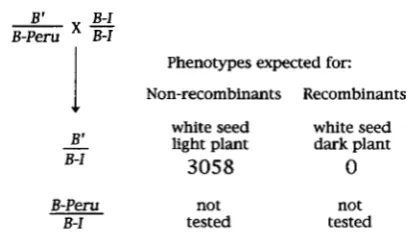
FIGURE 1.-Sequences required for paramutation are
tightly linked to B’. The crosses performed to screen for re- combination between B-Peru and B’ are shown with the pre- dicted seed and plant phenotypes for nonrecombinants and recombinants. A total of 3058 white seeds were planted; all produced light plants. The purple seed were not screened for recombinants because spontaneous paramutation would produce the same phenotype as that expected for recombi- nants (see text).
of the sheath; 7, intense purple at base of sheath, decreasing to faint color at the top; 8, intense purple at base of sheath, decreasing to medium color at top; 9, intense purple through- out sheath, with green barely detectable; 10, intense purple throughout the sheath, no green showing. In rare cases in which different sheaths on the plant gave different scores, an average was taken. In no case did different sheaths on the same plant differ by more than one unit.
RESULTS
The ability to paramutate
BZ
maps to B ’ : COE( 1966) demonstrated that the ability of B’ to paramu- tate B-I maps in the vicinity of B‘ on chromosome
2
( C O E 1959, 1966). He combined B‘ (light purple plant, paramutates B-I) with bK55 (green plant, unable to paramutate B-I) in a heterozygote. When the hetero- zygote was crossed to B-I, the ability to paramutate was always transmitted with the light color of B’. Thus, the ability to paramutate is linked to B’. Since only 44 B’/ B-Z progeny were tested, these data are consistent with the ability to paramutate being as far as 6 map units from B’ (see MATERIALS AND METHODS for calculations)
.
To address whether a separate, but closely linked, gene causes paramutation, additional recombination m a p ping experiments were performed. The experiment was similar to that of COE ( 1966), except that the paramuta- tion-insensitive B-Peru allele was used instead of the para- mutation-insensitive bK55 allele. bK55 is recessive to B’ and B-I: therefore, to determine the genotype of a partic- ular plant, COE had to cross to testers and score the color of progeny families ( COE 1966).
The B-Peru allele does not paramutate B-I and is not sensitive to B‘ ( C O E et al. 1988) but is dominant for pigment production in the aleurone layer of the seed (STYLES et al. 1973; PATTERSON et al. 1991). Since B’ and B-Zdo not produce aleurone pigment, the B’ / B I and B-Peru/BI progeny can be distinguished by aleurone color, enabling much larger numbers of plants to be more easily scored.B’/B-Peru plants were crossed with BI/B-Z plants (Fig- ure 1 ) , and the B’/B-I progeny, identified by lack of
aleurone pigment, were planted and scored for plant color. Nonrecombinant B’/B-Iplants would be light be- cause B’ efficiently paramutates B-I. If a recombination event separated the sequences controlling the tissue-spe- cific pigmentation pattern of B’ (colorless aleurone) from closely linked sequences causing paramutation, rare seeds with colorless aleurone (B’/B-I) that p r e duced dark purple plants would be observed, because the recombinant B‘ would not alter B-Z.
Several thousand seeds with colorless aleurones (ge- notype B’/B-I) were planted and scored. None of the 3058 B’/B-I plants had a dark phenotype that would indicate the isolation of a B‘ recombinant that had lost the ability to paramutate B-I (Figure 1 )
.
Thus, the abil- ity to cause paramutation either resides within the B’ allele or is very tightly linked. The B-Peru/B-I siblings were not screened for the reciprocal recombinant, a B- Peru allele that had become paramutagenic, because the B-I/BI parent will transmit B‘ to some of the prog- eny due to spontaneous paramutation ( COE 1966), which is seen in our stocks at a frequency of l - l O % . This experiment demonstrates that the sequences re- quired for the ability to paramutate B-I and the se- quences required for the tissue-specific pigmentation pattern of B’ are tightly linked. Given that no recombi- nants were seen in 3058 progeny, there is a >0.95 prob- ability that the ability to paramutate is <0.1 cM from B’ sequences conferring tissue specificity (see MATERI-The interpretation of these experiments is compli- cated by the fact that the structure of the &Peru allele is different from that of B’ in the sequences immediately upstream of the transcription start site. Sequencing, hybridization and restriction mapping with B-Peru, B’ and B-I genomic and cDNA clones indicates that the transcribed region of B-Peru is 98% identical to that of B‘ and B-I, which are indistinguishable from each other ( RADICELLA et al. 1991, 1992; PATTERSON et al. 1993). However, the B-Peru sequences immediately upstream of the transcription start site are unrelated to B’ and B-I (comparing 1980 and 1487 bp upstream of the B- Peru and B’, B-I transcription start sites, respectively). If no sequence similarity is available for homologous recombination upstream of the transcription start, then even sequences that are physically very far away might be genetically close. However, when the B-Iand B-Peru alleles are heterozygous with each other, recombination between flanking morphological markers and b gives typical map distances as that observed with other b al- leles. Thus, B-Peru and B-I map to the same location relative to other chromosome 2 markers, suggesting that the local lack of homology is not dramatically alter- ing recombination.
To compare the structure of B-Peru and B’ further upstream, additional B‘ sequences were cloned (MATE-
Sequences Required for Paramutation
TABLE 1
Alleles of b used in this study
1393
b allele Derivation Structural features Phenotype Reference
B-I Natural NA" Dark purple plant, colorless EMERSON (1921)
seed
B' Paramutant derivative of B-Z Indistinguishable from B-I Light purple plant, colorless COE (1966)
B-V B'-v b'-vl
b"v4
B - P a
bPm5 b m l b534
Insertion derivative of B-I Paramutant derivative of B-v Paramutant excision
derivative of B-v Paramutant excision
derivative of B'-v Natural
Insertion derivative of BPeru Insertion derivative of B-Peru Lab stock, obtained from
Maize GOOD
5-kbp insertion in exon 7 Indistinguishable from B-v Loss of 5-kbp insertion in
Loss of 5-kbp insertion in
NA
exon 7
exon 7
Spm-w insertion in intron 2 Dsl insertion in exon 5 Polymorphic to B-Zand
B - P m
seed
Dark purple sectors in plant Light purple sectors in plant Green plant, colorless seed
Green plant, colorless seed
Purple seed, weak purple
Spotted purple seed Colorless seed, green plant Green plant, colorless seed
plant
COE (1966) COE (1966) COE (1966)
COE (1966)
STYLES et ai. (1973)
PATTERSON et al. (1991) CLARK et al. (1990) PATTERSON et al. (1991)
NA, not applicable.
rived from
B'
and the related alleles B-I and B'-v. B-vand B'-v contain a transposable element insertion in exon
7
of B-I and B'-like alleles, respectively (Table 1 ) (T. SHROYER, G. PATIERSON and V. CHANDLER, u n p u b lished data).
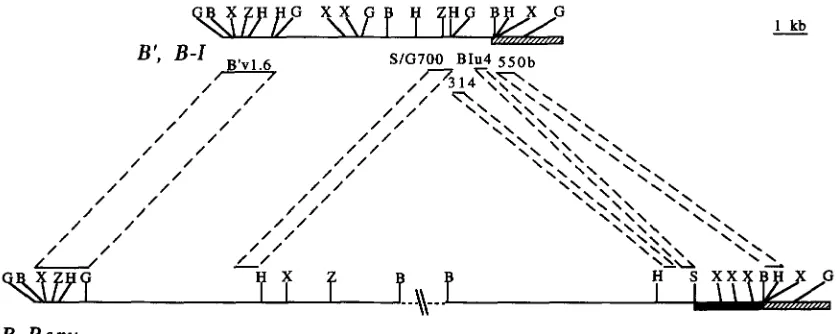
The transposable element has no effect on paramutation ( COE 1966). Sequencing and extensive restriction mapping revealed no differences between the upstream sequences of B', B'-TJ and B-Z (PATTERSON et al. 1993) (data not shown). Figure 2 shows the re- striction maps of &Peru and of B', B-I (this nomencla- ture is used to indicate that the structure of both alleles is the same). All of the indicated probes from the u pstream region of
B',
B-I also hybridize to BPeru at the high stringency conditions used. Probes derived from the region between B 'v1.6 and S/G700 recognize se- quences that are repeated >10 times in the maize ge- nome, so could not be used to determine if this region is also linked to B-Peru. However, the restriction map of the region between these two probes in B', B-Iis not similar to the restriction map of B-Peru in the same region (Figure2 )
(data not shown). These results demonstrate that B-Peru does have extensive sequence similarity to B', B-Iupstream of the transcription start site, but it has additional sequences as well. Thus, re-B - P e r u
1394 G . I. Patterson et al.
combination could, in principle, occur using this ho- mology that exists upstream of the transcription start of the two alleles. While the possibility of a very tightly linked gene causing paramutation cannot be elimi- nated by these data, the failure to detect a recombina- tion event separating sequences required for paramuta- tion from B’ regulatory sequences supports the hy- pothesis that the sequences involved in paramutation are a part of B’.
Fine structure mapping of sequences necessary for paramutation and tissue-specific expression: The data in Figure 1 show that the ability to cause paramutation resides very near or within B‘. Paramutation affects b
transcription (PATTERSON et al. 1993), raising an im- portant question: Does the capacity of B’ to paramutate B-I and the capacity of B-I to respond to B’ map to the same location as the sequences that control tissue- specific expression? B-Peru, which differs in tissue-spe- cific expression and does not participate in paramuta- tion, was used to isolate recombinant alleles between B-Peru and B’ or B-I. These intragenic recombinants were then tested for their tissue-specific expression and their ability to paramutate B-I or to respond to B’.
Isolation of recombinants The strategy to isolate in- tragenic recombinants takes advantage of the tissue- specific patterns of pigmentation in B-Peru, B-I and B’ plants. B-Peru produces pigmentation in the aleurone layer of the seed, but B’ and B-I do not ( STYL.ES et al.
1973). Transient transformation assays showed that this difference in seed expression is controlled by
-2
kb of sequences that contain the promoter, upstream flank- ing sequences, and part of the untranslated leader of B-Peru and B-I ( RADICELLA et al, 1992 ).
The 5’
sequence of B-Peru used in the transformation experiments in- cludes all of the 2-kb insertion shown in Figure2,
which has no sequence identity with B-I ( RADICELLA et al.1992). In contrast to the upstream sequences, the cod- ing regions of B-Peru and B-I are -98% identical, and the regions downstream of the coding region have 85- 90% sequence identity for several kb ( RADICELLA et al. 1991, 1992; D. BROWN and V. CHANDLER, unpublished data).
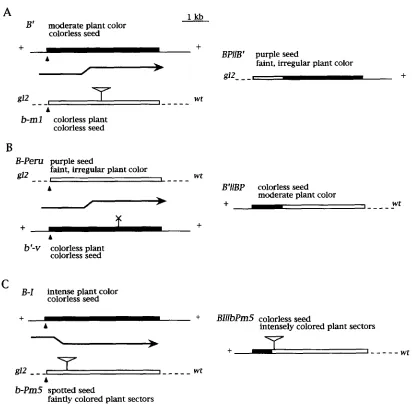
The first strategy was to isolate an intragenic recombi- nant between bml, a mutant derivative of B-Peru, and B‘ (Figure 3A)
.
b m l was isolated from a strain with active Ac/Ds transposable elements (CLARK et al. 1990), and sequence analysis indicates that it contains a Dsl element in the coding region, -1800 bp downstream from the transcription start site (J. CLARK and V. CHANDLER, unpublished data). b-ml does not produce pigment in the aleurone due to the Dsl element, which can excise only in the presence of an Ac element (FED- OROFF 1989). As there is no active Ac present in this experiment, the b m l allele behaves as a stable recessive, producing colorless seeds and plants. B’ also does not produce pigment in the aleurone, because it does not have the necessary regulatory sequences. If an intra-genic recombination event combines the B-Peru up- stream regulatory sequences with the B’ coding se- quence that lacks a Ds element, the result should be an allele that can produce pigment in the aleurone. Figure 3A schematically shows the expected result if the recom- bination event is associated with crossing over of flank- ing markers. The recombinants isolated in this manner have the 5
’
flanking sequences of B-Peru combined with the 3’
flanking sequences of B’ and a transcribed re- gion that is a hybrid of the two alleles. These recombi- nants were designated BPII
B‘. Recombinants between b m l and B-Iwere isolated in a similar manner and were designated BPII
BZ.A similar strategy was used to isolate reciprocal re- combinants (Figure 3, B and C )
.
In one case B-Peru and b’-v alleles were used. 6’-v, which produces green plants lacking anthocyanins, is fully able to paramutate B-I ( COE 1966). Two b‘-v alleles, b’-vl and b ‘ d , are independent paramutant derivatives of the B-v or B’-v allele ( COE 1966),
which contain a transposable ele- ment insertion in exon7
(Table 1) (T. SHROYER, G. PATTERSON and V. CHANDLER, unpublished data). Re- striction mapping indicates that the element has ex- cised from b‘-vl and b’-v4 (data not shown). These alleles produce green plants with no anthocyanins. Pre- sumably, the green phenotype is the result of excision of the element, producing a mutation at the excision site. An intragenic recombination event that combines the functional B-Peru coding sequences with the b’-v upstream regulatory sequences should result in an al- lele that produces a colorless seed and a light purple plant (Figure 3B).
Recombinants isolated in this man- ner have the 5’
flanking sequences of B’ combined with the 3‘
flanking sequences of B-Peru and a tran- scribed region that is a hybrid of the two. These recom- binants are designated B‘I I
BP.The final recombinant was isolated between B-I and bPerum5 ( bPm5)
.
b-Pm5 is a mutant allele of B-Peru that contains an Spm-w transposable element inserted into the second intron (PATTERSON et al. 1991 ).
In the pres- ence of a Spm-s element elsewhere in the genome, this allele produces frequent spotting in the aleurone and faintly pigmented plant sectors. A recombinant that combines the regulatory sequences of B-Iwith the cod- ing region of bPm5, which contains the transposable element, should produce an allele that makes colorless aleurone with intensely pigmented plant sectors.Recombinants were isolated by crossing plants het- erozygous for the alleles of interest to a g12 b534 wt tester. Recombinants were identified by plant and seed color as shown in Figure 3 and as explained in detail in MATERIALS AND METHODS. The frequency at which intragenic recombinants were isolated was -1 X
lo-’
Sequences Required for Paramutation 1395
A
1 kbB'
moderate plant color colorless seed+
+
812
"-
,A,
""_
W tA
b-ml
colorless plantcolorless seed
B
B-Peru purple seed
faint, irregular plant color
gI2
-
-
-
I ""/
wt
A
+
AI
+
b'-v colorless plant colorless seed
C
B-I intense plant color colorless seed
-k
+
A
-
g1-2
- - -
Y
""_
W tA
b-Pm5 spotted seed
faintly colored plant sectors
BPIIB' purple seed
g12-
-
- P+
faint, irregular plant color
B'IIBP colorless seed
+
W tmoderate plant color
-""
BlIIbPmS colorless seed
intensely colored plant sectors
'f
+
"_""
wtFIGURE 3.-Schematic of intragenic recombination. The boxes represent the transcribed regions of B-land B-Peru. The vertical arrows indicate the junction between highly conserved and unrelated sequences. The lesion or insertions that create the mutant phenotype of b'-v, bmI and bPm5 are shown as an X or triangles, respectively. In all cases seed color refers to color in the aleurone layer of the seed.
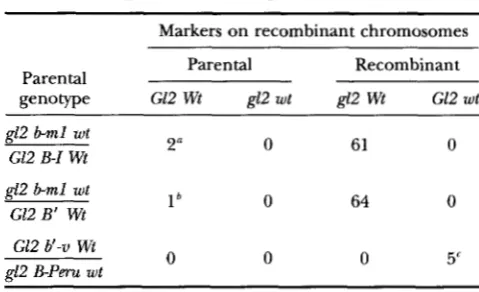
combinants between b m l and B-Zor B' were primarily
gZ2 and Wt ( Table 3 ) , indicating that most of the recom- bination events were associated with crossing over. Three recombinants had parental flanking markers ( GZ2, Wt)
,
but physical mapping (see below) suggests that these alleles were derived by a crossover in the b gene, combined with a second crossover in the 19 map unit g124 interval. None of the 133 recombinant alleles shown in Table 3 had the structure that would be ex- pected for a gene conversion event. The fact that the recombinants contained the g12 Wt marker configura- tion demonstrates that transcription terminates closest to wt, which is centromere proximal to b. Thus, the b gene is transcribed in the direction of the centromere. Structure of recombinant alleles: The recombinants were physically mapped to determine what part of the allele had B-Peru sequence and what part had B' orB-I sequence. Initially, the alleles were mapped using
several restriction fragment length polymorphisms ( RFLPs) upstream and downstream of the transcribed region. The
22
B' II
BPrecombinants, the BZ] 1 bPm5 re- combinant, 10 BPII B' and three BPI
I BZrecombinants
were analyzed in this way (MATERIALS AND METHODS). All of the B'I
1
BP and BZII
bPm5 recombinants had the 5' B' and B-Z sites and all of the BPII
B' and BPII BZ
recombinants had the 5'
B-Peru sites (data not shown). The22
B'I I
BP alleles and the BZII bPm5 allele had the
3 ' B-Peru sites, and all 10 BPI1
B' alleles and all three BPII
BZ
alleles tested had the 3'
B' and B-Z sites (data not shown). Thus, all of the recombinants examined had the structures expected for a crossover event within the b transcription unit.1396 G . I. Patterson et al. TABLE 2
Frequency of recombinant allele isolation
No. of
Recombinant No. scored recombinants" Frequencyb
BPI
I
B' 2.2 X lo5 65 7.4 X 1 0 - ~BPI
I
BI 1.8 X lo5 63 9.2 X 1 0 - ~B'I
I
BPExperiment 1' 7 X lo3 5 9.2 X
Experiment 2 4.1 X lo4 17
BZ1
I
bPm5 4.6 Xlo3
1 4 X 1 0 - ~a The numbers scored for BPI
I
B' and BPII
BI were esti-mated by counting a random sample of 15 ears and multi- plying the average by the total number of ears scored. For B'
1
I
BP and BZII
bPm5 the exact number of plants scored is indicated.For BPI
1
B' and BPII
BI, the recombination frequency was estimated as described in MATERIALSAND METHODS. Otherwise, the recombination frequency is 2 X (number of recombi- nants) / (number scored).Experiments 1 and 2 differ slightly in method of scoring, as described in MATERIALS AND METHODS.
dThis frequency represents a weighted average of experi- ments 1 and 2.
could a double crossover, one within the b gene, the second in the glossy2 to b interval ( 19 map units). Two of the plants with recombinant alleles died as seedlings before DNA isolation. The remaining recombinant al- lele (designated BPI
I
BI-3), was analyzed for RFLPs. This recombinant allele had the B-Peru sites in the 5'
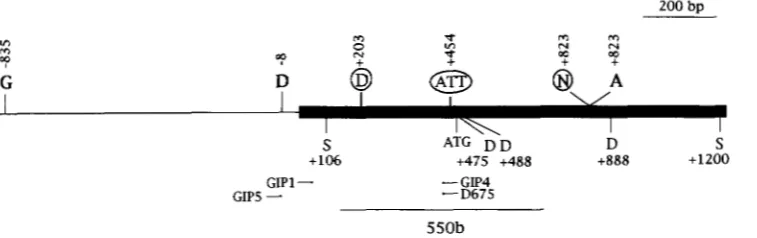
region and B', B-I sites in the 3' region, indicating a crossover occurred within b. Thus, with the possible exception of the two alleles that were lost, all of the recombinant alleles appear to have derived from cross- over events rather than gene conversion events without associated crossing over.Testing of sites closer to the transcription start site allowed the point of crossover to be further localized. Figure 4 shows polymorphisms near the transcription start site that were used to determine the recombinants' structure. The coordinates are relative to the start of transcription of B-I and B' (
+
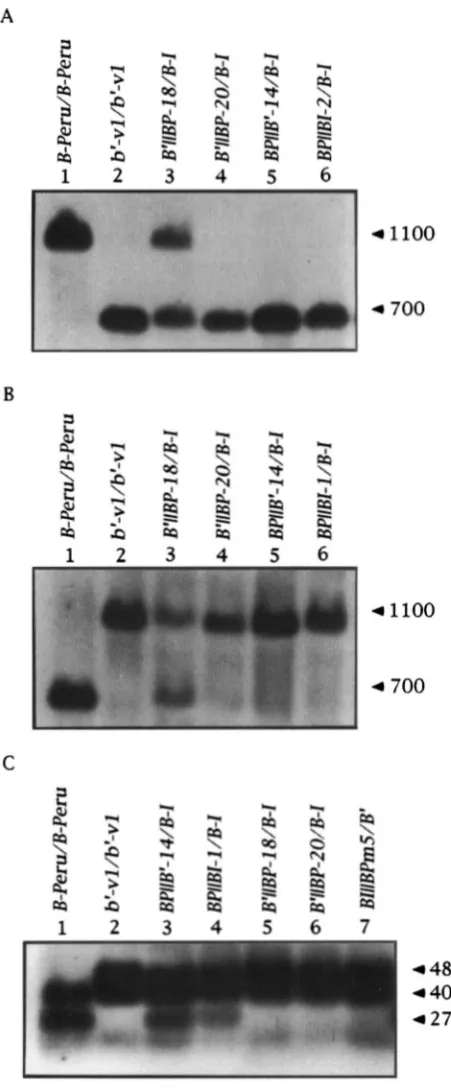
1 ) , which is the same for both alleles ( RADICELLA et ul. 1992; PATTERSON 1993). A single bp change at +823 changes an AvuI site inB-I and B' into an NmI site in B-Peru. These sites were examined in the recombinants with examples shown in Figure 5, A and B. One B'
1
I
BP recombinant, B'I
1
BP-20yielded fragments that migrated at the same size as the b'-v, B', B-I fragments, indicating that this recombi- nant has an AvuI site but no NmI site at +823 (lane 4, Figure 5 , A and B)
.
The presence of b'-v sequence at this position suggests the crossover occurred down- stream. The other 21 B'I 1
BP recombinants produced fragments that comigrated with B-Peru indicating that these recombinants have an NmI site at +823 but noAm1 site (see one example in lane 3, Figure 5 , A and B ) . Since these recombinants are like B-Peru at this polymorphism, the crossover events occurred up-
TABLE 3
Flanking markers of intragenic recombinants
Markers on recombinant chromosomes
Parental
genotype G12 Wt g12 wt g12 Wt G12 wt
Parental Recombinant
g12 b-ml wt
G12 B-I Wt 2" 0 61 0
g12 b m l wt G12 B' Wt G12 b'-v Wt
l b 0 64 0
0 0 0 5'
d 2 B - P m wt
a One of these plants died as a seedling; the other recombi-
nant chromosome was physically mapped as described in RE- SULTS and represents a crossover within the b gene in combina- tion with a second crossover in the 19 map unit g12-b interval. 'This plant died as a seedling; thus it was not possible to determine the nature of the recombination event that pro- duced it.
Only the recombinants from experiment 1 (see Table 2) are included in this number, as these recombinants were iso- lated without prescreening for recombinant flanking markers.
stream. DNA from BPI
I
B' and BPI1
BI plants always yielded the fragments that comigrated with the B', B-Ifragments, indicating that all of these alleles have an
AvuI site at +823. This pattern is consistent with all the crossovers occurring upstream. It was not necessary to examine BI(
I
bPm5 using these digests, because the in- sertion is upstream of the NruI/AvuI polymorphism. The sectored phenotype of the recombinant allele indi- cates that the crossover occurred upstream of this inser- tion, transfering it to B-I. Restriction mapping of the recombinant allele verified that BI1I
bPm5 has the Spm-w insertion at a similar location to the bPerum5 allele (data not shown)
.
A DdeI site at +203 that is found in B-Peru, but not in B', B-lor 6'-v, was also examined in the recombinant alleles (Figure 5C) to further localize the crossover point. Figure 5C shows two recombinants, BPI
I
B'-14and BPI
I
BI-1, that like 12 of the 13 tested BPII
B' andBPI
I
B l alleles produce a DdeI fragment typical of B- Peru, indicating these recombinant alleles have the B- Peru sequence at this site. This result places the cross- over between +203 and +823 in these alleles. TheBPI
I
BI-2 allele is an exception for this class in that it produces the B-ID&I fragment (data not shown), plac- ing the site of crossover in this allele between the heter- ology between B-Peru and B-I at +43 and +203. None of the 22 B'1 1
BP or the BIII
bPm5 alleles produced theB-Peru DdeI fragment (Figure 5C)
.
This result indicates that all of these alleles have the B', B-I sequence at this site, placing the crossover between +203 and +823.Sequences Required for Paramutation 1397
200 bo
S ATG D‘D D S
+lo6 4 7 5 +4aa + m a +1200
GIPS
-
GIPl--
-
GIP4 D67S550b
FIGURE 4.-Polymorphisms used to distinguish the B-Zand B‘ sequence from the B-Peru sequence. The sites above the line are unique to B-Peru (circled letters) or B’ and B-Z (bold letters). The sites below the line are found in all three alleles. The location of the primers used in the PCR analysis are shown as arrows below the line. The box represents the region in which B-Peru is very similar to B’ and B-Z (-98% DNA sequence identity). The location of hybridization by the 550-bp probe is
indicated. All coordinates are relative to the start of B-Z and B‘ transcription at +1 ( RADICELLA et al. 1992). G, BgZII; D, DdeI; S, Sad; N, NruI; A, AvaI; A n , 3-bp insertion in B-Peru relative to B’ and B-Z; ATG, initiator codon.
allele-specfic PCR. B-Peru has a 3-bp insertion relative to B’ and B-I (shown by ATT in Figure 4 ) . DNA oligo- nucleotides that matched the B-Peru or B’, B-Isequence across this insertion were used in PCR reactions with DNA heterozygous for recombinant alleles and B-I (MA- TERIALS AND METHODS). In the case of B’
I I
BP and BZII
bPm5, the upstream oligonucleotide (GIP1, see Fig- ure 4 ) was from a region near the start of transcription in which B’, B-Z and B-Peru have identical sequence. When DNA from a 6’-v plant is amplified with the B’, B-I-specific oligonucleotide (D675, see Figure 4 ) , am- plification is robust, as indicted by a 400-bp fragment (lane 12, Figure 6 ) . This 400-bp fragment is the specific amplification product, as it is the expected size, and hybridizes to the 550-bp probe (data not shown).
The higher molecular weight fragments are nonspecific as they do not hybridize to the 550-bp probe and are only seen in a subset of the reactions. When the B-Pm spe- cific oligonucleotide (GIP4, see Figure 4 ) is used with6’-v DNA, amplification is weak or not detectable (lane 1 1, Figure 6 ) ( data not shown )
.
Conversely, DNA from B-Peru amplifies well only with the B-Peru specific oligo- nucleotide (compare lanes 13 and 14, Figure 6 ).
Some of the B’I I
BPrecombinant alleles amplify well with the B-Peru specific oligonucleotide, indicating that these al- leles have the B-Peru sequence at this site (Figure 6 ) . Other alleles do not amplify with the B-Peru oligonucle- otides (Figure 6 ) . The amplification of the B-1 allele in these heterozygous plants serves as an internal con- trol for the amplification reaction. Similar reactions were performed for a subset of BPII
B’ and BPII
BI alleles (data not shown). In these reactions, the up- stream oligonucleotide was the B-Peru specific oligonu- cleotide GIP5 (Figure 4 ) . These results establish that the physical crossover point for all the recombinants lies within the transcribed b region. A summary of the number of recombination events that occurred within each interval for each type of recombinant is shown in Figure 7.The b gene contains a recombination hotspot: The
recombination in b can be estimated at 22 kb/cM by dividing the distance between the B-I/B-Peru sequence divergence and the insertion sites by the recombination frequencies in Table
2.
It is clear that the rate of recom- bination in the b gene is high relative to the average rate of recombination in the maize genome, which can be estimated to be 1460 kb/cM by dividing the size of the maize genome in kb by its size in cM ( CIVARDI etal. 1994). The overall rate of recombination in b is similar to that previously estimated for bzl ( 14 kb/cM) (DOONER et al. 1985) and a1 ( 12-25 kb/cM) (BROWN and SUNDARESEN 1991 )
.
However, our studies show that the recombination rate is not uniform within the b gene (Figure7 ) .
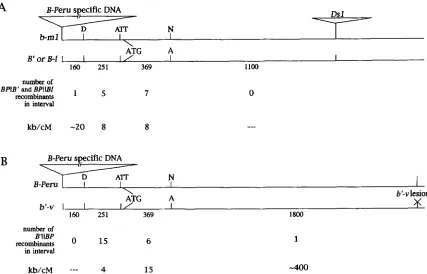
Recombinants between the D&I site and the PCR polymorphism are seen at frequencies of 4 and 8 kb/ cM and similarily between the PCR polymorphism and the NruI/AvuI polymorphism at rates of 15 and 8 kb/cM. In contrast, recombination rates between the NruI/AvaI polymorphism and the mutant lesions inb-ml and b’-u were significantly lower at -400 kb/cM. Thus, not only is b more recombinogenic than the maize genome as a whole, but the 5
’
end of b is more recombinogenic than sequences further downstream in the coding region of 6.Pigmentation phenotype of recombinant alleles: The B-Peru allele produces a different phenotype from B-Z and B’ in a number of tissues. In the aleurone, B-Peru produces intense purple color, while B-Zand B’ produce none. In many tissues of the mature plant (e.g., leaf sheath, tassel, and husk) B-Z is intensely purple, B’ is moderately purple, and B-Peru produces only very faint spotty color ( RADICELLA et al. 1992;
PATTERSON
et al.1398 G. I. Patterson et al.
A
r
*
Qa
Y
d
s
"
cg
1
2
3
4
5
6
1
2
3
4
5
6
L
C
31
?
b
2
?
b
1
2
3
4
5
6
7
4
480
4400
4270
FIGURE 5.-Restriction analysis of recombinant alleles. A p proximately 4 pg of maize DNA samples were digested with restriction enzymes, separated by electrophoresis, and blot- ted. The blots were probed with the 550-bp probe shown in Figure 4. This probe also hybridizes to the homologous rgene (CHANDLER et dl. 1989), and the r cross-hybridizing band was trimmed out of the prints. The b genotype of the plants from which the DNA was isolated is shown above each lane. The size of the fragments seen was estimated by comparison to a Hind111 / EcoRI digested lambda DNA ladder and is shown to the right. ( A ) Sad / AuaI digest. ( B ) Sac1 / NruI digest. A Sac1 digest produces a 1100-bp fragment recognized by the 550-
D.l rnLa%La%h%h%La%h%La%La oligo
1 3 5 7 9 11 13 15 17 lane 2 4 6 8 10 12 14 16
FIGURE 6.-PCR analysis of recombinant alleles. The oligo- nucleotides used in the PCR reactions ( MATERIAIS AND METH-
ODS) match either the R - P m genomic sequence ( BPrefers to oligonucleotides GIPl and GIP4) or the R' and RI genomic sequence (R' refers to oligonucleotides GIPl and D675). The genotype of the genomic DNA used in each reaction is shown. The arrow marked with b indicates the fragment that hybridizes to the 550-bp probe shown in Figure 4; the other fragments seen in the gel do not hybridize to this probe. The sizes of the DNA fragments in the ladder in lane 17 are shown.
The BPI
I
B' and BPII BIrecombinant alleles produce
the same pattern of pigment as B - P m in all seed and mature plant tissues. The recombinants were isolated as BPI
I
B ' / b 5 3 4 or BPII
B I / b 5 3 4 seeds, which had in- tense purple aleurones. Plants grown from these seed had very weak, spotty color in the sheath, husk and tassel, similar to B-Peru, but unlike B' or B-I. All classes of BPII
B' and BPII
BI recombinants shown in Figure7
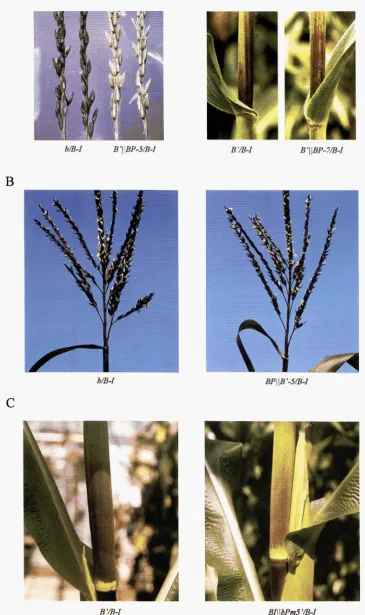
have similar aleurone, sheath, and tassel color pheno- types, indicating that upstream sequences confer this differential phenotype. Figure 8, A andB
show a com- parison of B-Peru and one recombinant allele, BPII
B'- 6. A BPII
B'-b/B-Peru plant was crossed by a green plant with recessive b 5 3 4 / b 5 3 4 alleles, and the seed were planted and genotyped by RFLP analysis. The BPII
B'/ b 5 3 4 plants could be distinguished from the B-Peru/b 534 sibs on the basis of RFLPs but not by phenotype.The B'
I I
BP recombinants were identified as excep tional light purple plants ( B 'I I
BP/ 6-534) among green siblings ( b ' - v / b 5 3 4 ) . All of the purple-pigmented plants had moderate color typical of B', with approxi- mately equal anthocyanin intensity. To provide a direct comparison to B', a B'I I
BP/B' plant was crossed to b 534/b534. The B ' / b 5 3 4 and B'II
B P / b 5 3 4 siblingsSequences Required for Paramutation
A
Dsl
N
ATG A
B' or B-I I I I
160 251 369 1 l o o
1399
BlllE' and number of BPHBI in interval
recombinants 1 5 7 0
kb/cM -20 8 8
"_
B
B-Peru specific DNAN
ATG A b'-vlesion
b"v I I I
Y
160 251 369 1800
number of B'I IBP in interval
recombinants 0 15 6 1
kb/cM --- 4 15 -400
FIGURE 7.-Recombination frequency in different intervals of the b gene. The number of recombinants in each interval are shown. The drawings are to scale, except that the insertion at the 5' end of B-Peru is shown smaller than its actual size ( 2 kb) .
The numbers under each interval indicate the number of bp in that interval. The ATG indicates the translation initiation codon.
kb/cM is calculated as follows: (number of recombinants in the interval/total number of recombinants tested for crossover point) X (number of kb in the interval/ recombination frequency from Table 2 ) . ( A ) Recombinants between b m l and B' or
B-Z. ( B ) Recombinants between b'-u and B-Peru.
were distinguished by RFLP analysis. The two genotypes produced indistinguishable phenotypes (Figure 8 C ) ,
The BZI
1
bPm5 allele confers intense anthocyanin pig- ment in mature plant tissues, similar to B-I. This allele contains a Spm-w transposable element, and so instead of producing uniform intense color, like B-I, it produces sectors of intense color on a green background (Figure 8 D ).
Stable revertants of the BZ(I
bPm5 allele, which have lost the element, produce color indistinguishable from B-Z (Figure 8D ).
For each type of recombinant allele (B'l
1
BP, BZII bPm5,
BPI1
B', BPI1
BZ) recombinants were isolated in which the recombination event occurred upstream of the PCR polymorphism (see Figure7)
,
which is u p stream of the translation initiation codon of the b gene. Thus, the entire protein coding region and 3' flanking sequence of the three alleles are interchangeable and do not contribute to differences in tissue-specific ex- pression. Differences upstream of the PCR polymor- phism, including the first intron, the untranslated leader and sequences upstream of the transcription start site, are candidates for sequences responsible for the difference in B', B-Zand B-Peru expression.B'
I
1
B P a u recombinants paramutate &I: If the B'I1
BP recombinant allele can paramutate B-I, a B'1
I
BP/B-I heterozygote should be light purple and only transmit light purple progeny; if it cannot, theheterozygote should be dark purple and both light and dark progeny should segregate. The B'
I
1
BPalleles were initially isolated as heterozygotes with the b534 allele, which does not participate in paramutation (data not shown). The first step to test the ability of this allele to paramutate B-Zwas to cross B'I
I
BP/b534 heterozygotes to B-Z/B-I and score the progeny for pigment intensity. Plants were scored for anthocyanin intensity and geno- typed by RFLP. The B'I
1
BP/B-Zplants were always light purple, typical of a B'/B-Z heterozygote, whereas the control b534/B-Z siblings were intensely pigmented (Figure 9 A ) . A number of plants of each genotype were visually scored for pigment intensity on a scale of 1(lightest) to 10 (darkest), described in MATERIALS AND METHODS. B'
1
I
Bp/B-Z individuals were consistently much less pigmented than 6-534/B-I plants (Table 4 ) .To determine whether the recombinant allele is equiva- lent to B' in causing paramutation, siblings containing each allele were compared. A B'
1
I
BP/B' plant was crossed to B-I/B-Z, and the two types of progeny were identified by RFLP analysis and visually scored for color phenotype. The B'I
I
BP/B-Zplants were phenotypically indistinguishable from the B'/B-Z plants (Figure 9A).
Thus, B'
I I
BP and B' are equivalent in the ability to alter B-Zpigment in the heterozygote.A
C
G. I. Patterson et al.
B
I
D
B 'h BA IBPh
FIGURE 8.-Pigmentation phenotypes of recombinant alleles. Plants were photographed at maturity. Genotypes of plants are as shown. The recessive b allele is 6-534 (Table 1 ) .
B'
I I BP/EI and b534/EI siblings were self-pollinated,
and the progeny were scored for color. If B'
I I
BP does not heritably alter B-I, onequarter of the B'I
I
BP/B-I self progeny should be B-I/EI and intensely colored. Several families were examined for each of the B'I I
BP/B-I recombinants, and all of the progeny were light purple (395 plants examined, all with tassel color scores
<6 and sheath color scores <S)
.
None of the progeny had the dark purple color typical of B-I, as was seen in the progeny of the b534/B-Iself control. Eleven percentof the progeny receiving the B-I chromosome from the b-534/B-Iparent had the B' phenotype. These are likely to represent spontaneous changes of B-I to B' ( COE 1966), as this is a typical spontaneous frequency. This experiment demonstrates that B'
I 1
BP heritably alters B-I, just as B' does, 100% of the time.Sequences Required for Paramutation
A
1401
B
C
B *B-I
B 'B-Z B