Copyright 0 1994 by the Genetics Society of America
Structure-Based Systematic Isolation of Conditional-Lethal Mutations
in
the
Single Yeast Calmodulin Gene
Yoshikazu Ohya*It and David Botstein*
*Department of Genetics, Stanford University School of Medicine, Stanford, California 94305-5120, and tDepartment of Plant Sciences, Graduate School of Science, University of Tokyo, Hongo, Bunkyo-ku, Tokyo 133, Japan
Manuscript received April 12, 1994 Accepted for publication August 26, 1994
ABSTRACT
Conditional-lethal mutations of the single calmodulin gene in Saccharomyces cerevisiae have been very difficult to isolate by random and systematic methods, despite the fact that deletions cause recessive lethality. We report here the isolation of numerous conditional-lethal mutants that were recovered by systematically altering phenylalanine residues. The phenylalanine residues of calmodulin were implicated in function both by structural studies of calmodulin bound to target peptides and by their extraordinary conservation in evolution. Seven single and 26 multiple Phe + Ala mutations were constructed. Mutant phenotypes were examined in a haploid cmdl disrupted strain under three conditions: single copy, low copy, and overexpressed. Whereas all but one of the single mutations caused no obvious phenotype, most of the multiple mutations caused obvious growth phenotypes. Five were lethal, 6 were lethal only in synthetic medium, 13 were temperature-sensitive lethal and 2 had no discernible phenotypic conse- quences. Overexpression of some of the mutant genes restored the phenotype to nearly wild type. Several temperature-sensitive calmodulin mutations were suppressed by elevated concentration of CaCl, in the medium. Mutant calmodulin protein was detected at normal levels in extracts of most of the lethal mutant cells, suggesting that the deleterious phenotypes were due to loss of the calmodulin function and not protein instability. Analysis of diploid strains heterozygous for all combinations of cmdl-ts alleles revealed four intragenic complementation groups. The contributions of individual phe+ala changes to mutant phenotypes support the idea of internal functional redundancy in the symmetrical cal- modulin protein molecule. These results suggest that the several phenylalanine residues in calmod- ulin are required to different extents in different combinations in order to carry out each of the several essential tasks.
C
ALMODULIN is a Ca2+-binding protein found in alleukaryotic cells. Calmodulin is implicated in a great variety of Ca2+-dependent cellular processes, in- cluding signal transduction, motility, secretion, control of the cell cycle, and regulation of glycolysis as well as other aspects of cell metabolism. Calmodulin is known to regulate more than 20 enzymes and to bind several
cytoskeletal components (COHEN and KLEE 1988). Pre-
sumably the great variety of different functions of cal- modulin is expressed through orchestrated interactions with the many calmodulin-binding proteins.
The three dimensional structure of calmodulin shows
a dumbbell-shaped molecule consisting of two structur-
ally similar globular lobes (corresponding roughly to the N-terminal and Gterminal halves of the amino acid se- quence) connected by an eight turn central a-helix
(BABU et al. 1988; TAYLOR et al. 1991; CHATTOPADHXAYA
et al. 1992; RAO et al. 1993). Upon binding its target peptide and Ca2+, the central a-helix bends to form a
jaw-like structure-the two lobes clamping down on the
target peptide (IKURA et al. 1992; MEADOR et al. 1992). Each of the lobes contains a very large hydrophobic in- teraction surface; this may help to explain why calmod- ulin forms complexes with so many dissimilar (at the
Genetics 138: 1041-1054 (December, 1994)
level of primary sequence identity) calmodulin-binding proteins
(MEADOR
et al. 1992).The budding yeast Saccharomyces cerevisiae has
proven to be an excellent organism for studying the
function of calmodulin in cell proliferation (OHYA and
ANRAKU 1992; DAVIS 1992a). There is only one structural gene ( C M D l ) encoding this protein which is essential for cell growth (DAVIS et al. 1986). The amino acid se- quence of yeast calmodulin is 60% identical to that of mammalian calmodulin. Although the sequence of cal- modulin is somewhat less conserved than those of the cytoskeletal proteins actin and tubulin (BOTSTEIN 1991), functional replacement of yeast calmodulin by expres- sion of vertebrate calmodulin ( OHYA and ANRAKU 1989a;
DAVIS and THORNER 1989) indicates conservation of the
essential activities required for cell growth.
Despite considerable effort, it has not been possible
to find simple point mutations in the CMDl gene with
conditional-lethal phenotypes. Instead, three more complicated genetic circumstances that result in condi- tional lethality have been used to try to characterize the function of calmodulin. One involves a strain in which
the only functional calmodulin gene is driven by a GAL1
1042 Y. Ohya and D. Botstein
double-mutant ( c m d l - I ) that consists of two sequence changes (I100N and E104V), both required to produce a temperature-sensitive growth phenotype (DAVIS 1992b); the third involves an overproduced Gterminal fragment of the CMDl gene ( c m d l - 1 0 1 ) (SUN et al. 1991). When expression of the intact CMDl driven by the G A L l promoter is turned off, the yeast cell cycle eventually arrests at nuclear division; most cells are bud- ded and the DNA has apparently been duplicated (OHYA and ANRAKU 1989a,b). The cmdl-1 double mutant loses viability during nuclear division, although the terminal phenotype is not homogeneous (DAVIS 1992b). Cells with the mdl-101 mutation, consisting of a Gterminal frag- ment (“halfcalmodulin”) expressed at high level by the
GAL1 promoter (SUN et al. 1992), show a Ca“suppressib1e temperature-sensitive phenotype (SUN et al. 1991). These cells arrest with apparently duplicated DNA but with a single spindle pole body (SUN et al. 1992).
The relatively small number of useful conditional cir- cumstances, their complexity, and the ensuing confu- sion about the function (s) of calmodulin, stimulated us to undertake systematic mutagenesis of this gene. Con- ventional methods of isolating temperature-sensitive
cmdl mutations at random yielded an unexpectedly small number of conditional-lethal mutations. DAVIS (1992b) used a “plasmid shuffle” technique to screen random mutations in the CMDl gene, and isolated only one temperature sensitive strain containing the two mu- tations that comprise d l - 1 from 35,000 mutagenized colonies. Other schemes of random mutagenesis, al- though quite useful with other proteins (HOLM et al. 1985; HUFFAKER et al. 1988; SCHATZ et al. 1988), had repeatedly failed to yield conditional-lethal mdl mutants (G. H. SUN,
Y. O m and Y. ANRAKU, unpublished result).
Classical mutagenesis studies with the single yeast ac- tin gene ( A C T 1 ) had also yielded relatively few useful conditional-lethal alleles. Unlike actin, however, classi- cal mutagenic strategies with calmodulin failed to pro- duce even simple unconditional lethal alleles; although deletion was clearly lethal, point mutations apparently never sufficed to eliminate the essential function(s) of calmodulin. Recently systematic site-directed mutagen- esis, in which clusters of charged residues were changed to alanine residues yielded a surprisingly large number of new lethal and conditional-lethal alleles in A C T l
(WERTMAN et al. 1992). Asimilar approach yielded many new alleles in the single etubulin ( TUB2) gene (REIJO et al. 1994). However, application of the same technol-
ogy to the CMDl gene again failed, most surprisingly, to yield conditional-lethal or lethal alleles (Y. OHYA and D. BOTSTEIN, unpublished result).
For two reasons we then focused our site-directed mu- tagenesis effort on phenylalanine residues in the yeast calmodulin sequence. First, phenylalanine residues are particularly well conserved in calmodulins (COHEN and KLEE 1988): the phenylalanine residues in the yeast se-
quence appear in the same positions as in the vertebrate sequences. None of the other 19 amino acid residues shows this degree of exact conservation. Given that ver- tebrate calmodulin can substitute for essential func- tion(s) of yeast calmodulin (OHYA and ANRAKU 1989a; DAVIS and THORNER 1989), conserved phenylalanine resi- dues in calmodulin seemed likely to play fundamental roles for cell growth. Second, the three-dimensional structure of calmodulin suggests that the phenylalanine residues are likely to be important for interaction with other proteins. Phenylalanine residues form clusters that project from the hydrophobic interaction surface in both in the N-terminal lobe and the C-terminal lobe (BABU et al. 1988; IKURA et al. 1991). Further, the NMR structure of calmodulin in solution and that of a calmodulin-binding peptide complex (IKURA et al. 1992) shows that seven of the eight phenylalanine residues interact with the target peptide.
We present here the results of systematic phenylala- nine to alanine mutagenesis of CMD1, the yeast calmod- ulin gene. After introduction of mutations by site- directed mutagenesis, we assessed the growth phenotype across a broad temperature range. We recovered
7
single mutations and 26 multiple mutations. One of the seven single mutations, and 24 of the 26 multiple mutations caused a lethal or conditional-lethal phenotype.MATERIALS AND METHODS
Yeast media and genetic methods: Yeast growth, complete and minimal media, and tetrad analysis were performed as described by ROSE et al. (1990). For induction of the GALl promoter, minimal medium containing 2% galactose plus 0.1% sucrose (SGS) and rich media containing 2% galactose plus 0.1% sucrose (WGS) were used. Ca‘+-rich medium con- taining final concentration of 100 mM CaC1, was made by ad- dition of 5 M CaCl, into WD liquid or YPD agar media cooled below 70”. Lithium acetate yeast transformation was per- formed using a modification ( SCHIESTL and GIETZ 1989) of the original method (ITO et al. 1983).
Plasmid construction: All DNA manipulations were per- formed according to standard techniques (SAMBROOK et al. 1989). DH5aF’ was used to maintain and propagate plasmids. Restriction endonucleases, T4 polymerase, T4 ligase, T4 polynucleotide kinase were obtained from New England Biolabs. Vent DNA polymerase (New England Biolabs) and Pfu DNA polymerase (Stratagene) were used for polymerase chain reaction (PCR) with DNA thermal cycler (Perkin-Elmer). Purification of DNA fragments was routinely carried out by electrophoresis in agarose followed by treatment with Geneclean (BIO 101, Inc.).
pRB1612 (pRSCAM101) was made as follows: a 2.@kb Ch4Dl-
containing genomic Sa&-BamHI fragment from pCAM106
(Y. OHYA, unpublished) was inserted into the SalI-BamHI gap of the
m,
.?XU3 plasmid pRS316 (SIKORSKY and HIETER 1989).pRB1613 (YIpCAMTlO6) was used for disruption of C M D l with TRPl ( c r n d l - A I : : T R P l ; SUN et al. 1991).
Phe to Ala Mutants of Calmodulin 1043
TABLE 1
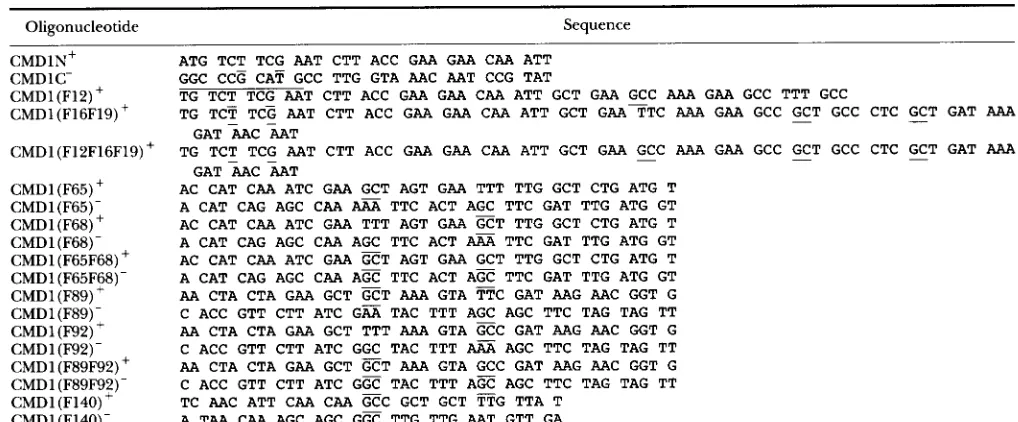
Primers used for PCR-based mutagenesis
Oligonucleotide Sequence
C M D ~ N +
C M D ~ ( ~ 1 2 ) +
CMD 1 C-
CMDl(Fl6Fl9)’
CMDl(FlZF16F19)’
CMDl(F65)’ CMDl(F65); CMDl(F68) CMDl (F68)- CMDl (F65F68)’ CMDl (F65F98)- CMDl (F89) CMD 1 (F89) CMDl (F92) CMDl (F92)- CMDl (F89F92)’ CMDl (F89F9;)- CMDl (F140) CMDl (F140)-
ATG TCT TCG AAT CTT ACC GAA GAA CAA ATT GGC CC6 CAY GCC TTG GTA AAC AAT CCG TAT
TG TCT TCG AAT CTT ACC GAA GAA CAA ATT GCT GAA GCC AAA GAA GCC TTT GCC
TG
TCT
TCG AAT CTT ACC GAA GAA CAA ATT GCTGAATTC
AAA GAA GCC - GCT GCC CTC GCT GAT AAAGAT -AAC -AAT
GAT -AAC -AAT
-
TG TCT TCG AAT CTT ACC GAA GAA CAA ATT GCT GAA GCC - AAA GAA GCC GCT - GCC CTC GCT - GAT AAA
AC CAT CAA ATC GAA GCT AGT GAA TTT TTG GCT CTG ATG T A CAT CAG AGC CAA
m
TTC ACT AGC TTC GAT TTG ATG GT AC CAT CAA ATC GAA TTT AGT GAA E T TTG GCT CTG ATG T A CAT CAG AGC CAA AGC TTC ACTm
TTC GAT TTG ATG GT AC CAT CAA ATC GAA E T AGT GAA GCT TTG GCT CTG ATG T A CAT CAG AGC CAA A= TTC ACT A m TTC GAT TTG ATG GTAA CTA CTA GAA GCT E T AAA GTA R C GAT AAG AAC GGT G C ACC GTT CTT ATC G a TAC TTT AGC AGC TTC TAG TAG TT
AA CTA CTA GAA GCT TTT AAA GTA E C GAT AAG AAC GGT G C ACC GTT CTT ATC GGC TAC TTT AGC TTC TAG TAG TT
AA CTA CTA GAA GCT E T AAA GTA GCC GAT AAG AAC GGT G C ACC GTT CTT ATC G E TAC TTT A m AGC TTC TAG TAG TT TC AAC ATT CAA CAA E C GCT GCT 3 G TTA T
A TAA CAA AGC AGC G E TTG TTG AAT GTT GA
. . ~
“+”
and “-” mean the sense strand and anti-sense strand, respectively. Nucleotide changes are underlined.prb1615 (YCpTG5189T) is a CEN plasmid containing a GALl promoter, a CMKl terminator and a TRPl marker and was made as follows: an 0.8-kb BamHI-EcoRI fragment of the GALl promoter (OHYA and ANRAKU 1989a,b), a 34bp EcoRI- Hind111 oligonucleotide synthesized cassette (mixture of
5’AATTCAATGTCTTCGAATCTTACGCATGCA3’ and 5’AG
CTTGCATGCGTAAGATTCGAAGACATTG3’; it contains EcoRI, BstBI, SphI and Hind111 sites in this order) and a 0.9-kb HindIII-ClaI fragment of the CMKl terminator (OHIA et al. 1991) were inserted into BamHI-CZaI gap of pRS316 with suc- cessive subcloning steps. Then, the whole 1.7-kb BamHI-CZaI GALl promoter-CMKl terminator fragment was subcloned into the BamHI-CZaI gap of pRS315 (SIKORSKY and HIETER 1989) to make pRB1615. pRB1615 was designed to overexpress yeast calmodulin after subcloning a PCR-amplified BstBI-SphI fragment of CMDl.
pRB1616 (YCpTcmdlp) is a CEN plasmid containing a CMDl promoter, the CMKl terminator and the TRPl marker, constructed as follows: the CMDl promoter fragment
(212 bp) was PCR-amplified with 5’CGCTTCGAAGACATTG TACTT??TTATTTG3’ and 5’CCCGGATCCTGTATTTATA- TTTTCGTGTACS’ as primers and pRB1612 as a template. These primers were designed so that (1) a BamHI site was placed upstream of the promoter and (2) a BstBI site was in- troduced just after the translational start without changing the amino acid sequence of calmodulin (OHYA and ANRAKU 198913). The presence of a competent promoter on this frag- ment was confirmed both by its ability to express calmodulin enough to complement the cmdl disruption mutation and by direct measurement of the level expression (see Table 4 be- low). pRB1616 was constructed by insertion of the BamHI- BstBIfragment of the PCR-amplified CMDl promoter into the BamHI-BstBIgap of pRB1615 (a CENplasmid). pRB1616 was designed to test the calmodulin mutant phenotype in a “low copy” condition after subcloning the BstBI-SphI PCR ampli- fied CMDl fragment.
pRB1617 (MpHade3) is an integration plasmid containing a HIS3 marker inserted into the coding region of ADE3. To make it, a 2.4kb SacII-KpnI fragment of the genomic ADE3 gene was subcloned into the SacII-KpnI gap of pBluescript KS+
(Stratagene). Then, a 1.5-kb Sun-XhoI HIS3-containing frag-
ment of ~ ~ ~ 2 1 7
UONES
and PRAKASH 1990) was inserted into the unique XhoI site such that HIS3 is transcribed in the direction opposite to ADE3. pRB1617 has advantages as a vehicle for chromosomal integration of the cmdl mutations. First, pRB1617 had unique and adjacent BamHI and SphI sites sothat the BamHI-SphI CMDl-containing fragment was easily inserted to make the CMDl integration plasmids. Sac11 and AlwNI (or AurII) could be used for linearization of the plas- mid. Second, after transformation of the yeast ade2 strains, the correct chromosomal integration could be screened by colony color.
pRB1619 (YCpLGcCaM) is a CEN plasmid containing the chicken calmodulin coding sequence under the GALl pro- moter and a LEU2 marker. To construct it, a 1.7-kb BamHI-
SaZI fragment of chicken calmodulin under the GALl pro- moter was cut out from pCCAM211 (OHYA and ANRAKU 1989a) and inserted into the BamHI-SaZI gap of pRS315 (SIKoRSKYand HIETER 1989). pRB1619 was used for the measurement of the steady state level of calmodulin in the lethal calmodulin mutants.
PCR-based mutagenesis: Introduction of Phe + Ala mu- tations was performed with PCR-based mutagenesis (Ho et al. 1989). We synthesized 19 oligonucleotides (Table 1). CMDlN’, corresponding to the translation start sequence of calmodulin, introduced an artificial BstBI site without chang- ing any amino acid sequence and CMDlC-, corresponding to the 3‘-noncoding sequence, contained an SphI site at the end. PCR reactions (SAIKI et al. 1988) with these primers yielded 656bp fragments containing BstBI and SphI sites at the end(s) making it easy to subclone into pRB1616.
Long N-terminal primers with N-terminal Phe + Ala utations, CMDl(F12)’, CMDl(F16F19)’ and CMDl(F12F16F19)+, were used for amplification of the cmdl-221, cmdl-222 and
1044 Y. Ohya and D. Botstein
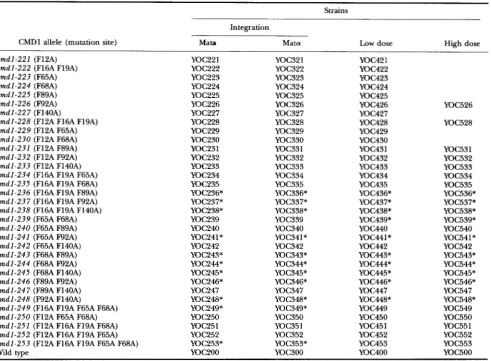
TABLE 2
Phe-+Ala calmodulin mutants constructed in this study
Strains
~~
Integration
CMDl allele (mutation site) Mata Low Matcu dose High dose
cmdl-221 (F12A) YOC221 YOC321 YOC421
c m d l - 2 2 2 (F16A F19A) YOC222 YOC322 YOC422
c m d l - 2 2 3 (F65A) YOC223 YOC323 YOC423
c m d l - 2 2 4 (F68A) YOC224 YOC324 YOC424
c m d l - 2 2 5 (F89A) YOC225 YOC325 YOC425
c m d l - 2 2 6 ( F 9 2 A ) YOC226 YOC326 YOC426 YOC526
cmdl-227 (F140A) YOC227 YOC327 YOC427
cmdl-228 (F12A F16A F19A) YOC228 YOC328 YOC428 YOC528
c m d l - 2 2 9 (F12A F65A) YOC229 YOC329 YOC429
cmdl-230 (F12A F68A) YOC230 YOC330 YOC430
cmdl-231 (F12A F89A) YOC231 YOC331 YOC431 YOC531 c m d l - 2 3 2 (F12A F92A) YOC232 YOC332 YOC432 YOC532 c m d l - 2 3 3 (F12A F140A) YOC233 YOC333 YOC433 YOC533 cmdl-234 (F16A F19A F65A) YOC234 YOC334 YOC434 YOC534 c m d l - 2 3 5 (F16A F19A F68A) YOC235 YOC335 YOC435 YOC535 c m d l - 2 3 6 (F16A F19A F89A) YOC236* YOC336* YOC436* YOC536* cmdl-237 (F16A F19A F92A) YOC237* YOC337* YOC437* YOC537* c m d l - 2 3 8 (F16A F19A F140A) YOC238* YOC338* YOC438* YOC538* c m d l - 2 3 9 (F65A F68A) YOC239 YOC339 YOC439* YOC539* c m d l - 2 4 0 (F65A F89A) YOC240 YOC340 YOC440 YOC540 cmdl-241 (F65A F92A) YOC241* YOC341* YOC441* YOC541* c m d l - 2 4 2 (F65A F140A) YOC242 YOC342 YOC442 YOC542 c m d l - 2 4 3 (F68A F89A) YOC243* YOC343* YOC443* YOC543* c m d l - 2 4 4 (F68A F92A) YOC244* YOC344* YOC444* YOC544* c m d l - 2 4 5 (F68A F140A) YOC245* YOC345* YOC445* YOC545* c m d l - 2 4 6 (F89A F92A) YOC246* YOC346* YOC446* YOC546*
cmdl-247 (F89A F140A) YOC247 YOC347 YOC447 YOC547 cmdl-248 (F92A F140A) YOC248* YOC348* YOC448* YOC548* c m d l - 2 4 9 (F16A F19A F65A F68A) YOC249* YOC349* YOC449 YOC549 c m d l - 2 5 0 (F12A F65A F68A) YOC250 YOC350 YOC450 YOC550 cmdl-251 (F12A F16A F19A F68A) YOC251 YOC351 YOC451 YOC551 c m d l - 2 5 2 (F12A F16A F19A F65A) YOC252 YOC352 YOC452 YOC552 c m d l - 2 5 3 (F12A F16A F19A F65A F68A) YOC253* YOC353* YOC453 YOC553 Wild type YOC200 YOC300 YOC400 YOC500
Strains carrying lethal mutations (marked with an asterisk*) also contained pRl31612 which carries wild-type 0 1and URA3. Integration strains, YOC221-YOC253 and YOC321-YOC353 were constructed from YOClOl (MATa ade2 lys2 his3 trpl leu2 ura3 cmdl-A1:TRPl [pRB1612]) and YOC102 (same as YOClOl except its mating type), respectively. Low dose and high dose strains were derived from YOC103 (MATa ade2 lys2 his3 trpl leu2 ura3 cmdldl::HIS3 [pRB1612]).
N-terminal fragment and Gterminal fragment were amplified separately and purified after electrophoresis on 15% polyacryl- amide ( SAMBROOK et al. 1989). These two fragments shared at least 18 bp overlapping region containing the Phe -+ Ala mu-
tations so that in a second PCR reaction, both fragments were mixed and the whole fragment was amplified with CMDlN' and CMDlC- as primers. Purification and subcloning of the PCR-amplified fragment was described before. In this way, cmdl-223, cmdl-224, cmdl-225, cmdl-226, cmdl-227 mutations were constructed. Other double and heavily mu- tagenized mutants were constructed in a similar way using the single mutation plasmids as template.
All mutations were verified by DNA sequencing. Double- stranded DNA sequencing with two sequencing primers
(5'TGACCGGAAACTACTGAAC3', S'GATGAACGAAATAG ATGTTGATGG3') sufficed to cover the entire coding se- quence of calmodulin. 7-DeazadGTP sequencing kit (U. S.
Biochemical Corp.), and version 2.0 Sequenase (U. S. Bio- chemical Corp.) were used for sequencing reactions.
A complete set of cmdl mutations on a centromere plas- mid (pRB1616) were made initially. Subsequently each of the BstBI-SphI fragments containing the mutant cmdl coding sequences were subcloned into the BstBI-SphI gap of
PRB1615 to make the set of overexpression plasmids. The same fragments were separately subcloned into the BamHI-+hI gap of PRB1617 to make the set of integration plasmids.
Introduction of the mutations into yeast: The 2.4kb BamHI fragment of PRB1613 that contains the c m d l d 1 : : T R P l frag- ment was purified by electrophoresis in agarose and used to transform a yeast diploid strain, WH501 (SIKORSKY and HIETER 1989). Southern hybridization analysis was conducted to con- firm that one copy of CMDl was replaced with cmdl- A1::TRPl. The heterozygous CMDl/cmdl-A1::TRPl strain was transformed with pRB1612 ( C M D l , U R A 3 ) , sporulated, and subjected to tetrad analysis. Two segregants harboring the cmdl-A1::TRPl allele and pRB1612 were selected: YOClOl [MATa ade2 lys2 his3 trpl leu2 ura3 cmdl-A1::TRPl
(pRB1612)l and YOC102 [ M A T a ade2 lys2 his3 trpl leu2 ura3 cmdl-A1::TRPl (pRB1612)l were usedfor parent strains for introduction of the mutations. YOC103 [MATa ade2 lys2 his3 trpl leu2 ura3 cmdldl::HIS3 (pRB1612)], a derivative of YOC101, was constructed using pRB1614 to replace the
TRPl his3 markers with t r p l H i s 3 this strain was used for introducing the mutations at low copy number.
Phe to Ala Mutants of Calmodulin 1045
plasmids with SacII and AlwNI (or SacII and AvrII) , the ade?- cmdl-HIS?-ade3fragmentswere used to transformYOClO1 or YOC102 selecting for the HIS3 marker. Correct integrants were recognized as white transformants (ade2 ade3; see above), and each was confirmed with PCR. Finally, strains that had lost pRB1612 were selected on FOA plates. The resulting Phe + Ala calmodulin mutant strains are listed in Table 2.
Plasmid loss using fluoro-orotic acid (FOA) plates: FOA (or FOA-Glc) plates containing 0.2% 5-FOA monohydrate (PCR Inc.) were made according to ROSE et al. (1990). FOA-Gal plates were similar except 2% glucose was replaced with 2% galactose and 0.1% sucrose.
Cells bearing the wild-type calmodulin gene on a URA? plasmid (pRB1612) and a calmodulin mutation either at the ade? locus (integration) or on a TRPl CEN-plasmid (low copy) were fully grown in WD from single colonies at 25”. The cell suspensions were diluted with FOA medium, incubated at 25” for 8 hr, spotted on the surface of FOA agar plates with a multi-point inoculator and incubated at 25” for 3 days to let Ura3- cells grow. Cells bearing the wild-type calmodulin gene on a URA? plasmid and a calmodulin mutation under the
GAL1 promoter were handled similarly, except that FOA-Gal plates were incubated at 25” for 1 week.
Occasionally we observed spotty FOA resistance where we expected none. In each such case PCR experiments showed that the wild-type C M D l gene was retained, indicating that these were the result of events unrelated to calmodulin, such as spontaneous ura? mutations or gene conversion.
Steady-state labeling and immunoprecipitation of calmod-
ulin: Cells were grown to 2 X 10’ cells/ml in synthetic minimal medium lacking sulfate (ROTHBLAT-I and SCHEKMAN 1989) and containing 2% galactose, 0.1 % sucrose and 100 PM (NH,),SO,. Cells (4 X 10’) were harvested, washed once with distilled wa- ter and resuspended in 500 pl of the same medium containing 2% galactose and 0.1% sucrose. After incubation for 10 min at 30”, 400 pCi [35S]Na$0, (ICN) were added. After 30 min, labeling was terminated by addition of equal volumes of ice- cold 20 mM sodium azide. Immunoprecipitation with anti- calmodulin antibody ( O m et al. 1987) was carried out ac- cording to ROTHBLATT and SCHEKMAN (1989). Mobility shift of
calmodulin by Ca2+ was examined by addition of either 100 mM CaCl, or 100 mM EGTA into all of the solutions used for SDS PAGE. Samples were heated again at 100” either in the pres- ence of 100 mM CaCI, or in the presence of 100 mM EGTA, and the equal amount of labeled proteins were subjected to SDS PAGE (LAEMMLI et al. 1970) using a 12.5% polyacrylamide gel. [ 14Cl-labeled Rainbow protein markers (Amersham, Eng- land) were used as protein size markers. After electrophoresis, the gels were treated with Amplify (Amersham), dried and exposed to Kodak X-Omat AR film for 1-2 days at -80”. The levels of the wild-type and the mutant calmodulin were deter- mined with PhosphoImager analysis according to the manu- facture’s manual (Molecular Probes).
Pulsechase labeling: After labeling as above with
[35S]Na$04 for 10 min, the chase was initiated by the addition of equal volume of 2 X WGS medium containing 2 mM (NH,),SO,, 0.006% L-cysteine and 0.008% L-methionine. Im- mediately after initiating the chase, equivalent aliquots were transferred to fresh WGS or YPGS plus 100 mM CaCl, media, and chased in the two media at different temperature. Equiva- lent aliquots were removed at the indicated time point and added to equal volumes of ice-cold 20 mM sodium azide to terminate the pulse and chase. Harvest of the cells, extraction of cell lysate, and immunoprecipitation are described in the previous section. Incorporation of s5S into the cell lysate was measured with Ready Cap (Beckman), and used for adjusting the cell lysate concentration before electrophoresis.
RESULTS
Experimental design: There are eight phenylalanine
residues in the yeast calmodulin sequence: F12, F16, F19, F65, F68, F89,
F92
and F140. These Phe residues were replaced systematically with alanine on the assump tion that this would eliminate the hydrophobic effect of the side chain beyond the @carbon without altering the main-chain conformation. All Phe residues were changed individuallywith the exception of F16 and F19, which are very close to each other in the structure and were changed together. Mutants are referred to below using single-letter code so that the aforementioned double mutation is called F16A, F19A. PCR-based mu- tagenesis (see MATERIALS AND METHODS) was used to in- troduce the mutations and every mutation was verified by direct DNA sequencing.Phenotypes resulting from Phe + Ala calmodulin mu-
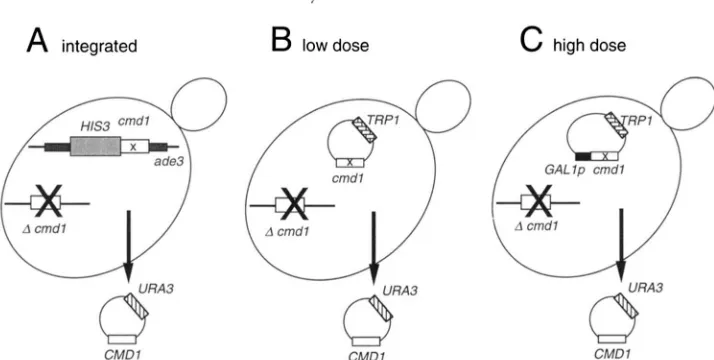
tants were assessed under three different expression conditions (Figure 1)
,
namely “integrated,” “low dose” and “high dose.”“Integrated” means that the mutant cmdl gene was integrated into the genome and thus presumably con- tains a single copy of the mutant gene driven by its normal promoter. Mutant cmdl genes were integrated at the ADE3 locus of a strain with a cmdl deletion
( c m d l d 1 : : T R P l ) and a wild-type Ch4Dl gene on a
URA3 plasmid to keep it alive (Figure 1A). We used strains YOClOl or YOC102 (MATa or MATa, ade2 Zys2 his3trpl leu2ura3cmdl-Al::TRPl [pRB1612]);eachof these forms red colonies (ROMAN 1956). After inser- tion of the cmdl-HIS3 fragment into the ADE3 gene, the cells form white colonies, having lost the ability to make the precursor of the red pigment that accumu- lates in ade2 strains
(CJ:
KOSHLAND et al. 1985). After integration, derivatives that had lost the URA3-CMLIl plas- mid were selected on 5-FOA plates, revealingany
recessive phenotype(s) caused by the integrated mutantd
l
gene. “Low dose” means that the mutant cmdl gene, again driven by its normal promoter, was present on a centromerecontaining plasmid. As shown in Figure lB, the mutant cmdl gene was placed on a centromere vec- tor marked with T R P l and introduced into a different strain [YOC103; M A T a ade2 lys2 his3 trpl leu2 ura3 cmdl-Al::HIS3 (pRB1612)] which again containsc m d l d l and the wild-type CMDl on a URA3 plasmid. Loss of the URA3-CMDI plasmid was again selected using FOA plates. We reasoned that the copy number of a centromere vector is 1-3 (possibly higher under se- lection), thus a strain with cmdl on a CEN plasmid should display any mutant phenotype in a “low dose” condition.
1046 Y. Ohya and D. Botstein
A
integratedK
w
CMDlB
low doseCMDI
c
high doseCMD 1
FIGURE 1.Schematic diagram representing three strategies for testing phenotypes of the yeast calmodulin mutants. The Phe + Ala cmdl mutations were integrated at the ade3locus of the chromosome (A, integrated), or placed on a centromere plasmid (B, low dose; and C, high dose) and under the G A L 1 promoter (C, high dose). Calmodulin was expressed under its own promoter (A and B) or by the GAL1 promoter (C). The mutant phenotype was examined after elimination of the wild-type CMDl plasmid marked with URA3 (pRB1612) on FOA plates.
source. Under these circumstances, we found previously an expression level of calmodulin about 20-fold higher than the normal level
(OHYA
and ANRAKU 1989b).A single Phe to Ala mutant with a temperature-
sensitive phenotype: We began characterization of the
new cmdl mutants by examining the ability to comple- ment cmd1-81::TRPI after integration of the mutations into the chromosome (Figure 1A). All of the strains that harbored the Phe - j Ala mutations (cmdl-221-cmdl-
227) could form colonies on FOA plates at 25", indi- cating that none of the mutations is lethal. Single colo- nies purified from these FOA plates were then tested across a broad temperature range (14-37.5"). As sum- marized in Figure 2, we found that all mutants save cmdl-226 (F92A) grew as well as the wild-type control strain at all temperatures. The cmd 1-226 mutant did not grow very well on rich (YPD) agar plates above 35.5"; it also showed a weak cold-sensitive phenotype (Figure 3). The growth rates of the mutants were measured; every mutant that showed robust growth on plates grew in liquid medium (YPD) at rates essentially equivalent to the wild-type strain both at 25" (2.1-2.3-hr doubling time) and 37" (1.7-1.8-hr doubling time). The cmdl- 226 mutant grew slowly (3.5-hr doubling time) even at 25". These results indicate that all but one (F92A) of the Phe += Ala mutants, unlike a deletion (DAVIS et al. 1986), have no obvious deleterious effect.
When the cmdl-226 (F92A) mutation was introduced on a centromere plasmid ( i . e . , low dose condition), its growth profile was noticeably different. It now grew well below 35.5", grew slowly at 37" and formed very tiny colo- nies even at 37.5". Thus under the low dose condition, only a partial temperature-sensitive phenotype could be observed (Figure 3). Introduction of cmdl-226on a Gal- promoter plasmid ( i . e . , high dose condition) s u p pressed its temperature-sensitive growth phenotype to the same degree (Figure 3), suggesting that a modest
Mutants Position Phenotype
- F 1 2 - - F 1 6 - F 1 9 - - - - F 6 5 - F 6 8 " - - F 9 2 - - F 9 2 - - F 1 4 0
FIGURE Z.-Growth of the Phe + Ala cmdl mutant strains. "Wild-type" means no discernible growth defect. Indepen- dently isolated mutant strains in a MATa background (YOC321, YOC322, YOC323, YOC324, YOC325, YOC326 and YOC327; see Table 2) gave the same results.
overproduction of the mutant protein suffices for
growth at all but the highest temperatures.
Most double Phe + Ala mutants showed either
temperature-sensitive (Ts) or lethal phenotype: Despite
our success in finding, for the first time, a single cmdl mutation with a phenotype, we were still puzzled by the failure of so many of the others to show phenotypes. Reasoning that there might be internal structural re- dundancy in the molecule, we systematically constructed multiple Phe - j Ala mutants. Alleles cmdl-229 to cmdl-
233 and cmdl-239 to cmdl-248 are Phe --$ Ala double mutations, and cmdl-228 and cmdl-234 to cmdl-238 contain F16A, F19A (which we are treating as a single lesion) and one additional Phe - j Ala mutation. Alleles,
d l - 2 4 9 t o d l - 2 5 2 c o n t a i n e d multiple lesionswithin the N-terminal lobe so that only one Phe residue (two in the case of F16 F19) remained in the N-terminal half domain. All of the phe residues in the N-terminal half domain were changed to Ala in d l - 2 5 3 .
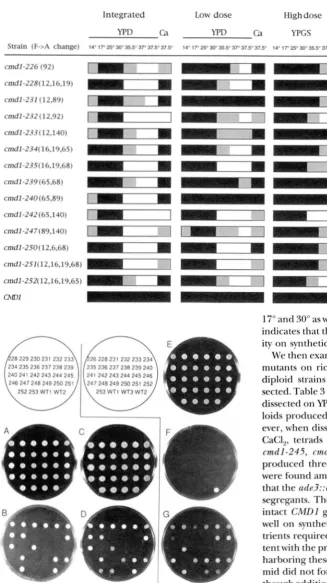
Figure 4 shows that 11 out of 26 strains that harbored the integrated mutations did not form colonies well on FOA plates at 25" (see MATERIALS AND METHODS). We
Phe to Ala Mutants of Calmoddin 1047
cmdl-2.76 (92)
cmdl-Z28(12,16,19)
cmdl-231(12,89)
cmdl-t32(12.92)
cmdl-233(12.140)
cmdl-234(16,19,65)
crndJ-Z35(16,19,68)
cmdl-239(65,68)
cmdl-Z40(65,89)
cmdI-242(65,140)
crndl-247(89,140)
cmdl-250(12,6,68)
cmdl-.75.7(12,16,19,65)
1
7
CMDl
- 1
28 229 230 231 232 233 26 228 231 232 233 234
#=
=
=
(52 253 WT1
W
)
T
(53 WTI WT3 W)'-t
234235236237238239247248249259251252 266247248249250251
241 242243244245246 240241242243244245
235236237238239240
FIGURE 4.-Examination of lethal phenotype caused by the Phe + Ala c m d l mutations. Integration (A, B ) , low dose (C, D) and high dose (E, F, G) were used to check loss of the wild-type CMDI plasmid (see Figure 1 and ~ I A T E R I A L A N D METIi- ODS for detail). Permissive agar plates (YPD; A, C and YPGS; E) and FOA agar plates (FOA-Glc; B, D, F and FOA-GS; G ) were incubated at 25". Wild-type control strains were YOClOl (WTl), YOC200 (WT2) and YOC500 (WT.7).
I I
FIGURE 3.-Growth of the Phe -+ Ala
cmdl mutants assessed in the "inte- grated," "low dose" and "high dose" condition. Growth at each tempera- ture was scored on YPD agar plates, YPGS agar plates and YPD agar plates containing 100 mM CaCI, (Ca), and is relative to growth of the wild-type strain at the same temperature. Black indicates growth equivalent to wild type, gray indicates weak growth, and white indicates no growth.
17"
and 30" as well, with essentially the same results. This indicates that these eleven cmdl mutations cause lethal- ity on synthetic medium.We then examined the growth phenotypes of these 11 mutants on rich medium. Heterozygous C M D I / c m d l
diploid strains were constructed, sporulated and dis- sected. Table 3 shows the results of tetrad analysis. When dissected on YPD plates at 25", all the heterozygous d i p
loids produced a maximum of two viable spores. How-
ever, when dissected on
YPD
plates containing 100 mM CaCl,, tetrads heterozygous for c m d l - 2 3 6 , c m d l - 2 4 1 , c m d l - 2 4 5 , c m d l - 2 4 6 , c m d l - 2 4 9 and c m d l - 2 5 3 often produced three or four viable spores. White colonies were found among the spores in these crosses, showing that the ade3::cmdl:HIS3 alleles were retained in these segregants. These strains do not contain, however, an intact CMDI gene: the cmdl segregants did not grow well on synthetic medium supplemented with the nu- trients required because of the markers. This is consis- tent with the previous observation (Figure 4) that strainsharboring these mutations with CMDI on a URA3 plas-
mid did not form colonies on synthetic FOA plates. Al- though addition of 100 mM CaCl, was necessary for these
cmdl mutants to grow into colonies from spores (Table
4), they did not require 100 mM CaCl, for growth after making colonies. All of them failed grow on rich me- dium at 37", showing a temperature-sensitive pheno- type. Based on these results, we concluded that cmdl- 2 3 6 , c m d l - 2 4 1 , c m d l - 2 4 5 , c m d l - 2 4 6 , c m d l - 2 4 9 and
c m d l - 2 5 3 cause a lethal phenotype on synthetic me-
1048 Y. Ohya and D. Botstein
TABLE 3
Tetrad analysis of diploid strains heterozygous for the Phe-Ala cmdl mutations
W D WD+ 100 mM CaC12
C M D l allele (F-Achange) 4+:0- 3+:1- 2+:2- 1+:3- 0+:4- 4+:0- 3+:1- 2+:2- 1+:3- 0+:4-
cmdl-236 (16 19 89) 0 0 21 4 0 8 7 5 2 0
cmdl-237 (16 19 92) 0 0 14 9 0 0 0 16 7
0
0
cmdl-238 (16 19 140) 0 20 0 3 0 0 23 0
0 0
cmdl-241 (65 92) 0 10 11 1 11 5 4 0
0 0
cmdl-243 (68 89) 0 19 4 0 0 0 21 1
0
2
cmdl-244 (68 92) 0 16 8 0 0 0 15 7 0
cmdl-245 (68 140) 0 0 22 3 0 23 0 5 2 0
cmdl-246 (89 92) 0 0 15 7 0 16 1 4 0 0
cmdl-248 (92 140) 0 0 15 2 5 0 0 25 0 0
cmdl-249 (16 19 65 68) 0 0 14 5 5 2 11 11 2 0
cmdl-253 (12 16 19 65 68) 0 0 20 2 2 0 7 15 0 2
Wild type 21 4 0 0 0 23 0 0 0 0
Haploid MATa strains harboring integrated cmdl mutations and pRB1612 were crossed with YOC300. After eliminating pRB1612 on FOA plates, the diploids were sporulated and subjected to tetrad analysis. Tetrad dissection was performed either on the YPD palates or the YPD plates containing 100 mM CaCl,. Number of viable (+) and inviable (-) spores was scored in each ascus.
TABLE 4
Steady-state level and electrophoretic mobilities of calmodulin in
the lethal cmdl mutants and wild-type (WT) controls
Relative Apparent M , (kDa)
Mutations (F-A change) calmodulin Ca2+ EGTA
cmdl-236 (16 19 89) 1
.o
13.7 16.5cmdl-237 (16 19 92) 1.2 13.3 16.5
cmdl-238 (16 19 140) 0.9 13.3 16.9
cmdl-241 (65 92) 1.5 13.3 16.9
cmdl-243 (68 89) 1.6 13.7 16.1
cmdl-244 (68 92) 1
.o
13.3 16.1cmdl-245 (68 140) 1.7 13.0 16.1
cmdl-246 (89 92) 1.6 13.3 16.5
cmdl-248 (92 140) 0.4 13.3 16.1
cmdl-249 (16 19 65 68) 0.7 14.3 17.3
cmdl-253 (12 16 19 65 68) 0.6 15.6 17.7 Wild type [WH499] 1.0 13.0 15.4 Wild type [YOC200] 1.0 13.0 15.4
amount of
The lethal calmodulin strains were maintained with pRB1619 ex- pressing chicken calmodulin under the GALl promoter. Mutant and wild-type calmodulins were analyzed by immunoprecipitation, after cells were labeled with [35S]S0, for 30 min as described in MATER~ALS
AND METHODS. Actin was used as an internal control and data are represented as relative values to the wild-type control (WH499). Apparent M , of mutant calmodulin was calculated using carbonic anhydrase, trypsin inhibitor and lysozyme as molecular markers.
medium. The remaining mutations, cmdl-237, cmdl-
238, cmdl-243, cmdl-244, cmdl-248, were lethal on both synthetic and rich media.
We analyzed the non-lethal mutant strains in terms of the growth phenotypes across a broad temperature range (14-37.5”), and found that almost all of the “double” and all “heavily mutagenized” integrated Phe + Ala mutations did not grow well at 3’7.5” (Figure 3). Exceptions were the cmdl-229 (F12A F65A) and cmdl-230 (F12A F68A) mutant strains, which grew as well as the wild-type controls at any temperature. Some mutant strains (cmdl-331, cmdl-232, cmdl-233, cmdl- 240, cmdl-242, and cmdl-247) grew slowly at 14”, but did not show strong cold-sensitive phenotypes. Variation of the phenotype was seen at intermediate temperature
(Figure 3). At 35.5”, some mutants (cmdl-228, cmdl- 232, cmdl-235, cmdl-240, cmdl-242, cmdl-247, cmdl- 250 and cmdl-251) did not grow, whereas others ( d l - 231, d l - 2 3 3 , d l - 2 3 4 , d l - 2 3 9 and d l - 2 5 2 ) grew
Effect of overproduction: When the “double” and “heavily-mutagenized” mutations were placed either on a centromere plasmid (“low dose”) or under the G A L l promoter (“high dose”), the phenotypic consequences were markedly different. Some Ts- mutations ( cmdl- 231, cmdl-233, cmdl-239and cmdl-240), when placed on a centromere plasmid, allowed cell growth even at the most restrictive temperature (37.5’). Furthermore, two of the Ts- mutants ( c m d l - 2 3 1 and c m d l - 2 4 0 ) , at high temperature in a low dose condition, began to grow as well as wild-type (Figure 3). When grossly overex- pressed, other mutations (cmdl-228, cmdl-232, cmdl- 234, cmdl-235, cmdl-247, cmdl-250, cmdl-251) also began to allow growth at previously non-permissive tem- perature. Other alleles ( c m d l - 2 4 2 and cmdl-252) still resulted in aTs- phenotype even when overexpressed by the G A L l promoter (Figure 3).
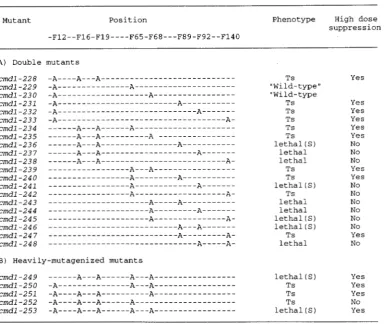
Figure 5 summarizes the growth phenotypes of the double and heavily-mutagenized Phe + Ala mutants. Of the 26 Phe + Ala mutants analyzed, 5 were dose- independent recessive lethal, 6 were lethal only in SF-
thetic medium, 2 were dose-independent temperature- sensitive, 11 were dose-suppressible temperature-sensitive, and 2 had no discernible phenotype.
Phe to Ala Mutants of Calmodulin 1049
Mutant Position Phenotype High dose
suppression -F12--F16-F19----F65-F68---F89-F92--F140
A ) Double mutants
c m d l - 2 2 8 c m d l - 2 2 9 c m d l - 2 3 0 c m d l - 2 3 1 c m d l - 2 3 2 c m d l - 2 3 3 c m d l - 2 3 4 c m d l - 2 3 5 c m d l - 2 3 6 c m d l - 2 3 7 c m d l - 2 3 8 c m d l - 2 3 9 c m d l - 2 4 0 c m d l - 2 4 1 c m d l - 2 4 2 c m d l - 2 4 3 c m d l - 2 4 4 c m d l - 2 4 5 c m d l - 2 4 6 c m d l - 2 4 7 cmdl -248
TS
“Wild-type“ “Wild-type
TS
TS TS TS
TS
lethal ( S ) lethal lethal
TS TS
TS lethal ( S )
lethal
lethal ( S ) lethal
lethal ( S ) lethal
TS
Yes
Yes Yes Yes Yes
No Yes
No No Yes Yes No No No No No No
No Yes
FIGURE 5.--Summary of the growth properties of the double (A) and multiple (B) Phe + Ala c m d l mutant strains. Phenotypes of the singlecopy integrated mutant strains are shown. High dose suppression includes any phenotypic suppression either under low dose and high dose condition.
lethal mutations) and antibody raised against yeast cal- modulin does not cross-reactwith vertebrate calmodulin
( O m and ANRAKU 1989a). In this experiment, we used
strains containing the cmdl deletion, the integrated le- thal cmdl mutations at the ade3 locus and a plasmid with the chicken calmodulin gene expressed under the
GAL1 promoter. Absence of a wild-type yeast calmod- ulin gene in these strains was tested by checking for in- ability to grow on glucose plates, where the vertebrate calmodulin is not expressed.
Production of wild-type and the mutant calmodulin was quantified by immunoprecipitation using poly- clonal antibodies raised against yeast calmodulin (Table
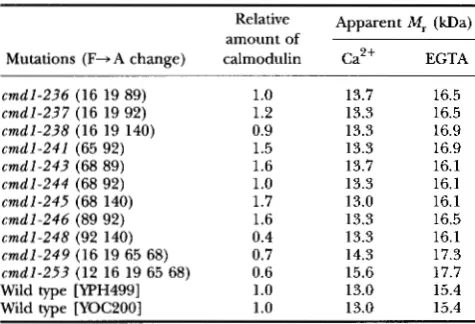
4). Single copy CMD1 integrated at the ade3 locus did not affect the calmodulin expression level, since the wild-type strain (YPH499) and the ade3::CMDl inte- grated strain (YOC200) had equivalent levels of calmod- ulin. Many of the lethal mutants proved to contain es- sentially wild-type levels of calmodulin ( c m d l - 2 3 6 , c m d l - 2 3 7 , c m d l - 2 3 8 and c m d l - 2 4 4 ) or levels slightly higher that wild type ( c m d l - 2 4 1 , c m d l - 2 4 3 , c m d l - 2 4 5
and c m d l - 2 4 6 ) . There were only three mutant strains
( c m d l - 2 4 8 , c m d l - 2 4 9 and c m d l - 2 5 3 ) that contained obviously lower levels of calmodulin.
Protein stability was then examined more directly by pulse-chase labeling of representative strains ( CMD1
control, cmdl-241 and cmdl-253, each integrated at
ade3) followed by immunoprecipitation. After 3 hr in- cubation at 30°, 80 and 70% of the calmodulin still re- mained in the wild-type and cmdl-241 cells, respectively. Even in the c m d l - 2 5 3 cells, which contain a lower steady-state level of calmodulin (Table 4), only 50% of the calmodulin had been degraded in 3 hr (Figure 6 ) .
Taken together, these data show that most of the lethal Phe + Ala mutant calmodulins are as stable as wild-type calmodulin. For these mutants the lethal phenotype must be due to differences in the quality of the protein, and not to any gross differences in amount.
Ca*+-suppressible phenotypes: Mutations in a num-
1050 Y. Ohya and D. Botstein
Media
Time (h) 0 1 3 5 5
Wild-type
Amount 1.0 0 9 0 8 0.6 0 9
[Media
I
YPGSleal
Media
I
Amounl 0 .7
(lold) 0.5 0.4 0.4
FIGURE 6.Stability of calmodulin in the wild-type and two lethal c m d l ( c m d l - 2 4 1 or c m d l - 2 5 3 ) mutants assessed by a pulsechase experiment. Haploid strains bearing pRB1619 (chicken calmodulin) and integrated C M D I , c m d l - 2 4 1 or
c m d l - 2 5 3 were grown in galactosecontaining medium and subjected to the pulsechase protocol described in the Meth- ods. The ratio of calmodulin at each indicated time point rela- tive to the calmodulin at time zero is given.
in an SDS polyacrylamide gel is shifted in a Ca2+- dependent manner ( W A ~ E R S O N et al. 1980; OHYA and ANRAKU 1989a), presumably because calcium binding causes a conformational change. All the recessive lethal
Phe + Ala mutant calmodulin showed very similar Ca2+-
dependent mobility shifts (Figure 7, Table 4), indicating that all of the mutants retained their Ca2+-binding ac- tivity. There are characteristic differences in mobility among the mutants, especially in the absence of Ca2+, the significance of which is not understood.
Intragenic complementation of the temperature
sensitive mutations: Recently we reported intragenic
complementation among the calmodulin mutants
(OHYA and BOTSTEIN 1994). Here we present comple-
mentation data for reciprocal matings of 14 different
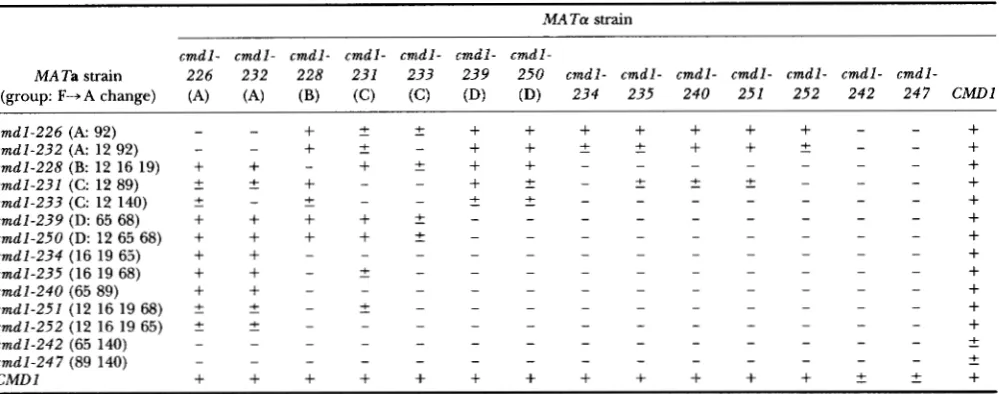
cmdl-ts alleles (Table 5). All diploid strains homozygous for the temperature-sensitive cmdl alleles did not grow at the restrictive temperature, but diploids bearing dif- ferent cmdl alleles often were able to grow. Heteroal- lelic diploids constructed with c m d l - 2 3 1 or c m d l - 2 3 3
grew relatively slowly, or even did not grow in one com- bination ( c m d l - 2 3 2 / c m d l - 2 3 3 ) because of the partial dominance of these alleles. All the heteroallelic diploids constructed with c m d l - 2 4 2 or cmdl-247grewvery badly at restrictive temperature; this is likely to be due to domi- nance, as each of these mutations showed partial domi- nance when mated with C M D l strains. Analyses of all combinations of diploids harboring recessive alleles re- vealed four intragenic complementation groups (A-D).
Since cmdl-234, cmdl-235, cmdl-240, cmdl-251 and
c
c
c
EGTA
I
1 M 2 3 4 5 6 7 8 M 9 1 0 1 1 1 2 1 3 1 4 M
1 1 M 2 3 4 5 6 7 8 M 9 1 0 1 1 1 2 1 3 1 4 M
il
FIGURE 7.-Casf-dependent electrophoretic mobility shifts of the wild-type calmodulin and the mutant calmodulins. Im-
munoprecipitated calmodulin in the wild-type control and the lethal c m d l mutants were analyzed as described in MATERIALS
AND METHODS. Wild-type ( 1 and 2), c m d l - 2 3 6 (4), c m d l - 2 3 7
(lane 5), c m d l - 2 3 8 (lane 6), c m d l - 2 4 1 (lane 7). c m d l - 2 4 3
(lane 8), c m d l - 2 4 4 (lane 9), cmdl-245 (lane lo), c m d l - 2 4 6 (lane l l ) , c m d l - 2 4 8 (lane 12), c m d l - 2 4 9 ( l a n e 13), c m d l - 2 5 3
(lane 14) calmodulin were analyzed. Lane 3 contains the im- munoprecipitates from the cells bearing the cmdl deletion
( c m d l d 1 : : T R P l ) and pRB1619 (chicken calmodulin) as a control to show that the anti-yeast antibody does not cross- react with the chicken calmodulin. M indicates molecular weight markers (Carbonic anhydrase, Trypsin inhibitor and Lysozyme). Apparent M , of the mutant calmodulins is listed in Table 4.
c m d l - 2 5 2 did not complement mutations in more than one of the four groups, we suppose that these alleles harbor multiple or overlapping functional defects.
DISCUSSION
The mutants described above were isolated on the basis of an inference, from structural data, that the highly conserved phenylalanine residues play an impor- tant role in the interaction of calmodulin and target proteins. The success of this approach, after so much difficulty in recovering calmodulin with phenotypes, can be seen as support for this inference.
Phe to Ala Mutants of Calmodulin 1051
TABLE 5
Intragenic complementation among the cmdl-ts mutations
M A T a strain
_ _ _~ ~ ~ ~ ~
c m d l - c m d l - c m d l - c m d l - c m d l - c m d l - c m d l - MA Ta strain 2 2 6 2 3 2 2 2 8 2 3 1 2 3 3 2 3 9 2 5 0 c m d l - c m d l - c m d l - c m d l - c m d l - c m d l - c m d l -
(group: F-A change) (A) (A) (B) (C) (C) (D) C M D l (D) 2 4 7 2 4 2 2 5 2 2 5 1 2 4 0 2 3 4 2 3 5
c m d l - 2 2 6 ( A 92) c m d l - 2 3 2 ( A 12 92) c m d l - 2 2 8 (B: 12 16 19) c m d l - 2 3 1 (C: 12 89) c m d l - 2 3 3 (C: 12 140) c m d l - 2 3 9 (D: 65 68) c m d l - 2 5 0 (D: 12 65 68) cmdl-234 (16 19 65) cmdl-235 (16 19 68) c m d l - 2 4 0 (65 89) c m d l - 2 5 1 (12 16 19 68) c m d l - 2 5 2 (12 16 19 65) c m d l - 2 4 2 (65 140) cmdl-247 (89 140) CMDl
MATa and M A T a strains, all ofwhich were leu2 Zys2, were transformed with pRS315 ( L E U 2 ) and pRS317 ( L Y S 2 ) (SIKORSKY and HIETER 1989), respectively in order to provide complementary auxotrophies for selection of diploids. Diploids were selected and growth was examined on WD medium at 25" and 37.5". Growth at the high temperature is indicated as follows:
+,
robust growth; C , less vigorous growth; -, no growth. phenotype. However, a large fraction of the double mu-tations turned out to be either lethal or to cause a readily scored temperature-sensitive phenotype.
Most of the lethal mutants contained levels of mutant calmodulin equivalent to wild-type calmodulin. This means that the mutant phenotypes are not due to in- stability of mutant calmodulins, but instead are due to impairment of calmodulin function(s). We can now sug- gest further that the phenylalanine residues are impor- tant for essential function (s) of calmodulin, but they are nevertheless functionally redundant.
Functional redundancy has to be seen also in the con- text of the diversity of essential functions carried out by calmodulin in yeast (OHYA and BOTSTEIN 1994) (see also below). The overall picture that emerges is that the sev- eral phenylalanine residues in calmodulin are required to different extents in different combinations in order to carry out each of the several essential tasks. In each of these tasks, there is a different degree to which each of the symmetrical lobes can compensate for the other.
Dosedependent phenotypes: In characterizing the
phenotype of the calmodulin mutants, we paid consid- erable attention to the copy number of calmodulin. We hypothesized that calmodulin mutants with low affinity to targets might be overcome stoichiometrically by in- creasing the amount of mutant calmodulin. There- fore, for the most rigorous test of mutant phenotype, we expressed the mutant protein under a situation
(integration into a known locus) that virtually guar- antees a single copy condition. Using the three dosage levels, we were able to identify a series of single and multiple Phe + Ala calmodulin mutations showing both dose-suppressible and dose-independent delete- rious phenotypes.
It is worth emphasizing that many of our mutants lost most or all of the phenotype that could be obsewed readily in single-copy when placed on a CEN plasmid. This means that CEN plasmids cannot be thought of as equivalent to single-copy when analyzing function of gene products.
Ranking the significance of the phenylaladne resi-
dues: Detailed analysis of the double mutants indicated
that the many phenylalanine residues do not contribute equally to function. Different combinations of the mu- tated sites resulted in three phenotypes: 'Wild-type," Ts-, and lethal. We can derive a hierarchy by ranking the phe residues based on the frequency with which they contribute to the more severe phenotypes. This method results in the order: F92
>
F89 = F140 =F16F19 > F68
>
F65>
F12, where F92 is the most im- portant phe residue. This ranking is gratifyingly con- sistent with the observation that F92 is the only position that causes a growth phenotype as a single Phe + Ala mutant. By this ranking scheme, the three Gterminal phe residues appear to be more crucial for cal- modulin function than the N-terminal Phe residues.The significance of the phe residues can be assessed in another way: by ranking the relative severity of the phenotypes of mutants with only one intact phe residue in either the N-terminal lobe ( c m d l - 2 4 9 , c m d l - 2 5 0 , c m d l - 2 5 1 , c m d l - 2 5 2 ) or C-terminal lobe ( c m d l - 2 4 8 , c m d l - 2 4 7 , c m d l - 2 4 6 ) . This scheme gives F16F19 = F68
= F65
>
F12 in the N-terminal lobe andF92
>
F89 = F140 in the Gterminal lobe. This assessment is consistentwith the first ranking method.Interactions among the phenylalanine residues: Fig-
1052 Y. Ohya and D. Botstein
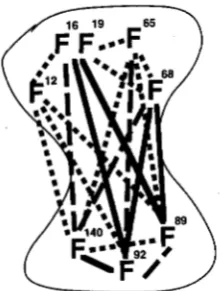
FIGURE 8.-Functional interaction among phenylalanine residues in calmodulin sequence. When double mutants are lethal the residues are connected with a solid line; when they are lethal in synthetic medium only, a broken line; when they are temperature-sensitive, a dotted line. The N-terminal lobe is at the top and the C-terminal lobe is at the bottom of the figure.
21 combinations and found that 19 have phenotypes more severe than either single lesion: 5 combinations produce a fully lethal phenotype, 4 produce a lethal phe- notype on minimal medium, and 10 produce a temperature-sensitive phenotype.
These genetic interactions must be interpreted in light of the three dimensional structure of calmodulin (BABU et al. 1988; IKURA et al. 1992; MEADOR et al. 1992). Clustering of the phe residues in each domain (BABU
et al. 1988) helps to explain synthetic interactions that are observed within the same half domain of calmod- ulin. Simultaneous alteration of the phe residues likely decreases disproportionately the surface hydrophobic- ity of the calmodulin lobes, weakening the hydrophobic interaction between the lobe and the target proteins.
Strong inter-domain synthetic interaction among our mutations is observed, as might be expected on the basis of our hypothesis of functional redundancy. For ex- ample, F68A in the N-terminal half domain has lethal interactions with two of the three Phe + Ala mutations in the C-terminal lobe, whereas it has either Ts- or no synthetic interaction with other mutations in the N-terminal lobe. The interactions between N-terminal lobe and C-terminal lobe can be understood in light of the three dimensional model of calmodulincalmodulin binding peptide complex (IKURA et al. 1992; MFADOR et al. 1992). Although direct interaction between the two lobes was not observed in the absence of the target peptides, in the calmodulin-calmodulin-binding p e p tide complex, the target peptide is engulfed by both lobes in a manner akin to an articulated jaw; coopera- tively by the two lobes.
Cooperativity in calmodulin action has been often demonstrated in biochemical analysis (YAZAWA et al. 1990; COHEN and KLEE 1988). Although either half- calmodulin fragment possesses ability to bind target pro- teins and to activate several calmodulin target enzymes,
more efficient binding and activation is observed with intact calmodulin.
Comparison between two half domains: It was unex-
pected that the C-terminal domain mutation, cmdl-248
(F92A F140A) caused a lethal phenotype even when
overproduced, since SUN et al. (1991) have shown that overexpression of either half-calmodulin is sufficient for cell growth. Our interpretation is that overexpression of the N-terminal half is sufficient for cell growth through substitution for the C-terminal half, but that association of the inactive Gterminal half-calmodulin somehow compromises the effect. A simple competition model is complicated by the observation that the most severe N-terminal mutant cmdl-253, which has all five phe resi- dues in the N-terminal half altered, caused a dose- suppressible lethal phenotype similar to the half- calmodulin mutants.
We often observed increased severity of phenotype in the C-terminal mutants over the N-terminal mutants (Figure 8). This cannot be explained simply by a dif- ference in calmodulin levels. N-terminal mutant cal- modulin ( cmdl-253) is even less stable than the Gterminal mutant calmodulin ( c m d l - 2 4 6 and cmdl- 2 4 8 ) . For this we offer two suggestions. First, the essen- tial function of the N-terminal lobe may be less impor- tant than that of the Gterminal lobe. Functional differences between the two lobes have been suggested for Paramecium calmodulin mutants that show behav- ioral phenotypes (HINRICHSEN et al. 1991; KUNG et al.
1992) and also in biochemical analysis of half-
calmodulin in vitro (COHEN and KLEE 1988). In support of this idea we also have observed that when integrated into the chromosome, expression of the N-terminal half- calmodulin under the GAL1 promoter does not support cell growth while the C-terminal half-calmodulin does
(Y. OHYA and D. BOTSTEIN, unpublished results). Second, there may be amino acid residues other than phe that are functionally redundant with the N-terminal phe resi- dues. The three dimensional structure of calmodulin- calmodulin binding peptide complex demonstrates that other amino acid residues such as methionine are also involved in interaction with calmodulin-calmodulin tar- get peptide IKURA et al. 1992). This notion could be tested by combining mutations in these residues with the Phe + Ala mutation of the N-terminal domain.
Complementation among cmdl-ts mutations: Ge-