1
Chemical and non-chemical solutions for managing twospotted spider mite, western
tarnished plant bug, and other arthropod pests in strawberries
Surendra K. Dara
1*, David Peck2
2, and Dave Murray
31
University of California Cooperative Extension, San Luis Obispo,
2Manzanita Berry Farms,
Santa Maria, and
3Sundance Berry Farms, Santa Maria, California, USA
*[email protected]
Abstract
The twospotted spider mite,
Tetranychus urticae
and the western tarnished plant bug,
Lygus hesperus
are major arthropod pests of strawberries in California. Other important insect
pests include the greenhouse whitefly,
Trialeurodes vaporariorum
and the western flower thrips,
Frankliella occidentalis
. Chemical pesticides play a major role in managing these pests, but not
without the associated risk of pesticide resistance and environmental safety. Two field studies
were conducted in Santa Maria to evaluate the potential of botanical and microbial pesticides in
the integrated pest management (IPM) of strawberry. Chemical, botanical, and microbial
pesticides were evaluated against
T. urticae
in a small plot study in 2013 and against
L. hesperus
and other insect pests in a large plot study in 2015 in commercial strawberry fields. Bug
vacuums were also used in the 2015 study. Results demonstrated that non-chemical alternatives
can play an important role in strawberry IPM.
Keywords: Frankliniella occidentalis
,
Lygus hesperus
,
Trialeurodes vaporariorum
,
Tetranychus
urticae
, entomopathogenic fungi, integrated pest management.
Introduction
2
Strawberry is the fifth most valuable agricultural commodity in California with a crop
value of $2.5 billion (CDFA, 2016). The twospotted spider mite,
Tetranychus urticae
Koch
(Acari: Tetranychidae) and the western tarnished plant bug also known as lygus bug,
Lygus
hesperus
Knight (Hemiptera: Miridae) are two major arthropod pests that cause significant yield
losses every season (Zalom et al, 2014). Other important insect pests that can cause significant
damage when populations are high include the greenhouse whitefly,
Trialeurodes vaporariorum
(Westwood) (Hemiptera: Aleyrodidae) and the western flower thrips,
Frankliniella occidentalis
(Pergande) (Thysanoptera: Thripidae). Twospotted spider mite is generally found on the
underside of the leaves scraping the epidermis and feeding on the plant juices. Mite damage
reduces plant vigor and thus fruit yields. Severe mite infestations can also lead to plant death.
Western tarnished plant bug nymphs and adults feed on developing fruit by inserting their stylets
and sucking fruit juices. As the fruit develops, damaged tissues result in uneven growth and
cause fruit deformity. Deformed berries are not marketable and contribute to yield losses.
Populations of the greenhouse whitefly and the western flower thrips are usually kept below
threshold levels with treatments targeted towards other pests, but can occasionally build up to
damaging levels. Biological control of the twospotted spider mites by releasing
commercially-produced predatory mites is a popular practice in California. Management of the western
tarnished plant bug continues to be a major challenge for California strawberry growers.
Although earlier studies show limited control of the western tarnished plant bug from vacuums,
their use is becoming popular especially on some large farms (Pickel et al., 1995). However,
strawberry is one of the crops where large quantities of pesticides are used and the twospotted
spider mite and the western tarnished plant bug are important targets for miticide and insecticide
3
Excessive use of chemicals leads to pesticide resistance, making it more challenging to
control already difficult pests. Although several botanical and microbial pesticides are registered
against these and other strawberry pests, they are used only to a limited extent and are primarily
perceived as viable options in organic agriculture. Earlier field studies demonstrated that
alternating or combining biopesticides with chemical pesticides are important in strawberry IPM
for western tarnished plant bug management (Dara, 2016). Two field studies were conducted, in
2013 and 2015, to further evaluate the role of biopesticides in managing arthropod pests
strawberry.
Twospotted spider mite
A small plot field study was conducted in 2013 at Manzanita Berry Farms in Santa Maria
to evaluate the efficacy of various botanical, chemical, and microbial pesticides. Treatments
included bifenazate (Acramite 50 WS at 1 lb/ac), abamectin (Agri-Mek SC at 4.29 fl
oz/ac), entomopathogenic fungus
Beauveria bassiana
(BotaniGard ES at a lower label rate of 1
qrt/ac) + bifenazate (Acramite 50 WS at the lowest label rate of 0.75 lb/ac), rosemary and cotton
seed oil (Eco-Mite at 1% concentration), fenpyroximate (Fujimite 5 EC at 2 pt/ac),
fenpyroximate (Fujimite XLO at 2 pt/ac),
Chromobacterium subtsugae
strain PRAA4-1
(Grandevo at 2 lb/ac),
Burkholderia
sp. strain A396 (Venerate XC at 2 gal/ac), and cyflumetofen
(Nealta SC at 13.7 fl oz/ac). A spray volume of 150 gallons/acre was used with 0.25% non-ionic
surfactant (Induce) except for the treatment with
B. bassiana
, where an organo-silicon surfactant
(Kinetic) was used. Each treatment was a 15' long strawberry bed and treatments were replicated
four times in randomized complete block design. Treatments were applied on 16 and 23 May,
4
7 days after each application. On each sampling date, 10 mid-tier leaflets were collected from 10
random plants within each plot, eggs and mobile stages of mites were collected using a mite
brushing machine (Leedom Enterprises, Mi-Wuk Village, CA) by passing each leaflet five times
and counted under a microscope. Data were analyzed using ANOVA and significant means
were separated using Tukey's HSD test.
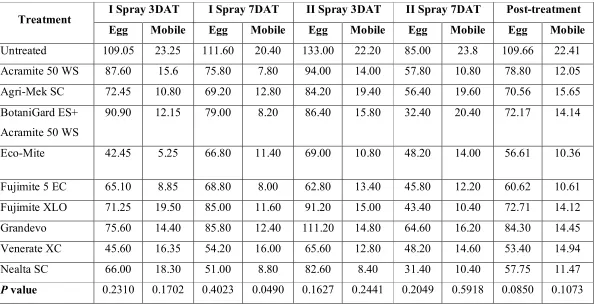
Pre-treatment counts were not available due to a technical issue, so comparisons were
made for pest and predatory mite (
Phytoseiulus persimilis
and
Neoseiulus
spp.) numbers after
each spray application and the post-treatment period. Compared to untreated control, treated
plots had fewer spider mites throughout the observation period, but the pest suppression was not
statistically significant (
P
> 0.05, Table 1).
Western tarnished plant bug and other insect pests
A large plot study was conducted in 2015 at Sundance Berry Farms in the Santa Maria
area. The following groups of treatment options were used in different combinations and
rotations and evaluated for their efficacy against insect pests with a particular emphasis on
L.
hesperus
(Table 3).
Chemical pesticides:
Six chemical pesticides from different Insecticide Resistance Action
Committee (IRAC) mode of action group were used.
IRAC Group 3A – Pyrethrins: Proprietary formulation and bifenthrin (Brigade)
IRAC Group 4A – Neonicotinoids: Acetamiprid (Assail 70 WP)
IRAC Group 4C – Sulfoximines: Sulfoxaflor (Closer)
5
IRAC Group 9C – Flonicamid: Flonicamid (Beleaf 50 SG)
IRAC Group 15 – Benzoylureas: Novaluron (Rimon 0.83 EC)
Botanical pesticide:
Azadirachtin is an insecticide, insect growth regulator, antifeedant, and a
repellent. Different formulations of azadirachtin used in this study were – AzaGuard (3%
azadirachtin), Neemix (4.5% azadirachtin), and Debug Turbo (65.8% of oils margosa and 0.7%
azadirachtin). Cold pressed neem (37.5 or 75 ppm) or natural pyrethrum (0.5 or 0.75%) were
also present in combination with
B. bassiana
in three products used in the study.
Entomopathogenic fungi:
Three fungi used in the study include
B. bassiana
[three proprietary
formulations with cold pressed neem at 75 ppm (XPULSE), pyrethrum at 0.75% (XPECTRO), or
both cold pressed neem at 37.5 ppm and pyrethrum at 0.5% (XCEDE)],
Isaria fumosorosea
(Pfr-97 20% WDG), and
Metarhizium brunneum
(Met 52 EC).
Mechanical:
Vacuuming was done with a commercial tractor-mounted bug vacuum twice a
week with one pass each time at a speed of 2 mph.
The study included 12 treatments where Assail 70 WP alone and vacuuming alone were
grower standards along with an untreated control (Table 3). Treatments were administered on 26
August, 2 and 9 September using a tractor-mounted sprayer. A spray volume of 100 gallons/acre
was used for pesticide treatments. Each treatment had six 75' long (4 row) beds and four
replications distributed in a randomized complete block design. Before the first treatment and 6
days after each treatment, 20 random plants from the middle two beds in each plant were
sampled for insect pests and natural enemies. The number of young and old nymphs, and adult
6
stages of natural enemies including
bigeyed bugs (
Geocoris
spp.), minute pirate bugs (
Orius
spp.), lace wings (
Chrysopa
spp. and
Hemerobius
spp.), damsel bugs (
Nabis
spp.), ladybeetles
(Coccinellidae), parasitic wasps (
Anaphes iole
), predatory thrips (Thripidae), predatory midge
larvae (Syrphidae), and spiders were counted from each sample plant. Data were subjected to
ANOVA and significant means were separated using Tukey's HSD test.
Results and Discussion
Twospotted spider mite
When the percent reduction in treatments relative to untreated control was compared for
both spray applications, Eco-Mite treatment caused a 49.3% reduction in egg and mobile stages
followed by Venerate XC (48.3%), Nealta SC (47.6%), and Fujimite EC (46.1%) (Fig. 1).
Control provided by the lower label rates of BotaniGard ES+Acramite 50 WS (34.6%) is
comparable to the commonly used chemical pesticides Agri-Mek SC (34.7%), Fujimite XLO
(34.3%) and Acramite 50 WS at the higher rate (31.2%). A 25.2% reduction in egg and mobile
stages obtained by Grandevo is also important from the IPM perspective.
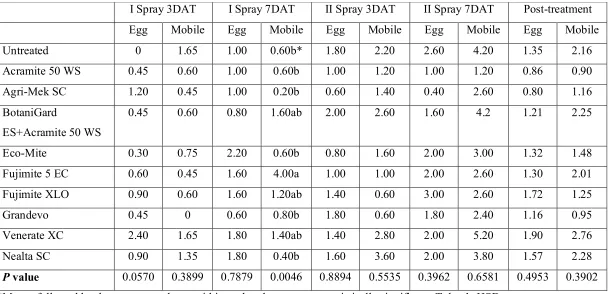
There were no statistically significant differences in predatory mite populations among
treatments except in mobile numbers 7 days after the first spray (
P
= 0.0046, Table 2). Plots that
were treated with Venerate XC and Nealta SC had a relatively higher numbers of predatory mites
and Acramite 50 WS and Agri-Mek SC had lower numbers, in general. Considering the recent
resistance issues with abamectin and bifenazate in
T. urticae
populations (personal
non-7
chemical alternatives against
T. urticae
and safety to predatory mites is very important in
developing IPM strategies.
Western tarnished plant bug
Populations of
L. hesperus
were very high during the study period (treatment threshold 1
nymph/20 plants) and control was difficult, in general (Table 4). Significant treatment
differences (
P
= 0.01) were seen only for post-treatment counts of older nymphs. When the
percent reduction in nymphs and adult western tarnished plant bugs was compared after three
treatments, 29% reduction was seen in sulfoxaflor/flupyradifurone/flonicamid treatment
compared to pre-treatment numbers (Fig. 2). Sivanto/Sivanto/vacuum treatment provided a 12%
control. XPECTRO/vacuum/Rimon 0.83 EC+Brigade treatment prevented the population
buildup. There was a 7.8 to 85.7% increase in
L. hesperus
numbers in all the remaining
treatments. Bug vacuums, which are becoming more popular in the recent years, were also not
effective in controlling
L. hesperus
populations but limited population buildup to 11.5%.
There were no significant difference (
P
> 0.05) in
F. occidentalis
,
T. vaporariorum
, or
natural enemy populations (Table 5). However, pest and natural enemy populations increased,
decreased or remained relatively unchanged post-treatment compared to pretreatment counts.
Frankliniella occidentalis
numbers increased in all treatments post-treatment except for a 41% in
Rimon 0.83 EC+Brigade/Met52 EC+Debug Turbo/Met52 EC+AzaGuard treatment and 22% in
XPULSE/XCEDE/XPECTRO treatment. In general, low numbers of
T. vaporariorum
adults
were seen during the observation period. After three weeks of administering the treatments,
reduction in numbers was seen in vacuum/Sivanto+Debug Turbo/Rimon 0.83 EC+Brigade,
8
EC+AzaGuard treatments.
Percent change post-treatment indicated that natural enemy
populations were relatively higher in Pfr-97 20% WDG+Neemix/Pfr-97 20%
WDG+Neemix/vacuum followed by Closer/Sivanto/Beleaf 50 SG, and Closer/Closer/vacuum
and XPULSE/XCEDE/XPECTRO treatments (Table 5).
These results show that both chemical and non-chemical alternatives vary in their
efficacy depending on the combinations and rotation. There is a general perception that
chemical pesticides are more efficacious and consistent in their control compared to
non-chemical alternatives, but it was not the case in this study. Similar to the findings of Picket et al.
(1995) vacuums provided limited control of western tarnished plant bug in this study. To reduce
the risk of insecticide resistance development, effective chemicals from different mode of action
groups and non-chemical alternatives such as botanical and microbial pesticides, should be
considered. Some of the biopesticides are more expensive compared to chemical pesticides, but
their long-term benefit in insecticide resistance management is very significant. Recent studies
also showed that entomopathogenic fungi can also promote crop growth, health, and antagonize
plant pathogens in addition to controlling arthropod pests (Sasan and Bidochka, 2012; Dara et
al., 2017a, b ). These additional roles can offer additional benefits and offset the higher costs of
entomopathogenic fungi-based biopesticides.
While predatory mite releases are commonly practiced in California strawberries for
spider mite control, using bug vacuums on some farms is the primary non-chemical alternative
practice for managing
L. hesperus
. There is a need to integrate a variety of pest management
practices both to improve the control efficacy against pests such as
L. hesperus
as well as to
9
with botanical and microbial pesticides is an effective strategy for managing
L. hesperus
in
strawberry (Dara, 2016). Although the combination of
I. fumosorosea
and
B. bassiana
with
azadirachtin or pyrethrum did not result in statistically significant reduction in
L. hesperus
numbers, in general, there were fewer
L. hesperus
in these treatments compared to the untreated
control in the current study. Similarly, the combination of
B. bassiana
and azadirachtin was
more effective in controlling the rice root aphid,
Rhopalosiphum rufiabdominale
, and the
honeysuckle aphid,
Hyadaphis foeniculi
, in organic celery (Dara, 2015). These studies
demonstrate the efficacy of a variety of control options for managing major arthropod pests in
strawberry, their impact on natural enemy populations, and present various ideas for developing
IPM strategies.
Acknowledgements:
Thanks to Ted Ponce and other crew members at Sundance Berry Farms
for treatment applications, and Sumanth Dara, Suchitra Dara, Chris Martinez, Fritz Light, Tamas
Zold, and Kristin Nicole Stegeman for technical assistance, and different pesticide companies for
donating materials and/or providing financial assistance for supporting these studies.
References
California Department of Pesticide Regulation (CDPR). 2015. Summary of pesticide use report
data 2013: indexed by commodity. (
http://www.cdpr.ca.gov/docs/pur/pur13rep/comrpt13.pdf
)
California Department of Food and Agriculture (CDFA). 2016. California agricultural statistics
10
Dara, S. K. 2013. Entomopathogenic fungus
Beauveria bassiana
promotes strawberry plant
growth and health. UC ANR eJournal Strawberries and Vegetables, September 30, 2013.
(
https://ucanr.edu/blogs/blogcore/postdetail.cfm?postnum=11624
)
Dara, S. K. 2015. Root aphids and their management in organic celery. CAPCA Adviser 18(4):
56-58.
Dara, S. K. 2016. Managing strawberry pests with chemical pesticides and non-chemical
alternatives. Int. J. Fruit Sci. 16: 129-141. DOI:
10.1080/15538362.2016.1195311
Dara, S. K., S.S.R. Dara, and S. S. Dara. 2017a. Impact of entomopathogenic fungi on the
growth, development, and health of cabbage growing under water stress. Amer. J. Plant Sci. 8:
1224:1233. DOI:
10.4236/ajps.2017.86081
Dara, S.S.R., S. S. Dara, S. K. Dara, and T. Anderson. 2017b. Fighting plant pathogenic fungi
with entomopathogenic fungi and other biologicals. CAPCA Adviser 20(1): 40-44.
Pickel C, Zalom FG, Walsh DB, Welch NC. 1995. Vacuums provide limited lygus control in
strawberries. Cal. Ag. 49: 19-22.
Sasan, R. K. and M. J. Bidochka, 2012. The insect-pathogenic fungus
Metarhizium robertsii
(Clavicipitaceae) is also an endophyte that stimulates plant root development. Amer. J. Bot. 99:
101-107.
Zalom FG, Bolda MP, Dara SK, Joseph S. 2014. UC IPM pest management guidelines:
strawberry. University of California Statewide Integrated Pest Management Program. Oakland:
12
Treatment
I Spray 3DAT
I Spray 7DAT
II Spray 3DAT
II Spray 7DAT
Post-treatment
Egg
Mobile
Egg
Mobile
Egg
Mobile
Egg
Mobile
Egg
Mobile
Untreated
109.05
23.25
111.60
20.40
133.00
22.20
85.00
23.8
109.66
22.41
Acramite 50 WS
87.60
15.6
75.80
7.80
94.00
14.00
57.80
10.80
78.80
12.05
Agri-Mek SC
72.45
10.80
69.20
12.80
84.20
19.40
56.40
19.60
70.56
15.65
BotaniGard ES+
Acramite 50 WS
90.90
12.15
79.00
8.20
86.40
15.80
32.40
20.40
72.17
14.14
Eco-Mite
42.45
5.25
66.80
11.40
69.00
10.80
48.20
14.00
56.61
10.36
Fujimite 5 EC
65.10
8.85
68.80
8.00
62.80
13.40
45.80
12.20
60.62
10.61
Fujimite XLO
71.25
19.50
85.00
11.60
91.20
15.00
43.40
10.40
72.71
14.12
Grandevo
75.60
14.40
85.80
12.40
111.20
14.80
64.60
16.20
84.30
14.45
Venerate XC
45.60
16.35
54.20
16.00
65.60
12.80
48.20
14.60
53.40
14.94
Nealta SC
66.00
18.30
51.00
8.80
82.60
8.40
31.40
10.40
57.75
11.47
13
I Spray 3DAT
I Spray 7DAT
II Spray 3DAT
II Spray 7DAT
Post-treatment
Egg
Mobile
Egg
Mobile
Egg
Mobile
Egg
Mobile
Egg
Mobile
Untreated
0
1.65
1.00
0.60b*
1.80
2.20
2.60
4.20
1.35
2.16
Acramite 50 WS
0.45
0.60
1.00
0.60b
1.00
1.20
1.00
1.20
0.86
0.90
Agri-Mek SC
1.20
0.45
1.00
0.20b
0.60
1.40
0.40
2.60
0.80
1.16
BotaniGard
ES+Acramite 50 WS
0.45
0.60
0.80
1.60ab
2.00
2.60
1.60
4.2
1.21
2.25
Eco-Mite
0.30
0.75
2.20
0.60b
0.80
1.60
2.00
3.00
1.32
1.48
Fujimite 5 EC
0.60
0.45
1.60
4.00a
1.00
1.00
2.00
2.60
1.30
2.01
Fujimite XLO
0.90
0.60
1.60
1.20ab
1.40
0.60
3.00
2.60
1.72
1.25
Grandevo
0.45
0
0.60
0.80b
1.80
0.60
1.80
2.40
1.16
0.95
Venerate XC
2.40
1.65
1.80
1.40ab
1.40
2.80
2.00
5.20
1.90
2.76
Nealta SC
0.90
1.35
1.80
0.40b
1.60
3.60
2.00
3.80
1.57
2.28
P value
0.0570
0.3899
0.7879
0.0046
0.8894
0.5535
0.3962
0.6581
0.4953
0.3902
*Means followed by the same or no letter within each column are not statistically significant, Tukey’s HSD.
14
1
Untreated
Untreated
Untreated
2
Assail 70 WP (3 oz),
4A
Assail 70 WP (3 oz),
4A
Assail 70 WP (3 oz),
4A
3
Vacuum
Vacuum
Vacuum
4
Rimon 0.83 EC (12 fl oz),
15
+
Brigade (16 oz),
3A
Met52 EC
(16 fl oz) + Debug
Turbo (104 fl oz)
Met52 EC (16 fl oz) +
AzaGuard (16 fl oz)
5
Closer (4.5 fl oz),
4C
Closer (4.5 oz),
4C
Vacuum
6
Pfr-97 20% WDG (2 lb) +
Neemix (9 fl oz)
Pfr-97 20% WDG (2 lb) +
Neemix (9 fl oz)
Vacuum
7
Vacuum
Sivanto (14 fl oz),
4D
+
Debug Turbo (104 fl oz)
Rimon 0.83 EC (12 fl oz),
15
+
Brigade (16 oz),
3A
8
Sivanto (14 fl oz),
4D
Sivanto (14 fl oz),
4D
Vacuum
9
Closer (4.5 fl oz),
4C
Sivanto (14 fl oz),
4D
Beleaf 50 SG (2.8 oz),
9C
10
XPULSE
(1 qt)
XCEDE
(1 qt),
3A
XPECTRO
(1 qt),
3A
11
XPECTRO (1 qt),
3A
XPULSE (1 qt)
Beleaf 50 SG (2.8 oz),
9C
12
XPECTRO (1 qt),
3A
Vacuum
Rimon 0.83 EC (12 fl oz),
15
+
15
*Means followed by the same or no letter are not significantly different, Tukey's HSD (P > 0.05).
Treatment
Pretreatment
Post I Spray
Post II Spray
Post III Spray
Post-treatment Average
1–3
Instar
4–5
Instar
Adult
All
Stages
1–3
Instar
4–5
Instar
Adult
All
Stages
1–3
Instar
4–5
Instar
Adult
All
Stages
1–3
Instar
4–5
Instar
Adult
All
Stages
1–3
Instar
4–5
Instar
Adult
All
Stages
1
18.50
2.50
2.00
23.00
25.50
5.75
2.50
33.75
24.00
6.75
6.75
37.50
33.50
6.25
12.00
51.75
27.67 6.25a*
7.08
41.00
2
20.75
3.75
2.50
27.00
21.00
4.00
1.50
26.50
22.00
5.50
4.75
32.25
20.00
2.25
6.50
28.75
21.00 3.92ab
4.25
29.17
3
21.25
2.50
2.25
26.00
15.50
3.75
1.50
20.75
22.75
6.25
4.25
33.25
25.25
3.25
4.50
33.00
21.17 4.42ab
3.42
29.00
4
20.75
2.50
1.25
24.50
14.25
2.50
2.25
19.00
16.25
1.25
5.25
22.75
30.25
1.00
6.25
37.50
20.25
1.58b
4.58
26.42
5
11.50
1.75
0.75
14.00
11.50
2.25
3.25
17.00
13.25
2.75
4.00
20.00
26.50
0.50
7.75
34.75
17.08
1.83b
5.00
23.92
6
21.25
2.00
1.50
24.75
19.75
4.75
1.75
26.25
21.00
3.50
6.00
30.50
32.50
2.00
7.25
41.75
24.42 3.42ab
5.00
32.83
7
17.25
1.00
1.00
19.25
21.00
3.25
2.50
26.75
18.75
3.25
2.50
24.50
15.25
1.75
5.25
22.25
18.33 2.75ab
3.42
24.50
8
30.00
2.00
1.75
33.75
23.75
4.00
2.75
30.50
16.75
6.25
5.25
28.25
21.50
3.50
5.25
30.25
20.67 4.58ab
4.42
29.67
9
31.50
3.50
0.75
35.75
12.50
4.50
1.75
18.75
23.25
4.75
7.50
35.50
15.25
1.50
5.25
22.00
17.00 3.58ab
4.83
25.42
10
15.00
1.25
1.25
17.50
22.00
4.00
2.25
28.25
24.00
5.00
3.00
32.00
29.00
2.25
6.00
37.25
25.00 3.75ab
3.75
32.50
11
17.00
1.50
0.75
19.25
20.75
3.75
1.75
26.25
24.50
5.75
5.50
35.75
16.25
2.00
4.50
22.75
20.50 3.83ab
3.92
28.25
16
Treatment
Western Flower Thrips Greenhouse Whiteflies Natural Enemy Complex
Pre-treat. Post I Treat. Post II Treat. Post III Treat. Post-treat. Avg. % Change Pre-treat. Post I Treat. Post II Treat. Post III Treat. Post-treat. Avg. % Change Pre-treat. Post I Treat. Post II Treat. Post III Treat. Post-treat. Avg. % Change
1 7.00 15.75 13.25 12.25 13.75 96.43 0.25 1.00 0.25 1.75 1.00 300.00 1.25 2.25 4.75 2.25 3.08 146.67
2 9.00 21.00 13.25 13.50 15.92 76.85 0.25 0.25 1.25 0.50 0.67 166.67 2.25 5.25 3.75 2.00 3.67 62.96
3 4.75 20.50 15.50 15.75 17.25 263.16 0.75 1.25 0.75 0.75 0.92 22.22 2.00 3.00 3.00 1.00 2.33 16.67
4 18.25 12.25 8.25 11.50 10.67 -41.55 0.50 0.25 0.25 0.50 0.33 -33.33 2.00 3.50 1.75 2.00 2.42 20.83
5 5.50 17.75 14.75 18.25 16.92 207.58 0.00 0.25 0.00 0.50 0.25 - 0.75 3.00 3.00 2.75 2.92 288.89
6 13.25 18.50 15.25 13.50 15.75 18.87 0.00 1.00 0.25 1.00 0.75 - 0.25 2.50 2.25 2.50 2.42 866.67
7 5.50 14.25 11.75 6.25 10.75 95.45 0.75 0.00 0.00 0.00 0.00 100.00 1.00 2.25 2.25 2.25 2.25 125.00
8 9.75 12.50 11.75 10.50 11.58 18.80 0.25 0.00 0.00 0.25 0.08 -66.67 2.75 3.50 5.25 3.00 3.92 42.42
9 7.25 14.50 13.75 16.75 15.00 106.90 0.25 1.00 0.00 0.25 0.42 66.67 1.00 6.75 1.25 5.50 4.50 350.00
10 16.50 16.50 10.25 11.75 12.83 -22.22 0.25 1.25 0.00 0.25 0.50 100.00 0.75 3.50 2.00 3.25 2.92 288.89
11 6.00 17.00 8.75 10.25 12.00 100.00 0.00 1.25 0.50 0.75 0.83 - 2.50 3.75 1.75 2.00 2.50 0.00
17
applications.
-60
-40
-20
0
P
er
ce
n
t
re
d
u
c
ti
o
18