International Journal of Asian Social Science, 2014, 4(2): 112-120
† Corresponding author
COURSE OUTCOMES’ PERFORMANCE IN STATISTICS FOR ENGINEERS
Yuzainee Md Yusoff
†Department of Civil Engineering, College of Engineering, Universiti Tenaga Nasional, Kajang, Selangor,
Malaysia
Noor Saliza Mohd Salleh
College of Foundation & General Studies, Universiti Tenaga Nasional, Kajang, Selangor, Malaysia
Nur Liyana Zakaria
College of Foundation & General Studies, Universiti Tenaga Nasional, Kajang, Selangor, Malaysia
Khadijah Najid
Nilai University, Persiaran Universiti, Putra Nilai, Nilai, Negeri Sembilan, Malaysia
ABSTRACT
The purpose of this study is to assess the level of knowledge and abilities of student based on ten
course outcomes in Statistics for Engineers (MATB133). The course is a first year course in
Bachelor of Civil Engineering, Universiti Tenaga Nasional. The assessment was conducted on
ninety six students of semester 1, 2012/2013 through assignments, quizzes, test and final examination. The finding shows that the students’ achievement is quite good in CO6, CO9 and CO10. However, the performance in another seven course outcome were not as expected.
Hopefully, the result of analysis will help lecturers to improve the performance of future students.
The paper also provides suggestions on course outcomes that need to be focused on and more
attention.
© 2014 AESS Publications. All Rights Reserved.
Keywords:
Course outcomes, Programme outcomes, Achievement, Assessment, MATB133.1.
INTRODUCTION
The engineering programme needs to prepare young engineers to practice in an increasingly complex workplace with changing and increasing demands of public and employers. Teaching and learning process in engineering programmes abided by the outcome based education (OBE) approach. The (OBE) approach offers many advantages as a way to achieve this. In OBE approach, the educational outcomes are clearly and unambiguously specified (Harden, 1999). OBE is a performance-based approach in curriculum development, offers a powerful way of improving and managing engineering education (Schalock, 2001).The implementation of OBE is to ensure
International Journal of Asian Social Science
ISSN(e): 2224-4441/ISSN(p): 2226-5139
Special Issue: International Conference on Teaching and
Learning in Education, 2013© 2014 AESS Publications. All Rights Reserved.
the academic programme, the execution and delivery and assessment methods can produce engineering graduates who are competitive and skilled. This also will ensure the quality of engineering education attains the minimum standard comparable to global practice. In addition, by implementing OBE, the continuous quality improvement (CQI) can be done, especially in the coordination and improvement of the engineering programme which is also taken into account the role and needs of stakeholders and industries in the formulation of Programme Educational Objectives (PEO) and Programme Outcomes (PO) (Wan Hamidon, 2009).
As for that, College of Engineering, Universiti Tenaga Nasional (UNITEN) has an annual programme review (APR) to look into CQI in all engineering courses in order to meet accreditation and stakeholders’ requirement. The emphasis is onthe product - what kind of engineer will be produced - rather than on the educational process. In APR, the outcomes will determine the curriculum content and its organization, the courses offered, the teaching methods and strategies, the assessment process and the educational environment. The discussion is on PEO, PO followed by course outcomes (CO) of the courses. Coordinator of the course identified or improved the existing CO and PO based on what kind of engineer need to know and acquire. Each statement of CO shall be written clearly on evaluation methods and assessment criteria with an intention to determine the knowledge, skills and abilities of each student after completed the course. Assessment in OBE approach is a systematic and ongoing process of collecting, interpreting, and undertaking the information relating to the goals and outcomes developed to support the institution’s purpose and mission.
The achievement of CO and PO depend on the performance of students in their tasks such as quizzes, tests, final examination, projects, assignments or other types of assessments where all this gives the impression of student achievement (Rozeha et al., 2007). Assessment of each student for all tasks assigned in each course demonstrated the achievement of the CO. Through this CO achievement, the improvement on the course can be done, especially in terms of teaching, learning, and assessment methods. Therefore, this study aims to assess the level of knowledge, skills and abilities of student based on the CO and PO in the first year course of Bachelor of Civil Engineering, Statistics for Engineers. The study was conducted as one of initiative to improve the teaching and learning process in this particular course.
2.
STATISTICS FOR ENGINEERS COURSE
© 2014 AESS Publications. All Rights Reserved.
assignments assigned throughout the semester. The PO set by college contains twelve outcomes as listed in Table 1 in such a way MATB133 contribute in PO1 and PO2 only since it is a first year course.
Table- 1. Twelve Programme Outcomes Programme Outcomes
1. Apply knowledge of mathematics, science, engineering fundamentals and an engineering specializations to the solution of complex engineering problems
2. Identify, formulate, research literature and analyse complex engineering problems reaching substantiated conclusions using first principles of mathematics, natural sciences and engineering sciences
3. Design solutions for complex engineering problems and design systems, components or processes that meet specified needs with appropriate consideration for public health and safety, cultural, societal, and environmental considerations
4. Conduct investigation into complex problems using research- based knowledge and research methods, including design of experiments, analysis and interpretation of data, and synthesis of information to provide valid conclusions
5. Create, select and apply appropriate techniques, resources, and modern engineering and IT tools, including prediction and modelling, to complex engineering activities, with an understanding of the limitations
6. Apply reasoning informed by contextual knowledge to assess societal, health, safety, legal and cultural issues and the consequent responsibilities relevant to professional engineering practice;
7. Understand the impact of professional engineering solutions to societal and environmental contexts and demonstrate knowledge of and need for sustainable development
8. Apply ethical principles and commit to professional ethics and responsibilities and norms of engineering practice
9. Communicate effectively on complex engineering activities with the engineering community and with society at large, such as being able to comprehend and write effective reports and design documentation, make effective presentations, and give and receive clearance
10. Function effectively as an individual, and as a member or leader in diverse teams and in multidisciplinary settings
11. Recognize the need for, and have the preparation and ability to engage in independent and lifelong learning in the broadest context of technological change
12. Demonstrate knowledge and understanding of engineering and management principles and apply these to one’s own work, as a member and leader in a team, to manage projects and in multidisciplinary environments
Source:(Engineering Programme Accreditation Manual, 2012)
© 2014 AESS Publications. All Rights Reserved.
assessment in MATB133 was based on Bloom's Level of Cognitive Domain as presented by Huitt (2011) in order to assess the knowledge and development of intellectual skills. There is six Bloom's Levels of Cognitive Domain (Huitt, 2011),that the knowledge (LCD1), comprehension (LCD2), application (LCD3), analysis (LCD4), synthesis (LCD5) and evaluation (LCD6). The course comprises three Bloom's Levels of Cognitive Domains that are LCD2, LCD3 and LCD4.
Table-2.
Ten Course Outcomes of MATB133 – Statistics For Engineers for Sem 1,
2012/2013
CO Course Outcomes PO
Bloom's Level of Cognitive Domain
Method Of
Delivery
Method of Assessment
CO1 Understand and describe sample spaces and events for random experiments. Interpret and calculate probabilities of events in discrete sample spaces, and conditional probabilities of events using Bayes’ theorem.
PO1 LCD2 Lecture, Classroom discussions, Independent Literature & Tutorials
Assignment, quiz, test and final exam
CO2 Use probability as a tool to develop probability distribution that serve as models for any random variables
PO2 LCD3 Lecture, Classroom discussions, Independent Literature & Tutorials
Assignment, quiz, test and final exam
CO3 Distinguish any discrete distribution from continuous probability distributions. Apply these models in different physical situations.
PO2 LCD4 Lecture, Classroom discussions, Independent Literature & Tutorials
Assignment, quiz, test and final exam
CO4 Understand the concept of a probability distribution and real-world problems involving various distributions, including binomial, geometric, hypergeometric, and Poisson distributions and apply it to solve the real-world problem.
PO1 LCD3 Lecture, Classroom discussions, Independent Literature & Tutorials
Assignment, quiz, test and final exam
CO5 Identify continuous probability distribution, Normal distribution. Apply these models in different physical situations.
PO2 LCD2 Lecture, Classroom discussions, Independent Literature & Tutorials
Assignment, quiz and final exam
CO6 Construct interval estimation of the mean in making inferences about a population.
PO2 LCD2 Lecture, Classroom discussions, Independent Literature & Tutorials
Assignment, quiz and final exam
CO7 Perform a significant test of hypothesis concerning the values of population mean based on
PO1 LCD4 Lecture, Classroom discussions, Independent
© 2014 AESS Publications. All Rights Reserved.
CO Course Outcomes PO
Bloom's Level of Cognitive Domain
Method Of
Delivery
Method of Assessment
Normal distribution. Literature &
Tutorials CO8 Perform a significant test of
hypothesis concerning the values of population mean based on t - distribution.
PO1 LCD4 Lecture, Classroom discussions, Independent Literature & Tutorials
Assignment, quiz and final exam
CO9 Predict the value of any independent variable to the value of dependent variable using a linear regression analysis.
PO2 LCD4 Lecture, Classroom discussions, Independent Literature & Tutorials
Quiz and final exam
CO10 Measure and analyse the strength of the relationship between 2 variables using a correlation analysis.
PO2 LCD4 Lecture, Classroom discussions, Independent Literature & Tutorials
Quiz and final exam
3.
METHODOLOGY
The study was done by analysing all scoring information from assignments, quizzes, tests and final exam that contributes to the achievement of CO. There were 100 students taking the course in session 2012/2013. The number of students divided into three groups: excellent, moderate and weak, referring to the students in the class based on their total mark. The students in one third highest mark meaning with the first 32 position is in group ‘excellent’; position 33th till 65th in group ‘moderate’, and ‘weak’ students are in the position 66th to 96th.
The achievement of each CO, performed by students has been analysed using average and percentage. The average scores of CO for each group of students is analysed to ensure that the strengths of each student and identify CO that does not have a good track for all groups. To obtain the achievement of CO by each student, each mark contributes to a CO are aggregated and divided by total full marks CO, and then multiplied by 100 to get its percentage. The average of this score for all students represents the achievement of CO. The calculation for CO achievement present by the following equation.
Where CO – Course
outcomes; SO - student’s score for COi; Oi - Course outcome
1 100 n i i i i SO CO Achievement Average
© 2014 AESS Publications. All Rights Reserved.
4.
ACHIEVEMENT OF CO, IN MATB133
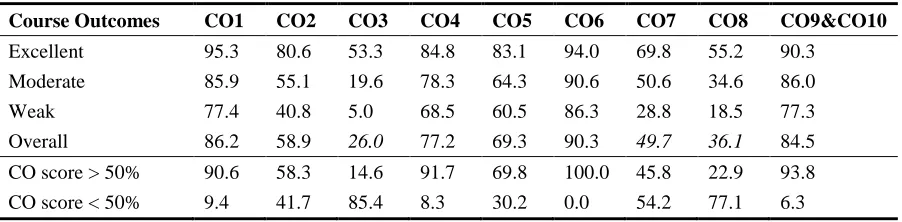
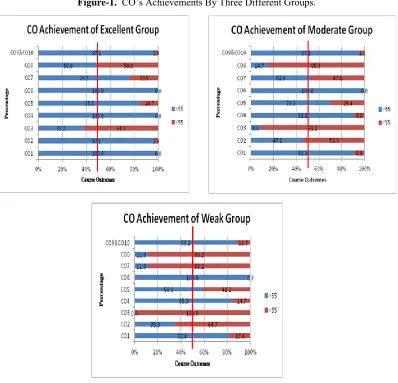
The finding of the study, the average of ten course outcomes for three groups and overall presented in Table 3 and Figure 1. The study also looks into percentage of students obtained above and below 55% of each CO. UNITEN has set 55% as a minimum score for grade C, where the student may retake the course if they obtained grade C- and below. The students who fail the course are compulsory to repeat the course.
Table-3. Achievement of CO
Course Outcomes CO1 CO2 CO3 CO4 CO5 CO6 CO7 CO8 CO9&CO10 Excellent 95.3 80.6 53.3 84.8 83.1 94.0 69.8 55.2 90.3
Moderate 85.9 55.1 19.6 78.3 64.3 90.6 50.6 34.6 86.0
Weak 77.4 40.8 5.0 68.5 60.5 86.3 28.8 18.5 77.3
Overall 86.2 58.9 26.0 77.2 69.3 90.3 49.7 36.1 84.5
CO score > 50% 90.6 58.3 14.6 91.7 69.8 100.0 45.8 22.9 93.8 CO score < 50% 9.4 41.7 85.4 8.3 30.2 0.0 54.2 77.1 6.3
Table 3 shows that three highest scores for excellent group are CO1 (95.3%), CO6 (94%) and CO9 & CO10 (90.3%). Meanwhile, moderate group obtained three highest scores in CO6 (90.6%), CO9 & CO10 (86%) and CO1 (85.9%). The weakest group obtained CO6 (86.3%), CO1 (77.4%) and CO9 & CO10 (77.3%) as their three highest scores. The overall result shows that CO6 (90.3%), CO1 (86.2%) and CO9 & CO10 (84.5%) have been achieved more than 80% by the student. The CO1 and CO6 are two easiest topics in MATB133 and it was expected to have a very good score. However, CO9 & CO10 are an unexpected topic to be performed well by students, and the topic was taught two weeks before final exam.
© 2014 AESS Publications. All Rights Reserved.
Figure-1. CO’s Achievements By Three Different Groups.
© 2014 AESS Publications. All Rights Reserved.
Figure-2. Achievements of CO
5.
CONCLUSION
The studies on achievements COs’ for the course Statistics for Engineers (MATB133), a first year course in Bachelor of civil engineering, Universiti Tenaga Nasional, using the marks of assignments, quizzes, test and final examination. The CO1 and CO6 have the best performance, in which the results are expected because the Bloom's Level of Cognitive Domain for these two COs assessments are at LCD2. Though CO9 and CO10 also having assessment at LCD4, the topics are on linear regression and correlation, which are interrelated and easy to understand. Achievement of the other six COs: CO1, CO4, CO5, CO6, CO9 and CO10 are good since their average scores and the number of students who pass a relatively higher than 55%. CO3 has the lowest average scores compared to the CO where none of the student achieves 55% and above. However, improvement should also be taken by the lecturers such as emphasis on weak topics to overcome poor achievement.
It is suggested for lecturers to focus more on CO3, CO7 and CO8. It is important for lecturers make a greater effort to increase student understanding in the related topics. Lecturers are also urged to employ a different approach in delivering the related topics that might help improving the achievement on these three COs. More assignments need to be given after the lecture class to enhance students' understanding of the related topics. Among other improvements that could be done are: more exercises in the classroom and more frequent short quizzes in order to raise awareness, and give out more group works to get students study in groups. A great effort need to be made to the topics related to CO3, CO7 and CO8 in enhancing students' understanding of the
ALL, CO1, 86.2
ALL, CO2, 58.9
ALL, CO3, 26.0 ALL, CO4, 77.2
ALL, CO5, 69.3 ALL, CO6, 90.3
ALL, CO7, 49.7
ALL, CO8, 36.1 ALL, CO9&CO10,
84.5
EXCELLEN T
MODERA TE WEAK
PERCEN
TAG
E
© 2014 AESS Publications. All Rights Reserved.
probability of random variable in real world problems. It can be done by having a study case that can relate exercise problems to the real world problems.
REFERENCES
Engineering Programme Accreditation Manual, 2012. Document /EAC manual 2012.pdf. Available from
http://www.eac.org.my/web/ [Accessed Feb 18, 2013].
Harden, R.M., 1999. AMEE guide No. 14: Outcome-based education: Part 1-An introduction to outcome-based education. Medical Teacher, 21(1): 7-14.
Huitt, W., 2011. Bloom et al.'s taxonomy of the cognitive domain.Educational psychology interactive. Valdosta, GA: Valdosta State University. Retrieved [Feb 18, 2013]. Available from
http://www.edpsycinteractive.org/topics/cognition/bloom.html.
Rozeha, A.R., Z. Azami and M. Saidfudin.M., 2007. Application of rasch measurement in evaluation of learning outcomes: A case study in electrical engineering. Regional Conference on Engineering Mathematics, Mechanics, Manufacturing & Architecture 2007.
Schalock, R.L., 2001. Outcome-based evaluation. New York: Kluwer Academic/Plenum Publishers.
Wan Hamidon, W.B., 2009. Pendekatan pembelajaran berasaskan hasil. Dalam: Mohamed Amin Embi, 2009. Panduan Amalan Pengajaran dan Pembelajaran Berkesan. Pusat Pembangunan Akademik, UKM. ISBN: 978-967-5048-64-7. pp: 27-42.
\