Type of the Paper (Article)
1
Empowerment and Tech Adoption: Introducing the
2
Treadle Pump Triggers Farmers’ Innovation in
3
Eastern Ethiopia
4
Shimelis Beyene1, Teshome Regassa1*^, Belaineh Legesse2, Martha Mamo1^, Tsegaye Tadesse3^
5
1 Department of Agronomy and Horticulture, University of Nebraska-Lincoln, Lincoln, Nebraska, United
6
States of America; [email protected], [email protected]
7
2 School of Agricultural Economics and Agribusiness Management, College of Agriculture and
8
Environmental Sciences, Haramaya University, Haramaya, Ethiopia; [email protected]
9
3 National Drought Mitigation Center, School of Natural Resources, University of Nebraska-Lincoln,
10
Lincoln, Nebraska, United States of America; [email protected]
11
* Correspondence: [email protected]; Tel.: +x1-402-472-1489
12
^ Daugherty Water for Food Global Institute Faculty Fellow
13
14
Received: date; Accepted: date; Published: date
15
Abstract: In 2013, thirty-eight treadle pumps (TPs) were installed as low-cost technology
16
introduction for small-scale irrigation in eastern Ethiopia. This pilot project also trained six farmers
17
on tube well excavation, installation and maintenance of pumps. In June 2015, researchers visited
18
nine of the 38 TP villages, and found only two functional TPs. The rest were replaced with a new
19
technology developed by the trained farmers. Adopters of the new technology stated that the
20
limited water output and high labor demand of the conventional TP did not optimally fulfil their
21
irrigation water requirements. The new technology had spread quickly to more than one hundred
22
households due to three key factors. First, farmers’ innovative modifications of the initial excavation
23
technique addressed the discharge limitations of the conventional TP by excavating boreholes with
24
wider diameter. Second, local ownership of the new technology, including skills used in well
25
drilling and manufacturing excavation implement, made the new irrigation technology affordable
26
and accessible to the majority of households. Third, this innovation spread organically without any
27
external support, confirming its sustainability. Farmers, empowered by training, gained more
28
control in developing technology options tailored to local needs and conditions of their
29
communities.
30
Keywords: irrigation; technology adoption; farmers’ innovation; diffusion
31
32
1. Introduction
33
In Ethiopia, smallholder farmers contribute to more than 90% of all the agricultural production
34
and cultivate over 96% of the total arable land [1]. Thus, agricultural growth has the potential to
35
contribute not only to food security, but also to poverty reduction and livelihood improvement for
36
the rural population. This is particularly true in light of the high yield gap between potential and
37
the actual agricultural production in Ethiopia [2]. Almost all smallholder farming in Ethiopia is
38
rain-fed [3]. Erratic rainfall and recurrent drought exposes the majority of the rain-fed farming
39
population to food insecurity and perpetual poverty [4], and negatively affect the economy of
40
Ethiopia [5]. Given the rapid population growth and low level of current food production, the
41
country cannot meet its food deficit through rain-fed production alone [6]. Even during relatively
42
good rainfall years, the survival of about 10% of the population depends on external food assistance
43
[7]. Furthermore, climate change is expected to exacerbate extremes in weather patterns and rainfall
44
variability [8]. Paradoxically, the highlands of Ethiopia receive very high amounts of rainfall, with
45
annual runoff volume of up to 122 billion m3 of water from 12 major river basins [3]. The region also
46
possesses an estimated ground water potential of 27 to 40 billion m3 [3,9-11]. However, lack of
47
water storage structures [5], weak water management institutions, and poor implementation of
48
water use and management policies in Ethiopia have limited realization of the economic potential
49
possible from the abundant water resources [12].
50
The government, recognizing the economic and livelihood importance of agriculture, expresses
51
commitment to solve this paradox through an agriculture focused development program that also
52
includes irrigation development as one of the major strategies [13]. Key government documents
53
such as the Water Resources Management Policy [14], Water Sector Strategy [15], and the country’s
54
Growth and Transformation Plans have all emphasized irrigation development as crucial to ensure
55
food security, reduce poverty, and improve the broader national economy [16]. Small-scale
56
irrigation development is widely viewed as having great potential for improving livelihoods of
57
rural households and facilitating adaptation to climate change [17]. As rural households constitute
58
more than 80% of the population [17], significant effort is being made by the Ethiopian government
59
and its development partners to expand irrigated agriculture, including small-scale irrigation [18].
60
Similar to other parts of sub-Saharan Africa [19], data on small-scale irrigation in Ethiopia is
61
very limited [9]. It is estimated that current irrigated area covers only about 5-6% of the total
62
estimated 5 million hectares considered suitable for irrigation [20,11]. The Ethiopian government
63
has introduced new irrigation technologies for small-scale irrigation that includes rainwater
64
harvesting, ponds, hand-dug-wells and stream diversions. Depending on the spatial position of the
65
farm plots and the water sources, farmers are introduced to the use of gravity irrigation, manual
66
water lifting devices, treadle and powered pumps to irrigate their crops [18,21]. Because of the
67
enhanced productivity, relative to rain-fed farming, governmental and non-governmental
68
development actors have invested considerable efforts and resources to support adoption of
69
irrigation by smallholder farmers [18] with some positive results in, both rural poverty reduction
70
and improved technology adoption [22]. However, many researchers observed that the uptake rate
71
of improved agricultural technology is lower than expected due to primarily the top-down
72
approach and coercive nature of agricultural development in general and implementation of
73
extension services in particular [23] contributing to chronic food insecurity in Ethiopia. In order to
74
improve the relationships between farmers and researchers, we designed an empowering approach
75
through participatory action research, which developed pilot projects, based on community stated
76
needs, and assessed the performance of these pilot projects for lessons learnt for improvement,
77
scaling and sustainability.
78
In 2010, we developed a long-term collaborative research program, “Farming, Food and
79
Fitness” (3F), which aimed to develop strategies to enhance agricultural productivity, improve
80
dietary practices and measure the efficacy of these strategies through participatory action research
81
and pilot projects in two of the most drought prone regions in Ethiopia: East Hararghe Zone and
82
South Wollo Zone [24]. Baseline information collected in 2010 and 2011 revealed high demand for
83
access to irrigation among study households. In order to address this high demand through a pilot
84
project, the 3F research program sponsored International Development Enterprise (iDE) Ethiopia to
85
install 38 treadle pumps (TPs) in 2013. This report presents the result of a preliminary assessment of
86
this pilot project. The objectives of the preliminary assessment were to assess outcomes of the pilot
87
project in general and the status of TPs installed by iDE in particular from the farmers’ perspectives.
88
The preliminary assessment had the following research questions. What was the status of the TPs
89
installed by the pilot project? What were the benefits and limitations of the TPs? Why did farmers
90
switched to the new technology? What were the contributing factors for the diffusion of the new
91
technology? What were the outcomes of the pilot project?
92
2. Approach and Methods
94
2.1. Approach
95
This preliminary assessment and the pilot project were part of the long-term multi-disciplinary,
96
collaborative research program, 3F, involving three universities: University of Nebraska-Lincoln in
97
the USA, and Haramaya and Wollo Universities, both in Ethiopia. The partners are engaged in a
98
participatory approach to address agricultural productivity, food security and nutrition in two
99
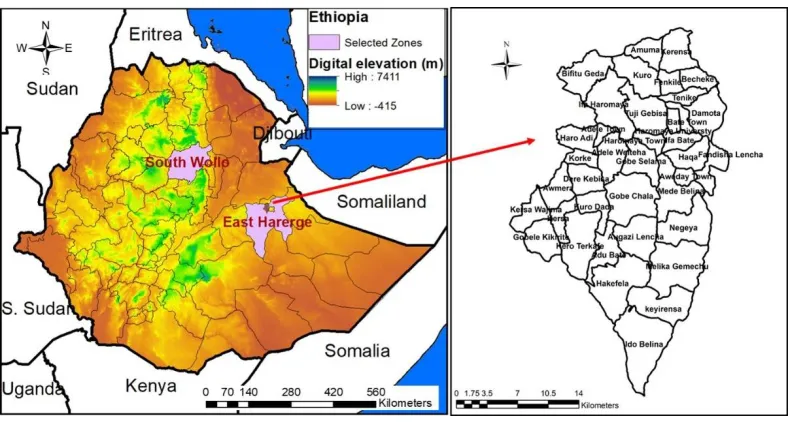
drought prone areas: South Wollo and East Hararghe in Ethiopia (see Figure 2). Qualitative fieldwork
100
and extensive quantitative surveys were conducted in 2010 and 2011, respectively, to provide
101
baseline information for the program [24]. Subsequent fieldwork focusing on small-scale irrigation in
102
Haramaya was carried out in 2012 and 2013 to assess areas suitable for installing TPs for low cost
103
Household Irrigation Technologies (HITs).
104
Between February and June 2013, fifty-five wells were drilled in five Kebeles (sub districts)
105
Haramaya Woreda (district) in East Hararghe as a pilot project to provide HITs (Figure 2). Out of
106
the 55 wells drilled during the pilot project, 38 wells were successful, with sufficient water at
107
appropriate depthfor manual pumps. The remaining 17 wells were unsuitable due to stone
108
impediment, insufficient and/or absence of a permeable layer, and static water level being too deep
109
for manual pumping. This 70% success rate is considered good by international standards [25].
110
Figure 1. Traditional Irrigation Water Extraction (3F Photo Archive)
111
112
113
114
115
116
117
During the pilot project, the area irrigation branch of the ministry of agriculture, in collaboration
118
with Haramaya University and an iDE Ethiopia, trained six individuals in drilling boreholes and
119
installing casings, hoses and pumps. Although the training mainly focused in manual well drilling,
120
it also included skills on well casing installation, maintenance of wells, installation and
121
maintenance of pumps. The trainees, hired as daily laborers during the pilot project, participated in
122
excavating and installing TPs and quickly attained the skills required to maintain the wells and
123
service the equipment for proper function. The TP technology, although very low in capacity, was
124
an improvement over the preexisting farmers’ irrigation practices in the study sites. The pilot
125
project assumption was that TPs, in addition to being low-cost HITs, would also minimize the
126
dependency of local farmers on harvesting water in big and open hand-dug wells, with diameters
127
of up to 20 meters (Figure 1). These wells created large soil disturbances and required costly
128
cleaning, using both human labor and excavators when the water level drops during the dry
129
season, to remove accumulated sediment. Moreover, these open wells pose perpetual danger to
130
human and livestock.
131
After the completion of the pilot project, these trainees, in collaboration with local artisans,
132
were able to locally manufactured replacement parts and excavation tools modified from the
133
original implements. These local entrepreneurs proceeded to install modified technologies based on
134
most influential theories in agricultural technology adoption, the theory of ‘diffusion of
136
innovations’ by Everett Rogers [26] [27], this report investigates the adoption and subsequent fate of
137
the TPs introduced during the pilot project and the diffusion of the new technology in East
138
Hararghe Ethiopia. This theory explains not only how innovations are adopted and spread through
139
a population, but also how they are modified or altered during implementation, providing an
140
appropriate framework for interpretation of the preliminary assessment findings in this report.
141
2.2. Study Areas
142
Haramaya Woreda (district) is located in East Hararghe Zone of Oromia Regional State (Figure
143
2). The capital town, Haramaya, is located about 500 km from Addis Ababa. Haramaya Woreda has
144
33 rural and two urban Kebeles (subdistricts) with a total population of 220,986 [28]. Most of the
145
Kebeles, including those selected for this study, are considered highland and mid-land. The average
146
annual rainfall, based on 25 years of data from the Haramaya meteorological station, shows a mean
147
total annual rain fall of 775 mm [29]. Although the amount and pattern vary locally, rainfall is
148
bimodal in distribution; a short season from March to May is known as belg, and a longer rainy reason
149
from July to September is known as meher. The maximum and minimum mean annual temperatures
150
for the area are 23.8 °C and 9.6 °C respectively [30]. The endowed with high underground water, the
151
woreda is characterized by frequent drought, crop failure, severe land degradation, and increased
152
vulnerability to chronic food insecurity.
153
Figure 2. Map of Ethiopia showing the study areas.
154
155
156
In East Hararghe Zone, Lake Haramaya and shallow, ground water (6 to 30 m deep) in the dry
157
lakebed and catchments provided the opportunity to access irrigation for the households that can
158
afford the irrigation infrastructure [31]. Deep wells, open pits, and ponds were used to access the
159
underground water for irrigating fields (Figures 1). The management of these small-scale irrigation
160
schemes also varied; most are privately owned but large ponds were shared by multiple
161
households. Farmers used furrow and flood irrigation by pumping the water directly to the fields
162
using large hoses, often using motorized pumps. Alternatively, farmers pumped water to a
163
reservoir (3000 to 10000 m3) first and then distributed the water from the reservoir to fields (Figure
164
3). Sometimes, they also have a series of reservoirs and pumps that can take the water more than
165
half a kilometer away from the original source. Irrigation is primarily used for vegetable and high
166
value cash crops in East Hararghe. The major vegetable crops include onion, potato, tomato, carrot,
167
beets, various leafy greens and Khat, a perennial shrub produced for its stimulant leaf and soft buds
168
common to observe a portion of irrigated plot used for the production of subsistence crops during
170
one of the cropping cycles [32].
171
2.2. Data Collection
172
Qualitative data was collected using focus group discussions, key informant interviews and field
173
observations. Before the actual interviews were made, enumerators obtained informed consent from
174
participants. The University of Nebraska Institutional Review Board reviewed and approved the
175
study protocol and all supporting documents (IRB Approval #: 20100710992EP).
176
Focus-Group Discussion: Focus-group discussions (FGD) were conducted with farmers from eight
177
different villages in Haramaya where the TPs were installed. The size of a group differs from village
178
to village ranging from three to nine farmers of mixed gender, as determined by the number of people
179
available in the proximity of their farm plots. Points of discussions covered a wide variety of issues
180
but focused on farmers’ perceptions of TP irrigation experience and impacts (both negative and
181
positive) of TP irrigation. Included in the discussion were topics, such as cropping patterns, use of
182
inputs (seeds, fertilizers, pesticides), concerns and challenges related to irrigation practices and
183
institutions related to water use and management. Also included were questions related to why
184
farmers switched to the new technology, whether or not there are households who abandoned the
185
TP without switching to the new technology, and why as detailed in the Appendix.
186
Key Informant Interview: Key Informant Interviews (KIIs) were held with government officials (4),
187
development agents (2), local well drillers (2), technical experts (1), researchers (2), university officials
188
(4) and local elders (4). The KIIs included semi-structured interviews covering a wide variety of
189
information, depending on the interviewee’s institutional affiliation. It included topics on aggregate
190
data on irrigation, policies and practices related to irrigation development, institutional support to
191
farmers, market-related and natural resource management issues.
192
Field Observation: During farm visits, observations were made on the status of the irrigation
193
schemes, major crop types grown on irrigated fields, cropping patterns (strip or intercropping),
194
cropping cycles, irrigation methods used (flood, furrow or other), climatic impacts (frost), plant pests
195
and disease pressures and use of TP systems and the new technology.
196
3. Results and Discussion
197
3.1. Farmers Perception of Irrigation
198
The majority of farmers in the focus group discussions were enthusiastic about access to
199
irrigation. Farmers who have access to irrigation explained the benefits, but also challenges of access
200
to irrigation. Among the benefits, farmers explained that they were able to cultivate at least two times
201
a year, which would not have been possible without irrigation. In addition, they stated that irrigation
202
enabled them to produce high value crops for the market. This enabled them to generate income to
203
meet some of their financial needs, such as children education, health care services and improved
204
homes. The income generated from TP irrigation, for example, paid for the new technology. The most
205
important outcome in all focus group discussions was that access to irrigation minimized the impacts
206
of drought. They also indicated that access to irrigation improved the wellbeing of not only the
207
households who have access to irrigation but also communities at large due to the social support
208
system of relatives and friends.
209
Farmers that have practiced irrigation for at least two cropping cycles mentioned improved
210
production and increased income. The challenges farmers faced included not realizing the full
211
potential of irrigation agriculture due to limited access to improved seeds and other inputs, price
212
caused economic losses, farmers claimed that irrigation agriculture outperformed rainfed agriculture
214
significantly.
215
3.2. Farmers’ Innovation in East Hararghe
216
Most of the TP component systems installed in 2013 had been partially or entirely replaced by locally
217
modified technology. Farmers stated that the TPs had two primary limitations:
218
1. Limited capacity of water lifting – farmers mentioned that the area that can be irrigated with TP
219
is at most 50 by 50 m, which was too small for most farmers’ needs, especially when they need
220
to expand irrigated fields.
221
2. High demand for labor – farmers explained that the manual operation of the TP required high
222
labor input for the small amount of water output. One of the farmers, who still uses the original
223
TP as his only means of irrigation, stated that he was planning to switch to the new technology.
224
Figure 4. Still Functional Treadle Pump (3F Photo Archive)
225
226
For these two reasons, among the nine TP sites observed during the preliminary assessment,
227
only two were still functional. The other seven had been replaced by locally modified technology.
228
Furthermore, of the two TPs that were still functional, one was being used as a supplement to a new
229
system installed about 5 m away. The second, owned by an elderly farmer, was the only TP still in
230
use as a sole source for household irrigation (Figure 4). During the preliminary assessment, this
231
farmer was planning to switch to the new technology. One of the female farmers who recently moved
232
to the new technology acknowledged the significant impact of the TP. She stated, “the TP enabled
233
me to compete with male farmers” and that she would not be in the position she is now, if she did
234
not have the TP.
235
3.3. Local “Reinvention”: The New Technology
236
As mentioned above during the pilot project, one of the interventions included training selected
237
community members on construction and maintenance of TP systems. The training aimed to build
238
local capacity for maintaining installed TP systems or for installing new TPs if the demand would
239
arise. Although the local demand for access to irrigation was high and the drilling skills acquired by
240
trained farmers was expected to be high, the assumption was that the conventional TPs would spread
241
widely. However, the demand was more for the higher capacity system than what the conventional
242
TP could provide and the newly trained individuals were able to meet this demand through local
243
innovation. This local innovation had four main components: locally manufactured efficient
244
excavation tools, wider diameter boreholes, effective casing and installing pumps. The later three are
245
the direct result of training by the pilot project. However, the first, although inspired by the augur
246
used in the pilot project, was an improved version, in both its diameter and excavating efficiency due
247
to its serrated edges.
248
Well casing
Locally constructed tools: The need to increase the diameter of the well required a different sized
249
drilling tool than the one used originally for TP systems. The trained individuals, in consultation with
250
the local blacksmith, were able to design a more efficient auger with different diameters and serrated
251
edges. These augers, developed locally, were used to excavate wider boreholes to provide a larger
252
volume of water than the TP system could provide, meeting farmer’s demands for higher water
253
volume per unit time.
254
Figure 5. Well Excavation: Traditional (Top) and New Excavation (Bottom).
255
256
Wider diameter of borehole: One of the limitations of the TP technology is the narrow diameter of
257
the well. According to farmers, the TP borehole of 4 cm in diameter was too small to conduct enough
258
water to irrigate more than one plot (an average household plot was about 0.2 ha and households
259
typically have multiple plots). The farmers trained during the pilot project were now able to excavate
260
wells with a diameter of 13 cm, which, depending on the discharge rate of the well, can deliver three
261
times more water than the original TP. This diameter seems optimal for Haramaya households, where
262
the average landholding is about 0.5 hectares [24]. The wide use of underground water raised issues
263
among communities. Farmers revealed their concerns for underground water depletion due to
264
increased extracting of water for irrigation and other purposes. However, they also indicated hope
265
Cost effective casing: One of the major constraints for traditional methods of accessing underground
267
water for irrigation in Haramaya Woreda was the collapsing of well walls, due to the common nitisols
268
soil [33] in Haramaya [33] that easily fall apart. The high diameter of the open pits wells in the woreda
269
minimized wall collapse (Figure 1). The trained farmers were able to innovate using cost effective,
270
plastic casing for the new system to function properly.
271
Between the end of the pilot project in June 2013 and the preliminary assessment in June 2015,
272
community members trained during the pilot project constructed more than 100 new systems.
273
Furthermore, the new system costs 250 to 400 USD. Farmers used to pay more than 1,000 USD for
274
excavation of traditional water pits as in Figure 1. One particularly large water pit, shared by 21
275
individuals, cost nearly 2,000 USD. Traditional water pits are not only expensive to construct and
276
maintain, as the walls cave in frequently, but also take more land that could be used for cultivation.
277
Since the introduction of the TP system, farmers reported doubling crop production. Using the
278
new system, they reported increases in income from an estimated 2,000 USD to 4,500 USD annually
279
(Focus Group Discussion in Tuji Gebissa, June 13, 2015). According to farmers, the new excavation
280
techniques (Figure 5) go deeper, up to 30 meters making more areas available for irrigation, while the
281
initial TP excavation could reach a maximum depth of only 20 meters. The new systems can support
282
up to 10 households, with an average of six individuals per household. This, according to farmers
283
interviewed, is 10 times more than the original TP system. Building the capacity of selected farmers
284
empowers local communities and individuals to think and act in their own interests and to develop
285
irrigation technologies that meet their needs and conditions without the support or direction of
286
external bodies. This confirms the sustainability of the innovation.
287
It may be instructive to see our preliminary observation through the framework of Rogers’
288
diffusion of innovation theory [26] particularly the five attributes that influence the rate of adoption:
289
relative advantage, compatibility, complexity, trialability, and observability. First, with respect to
290
relative advantage, it is clear that both in terms of water output and reduced labor demand, the new
291
technology is considered advantageous over both the TP system it replaced as well as the traditional
292
pit well irrigation system. Second, the technology is consistent with values, experiences and needs of
293
farmers in Haramaya Woreda, where about 60% households were engaged in some form of irrigation
294
prior to the pilot project [24]. Third, the unique aspect of the new technology in Haramaya is that it
295
was a local innovation, which makes the ‘complexity attribute’ [26] negligible. The relatively rapid
296
spread of the innovation is an indication of its ease of use for local farmers. Fourth, regarding
297
trialability, the rapid diffusion of the innovation and the preliminary nature of our study preclude
298
the proper assessment of this attribute. The training of selected farmers and their participation in
299
installing the TP systems can be considered trialing without cost to them. It is also fair to assume that
300
the close social network of farmers in Haramaya would allow the rapid dissemination of information
301
about the nature of the TP as well as the new technology experiences across the woreda and beyond.
302
Finally, in terms of ‘observability’, the results of the new technology will be apparent at least to
303
neighboring farmers immediately. The same mechanism mentioned for rapid dissemination of
304
information mentioned above, would also enhance observability of the results to distant farmers.
305
Moreover, the proximity of the study Kebeles to Haramaya University and Woreda Extension Office,
306
two entities that have an interest in associating with the farmers’ success stories, could have helped.
307
Another insightful contribution by Rogers [26] is the concept of “reinvention” – “the degree to
308
which an innovation is changed or modified by a user in the process of its adoption and
309
implementation” (p. 180). He argues that although experts and development agents do not generally
310
see reinvention as desirable, a higher degree of reinvention often leads to faster rate of adoption as
311
reinvention makes the innovation fit to a broad range of adopters’ conditions [26]. As reinventions
312
enhance the fit between an innovation and adopters’ needs, they are likely to lead to the continued
313
use of the innovation, hence to the sustainability of the innovation [26,32]. Although difficult to
314
not only the rapid diffusion, but also the sustainability of this local innovation. Future studies in East
316
Hararghe may reveal that the reinvention on the TP system also plays a key role in scaling up of the
317
new technology.
318
In East Hararghe, almost all farmers with TP systems have invested in the reinvention and
319
created a new irrigation system. Nevertheless, the new system would not have been possible without
320
the introduction of the TP system in the first place and, in particular, without the training of local
321
farmers on excavating tube wells and installing pump systems. However, without the independent
322
experimentation of the trained farmers (empowerment), the new systems would not have been
323
possible. The local origin of the new technology suggests it will continue to be adopted by farmers
324
until further improvements, which meet the changing needs of farmers, replace it. The local control
325
of this technology suggests it will continue to be sustainable. This has profound implications to
326
adoption and diffusion of agricultural technologies elsewhere. This can be a classic example of
327
capacity building and provision of technology options open enough to empower local communities
328
to shape their own destiny.
329
4. Conclusions
330
Trained farmers, empowered to experiment independently, developed new tools and came up
331
with sustainable solutions tailored to the local needs. The breakthrough and the missing link from
332
the traditional irrigation schemes in Haramaya Woreda to the pilot project was the introduction of
333
the controlled excavation technique. Compared to the traditional hand excavation, the new
334
excavation technique was more efficient in reducing cost, labor and the land area needed for
335
construction of the system, which enhanced its comparative advantage. The introduction of
336
controlled excavation, now wide spread in the study areas, led to innovative modifications of the
337
initial TP technology to satisfy the needs and aspiration of the farmers. The major impact of the new
338
technology is that it made irrigation affordable and accessible to a large number of households and
339
enabled many farmers to accumulate enough resources to diversify their livelihoods into off-farm
340
activities. It is not, therefore, surprising to see the rapid diffusion of the new technology. Local
341
capacity for installing and maintaining the whole irrigation structure and for fabricating tube well
342
excavating tools ensures sustainability of the innovation. A more detailed study is necessary to gain
343
more insights into the nuances of this successful case of technology introduction, reinvention
344
(innovative modification) and diffusion for possible replication in other sites with similar
345
conditions.
346
347
Acknowledgments: We gratefully acknowledge financial support from Daugherty Water for Food Global
348
Institute at University of Nebraska-Lincoln and in-kind support of Haramaya University. We thank our partners
349
at Haramaya University, Haramaya Woreda officials, and iDE Ethiopia for their time and commitment. We are
350
also grateful for all the farm households who took their time to respond to our interviews.
351
352
Conflicts of Interest: The authors declare no conflict of interest
353
354
References
355
1. Taffesse, A., Dorosh, P. and Gemessa, S. Crop Production in Ethiopia: Regional Patterns
356
and Trends. In Food and agriculture in Ethiopia: Progress and policy challenges, Dorosh, P.
357
and Rashid, S., Eds.; University of Pennsylvania Press: Philadelphia, PA, USA 2013; pp. 53–
358
83. https://doi.org/10.2499/9780812245295 (Accessed on 23 April 2018)
359
2. Licker, R.; Johnston, M.; Foley, J.; Barford, C.; Kucharik, C.; Monfreda, C.; Ramankutty, N.
360
croplands around the world? Global Ecol. Biogeogr. 2010, 19, 769–782.
362
3. Awulachew, S.B.; Yilma, A.D.; Loulseged, M.; Loiskandl, W.; Ayana, M.; Alamirew, T.
363
Water Resources and Irrigation Development in Ethiopia. Colombo, Sri Lanka:
364
International Water Management Institute. Working Paper 123, 2007.
365
4. Chemeda, E.D.; Babel, M.S.; Gupta, A.D.; Seleshi, B.A.; Merrey, D. Farmers’ Perception of
366
Water Management under Drought Conditions in the Upper Awash Basin, Ethiopia. Int. J.
367
Water Res. D. 2006, 22(4), 589–602. DOI: 10.1080/07900620600779723 (Accessed on 30 July
368
2018).
369
5. World Bank. Ethiopia: Managing water resources to maximize sustainable growth. A
370
World Bank water resources assistance strategy for Ethiopia. The World Bank Agriculture
371
and Rural Development Department. Report No. 36000-ET. Washington, DC, USA, 2006.
372
6. Devereux, S. Food insecurity in Ethiopia: A discussion paper for DFID. IDS: Sussex: England;
373
2000, pp. 1-18. Available online: https://www.ids.ac.uk/files/FoodSecEthiopia4.pdf.
374
(accessed on 25 April 2018)
375
7. Diouf, J., Sheeran, J. The State of Food Insecurity in the World: Addressing food insecurity in
376
protracted crises. Rome: World Food Program (WFP) and Food and Agriculture
377
Organization of the United Nations (FAO) Joint Report. 2010.
378
8. Conway, D.; Schipper, E. Adaptation to climate change in Africa: Challenges and
379
opportunities identified from Ethiopia. Global Environ. Chang. 2011, 21, 227–237.
380
9. Makombe, G.; Kelemework, D.; Aredo, D. A comparative analysis of rainfed and irrigated
381
agricultural production in Ethiopia. Irrig.Drainage Syst. 2007, 21, 35–44.
382
10. MoWIE (Ministry of Water, Irrigation and Energy).Water Resources of Ethiopia. The
383
National and International Perspective, Awareness Creation Program prepared for Public
384
Relation officials, Addis Ababa, Ethiopia, 2013.
385
11. Semu, M. Agricultural Use of Ground Water in Ethiopia: Assessment of Potential and
386
Analysis of Economics, Policies, Constraints and Opportunities. AgWater Solutions Project
387
Case Study IWMI, 2012.
388
12. Mosello, B.; Calow, R.; Tucker, J.; Parker, H.; Alamirew, T.; Kebede, S.; Alemseged, T.;
389
Gudina, A. Building adaptive water resources management in Ethiopia. ODI Report,
390
London: ODI, 2015. Available online: https://www.odi.org/ (accessed 10 February 2018).
391
13. GTP I. Growth and Transformation Plan (GTP) 2010/11-2014/15. Ministry of Finance and
392
Economic Development (MoFED), Addis Ababa, Ethiopia, 2010.
393
14. MoWR (Ministry of Water Resources). Water Resources Management Policy. Federal
394
Democratic Republic of Ethiopia, Addis Ababa, Ethiopia, 1998.
395
15. MoWR (Ministry of Water Resources). Irrigation Development Strategy (Component of the
396
Water Sector Development Strategy). National Planning Commission Draft Report. Addis
397
Ababa, Ethiopia, 2001.
398
16. NPC. The second growth and transformation plan (GTP II) (2015/16-2019/20). National
399
Planning Commission, Ethiopia, 2015.
400
17. Burney, J.; Naylor, R.; Postel, S. The case for distributed irrigation as a development priority
401
in sub-Saharan Africa. Proceedings of the National Academy of Sciences of the United States of
402
America (PNAS). 2013, 110(31), 12513-12517.
403
in Werii Watershed, Tekeze River Basin, Ethiopia; Application of Climate Downscaling
405
Model. J. Earth Sci. & Clim. Change. 2015, Jan 1:6(8), 1-11. Doi: 10.4172/2157-7617.1000300
406
19. Woodhouse, P.; Veldwisch, G.; Venot, J.; Brockington, D.; Komakech, H.; Manjichi, A.
407
African farmer-led irrigation development: re-framing agricultural policy and investment?
408
J. Peasant Stud. 2017, Jan 2;44(1), 213-233.
409
20. Awlachew, S.B.; Ayana, M. Performance of irrigation: An assessment at different scales in
410
Ethiopia. Exp. Agr. 2011, Jan;47(S1), 57-69.
411
21. Dessalegn, M.;Merrey. D. Motor pump revolution in Ethiopia: Promises at a crossroads.
412
Water Altern. 2015 Jun 1;8(2), 237-57.
413
22. Dercon, S.; Gilligan, D.; Hoddinott, J.; Waldehanna, T. The Impact of Roads and
414
Agricultural Extension on Consumption Growth and Poverty in Fifteen Ethiopian Villages.
415
Amer. J. Agr. Econ. 2009, Nov;91(4), 1007–1021
416
23. Berhanu, K.; Poulton, C. The Political Economy of Agricultural Extension Policy in
417
Ethiopia: Economic Growth and Political Control. Development Policy Review. 2014, 32(s2), s197–
418
s213.
419
24. Beyene, S.; Regassa, T.; Legesse, B.; Mamo, M.; Willis, M.S.; Tadesse, T.; Woldehawariat, Y.
420
Rural livelihoods in drought prone areas of East Hararghe and South Wollo, Ethiopia:
421
Surviving or thriving? PLOoS One (Under Review).
422
25. Holistic Approach to Sustainable Food Security through Adaptive Eco-Region Based
423
Watershed Management in Ethiopia. International Development Enterprise (IDE) Final
424
Report. 2013. Addis Ababa, Ethiopia.
425
26. Rogers, E. Diffusion of Innovations, 5th ed. A Division of Macmillan Publishing Co Inc. The
426
Free Press: New York. New York, 2003.
427
27. Ansari, S.; Fiss, P.; Zajac, E. Made to Fit: How Practices Vary as They Diffuse. Acad. Mgmt.
428
Rev. 2010, Jan;35(1), 67-92.
429
28. Central Statistical Agency (CSA). Statistical Oromiya. Central Statistical Agency of Ethiopia,
430
Addis Ababa, Ethiopia, 2007. http://catalog.ihsn.org/index.php/catalog/3583 (Accessed on
431
25 March 2018).
432
29. Alemayehu, T.; Furi, W.; Legesse. D. Impact of water overexploitation on highland lakes of
433
eastern Ethiopia. Environ. Geol. 2007, Mar 1;52(1), 147-154.
434
30. Tadesse, N. and Abdul Aziz, M. Water Balance of Haromaya Watershed, Oromiya Region,
435
Eastern Ethiopia. Int.l J. Earth Sci. Eng. 2009, 2(06), 484-498.
436
31. Senti, E.; Tufa, B.;, Gebrehiwot, K. Soil erosion, sediment yield and conservation practices
437
assessment on Lake Haramaya Catchment. World J. Agricul.l Sci. 2014, Nov;2(7), 186-193.
438
32. Setegn, S.; Chowdary, V.M.; Mal, B.C., Yohannes, F., Kono, Y. Water Balance Study and
439
Irrigation Strategies for Sustainable Management of a Tropical Ethiopian Lake: A Case
440
Study of Lake Alemaya. Water Res. Manage. 2011, Jul 1;25(9), 2081-2107.
441
33. Asad, Z.; Adem, D.; Farah, A. Evaluation of the existing conservation practices on Lake