1NP-Group, Inter University Accelerator Centre, New Delhi - 110 067, India 2Department of Physics, Aligarh Muslim University, Aligarh 202 002, India
3Department of Physics, Indian Institute of Technology Ropar, Punjab 140 001, India 4Physics Department, S. V. College, Aligarh - 202 001, India
5Department of Physics, University of Petroleum and Energy Studies, Dehradun - 248 007, India
Abstract.Present work deals with the experimental studies of incomplete fusion reaction dynamics at ener-gies as low as≈4 - 7 MeV/A. Excitation functions populated via complete fusion and/or incomplete fusion
processes in12C+175Lu, and13C+169Tm systems have been measured within the framework of PACE4 code. Data of excitation function measurements on comparison with different projectile-target combinations suggest
the existence of ICF even at slightly above barrier energies where complete fusion (CF) is supposed to be the sole contributor, and further demonstrates strong projectile structure dependence of ICF. The incomplete fusion strength functions for12C+175Lu, and13C+169Tm systems are analyzed as a function of various physical pa-rameters at a constant vrel≈0.053c. It has been found that one neutron (1n) excess projectile13C (as compared to12C) results in less incomplete fusion contribution due to its relatively large negativeα-Q-value, hence,α Q-value seems to be a reliable parameter to understand the ICF dynamics at low energies. In order to explore the reaction modes on the basis of their entry state spin population, the spin distribution of residues populated via CF and/or ICF in16O+159Tb system has been done using particle-γcoincidence technique. CF-αand ICF-α channels have been identified from backward (B) and forward (F)α-gatedγspectra, respectively. Reaction dependent decay patterns have been observed in differentαemitting channels. The CF channels are found to be fed over a broad spin range, however, ICF-αchannels was observed only for high-spin states. Further, the existence of incomplete fusion at low bombarding energies indicates the possibility to populate high spin states.
1 Introduction
The study of breakup of heavy ions followed by the fu-sion of one of the fragments with the target has gained a resurgent interest. Several authors reported the competi-tion of complete fusion (CF) and incomplete fusion (ICF) reactions at energies slightly above the Coulomb barrier [1–10], and a substantial ICF fraction has been observed at these energies. In general, the complete fusion (CF) process is considered to be the sole contributor to the to-tal fusion cross section at low energies i.e. starting from threshold to 7 MeV/A.
Though, several studies and models [11–18] are de-veloped to understand ICF phenomenon, but the dynamics of ICF at low incident energies is still not fairly under-stood and thus continues to be an active area of investiga-tions. High quality data for ICF processes has been ob-tained and reported so far worldwide [1–8, 19, 20], and conclusively demonstrate the low energy ICF, but are lim-ited only for a few projectile-target combinations. There-fore, for better understanding of ICF dynamics, several inclusive experiments at the Inter-University Accelerator
e-mail: [email protected] e-mail: [email protected]
Center (IUAC), New Delhi, India were performed by our group [5, 7, 8, 21, 22]. Based on experimental findings an attempt has been made to correlate data with suitable set of physical parameters viz., (a) projectile energy, (b) mass-asymmetry of interacting partners (µ), (c)α-Q value, and (d) inputvalues. In the present work, the percentage fraction of ICF were deduced from the analysis of experi-mental excitation functions of individual reaction residues for different projectile-target combinations. This suggests
at the studied energy regime projectile structure plays an important role to understand ICF dynamics. To understand the role ofvalues, a particle-γcoincidence experiments were performed and spin distribution of individual reac-tion residues have been measured. The spin distribureac-tion of various evaporation residues reveals that the mean input angular momenta (<>) associated with the ICF observ-able are found to be higher than those involved with CF. Further, the occurrence of ICF is due to the influence of centrifugal potential in peripheral interactions, where driv-ing angular momentum limits do not allow CF to occur.
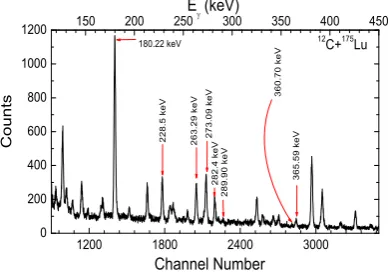
en-Figure 1. (Color online) Typicalγ-ray spectrum of12C+175Lu interaction at≈78.36±1.08 MeV
trance channel parameters are demonstrated. Summary of the present work is given in Section 4.
2 Experimental details
To explore the dynamics of incomplete fusion reaction processes, experiments were performed using 15 UD pel-letron accelerator of Inter University Accelerator Centre (IUAC), New Delhi, India. These experiments were per-formed using two different setups (a) General Purpose
Scattering Chamber (GPSC) and (b) Gamma Detector Ar-ray (GDA) coupled with Charged Particle Detector ArAr-ray (CPDA). The detailed methodology and experimental se-tups have been discussed in refs.[5, 7, 21, 22]. However, a short account of experimental conditions are given here for the ready reference.
In order to achieve information on the behavior of frac-tion of ICF observable on various entrance channel param-eters, the value of incomplete fusion fraction (FICF) has been deduced as a function of various physical parameters (discussed in sec 3) in a separate set of experiment. In this experiment, absolute production cross-sections of in-dividual reaction residues populated via CF and/or ICF in
12C+175Lu, and13C+169Tm systems have been measured
at energies starting from threshold to 7 MeV/A [7, 23].
The target foils of isotopically pure (99.9%) 175Lu, and 169Tm along with in 27Al catchers were prepared using
rolling technique. The thickness of the samples were de-termined from the observed change in the energy of theα -particles by using stopping power values and were found to≈1.5 to≈2.5 mg/cm2for both targets and≈1.0 to≈3.0
mg/cm2 for Al-catchers. The thickness of the Al-catchers
was chosen keeping in view the fact that even the most en-ergetic residues produced due to the complete momentum transfer may be trapped in the catcher thickness. The ir-radiation has been carried out with a beam current≈2-3 pnA. The evaporation residues (ERs) produced during the irradiations were counted off-line with two pre-calibrated
HPGe detectors. The ERs have been identified by their characteristicγ-lines and are further confirmed by decay-curve analysis. A part ofγ-ray spectra obtained at ELab
= 78.36± 1.08 MeV in 12C+175Lu system is shown in
Figure 2. (Color online) Typical decay curve of 183Ir residue observed in12C+175Lu interaction at≈78.36±1.08 MeV beam energy.
Fig.1. Some of the peaks corresponding to different
re-action residues are marked. As a typical example, the ob-served decay curve for one of the Iridium isotopes183Ir
(T1/2 =57 min) populated in12C+175Lu system is shown
in Fig. 2. Further, the production cross-sections (σR) of ERs have been calculated using standard formulation [23]. The overall errors in the present measurement are estimated to be ≈ 10%. A detailed discussion on error analysis is presented in Refs. [24].
To probe the role of-values in the onset of ICF at low projectile energies, the spin-distributions (SDs) of xn/pxn/αxn channels has been measured in 16O+159Tb
system using particle-γcoincidence technique. The exper-iment was performed at four set of projectile energies viz.
≈83.5±1.5, 88.5±1.5, 93.5±1.5 and 97.6±1.4 MeVs, using GDA alongwith CPDA facility of IUAC, New Delhi, India. The particle-γcoincidences were recorded using 12 Compton suppressed, high resolution HPGe detectors in-stalled at an angles 450, 990, 1530with respect to the beam
axis in Gamma Detector Array (GDA). It may be men-tioned that there were four detectors at each of these angles in GDA set up. Further, the GDA set up is coupled with the Charge particle detector array (CPDA) which is a set of 14-phoswich detectors housed in a 14 cm diameter scattering chamber. These particle detectors cover nearly 90% of the total solid angle. All 14 detectors of CPDA have been di-vided into the angular zones viz.; (i) Forward angle (F) 100
to 600, (ii) Sideways (S) 600to 1200, and (iii) Backward
angle (B) 12001700. Depending on the fast and slow
com-ponents of the CPDA, proton andα-particles in each angu-lar ring can be identified. For the experiment, isotopically pure, self-supporting 159Tb (100%) target of thickness ≈ 1.5 mg/cm2 (prepared by rolling technique) has been
bombarded with16O+7 beams delivered from 15UD Pel-letron Accelerator. A promptγ-ray spectra was recorded in event-by-event multi parameter mode, which includes different coincidences i.e. particles (Z=1,2) detected in
backward (B), forward (F) and 900 (S)-angles. Singles
(pro-Figure 1. (Color online) Typicalγ-ray spectrum of12C+175Lu interaction at≈78.36±1.08 MeV
trance channel parameters are demonstrated. Summary of the present work is given in Section 4.
2 Experimental details
To explore the dynamics of incomplete fusion reaction processes, experiments were performed using 15 UD pel-letron accelerator of Inter University Accelerator Centre (IUAC), New Delhi, India. These experiments were per-formed using two different setups (a) General Purpose
Scattering Chamber (GPSC) and (b) Gamma Detector Ar-ray (GDA) coupled with Charged Particle Detector ArAr-ray (CPDA). The detailed methodology and experimental se-tups have been discussed in refs.[5, 7, 21, 22]. However, a short account of experimental conditions are given here for the ready reference.
In order to achieve information on the behavior of frac-tion of ICF observable on various entrance channel param-eters, the value of incomplete fusion fraction (FICF) has been deduced as a function of various physical parameters (discussed in sec 3) in a separate set of experiment. In this experiment, absolute production cross-sections of in-dividual reaction residues populated via CF and/or ICF in
12C+175Lu, and13C+169Tm systems have been measured
at energies starting from threshold to 7 MeV/A [7, 23].
The target foils of isotopically pure (99.9%) 175Lu, and 169Tm along with in27Al catchers were prepared using
rolling technique. The thickness of the samples were de-termined from the observed change in the energy of theα -particles by using stopping power values and were found to≈1.5 to≈2.5 mg/cm2for both targets and≈1.0 to≈3.0
mg/cm2for Al-catchers. The thickness of the Al-catchers
was chosen keeping in view the fact that even the most en-ergetic residues produced due to the complete momentum transfer may be trapped in the catcher thickness. The ir-radiation has been carried out with a beam current≈2-3 pnA. The evaporation residues (ERs) produced during the irradiations were counted off-line with two pre-calibrated
HPGe detectors. The ERs have been identified by their characteristicγ-lines and are further confirmed by decay-curve analysis. A part ofγ-ray spectra obtained at ELab
= 78.36± 1.08 MeV in 12C+175Lu system is shown in
Figure 2. (Color online) Typical decay curve of 183Ir residue observed in12C+175Lu interaction at≈78.36±1.08 MeV beam energy.
Fig.1. Some of the peaks corresponding to different
re-action residues are marked. As a typical example, the ob-served decay curve for one of the Iridium isotopes 183Ir
(T1/2 =57 min) populated in12C+175Lu system is shown
in Fig. 2. Further, the production cross-sections (σR) of ERs have been calculated using standard formulation [23]. The overall errors in the present measurement are estimated to be ≈ 10%. A detailed discussion on error analysis is presented in Refs. [24].
To probe the role of-values in the onset of ICF at low projectile energies, the spin-distributions (SDs) of xn/pxn/αxn channels has been measured in 16O+159Tb
system using particle-γcoincidence technique. The exper-iment was performed at four set of projectile energies viz.
≈83.5±1.5, 88.5±1.5, 93.5±1.5 and 97.6±1.4 MeVs, using GDA alongwith CPDA facility of IUAC, New Delhi, India. The particle-γcoincidences were recorded using 12 Compton suppressed, high resolution HPGe detectors in-stalled at an angles 450, 990, 1530with respect to the beam
axis in Gamma Detector Array (GDA). It may be men-tioned that there were four detectors at each of these angles in GDA set up. Further, the GDA set up is coupled with the Charge particle detector array (CPDA) which is a set of 14-phoswich detectors housed in a 14 cm diameter scattering chamber. These particle detectors cover nearly 90% of the total solid angle. All 14 detectors of CPDA have been di-vided into the angular zones viz.; (i) Forward angle (F) 100
to 600, (ii) Sideways (S) 600 to 1200, and (iii) Backward
angle (B) 12001700. Depending on the fast and slow
com-ponents of the CPDA, proton andα-particles in each angu-lar ring can be identified. For the experiment, isotopically pure, self-supporting 159Tb (100%) target of thickness ≈ 1.5 mg/cm2 (prepared by rolling technique) has been
bombarded with16O+7 beams delivered from 15UD Pel-letron Accelerator. A promptγ-ray spectra was recorded in event-by-event multi parameter mode, which includes different coincidences i.e. particles (Z=1,2) detected in
backward (B), forward (F) and 900 (S)-angles. Singles
data have also been collected to identify xn-channels
(pro-tra. The intensity and area under the photo-peak (effi
-ciency corrected) of the characteristic promptα-transitions were used to determine the relative production yield [21]
3 Projectile Dependence of ICF: Recent
Results
In the present work, a systematic investigation have been done to understand the effect of various entrance channel
parameters (i.e. projectile energy, entrance channel mass-asymmetry of interacting partners, α-Q-value, and input -values) on the onset and strength of incomplete fusion. Interpretation of the data and results are presented in this section.
3.1 ICF dependence on incident energy
The excitation functions (EFs), expected to be popu-lated via CF and/or ICF mode have been measured for
12C+175Lu, and 13C+169Tm systems at energies starting
from the Coulomb barrier to 7 MeV/A and analyzed in the
framework of statistical model code PACE4 to probe the energy dependence of ICF. Details of code PACE4 can be found in ref. [25]. In this code, the nuclear level density (a=A/K) plays an important role which can be tuned to
fit the experimental data. In order to choose the suitable value of level density to reproduce fusion EFs, different
values of K =8 - 12 have been tested. The evaporation
residues (ERs) populated via xn/pxnchannels have been
found to be in good agreement with that estimated from code PACE4. On the other hand, the experimental EFs of α-emitting channels have been found to be significantly enhanced as compared to the PACE4 predictions. This en-hanced value ofαERs may be attributed to ICF. To have the enhanced value of ERs (i.e. ICF contribution), exper-imental EFs ofα-emitting channels were subtracted from the PACE4 values (σICF =σexp-σPACE4) [25]. For
bet-ter insight into the onset and strength of ICF, the percent-age fraction of ICF (FICF) has been deduced and is plotted as a function of projectile relative velocity (vrel) [5] for
12C+175Lu,13C+169Tm and12C+169Tm systems in Fig.3.
It may be mentioned that FICFdefines empirical probabil-ity of ICF.
As shown in this figure, the FICF increases linearly with normalized projectile energies in terms of relative ve-locity of projectile (i.e., vrel). This suggests strong pro-jectile energy dependence of ICF reactions. On the other
Figure 3. (Color online) The percentage fraction of ICF as a function of projectile relative velocity (vrel) for 12C+175Lu, 12C+169Tm and13C+169Tm systems
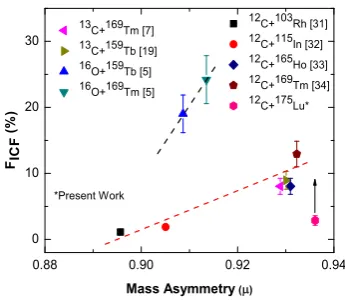
Figure 4. (Color online) The percentage fraction of ICF as a function ofµfor 9 projectile-target combinations at a constant value of vrel≈0.053c. Dashed lines are drawn to guide the eyes.
hand, Morgenstern systematics [26, 27] suggests that ICF contributes significantly above vrel≥0.06 (6 % speed of light). However, in figure 3, the values of vrel are in the range from≈2.7 % of c to≈7.8 % of c for12C+175Lu,
and 12C+169Tm systems and from 2.3 % of c to 7.0 %
of c for13C+169Tm system. Hence, the results presented
in Fig.3 clearly demonstrate the onset of ICF at relatively lower value of vrel i.e. FICF is significant at well below the proposed onset value of vrel. Further, for the same tar-get the value of FICFfor12C-projectile is lower than13 C-projectile for the entire measured energy range. The dif-ference in FICFfor two systems (12C,13C+169Tm ) clearly points towards projectile structure and/or mass asymmetry
effect on ICF.
3.2 Projectile structure dependence of ICF
To understand projectile structure and/or mass asymmetry
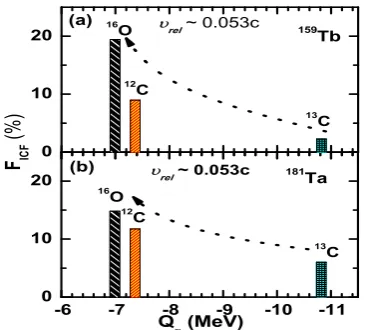
Figure 5.(Color online) Comparison of FICF on the basis ofα -Q value of the projectile at a constant vrel=0.053c for different
projectile-target combinations
7 projectile-target combinations are plotted as a function of mass asymmetry at a constant value of vrel ≈ 0.053 in Fig.4. In order to understand projectile dependence on ICF more conclusively, data for the16O projectile is also
added. It may be pointed out that12C,13C and16O are
widely different projectiles and hence the probability of
breakup depends on the input-values imparted into sys-tem in peripheral interactions. As can be seen from Fig.4, the Morgensterns systematics does not explain the varia-tion of FICFwithµfor given systems. However, the value of FICF increases withµfor12C,13C projectiles and indi-vidually for16O projectile. It is interesting to note that the 12C,13C+169Tm systems is a more mass asymmetric (µ≈
0.9337) system than16O+169Tm system (µ≈0.9135), but
the value of FICF is≈18 % higher than that observed for
12C,13C+169Tm system. The aforementioned observations
based on 9 projectile-target combinations strongly contra-dict Morgensterns mass-asymmetry systematics, and sug-gest strong projectile dependence of ICF for alpha cluster projectiles. However projectile dependence of mass asym-metry is valid for same atomic number and different mass
number projectiles (i.e.12C,13C, etc. on the same target) is
a question of interest. As can be seen in Fig 3 the values of FICFfor the13C projectile are less than for the12C projec-tile in the studied energy range. The difference in FICFfor two systems (12C,13C+169Tm) is clearly evident, and
indi-cates the strong projectile dependence of FICF with some physical parameter other thanµ. In order to explore this issue, the ICF strength functions for12C,13C+169Tm
sys-tems have been studied in terms of projectileα-Q value.
3.3 Projectileα-Q value dependence of ICF
The percentage fraction of ICF is analyzed in terms of pro-jectileαQ-value for 6 projectile-target combinations. The value of FICF is plotted as a function of Qα in Fig.5(a-b) at a constant vrel ≈0.053c. As shown in this figure, the probability of ICF for the 13C projectile is smaller than
that for the12C projectile. This clearly point towards the
Figure 6. (Color online) Experimentally generated spin-distributions ofα3n-(B), andα3n-(F) channels. Lines and curves are the best fit to the experimental data points.
projectile structure effect. It may be pointed out that12C
is a well knownα-cluster nucleus withQα=-7.37 MeV. However, 13C has a largerQ
α (=-10.64 MeV) than12C. The higherα Q-value for13C translates into the smaller breakup probability into constituent α-clusters, resulting smaller ICF fraction than that found in12C induced
reac-tions. In order to strengthenα Q-value dependence, the value of FICFfor the16O (Qα=-7.16 MeV)+159Tb system is found to be 18% which is reduced to only 3% for the
13C (Q
α=-10.64 MeV)+159Tb system. Similar trend was observed for the181Ta target. Hence, from the data
pre-sented in this figure, it can be inferred that theαQ-value is an important entrance channel parameter which essen-tially dictates the probability of ICF.
3.4 dependence of ICF
In order to understand the physics of angular momentum involvement and de-excitation pattern of any residual nu-clei, the spin distribution of various CF and ICF chan-nels have been measured for 16O+159Tb system at
labo-ratory energies (Elab) ≈83.5±1.5, 88.5±1.5, 93.5±1.5 and 97.6±1.4 MeV with beam intensities of≈4-6 pnA. It is expected that in case of CF residues (high E∗and low)
the de-excitation pattern are more likely as statistical tran-sitions, on the other hand, the ICF residues achieve low E∗
(due to the involvement of partial degrees of excitations) and high(relatively higher values of impact parameters contribute to the high spin states) at a given projectile en-ergy, therefore, the number of yrast - like transitions are much larger than that of statistical ones.
In view of the above, a comparison of the spin distribu-tion pattern for theα3n channel (168Lu) populated via both
CF mode (→identified in the backward (B)α-gated spec-tra) and ICF mode (→identified in the forward (F)α-gated spectra) are plotted in Fig.6. As shown in this figure, there is a difference in the spin-distributions which indicate the
involvement of entirely different mode of reactions in the
(B)-Figure 5.(Color online) Comparison of FICFon the basis ofα -Q value of the projectile at a constant vrel=0.053c for different
projectile-target combinations
7 projectile-target combinations are plotted as a function of mass asymmetry at a constant value of vrel ≈ 0.053 in Fig.4. In order to understand projectile dependence on ICF more conclusively, data for the16O projectile is also
added. It may be pointed out that12C,13C and16O are
widely different projectiles and hence the probability of
breakup depends on the input-values imparted into sys-tem in peripheral interactions. As can be seen from Fig.4, the Morgensterns systematics does not explain the varia-tion of FICFwithµfor given systems. However, the value of FICF increases withµfor12C,13C projectiles and indi-vidually for16O projectile. It is interesting to note that the 12C,13C+169Tm systems is a more mass asymmetric (µ≈
0.9337) system than16O+169Tm system (µ≈0.9135), but
the value of FICF is≈18 % higher than that observed for
12C,13C+169Tm system. The aforementioned observations
based on 9 projectile-target combinations strongly contra-dict Morgensterns mass-asymmetry systematics, and sug-gest strong projectile dependence of ICF for alpha cluster projectiles. However projectile dependence of mass asym-metry is valid for same atomic number and different mass
number projectiles (i.e.12C,13C, etc. on the same target) is
a question of interest. As can be seen in Fig 3 the values of FICFfor the13C projectile are less than for the12C projec-tile in the studied energy range. The difference in FICFfor two systems (12C,13C+169Tm) is clearly evident, and
indi-cates the strong projectile dependence of FICF with some physical parameter other thanµ. In order to explore this issue, the ICF strength functions for12C,13C+169Tm
sys-tems have been studied in terms of projectileα-Q value.
3.3 Projectileα-Q value dependence of ICF
The percentage fraction of ICF is analyzed in terms of pro-jectileαQ-value for 6 projectile-target combinations. The value of FICFis plotted as a function of Qαin Fig.5(a-b) at a constant vrel ≈0.053c. As shown in this figure, the probability of ICF for the 13C projectile is smaller than
that for the12C projectile. This clearly point towards the
Figure 6. (Color online) Experimentally generated spin-distributions ofα3n-(B), andα3n-(F) channels. Lines and curves are the best fit to the experimental data points.
projectile structure effect. It may be pointed out that12C
is a well knownα-cluster nucleus withQα=-7.37 MeV. However, 13C has a largerQ
α (=-10.64 MeV) than12C. The higher αQ-value for13C translates into the smaller breakup probability into constituent α-clusters, resulting smaller ICF fraction than that found in12C induced
reac-tions. In order to strengthen αQ-value dependence, the value of FICFfor the16O (Qα=-7.16 MeV)+159Tb system is found to be 18% which is reduced to only 3% for the
13C (Q
α=-10.64 MeV)+159Tb system. Similar trend was observed for the181Ta target. Hence, from the data
pre-sented in this figure, it can be inferred that theαQ-value is an important entrance channel parameter which essen-tially dictates the probability of ICF.
3.4 dependence of ICF
In order to understand the physics of angular momentum involvement and de-excitation pattern of any residual nu-clei, the spin distribution of various CF and ICF chan-nels have been measured for 16O+159Tb system at
labo-ratory energies (Elab) ≈83.5±1.5, 88.5±1.5, 93.5±1.5 and 97.6±1.4 MeV with beam intensities of≈4-6 pnA. It is expected that in case of CF residues (high E∗and low)
the de-excitation pattern are more likely as statistical tran-sitions, on the other hand, the ICF residues achieve low E∗
(due to the involvement of partial degrees of excitations) and high(relatively higher values of impact parameters contribute to the high spin states) at a given projectile en-ergy, therefore, the number of yrast - like transitions are much larger than that of statistical ones.
In view of the above, a comparison of the spin distribu-tion pattern for theα3n channel (168Lu) populated via both
CF mode (→identified in the backward (B)α-gated spec-tra) and ICF mode (→identified in the forward (F)α-gated spectra) are plotted in Fig.6. As shown in this figure, there is a difference in the spin-distributions which indicate the
involvement of entirely different mode of reactions in the
production of these residues. The intensity of α3n
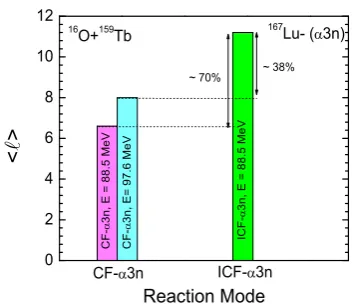
(B)-Figure 7.(Color online) The value of the mean angular momenta i.e., the value of<>deduced from the best fitting procedure of spin distributions [21] involved in167Lu isotope populated via CF and ICF processes as a function of modes of reaction.
channels (CF residues) falls off rather quickly with
ob-served spin (Jobs), indicating strong feeding and/or broad spin population during the de-excitation of CN. However, forα3n (F)-channels (ICF residues), the intensity appears to be almost constant up to a certain value of Jobs, and then decreases towards band head. This indicates the absence of feeding to the lowest members of the Yrast band and/or
the population of low spin states are strongly hindered in ICF-channels.
Concerning the usefulness of incomplete fusion as a tool to populate high-spin states in final reaction products the mean input angular momenta (< >) associated with α3n channel (populated via both CF and ICF modes) have been deduced as suggested in Ref [21] and is plotted in Fig.7. As can be seen in Fig. 7, the< >values involved in the production of 168Lu via ICF-α3n channel (i.e. ≈
11.0 ) is found to be 70% larger than that via CF-α3n channel (i.e. ≈6.5) at the same projectile energy, i.e., Elab ≈88.5±1.5 MeV. On the other hand, the value of involved in ICF-α3n channel (i.e. ≈10.5) at 83.5±1.5 MeV is found to be≈40% more than that involved in CF-α3n channel (i.e. ≈7.5) even at highest experimental incident laboratory energy (Elab)≈97.6±1.4 MeV. This clearly demonstrates the involvement of higher -values in the production of incomplete channels which may lead to the population of higher spin-states in the final reac-tion products which may not be possible otherwise. The present spin distribution measurement for16O+159Tb
sys-tem supports earlier findings by Dracouliset al[28], Lane
et al[29], and Mullins et al[30] on the populatation of high spin states in final reaction products at low bombard-ing energies. Hence, ICF can be used as a spectroscopic tool to study the high spin states even at low energies.
4 Summary
This paper gives the recent experimental results for the ex-citation function and particle-γcoincidence experiments.
The spin-distribution(s) associated with ICF are found to be originated from the narrow spin population, local-ized near and/or above to the critical angular momentum
(crit) for CF, where a given direct-α-fragment is emitted to release excess driving angular momenta. This reveals a competition from successively opened ICF channels for each value ofabove thecritfor normal fusion (CF). On the basis of the present analysis of experimental data, the mean angular momenta associated with ICF are found to be≈70% higher than that for CF at the same energy. Fur-ther, the mean input angular momenta associated with ICF residues at lowest energy is 40 % higher than that for the CF residue at the highest studied energy, this helps to un-derstand the population of high spin states via ICF route.
5 Acknowledgements
The authors thank to the Director, IUAC, New Delhi, for providing all the necessary facilities to carry out this work. One of the author (VRS) thanks to DST for providing travel support.
References
[1] P. R. S. Gomes, R. Linares, J. Lubian, C. C. Lopes, E. N. Cardozo, B. H. F. Pereira, and I. Padron, Phys. Rev. C 84, 014615 (2011).
[2] K. Surendra Babu, R. Tripathi, K. Sudarshan, B. D. Shrivastava, A. Goswami, and B. S. Tomar, J. Phys. G 29, 1011 (2003).
[3] K. Sudarsan Babu et al., Nucl. Phys. A 739, 229 (2004).
[4] D.J. Hinde, M. Dasgupta, Phys. Rev. C 81, 064611 (2010), and the references therein.
[5] P. P. Singh, B. P. Singh, M. K. Sharma, Unnati, D. P. Singh, and R. Prasad, Phys. Rev. C 77, 014607 (2008). [6] M. Dasgupta, D. J. Hinde, R. D. Butt, R. M. Anjos, A. C. Berriman, N. Carlin, P.R. S.Gomes, C. R. Morton, J. O. Newton, A. Szanto de Toledo, and K. Hagino, Phys. Rev. Lett. 82, 1395 (1999).
[7] Vijay R Sharma et al., Phys. Rev. C 89, 024608 (2014).
[12] E. Takada, T. Shimoda, N. Takahashi, T. Yamaya, K. Nagatani, T. Udagawa, and T. Tamura, Phys. Rev. C 23, 772 (1981).
[13] J.Wilczynski, K. Siwek-Wilczynska, J. Van Driel, S. Gonggrijp, D. C. J. M. Hageman, R. V. F. Janssens, J. Lukasiak, R. H. Siemssen, and S. Y. Van Der Werf, Nucl. Phys. A 373, 109 (1982).
[14] M. Blann, Phys. Lett. 27, 337 (1971).
[15] J. P. Bondrof et al., Nucl. Phys. A 333, 285 (1980). [16] B. G. Harvey, Phys. Lett. B 130, 373 (1983). [17] B. G. Harvey, Nucl. Phys. A 444, 498 (1985). [18] A. Y. Abul-Magd, Z. Phys. A 298, 143 (1980). [19] A. Yadav, V. R. Sharma, P. P. Singh, R. Kumar, D.
P. Singh, Unnati, M. K. Sharma, B. P. Singh, and R. Prasad, Phys. Rev. C 86, 014603 (2012), and references therein.
[20] Manoj K Sharma Physical Rev. C 91, 024608 (2015). [21] Vijay R. Sharma, et al., J. Phys. G, Nucl. Part. Phys.
42 055113 (2015).
[22] Pushpendra P. Singh, et al., Phys. Lett. B 671, 20 (2009).
[23] Vijay R. Sharma, Ph.D. Thesis, A.M. University, Aligarh-Unpublished, (2015).
[24] B. P. Singh, M. G. V. Sankaracharyulu, M. A. Ansari, H. D. Bhardwaj, and R. Prasad, Phys. Rev. C 47, 2055 (1993).
[25] O. B. Tarasov and D. Bazin, Nucl. Instrum. Methods Phys. Res., Sect. B 204, 174 (2003).
[26] H. Morgenstern, W. Bohne, W. Galster, and K. Gra-bisch, Z. Phys. A. Atomic Nuclei 324, 443 (1986). [27] H. Morgenstern, W. Bohne, W. Galster, K. Grabisch,
and A. Kyanowski, Z. Phys. A 313, 39 (1983); H. M. Morgenstern, W. Bohne, K. Grabisch, D. G. Kovar, and H. Lehr, Phys. Lett. B 113, 463 (1982).
[28] G.D. Dracoulis, et al., J. Phys. G, Nucl. Part. Phys. 23, 1191 (1997).
[29] G.J. Lane, G.D. Dracoulis, A.P. Byrne, A.R. Poletti, T.R. McGoram, Phys. Rev. C 60, 067301 (1999). [30] S.M. Mullins, et al., Phys. Lett. B 393, 279 (1997);
S.M. Mullins, et al., Phys. Rev. C 61, 044315 (2000). [31] Bindu Kumar, et al., Phys. Rev. C 59, 2923 (1999). [32] S. Mukherjee, et al., Int. J. Modern Phys. E 15, 237
(2006).
[33] S. Gupta, et al., Phys. Rev. C 61, 064613 (2000). [34] P. P. Singh, et al., Jour. of Phys: Conf. Series 590,