Article
Choice Poetics by Example
Peter Mawhorter *1 ID, Carmen Zegura2, Alex Gray3, Arnav Jhala3 ID, Michael Mateas4 ID and Noah Wardrip-Fruin4 ID
1 Massachusetts Institute of Technology; [email protected]
2 Brown University; [email protected]
3 North Carolina State University; [magray2, ajhala]@ncsu.edu
4 University of California Santa Cruz; [michaelm, nwf]@soe.ucsc.edu
1
2
3
4
5
6
7
8
9
10
11
12
13
14
15
16
17
* Correspondence:[email protected]
Abstract:Choicepoeticsisaformalistframeworkthatseekstocapturetheimpactschoiceshaveon playerexperienceswithinnarrative games. Developedinparttosupportalgorithmicgeneration of narrative choices, the theoryincludes adetailedanalytical framework for understandingthe impressions choice structures make by analyzing the relationships between options, outcomes, andplayergoals. Thetheoryalsoemphasizestheneedtoaccountforplayers’variousmodesof engagement, whichvarybothduring playandbetween players. Inthis work, weillustratethe non-computationalapplicationofchoicepoeticstotheanalysisofthreedifferentchoices,inorderto furtherdevelopthetheoryandmakeitmoreaccessibletoothers.Wefocusfirstonanalyzingso-called falsechoicesinthegame“MassEffect,”andshowhowtheyactuallyprovidemeaningfullydifferent outcomesforplayerswhoareutilizingcertainmodesofengagement.Second,weusechoicepoetics toexaminethe centralrepeatedchoicein “Undertale,”andshowhowit canbeusedtocontrast twodifferentplayertypesthat willapproachachoicedifferently. Finally,wegiveanexampleof fine-grainedanalysisusingachoicefromthegame“PapersPlease,”whichbreaksdownoptionsand theiroutcomestoillustratehowthechoicepushesplayerstowardscomplicityviatheintroduction ofuncertainty. Throughalloftheseexamples,wehopetoshowtheusefulnessofchoicepoeticsas aframeworkfor understandingnarrative choices,andto demonstrateconcretelyhowonecould productivelyapplyittochoices‘inthewild.’
Keywords:choicepoetics;poetics;narrativegames;choices;playergoals;roleplay;complicity 18
1. Introduction 19
Originally developed in some of our prior work (Mawhorter 2016;Mawhorter et al. 2015ab 2014), 20
choice poetics is a formalist framework for understanding the impact of narrative choices on the player 21
experience via their options, their outcomes, and how those relate to player goals. Choice poetics 22
was developed in order to be deployed in a generative system that produces narrative choices, as 23
described in (Mawhorter 2016;Mawhorter et al. 2015a). However, the theory also supports human 24
analysis, and the goal of this paper is to provide examples of that. We hope that these examples not 25
only demonstrate the use of the framework, but also meaningfully contribute to existing discussions 26
of the choices that we analyze. 27
The formal process of choice poetic analysis, having been designed with operationalization in 28
mind, is quite detailed, but it can be summarized in four steps: 29
1. Goal Analysis: Consider the player’s mode(s) of engagement (e.g., role play, power play, etc.), 30
and observe or assume the set of goals that influences their decisions. For a specific analysis, 31
defining one or more model players in terms of goal sets is often sufficient. 32
2. Likelihood Analysis: Review the options offered at the choice in question, and note the full 33
range of outcomes that they suggest, as well as the outcomes they actually produce. Also note 34
how likely each suggested outcome seems to be. 35
3. Prospective Analysis: Describe the impact of eachsuggested outcomeon each player goal. This 36
gives an overall impression of how the choice will appear to the player as they encounter it, 37
known as theirprospective impression. Specific option/outcome patterns may be recognizable 38
at this point. 39
4. Retrospective Analysis: Review theactualoutcomes of each option, and describe their impacts 40
on each player goal. This produces a picture of theretrospective impressionthat the choice will 41
leave on the player once they observe an outcome. Pay close attention to any differences between 42
suggested and actual outcomes. Again, specific patterns may be identifiable at this stage. 43
Usually, specific questions about a choice can be answered by examining the prospective and/or 44
retrospective impression tables for each option at a choice. 45
For prospective analysis, the valence and likelihood of outcomes can be summarized using 46
concise labels. For each option×goal, labels can be assigned depending on whether that option has 47
likely/unlikely outcomes that advance/hinder that goal. For likely outcomes, we assign the labels 48
advancesandhinders, and for unlikely/unknown outcomes, we use the labelsenablesandthreatens. 49
Note that most option/goal combinations will receive more than one label, e.g., an advantageous 50
but not certain option could boththreatenandadvancea goal. The assignment of prospective labels 51
allows us to analyze the choice by comparing it to known choice structures, or just by observing 52
patterns among the labels. 53
Our first example analysis is a “false” choice from the gameMass Effect(BioWare 2007), which 54
demonstrates the importance of modes of engagement in approaching choice analysis. Throughout 55
the game, the player is presented with choices where several options lead to identical results, even to 56
the point where the dialogue spoken by the player character as a result of the choice is the same. The 57
motives behind these choice constructions and their impact on the player have already been discussed 58
(see e.g.,Bizzocchi and Tanenbaum(2012);Boyan et al.(2015);Jørgensen(2010)), but we feel that 59
their specific relation to role play has not been examined in detail. As we will demonstrate, a careful 60
consideration of possible player goals reveals that these choices, which seem to have no difference in 61
their outcomes, can actually have significance for the extra-digital narrative produced by the player, 62
and they are thereby meaningful for players who are interested in role play. 63
After highlighting modes of engagement inMass Effect, we give an example of contrasting modes 64
of engagement by looking atUndertale’s central repeated choice of how to interact with wandering 65
monsters (Fox 2015).Undertale’s plot revolves around the player’s aggression: does the player take 66
their cue from other games and attack every ‘monster’ they come across, or do they instead use the 67
game’s unusual ‘Mercy’ option to avoid violence? Our analysis ofUndertaleexamines both how that 68
choice changes as the player learns about its outcomes, and how different goals might lead to different 69
play styles. The game reinforces both aggressive and pacifist styles but gives those players different 70
endings to encourage dialogue within the player community. 71
After exploring the importance of modes of engagement, we shift focus by deconstructing a 72
repeated choice fromPapers Please: whether or not to approve the entry permit of someone who 73
claims to be a refugee (Pope 2013).Papers Pleaseuses a carefully crafted choice structure to illustrate 74
to the player how autocratic regimes instill complicity in their citizens by manipulating uncertainty. 75
A detailed analysis of the options and outcomes involved reveals exactly how this choice structure 76
operates, and how it would take a different form without the element of uncertainty. By putting the 77
player in a situation in which they themselves become complicit,Papers Pleaseleverages the full power 78
of interactive media to evoke empathy via interactive perspective-taking. 79
By providing examples of the application of choice poetics “by hand” as opposed to 80
algorithmically, we hope to inspire others to use and eventually help refine this theory. Ideally, 81
the exhaustive analysis of goals, options, and outcomes can help analysts uncover quirks and details 83
not readily apparent from a more gestalt perspective. Although we do not believe in formalism as 84
an ultimate goal of literary (or interactive) analysis, we do hope that this framework can become one 85
useful tool among many for both designers and critics to better understand the impacts of narrative 86
choices on their audiences. 87
2. Related Work 88
As already mentioned, this work builds on our previous work on the theory of choice poetics. 89
In particular, our paper “Towards a Theory of Choice Poetics” (Mawhorter et al. 2014) provides 90
a concise summary of the aims of the theory and the phenomena that it attempts to explain, and 91
Peter Mawhorter’s dissertation2016contains a chapter that provides a more detailed examination 92
of the theory, including a walkthrough of thePapers Pleaseexample that we also present here. It is 93
worth acknowledging the lines of inquiry that choice poetics is in dialogue with, including formalist 94
narratology (from Aritstotle1917to Barthes1975), the psychology of narrative (Green and Brock 2000; 95
Mar and Oatley 2008;Tversky and Kahneman 1981;Zunshine 2006), the psychology of decision-making 96
(Mellers et al. 1997;Schwartz et al. 2002), and of course other modern theories of interactive narrative 97
(Aarseth 1997;Frasca 2003;Lindley 2005;Mateas 2001;Murray 1997;Ryan 1991;Tosca 2000). The 98
development of choice poetics was also informed by non-academic writing on choice design, such 99
as design advice for authors of online interactive narratives (Fabulich 2010) or tabletop roleplaying 100
game masters (Laws 2001). Finally, concurrent experimental work (including some of our own) 101
around choices and outcomes in games has provided useful empirical data about choices and their 102
consequences (Cardona-Rivera et al. 2014;Fendt et al. 2012;Iten et al. 2018;Mawhorter et al. 2015a). 103
In the context of our present analysis, it is useful to also discuss existing theoretical treatments of the 104
specific choice types under consideration. 105
2.1. False Choices 106
The subject of false choices in games has already received serious critical and scholarly attention. 107
For instance, theExtra Creditsvideo series (which focuses on games criticism for a popular audience) 108
has discussed false choices, and even usedMass Effectas an example (Floyd et al. 2013). Their analysis 109
focuses on the necessity of false choice as a means of avoiding budget problems due to content 110
expansion, but our analysis emphasizes the fact that these choices are not completely illusory, at least 111
for certain players. As already mentioned, scholarly studies ofMass Effecthave also touched upon the 112
subject: 113
• In “Game Characters as Narrative Devices. A Comparative Analysis ofDragon Age: Originsand 114
Mass Effect 2,” Kristine Jørgensen (2010) discusses role play in Mass Effect 2 and mentions 115
the limited agency given to the player. They can shape the main character’s actions to a 116
degree, but don’t have full control over the end result, in part because of discrepancies between 117
player-selected text and the voice-acted outcomes that result. The resulting distance between 118
character and player is something that players who are interested in full control over the 119
construction of their character’s persona might want to erase, and we argue here that seemingly 120
inconsequential choices can give the player some room to do so. 121
• In “Mass Effect 2: A Case Study in the Design of Game Narrative,” Jim Bizzocchi and Joshua 122
Tanenbaum (2012) discuss several playthroughs ofMass Effect 2, and give a detailed account 123
of their experiences. They also briefly mention false choices, as well as the fact that the main 124
character has certain qualities that are outside the player’s control. 125
Other work not related toMass Effecthas also discussed the impacts of choices and how these affect 126
the player. For example, Anders Tychsen and Michael Hitchens have talked about how consequences 127
are managed in the shared narrative worlds of multiplayer online games (Tychsen and Hitchens
128
constructed nature of choices in games and how that inevitably limits the player’s agency (Andrews
130
2017). Gail Carmichael and David Mould have grappled with how player choice can be reconciled 131
with nonlinear narrative techniques, and discuss different levels of playability; a useful framework for 132
thinking aboutMass Effect’s choices (Carmichael and Mould 2014). 133
Because our take onMass Effect’s choices is that they matter to some players but not others, it is 134
also important to mention previous work on modes of engagement with games. Craig Lindley has an 135
excellent treatment of some of these modes, and discusses the different pleasures of being a passive 136
audience member, an active performer, and a completely immersed player (Lindley 2005). In particular, 137
Lindley’s performer mode of engagement specifically addresses the pleasures of performance that 138
we claim are affected by the “false” choices inMass Effect. Interestingly enough, empirical studies of 139
player behavior suggest that while people who explicitly role-play are probably not a majority (Lange
140
2014), many do still enjoy interactions related to characterization in narrative games (Mallon and Webb
141
(2005), see especially pp. 6–7). 142
2.2. Moral Choices 143
Our second analysis engages with the popular 2015 indie roleplaying gameUndertaleand how 144
players with similar goals but different priorities can be steered towards different decisions. Existing 145
scholarly literature onUndertalehas examined its portrayal of morality and ethics through its primary 146
choice of ’kill’ or ’spare’ (Müller 2017), the ways the game solidifies the significance of its choices 147
through various mechanics (Day and Zhu 2017), and how its musical score changes from tonal and 148
pleasant to atonal and eerie depending on the player’s approach (Perez 2017). Notably,Undertalegoes 149
so far as to remember a player’s decisions even after they ostensibly reset the game, encouraging the 150
idea that its choices are meaningful (Hughes 2015). AlthoughUndertale’s designer Toby Fox has been 151
reticent about his intentions regarding the game’s moral choices, he is clearly interested in aspects of 152
game design beyond traditional roleplaying game mechanics (quoted inFeeld(2015)): 153
The addictive quality of “numbers increasing” is what drives a lot of games. But some of the most 154
important things in life can’t be accurately represented by numbers. 155
Broader research on moral choices in games includes examinations of their implementation and 156
studies of how players respond to them (Consalvo et al. 2016;Švelch 2010;Weaver and Lewis 2012). 157
Of course, research on the psychological effects of games, especially violent games, is quite popular, 158
but has come to largely mixed conclusions (Ellithorpe et al. 2015;Ferguson 2008). In fact, there is also 159
interest in using video games to encourage better moral decision making (Katsarov et al. 2017) 160
2.3. Coercion and Complicity 161
In our third example analysis, we will discuss complicity inPapers Please, and use a detailed 162
breakdown of a single choice to illustrate how this moral issue is raised within the game. A version of 163
this analysis appears in (Mawhorter 2016), but a more thorough analysis of the game and its themes has 164
also been undertaken by Paul Formosa, Malcolm Ryan, and Dan Staines (2016; for a critical perspective, 165
see alsoAlexander(2013), which Formosa et al. cite themselves). Formosa, Ryan, and Stanies’ excellent 166
analysis of the game and its relationship with morality largely agrees with our conclusion that the 167
game uses ambiguity as a mechanism to encourage complicity, and in fact they even quote personal 168
correspondence with Lucas Pope, the game’s designer, to the same effect: “On some level I want 169
players to reach a point of self-realization—about how good people can be turned into uncaring cogs,” 170
(Pope quoted inFormosa et al.(2016)). We believe that the choice poetics approach to analysis is useful 171
not because it can reach the same conclusions as others, but because it can give a detailed accounting 172
of why a particular choice operates in the way it does, and from a designer’s perspective, may offer 173
insight about what to tweak to change the player experience. 174
Beyond analyses ofPapers Please, other scholarly work dealing with complicity in games is relevant 175
a section on complicity (Smethurst and Craps 2015). Their work is also relevant to our analysis of 177
Mass Effectbecause they discuss role-playing and false choices. In a similar vein, Holger Pötzsch has 178
discussed complicity in games, again in the context of more scripted narrative settings (Pötzsch 2017). 179
Both of these analyses includeSpec Ops: The Line(Yager Development 2012) as an example of a game 180
that deals with complicity, but it does so in a completely different manner toPapers Please, using a 181
scripted narrative and being much more direct and extreme about the moral decisions being made (see 182
alsoMurray(2016) on the game’s failure to grapple with issues of racism and sexism even as it does 183
address toxic masculinity). 184
3. “False” Choices inMass Effect
185
The first step in any choice poetic analysis is determining the motivations and goals of the player(s) 186
you want to consider. Generally, there will be multiple player types who will engage differently with a 187
choice under consideration, and identifying these player types (or even just limiting analysis to a single 188
type for expedience) is a prerequisite for detailed choice analysis. False choices inMass Effecthelp to 189
illustrate why these considerations are so important, because despite having nosystemicconsequences 190
within the game, they offer opportunities for the player to flesh out their own version of the main 191
character who has specific mannerisms and preferences. For players interested in engaging with the 192
game as role players, especially those who want to act out a specific persona, these “false” choice have 193
real consequences. 194
For a detailed description ofMass Effectgameplay (largely the same between different games in 195
the trilogy), we invite the reader to consultBizzocchi and Tanenbaum(2012). For our purposes, it 196
suffices to note that within a science fiction universe, the player is thrust into the role of Commander 197
Shepard, the protagonist in a galactic struggle to unite several alien factions against a formidable 198
and ancient threat. Although the player may choose a first name, the outline of a backstory, and a 199
profession for Shepard, the character has some distinctive qualities that the player cannot really alter: 200
Shepard will always be a commander, and will take an active role in the events that unfold. 201
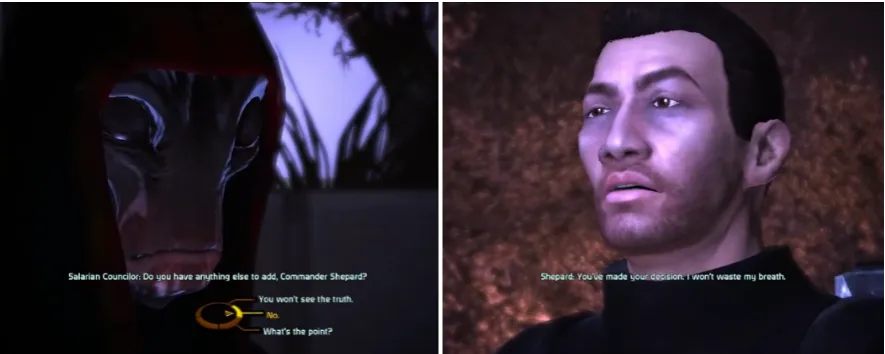
Throughout the game, interactions with other characters are carried out via dialogue trees, where 202
options are selected from a wheel of responses. Fig. 1shows an example of this interface, and also 203
illustrates the most extreme version of a false choice—in the choice shown, all three text options lead 204
to exactly the same spoken response (and they have no other consequences within the game later)1. 205
As with most choices in the game, none of the text responses exactly matches the spoken dialogue, 206
and this serves not only to obfuscate false choices like this one but also to position the text choices as 207
something closer to a character’s internal monologue than an external diegetic utterance. Thinking of 208
the option text in this way reveals that although these choices may not have consequences within the 209
game, they do lead to different portrayals of Shepard’s character. When faced with stonewalling from 210
the council bureaucracy, who in this case are denying his eyewitness testimony against a traitorous 211
special agent, is Shepard the kind of person who is defiant, or resigned? 212
The spoken response is cleverly crafted so that it can be read in multiple ways. If you selected 213
“You won’t see the truth,” Shepard’s utterance seems to take on more defiant undertones than if 214
you selected “What’s the point?” even though the delivery is identical. And although within the 215
mechanical systems of the game this choice has no consequences, Shepard’s attitude is an important 216
part of who they are, so for someone interested in crafting a specific narrative that portrays Shepard in 217
a particular light (as e.g.,Bizzocchi and Tanenbaum(2012) did in their close playing ofMass Effect 2), 218
the nuances of these responses have consequences for that portrayal. Over the course of the game, the 219
way that many “false” choices are made can add up to redefine the character enacted by the player, and 220
since in many cases some choices along a particular axis (such as the defiant–resigned range suggested 221
1 A video that gives more context for this choice and which shows the responses to different choices throughout this scene is
Figure 1.Two screenshots fromMass Effectshowing the moment before and after making a choice. An NPC asks “Do you have anything else to add, Commander Shepard?” and the options given are labeled “You won’t see the truth,” “No,” and “What’s the point?” No matter which option you select, your character responds to the NPC with “You’ve made your decision. I won’t waste my breath.”
here) will have more serious in-game consequences, not all of them need to in order to have meaning 222
to the player. 223
To draw this same conclusion by another process, we can observe that even at the player-goal 224
estimation stage of choice poetics analysis, it becomes clear that any mechanics-related considerations 225
regarding this choice will be irrelevant, because it produces no distinct in-game outcomes. If an analyst 226
were to consider this choice using a set of diegetic player goals, they would rightly conclude that 227
although the options presented mightsuggestsome relevance (e.g., to a goal of pleasing the council 228
members), the outcome, due to being singular, does not actually have any. However, such an analytical 229
outcome should naturally provoke the question: “For what set of player goalswouldthis choice have 230
different outcomes?”—to which the answer is exactly: a set of player goals which includes preferences 231
over not only in-game outcomes but also external considerations, such as the story that the player 232
helps to express through their gameplay. 233
Even the partial lists of modes of engagement that have been suggested for choice poetics (see 234
e.g.,Mawhorter et al.(2014)) include role play as an important player perspective, and that is at least 235
one perspective which includes goals involving the narrative produced by gameplay, rather than 236
simply goals described in terms of the game’s mechanics alone. Once we begin to consider such goals, 237
we have to take a different view of options and outcomes as well. Whereas an initial analysis might 238
label a choice as having only one outcome no matter the option selected, a more nuanced analysis 239
would consider divergent portrayals of Shepard’s character as divergent outcomes, with their own 240
relationships with various possible player goals. The result of this line of reasoning is the realization 241
that even the illusion of choice can have consequences for players who value the impressions their 242
play creates. 243
Although this conclusion may be apparent without resorting to a formal analysis of the choice 244
in question, it highlights the importance of considering modes of engagement and player goals 245
before analyzing a choice, and forced consideration of these factors tends to expose details like those 246
explored here. It may also seem ridiculous to focus so much analytical effort on a single choice in a 247
now decade-old game, but the broader implications of this line of reasoning should be of interest to 248
designers. Rather than viewing such false choices as an evil necessitated by budgetary constraints, they 249
can be thought of instead as opportunities to let the player develop their character in ways outside of 250
the capabilities of whatever character modelling systems a game may contain. After all,Mass Effecthas 251
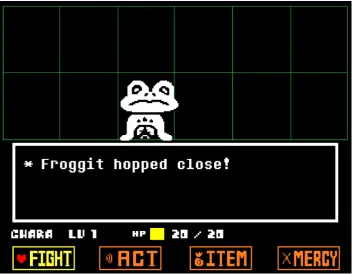
Figure 2.A screenshot fromUndertaleshowing the first random encounter of the game, in which a ‘Froggit’ “hops close,” (note that aggression is implied via the convention of a random encounter but not via the game’s text). The main options are “fight,” “act,” “item,” and “mercy,” the last of which is unconventional.
consequences to their actions along one dimension of behavior, but this choice does not engage with 253
that system directly. Instead, choices such as this allow the player the opportunity to develop their 254
character along a multitude of psychological dimensions without the designers having to implement 255
systems for all of those. 256
4. Reinforcing Disparate Choices inUndertale
257
Undertaleis an independently developed roleplaying game (Fox 2015) about a kid trying to 258
get back home. The game appears at first to be a normal roleplaying game with some interesting 259
mechanics, but the facade of standard RPG mechanics hides a deeper morality-based storyline which 260
challenges gamers to think more deeply about the random ‘monsters’ they are fighting. Players face 261
different challenges and receive different endings depending on whether they play the game passively 262
or aggressively. These paths allow for the game to be a straightforward example of what happens 263
when players with different play styles are forced to make the same choice. 264
Figure2shows the very first random encounter of the game, and illustrates the repeated central 265
choice of whether to fight, flee, or ‘spare’ each opponent (“Flee” and “Spare” are the options in the 266
“Mercy” menu). With the exception of certain bosses, all ‘enemies’ in the game must be dealt with 267
in one of these three ways, where killing them awards gold and experience points, fleeing gives no 268
reward, and sparing them awards just gold, and is only possible after taking a specific sequence of 269
actions that pacify the opponent which the player must learn for each type of ‘monster.’ To understand 270
how this repeated choice is set up to create dialogue within player communities, we can break it down 271
using a formal analysis. 272
To simplify the analysis somewhat, we ignore concerns about player skill, which would provide 273
different skill levels would also be an interesting approach, we consider here the perspective of players 275
that have no trouble with the challenges involved in either attacking or pacifying the enemies. 276
The remaining subsections here describe the results of each of the analysis steps outlined in 277
section1, and how they differ both for two different model players and between initial and subsequent 278
encounters with the choice. Our first model player (we’ll call them the power player) is an experienced 279
roleplaying game player, who is familiar with the conventions of the genre and who expects to be asked 280
to fight their way to victory, collecting experience and gold along the way to gain power and overcome 281
challenging bosses. Our second model player (we’ll call them the story player) is someone who has 282
little experience with roleplaying games and is interested in experiencing the story ofUndertale. In 283
terms of modes of engagement (cf.Mawhorter et al.(2014)), these model players are focused on power 284
play and avatar play respectively. 285
4.1. Goal Analysis 286
We use the following set of goals, with the listed power/story priorities for our respective player 287
models: 288
• Gain experience points (high/low)—The power player prioritizes experience points (XP), 289
knowing that they may be necessary to accumulate power and beat the game. The story player 290
understands them as a reward, but does not seek them out to the detriment of other goals. 291
• Gain gold (high/low)—Just like XP, the power player seeks out gold while the story player 292
welcomes it but does not prioritize it. 293
• Show mercy (none/high)—While the power player sees interactions with the monsters as 294
instrumental and inconsequential, our hypothetical story player, swayed by the aesthetics of the 295
game, finds them cute and feels bad being violent towards them (of course, not all story-focused 296
players would have this outlook). 297
• Explore options (low/high)—Faced with a new game, both the power and story players are 298
interested in figuring out what makes this game unique and what is possible within it, although 299
for the power player this is secondary to other concerns. The ‘Mercy’ menu especially, as an 300
unconventional option, will attract interest. 301
• Behave consistently (low/low)—Both of our hypothetical players not only exhibit standard 302
human biases towards consistent action (and justification of their past actions using future 303
actions), but also recognize that in most game systems, rewards are reserved for extreme 304
behavioral profiles. This goal does not trump others, but influences ambiguous cases. 305
Although these exact goal sets might not be those of real players, they serve our purpose of illuminating 306
Undertale’s choice poetics. 307
Table 1.Likelihood analysis for the player’s initial encounter with the choice shown in Fig. 2. The “new option” ‘outcome’ reflects the player goal of exploring unknown options, whereas the “repeated” ‘outcome’ reflects the player goal of behaving consistently (both are the same for all three options the
first time the player encounters this choice).
Fight Flee Spare
(likely) Froggit dies (likely) Froggit lives (likely) Froggit lives (likely) XP reward (likely) no XP (unlikely) XP reward (likely) Gold reward (likely) no Gold (unlikely) Gold reward (known) New option (known) New option (known) New option (known) Not repeated (known) Not repeated (known) Not repeated
4.2. Likelihood Analysis 308
The next task is to decide which options suggest what outcomes. Per our earlier examination 309
our choice of player goals can narrow that range somewhat—for example, in this analysis, we have 311
assumed our players are skilled enough that they will always succeed, so we ignore outcomes related 312
to player injury or death. 313
Table1shows likelihood analysis results for the player’s first encounter with this choice (which 314
are the same for both player models), including extradiegetic outcomes relating to exploration and 315
consistency goals. Once the player learns the actual outcomes of each choice, these likelihoods will 316
be simplified: the player will know the true outcomes (all ‘likely’ outcomes become ‘known’), and 317
the two unlikely outcomes will be revealed (sparing rewards gold, but no XP). For the extra-diegetic 318
outcomes, players who have explored all the options will view none of them as novel, and depending 319
on which option they picked most, they will view one as more consistent with their past behavior. 320
Table 2.Option analysis for the example choice shown in Fig.2. The results for initial and subsequent encounters are shown separately in the left and right halves of the table. All of the labels apply to both of our player models, except the be-consistent labels for the subsequent analysis, where the power (P) and story (S) players each view either ‘fight’ or ‘spare’ as consistent and the other options as inconsistent (elsewhere stacked labels indicate that multiple labels apply for both models).
Initial Subsequent
Goal Fight Flee Spare Fight Flee Spare
gain-XP enables hinders enables advances hinders hinders advances threatens threatens
gain-gold enables hinders enables advances hinders advances advances threatens threatens
show-mercy hinders enables enables hinders advances advances
threatens advances advances
explore-options advances advances advances <none> <none> <none>
be-consistent <none> <none> <none> advances(P) hinders advances(S) hinders(S) hinders(P)
4.3. Prospective Analysis 321
Having listed a set of suggested outcomes and their likelihoods, the analysis can proceed to 322
evaluate the prospective impressions created by this choice (as described in section1). The results 323
are shown in Table2, which includes two versions: the block on the left shows evaluations using the 324
initial likelihoods, while the block on the right shows the evaluations after all outcomes are known. 325
The subsequent results also use (P) and (S) to show labels that differ between the power (P) and story 326
(S) player models (mostly, the two models just have different priorities for the different goals). 327
In this case, we can see that for both player models, the fight and spare options are more attractive 328
than the flee option, and in fact the spare option dominates the flee option for this goal set in all 329
cases, making it mostly irrelevant (of course, this is because we are ignoring player skill as a factor). 330
Comparing just the fight and spare options for the initial decision, we can see that the spare option is 331
seen as a bit dubious in terms of the power-related goals, but clearly superior in terms of the mercy 332
goal. 333
Considering the power and story players, the power player is most likely to pick ‘fight,’ because 334
they ignore the show-mercy goal, so from their perspective, fight is the only option without downsides 335
(of course considering player skill would have complicated that). Meanwhile, the story player, whose 336
highest-priority goals are to explore and show mercy, will likely pick ‘spare,’ as it is best for those 337
goals while not entirely sacrificing their low-priority goals. As both of these players encounter this 338
choice again, their explore-options goal will now favor the options they did not choose at first, and the 339
story player may now attempt fighting, and will probably attempt fleeing, because their high-level 340
rewarding after all options have been explored. In contrast, the power player, with a lower priority 342
on exploration, may eventually try spare and/or flee out of boredom, but upon learning that those 343
options do not award XP, they will continue to fight most enemies. 344
As these patterns are established, biases that promote consistency (see e.g.,Brehm(1956);Hall
345
et al.(2012); Mather et al.(2000)) will be reinforced, and the power and story players will in all 346
likelihood settle for picking fight and spare respectively. As we can see, the key factor that separates 347
these models is their relative prioritization of the mercy goal, in conjunction with their priorities for 348
gaining XP and gold. Importantly, beyond the immediate rewards shown here, sparing monsters also 349
leads to a number of other acknowledgements and ultimately rewards the player with the ability to 350
befriend some of the more important characters, which is a reward well-suited to players interested 351
in exploring a deeper story. Given an audience of players with a spectrum of preferences, the game 352
prompts different initial choices, and then encourages sticking to those choices (via consistent gold 353
and XP rewards for fighting, and via gold and story rewards for sparing). 354
4.4. Retrospective Analysis 355
After making each decision, the immediate rewards are as expected. However, as the game 356
progresses there are longer-term consequences for both systematic approaches that we consider here. 357
In particular, towards the end of the game, the story line diverges sharply, in the aggressive case 358
throwing the player into brutal battles against several bosses, and in the passive case allowing the 359
player to befriend some of those characters and not fight them at all (although other bosses appear). 360
The long-term consequences of these individual decisions are not simply rewards or punishments, 361
although sparing monsters leads to a happier story outcome. Instead, they represent divergent worlds, 362
which gives the player a strong sense of agency, but also causes players who take different paths and 363
then compare notes to surprise each other. By reinforcing each path separately and letting content 364
diverge significantly,Undertalefosters dialogue between its players, because once they learn of each 365
others’ disparate experiences, they will naturally be curious as to how those experiences were unlocked. 366
Had the game simply punished players for fighting the enemies, this would have delivered a fairly 367
simplistic moral message, but instead, the game lets that message unfold via dialogue with other 368
players, and as previously mentioned, uses some extra-diegetic mechanics to give its choices extra 369
permanence. 370
As explored in Hughes’ review of the game2015, part of the message ofUndertaleis not merely 371
about violence itself, but about the player’s willingness to callously manipulate the lives of the 372
characters in the game. The moral dichotomy that it sets up through a carefully crafted choice that 373
will separate its audience into opposing camps serves to underline this point and get players to think 374
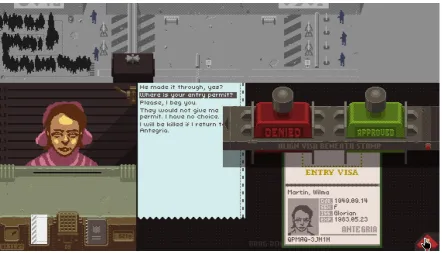
Figure 3.A screenshot fromPapers Pleaseshowing the interface as the player decides whether or not to admit a traveler. The traveler in question claims that she was denied an entry permit but will be killed if turned away. At this point, the player may pursue further questioning or examine the details of the applicant’s passport, but must eventually either approve or deny her entry visa.
5. Uncertainty and Complicity inPapers Please
376
Papers Please(Pope 2013) gives the player the role of a border inspector in the fictional autocratic 377
regime of Arstotzka. Struggling to support their family at home, they are challenged to quickly 378
inspect passports, visas, and eventually travel permits and vaccination records to either permit or deny 379
entry for a stream of hopeful immigrants and travelers, earning money for each applicant correctly 380
approved or denied. A central part of the game is unresolved ambiguity, both about the identities and 381
claims of those seeking entry and about the motives and legitimacy of the government and opposing 382
revolutionary forces.Alexander(2013) gives a nice overview of the game from a critical perspective, 383
andFormosa et al.(2016) provides a detailed analysis of its systemic engagement with a variety of 384
moral issues. 385
Of interest to this analysis is the choice shown in Fig3, which comes up in several different guises 386
throughout the game. In each case, the player must decide whether to take someone at their word 387
that despite a missing or incorrect document, they deserve admission because they would face terrible 388
consequences were they refused. This decision is complicated by the fact that the game also presents 389
situations where entrants attempt to bribe or threaten the player, implying that not all of their claims 390
can be taken at face value. This decision about the fate of an ostensible refugee embodies one of the 391
central themes of the game: how the uncertainty of information from unreliable sources can be pitted 392
against the certain plight of one’s family to turn a moral dilemma into a choice with a reluctant “better” 393
option. In the rest of this section, we show the results of each step of a choice poetic analysis (see 394
section1) for the choice described in Fig.3. 395
5.1. Goal Analysis 396
For the purposes of understanding this choice, it is sufficient to use a single player model with 397
the following prioritized goals: 398
• (high-priority) Provide for your family—the player wants to earn credits and avoid penalties to 399
• (high-priority) Act ethically—as much as possible, the player wants to treat applicants ethically 401
and avoid acting in ways that would intentionally harm them without reason, even when this 402
goes against the government’s dictates. 403
• (medium-priority) Apprehend criminals—separate from their desire to earn credits, the player 404
actively wants to identify applicants who might be attempting to gain entry to the country 405
deceitfully and reject their applications. 406
• (low-priority) Admit approved travellers—all else being equal, the player seeks to treat applicants 407
fairly and admit those that have everything in order. 408
If we were concerned about differences between players, we could repeat this analysis with another 409
set of player goals and contrast the results, as we did withUndertale. 410
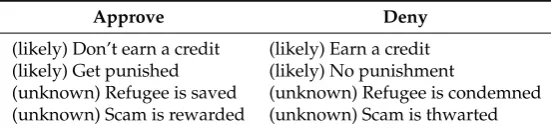
Table 3.Likelihood analysis for the choice shown in Fig.3.
Approve Deny
(likely) Don’t earn a credit (likely) Earn a credit (likely) Get punished (likely) No punishment
(unknown) Refugee is saved (unknown) Refugee is condemned (unknown) Scam is rewarded (unknown) Scam is thwarted
5.2. Likelihood Analysis 411
Table3shows a breakdown of outcomes and their likelihoods for both possible decisions; relevant 412
outcomes have been essentially intuited from player goals. Note in particular the outcomes with 413
unknown likelihood that represent competing possible worlds with respect to the trustworthiness 414
of the applicant: if they are telling the truth about their plight, admitting them realizes a different 415
outcome than if they are just making up their story to gain entrance, and the player does not have 416
enough information to make an informed judgement either way. 417
Table 4.Option analysis for the example choice shown in Fig.3. The default analysis is shown on the left (‘With Suspicion’), and a revised analysis assuming that the player trusts the applicant (‘Without Suspicion’) is shown on the right. See section1for how the labels were applied.
With Suspicion Without Suspicion
Goal Approve Deny Approve Deny
provide-for-family threatens enables threatens enables hinders advances hinders advances
act-ethically enables threatens enables threatens advances hinders
apprehend-criminals threatens enables <none> <none>
admit-approved <none> <none> <none> <none>
5.3. Prospective Analysis 418
The prospective analysis results are shown on the left side of Table4; note that one of the goals 419
(that of admitting approved applicants) is irrelevant here. From these results, we can immediately see 420
that although both options threaten some goals, the deny option is clearly better with regards to the 421
high-priority goal of feeding your family. In fact, although approving the applicantmightbe an ethical 422
action, that is not certain, and denying the applicant might also be in line with ethical standards if in 423
fact they are making up their story. 424
While this choice does not contain any well-known outcome patterns (cf.Mawhorter et al.(2014)), 425
it does involve some moral concerns, pitting one’s desire to help one’s family against concerns about 426
assumption that the applicant is telling the truth, which is shown on the right side of Table4. This 428
new analysis has the structure of a classic dilemma: Two options, each of whichhindersan equally 429
important goal. Compared to the left side of Table4, concerns about apprehending criminals are gone, 430
and the refugee-related outcomes, now believed to be likely, make the moral weight of the decision 431
unambiguous. 432
This comparison thus illustrates exactly howPapers Please(and governments) can manufacture 433
complicity: by introducing doubts about the motives of strangers while emphasizing the certainty of 434
outcomes for loved ones, a dilemma that clearly warrants serious moral concern can be transformed 435
into an uneven choice where multiple avenues of justification are available. Note in particular that the 436
model player’s goal of apprehending criminals was not a deciding factor in this case. Regardless of the 437
existence of that goal, uncertainty about the applicant’s situation still eliminates anyadvanceslabels 438
from the ‘Approve’ column while leaving the ‘Deny’ columnhinders-free. The ambiguous decision is 439
still not an easy one, as evidenced by the fact that itthreatensa top-priority goal (behaving ethically). 440
This leaves the player feeling uneasy about the decision, and potentially helps prompt more reflection 441
on the decision, but ultimately our model player will still view denying the application as the better 442
choice once uncertainty is introduced. 443
5.4. Retrospective Analysis 444
At the end of each day inPapers Please, the player is paid based on the number of applicants they 445
processed “correctly,” and then must decide how much money to allocate for family needs, such as 446
food, heating, and eventually, medicine. However, except in a few special cases, there is no information 447
provided about the subsequent outcomes for the applicants who have entered the country that day. 448
The player is thus not given a chance to form any kind of justification for their beliefs about the 449
truth of applicants’ statements. Of course, such blanket beliefs about future applicants based on past 450
applicants are simple biases, not rational conclusions, because the applicants are independent of each 451
other, but they would help assuage the player’s conscience (or potentially inflame it if the evidence 452
contradicted the player’s assumptions). However, by denying even such a false sense of closure, the 453
game encourages the player to feel vaguely uneasy about their role. 454
At the same time, by emphasizing the outcomes for the player’s family, the game pushes the 455
player away from the dilemma mindset and towards an obvious justification for complicity: the 456
player “had” to act in the state’s interests because their family’s welfare was at stake. From a choice 457
poetic perspective, this choice thus has two interesting properties: First, certain outcomes remain 458
hidden from the player indefinitely, and second, the outcomes that are apparent are emphasized in 459
the course of continued play. The withholding of information serves the purpose of introducing and 460
even emphasizing the uncertainty about outcomes that tilts the choice as discussed above, while the 461
emphasis on the relatively certain outcomes gives the player an extra push towards viewing the choice 462
not as a moral dilemma but as a situation where there is only one “correct” choice. 463
6. Conclusion 464
Through our analyses ofMass Effect,Undertale, andPapers Please, we have demonstrated the 465
concrete application of choice poetics to three very different choices, and hopefully the framework’s 466
utility is evident from the conclusions we have drawn. Certainly, as already mentioned, the statements 467
made here about both games have already been made to some degree by others, and choice poetics 468
does not claim to generate insights that are radically different from those drawn by experienced games 469
critics. Instead, choice poetics has three goals: first, to provide acomputableframework for automated 470
reasoning about choices (as discussed in previous literature), second to make that framework accessible 471
to critics (especially novice critics) so that they can systemically identify interesting aspects of a 472
choice, and third, to provide a detailed language for talking about narrative choices to aid precise 473
communication about their poetic effects, as well as precise reasoning about what changes might be 474
how a choice achieves its poetic effect, and should enable those discussions to be more detailed and 476
specific. 477
In our analysis of Mass Effect, we demonstrated how the theory’s emphasis on modes of 478
engagement naturally leads to the question: “If this choice doesn’tseemto have any relevant outcomes, 479
for what kind of player (i.e., for what set of player goals) would it be relevant?” From there, we 480
found that although some ofMass Effect’s choices have no mechanical or diegetic differences between 481
outcomes, from a narrative perspective they can change the player’s (or a spectator’s) interpretation of 482
a character, and that is enough to be meaningful to some players. Ultimately, this analysis highlights 483
the importance of considering player motives when analyzing choices, and also foregrounds how 484
broad the notion of a ‘consequence’ is in narrative games. 485
Furthering our exploration of modes of engagement, we gave an example of paired choice analysis 486
withUndertale, showing how choice poetics can be used to contrast different play styles. The benefit in 487
this case was a detailed look at howUndertaleseparates players with different priorities into different 488
choice patterns in order to encourage dialogue between players who experience the game differently, 489
including how divergence is encouraged at both initial and subsequent encounters with a repeated 490
choice. Choice poetics helps pinpoint exactly which outcomes drive that separation, and what sets of 491
priorities are necessary for it to happen. 492
We then went into depth withPapers Please, using prospective and retrospective analysis to pin 493
down subtle characteristics of a common choice in that game. Noting how uncertainty undermined a 494
dilemma configuration for that choice, we were able to describe in detail how that choice tilts players 495
towards complicity with the game’s fictional regime, and what other aspects of the choice design 496
help contribute to this outcome. In fact, our analysis reveals several simple changes that could have 497
been implemented had the author wished to create a different narrative. For example, revealing 498
after-the-fact that most applicants begging for asylum were in fact refugees would be enough to permit 499
a story where the player bravely resists their regime’s authoritarian tendencies by turning the present 500
ambiguous choice into a clear moral dilemma. The utility of choice poetics here then is to identify 501
exactly how a choice creates a certain feeling, and which elements of the choice might be changed to 502
create a different one. 503
In all of the analyses presented here, we engage with choice poetics as human scholars, using only 504
those pieces of the theory that are relevant to the specific choices at hand and glossing over details that 505
seem evident from common sense. Although choice poetics was designed with operationalization in 506
mind, our analyses show that it can also be of use to human critics as a framework for discussion. We 507
also expect that the framework’s systematic steps will be useful when confronted with choices that are 508
difficult to understand, and that the notion of different model players will help illuminate choices that 509
leave different actual players feeling different things. 510
As we continue to develop this theory, we plan to explore further computational models and 511
collect and analyze play traces to demonstrate the theory’s utility in the domain of automated analysis, 512
with the eventual goal of using it for on-line player modelling to enable responsive stories. Additionally, 513
we hope to remain in dialogue with critics and games scholars who seek to understand narrative 514
choices, and hope that our framework can at least provide useful language to this community for 515
discussing poetic choices. Of course, we will also continue examining games, and may come up with 516
more examples of how choice poetics can be productively applied to understanding how their choices 517
fit into their narratives. 518
Supplementary Materials:A video illustrating the possible outcomes of one false choice inMass Effectis available 519
athttp://www.mdpi.com/2076-0752/xx/1/1/s1, as well as on YouTube athttps://www.youtube.com/watch?
520
v=8BewZnUnDoE.
521
Author Contributions: Conceptualization, all authors; Investigation, Peter Mawhorter and Arnav Jhala; 522
Writing–Original Draft Preparation, Peter Mawhorter; Writing–Review & Editing, all authors. 523
Funding:The authors would like to acknowledge the support of NSF grant IIS-1409992, which supported some 524
Conflicts of Interest:The authors declare no conflict of interest. 526
527
Aarseth, Espen J. 1997.Cybertext: Perspectives on Ergodic Literature. JHU Press. 528
Alexander, Leigh. 2013. Designing the bleak genius ofPapers, Please. Online:http://www.gamasutra.com/view/ 529
news/199383/Designing_the_bleak_genius_of_Papers_Please.php; accessed 2018-05-22.
530
Andrews, Richard J.. 2017.Metagames: Postmodern Narrative and Agency in the Video Games of Davey Wreden. Ph. D. 531
thesis, The University of Southern Mississippi. 532
Aristotle. 1917.The Poetics of Aristotle. London: Macmillan. 533
Barthes, Roland and Lionel Duisit. 1975. An introduction to the structural analysis of narrative. New Literary
534
History 6(2), 237–272. 535
BioWare. 2007. Mass effect. Microsoft Game Studios. Various platforms. 536
Bizzocchi, Jim and Joshua Tanenbaum. 2012. Mass Effect 2: A case study in the design of game narrative. Bulletin
537
of Science, Technology & Society 32(5), 393–404. 538
Boyan, Andy, Matthew Grizzard, and Nicholas David Bowman. 2015. A massively moral game? Mass Effect as a 539
case study to understand the influence of players’ moral intuitions on adherence to hero or antihero play styles. 540
Journal of Gaming & Virtual Worlds 7(1), 41–57. 541
Brehm, Jack W. 1956. Postdecision changes in the desirability of alternatives. The Journal of Abnormal and Social
542
Psychology 52(3), 384. 543
Cardona-Rivera, Rogelio E, Justus Robertson, Stephen G Ware, Brent Harrison, David L Roberts, and R Michael 544
Young. 2014. Foreseeing meaningful choices. In10th Artificial Intelligence and Interactive Digital Entertainment
545
Conference. 546
Carmichael, Gail and David Mould. 2014. Chronologically nonlinear techniques in traditional media and games. 547
InInternational Conference on the Foundations of Digital Games, FDG ’14. 548
Consalvo, Mia, Thorsten Busch, and Carolyn Jong. 2016. Playing a better me: How players rehearse their ethos 549
via moral choices.Games and Culture 11(7–8), 1–20. doi:10.1177/1555412016677449. 550
Day, Timothy and Jichen Zhu. 2017. Agency informing techniques: Communicating player agency in interactive 551
narratives. InProceedings of the 12th International Conference on the Foundations of Digital Games, FDG ’17, New 552
York, NY, USA, pp. 56:1–56:4. ACM. doi:10.1145/3102071.3106363. 553
Ellithorpe, Morgan E., Carlos Cruz, John A. Velez, David R. Ewoldsen, and Adam K. Bogert. 2015. Moral license 554
in video games: When being right can mean doing wrong. Cyberpsychology, Behavior, and Social Networking 18(4), 555
203–207. PMID: 25803312, doi:10.1089/cyber.2014.0599. 556
Fabulich, Dan. 2010. 5 rules for writing interesting choices in multiple choice games. Online: http://www. 557
choiceofgames.com/2010/03/5-rules-for-writing-interesting-choices-in-multiple-choice-games/; accessed
558
2018-06-22. 559
Feeld, Julian. 2015, 9. Interview: Toby fox of undertale. Online; http://outermode.com/interview-toby-fox-560
undertale; accessed 2018-06-22.
561
Fendt, Matthew William, Brent Harrison, Stephen G Ware, Rogelio E Cardona-Rivera, and David L Roberts. 2012. 562
Achieving the illusion of agency. InInteractive Storytelling, pp. 114–125. Springer. 563
Ferguson, Christopher J. 2008. The school shooting/violent video game link: Causal relationship or moral panic? 564
Journal of Investigative Psychology and Offender Profiling 5(1-2), 25–37. 565
Floyd, Daniel, James Portnow, et al.. 2013, 10. The illusion of choice How games balance freedom and scope -566
Extra Credits. Online:https://www.youtube.com/watch?v=45PdtGDGhac; accessed 2018-05-21. 567
Formosa, Paul, Malcolm Ryan, and Dan Staines. 2016, Sep. Papers, Please and the systemic approach to engaging 568
ethical expertise in videogames.Ethics and Information Technology 18(3), 211–225. doi:10.1007/s10676-016-9407-z. 569
Fox, Toby. 2015. Undertale. Self-published. Various platforms. 570
Frasca, Gonzalo. 2003, November. Ludologists love stories, too: Notes from a debate that never took place. In 571
Level Up Conference Proceedings. University of Utrecht. 572
Green, Melanie C and Timothy C Brock. 2000. The role of transportation in the persuasiveness of public narratives. 573
Journal of Personality and Social Psychology 79(5), 701. 574
Hall, Lars, Petter Johansson, and Thomas Strandberg. 2012, 09. Lifting the veil of morality: Choice blindness and 575
Hughes, William. 2015, 12. Undertale dares players to make a mistake they can never take back. Online; 577
https://games.avclub.com/undertale-dares-players-to-make-a-mistake-they-can-neve-1798287299; accessed
578
2018-06-22. 579
Iten, Glena H., Sharon T. Steinemann, and Klaus Opwis. 2018. Choosing to help monsters: A mixed-method 580
examination of meaningful choices in narrative-rich games and interactive narratives. In2018 ACM CHI
581
Conference on Human Factors in Computing Systems. 582
Jørgensen, Kristine. 2010. Game characters as narrative devices. A comparative analysis of Dragon Age: Origins 583
and Mass Effect 2.Eludamos. Journal for Computer Game Culture 4(2), 315–331. 584
Katsarov, Johannes, Markus Christen, Ralf Mauerhofer, David Schmocker, and Carmen Tanner. 2017. Training 585
moral sensitivity through video games: A review of suitable game mechanisms. Games and Culture 12(5), 1–23. 586
doi:10.1177/1555412017719344. 587
Lange, Amanda. 2014. “you’re just gonna be nice:” How players engage with moral choice systems. Journal of
588
Games Criticism 1(1), 1–16. 589
Laws, Robin. 2001. Robin’s Laws of Good Game Mastering. Steve Jackson Games. 590
Lindley, Craig A. 2005. Story and narrative structures in computer games. In B. Bushoff (Ed.),Developing
591
Interactive Narrative Content: sagas/sagasnet reader. Munich: High Text Verlag. 592
Mallon, Bride and Brian Webb. 2005. Stand up and take your place: Identifying narrative elements in narrative 593
adventure and role-play games. Computers in Entertainment 3(1), 6–6. 594
Mar, Raymond A and Keith Oatley. 2008. The function of fiction is the abstraction and simulation of social 595
experience. Perspectives on Psychological Science 3(3), 173–192. 596
Mateas, Michael. 2001. A preliminary poetics for interactive drama and games. Digital Creativity 12(3), 140–152. 597
Mather, Mara, Eldar Shafir, and Marcia K Johnson. 2000. Misremembrance of options past: Source monitoring 598
and choice. Psychological Science 11(2), 132–138. 599
Mawhorter, Peter. 2016. Artificial Intelligence as a Tool for Understanding Narrative Choices. Ph. D. thesis, University 600
of California Santa Cruz. 601
Mawhorter, Peter, Michael Mateas, and Noah Wardrip-Fruin. 2015a. Generating relaxed, obvious, and dilemma 602
choices with dunyazad. InProceedings of the 11th Annual AAAI Conference on Artificial Intelligence and Interactive
603
Digital Entertainment, AIIDE ’15, pp. 58–64. 604
Mawhorter, Peter, Michael Mateas, and Noah Wardrip-Fruin. 2015b. Intentionally generating choices in interactive 605
narratives. InProceedings of the 6th International Conference on Computational Creativity, ICCC ’15, pp. 292–299. 606
Mawhorter, Peter, Michael Mateas, Noah Wardrip-Fruin, and Arnav Jhala. 2014. Towards a theory of choice 607
poetics. InInternational Conference on the Foundations of Digital Games, FDG ’14. 608
Mellers, Barbara A., Alan Schwartz, Katty Ho, and Ilana Ritov. 1997. Decision affect theory: Emotional reactions 609
to the outcomes of risky options. Psychological Science 8(6), 423–429. 610
Murray, Janet H.. 1997. Hamlet on the Holodeck: The Future of Narrative in Cyberspace. New York: Free Press. 611
Murray, Soraya. 2016. Race, gender, and genre in Spec Ops: The Line.Film Quarterly 70(2), 38–48. 612
Müller, Alexandra Karin. 2017. Undertale: Violence in Context. Ph. D. thesis, Simon Fraser University. Capstone 613
paper. Online:http://summit.sfu.ca/item/17572; accessed 2018-06-22. 614
Perez, Matthew. 2017. Undertale: A Case Study in Ludomusicology. Ph. D. thesis, Queens College of the City 615
University of New York. Master’s thesis. 616
Pope, Lucas. 2013. Papers please. 3909 LLC. Various platforms. 617
Pötzsch, Holger. 2017. Selective realism: Filtering experiences of war and violence in first- and third-person 618
shooters. Games and Culture 12(2), 156–178. doi:10.1177/1555412015587802. 619
Ryan, Marie-Laure. 1991. Possible Worlds, Artificial Intelligence, and Narrative Theory. Indiana University Press. 620
Schwartz, Barry, Andrew Ward, John Monterosso, Sonja Lyubomirsky, Katherine White, and Darrin R Lehman. 621
2002. Maximizing versus satisficing: Happiness is a matter of choice. Journal of Personality and Social
622
Psychology 83(5), 1178. 623
Smethurst, Toby and Stef Craps. 2015. Playing with trauma: Interreactivity, empathy, and complicity in the 624
walking dead video game.Games and Culture 10(3), 269–290. doi:10.1177/1555412014559306. 625
Tosca, Susana Pajares. 2000. A pragmatics of links. In11th ACM Conference on Hypertext and Hypermedia, pp. 77–84. 626
ACM. 627
Tversky, Amos and Daniel Kahneman. 1981. The framing of decisions and the psychology of choice. 628
Tychsen, Anders and Michael Hitchens. 2006. Ghost worlds–Time and consequence in MMORPGs. InInternational
630
Conference on Technologies for Interactive Digital Storytelling and Entertainment, pp. 300–311. Springer. 631
Švelch, Jaroslav. 2010. The good, the bad, and the player: The challenges to moral engagement in single-player 632
avatar-based video games. In K. Schrier and D. Gibson (Eds.),Ethics and Game Design: Teaching Values through
633
Play, pp. 52–68. IGI Glboal. doi:10.4018/978-1-61520-845-6. 634
Weaver, Andrew J. and Nicky Lewis. 2012. Mirrored morality: An exploration of moral choice in video games. 635
Cyberpsychology, Behavior, and Social Networking 15(11), 610–614. PMID: 23017118, doi:10.1089/cyber.2012.0235. 636
Yager Development. 2012. Spec ops: The line. 2K Games. Various Platforms. 637