Article
The Use of Patterns as an Urban Design Approach
Hernan CasakinAriel University, P. O. Box 3, 44837, Ariel, Israel, [email protected] * Correspondence: [email protected]; Tel. +972-508167756
Abstract: Urban design is a complex problem-solving activity that commonly requires the aid of a variety of methods to support the process and enhance the quality of the outcomes. How to help designers with adequate methods to deal with ill-defined urban problems constitutes a major challenge in the urban design domain. In this regard, the use of urban design patterns is considered as a method that can contribute to urban design problem-solving. However, this tool was never investigated to understand its role in the task-related activities that take place during the design process by designers working in team, and its effect on the creativity of the final design outcome as perceived by urban designers and students. Therefore, an empirical research based on a controlled experiment was carried out to explore the aid provided by design patterns during the conceptual stages of the process. The study contributed to gain a better insight into the main design activities derived from the use of patterns as problem-solving tools, and to unveil their contribution to urban design. Implications for design practice and design education are discussed.
Keywords: design patterns; urban design; problem-solving; creativity; urban design education; teamwork
1. Introduction
Design problems, and urban design problems in particular, are ambiguous, lack clear initial conditions and completely specified goals and requirements, and demand the generation of innovative solutions [1, 2]. For this reasons, urban design is a complex problem-solving activity that commonly requires a variety of methods such as heuristics, design principles, standards and guidelines to support the design activity. These approaches, however, have been criticized for being too simplistic, too specific, hard to interpret, and difficult to [3]. Another important limitation is that they generally fail to deal with complexity issues [4]. There are not few reasons since complexity is bothersome for students, but also professional designers. Among these are the background and level of expertise of the design agents involved in the process, the large and varied body of knowledge necessary for an integrated design solution, and the difficulties to predict successful solutions based on a vast number of design variables that are hard to seize [5]. In consequence, how to equip designers with adequate methods to tackle ill-defined urban problems has remained a major challenge in both, professional practice and education. In this regard, design patterns are considered a powerful resource containing comprehensive and easy to understand information, which can be applied to resolve conflicts between social and physical aspects of the design [6].
The present interest with patterns is related to Christopher Alexander, who in his books “The timeless way of building”, and “A pattern language”, introduced his theory and practical approach to architectural and urban design [7, 8]. The notion of patterns was first introduced as an alternative approach for tackling ill-defined problems [9] in the architectural and urban fields [7]. The use of pattern as a kind of language was also found relevant in fields such as software engineering, web design, interaction design, and human-computer interaction, where they were seen as a promising technique for assembling and reusing software architectures [10, 11, 12, 13].
Patterns are concerned with problems related to specific design situations that explain how solutions can be efficiently applied. Basically, a pattern is composed of three parts, which represents a relation between a context, a frequent design problem, and the fundamental nature of a solution to tackle the problem [8]. Moreover, pattern representations also inform how they relate to other
patterns, and present solution examples by means of visual and text information. According to Alexander [7], a suitable pattern language includes solutions containing recurring features and principles that are common in many feasible ways for solving a problem at hand.
Chung et al. [14] found that patterns differ from other approaches such as heuristics and guidelines in that they offer concrete solutions to specific problems, instead of abstract suggestions. Consequently, rather than replacing these methods they can complement them. By providing design examples, patterns can be seen as more generative than reductive tools and therefore. Another advantage is that they provide assistance for effectively structuring problems, and producing functional and well-integrated design solutions [15]. While facilitating schemas to reinterpret a problem in terms of other smaller problems [7], patterns are considered as a prescriptive design approach that enables a fast generation of alternative design solutions. Some researchers consider that they enhance the chances for flexibility and adaptability to changing design conditions, leaving enough room for design creativity and innovation [16]. However, when used inadequately, they can also lead to fixation and the repetition of known solutions [17, 18].
Urban design problem solving is an increasingly complex activity demanding a thorough collaboration between members of a team [19]. Dealing with urban problems requires effective communication within teams with different goals, interests, and views of the problem. Thus, a major challenge for design teams is how to generate mutual knowledge, and integrate individual perspectives into shared ones [20, 21]. Enhancing communication can contribute to this end, with a positive impact on both the design process and the design outcome [22]. In this vein, the use of design patterns can be instrumental in keeping a fluent communication and exchange of information about recurrent design situations. This tool can enhance the interaction and shared understanding among team members and can assist in the efficient coordination of design activities [3]. The information contained in the patterns can provide critical guidance to urban designers into how to make appropriate decisions about the design task at different levels of scale and detail [23, 24].
As an educational approach, design patterns constitute an alternative to the traditional teaching system of the Ecole de Beaux Arts. This model, which continues to be largely influential in many schools of architecture and urbanism nowadays, stresses individual knowledge transfer from tutors to students [25, 26]. Patterns can help to simplify the complexity of urban problems, as requested in the design studio. By facilitating criteria for valuing experiences, ideas, personal views, these instruments aid students to progressively develop and integrate their knowledge and creative skills [27], while they gain independence from their design studio tutors [28, 29]. Griffiths and Pemberton [30] proposed ways to use pattern language in design education, such as connecting patterns with design theory, using existing patterns in practical exercises, and exploring and identifying new patterns. Practicing with patterns in the design studio helped to enhance design team interactions and improve the quality of the outcomes.
2. Materials and Methods
2.1 Research Goals
An investigation was carried out to explore how the use of design patterns can contribute to urban design problem solving activities during the conceptual stages of the process. A focus was on the task, the team, and the creativity of the design outcomes. One general objective was to test whether urban designers and urban design students have the same conceptions of creativity, and how alike these are. Thus, the first goal was to examine how urban designers assess the creativity of design students by analyzing the originality, functionality, aesthetic value, and overall value of their products. The second goal was to learn how students assess the creativity of their own urban design products, by considering variables similar to those used by the urban designers. In addition, we wanted to gain insight into how the use of design patterns help students to deal with the task and interact with the other team members during the process. The third goal was to identify main design factors and determine their contribution to the creativity of the urban design outcome. We validated this procedure by analyzing the relations between the above-mentioned factors, and the evaluations of design creativity by both urban designers and students. We assume that the nearer the assessments of creativity in urban design of students and urban designers are, the higher the prospects that the lessons taught in educational environments such as the urban design studio will be transmitted to the students.
2.2 Participants and Set Up
Sixty-three master students belonging to the Faculty of Architecture and Urbanism, Department of Urbanism at TU Delft were recruited for the design study. Students were informally approached in the urban studio and were invited to take part in the experimental sessions. They worked in teams composed of three members, and in return for their participation they received 15 euros. Design patterns were used as a design method, in which the students were requested to solve an urban design problem.
2.3 Design session
Students were assigned a task sheet containing general instructions, a design problem, and photographs and a map of the area. They were also assigned a set of four patterns and were said that they must use the material to solve the problem at hand. In addition, participants were provided with several A3 numbered sheets of paper and used them to produce as many creative conceptual urban design solutions as possible.
2.4 Design Task, Procedure, and Instruments
Participants were requested to design a public space for the sake of revitalizing an awkward area located at the entrance of Amsterdam Schiphol Airport. To this end, they were encouraged to propose design ideas about spaces and activities that could make the access to the airport a pleasant and welcoming experience. For example, the brief included the design of small human scale urban spaces at various levels of privacy, as well as distinguishable circulation paths for the connection of the different areas allocated in the public space. Due to the nature of the study, the design was to be developed at a schematic level. Participants were familiarized with the area, including physical, cultural, and social aspects of the problem. Each session lasted half an hour, where 10 minutes were assigned to produce a final solution to the design problem, and a brief description of how the solution works. About 15 minutes were added at the end of the sessions for the completion of questionnaires about the design task and the design outcome, and another 15 minutes were devoted to a debriefing activity.
such as “The design patterns helped me to think about new ideas”, “The design patterns helped me to make clarifications about the problem, “The design patterns helped me to understand what other team members are saying about the problem”, or “The design patterns helped me to provide assistance to others” (See Table 1). Cronbach’s alpha value for the questionnaire was .75. In addition, students and urban designers were requested to assess the creativity of the final outcome with regard to originality, functionality, aesthetic value, and overall value (See Tables 2 and 3). These items have been used and validated in previous studies [32, 33]. All participants responded on a scale of five points, from 1 (“Not at all”) to 5 (“Quite a lot”).
Cohen's κ was run to determine if there was agreement between the two urban designers’ judgement on the creativity of the final solution. There was substantial agreement for all the assessed variables: originality, κ = .760,
p
< .001; functionality, κ = .737,p
< .001; aesthetic value, κ = .752,p
< .001; and overall value, κ = .775,p
< .001.Table 1. Means, and standard deviations of the aid provided by the design patterns, assessed by the studentsa
Variable of assessment used by the students Mean Standard Deviation
Definition of problems 3.86 .877
Analysis of ideas 3.79 .953
Clarifications of ideas 3.73 .919
Evaluation of ideas 3.59 1.116
Take final design decisions 3.48 .895
Stating new ideas 3.06 .896
Produce an innovative solution 2.75 .842
Support ideas from others 3.90 .756
Understanding what others are saying about the problem 3.94 .914
Positive atmosphere 3.86 1.014
What the team has been doing so far 2.81 1.162
Assistance to others 3.40 .976
a The 5-value scales ranged from low ratings (=1) to high ratings (=5), each level of rating being described verbally
Table 2. Means, and standard deviations of the creativity variables assessed by the studentsa
Variable of assessment by students Mean Standard Deviation
Originality 2.95 .771
Functionality 3.97 .718
Aesthetic value 3.32 .947
Overall value 3.40 .661
a The 5-value scales ranged from low ratings (=1) to high ratings (=5), each level of rating being described verbally
Table 3. Means, and standard deviations of the creativity variables assessed by the urban designers Variable of assessment by urban designers Mean Standard Deviation
Originality 2.55 .974
Functionality 2.87 .583
Aesthetic value 2.39 .891
Overall value 2.59 .599
3. Results
The first phase of data analysis consisted in carrying out a factor analysis on the assessments made by the students on the aid provided by urban patterns during the process. In the second phase of data analysis, the relation between the factors resulting from the factor analysis and the evaluations of quality of the design outcome regarding originality, functionality, aesthetic value, and overall value were analyzed by means of regressions as follows: (i) regression of the factors of the use of urban patterns based on the students’ responses and the evaluation of the final outcome by the urban designers; (ii) regression of the factors of the use of urban patterns based on the students’ responses, and their own evaluation of the final outcome. The creativity of the final solution measures was obtained as variables independently rated by both architects and students.
3.1 Factor analysis of students’ evaluations
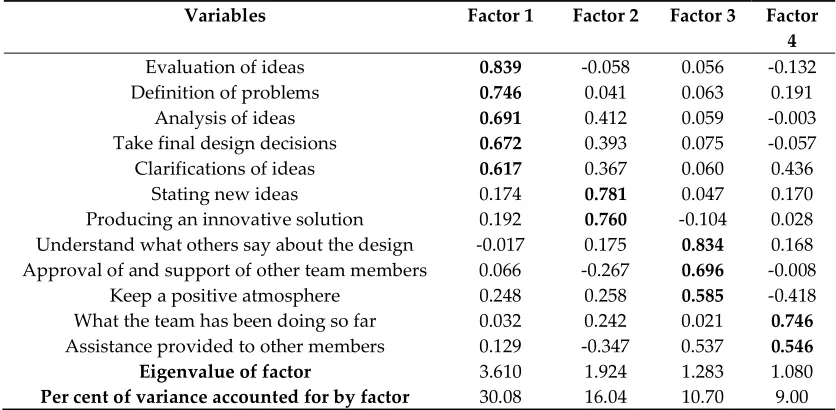
Factor analysis was applied to the 12 different variables assessed by the students (See Table 4). Four valid factors resulted from this operation, as indicated by their values (>1.00) and the percentages of the variance for which they account (>65.81%). The first and strongest factor (accounting for 30.08% of the variance) represents mainly consideration of the context and requirements of the design task, and may therefore be labeled as ‘analysis and assessment of the design'. The second factor accounting for 16.04% of the variance represents consideration of novelty of ideas and solutions. Hence this factor may be labeled as the factor of 'design innovation’. The third factor accounting for 10.70 % of the variance is highly saturated on ‘understand what others say about the design’, ‘approval of and support of other team members’ and ‘keep a positive atmosphere’. Therefore, the factor may be labelled as ‘team cohesion’. Finally, the fourth and weakest factor is saturated mainly on ‘what the team has been doing so far’ and ‘assistance provided to others’, and hence the factor may be labeled as 'design reflection’.
Table 4. Results of a factor analysis on the variables assessed by the students a
Variables Factor 1 Factor 2 Factor 3 Factor
4
Evaluation of ideas 0.839 -0.058 0.056 -0.132
Definition of problems 0.746 0.041 0.063 0.191
Analysis of ideas 0.691 0.412 0.059 -0.003
Take final design decisions 0.672 0.393 0.075 -0.057 Clarifications of ideas 0.617 0.367 0.060 0.436
Stating new ideas 0.174 0.781 0.047 0.170
Producing an innovative solution 0.192 0.760 -0.104 0.028 Understand what others say about the design -0.017 0.175 0.834 0.168 Approval of and support of other team members 0.066 -0.267 0.696 -0.008
Keep a positive atmosphere 0.248 0.258 0.585 -0.418 What the team has been doing so far 0.032 0.242 0.021 0.746 Assistance provided to other members 0.129 -0.347 0.537 0.546
Eigenvalue of factor 3.610 1.924 1.283 1.080
Per cent of variance accounted for by factor 30.08 16.04 10.70 9.00 Note. The numbers in the cells are saturations of the variables on each of the factors. The highest saturations that are considered for defining the factor are typed in bold.
a The factor analysis was performed according to the principal components rotated varimax procedure after
Kaiser normalization. 3.2 Regression analyses of the design factors on urban design creativity
In order to examine the relation of the design factors to the different aspects of the creativity of the urban design outcome, we performed different regression analyses with the factors as predictors, and the evaluation of the creativity components as dependent variables.
3.2.1 Regression analysis of the design factors of students on originality evaluation by students The first regression is of the students' factors on their evaluation of the originality of the final solution. The overall results (of the four factors) are highly significant and show that, of the four factors, only one was related to originality and this is factor 2: novelty of ideas and solutions. The fourth factor dealing with reflection was only close to significance (See Table 5).
Table 5. Regression analysis of the factors on originality evaluation by students
Sum of squares Df Mean squares F Sig.
Regression 8.760 4 2.190 4.521 .003 a
Residual 28.097 58 .484
Total 36.857 62
aR Square .238 Standardized Beta Coefficients
First factor .055 t=.476 ns Second factor .427 t=3.724 (p<.001) Third factor .094 t=.823 ns Fourth factor .088 t=1.819 ns
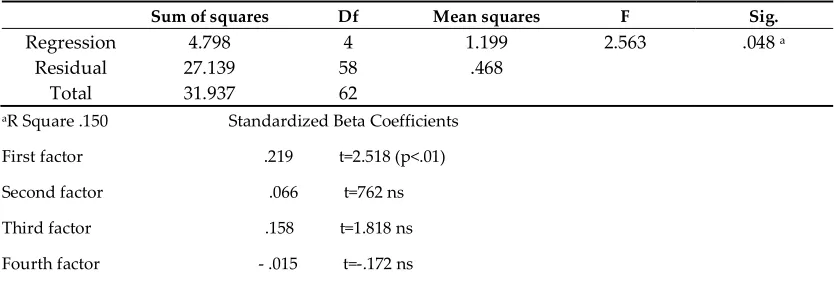
3.2.2 Regression analysis of the design factors by students on functionality evaluation by students The second regression is of the students' factors on their evaluation of the functionality of the final design outcome. The overall results are significant, and indicate that of the four factors, only one was related to functionality and this is factor 1: analysis and assessment of design (See Table 6).
Table 6. Regression analysis of the factors on functionality evaluation by students
Sum of squares Df Mean squares F Sig.
Regression 4.798 4 1.199 2.563 .048 a
Residual 27.139 58 .468
Total 31.937 62
aR Square .150 Standardized Beta Coefficients
3.2.3 Regression analysis of the design factors by students on aesthetic value evaluation by students The third regression is of the students' factors on their evaluation of the aesthetic value of the final design. The overall results are close to significance and show that, of the four factors, only one was related significantly and this is factor 3: team cohesion (See table 7).
Table 7. Regression analysis of the factors on aesthetic value evaluation by students
Sum of squares Df Mean squares F Sig.
Regression 7.801 4 1.950 2.364 .063 a
Residual 47.850 58 .825
Total 55.651 62
aR Square .140 Standardized Beta Coefficients
First factor .101 t=.878 ns Second factor .129 t=1.116 ns Third factor .294 t=2.552 (p<.05) Fourth factor .111 t=-.961 ns
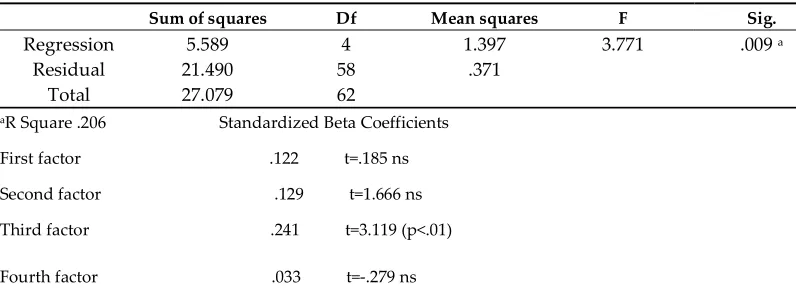
3.2.4 Regression analysis of the design factors by students on overall value evaluation by students The last regression of the students' factors on their self-evaluation is on the overall value of the final product. The overall results are highly significant, and demonstrate that only one factor was related to originality, and this is factor 3: team cohesion (See Table 8).
Table 8. Regression analysis of the factors on overall value evaluation by students
Sum of squares Df Mean squares F Sig.
Regression 5.589 4 1.397 3.771 .009 a
Residual 21.490 58 .371
Total 27.079 62
aR Square .206 Standardized Beta Coefficients
First factor .122 t=.185 ns Second factor .129 t=1.666 ns Third factor .241 t=3.119 (p<.01)
3.2.5 Regression analysis of the design factors on originality evaluation by urban designers
The fifth regression is of the students' factors on the evaluation of the urban designers on the originality of the final solution. The overall results are highly significant and indicate that of the four factors, only one was related to originality and this is factor 1: analysis and assessment of design (See Table 9).
Table 9. Regression analysis of the factors on originality evaluation by urban designers
Sum of squares Df Mean squares F Sig.
Regression 10.743 4 2.686 3.283 .018 a
Residual 48.114 58 .830
Total 58.857 62
aR Square .183 Standardized Beta Coefficients
First factor -.384 t=-3.2331 (p<.01) Second factor .072 t=.609 ns Third factor .165 t=1.388 ns Fourth factor .053 t=-.446 ns
3.2.6 Regression analysis of the design factors on functionality evaluation by urban designers The sixth regression is of the students' factors on the evaluation of the urban designers on the functionality of the design. The overall results are highly significant and show that two of the four factors were related to functionality, and these are factor 1: analysis and assessment of design, and factor 3: team cohesion (See Table 10).
Table 10. Regression analysis of the factors on functionality evaluation by urban designers
Sum of squares Df Mean squares F Sig.
Regression 3.293 4 .823 2.681 .040 a
Residual 17.810 58 .307
Total 21.103 62
aR Square .156 Standardized Beta Coefficients
3.2.7 Regression analysis of the design factors on aesthetic value evaluation by urban designers The next regression is of the students' factors on the evaluation of the urban designers on the aesthetic value of the final outcome. The overall results are significant and indicate that only one factor was related to aesthetic value, and this is factor 1: analysis and assessment of design (See Table 11).
Table 11. Regression analysis of the factors on aesthetic value evaluation by urban designers
Sum of squares Df Mean squares F Sig.
Regression 5.266 4 1.316 1.737 .154 a
Residual 43.957 58 .758
Total 49.222 62
aR Square .107 Standardized Beta Coefficients
First factor -.270 t=-2.179 (p<.05) Second factor .086 t=.691 ns Third factor .161 t=1.298 ns Fourth factor .024 t=-.848 ns
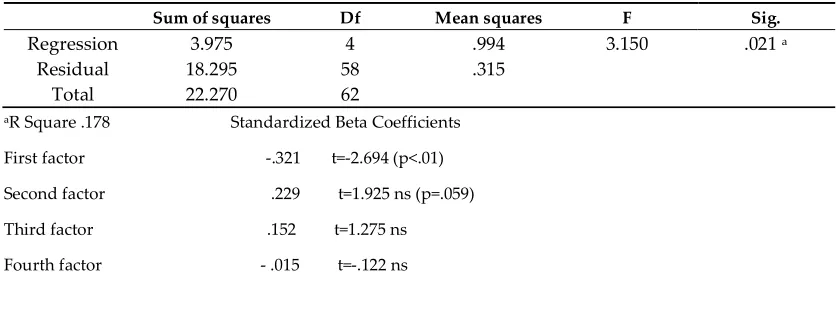
3.2.8 Regression analysis of the design factors on overall value evaluation by urban designers The last regression is of the students' factors on the evaluation of the urban designers on the overall value of the final product. The overall results are highly significant and show that of the four factors, only one was related to overall value and this is factor 1: analysis and assessment of design (See Table 12).
Table 12. Regression analysis of the factors on overall value evaluation by urban designers
Sum of squares Df Mean squares F Sig.
Regression 3.975 4 .994 3.150 .021 a
Residual 18.295 58 .315
Total 22.270 62
aR Square .178 Standardized Beta Coefficients
First factor -.321 t=-2.694 (p<.01) Second factor .229 t=1.925 ns (p=.059) Third factor .152 t=1.275 ns
Fourth factor - .015 t=-.122 ns
4. Discussion
This study dealt with the use of patterns as urban design aids. A focus was set on the study of correspondences and divergences between urban designers and students in the assessment of the creativity of design outcomes. Four significant variables defining design creativity were considered and included: originality, functionality, aesthetic value, and overall value [32, 33]. The high degree of correspondence between the two referees that evaluated the design outcomes corroborates that expert judgment of design creativity is a reliable and legitimate method of evaluation.
'clarifications of ideas', 'analysis of ideas', 'evaluation of ideas', and 'definitions of problems'. These findings suggest that when students are requested to evaluate the use of design patterns, their attention is mainly directed to the analysis and evaluation of the design, including both problem and design ideas [34]. On the other hand, the aid of the design patterns in the synthesis design activity - concerned with the development of design solutions- was evident in the second dominant factor represented by 'design innovation', which included the variables of 'stating new ideas' and 'producing innovative solutions'. The study by Stempfle and Badke-Scuab [35] suggests that in the usual thinking process of design teams, the generation of solution ideas is followed by evaluations, except when there are questions or clarifications. If an evaluation yields a positive result, then the solution is normally accepted. Otherwise, new solution ideas are pursued. It is remarkable that overall, the use of design patterns was seen by the students as a tool for analysis and evaluation, rather than as a means for supporting the generation of novel design solutions. This result is in line with previous studies arguing that patterns are effective in structuring problems [15], and those that raised questions regarding their contribution to design creativity and innovation [16]. Another interesting result is that whereas the most dominant factors centered on the design task, the less important ones focused on the team activities.
Findings from the regression coefficients between the four factors resulting from the factor analysis, and the evaluation by the students of the design outcome indicated that the assessment of the originality of the urban design corresponds mainly to 'novelty of ideas and solutions’. It is not surprising that when students are asked to evaluate design originality they tend to focus mostly on innovation. However, different results were obtained from the regression coefficients between the four factors resulting from the students' factor analysis and the evaluation of the originality of the design by the urban designers. According to their view, 'analysis and evaluation of the design' was the dominant factor but with a negative contribution on the originality of the design. As commented before, it is possible that students used urban patterns more as an analytical tool to structure, inspect and judge their ideas and outcomes, than as a means to generate innovative ideas. In this sense, employing patterns for analysis and evaluation operations characterizes the design as a convergent activity [36]. As a result of this, the generation of novel solutions (characteristic in divergent design activities) was to a certain extent limited. This claim is supported by the results of the factor analysis presented above, where 'analysis and evaluation of the design' was more dominant than the generation of new design outcomes.
Results obtained from the regression equation of the factors that predicted the evaluation on the functionality of the design by the students corresponded to 'analysis and evaluation of the design'. Whereas the assistance provided by the patterns was largely on the assessment of the design task, this dominant factor had a positive impact in enhancing the functionality of the design. Nevertheless, different results were obtained from the regression coefficients between the four factors and the evaluation carried out by the urban designers on the functionality of the design. In their view, 'team cohesion' had a positive contribution to the design use. A major challenge for design teams is to ensure that team members interact and communicate in ways that facilitate collaboration and cohesion to allow extensive knowledge integration [37, 38]. Thus, it is suggested that the higher the cohesion among team members, the better the contribution of the design patterns to the functionality of the urban design outcomes [22, 19].
Findings from the regression equation of the factors analyses that predicted the evaluation by the students on the aesthetic value of the outcome corresponded also to 'team cohesion'. Once again, it can be inferred that enhancing a shared understanding among team members along the process may have a positive impact on the aesthetics of the design outcome. On the other hand, results from the regression coefficients between the four factors and the evaluation by the urban designers indicated that the aesthetic value of the urban design corresponded to 'analysis and evaluation of the design'. However, this variable had a negative contribution, suggesting that when used for convergence activities [36], design patterns may be detrimental to the development of aesthetic solutions.
understanding about the design contributed to align the views of the team members about the value of the final design solution [37]. Nevertheless, the assessment carried out the urban designers indicated that the overall value of the design solution corresponded mainly to 'analysis and evaluation of the design'. Once again, this variable was found to have a negative contribution, suggesting that the aid provided by design patterns as an assessment tool was counterproductive for the general value of the final solution.
5. Conclusions
This study dealt with
the use of design patterns as an approach in urban design problem
solving
activities during the conceptual stages of the process. An empirical analysis of the dataprovided insights into the challenges of using this instrument when working in a team. It was possible to understand how patterns help to deal with the task, interact with other team members, and arrive at a final solution. Moreover, a focus was set onto how urban designers compared to students assess the final design solutions.
From the perspective of the students, the aid provided by the urban patterns was mainly concerned with the task, and thereafter with the interaction of the team. Overall, this tool assisted in the analysis and assessment of the design, and thereafter on the generation of novel ideas and solutions. It is remarkable that urban designers and students had dissimilar perceptions regarding the contribution of the different design factors to the creativity of the final design solution. The former consider that using design patterns for 'analysis and evaluation of the design' had a negative contribution on most aspects of the design, and as consequence it limited the creativity of the final outcome. In contrast, the latter believe that this and the design innovation factor had a positive impact on their designs. However, irrespective of this, both students and urban designers agree that the use of patterns mainly aided in enhancing the functionality of the design, and to a lesser extent in improving its originality and aesthetic value.
Important implications for design practice and design education can be drawn from the finding that, overall, the employment of urban patterns helps to enhance the functionality of the design. It is confirmed that these tools can be used to complement other approaches such as design heuristics and guidelines. Specifically, patterns can be applied to structure the task in an effective way, and resolve urban situations mainly characterized by complex functional conflicts. They can also help design teams, mainly heterogeneous ones, to develop a common language to enhance communication exchange, and to create mutual understanding among team members. A future study will test the use of urban patterns in a larger and more complex context that will include multi-disciplinary teams composed by urbanists, architects, and environmental engineers, with different levels of expertise.
References
1. Akin, O., Akin, C. On the process of creativity in puzzles, inventions, and designs. Automation in Construction 1998, 7, 123-138.
2. Goldschmidt, G., Tatsa, D. How good are good ideas: Correlates of design creativity. Design Studies 2005, 26, 593-611.
3. Karlgren, K., Ramberg, R. The use of design patterns in overcoming misunderstandings in collaborative interaction design. CoDsign 2012, 8, 231-246.
4. Timmeren, A. van. (Delft University of Technology, The Netherlands) ReciproCities: Inaugural Speech, Chair Environmental Technology and Design. Personal Communication, 2013.
5. Gerrits, L. A co-evolutionary revision of decision making processes: An analysis of port extensions in Germany, Belgium and the Netherlands. Public Administration Quarterly 2011, 35, 309–39.
6. Pemberton, L. The promise of pattern languages for interaction design, 2000. Available online: http://www.cmis.brighton.ac.uk/staff/lp22/HF2000.html (Accessed 1 September 2018).
7. Alexander, C. A pattern language. Oxford University Press, New York, 1977. 8. Alexander, C. The timeless way of building. Oxford University Press, New York, 1979.
9. Simon, H. The structure of ill-structured problems. In Developments in design methodology, Cross, N., Ed.; John Wiley and Sons, New York, 145-165, 1984.
10. Coplien, J., Schmidt, D. Pattern languages of program design. Addison-Wesley, Reading MA, 1995. 11. Dearden, A., Finlay, J. Pattern languages in HCI: a critical review. Human–Computer Interaction 2006, 21, 49–
102.
12. Frauenberger, C., Stockman, T. Auditory display design – An investigation of a design pattern approach. International Journal of Human-Computer Studies 2009, 67, 907-922.
13. Rodriguez, F.D., Acuna, S.T., Juristo, N. Design and programming patterns for implementing functionalities in web applications. Journal of Systems and Software 2015, 105, 107-124.
14. Chung, E.S., Hong, J.I., Lin J., Prabker, M.K., Landay, J.A., Liu, A.L. Development and evaluation of emerging design patterns for ubiquitous computing, Proceedings of DIS'04 Conference, Boston, MA, USA. Aug 1-4, 2004.
15. Salingaros, N. The structure of pattern languages. Urban Research Quarterly 2000a, 4, 149-161.
16. Duarte, J.P., Beirão, J. Towards a methodology for flexible urban design: designing with urban patterns and shape grammars. Environment and Planning B: Planning and Design 2011, 38, 879-902.
17. Atilola, O., Tomko, M., Linsey, J.S. The effects of representation on idea generation and design fixation: A study comparing sketches and function trees. Design Studies 2016, 42, 110-136.
18. Jansson, D., Smith, S. Design fixation. Design Studies 1991, 12, 3-11
19. Casakin, H., Badke-Schaub, P. Sharedness of team mental models in the course of design-related interaction between architects and clients. Design Science 2017, 3, 21 pages.
20. Badke-Schaub, P., Buerschaper, C. Creativity and complex problem solving in the social context. In Decision Making: Social and Creative Dimensions; Allwood, C.M., Selart, M., Eds.; Kluwer, Dordrecht, 2001, pp. 177-196.
21. Casakin, H., Badke-Schaub, P. Mental models and creativity in engineering and architectural design teams. In Design Computing and Cognition’14; Gero, J.S., Hanna, S., Eds.; Springer International Publishing; Switzerland, 2015, pp. 155-171.
22. Badke-Schaub, P., Neumann, A., Lauche, K. An observation-based method for measuring the sharedness of mental models in teams. In Coordination in Human and Primate Groups; Boos, M., Kolbe, M., Kappeler, P.M., Ellwart, T. Eds.; Springer-Verlag, Berlin, 2011, pp. 177-197.
23. Salingaros, N. Architecture, patterns, and mathematics. Nexus Network Journal 1999, 1, 75-85.
24. Salingaros, N. Hierarchical cooperation in architecture, and the mathematical necessity of ornament. Journal of Urban and Planning Research 2000b, 17, 221-235.
25. Casakin, H., Gigi, A. Cognitive styles in admission procedures for candidates of architecture. Assessment and Evaluation in Higher Education 2016, 41, 167-182.
26. Cuff, D. Architecture: The story of practice. MIT Press, Cambridge, Massachusetts, 1992.
28. Casakin, H., Kreitler, S. Correspondences and divergences in creativity evaluations between architects and students. Environmental Planning B: Planning and Design 2008, 35, 666-678.
29. Lee, N. Project methods as the vehicle for learning in undergraduate design education: A typology. Design Studies 2009, 30, 541-560.
30. Griffiths, R.N., Pemberton, L. Don’t write guidelines write patterns! Available online: http://www.cmis.brighton.ac.uk/staff/lp22/guidelinesdraft.html (Accessed 10 August 2018).
31. Arvola, M., Interaction design patterns for computers in sociable use. International Journal of Computer Applications in Technology 2006, 25, 128–139.
32. Casakin, H., Kreitler, S. The nature of creativity in design: Factors for assessing individual creativity. Proceedings of Studying Designers International Conference, Aix-en- Provence, France, 17–18 October 2005a; Gero, J.M., Bonardell, N. Eds.
33. Siang, J.K.K., Koronnis, G., Chia, P.Z., Silva, A. Exploring the use of a full factorial design of experiment to study design briefs for creative ideation. Proceedings of the ASME 2018 International Design Engineering Technical Conferences and Computers and Information in Engineering Conference, IDETC2018, Quebec City, Quebec, Canada, 26-29 August 2018.
34. Dorst, K, Cross, N. Creativity in the design process: Co-evolution of problem-solution. Design Studies 2001, 22, 425-437.
35. Stempfle, J., Badke-Schaub P. Thinking in design teams: An analysis of team communication. Design Studies 2002, 23, 473–496.
36. Goldschmidt, G. Linkographic: Evidence for concurrent divergent and convergent thinking in creative design. Creativity Research Journal 2016, 28, 115-122.
37. Casakin, H., Ball, L., Christensen, B., Badke-Schaub, P. How do analogizing and mental simulation influence team dynamics in innovative product design? AIEDAM 2015, 29, 173-183.
38. Owen, W.F. Metaphor analysis of cohesiveness in small discussion groups. Small Group Research 1985, 16, 415–424.