RE-WRITING PROFESSIONAL DISCOURSE
Anna Tsatsaroni
A thesis submitted to the university of London for the degree of Doctor of Philosophy
ABSTRACT
The following thesis is concerned with what I have termed professional discourse. I have used the term to call attention to two elements. With professional, I have indicated a recent move in educational analysis and research on teachers and other practitioners which represents a shift to a concern with practical activities, a tacit or explicit resistance to theory, and an attempt to displace the cognitive paradigm of research and theorizing. With the notion of discourse, I have indicated that, in order that the as yet limited debate on professional activity be opened up, it has to be linked with the discourse on practice. By the latter, I mean the opposition between practice and theory at the analytical level, and its most recent unfoldings and manifestations.
The thesis identifies a vocabulary of practice, implicating such concepts as reflection, repetition, judgment, skill, example, exemplar, and a series of oppositional terms, such as saying/showing, competence/performance, explicit/implicit knowledge. These serve as a link between the professional and the practical. The problematic of the theory/practice relation in its various formulations is, then, explicitly addressed in the work of Dreyfus, Habermas, Lyotard and Derrida.
ACKNOWLEDGEMENTS
I wish to thank the following people and institutions which over the few past years contributed, in one way or another, to the development and completion of this thesis: The State Scholarships Foundation of Greece for its generous financial support: a scholarship during the academic years of 1987-90, and a supplementary support grant for the Autumn term of 1990; and the Greek Ministry of Education for study leave during the academic years 1987-90. They both allowed me to devote my full attention to research on this thesis;
My supervisor, John Hayes, whose special interest in this work stimulated our multiple correspondences: hours and days of challenging discussion, and invaluable advice and expert guidance throughout the shaping and reshaping of the thesis; missives of all sorts which often disturbed my little certainties as soon as they had been established; and `calling events', in whose structure the possible intervention of the 'other' is always inscribed. Thus, I found myself in debt and so obliged to engage myself to listen in. But if one cannot get on the line responsively unless s/he is ready to speak, can one still distinguish the acts of giving and receiving?
Professor Ernesto Laclau for allowing me to attend his seminars on 'Ideology and Discourse Analysis' at the University of Essex during 1985-86; and Dr Emilia Steuerman who kindly offered to read the final version of the thesis, as well as for her valuable advice on future developments;
The research students and the members of the staff at the Sociology Department of the Institute of Education. I would like to mention, in particular, John Hayes for his 'Contemporary Debates in Social Theory' course, for M.A and research students in 1984-86; Tony Green for helping me find my way in the Institute of Education in the early days; and Peter Hodgkinson for his friendship, continuous support and help. I wish also to acknowledge the help and support I received from my friends in London during the period of working on the thesis. In particular, I would like to mention: Diana, whose expertise in English made a world of difference to the text; Babis, Sira, Paul and Georgia, for facilitating the final production of the thesis; Zachos, for helping me overcome my fear of technology; and Joanna for her encouragment and friendship during the early years.
I would also like to thank my sister and her family in Greece for their support and help; my father for his understanding and patience with my work which kept me away from home for so long; and my friends, Costas and Kiki, who boosted my confidence to embark on this journey, and kept encouraging me from far away;
And, of course, Jeff, who supported and intellectually stimulated my engagement with this thesis; and whose special friendship has made my stay in England a delight.
To all these, I express my sincere gratitude.
Anna Tsatsaroni
"One repays a teacher badly if one remains only a pupil" Friedrich Nietzsche, Ecce Homo
page CONTENTS
Title page 1
Abstract 2
Acknowledgements 3
GENERAL INTRODUCTION TO THE THESIS 8
PART ONE: COGNITIVE RULES VS EXEMPLARS:
DISPLACEMENT OR HIERARCHICAL REVERSAL
CHAPTER 1: THE COGNITIVE PARADIGM AND THE THEORY/PRACTICE OPPOSITION
1.1 Introduction 17
1.2 Heidegger on the relation between theory and
practice 22
CHAPTER 2: REVIEW OF EMPIRICAL RESEARCH
2.1 Studies on the mental life of the teacher 52 2.2 The shift to the practical
2.2.1 The debate on 'Teacher Appraisal' in the U.K. 61
2.2.2 Reflection-in-action 65
2.3 Review of laboratory research 77
CHAPTER 3: CALCULATIVE RATIONALITY: RULES AND EXEMPLARS
3.1 Introduction 90
3.2 A critique of calculative rationality: cognitive simulation and Artificial Intelligence as a paradigm of theory as
calculation 91
3.3 What is to follow a rule: a critique of the linguistic-
cognitive paradigm 107
CHAPTER 4: EXEMPLARITY 148
CHAPTER 5: HABERMAS' COMMUNICATIVE ACTION: PERFORMATIVES WITHOUT FORCE
5.1 Introduction 173
5.2 The concepts of communicative action and lifeworld 174 5.3 From subject-centred reason to intersubjectivity:
implications for practical discourse 190
PART TWO: THE SUPPLEMENTARY STRUCTURE OF EXEMPLARITY
INTRODUCTION TO PART TWO 203
CHAPTER 6: REFLECTION REPETITION AND ITERABILITY
6.1 Introduction 205
6.2.1 The paradigm of reflection 213
6.2.2 Repetition 222
6.3.1 Derrida's confrontation with the pragmatic
philosophy of language 235
6.3.2 A note on context 246
6.3.3 Explicit/implicit dichotomy and the problem of
the exemplar 253
6.4 From pragmatics to pragrammatology 259
CHAPTER 7: CALCULABLE VS CRITICAL JUDGMENT
7.1 Introduction 274
7.2 Kant and the problematic of judgment 280
7.3.1 Lyotard's Kant 288
7.3.2 A critical note on language 302
CHAPTER 8: EXEMPLARITY AND COMMUNICATION: ENDINGS 309
PRAGMATIC CONCLUSIONS 341
NOTES
Notes to general introduction to the thesis 345
Notes to chapter 2 346
Notes to chapter 3 349
Notes to chapter 4 352
Notes to chapter 5 353
Notes to chapter 6 355
Notes to chapter 7 360
Notes to chapter 8 361
APPENDIX A: RATIONALITY AS PRACTICAL REASONING: THE
CASE OF ETHNOMETHODOLOGY 364
Notes to Appendix A 370
BIBLIOGRAPHY 371
TABLES-FIGURES Chapter 1
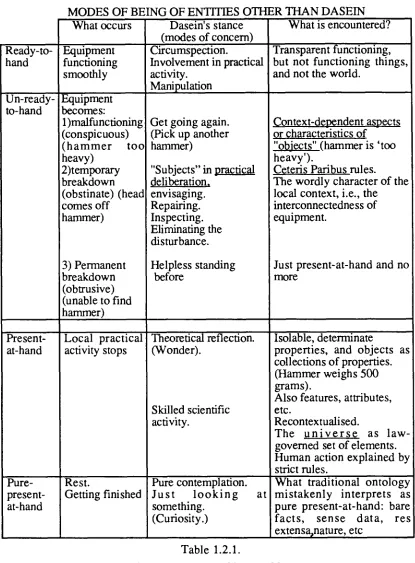
1.2.1 Modes of Being of entities other than Dasein 35 Chapter 2
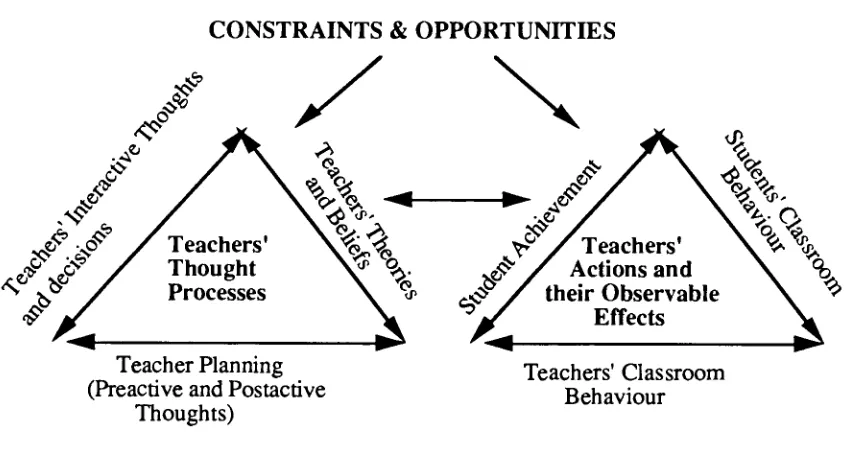
2.1.1 Teachers' thought processes 55
Chapter 4
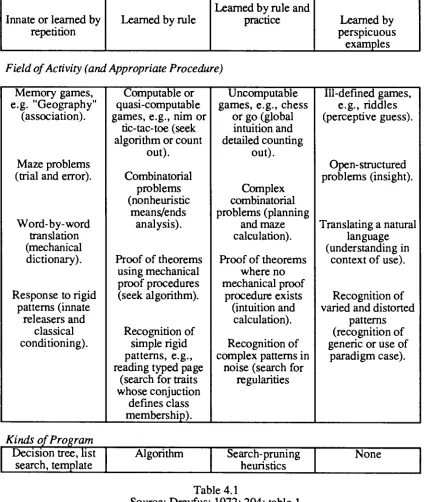
4.1 Classification of intelligent activities 150
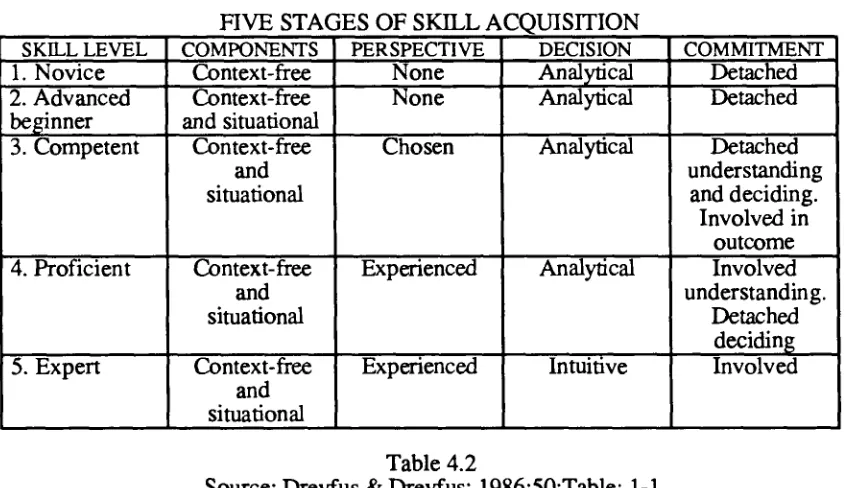
4.2 Five stages of skill acquisition 155
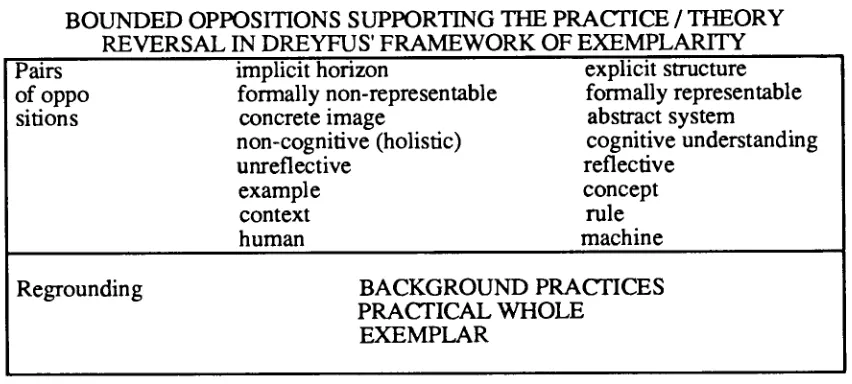
4.3 Bounded oppositions supporting the practice/theory
reversal in Dreyfus' framework of exemplarily 167 Chapter 6
6.4.1 A pragrammatological space of research vis-a-vis
a typology of pragmatics 272
Chapter 7
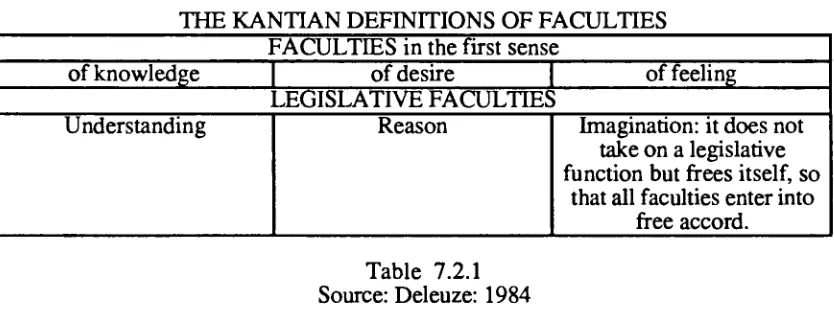
7.2.1 The Kantian definitions of Faculties 281 Appendix A
A.1 Versions of Empiricism 366
A.2 The linguistic empiricism of Ethnomethodology 367
A.3 Indexicality 368
GENERAL INTRODUCTION TO THE THESIS
This thesis raises the question of the relation between theory and practice, by tracing the debate on professionals' practical action, teachers' in particular, and by linking it to the discourse on practice. Three kinds of relation are presented. The first two are identified as the relation of opposition between theory and practice, and that of the reversed opposition (practice/theory) which respectively organize what is here called the 'cognitivist', and the 'practical' paradigms of research. The third, by deconstructing some of the terms which define the opposition in its two modes, presents and argues for a displaced relation which multiplies the differences.
That is to say, the third position starts with the understanding that there is an (hierarchical) opposition between theory and practice, itself defined by a series of opposed terms resting on the opposition between thinking, i.e., securing a rational foundation upon which one may establish the totality of what is knowable, and acting, i.e., conforming one's actions to the foundation so secured. The foundation grounds the theory of action - i.e., legitimates, furnishes criteria, and sets standards for action.
This describes accurately, although in very general terms, the fundamental assumption of the cognitivist paradigm.
Further, it embraces, as its working hypothesis, the Heideggerian hypothesis that metaphysical rationality produces its own closure. This means that the displacement of metaphysical conceptuality entails more than the abandonment of the foundational base. Theoretical moves, and specific empirical research projects which attempt to abandon
into metaphysical determinations and/or falls into a crude empiricism in one way or another. The reviewing of relevant literature confirms the suspicion that, to state it strongly, the current debate on professional action, when and to the extent to which it moves to the practical, cannot but pay the price for the unthought determinants of its
oppositional terms, with empiricism; i.e., recourse to cognitivist- psychological categories of analysis (e.g. perception, intuition), and the employment of a notion of subject which is the cognitive-psychological and/or practical-ethical - i.e., the active self who makes the law and obeys it; the latter, embedded in the dichotomy between constituted/constituting subject, is already anticipated in any critique of the philosophy
of the subject.
Hence, the thesis has chosen to be directed by the hypothesis that metaphysical closure necessitates deconstruction. The latter situates historically what appears to be a foundation; that is to say, the determinations - epochal constellations of presencing in the Heideggerian terminology- which have always already prescribed the terms in which the question of action can and must be raised (e.g., transcendental or linguistic as the
most recent), the ground from which it is answered (e.g., cogito, discursive community), and the types of answers that must be adduced (hierarchy of imperatives, hierarchy of discursive interests -cognitive or emancipatory) [Schiirmann:1987:1-21]. At the same time, it situates itself historically: historically, it is the possibility of deconstruction of metaphysical oppositions; to be precise, it does not directly attack the opposition between theory and practice, which would allow one's position to be enclosed within it, rather it deconstructs the series of dichotomies within which and upon which the theory/practice relation currently rests. By uprooting action from
rule-coercion, it frees the space for analytical categories to be worked out.
To facilitate the reviewing - in Part I of the thesis - of the empirical research on
sciences and cognitive procedures, the thesis has worked out the basic presuppositions of the cognitivist paradigm. These are:
(i) a subject/object dichotomy, where a consciously or unconsciously knowing subject is directed to a world of objects, the latter governing the 'given' and the 'situation';
(ii) the subject acts as a consequence of, or is determined by, code/rules - inside the mind as mental/formal representations, or outside the mind as social rules- and by meanings either explicit or implicit; it is assumed that the latter can be analysed and made explicit;
(iii) a concept of reflection on rules as a grounding for action, and as a grounding and unification of subjectivity, so that clarity about the rules clarifies and constitutes the
mind of the subject and the quality of the action. Assessment turns on being clear about rules, principles, meaning (plan, programme). This either gives the sovereign subject, preconstituted prior to the social, or the enslaved subject, particularly in the marxist tradition, where the subject is the constituted subject within the social; e.g., Althusser's thesis on ideology and the mechanism of interpellation - a variant on reflection and presentation which conceals the epistemological problematic of reflection, object re-presentation and the transparency of the self;
(iv) a certain conception of theory as an infinitely repeatable and demonstrable truth, and of the thesis as a position that stays the same within a system whose repeatability guarantees its place. This conception pressuposes the ideality of the 'object' of inquiry, that is to say, the notion of its being as presence so that the thesis can survive the present moment. This, in turn, is supposed to confirm the ideality of a 'subject' and its ability to transcend its temporality.
rule? How does a rule regulate a discourse or a human subject? Where are the rules located? The last two questions tend to dominate the debate furnishing the following two answers.
The first, put forward by advocates of the cognitive paradigm, argues that the order of the activity is determined either by the deep structure of the rule (Chomsky), or by our intending a rule (Husserl), where the rule is conceived, by virtue of its identity (i.e., its form), as intrinsically linked to the steps of the activity that it governs. This amounts to saying that rules located in the human mind or consciousness generate speech or performances. The deep structure of the rules is internalized within the human mind (level of competence) so that one can perform (level of performance).
The second argues that the rules are located in social practices. Wittgenstein, in particular, in his critical stance towards cognitivism, rejects the idea of the rules underlying the diversity of uses, in favour of looking at these uses to see how they are in fact ordered. He finds no underlying essence but a "complicated network of similarities and criss-crossing: sometimes overall similarities, sometimes similarities of detail" [1968:§66,§67]. This second answer postulates that 'following a rule' is a practice which one learns against a background or form of life. This important move
to recognizing the significance of practice in the determination of action, brings with it an emphasis on illustration, demonstration, showing, and skilful attention of how old uses of, say, language, are connected with new ones, as well as a conception of community standards and agreement in language and/or rule-use.
The last point, already an advance, because it repudiates and denies the causality of the rule or rule-intention, is theoretically crucial. However, most commentators offer a communitarian reading of Wittgenstein which, though accurate as far as it goes, is,
possible because people share certain judgments - and is ultimately communitarian in the sense that agreement is grounded in the notion of a community as substance, or even quite simply as an entity (a people, their language, a professional group, etc.).
For the thesis, the problematic and the critique of 'rule following', presented in detail in chapter 3, indicates a general shift from the cognitivist paradigm to the practical. This shift becomes the main focus of the thesis. More specifically, two kinds of move to the practical are identified:
(a) a general resistance to theory and an emphasis on practice and practical activity expressed in a practical vocabulary such as tacit knowledge, skill, judgment, context-specificity, practical considerations, know-how, reflection-in-action, etc. Disguised in this problematic, there remains intact the cognitivist paradigm by its emphasis and grounding on reflection, and its employment of the subject/object model. A representative piece of work, "The Reflective Practitioner" by Schon, is discussed in chapter 2;
(b) a more direct and explicit questioning of, and opposition to, the cognitivist paradigm can be found in Dreyfus' work, discussed in chapter 4. This identifies the problematic of the theory/practice relation and confronts it at the analytical level. Drawing on the problematic of early Heidegger, as presented in chapter 1, Dreyfus exposes the
presuppositions of cognitivism. He concentrates on the notion of rule, and presents a critique of the notion of reflection on rules. This leads him to a counter-proposal of types of action grounded on a non-cognitive base. Dreyfus indicates this base by using notions such as the Heideggerian 'background practices', Kuhn's 'exemplars' and Wittgenstein's 'forms of life'. The notions of rule and example/exemplar are used as indicative of two types of action-situation which are different in nature, opposed, and
exclusive of its other. Moreover, it is argued that, as opposed to action determined by rules, reflection on acts or performances that are normalized and focused by exemplars,
You cannot have a theory of practical activity is the explicit position that Dreyfus takes as an implication of his analysis of the theory/practice relation. But the thesis implicit in Dreyfus' text is a model of exemplarity, the unseen metaphysical determinants of which
request a response in the form of a question concerning the function of the notion of background practices in his framework. I will refrain from analysing here the difficulties and the specific problematic which led to the uncovering of this question; but what follows from that point onwards is a challenging of the assumption of self-evidence, transparency and concreteness of the notion of practice that brings forth a series of other metaphysically employed terms such as perception, intuition, memory, image, representation, repetition, calculation and decision. These are all linked to the question of the subject, and of language.
Chapter 5, then, links the problematic of the theory/practice relation to its linguistic turn via Habermas, since the latter claims to have made a break with the philosophy of consciousness through his notion of intersubjectivity in his theory of (linguistic) communicative action. The linguistic turn problematizes the structure of the theory/practice relation by linking practice to a (linguistic) performative act, a situation which poses the problem of how one moves from a language of identity to linguistic intersubjectivity through non-communication, dispersion and absolute difference. Implicated in this is 'speech act theory', and its examination links the work of Habermas to that of Derrida (chapter 6) and Lyotard (chapter 7) so that the metaphysical
determinants of the theory/practice relation are examined with reference to the work of all three. In particular, because of the constative/performative distinction, the discourse
on practice slips into a serious/play distinction which, quite simply, is the Platonic presupposition of logos/mythos and mimesis.
With the following brief points, I would like now to situate, in this opening, the intention of my title: "Re-writing professional discourse". With this title, first, I
with the complicating remark that the oppositional logic on which it still rests, as I will explicate in this thesis, blocks a movement whose impossibility of description is the impossibility of concluding such a general theory. Hence the requirement to re-write a discourse which creates the possibility of movement.
Secondly, I am aware that the thesis represents an attempt to challenge a teleocratic structure while writing in a teleocratic fashion. To re-write and displace logocentrism, which supports the oppositional structure on which exemplarity relies, is to intervene in a text and re-inscribe oneself into this text. It entails the stating of a thesis - i.e., a detachment - but one which is negotiated in a movement of detachment from/attachment to the specific texts. The result is presented as a series of theses in the final chapter, which amounts to arguing for the supplementary structure of exemplarity. It is supported by, and, at the same time, attempts to elaborate and explicate Derrida's statement which reads as follows:
"What happens when acts or performances (discourse or writing, analysis or description, etc.) are part of the objects they designate? When they can be given as examples of precisely that of which they speak or write? Certainly, one does not gain an auto-reflective transparency, on the contrary. A reckoning is no longer possible, nor is an account, and the borders of the set are then neither closed nor open. Their trait is divided, and the interlacings can no longer be undone."
[1987:391; emphasis added]
Finally, the notion of an exemplar, a necessary feature of teaching and learning, almost
subverts the very title of the thesis - its authority to designate a theme (e.g., professional) - by linking it to the pedagogical structure in general. Throughout the thesis, a pedagogical structure which repeats in different ways or forms, such as theory/practice, rule/example, judgment/decision, saying/showing, listening/hearing, etc., reveals its fundamental determination, viz., the metaphysics of presence. The latter governs the notion of theory (saying, but also phonocentrism) as pure seeing, and showing as pure handling of 'a thing'. As will become clear, the eye/hand and pure
PART ONE
COGNITIVE RULES VS EXEMPLARS: DISPLACEMENT OR
HIERARCHICAL REVERSAL
"...In most 'crafts or branches of learning' what we call 'expertise' is the essence of the art. And for the domains of knowledge that we touch with our art, it is the 'rules of expertise' or the rules of 'good judgment' of the expert practitioners of the domain that we seek to transfer to our programs."
" ...Experience has also taught us that much of this knowledge is private to the expert, not because he is unwilling to share publicly how he performs, but because he is unable. He knows more than he is aware of knowing. (Why else is the Ph.D or the Internship a guild-like apprenticeship to a presumed 'master of the craft'? What the masters really know is not written in the textbooks of the masters.)"
CHAPTER 1: THE COGNITIVE PARADIGM AND THE THEORY/PRACTICE OPPOSITION
1.1 INTRODUCTION
Writers from various disciplines of the social sciences, including education studies, note - either as critics or as followers- the dominance of the cognitive paradigm. Its beginnings are often located in the late 1950's when the celebrated Chomsky - Skinner debate signalled a paradigm shift [Coulter:1983:1]. Though it is in psychology that a strong cognitive movement dominates over the classic behaviorist view, this is also and increasingly the case within theoretical linguistics, philosophy of mind and action, sociology, anthropology, and the exemplary field of cognitivism, namely, Artificial Intelligence (A.I). The latter, in fact, embodies and realizes the most basic principle of the cognitive view, viz.,
"
...any form of information processing, whether natural or artificial, requires a device that has in some way or another, an internal model orrepresentation of the environment in which it operates."
[Mey:1982:xv]
If the cognitive view has been widely discussed, elucidated and applied in the various disciplines and multi-disciplinary studies ('Cognitive Studies'), in the last two decades or so, its basic assumptions are not new. In fact, being as old as the Greek metaphysical understanding of everything as 'formed matter, the cognitive view, in its modern form, is formulated by Husserl's phenomenology, which is aimed at a purely ideal
identically the same for different subjects, who cannot share identically the same real sensory contents.
I will not trace here the history of cognitivism, though I will have the opportunity to refer to this history at several points throughout the thesis. Instead, I would like to give a few examples, in order to show the extent to which the contemporary thinking and searching about knowledge and action is framed by the cognitive paradigm, the latter itself understood as a cognitive structure which shapes expectations and guides research activities [Mey:ibid: xvii].
Mey formulates his proposal for the extension of the cognitive viewpoint in the study of science with the following words:
"Science is a socially organized process of knowledge acquisition. It might be impressive because of the hugeness of the organization it has acquired by now or because of the long list of achievements it has accumulated, but this does not imply that it yields knowledge which is basically different from the knowledge a cook has of spices, or a farmer of the weather, or a salesman of buyers. When the cognitive view is applied to science, it is not because science is a priori considered a superior and very special kind of knowledge, but it is because science is just another kind of knowledge and the cognitive view should hold as well for science as it does for more modest forms of knowledge."
[ibid:xvi]
In this view, the traditional dichotomy between common sense/theory, or practical/theoretical knowledge is bridged by the fact that, in both cases, knowledge is attributed to common cognitive processes in individuals or, at best, in individuals functioning within certain patterns of social organization.
psychological mechanism of learning transfer to account for stability and continuity of cognitive activity across different situations. The exemplar for the forementioned distinction is provided by experimentation in cognitive psychology:
"
...psychological experimentation...looks for evidence of stable (mental) structures at a moment in time, and values the ability of experimental methods to keep history and past experience from 'contaminating' the investigation of that structure..."[1988:191-192,n.3]
It is quite obvious that such a conceptualization of the mind (the sovereign subject) parallels that of the conceptualization of the subject as constituted within the social (the enslaved subject), the mechanism of interpellation - a variant of representation - being the direct analogue of the psychological mechanism of learning transfer.
consequence that the rational, as the cognitive and representational element, prevails as that which determines action. This, however, is at the expense of an important area of inquiry, namely decision and judgment.
In chapter 2 below, I present empirical research projects into professional activity, professional education and professional development, and I treat this area as an instance which will enable me to expose the model of action presupposed by the cognitive paradigm. The subject/object dichotomy, on which the model rests, is evident in all the studies reviewed there. The problem is often formulated in terms of a body of knowledge possessed by a practitioner, and an object domain on which the practitioner is to act upon. Moreover, the understanding of the 'knowledge domain' is caught in the dichotomy of explicit/implicit in such a way that
"...if we are to develop rational educational practice...we must start from a consideration of current practice, the rules and principles it actually embodies and the knowledge, beliefs and principles that the practitioners employ in both characterising that practice and deciding what ought to be done... Getting at current practice and policy will necessarily involve articulating accurately the concepts and categories that practitioners use implicitly and explicitly..."
[Hirst:1983:16]
As a consequence, the question of research into professional activity is posed as the
elicitation of tacit knowledge via an individual expert (Bliss & Ogbom:1987), which, further, requires the formation of hypotheses about the underlying knowledge-structure, to be tested against how well they predict expert performance. The notion of tacit knowledge conveys a basic assumption of cognitivism, namely, that actions are
determined by rules which may no longer be available to attention (overleamed skills) or by schemes abstracted from the structures of action (internalisation).
practice that characterizes it in terms of the dichotomies which support it and which I have just introduced here; namely, explicit/implicit - and the related distinction between verbal/non-verbal - knowledge, common sense/theoretical understanding, theoretical/practical reasoning, and competence/performance. Further, I would like to introduce, in the section which immediately follows, aspects of Heidegger's early work that challenge these dichotomies and render them problematic. To indicate the problematic, in his "Being and Time" (1962) Heidegger, in seeking to challenge the mentalistic framework of Husserl's phenomenology, focuses on a notion of practical activity, which is based on the observation that our directedness towards objects ('intentionality') is practical rather than cognitive, and that the primary form of understanding is doing something for a purpose rather than being conscious of something.
With such an alternative framework, I will, then, in chapter 2, look at empirical research projects into professional activity, with a view to demonstrating that the forementioned dichotomies of the cognitive paradigm are the domimant categories through which action and professional activity are currently being thought, understood and researched.
1.2 HEIDEGGER ON THE RELATION BETWEEN THEORY AND PRACTICE
The early work of Heidegger promises at least two concrete gains regarding the
dichotomy between theory/ practice:
(i)a clarification of the concepts of practice and theory which might enable one to develop a vocabulary, subversive of any move towards dichotomization and hierarchization of theory/ practice. With regard to this, I will consider Heidegger's formulation of four kinds (levels) of activity, which reveal four different ways in which 'subjects' stand towards 'objects', and examine the kinds of hierarchies which are suggested;
(ii)a subordination of theory/ practice dichotomy to 'Dasein' (being-there, human being); With regard to this, the notion of 'Dasein as a situation' will be considered.
Further, the Heideggerian framework questions two basic assumptions implicated in the theory/practice dichotomy - namely, reflection and the philosophy of consciousness. With regard to the former, the dichotomy between implicit/ explicit knowledge, for example, which is presupposed in the current debate on professional practice, leads to the strategy that the implicit must become explicit as an object of representation which would then direct action. It is, therefore, presupposed that one acts better if s/he is clear about the beliefs, cognitive structures, rules, dispositions, etc., which are held to determine action. While the Heideggerian position would not want to deny that deliberation very often takes place, it would nevertheless question a move which posits that action depends on the reflective clarification of cognitive representations.
difference between saying that a person understands something or somebody and claiming that that person can display the knowledge-base of this understanding, especially when the latter privileges the linguistic form. Such a formulation of the problem, i.e, as an attempt to make explicit the structure of the intentional content of the mind which directs action, displays both a particular philosophical position, i.e, a philosophy of 'consciousness', and the adoption of a particular notion of understanding which is congruent with this position. That is to say, the 'scientific' mode of understanding, which is equated with being able to say how - describe procedures - and why - explaining -. However, it is possible to show, as Heidegger did, that this view of understanding is only a specific case and therefore it cannot be taken as foundational.
The rupture that Heidegger brings to the traditional model of reflection and the philosophy of consciousness, can be captured by contrasting his starting point with that of Husserl. For Husserl, the common characteristic of all mental experiences is directedness towards or reference to a meant object. The essence of mental experience is intentionality. Husserl gives a transcendental argument concerning the necessary conditions for the possibility of intentionality. As Okrent [1988:6-10] explains,since Kant, all transcendental arguments have proceeded in two stages: first, one argues that some set of conditions is necessary for intentionality or some particular kind of intentional state (e.g. consciousness, experience); then, secondly, one argues that these conditions fix the conditions that an object or entity must satisfy if it is to be capable of being intended (thought of, experienced, meant).
(ii) through transcendental reduction attention is transferred from what our thoughts are standardly about to the very senses or meanings of those acts of thinking themselves, i.e., to the noemata of those noetic acts. This moment becomes a radical bracketing of the entire natural attitude, to reveal how entities are intended by pure
consciousness (transcendental consciousness) in their essential whatness, free from individuating characteristics. The noema is not an (actual) object but becomes the object for the phenomenological reduction (object as meant) which is directed not towards objects but towards the modes in which consciousness is aware of objects.
Heidegger, too, gives a transcendental argument concerning the necessary conditions for the possibility of intentionality. But his transcendental argument is distinct in two
ways [Okrent;op.cit.]:
(i) he believes that the tradition has failed to address an important question regarding intentionality, thus making the mistake of moving directly from a transcendental discussion of it to the attempt to ground metaphysics. This means that the tradition thinks of the intentional agent as a substance to which a range of properties are attributed: mental properties, private mental states, consciousness and self-consciousness, which cause that being to act. Heidegger's answer to the question of the nature of the intender is that to be an intentional agent is to be a certain kind of
organized activity (temporality);
More specifically, Heidegger, in "Being and Time", offers a phenomenological analysis of everyday masterful, practical know-how that dispenses altogether with the need for mental states such as desiring, believing, following a rule, etc. and thus with the notion of an 'intentional content'. Though he does not deny that there is a place for contemplation and consciously-directed action, he nonetheless reminds us that first and foremost we are coping beings already involved in the world. He calls this kind of everyday skilful coping 'primordial understanding', with the entities thus encountered 'ready-to-hand' and thus locates the starting point of Husserl's phenomenology at the 'unready-to-hand' level; that is to say, situations where 'transparent coping' is disturbed, a fact which raises the possibility of the reflecting and problem-solving
subject.
The contrast between Husserl and Heidegger, even in this summary form, calls attention to two kinds of issues which I will subsequently attempt to explore: first, the status of the claim that human beings are in a primary sense 'observing subjects' or 'knowing beings', and the model of perception/seeing implied in this position; second, the primacy or not of practical activity over theorizing and its implications for the conceptualization of the relationship between theory and practice.
With regard to the first issue, Heidegger avoids the Cartesian/ Husserlian problem which arises from starting with an isolated, individual self, by explaining things the other way round: he starts with the conforming public self and then tries to show how the autonomous individual crystalizes out of this rather amorphous 'public us'. Dasein points to the fact that human beings are always a shared, social, situated way of being and only sometimes are conscious subjects directed towards objects.
With regard to the second issue, Heidegger wants to expose the principle of reflection -i.e., that true knowledge of the world is to be gained by means of detached,
consciousness and knowledge into proper perspective, which is to show how the latter arises out of involved, everyday practical activity. Thus, he starts with involved acting in the world to claim that detached knowing is a deficient modification of everyday involvement. In this sense, passive perception is seen as an impoverished and derivative version of our natural tendency to manipulate things. But it is not just practical activity Heidegger wants to make primary; more importantly, he wants to show, first, that the practical activity cannot be analysed using Husserl's account of intentionality. Secondly, he wants to emphasise that there is a more basic way of being than either detachment or involvement [Dreyfus:1987a:59]. Thus, in Heidegger, there is no suggestion that intentionality is to be taken as a mark of the mental or a distinguishing characteristic of consciousness. His term 'comportment', equated here with directionality, just means behaviour or conduct, and has no mentalistic overtones. Heidegger accepts Husserl's overall formulation of intentionality, but rejects the notion that this concept is applicable primarily or exclusively to the mind. He wants to understand intentionality as characterizing not merely acts of consciousness, but activity in general. Thus, intentionality is attributed to Dasein rather than consciousness. He points out that it is part of the essentialism of the tradition to introduce some kind of intentional content to explain the directedness of the mind and bridge the gap between subject and object.
old epistemological problems. The importance of this move becomes apparent if we pause here to think of the consequences of the move to take 'intentionality', 'mental states', 'reflection', 'thematic consciousness' as the main paradigm of thinking about human beings and their relationships to the 'world'. One might want to draw a parallel between this and the dominant approach which takes intelligence as sequential reasoning to be a paradigm of human reasoning in general. Taken together, these two moves may account for the 'cognitive' perspective, both in its psychological stream - how people process information - and the epistemological stream - how people know and how they know it - which is at the heart of research on A.I and 'Expert Systems' (see chapter 3).
shows a difference in understanding; that is to say, in the latter case, first, our understanding of world is pre-ontological in that it is an understanding of what we are and a specification of what, in general, it means to be, which is in the practices, although it need not be noticed or spelled out. Secondly, there is no such thing as 'my world', if this is taken as some private sphere of experience and meaning, which is self-sufficient and intelligible in itself, and so, more fundamental than the shared public world and its local modes. Heidegger thinks that it belongs to the very idea of a world that can, in principle, be shared, so 'the world' is always prior to 'my world'; (d) the ontological-existential sense (no. 4): this is the structure common to our most general system of practices and to any of its sub-regions. Though we can never abstract the world's essential structure so as to be able to describe it to a pure intelligence who does not in-habit our world, we can still point out to those who dwell in the world with us certain prominent structural aspects of this actual world.
With this analysis, Heidegger seeks to show that the categorial sense of world, with its subjects and objects, can only be understood in terms of the existential sense of our shared world and not vice versa. He wants to 'concretely demonstrate' that there is an involved way of encountering entities, which reveals a way of being of these entities which is inaccessible to a detached knower or viewer.This involved way underlies both
theory and practice, and cannot be explained in terms of cartesian subject/ object intentionality [Dreyfus:1987a:71].
Heidegger notes that we do not by and large encounter 'mere things', but rather we use things to get things done. He calls those entities which we encounter in concern 'equipment'. For something to function as equipment in Heidegger's sense, there must
"Each particular equipmental thing has as such a specific reference to another particular equipmental thing...Every entity that we uncover as equipment has with it a specific functionality. The contexture of the what-for or in-order-to is a whole of functionality relations. This
functionality which each entity carries with it within the whole
functionality complex is not a property adhering to the thing, and it is also not a relation which the thing has only on account of the present-at-hand of another entity."
[Heidegger, quoted in Dreyfus:ibid:74]
Heidegger calls the way of being of those entities which are defined by their use 'readiness to hand' and notes that perception - subject sees object - cannot be the mode of access of anything ready-to-hand. In fact, when we are using the equipment, it has a tendency to 'disappear'. We are not aware of it as having any characteristics at all [Dreyfus:1987a:76].
Everyday skilled activity involves knowledge of what a piece of equipment is. However, this primordial understanding should be distinguished, first, from a positive understanding of equipment - i.e., mere familiarity with its normal cultural function. Secondly, primordial intentionality, while not deliberate action in the traditional intentionalistic sense - i.e., requiring beliefs, desires and goals - in no sense indicates an adherence to behaviourism [3]. The behaviour is directed but, in this case, it is not the mind which is directed but the person going about his/her business; this directedness reveals what it is directed towards under an aspect. To carry on directed activity one need not have the relevant goal in mind, nor need one have ever had the goal in mind. [Dreyfus:1987a:79-80]. Thus, the description of skilled activity enables Heidegger to introduce both a new kind of intentionality (transparent use) which is not that of a self-contained subject, and a new sort of entity encountered (equipment) which is not a determinate, isolable object. Starting from primordial intentionality, Heidegger then sketches how thematic consciousness and its objects enter the picture:
"Being-in-the-world...amounts to a non-thematic circumspective absorption in references or assignments constitutive for the readiness-to-hand of a totality of equipment...the present-at-hand of entities is thrust to the fore by the possible breaks in that referential totality in which circumspection 'operates'."
Traditional intentionality is, therefore, introduced at the point where there is a disturbance or breakdown, when it rises to the level of deliberate attention. He describes three modes of disturbance that progressively bring to the fore both Dasein as a knower and the present-at-hand way of being of isolated, determinate substances, which 'underlies' the ready-to-hand ways of being of equipment. Dreyfus's elaborate analysis at this point is worth paying attention to, as he is attaching more emphasis on these different modes of breakdown than the Heideggerian text warrants. Basically, Dreyfus's claim is that what he calls 'temporary breakdown' and 'total breakdown' reveal two new modes of encountering entities and two new ways of being of entities. A third kind of breakdown, 'malfunction', provides a preview of these two. Thus:
(1) when equipment malfunctions, Heidegger says, we discover its unusability by the "circumspection of the dealings in which we use it", and the equipment thereby becomes 'conspicuous'. "Conspicuousness presents the ready-to-hand equipment as in a certain un-readiness-to-hand" [Heidegger:1962:102-3]. Nevertheless, for most normal forms of malfunction, we have a ready way of coping so that we easily shift to the new way of coping and go on. "Pure presence-at-hand announces itself in such equipment but only to withdraw to the readiness-to-hand of something with which one concerns oneself' [ibid:103]. Another response is to ask for help; coping with malfunction
"may take some such form as [saying] 'The hammer is too heavy', or rather just 'Too heavy', 'hand me the other hammer'. Interpretation, is carried out primordially not in a theoretical statement but in an action of circumspective concern - laying aside the unsuitable tool, or exchanging it, 'without wasting words'."
[ibid:200]
(2) Further disturbance would lead to temporary breakdown which is the transition from involved coping to involved deliberation. Dreyfus describes this kind of disturbance as
follows:
"When there is a serious disturbance and even deliberate activity is blocked, Dasein is forced into a new stance.This attitude is called 'deliberation', and involves reflective planning. But even deliberation is not the sort of detached theoretical reflection described by the tradition."
[1987a:85]
This kind of deliberation is what is known as practical reflection, which can either be limited to a local situation or it can take account of what is not present. Heidegger calls this latter kind 'envisaging': "In envisaging, one's deliberation catches sight directly of that which is needed but which is un-ready-to-hand" [Heidegger:1962:410].
If one starts from the level of 'envisaging', as traditional epistemology actually does, then the next move is to see the subject as being related to an object by means of some mental content. Mental representations are assumed to be special meanings in the mind of the subject, which can be described in complete independence of the world, while the objects of such representations are context-free, independent referents. Heidegger specifically rejects this interpretation of our ability to relate to objects in terms of the contents of a subject - a mind containing 'internal representations'. More specifically, he
argues: (i). in situations of involved deliberation, envisaging does not relate itself to 'mere representations'; however, (ii)., it is not denied that when skilful coping reaches
its limits and requires deliberate attention, there is a 'subject' conscious of objects. Heidegger, though, emphasises the need for this 'subject' to be described accurately and interpreted anew. Further, (iii)., even when people have beliefs, desires, plans,
follow rules etc, such 'mental representations' make no sense except against a background of practices.
does not need any rules at all. S/he has learned from examples how to do it. If something goes wrong, a rule is then invoked; this rule, though, is not a strict rule whose conditions of application are stated in the rule itself. It is a 'ceteris paribus' rule. 'Ceteris paribus' rules generally work as a consequence of our shared background practices - i.e., everyday transparent ways of coping. They are not in the mind, but rather in the ways we have learned to behave. Dreyfus concludes on this point:
"Thus even when rules, beliefs and desires play an explanatory role on the un-ready-to-hand level, they cannot be analysed as the self-contained representations supposed by the tradition, nor do they simply depend on a network of other beliefs and desires, etc. Deliberative activity remains dependent upon Dasein's involvement in a transparent background of coping skills."
[Dreyfus:1987a:89]
Thus, in Dreyfus's reading [1987a:90:91,n.13], once it becomes clear that the subject/object relation arises only on the level of the unready-to-hand, there are two objections to cognitivism: (a) this relation only makes sense against a background which itself cannot be analysed in terms of further mental states; and (b) a mental state is not a relation to a representation but is in direct relation to its object. Moreover, this relation is a derivative form of intentionality which presupposes a mode of being which is not a relation at all, and, therefore, the relation between mind and things is not basic.
Thus far temporary breakdown has been seen from the perspective of Dasein. Situations of disturbance of transparent coping should now be seen from the side of the entities. These situations reveal something like an 'object' which is not an isolable, self-sufficient, substance assumed by the tradition, but an object contextually defined by its failure to be ready-to-hand. Two points are important here: (i) the un-ready-to-hand
necessarily shows up in a practical context:
"When something cannot be used - when, for instance, a tool definitely refuses to work - it can be conspicuous only in and for dealings in which something is manipulated. Even by the sharpest and most persevering 'perception' and 'representation' of things, one can never discover anything like the damaging of a tool."
(ii) When equipment temporarily breaks down, involved users no longer encounter equipment as transparent, but as having specific characteristics. Thus, a way of equipment is revealed which is more determinate than transparent functioning; yet it is not that of an isolated, present-at-hand thing with present-at-hand properties:
"When we are using a tool circumspectively, we can say,for instance, that the hammer is too heavy or too light. Even the proposition that the hammer is heavy can give expression to a concernful deliberation, and signify that the hammer is not an easy one - in other words, that it takes force to handle it, or that it will be hard to manipulate."
[ibid:412]
Dreyfus calls those situational characteristics which are revealed in situations of breakdown, 'aspects: in order to distinguish them from the decontextualized features Heidegger calls 'properties'. He notes that although we spend most of our lives either transparently coping or dealing with things in terms of the aspects they reveal when there is a disturbance, the philosophical tradition has nothing to say about aspects.
(3) In situations of total breakdown, there is a transition from involved deliberation and its 'objects' to theoretical reflection and its objects.
"The more urgently we need what is missing, and the more authentically it is encountered in its un-readiness-to-hand, all the more obtrusive... does that which is ready-to-hand become - so much so, indeed, that it seems to lose its character of readiness-to-hand. It reveals itself as something just present-at hand and no more..."
[ibid:103]
(i) Once our work is permanently interrupted, we can either stare helplessly at the remaining objects, or we can try to fit the objects, which now have no practical context, into some new explanatory framework; (ii) only when ongoing activity stops, is there
properties (looking away from their context) needs to be independently motivated and requires its own kinds of skills [Dreyfus:1987a: 95-96].
It should be noted here that Heidegger's elaboration of the special character of the theoretical attitude, i.e, the conditions of the possibility of Dasein's existing in the way of scientific research, seems to point to a difference between a 'theoretical' and a 'practical' statement. For example, in situations of temporal breakdown, 'heaviness', in the assertion 'the hammer is heavy', is encountered under an aspect. In contrast, in theoretical explanation, 'heaviness' is encountered as a property. In Heidegger's own words:
"... this proposition can also mean that the entity before us, which we already know circumspectively as a hammer, has a weight - That is to say, it has the 'property' of heaviness...When this kind of talk is so understood, it is no longer spoken within the horizon of awaiting and retaining an equipmental totality and its involvement-relationships."
[Heidegger:1962: 412]
Once characteristics are no longer related to one another in a concrete, everyday, meaningful way as aspects of an object in a particular context, the isolated properties of the present-at-hand entities can be quantified and related by scientific covering laws.
Dreyfus [1987a:97] formulates Heidegger's position on the 'theoretical attitude' in the .
folot wmg way: (i). it is necessary to get beyond our local practical concerns in order to
be able to encounter 'mere' objects; (ii). the 'bare facts' related by scientific laws are isolated by a special activity of selective seeing rather than simply found; (iii).
scientifically relevant 'facts' are not merely removed from their context by selective seeing; they are theory-laden, i.e., recontextualized in a new projection.
MODES OF BEING OF ENTITIES OTHER THAN DASEIN What occurs Dasein's stance
(modes of concern)
What is encountered?
Ready-to- hand Equipment functioning smoothly Circumspection.
Involvement in practical activity.
Manipulation
Transparent functioning, but not functioning things, and not the world.
Un-ready- to-hand Equipment becomes: 1)malfunctioning (conspicuous) (hammer too heavy) 2)temporary breakdown (obstinate) (head comes off hammer) 3) Permanent breakdown (obtrusive) (unable to find hammer)
Get going again. (Pick up another hammer)
"Subjects" in practical
Context-dependent aspects or characteristics of
"objects" (hammer is 'too heavy').
Ceteris Paribus rules. deliberation. The wordly character of the
local context, i.e., the interconnectedness of equipment.
Just present-at-hand and no more envisaging. Repairing. Inspecting. Eliminating the disturbance. Helpless standing before Present- at-hand Local practical activity stops Theoretical reflection. (Wonder). Skilled scientific activity. Isolable, determinate
properties, and objects as collections of properties. (Hammer weighs 500 grams).
Also features, attributes, etc.
Recontextualised.
The universe as law- governed set of elements. Human action explained by strict rules. Pure- present- at-hand Rest. Getting finished Pure contemplation. Just looking at something.
(Curiosity.)
What traditional ontology mistakenly interprets as pure present-at-hand: bare facts, sense data, res extensa,nature, etc
Table 1.2.1.
Source: Dreyfus, 1987 (a):103a
Dreyfus [1987a:101-103] concludes his reading of early Heidegger by postulating the priority of the everyday copying which he justifies in the following way:
(1) for Heidegger, mental states in which subjects stand over against objects, are not necessary for Dasein's way of being. Dasein could stay on the level of ready-to-hand and just cope. Husserl, in contrast, would say that skills are just unconscious rule-following. A modified position, for example, Searle's [4], although admitting that skills do not need to be caused by intentional states, would still argue that any sequence of skilled activity must be initiated by a fullfledged intentional state. This latter position, however, would make primordial intentionality and mental intentionality equiprimordial, since each would require the other,
(2) transparent coping does not require intentional awareness, while intentional awareness does require transparent coping. The point is that while transparent coping is intentional, in Searle's sense, its details are not contained in, nor explained by, the intentional content of conscious intentions. In the execution of an action, one calls upon the flexible, adaptive, transparent, everyday coping, and it is in this sense that these basic skills are called 'primordial intentionality'. The latter is both necessary and sufficient for Dasein's everyday activity. Therefore, the everyday, ready-to-hand coping is more fundamental than the epistemological level of subjects directed towards objects; this is to be interpreted as saying that the whole activity of both thematic intentionality and non-thematic coping takes place against a background of transparent ready-to-hand coping. Moreover, this background is understood as a holistic web of practices, containing a unified style or understanding of being.
His line of argument is the following. Okrent sets out to understand the stand-point under which Heidegger can claim that "[understanding] is the condition of possibility for all kinds of comportment, not only practical but also cognitive" [Heidegger, quoted in Okrent:1988:23]. He recalls that, traditionally, a distinction is drawn between cognitive and practical understanding. Cognitive (theoretical) understanding is the subsumption under a concept, which results in a judgement of the form 'x is y'. Practical understanding is associated with some practical ability; to understand in this way is to know how to accomplish a number of tasks [ibid:14]. Okrent, then, claims that, in Heidegger, there is overwhelming textual evidence that the word 'understanding' is used in the sense of practical coping, and that cognitive understanding is seen as a derivative of practical understanding [ibid:25]. On the other hand, he claims, Heidegger does hold the position which seems to derive from the cognitive sense of the term, that is to say, the claim that, perhaps as a function of the role of beliefs in all intentions, one cannot intend anything without having some beliefs in regard to that thing. Indeed, in the traditional cognitive sense, understanding amounts to taking something as something, or having a belief in regard to it. Heidegger would agree, but he would further suggest that it is possible to be aware of 'something' without having any beliefs in regard to it, or being aware of it as something with a
definite character. Further, Okrent argues that Heidegger grants some sort of priority to self-understanding, and interprets the claim that "understanding is practical copying" as asserting one of the following: either that one can't intend oneself unless one understands oneself, and that one can't intend anything else unless one intends oneself; that is, the claim that there are no intentions without practical self-understanding. Or, the different claim, that there can be no intentions directed towards a thing unless we understand it; that is, unless we have practical understanding of the thing intended,
self-understanding. Thus, it is argued that the conditions of the possibility of all intentionality is practical self-understanding or, in Okrent's words, "competence over being as existing" [ibid:25].
In his elaboration of this last claim [ibid:28], Okrent shows the full sense in which Heidegger argues for the priority of the practical over the theoretical. Following Kant, Heidegger still sees the subject as the source of the unity among our intentions of objects, albeit with a radical transformation of subject and object through his notion of Dasein. But he diverges from Kant in thinking of the primary unity of experience as a practical rather than a theoretical one. This means that Dasein always understands itself as action-oriented or, better still, as 'for-the-sake-of-which', which Okrent translates as 'purposiveness' to denote the being of Dasein.
Heidegger's claim, then, that Dasein understands itself and does so by understanding its own being, is the claim that understanding consists in Dasein's projecting a 'for-the-sake-of-which' in terms of which these things other than Dasein have significance, and, furthermore, that one's understanding of oneself is a 'for-the-sake-of-which' to be accomplished [ibid:30]. This is actually what Heidegger means by saying that Dasein is 'aware of something' without having any beliefs; Dasein is aware of possibilities, and
to project possibilites is not to 'grasp thematically' that which is projected. As Okrent puts it,
"...the purpose of my actions, which is my self understanding, is not identical with any thought I might have of myself as being in a certain way in the future or with any mental intention on my part."
[ibid:36]
For, in Heidegger's words,
"[g]rasping [a possibility] in such a manner would take away from what is projected its very character as a possibility, and would reduce it to the given contents which we have in mind."
To conclude, Heidegger's claim that self-understanding as 'directedness' or 'purposiveness' is the condition of possibility of all understanding, is to be understood as distinct from both our cognitive understanding of things as substances with properties, and our practical understanding of how to cope with and deal with things in a variety of situations. Moreover, with the notion of 'purposiveness', Okrent forges a link between Heidegger's analysis of self-understanding and his analysis of the practical understanding involved in understanding how to use tools, perform actions, and cope with situations.
Connecting the conclusion above with the earlier discussion on the distinction between ready-to-hand and present-at-hand, I might say that, in this reading, the Heideggerian text warrants the general conclusion of the priority of the practical over the theoretical. Further, one might want to claim, as Dreyfus does, that the practical, everyday copying in situations of the ready to hand is, so to speak, of the same qualitative character as practical self-understanding. This position takes cognitive understanding as a specific case which is possible only when there are subjects directed towards objects. Moreover, it should be emphasised here that this notion of 'purposiveness' as "a holistic web of practices containing a unified style or understanding of being" is, for Dreyfus, an implicit understanding which radically departs from its traditional definition within the cognitive paradigm. While the latter defines practical knowledge as knowledge of how to apply cognitive knowledge (know-that), in specific situations (know-how), the former puts forward a strong view of practical understanding as a web of practices which cannot become explicit or formalized.
systematise a little here there will be a fuller treatment in subsequent chapters -arguments on language which are implicated in the two issues above. It is hoped that this discussion will facilitate the presentation, in chapter 4, of Dreyfus' basic claim, namely that the starting point of any investigation of practical/professional activity should be ready-to-hand coping and the background on which it rests - i.e., a holistic web of practices containing a unified style or understanding of being.
Heidegger shows that all three ways of being (ready-, unready-, and present-at-hand) presuppose the phenomenon of world which cannot be made intelligible in terms of any of these ways of being. With the notion of 'world' (no.4, earlier), Heidegger moves from an analysis of what shows up to an analysis of the 'there' of the world. I mentioned earlier that equipment only functions when it fits in with other equipment.
Heidegger calls this fitting in involvement:
"...an involvement is itself discovered only on the basis of the prior discovery of a totality of involvements. So in any involvement that has been discovered (that is in anything ready-to-hand which we encounter), what we have called the 'worldly character' of the ready-to-hand has been discovered before ready-to-hand."
[1962:118]
Dreyfus [1987a:108-109] stresses the interrelatedness which is not analysable in terms of isolated elements. This holistic insight equates the context of involvements (the 'wherein') with the phenomenon of 'world'. Worldhood is meant to be an illustration of what Heidegger will later generalize as Dasein's transcendence. This means that Dasein is always outside itself because it is being-in-the-world [ibid:110].
Moreover, the equipment we use make sense to us, has a point. The world-structure exhibits an in-order-to, towards-which, where-in and a for-the-sake-of-which, which is called significance:
discovering of a totality of involvements goes back to a 'for-the-sake-of-which'; and on the understanding of such a 'for-the-sake-of-which' is based in turn the understanding of significances as the disclosedness of the current world. In seeking shelter, sustenance, livelihood, we do so 'for-the-sake-of constant possibilities of Dasein which are very close to it; upon these the entity for which its own being is an issue has already projected itself."
[Heidegger:1962:344]
In other words, for early Heidegger, it is the ready-to-hand mode which provides Dasein's ontological structure. Dasein relates to 'worldhood', on the one hand, through 'involvement' as the being of equipment, and, on the other hand, through self-interpretation or significance.
In fact, the above elaboration makes Dreyfus's question of "how can I be a situation" sound less strange. To use his example,
"When I'm driving - if we consider that aspect of me which is coping, not my physical body - being-there [Dasein] is actively being taken up into the situation in which my directed activity is going on. My skills are completely geared into the situation."
[1987:263]
To be a situation is the basic structure of Dasein, and consists of the equipmental
"One understands how to hammer if in a situation that 'calls for' hammering he successfully completes the operation of hammering and tends to be able to do so habitually"
[Olcrentibid:33]
Furthermore, the evaluation of success in a given situation would consider (a) the ability to respond differentially to a situation that 'calls for' a specific operation; and (b) the successful completion of the operation which is, in turn, fixed as a certain functionally
defined resolution in the light of 'directedness'. Therefore, (iv) it can be said that Dasein has competence [ Okrent:44-45] when it has (a) self-understanding, accomplished by and through (b) an understanding of oneself as an 'end' to be accomplished, which is always embodied in (c) a practical understanding of tools and a practical capacity to realize a variety of 'ends' with those tools, when (d) these actions are socially regulated activities (use of socially standardized tools, in socially sanctioned ways, to attain socially recognized and useful 'ends'), which (e) requires a community of Daseins for whom equipment is used in a certain way.
One might want to conclude, at this point, that, within this framework, the distinction between competence /performance can only make sense to the extent to which it is used to differentiate situations of the ready-to-hand mode from those of the unready-to-hand; that is to say, the former provides the criteria of correct use (competence) against which on-going activity is evaluated. This, again, departs from traditional cognitivist
definitions of competence as the cognitive deep structure of knowledge and skills against which any particular performance is judged.
The previous points help bring together various arguments on Heidegger's understanding of theory, namely: (a) theory stems from engagement with the 'world' in its ontical/ categorial sense (no. 1); its general structure is the structure of the 'world' (universe) in its ontological/ categorial sense (no. 2); (b) the theoretical attitude
encountering objects; (c) when on-going activity stops, there is room for reflection which might lead to theoretical reflection and, further, an engagement with a specific activity, i.e., theoretical explanation; (d) theoretical understanding, i.e., the subsumption under a concept which results in a judgement (theoretical statement), whereby the isolated properties of the present-at-hand entities are quantified and related by scientific covering laws, is a specific kind of activity. Its status cannot be judged without reference to the purpose of the activity one is engaged in. This is to say that theory is perfectly capable of explaining the 'world' in its first or second sense; it only becomes a derivative and deficient instrument when attempts are made to use it for
understanding the world in its ontical/ or ontological existential sense.
It is important to elaborate the notion of interpretation and the use of language in such situations of unready-to-hand. As Heidegger argues, in interpretation:
"That which has been circumspectively taken apart with regard to its 'in-order-to' - that which is explicitly understood - has the structure of something as something. The circumspective question as to what this particular thing that is ready-to-hand may be receives the circumspectively interpretative answer that it is for such and such a purpose."
[1962:189]
Thus, everyday interpretation, for Heidegger, is to lay out the as-structure in some local, practical context when there is some sort of problem. Relevant to this is Heidegger's use of 'assertion'. 'Assertion' presupposes that there has been some sort of disturbance and therefore that understanding has already been explicitly laid out:
"That which is understood gets articulated when the entity to be understood is brought close interpretatively by taking as our clue the 'something as something"; and this articulation lies before our making any thematic assertion about it. In such an assertion the 'as' does not turn up for the first time; it just gets expressed for the first time and this is possible only in that it lies before us as something expressible."
[ibid: 190]
Dreyfus emphasises that in 'assertion', language functions as equipment, doing its job in a context of practical activity, although this context can become more and more remote. Thus, in 'pointing out' - one of the three aspects of the unified structure of 'assertion' - language is used to point out characteristics of the work in progress; what I let her/him see by pointing is the shared situation, not some representation or meaning I have in mind [Dreyfus:1987a:230]. In 'predication' - the second aspect of 'assertion'- I may take a step back from the immediate activity and attribute a 'predicate' - e.g., 'too heavy' - to the hammer as 'subject'. This singles out the hammer and selects the difficulty of the hammering, thus narrowing my /our attention to the specific 'aspect' of the total activity; 'predicate' here is used in its grammatical sense, but not yet as attributing an abstractable 'property' to the subject. 'Communication' - the third aspect of 'assertion' - can take place in the course of a shared activity, and, also, can be 'shared' with those who are not directly involved in the activity in question. The latter can have a positive function of giving others the information they need to contribute to that job, but it also makes possible the privative passing of the word along, as in idle talk.