Equation in Three Space Dimensions and Its
Parallelization Using PVM
Mohd Salleh Sahimi1, Norma Alias2, and Elankovan Sundararajan2
1 Department of Engineering Sciences and Mathematics,
Universiti Tenaga Nasional, 43009 Kajang, Malaysia
2 Department of Industrial Computing,
Universiti Kebangsaan Malaysia, 43600 UKM, Malaysia
norm [email protected] [email protected]
Abstract. In this paper, a new algorithm in the class of the AGE method based on the Brian variant (AGEB) of the ADI is developed to solve the heat equation in 3 space dimensions. The method is it-erative, convergent, stable and second order accurate with respect to space and time. It is inherently explicit and is therefore well suited for parallel implementation on the PVM where data decomposition is run asynchronously and concurrently at every time level. Its performance is assessed in terms of speed-up, efficiency and effectiveness.
1 Introduction
The ADI method deals with two-dimensional parabolic (and elliptic) problems. Since the method has no analogue for the one-dimensional case, in [1] the al-ternating group explicit method which offers its users many advantages was developed. It is shown to be extremely powerful and flexible. It employs the fractional splitting strategy of Yanenko [2] which is applied alternately at each intermediate time step on tridiagonal systems of difference schemes. Its imple-mentation was then extended to two space dimensions [3]. In this paper, we present the formulation of AGEB for the solution of the heat equation in three space dimensions and then describe its parallel implementation on the PVM on a model problem.
2 Formulation of the AGEB Method
Consider the following heat equation, ∂U
∂t = ∂2U
∂x2 + ∂2U
∂y2 + ∂2U
∂z2 +h(x, y, z, t), (x, y, z, t)∈R×(0, T] , (1) V.N. Alexandrov et al. (Eds.): ICCS 2001, LNCS 2073, pp. 918–927, 2001.
c
subject to the initial condition
U(x, y, z,0) =F(x, y, z), (x, y, z, t)∈R× {0} , (2) and the boundary conditions
U(x, y, z, t) =G(x, y, z, t), (x, y, z, t)∈∂R×(0, T] , (3) whereR is the cube 0< x, y, z <1 and∂Rits boundary. A generalised approx-imation to (1) at the point (xi, yj, zk, tN+1/2) is given by (with 0≤θ≤1),
u[i,j,kN+1]−u[i,j,kN]
∆t =
1 (∆x)2
n θ(δ2
x+δy2+δz2)u[i,j,kN+1]+ (1−θ)(δ2x+δy2+δz2)u[i,j,kN]
o
+h[i,j,kN+1/2], i, j, k= 1,2, . . . , m , (4) leading to the seven-point formula,
−λθu[iN−1+1],j,k+ (1 + 6λθ)u[i,j,kN+1]−λθui[N+1+1],j,k−λθui,j[N−1+1],k−λθu[i,j,kN+1]−1
−λθu[i,jN+1]+1,k−λθu[i,j,kN+1]+1=λ(1−θ)u[iN−1],j,k+ (1−6λθ)(1−θ)u[i,j,kN] +λ(1−θ)u[iN+1],j,k+λ(1−θ)u[i,jN−1] ,k+λ(1−θ)u[i,j,kN]−1+λ(1−θ)u[i,jN+1] ,k
+λ(1−θ)u[i,j,kN] +1+∆th[i,j,kN+1/2] . (5)
By considering our approximations as sweeps parallel to thexy-plane of the cube R, (5) can be written in matrix form as,
Au[[Nxy+1]] =f . (6)
By splittingAinto the sum of its constituent symmetric and positive definite matricesG1,G2,G3,G4,G5 andG6 we have
A=G1+G2+G3+G4+G5+G6 , (7) with these matrices taking block banded structures as shown in Fig. 1.
Using the well-known fact of the parabolic-elliptic correspondence and em-ploying the fractional splitting of Brian [4], the AGEB scheme takes the form,
(rI+G1)u[(xyn+1] /7)= (rI−(G1+G2+G3+G4+G5+G6))u([xyn)]+f = ((rI+G1)−A)u([xyn)]+f
(rI+G2)u([xyn+2] /7)=ru([xyn+1] /7)+G2u([xyn)]
(rI+G3)u([xyn+3] /7)=ru([xyn+2] /7)+G3u([xyn)] (8) (rI+G4)u([xyn+4] /7)=ru([xyn+3] /7)+G4u([xyn)]
(rI+G5)u([xyn+5] /7)=ru([xyn+4] /7)+G5u([xyn)] (rI+G6)u([xyn+6] /7)=ru([xyn+5] /7)+G6u([xyn)]
(a) (b)
(c) (d)
Fig. 1.(a)A, (b)G1+G2, (c)G3+G4, and (d)G5+G6. Note that diag(G1+G2) =
diag(A)/3, diag(G3+G4) = diag(A)/3, diag(G5+G6) = diag(A)/3. All are of order
The approximations at the first and the second intermediate levels are com-puted directly by inverting (rI+G1) and (rI+G2). The computational formulae for the third and fourth intermediate levels are derived by taking our approxi-mations as sweeps parallel to the yz-plane. Here, theuvalues are evaluated at points lying on planes which are parallel to the yz-plane and on each of these planes, the points are reordered row-wise (parallel to the y-axis). Finally, by considering our approximations as sweeps parallel to thexz-plane followed by a reordering of the points column-wise (parallel to thez-axis) enable us to deter-mine the AGEB equations at the fifth and sixth intermediate levels. Note that all solutions at each iterate are generated rather than stored. Hence the actual inverse is not used by the algorithm. The AGEB sweeps involve tridiagonal sys-tems which in turn entails at each stage the solution of (2×2) block systems. The iterative procedure is continued until convergence is reached.
3 Parallel Implementation of the AGEB Algorithm
One must ensure that an effective parallel implementation of the algorithm leads to a substantial increase in the computational count per data exchange, major reduction in synchronisation frequency and subsequent decrease in communica-tion sessions.
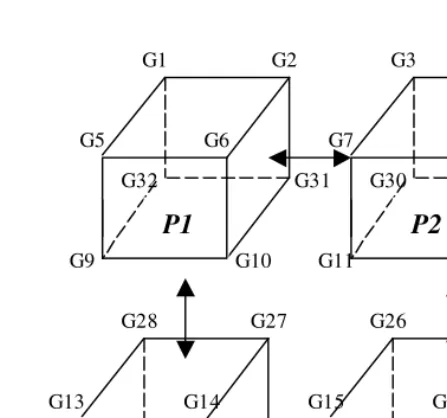
A typical parallel implementation involves the assignment of a block of grids to each task to a surface so that each task only communicates with its limited nearest neighbours. Only the top, bottom, left and right surfaces of the block need to be exchanged between neighbouring tasks. As an example, Fig. 2 illus-trates the pattern of communication with 4 tasks (p= 4) on a linear system of orderm= 32.
It is also important to maintain load balancing in the distribution of m grids to tasksP1, P2, . . . , Pp. The data decomposition of the AGEB algorithm is
run asynchronously and simultaneously at every time level, where each task is allocatedm/pgrids. It proceeds for every task at each time level until the local error and the approximate solution are computed at the last time level. These tasks then send the local errors to the master, which in turn processes the global error.
On the PVM, parallel implementation of AGEB is based on one master and many tasks. The master program is responsible in constructing themgrid sizes, computing the initial values, portioning the grid into blocks of surface, assigning these blocks to theptask modules, distributing the task to different processors and receiving local errors from the tasks. Each block that is assigned to a task module is composed of m/pblocks.
A task process starts computations after it receives a work assignment. A task module q(q < P) performs the AGEB iterations on the grid points of the assigned block which is composed of surfaces with indices between
SURq(start) = m(qp−1) and SURq(end) = mqp −1 ,
G1 G2
G5 G6
G9 G10 G31 G32
G3 G4
G7 G8
G11 G12 G29 G30
G28 G27
G13 G14
G17 G18 G23 G24
G26 G25
G15 G16
G19 G20 G21 G22
P1
P3
P2
P4
Fig. 2.Communication of data exchange between 4 tasks and 32 grids
i. to its upper neighbour (taskq−1),SURq(start) and receive from it
SURq(start)−1 =SURq−1(end)
ii. to its lower neighbours (taskq+ 1),SURq(end) and receive from it
SURq(end) + 1 =SURq+1(start) .
Since multiple copies of the same task code run simultaneously, the tasks will exchange data with their neighbours at different times. At this point, the barrier function is called by the PVM library routine for synchronisation. The tasks will repeat the above procedure, until the local convergence criterion is met. The definition of the residual computed in the taskq is as follows,
r[i][j][k] = maxnu[i,j,kN+1]−ui,j,k[N] , (i, j, k)∈qo .
The tasks will return all its local errors to the master module. After receiving the locally converged blocks from the tasks, the master module checks whether the global convergence is satisfied,
This procedure is repeated and the system terminates if a global convergence is reached. Otherwise the master repartitions the blocks and reassigns them to theptasks.
4 Numerical Results and Discussion
The following problem is solved using the AGEB algorithm, ∂U
∂t = ∂2U
∂x2 + ∂2U
∂y2 + ∂2U
∂z2 +h(x, y, z, t), 0≤x, y, z, t≤1, t≥0 , with
h(x, y, z, t) = (3π2−1)e−tsinπxsinπysinπz ,
subject to the initial condition,
U(x, y, z,0) = sinπxsinπysinπz , and boundary conditions
U(0, y, z, t) =U(1, y, z, t) =U(x,0, z, t) =U(x, y,0, t) =U(x, y,1, t) = 0 , Our PVM platform consists of a cluster of 9 SUN Sparc Classic II work-stations each running at a speed of 70 MHz and configured with 32 Mbytes of system memory. The workstations are connected by a 100/10 base T/3com Hub, Super stack II via a Baseline Dual Speed Hub 12 port network. The PVM software only resides in the master processor.
As measures of performance of our algorithm, the following definitions are used:
Speed-up ratio Sp=T1/Tp (9)
Efficiency Ep=Sp/p (10)
Effectiveness Fp=Sp/Cp (11)
whereCp=pTp,T1the execution time on a serial machine andTpthe computing
time on a parallel machine withpprocessors.
Fig. 3.Speedup ratio vs Number of processors
memory of the system. The speedup starts to degrade when more than 5 pro-cessors are used. It must also be noted that the timing for message passing is relatively slow for inter-processor communication using Ethernet Card 10-based network.
As expected, Fig. 4 depicts that efficiency decreases with increasing p. It deteriorates when more than 3 processors are used. This deterioration is a result of poor load balancing attained when only the small block is spread across more than 3 processors. Hence the high overhead cost due to synchronisation. From (9)–(11),
Fp=Sp/(pTp) =Ep/Tp=EpSp/T1
which clearly shows thatFpis a measure both of speedup and efficiency.
There-fore, a parallel algorithm is said to be effective if it maximises Fp and hence
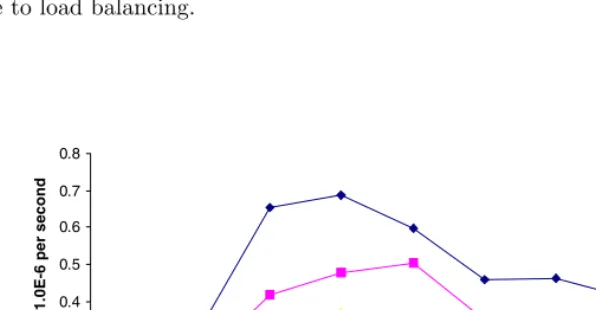
FpT1(= SpEp). From Fig. 5, we see thatFpT1 has a maximum when p= 3 for m= 39 which indicates thatp= 3 is the optimal choice of number of processors. Similarly, we can infer fromm= 45 and 55 that the optimal choice of number of processors is given respectively by p= 3 and p= 4 allowing for inconsistencies due to load balancing.
0 0.1 0.2 0.3 0.4 0.5 0.6 0.7 0.8
1 2 3 4 5 6 7 8 9
No. of processors
Effectiveness x 1.0E-6 per second
m=39 m=45 m=55 m=65
Fig. 5. vs Number of processors
As a general conclusion, the inherently explicit, stable and highly accurate algorithm is found to be well suited for parallel implementation on the PVM where data decomposition is run asynchronously and concurrently at every time level.
5 Conclusions
The stable and highly accurate AGEB algorithm is found to be well suited for parallel implementation on the PVM where data decomposition is run asyn-chronously and concurrently at every time level. The AGEB sweeps involve tridiagonal systems which require the solution of (2×2) block systems. Ex-isting parallel strategies could not be fully exploited to solve such systems. The AGEB algorithm, however, is inherently explicit and the domain decomposition strategy is efficiently utilised.
The PVM is favoured to MPI as the computing platform because of the flexibility of the former to communicate across architectural boundaries. This is especially relevant since this research project was initially undertaken with the view of utilising readily available heterogeneous cluster of computing resources in our laboratories. Furthermore, we have already noted that higher speedups could be expected for larger problems. Coupled with this is the advantage that the PVM has on its fault tolerant features. Hence, for large real field problems which we hope to solve in the immediate future these features become more important as the cluster gets larger.
Acknowledgments
The authors wish to express their gratitude and indebtedness to the Universiti Kebangsaan Malaysia, Universiti Tenaga Nasional and the Malaysian govern-ment for providing the moral and financial support under the IRPA grant for the successful completion of this project.
References
1. Evans, D.J., Sahimi, M.S.: The Alternating Group Explicit Iterative Method (AGE) to Solve Parabolic and Hyperbolic Partial Differential Equations. In: Tien, C.L., Chawla, T.C. (eds.): Annual Review of Numerical Fluid Mechanics and Heat Transfer, Vol. 2. Hemisphere Publication Corporation, New York Washington Philadelphia London (1989)
2. Yanenko, N.N.: The Method of Fractional Steps. Springer-Verlag, Berlin Heidelberg New York (1971)
3. Evans, D.J., Sahimi, M.S.: The Alternating Group Explicit(AGE) Iterative Method for Solving Parabolic Equations I: 2-Dimensional Problems. Intern. J. Computer Math. 24 (1988) 311-341
4. Peaceman, D.W.: Fundamentals of Numerical Reservoir Simulation. Elsevier Sci-entific Publishing Company, Amsterdam Oxford New York (1977)
5. Geist, A., Beguelin, A., Dongarra, J., Jiang, W., Manchek, R., Sunderam, V., PVM: Parallel Virtual Machine & User’s Guide and Tutorial for Networked Parallel Computing. MIT Press, Cambridge, Mass (1994)
6. Hwang, K. and Xu, Z., Scalable Parallel Computing: Technology, Architecture, Programming. McGraw Hill, (1998)
8. Quinn, .M.J., Parallel Computing Theory and Practice, McGraw Hill, (1994) 9. Wilkinson,.B. and Allen, M., Parallel Programming Techniques and Applications