MULTI-OPERATION DATA ENCRYPTION MECHANISM
USING DYNAMIC DATA BLOCKING AND RANDOMIZED
SUBSTITUTION
IJAZ ALI SHOUKAT
MULTI-OPERATION DATA ENCRYPTION MECHANISM USING DYNAMIC DATA BLOCKING AND RANDOMIZED SUBSTITUTION
IJAZ ALI SHOUKAT
A thesis submitted in fulfilment of the requirements for the award of the degree of
Doctor of Philosophy (Computer Science)
Faculty of Computing Universiti Teknologi Malaysia
ACKNOWLEDGEMENT
On completion of my PhD Thesis, I significantly gratified and grateful to “Allah” Who endowed this passionate and flourishing occasion in my life.
Furthermore, I appreciate the devoted and continuous support of my parents and family members in my entire academic pursuits.
Immensely, I would like to express my special and enthusiastic gratitude to my respected Supervisor Professor Dr. Kamalrulnizam Abu Bakar who prop up me in my thesis with technical directions, creative suggestions and supportive criticisms in order to polish my research abilities. I always found him encouraging, compassionate and sincere upon each request and query. I found myself repeatedly assisted with his professional and scientific exposure throughout the PhD program. I will forever be thankful to him for his fundamental and vital role in the completion of my degree.
ABSTRACT
ABSTRAK
TABLE OF CONTENTS
CHAPTER TITLE PAGE
DECLARATION ii
DEDICATION iii
ACKNOWLEDGEMENT iv
ABSTRACT v
ABSTRAK vi
TABELE OF CONTENTS vii
LIST OF TABLES xii
LIST OF FIGURES xiii
LIST OF ABBREVIATIONS xvi
LIST OF SYMBOLS xvii
LIST OF APPENDICES xviii
1 INTRODUCION 1
1.1 Overview 1
1.2 Problem Background 3
1.2.1 Fixed Data Blocking 4
1.2.2 Static Substitution 7
1.2.3 Static and Identical Enciphering Operations 9
1.3 Problem Statement 10
1.4 Research Questions 11
1.5 Research Aim 12
1.6 Research Objectives 12
1.7 Significance of the Study 12
1.9 Thesis Structure 14
2 LITERATURE REVIEW 16
2.1 Introduction 16 2.2 Background and Taxonomy of Secret Writings 17
2.3 Fixed Block Sized Symmetric Cryptosystems 20 2.3.1 Data Encryption Standard (DES) 20 2.3.2 Triple Data Encryption Standard (TDES) 26 2.3.3 Advanced Encryption Standard (AES) 28
2.4 Variable Block Ciphers 35 2.4.1 RC5 35
2.4.2 RIJNDAEL 36
2.4.3 CRYPTON 37 2.4.4 Modified Symmetric Encryption Algorithm 38
2.4.5 Variable Size Block Encryption using Dynamic
Key Mechanism 38
2.4.6 Message based Random Variable Length Key
Encryption Algorithm 39
2.5 Comparison of Symmetric Encryption Algorithms 40 2.6 Related Work for Variable Data Blocking 43 2.7 Related Work for Randomized Substitution
Mechanism 48
2.8 Related Work for Multi-operation base Dynamic
Enciphering Mechanism 55
2.9 Research Gap and Evolution 61
2.10 Summary 64
3 RESEARCH METHODOLOGY 65
3.1 Introduction 65
3.2 Overall Research Plan and Research Framework 66
3.3 Research Design and Procedure 69 3.3.1 Proposed Research Design Comparison 69
3.3.3 Phase 2: Procedural Design of RSM 76
3.3.4 Phase 3:Procedural Design of MoDEM 78
3.4 Testing, Evaluation and Validation Methods 80 3.4.1 Steps for Experimental Testing of DDBM 81 3.4.2 Steps for Experimental Evaluation of RSM 83
3.4.3 Steps for Testing of MoDEM 85
3.4.4 Experimental Setup for Statistical Evaluation 85
3.4.5 Testing of Common (Known) Attacks 87 3.4.6 Testing of Brute Force Strength 88
3.5 Assumptions 89
3.6 Summary 90
4 DYNAMIC DATA BLOCKING MECHANISM 91
4.1 Introduction 91 4.2 Overview of Dynamic Data Blocking Mechanism 91
4.3 Design of DDBM 92
4.3.1 Logical Key Blocking Mechanism 95 4.3.2 Last Block Management Algorithm 97
4.4 Development of Proposed Dynamic Data Blocking
Mechanism 99
4.5 Experimental Setup 99
4.6 Results and Analysis 100
4.6.1 Performance Evaluation 105
4.7 Summary 109
5 RANDOMIZED SUBSTITUTION MECHANISM 110
5.1 Introduction 110
5.2 Overview of Randomized Substitution Mechanism 111
5.3 The Design of RSM 111
5.3.1 Session Key Generation and Mixing Algorithm 113
5.3.2 The Permutation Operation 114
5.3.3 Data Modification Algorithm 117
5.5 Experimental Setup 119
5.6 Results and Analysis 120
5.7 Summary 129
6 MULTI-OPERATION DATA ENCRYPTION
MECHANISM
130
6.1 Introduction 130
6.2 Overview of MoDEM 131
6.3 The Design of Proposed MoDEM 132
6.3.1 Selection and Control of Encryption and
Decryption Operations 134
6.4 Encryption and Decryption Operations for MoDEM 135
6.5 The Development of MoDEM 144
6.6 Experimental Setup 145
6.7 Results and Analysis 147
6.7.1 Statistical Evaluation and Validation 151
6.7.2 Performance Evaluation 165
6.7.3 Results of Testing Common Attacks 167 6.7.4 Testing and Justification of BFS 169 6.7.4.1 BFA Calculation of Propose Method 170
6.7.4.2 BFA Calculation of AES-128 170
6.7.4.3 BFA Calculation of TDES 170
6.8 Summary 173
7 CONCLUSION 175
7.1 Introduction 175
7.2 Achievements 175
7.2.1 The First Contribution Achieved through
DDBM 176
7.2.2 The Second Contribution Achieved through
RSM 177
7.2.3 The Third Contribution Achieved through
7.3 Limitations 180 7.4 Future Directions and Research Opportunities 181
7.5 Concluding Statement 182
REFERENCES 185
LIST OF TABLES
TABLE NO. TITLE PAGE
1.1 Randomness Comparison Between Dynamic and Static
Data Blocking 5
2.1 Comparison of symmetric algorithms 41
2.2 Cryptanalysis of AES 47
2.3 Previous Dynamic S-box Schemes 53
3.1 Overall Research Plan 66
3.2 Comparison of Proposed and Prior Design Parameters 70
3.3 Block Management Conditions 75
3.4 Recommended Statistical Tests with Descriptions 82 3.5 Setting of STS Parameters for Statistical Tests 86 4.1 Dynamic blocks against different keys and data 103 4.2 Comparison of DDBM with Prior Approaches 107 5.1 Five Statistical Tests with constant Result each time 121 6.1 OP-CODES with Encryption and encryption
Operations 135
6.2 Strict Key Avalanche Effect Keeping Data Constant 148 6.3 Plaintext Avalanche Effect with 1 bit Key Change 149 6.4 Three Statistical Tests with Constant Results each time 152
6.5 Results of Testing Common Attacks 168
LIST OF FIGURES
FIGURE NO. TITLE PAGE
2.1 Taxonomy of Secret Wirings 18
2.2 Road Map of Literature Review 19
2.3 Feistel Structure 21
2.4 Encryption and Decryption Flow of DES algorithm 21
2.5 Single Round Linear Cryptanalysis 24
2.6 TDES Known IV Attack 27
2.7 Substitution-Permutation Network (SPN) 29
2.8 Working Flow of AES 30
2.9 AES Boxes Operation of AES 31
2.10 Shifting of Row in AES 31
2.11 Mixing of Column in AES 32
2.12 Add Round Key Scheduler of AES 32
2.13 Cipher-Text Stealing 44
2.14 VIL-Enciphering Architecture 45
2.15 PN-Sequence Logic 49
2.16 Session Key Generation Method for Dynamic S-box 51
2.17 Chaotic Map based Dynamic S-box 52
2.18 Example of S-box and Permutation for SPN 56
3.1 Research Framework 68
3.2 Design Distinction between proposed Method and AES-128
70 48 3.3 Dynamic blocking mechanism vs. fixed data blocking
mechanism 72
3.4 The Procedural Design and Evaluation Methodology of
3.5 The Procedural Design and Evaluation Methodology of
RSM 77
3.6 The Procedural Design and Evaluation Methodology of
MoDEM 79
4.1 Proposed Dynamic Data Blocking Mechanism with
Working Flow 93
4.2 Conditions for 128 to 256 bit Block Management 96
4.3 Logical Key Blocking Mechanism 96
4.4 Dynamic Blocks against (K1, D1) 101
4.5 Dynamic blocks against (K2, D1) 101
4.6 Dynamic blocks against (K3, D3) 102
4.7 Dynamic blocks against (K4, D4) 102
4.8 Dynamic sized blocks against different keys and data 104 4.9 CPU Utilization against different Input Samples 106 4.10 Average CPU Utilization against different number of
blocks 107
5.1 RSM Design With Working Flow 112
5.2 Visualization of Permutation for 1-round 115 5.3 Statistical Results of Run Test against RSM 122
5.4 Mono-bit Frequency of RSM 123
5.5 Linear Complexity of RSM 124
5.6 Cumulative Sum Test of RSM 125
5.7 Block Frequency Results of RSM 126
5.8 Spectral (DFT) Results of RSM 127
6.1 Overall Study Goals and Contributions 132
6.2 Multi-operation Data Encryption Mechanism 133 6.3 The Alpha Encryption Operations OP-CODE (01) 136
6.4 The Beta Operations OP-CODE (10) 140
6.5 The Gamma Operation OP-CODE(00) 142
6.6 The Zeta Operation OP-CODE(11) 143
6.7 Parameter Setup of NIST Statistical Test Suite (STS) 146 6.8 Avalanche Comparison of Proposed and Prior
6.9 Mono-bit Frequency Results 154
6.10 Block Frequency Distribution 155
6.11 The Binary Matrix (Rank) Test Results 156
6.12 Results of Cumulative Sum Test 157
6.13 Linear Complexity 158
6.14 Results of Overlapping and non-overlapping Templates 159
6.15 Universal Test Results 160
6.16 Spectral (DFT) Results 161
6.17 The Run Test Results 162
6.18 Functional Execution Time 165
6.19 Comparison of Encryption Rounds with proposed
Algorithm 166
LIST OF ABBREVIATIONS
AES – Advanced Encryption Standard
AVG – Average
BFS – Brute Force Strength
DBAV – Data Block Average Value DCA – Differential Cryptanalysis
DDBM – Dynamic Data Blocking Mechanism DES – Data Encryption Standard
DMA – Data Modification Algorithm FDBM – Fixed Data Blocking Mechanism IETF – Internet Engineering Task Force ISO – International Standard Organization KBDV – Key Block Decimal Value
LBMA – Last Block Management Algorithm LFSR – Linear Feedback Shift Register
MoDEM – Multi-operation Data Encryption Mechanism NIST – National Institution of Standard and Technology OP CODE – Operation Code
RSM – Randomized Substitution Mechanism RXOR – Reverse Exclusive OR
SKGMA – Session Key Generation and Mixing Algorithm SPN – Substitution-Permutation Network
STS – Statistical Testing Suite
LIST OF SYMBOLS
DB – Data Blocks
B – Bits
μ – Number of bits of each block
β – Number of data blocks
ℬlx – block length
K – Initial Master Secret Key
ΔK – Session Key
D – Plaintext
Ć – Cipher Text
μ – Number of block bits
₱ – Probabilistic Randomness
∃Dℬ – Encrypted Data Block
Dℬav – Data block Average Value
KβDV – Key Block Decimal Value
– Belongs to
– Not equal to
⇒ – Implies that
ΔD – Chosen Plain Text
ΔĆ – Chosen Cipher Text
ßD – Known Plain Text
⊕ – Exclusive XOR
LIST OF APPENDICES
APPENDIX TITLE PAGE
CHAPTER 1
INTRODUCTION
1.1 Overview
Security is the major driving force for remote communication. Security against confidential transactions cannot be compromised over insecure communication channels. Variety of cryptosystems persist to offer encryption heuristics for such kind of transactions but the question of security strength of underlying algorithm matters against cryptanalysis attacks. Cryptanalysis is a way of breaking cryptographic algorithms using analytical reasoning, pattern locating, guessing and statistical analysis approaches as discussed in (Ayushi, 2010). Exhaustive key searching is commonly used, efficient and successful attack to defeat the security strength of any cryptographic algorithm discussed by Jarvinen (2008). Therefore, differential cryptanalysis, exhaustive key searching, shortcut attacks and side channel attacks are creating anxious and perilous scenario for remote communication. It is too critical to remain competitive in forgoing market with data privacy and security without the science of cryptography. Currently, symmetric cryptosystems are prime heuristics in designing of secure cryptosystems (Yadav, 2010) with several benefits such as short key length, computational efficiency and
attacks as reflected through many studies against advanced encryption standard (Alex and Johann, 2012; Derbez et al., 2013; Bogdanov et al., 2014; Chang et al., 2015; Gangadari et al., 2015).
Existing well-known encryption algorithms such as Advanced Encryption Standard (AES) and Data Encryption Standard (DES) are reliant on a reality of fixed data blocking (FIPS Pub 46; Chavan and Annadate, 2015) which means the block size (bit length) is not dynamic, fully known and total number of blocks against a plain text are also known before initiating encryption phase. AES deals with 8 bit static substitution and 128 bit fixed data blocking (Senthilkumar and Rajamani, 2014; Abdulgader et al., 2015). Similarly, DES contains 64 bit fixed block size (Jain et al., 2015). In existing algorithms (e.g. AES), each time fixed set of known and identical encryption operation are applied to encrypt data (Srinivas et al., 2014; Kaur and Madaan, 2014; Dara and Manochehri, 2014; Saini, 2014) which means there is no multi-operation based dynamic enciphering. Existing dynamic substitutions approaches have been designed to work with fixed-sized data blocking approaches (See Chapter 2, Section 2.7) due to which it cannot fit with dynamic natured ciphers which contains dynamic features such as dynamic data blocking, randomized substitution, dynamic selection of encryption opertions. The knowledge of block sets and fixed sizes are increasingly beneficial for any cryptanalyst to possibly crack any symmetric encryption algorithm (Biryukov et al., 2014; Gangadari et al., 2015). Static substitution causes less random permutation and is the primary weakness of existing block ciphers (Ritter, 1998; Mehla and Kaur, 2014) which means just to increase processing computational ability that can easily be defeated in current era‟s based high computing processors. In this situation, the practical cracking of DES (Biryukov et al., 2010) and academic (theoretical) cracking of all AES versions are noteworthy (Biryukov et al., 2009; Biryukov and Großschäd, 2012; Chang et al., 2015).
al., 2015). On 8 rounds of AES-192 and AES-256, the key recovery attack takes 2172 and 2196 time complexities respectively which give overall 2107 chose plaintext complexity with 296 memory lookup trails as well as 9-rounds based key recovery attack requires 2120 chosen plaintext complexity with 2203 memory lookup trails on AES-256 (Derbez et al. 2013). The 10, 11 and full 14 rounds of AES-256 are also vulnerable against modern attacks (Biryukov et al., 2009a; Biryukov et al., 2010; Lu, 2010; Bogdanov et al., 2011; Bogdanov et al., 2014; Chang et al., 2015). Lu (2010) claimed, AES has lowest impossible-boomerang-attack computational complexity (256) and according to Biryukov the quasi-practical attack takes only 270 time traces to recover 11 rounds of AES-256 with 245 time complexity having 233 memory lookups and 244 data complexity trials. This gives almost practical cracking complexity of (q.267) queries against full rounds of AES-256. Furthermore in year 2014 and 2015 the cryptanalysis of full rounds of AES remained carry on with further improvements. For full rounds of all AES versions (128, 192 and AES-256), the latest and outperformed attack complexities (2125.56, 2189.51 and 2253.87) have been found respectively (Bogdanov et al., 2014). The large scale machine (hardware) based attacks are also feasible on AES-128 and AES-256 which can be applied with time complexity of 2100 search trails (Biryukov and Großschäd, 2012). The hashing based biclique-cryptanalysis of AES-128 was conducted by change et al., (2015) and he observed that attack complexities lie between 2126.3 up to 2127.4 search trails. Thus, the critical literature findings show that full rounds of all AES versions are vulnerable to modern cryptanalysis attacks and overall discussion made in this section triggers the need of significant design parameters such as dynamic data blocking rather to fixed data blocking, randomized substituion rather to static substitution and dynamic selection of encryption operations as compare to static and identical selection of encryption operations in symmetric cryptosystems to encrypt data.
1.2 Problem Background
1.2.1 Fixed Data Blocking
Existing well-know symmetric cryptosystems (AES, DES, TDES) use fixed sized data blocks (FIPS Pub 46; Mehla and Kaur, 2014; Jain et al., 2015) with Substitution-Permutation Network (SPN) or Feistel cipher structure (Tu et al., 2015) which means they did not create dynamic sized blocks. Due to the lack of dynamicity in data blocking, the fixed sized block parameters help the cracker in cryptanalysis inspection as discussed by Biryukov et al., (2014), in case of Feistel based block ciphers (SIMON and SPECK), he considered four differential (d1, d2,….d4) to
recover key of SIMON32 through constructing of one set of 223 fixed plaintexts blocks (each with 9 bits) and he was succeed to locate several plaintext pairs 225 for each differential (di). In case of 4 key guess approach upon 2 ciphered rounds, to
locate 230.5 plaintext pairs, the achieved complexity was {233.5 * 4* (2/29)} ≈ 232 which gives ultimate 234 computational complexity to apply full key recovery attack. Moreover as compare to the random permutation on fixed or same sized (length) blocks, the differential attacks always provide larger differential probability for cryptanalysis (Lu, 2008; Lu, 2010) which has reflected the full cracking of all AES versions (128, 192, 256) with computational complexities trails 2125.56, 2189.51 and
2253.87 respectively (Bogdanov et al., 2014) because AES also uses fixed sized data
blocking. Several other studies about the cryptanalysis of AES are the part of literature (Une and Kanda , 2007; Biryukov et al., 2009; Alex and Johann, 2012; Derbez et al., 2013; Chang et al., 2015).
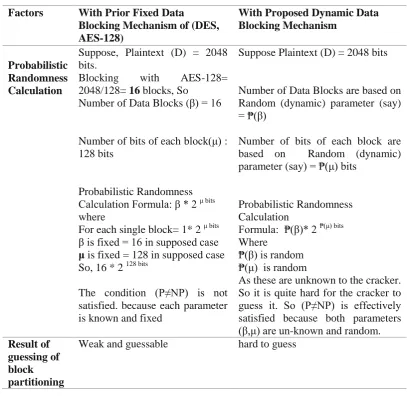
to which the brute force attack is more likely and effectively to be applicable as explained in Table 1.1.
Table 1.1: Randomness Comparison between Dynamic and Static Data Blocking
Factors With Prior Fixed Data
Blocking Mechanism of (DES, AES-128)
With Proposed Dynamic Data Blocking Mechanism
Probabilistic Randomness Calculation
Suppose, Plaintext (D) = 2048 bits.
Blocking with AES-128=
2048/128= 16 blocks, So
Number of Data Blocks (β) = 16
Number of bits of each block(μ):
128 bits
Probabilistic Randomness
Calculation Formula: β * 2 μ bits
where
For each single block= 1* 2 μ bits
β is fixed = 16 in supposed case
μ is fixed = 128 in supposed case
So, 16 * 2 128 bits
The condition (P≠NP) is not satisfied. because each parameter is known and fixed
Suppose Plaintext (D) = 2048 bits
Number of Data Blocks are based on Random (dynamic) parameter (say) = ₱(β)
Number of bits of each block are based on Random (dynamic) parameter (say) = ₱(μ) bits
Probabilistic Randomness Calculation
Formula: ₱(β)* 2 ₱(μ) bits
Where
₱(β) is random ₱(μ) is random
As these are unknown to the cracker. So it is quite hard for the cracker to guess it. So (P≠NP) is effectively satisfied because both parameters (β,μ) are un-known and random.
Result of guessing of block partitioning
Weak and guessable hard to guess
and similarly the Rijndael (Daemen and Rijmen, 2002) has also three fixed and known block sizes (128,192,256 bits). User can select any of block size from the 3 available options. These block sizes are publically known, variable in nature but not dynamic in nature. The Modified Symmetric Encryption Algorithm (MSEA) (Kumar et al., 2014) provides large block size selection list (128, 192, 216, 256…728, 936, 1024, 1384, 1712, 2048 bits) these are also fixed and publically known. Therefore, MSEA also provides fixed and known variable block sizes which are not dynamic in nature. In case of MSEA the many block size options (728, 936, 1024, 1384, 1712, 2048 bits) are inadequate because the block size range that has been used in recent well-known algorithms (DES, AES) lies among (64, 128, 256 bits) which means the block size larger to 256 bit is not a recommended approach. Many other ideas of dynamic encryptions are either based on dynamic Steganography approach with fixed block size (Sawant et al., 2015) or variable blocking using dynamic key (Shyamala-Bai et al., 2011) or pair of keys (static and dynamic) with fixed block size (Harmouch and Kouch, 2015) which means their data blocking approach is not dynamic.
The variable block partitioning policy of Message Based Random Variable Length Key Encryption Algorithm (MRVLK) (Mirvaziri et al., 2009; Davahli et al., 2014) is based on a secret number ranged from (Rnd: 7 to 61) in which initial (very
first) block size is decided in between 7 to 61 and other block sizes become arbitrary longer in such a way: (Rnd, 2Rnd, 4Rnd, 6Rnd ……). But, MRVLK has several
discrepancies such as, it‟s very first small-sized block (Mirvaziri et al., 2009) for
Concussively, fixed sized blocking (AES, DES) and fixed padding are more helpful (Biryukov et al., 2014) for cracker in succeeding of exhaustive key searching attack (brute-force attack) (Du and Atallah, 2001), reaction attack (Bellare et al., 2004), biclique attack (Chang et al., 2015) as well as other cryptanalysis attacks on AES (Bogdanov et al., 2014; Guo et al., 2014). Random padding is fine but not always especially in case if block size is fixed or known (e.g. 128 bit in AES) because if the random padding (e.g. 16 bits) has been used with 128 bits fixed block size which simply meaning that (128-16 = 112 bits) resulting many bits (112 bits) as a “waste bits” in cipher-text (C) due to which attacker can recover secret key bits through matching all possible keys (K ∈ K’) until block cipher (E-1K’(C)) starts with
112 zeros (Black and Rogaway, 2002), thus random-padding also provides trapdoor to render the algorithms vulnerable through back-door of an encryption key (Russell et al., 2015). Variable-input-length (VIL) based cipher designs associate several
issues such as infeasibility of encrypting disk sectors, weak security strength with smaller sized message, fixed padding, known-bit and weak block attacks (Bellare and Rogaway, 1999; Patel et al., 2005; Zhang, 2012; Nandi, 2014) that demand the improvement in data blocking approach with dynamic features such as block size should be dynamic rather to fixed or variable, must be multiple of 8 without fixed padding, not greater than 256 bits, and must not be known to the cracker.
1.2.2 Static Substitution
further mapped with XOR table entries q,f ∈ (0, 1, 2 …… 2m-1) deal with position q , f having {value|(Z ∈ {0, 1}m : S(Z) ⊕ S(Z ⊕ q) = f)|}. Thus, modern cryptanalysis attacks ideally demand fixed (static) relationship of input and output bits with S-boxes that prompt the need of key dependent randomized substitution policy (Senthilkumar and Rajamani, 2014). Furthermore, the substitution policy of AES is based on static numerical search tables which lead the AES to vulnerable against modern security attacks and have not been shown safe in terms of designing various cryptanalysis methods (Moreno-Diaz and Pichler, 2011; Gangadari et al., 2015).
be done against the probabilistic random values achieved from key. All these evidences negate the utilization of static (fixed) substitution in future cryptosystems.
1.2.3 Static and Identical Enciphering Operations
Each AES version has fixed number of multiple encryption rounds with repetition of identical (similar) operations having known strategies (Saini, 2014; Srinivas et al., 2014; Kaur and Madaan, 2014) and last-round-attack can be applied
on the final round of AES because this round does not apply mix-column operation (Tange and Andersen, 2014). AES encryption operations are publically well-known which is more serious aspect towards AES because the linear and differential attack always require known S-box transformation (Kazlauskas et al., 2015) but on the other hand, the dynamic transformation which is not known to the cracker makes the algorithm more resistive against modern attacks (Al-Wattar et al., 2015; Velayutham et al., 2015). Moreover, each round in AES is identical and computationally feeble (Mirvaziri et al., 2009) which are unclear to predict whether large number of rounds with fixed operations are really feasible to create strong enciphering as agreed by Ritter, (1998) in US Patient No. 5727062. Furthermore, existing enciphering designs (Feistel, SPN) are not reliably secure or suspected against various cryptanalysis attacks (Brown et al., 2009; Isobe and Shibutani, 2013; Biryukov and Nikolic, 2014; Guo et al., 2014). The other more surprising fact that reflecting the weakness of current enciphering mechanism is the cracking of DES (Franke et al., 2005; Batina et al., 2005; Zaidan et al., 2010) and the cryptanalysis of AES (Biryukov et al., 2009; Biryukov et al., 2010; Biryukov and Großschäd, 2012; Derbez et al., 2013; Chang et al., 2015) which has been discussed in Chapter 2.
Enhancing the randomness means enhancing the security of encryption algorithm (Al-Shakarchi, 2014). Poor, predictable and repeated randomness can be resulted as full security breakdown of cryptosystems (Ristenpart and Yilek, 2010; Alimomeni, 2014). Thus, for designing secure algorithms, randomness and dynamicity are the needy constraints because randomness enhances confusion to resist modern and common attacks (Cook, 2006; Mishra and Mankar, 2012). All these evidences prompt that the cryptographic algorithm is always as secure as it contains randomness and operational dynamicity. The solution to cope the issue of constant and static selection of encryption operations in prior algorithms (DES, AES) requires the need of dynamic selection of encryption operations by developing multi set of operations having sub-operations inside. This type of multiple operation development approach is known as design diversity approach and it can be achieved through joint committee of different sub-operations under a master encryption operation (Schneier, 1994). Currently, multi-encryption is the most focused area of development for symmetric cryptosystems (Harmouch and Kouch, 2015). Currently, there is a significant gap of this type of particular feature (i.e. dynamic selection of encryption operation for each data block) in existing literature.
1.3 Problem Statement
substitution and constant implementation of fixed set of known enciphering operations are the critical factors limiting the dynamicity and randomness in cryptosystems as reflected through mathematical cracking of AES-256 up to full of its14 rounds.
1.4 Research Questions
Prominent literature problems prompt the need to answer these several research questions.
i. How to improve fixed data blocking approach in symmetric cryptosystems with dynamic data blocking:-
(a) How to achieve effective and dynamic sized data blocks?
(b) How to avoid fixed padding and weak sized dynamic block even by fulfilling the condition of multiple of 8 bits?
ii. How effectively to enhance static substitution policy in symmetric cryptosystems with randomized substitution approach:-
(a) How to achieve key-dependent randomized substitution?
(b) How to enhance pseudo-randomness and dynamicity with randomized modifications in key and data?
iii. How to achieve effective and secure encryption in symmetric cryptosystems:-
(a) How to use multi-encryption operations dynamically for each data block?
1.5 Research Aim
The aim of this research is to develop dynamic multi-encryption method by „improving‟ fixed data blocking with dynamic data blocking, static substitution with
randomized substitution and known operation based identical encryption approach with dynamic multi-encryption method to improve data encryption effectively.
1.6 Research Objectives
To answer the projected research questions, this study includes several objectives which potentially required to be accomplished as an optimal solution for the said problem.
i. To develop dynamic data blocking mechanism for converting the data to dynamic sized blocks in order to achieve effective dynamicity and larger computational probability.
ii. To develop a randomized substitution mechanism for mixing (key and Data) through dynamic modifications in order to achieve effective dynamicity and probabilistic randomness.
iii. To develop a multi-operation data encryption mechanism to select enciphering operation dynamically in order to achieve effective data encryption (security) with less number of encryption rounds.
1.7 Significance of the Study
is enriched with great significance of data encryption with optimal security. It provides an encryption method with dynamic design features such as dynamic data blocking, randomized substitution and multi-operation based dynamic enciphering mechanism. These features are an optimal way to enhance the security of data encryption method. Earlier encryption algorithms (DES, AES) possesses static design features in various stages such as data blocking, substitution and selection of enciphering operations which are seriously effecting the overall security of already deployed design ciphers (Feistel, SPN) as discussed in problem background section. These static features are not effectively sufficient to create dynamicity, larger probability and optimal randomness due to which the past cryptanalysis of DES and present academic cracking of AES are being more critical day by day. Thus, the proposed study is timely significant to improve the static design features with dynamic design features through development of dynamic data blocking, randomized substitution and multi-operation data encryption mechanism. The proposed idea is essentially important to boost the security of symmetric cryptosystems. Furthermore, the proposed idea is effectively innovative for the researchers to design future cryptosystems and highly beneficial for the academic researchers to evolve the cryptography research.
1.8 Research Scope
This study focuses on symmetric data encryption method for providing both data privacy and security upon confidential data. The proposed idea mainly covers the design and development of proposed encryption method which includes dynamic data blocking, randomized substitution and multi-operation data encryption mechanism. Furthermore the scope of this study covers:-
i. The different natured plaintext (alphabets, numerical data, special characters or their combination) have been used to make user input samples for testing the system.
iii. Evaluation is done using standard tool - Statistical Testing Suite(STS) recommended by National Institute of Standard and Technology (NIST).
iv. In statistical evaluation, some tests require large sized input sample (106 bit longer sequence) which is recommended by NIST. Therefore, large sequence size has been used for some tests (Serial test, Lempel-Ziv, overlapping and non-overlapping tests).
v. The longer sequence size (1268784 bits) is used for evaluating the Randomized Substitution Mechanism (RSM) during the statistical randomness testing, because the longer parameter length in STS, must be greater than or equal to 106.
vi. The larger sequence (1153440 bits) is used to test the Multi-operation Data Encryption Mechanism (MoDEM) because it is recommended parameter length (≥ 106
) for STS tool.
1.9 Thesis Structure
The rest of this thesis is structured as:-
In Chapter 1, overview, problem background related to fixed data blocking, static substation including static and constant enciphering operations have been discussed to generate problem statement. Furthermore, the study aim, research questions, objectives, significance and research scope have been highlighted.
Chapter 2, provides the extensive literature review of most related research topics (Issues in symmetric cryptosystems, Feistel structure limitations, SPN design deficiencies, other potential security issues, need of proposed design and discussion of latest attacks on AES and DES).
evaluation metrics through which the proposed method can be evaluated. Detail about the recommend statistical tests and tool with experimental setup has also been discussed in this chapter.
Chapter 4, contributes the design, development and evaluation of proposed Dynamic Data Blocking Mechanism (DDBM) which is the first objective of this study. The DDBM has been developed in Visual Studio.Net and its evaluation has been done through practical experimentations.
Chapter 5, provides the design, development and evaluation of proposed Randomized Substitution Mechanism (RSM) by discussing all interrelated steps. The RSM is the second objective of this study which firstly developed through utilizing the Visual Studio. Net tool and after that it has been evaluated and validated by executing several statistical randomness tests (discussed in Chapter 3) by using Statistical Testing Suite (STS) tool recommended by National Institute of Standard and Technolgoy (NIST).
Chapter 6, discusses the design, development and evaluation of Multi-Operation Data Encryption Mechanism (MoDEM) which is the third objective of this study. The proposed MDEM has been developed in Visual Studio. Net and subsequently, it has been evaluated and validated through experimental testing of NIST‟s recommend statistical tests conducted through STS Tool. Mathematical
testing of common attacks against proposed method including brute force strength attack have also been provided in Chapter 6.
REFERENCES
Abdulgader, A., Ismail, M., Zainal, N., and Idbeaa, T. (2015). Enhancement of AES Algorithm Based On Chaotic Maps and Shift Operation For Image Encryption. Journal of Theoretical and Applied Information Technology, 71(1), 1-12. Abomhara, M., Zakaria, O., Khalifa, O. O., Zaidan, A. A., and Zaidan, B. B. (2010).
Enhancing selective encryption for H. 264/AVC using advanced encryption standard. International Journal of Computer and Electrical Engineering, 2(2), 223-229.
Acharya, B. (2015). Towards an automated and customizable linear cryptanalysis of a substitution-permutation network cipher, Master thesis, Washington and Lee University, West Washington.
Agrawal, H., and Sharma, M. (2010). Implementation and analysis of various symmetric cryptosystems. Indian Journal of Science and Technology, 3(12), 1173-1176.
Ahmad, M., Khan, P. M. and Ansari, M. Z. (2014). A simple and efficient key-dependent S-box design using fisher-yates shuffle technique. In Recent Trends in Computer Networks and Distributed Systems Security CCIS,420, 540-550, Springer.
Alabaichi, A., Mahmod, R., and Ahmad, F. (2013). Randomness Analysis of 128 bits Blowfish Block Cipher on ECB and CBC Modes. International Journal of Digital Content Technology and its Applications, 7(15), 77-89.
Alani, M. M. (2012). Neuro-Cryptanalysis of DES and Triple-DES. In Neural Information Processing – Lecture Notes in Computer Science, 7667,637-646.Springer Berlin Heidelberg.
Alimomeni M. (2014). New Notions of Secrecy and User Generated Randomness in Cryptography, Doctoral Thesis, Department Of Computer Science, University Of Calgary, Alberta.
Al-Shakarchi, N. D. (2014). Encryption and Decryption Digital Image Using Confusion System. European Academic Research. 1(11), 3947-3968.
Al-Wattar, A. H., Mahmod, R., Zukarnain, Z. A. et al. (2015). A New DNA based Approach of Generating Key Dependent Shift Rows Transformation, International Journal of Network Security & Its Applications, 7(1), 79-89 Amin, S., F., and Hunnergi, N., S. (2013). Hill Cipher algorithm with Self Repetitive
Matrix for Secured Data Communication. In International Journal of Engineering Research and Technology, 2(9), 2960-2971
Anderson, R., Biham, E., and Knudsen, L. (2000). Serpent and smartcards. In Smart Card Research and Applications (pp. 246-253). Springer Berlin Heidelberg Arora M., (2012), How secure is AES against brute force attacks, EE-Times. Cited at
URL: http://www.eetimes.com/document.asp?doc_id=1279619, Visited on September 2015.
Ayushi, (2010), A Symmetric Key Cryptographic Algorithm. International Journal of Computer Applications. 1(15), 01-04.
Balakrishnan, B. (2010). Three Tier Encryption Algorithm for Secure File Transfer. In Second International Conference on Computer Engineering and Applications, 2, IEEE, 259-263
Batina L., Mentens N., Oswald E., Pelzl J., Priplata C., et al. (2005), DVAM3 Hardware Crackers, ECRYPT-European Network of Excellence in Cryptology, IST-2002-507932
Bellare, M., and Rogaway, P. (1999). On the construction of variable-input-length ciphers. In Fast Software Encryption. 231-244. Springer Berlin Heidelberg. Bellare, M., Kohno, T. and Namprempre, C. (2004). Breaking and provably repairing
the SSH authenticated encryption scheme: A case study of the Encode-then-Encrypt-and-MAC paradigm. ACM Transactions on Information and System Security (TISSEC), 7(2), 206-241.
Bellini, E., Morgari, G., and Coppola, M. (2015). An Extension of Cook's Elastic Cipher. CSIT, arXiv preprint arXiv:1310.4050V2: (01-18)
Biham, E., and Shamir, A. (1993). Differential cryptanalysis of the data encryption standard (1st Edition), ISBN 978-1-4613-9314-6, Pages: 188, Springer-Verlag New York.
Biham, E., and Biryukov, A. (1995). An improvement of Davies' attack on DES. In Advances in Cryptology—EUROCRYPT'94 (pp. 461-467). Springer Berlin Heidelberg.
Biham, E., and Biryukov, A. (1997). An improvement of Davies‟ attack on DES.
Journal of Cryptology, 10(3), 195-205.
Biham, E. (1999). Cryptanalysis of Triple Modes of Operation. Journal of Cryptology, 12(3), 161-184.
Bernstein, D. J. (2005). Cache-timing attacks on AES. Technical Report, 2005, The University of Illinois at Chicago, Chicago, IL 60607-7045.
Biryukov, A. and Kushilevitz, E. (1998). Improved cryptanalysis of RC5. In Advances in Cryptology - EUROCRYPT ‟98, Finland, May 31 - June 4, 1998, Proceeding of Lecture Notes in Computer Science, 1403, 85–99. Springer Biryukov, A., De Canniere, C., Lano, J., Ors, S. B., et al. (2004). Security and
performance analysis of ARIA. Final report, KU Leuven ESAT/SCD-COSIC, 3(2004), 4-58.
Biryukov, A. (2005). The boomerang attack on 5 and 6-round reduced AES. In Advanced Encryption Standard–AES. 3373, 11-15. Springer Berlin Heidelberg. Biryukov, A., and Khovratovich, D. (2009a). Related-key cryptanalysis of the full
AES-192 and AES-256. In Advances in Cryptology–ASIACRYPT 2009. Lecture Notes in Computer Science. 5912,1-18. Springer Berlin Heidelberg. Biryukov, A., Khovratovich, D., and Nikolić, I. (2009). Distinguisher and related-key
attack on the full AES-256. In Advances in Cryptology-CRYPTO 2009. 5677, 231-249. Springer Berlin Heidelberg.
Biryukov, A., Dunkelman, O., Keller, N., Khovratovich, D., and Shamir, A. (2010). Key recovery attacks of practical complexity on AES-256 variants with up to 10 rounds. In Advances in Cryptology–EUROCRYPT 2010.Lecture Notes in Computer Science. 6110, 299-319. Springer Berlin Heidelberg.
Biryukov A., Gong G. (2010), Selected Areas in Cryptography, Douglas R. Stinson (Eds.), ISBN: 978-3-642-19573-0, LNCS, Springer, New York.
Biryukov, A., and Nikolic, I. (2014). Complementing Feistel ciphers. Fast Software Encryption- Lecture Notes in Computer Science, 8424: 3-18, Springer
Biryukov, A., Roy, A., and Velichkov, V. (2014). Differential analysis of block ciphers SIMON and SPECK. In International Workshop on Fast Software Encryption (FSE’14) London, UK, March (3-5), 2014: 546-570
Biryukov, A., and Velichkov, V. (2015). Improved Data Complexity of Attacks on RC5. Early Symetric Crypto ESC-2015, 12-16 January, Luxembourg, 96-103. Black, J., and Rogaway, P. (2002). Ciphers with arbitrary finite domains. In Topics
in Cryptology—CT-RSA . 114-130. Springer Berlin Heidelberg.
Bogdanov, A., Khovratovich, D., Rechberger, C.(2011). Biclique Cryptanalysis of the Full AES. (2011). In Lee, D.H., Wang, X., (Eds).: ASIACRYPT, Lecture Notes in Computer Science, 7073, 344-371, Springer
Bogdanov, A., and Wang, M. (2012). Zero correlation linear cryptanalysis with reduced data complexity. In Fast Software Encryption (pp. 29-48). Springer Berlin Heidelberg.
Bogdanov, A., Chang, D., Ghosh, M., and Sanadhya, S. K. (2014). Bicliques with Minimal Data and Time Complexity for AES (Extended Version). in 16th International Conference on Information Security and Cryptology. 29-30 May, Tokyo, Japan, 1-19
Brown, J. A., Houghten, S., and Ombuki-Berman, B. (2009). Genetic algorithm cryptanalysis of a substitution permutation network. In IEEE Symposium on Computational Intelligence in Cyber Security, 2009. CICS'09. March 30- April 2, Nashville, 115-121. IEEE.
Canteaut, A. and Roué, J. (2015). Differential Attacks Against SPN: A Thorough Analysis. In Codes, Cryptology, and Information Security, LNCS , 9084, 45-62, Springer
Chakraborty, R., Agarwal, S., Misra, S., Khemka, V., et al. (2011). Triple SV: A bit level symmetric block cipher having high avalanche effect. IJACSA) International Journal of Advanced Computer Science and Applications, 2(7): 61-68
Chavan, N. R., and Annadate, S. A. (2015). VHDL implementation of AES-128 on FPGA. International Journal of Innovative Research In Electrical, Electronics, Instrumentation And Control Engineering, 03(01), 43-45.
Chouinard, JY. (2002). Design of Secure Computer System Notes on Data Encryption Standard. CSI4138/CEG4394, PP. 1-31
Cook, D. L. (2006). Elastic block ciphers. Doctoral dissertation, Columbia University, Columbia.
Cook, D. L., Yung, M., and Keromytis, A. D. (2008). Methods for linear and differential cryptanalysis of elastic block ciphers. In Information Security and Privacy (2008), Springer, 187–202.
Cook, D. L., Yung, M., and Keromytis, A. D. (2009). Elastic block ciphers in practice: constructions and modes of encryption. In Proceedings of the 3rd European Conference on Computer Network Defense (2009), Springer, 69–91. Daemen, J., Knudsen, L., and Rijmen, V. (1997). The block cipher Square. In Fast
Software Encryption.LNCS, vol. 1267, 149-165. Springer Berlin Heidelberg Daemen, J., and Rijmen, V. (2000). The block cipher Rijndael. In Smart Card
Research and Applications (pp. 277-284). Springer Berlin Heidelberg.
Daemen, J. and Rijmen, V. (2002). Design of Rijndael. AES—The Advanced Encryption Standard. ISBN 3-540-42580-2, Springer Berlin Heidelberg.
Daemen, J., and Rijmen, V. (2010). The first 10 years of advanced encryption. IEEE Security & Privacy, 8(6), 0072-74.
Daemen, J. and Rijmen, V. (2013). The design of Rijndael: AES-the advanced encryption standard. Springer Science and Business Media, ISBN: 978-3-642-076466, Springer Berlin Heidelberg.
Damico, T. M. (2009). A Brief History of Cryptography. Student Pulse, 1(11): 1-1. Dara, M., and Manochehri, K. (2014). Using RC4 and AES Key Schedule to
Generate Dynamic S-Box in AES. Information Security Journal: A Global Perspective, 23(1-2), 1-9. Taylor & Francis
Das, S., Uz-Zaman, J.K.M.S. and Ghosh R. (2013). Generation of AES S-Boxes with various modulus and additive constant polynomials and testing their randomization, CIMTA-2013, Procedia Technology 10(2013):957–962, Science Direct
Intelligent Computing, Networking, and Informatics, Advances in Intelligent System and Computing 243 (pp. 303-318), Springer
Davahli, A., Mirvaziri, H., and Aminian, M. (2014), Structural Cryptanalysis of the Message Based Random Variable Length Key Encryption Algorithm (MRVLK), Journal of mathematics and computer science 12 (2014), 201-210 David C. W., and Jan Zizka, (2012). Advances in Computer Science, Engineering
and Applications (Dhinaharan Nagamalai Eds.), in Proceedings of the Second International Conference on Computer Science, Engineering and Applications (ICCSEA 2012), May 25-27, Vol. 2, 2012 Springer.
Demirci, H., and Selçuk, A. A. (2008). A meet-in-the-middle attack on 8-round AES. In Fast Software Encryption . LNCS, 5086, 116-126. Springer Berlin Heidelberg.
Demirci, H., Taşkın, İ., Çoban, M., and Baysal, A. (2009). Improved
meet-in-the-middle attacks on AES. In Progress in Cryptology-INDOCRYPT 2009. LNCS 5922, 144-156. Springer Berlin Heidelberg.
Derbez, P., Fouque, P. A. and Jean, J. (2013). Improved Key Recovery Attacks on Reduced-Round AES in the Single-Key Setting. In EUROCRYPT - Advances in Cryptology – 2013, 7881, 371-387, Springer
Dey, H., Das, S., and Ghosh, R. (2014). An Approach to find out the Optimal Randomness of Modified RC4, International Journal of Innovations & Advancement in Computer Science, 3(8),01-10.
Diffie, W., and Hellman, M. E. (1977). Special feature exhaustive cryptanalysis of the NBS data encryption standard. Computer, 10(6), 74-84.
Dinur, I., Dunkelman, O., Keller, N. and Shamir, A. (2015). New Attacks on Feistel Structures with Improved Memory Complexities. In: Advances in Cryptology – CRYPTO 2015, Lecture Notes in Computer Science, 1, 433-454, Springer Doganaksoy, A., Ege, B., Koçak, O. and Sulak, F. (2010). Statistical Analysis of
Reduced Round Compression Functions of SHA-3 Second Round Candidates.Technical Report, Institute of Applied Mathematics, Middle East Technical University, Turkey, IACR Cryptology ePrint Archive, 2010, 611. Du, W. and Atallah, M. J. (2001, December). Privacy-preserving cooperative
Duta, C., Mocanu, B., Vladescu, F. and Gheorghe L. (2014). Randomness Evaluation Framework of Cryptographic Algorithms, International Journal on Cryptography and Information Security, 4(01), 31-49
Ebrahim, M., Khan, S., and Khalid, U. B. (2013). Symmetric Algorithm Survey: A Comparative Analysis. International Journal of Computer Applications, 61(20), 12-19.
Faragallah, O. S., El-Rabaie, E. S. M., El-Samie, F. E. A., et al. (2014). Multilevel Security for Relational Databases. CRC Press.
Feistel, H. (1973). Cryptography and Computer Privacy. Scientific American, 228(5), 15-23. USA.
FIPS PUB 197, (2001). Announcing the Advanced Encryption Standard, Federal Information Processing Standards Publication 197, National Institute of Standard and Technology (NIST), 2001
FIPS PUB 46, (1977). Appendix A, Federal Information Processing Standards Publication 46. National Institute of Standard and Technology (NIST), 1977 FIPS PUB 46-3, (1999). Appendix A, Federal Information Processing Standards
Publication 46. National Institute of Standard and Technology (NIST), 1999 Flamm B. M. (2014). Extending Differential Fault Analysis to Dynamic S-Box
Advanced Encryption Standard Implementations, Master Thesis. Department of Electrical and Computer Engineering, Graduate School of Engineering and Management, Air University, USA.
Fontaine, C., andGaland, F. (2007). A survey of homomorphic encryption for nonspecialists. EURASIP Journal on Information Security, 2007, Article ID: 13801, pp.10 .Hindawi Publishing Corporation.
Franke, J., Kleinjung, T., Paar, C., Pelzl, J., Priplata, C., and Stahlke, C. (2005). SHARK: a realizable special hardware sieving device for factoring 1024-bit integers. In Cryptographic Hardware and Embedded Systems–CHES. 119-130. Springer Berlin Heidelberg.
Gangadari, B. R., Ahamed, S. R., Mahapatra, R. and Sinha, R. K. (2015). Design of Cryptographically Secure AES S-Box Using Cellular Automata, IEEE international conference on EESCO. 978-1-4799-7678, IEEE
Geiselmann, W., Shamir, A., Steinwandt, R., and Tromer, E. (2005). Scalable
factorization. In Cryptographic Hardware and Embedded Systems–CHES
2005, 131-146, Springer Berlin Heidelberg.
Gilbert, H., and Minier, M. (2000). A collisions attack on the 7-rounds Rijndael.Third AES Candidate Conference.
Gondal, M. A., Raheem, A., and Hussain, I. (2014). A Scheme for Obtaining Secure S-Boxes Based on Chaotic Baker‟s Map. 3D Research, 5(3), 1-8.
Goots, N., Izotov, B., Moldovyan, A., and Moldovyan, N. (2003). Modern Cryptography Protect your data with fast block CIPHERS, Wayne, A-LIST Publishing 2003.
Grundgeiger, D. (2002). Programming Visual Basic. NET. (1st Edition), ISBN: 0-596-00093-6, 464 pages O'Reilly Publisher.
Gülmezoglu, B., Inci, M. S., Irazoqui, G., Eisenbarth, T., and Sunar, B. (2015). A Faster and More Realistic Flush+ Reload Attack on AES. In COSADE-2015, 13-14 April, Berlin, 1-16
Gunasundari, T., and Elangovan, K. (2014). A Comparative Survey on Symmetric Key Encryption Algorithms. International Journal of Computer Science and Mobile Applications, 2(2), 78-83.
Guo, J., Jean, J., Nikolić, I., amd Sasaki, Y. (2014). Meet-in-the-Middle Attacks on
Generic Feistel Constructions. In Advances in Cryptology–ASIACRYPT 2014 (pp. 458-477). Springer Berlin Heidelberg.
Harmouch, Y. and El Kouch, R. (2015). A New Algorithm for Dynamic Encryption. International Journal of Innovation and Applied Studies, 10(1), 305-312.
Hellman, M. E. (1980). A cryptanalytic time-memory trade-off. Information Theory, IEEE Transactions on, 26(4), 401-406.
Heys, H. M., and Tavares, S. E. (1996). Cryptanalysis of substitution-permutation networks using key-dependent degeneracy. Cryptologia, 20(3), 258-274. Heys, H. M. (2001). Information leakage of Feistel ciphers. IEEE Transactions on
Information Theory, 47(1), 23-35.
Hong, D., Sung, J., Hong, S., Lee, W., Lee, S., Lim, J., and Yi, O. (2001). Known-IV attacks on triple modes of operation of block ciphers. In Advances in Cryptology—ASIACRYPT. 208-221. Springer Berlin Heidelberg.
Isobe, T., and Shibutani, K. (2013). Generic Key Recovery Attack on Feistel Scheme. In Advances in Cryptology-ASIACRYPT 2013 Lecture Notes in Computer Science, vol. (8269): 464–485. Springer.
Jacob, G., Murugan, A., and Viola, I. (2015).Towards The Generation of A Dynamic Key-Dependent S-Box to Enhance Security, IACR Cryptology ePrint Archive 92,1-5
Jain B., Rao V., chowdhary B. et al. (2015). Secure Mobile Internet Messaging, International Journal of Computer Application, 5(2): 201:205
Jarvinen. K. (2008). Studies on Efficient Implementation of Cryptographic Algorithms, Doctoral Thesis. Department of Signal Processing and Acoustics, Helsinki University of Technology, P.O. BOX 1000, FI-02015 TKK, Finland. Jithendra, K. B., and Shahana, T. K. (2015). Hardware Efficient Parallel Substitution
Box for Block Ciphers with Static and Dynamic Properties. Procedia Computer Science, 46, 540-547, Science Direct
Junod. P. (2004). Statistical Cryptanalysis of Block Ciphers. Doctoral Thesis. Presentee La Faculte Informatique & Communications, Institute de systems de communication.
Kaliski J., R., B. S., and Yin, Y. L. (1995). On differential and linear cryptanalysis of the RC5 encryption algorithm. In Advances in Cryptology—CRYPT0’95 USA, August 27-31, 1995, Proceedings, Lecture Notes in Computer Science, 963,171–184, Springer
Kaur, G., and Madaan, N. (2014). A Comparative Study of AES Encryption Decryption. International Journal. of Science and Research, 3(4), 279-283 Kazlauskas, K., Vaicekauskas, G., and Smaliukas, R. (2015). An Algorithm for
Key-Dependent S-Box Generation in Block Cipher System. INFORMATICA, 26(1), 51-65
Kelsey, J. (2002). Compression and information leakage of plaintext. In Fast Software Encryption (pp. 263-276). Springer Berlin Heidelberg.
Kessler. G. C. (1998).An Overview of Cryptography. Edition 1999. Published in Handbook on Local Area Networks: Auerbach Publishers.
Khatri, N., Dhanda, R., and Singh, J. (2012). Comparison of Power Consumption and Strict Avalanche Criteria at Encryption/Decryption Side of Different AES Standards, International Journal of Computational Engineering Research, 2(4), 1092-1096
Knudsen, L. R. and Meier, W. (1996). Improved differential attacks on RC5. In Advances in Cryptology - CRYPTO ‟96, USA, August 18-22, 1996, Proceedings of Lecture Notes in Computer Science, 1109, 216–228. Springer Knudsen, J. D. L., and Rijmen, V. (1997). The block cipher SQUARE. In Fast
Software Encryption: 4th International Workshop, FSE'97, Haifa, Israel, January 1997. Proceedings (p. 149-165). Springer Berlin/Heidelberg.
Kocher, P., Jaffe, J., Jun, B., and Rohatgi, P. (2011). Introduction to differential power analysis. Journal of Cryptographic Engineering, 1(1), 5-27.
Kumar V, Syed I. (2004). A Project Report On Password Encryption Using DES Algorithm. California State University Hayward
Kumar, S., Paar, C., Pelzl, J., Pfeiffer, G., and Schimmler, M. (2006). Breaking ciphers with COPACOBANA–a cost-optimized parallel code breaker. In Cryptographic Hardware and Embedded Systems-CHES.vol. 4249,101-118. Springer Berlin Heidelberg.
Kumar, R., Mishra, K. K., Tripathi, A., Tomar, A., and Singh, S. (2014). MSEA: Modified Symmetric Encryption Algorithm. IACR Cryptology, 280, 1-14 Lambić, D. (2013). A novel method of S-box design based on chaotic map and
composition method. Chaos, Solitons & Fractals, 58,16-21, Springer
Lee, R. B., Rivest, R. L., Robshaw, M. J. B., Shi, Z. J., and Yin, Y. L. (2004). Permutation Operations in Block Ciphers. Embedded Cryptographic Hardware: Design and Security. In
Nadia Nedjah and Luiza de Macedo Mourelle, editors, Embedded Cryptographic Hardware: Design and Security, Chapter 13. Nova Science Publishers, Hauppauge, NY, USA, 2004
Li, Y., and Cusick, T. W. (2007). Strict avalanche criterion over finite fields. Journal of Mathematical Cryptology, 1(1), 65.
Lim, C. H. (1998). CRYPTON: A new 128-bit block cipher. In the First AES Candidate Conference, National Institute of Standard and Technology.
Proceedings of the 29th Annual ACM Symposium on Applied Computing, ACM, 539-544
Lu J.(2008). Cryptanalysis of block ciphers. PhD Thesis. The University of London, UK (2008). A copy is available online as Technical Report RHUL-MA-2008-19, Department of Mathematics, Royal Holloway, University of London, UK. Lu, J., Dunkelman, O., Keller, N., and Kim, J. (2008). New impossible differential
attacks on AES. In Progress in Cryptology-INDOCRYPT 2008 .LNCS, vol. 5365, 279-293. Springer Berlin Heidelberg.
Lu, J. (2010). The (related-key) impossible boomerang attack and its application to the AES block cipher. Designs, Codes and Cryptography, 60(2), 123-143. Machicao, J., Baetens, J. M., Marco, A. G., et al. (2015). A dynamical systems
approach to the discrimination of the modes of operation of cryptographic systems. Communications in Nonlinear Science and Numerical Simulation. 29(3), 102-115
Maheswari, T., S., Kanagaraj, S. and Vasudevan, S., K. (2014). Enhancement of Cloud Security Using AES 512 Bits, Research Journal of Applied Sciences, Engineering and Technology 8(20), 2116-2120
Mahmoud, E. M., Abd, A., Hafez, E., and Elgarf, T. A. (2013). Dynamic AES-128 with key-dependent S-Box. International Journal of Engineering Research and Applications, 03(01),1662-1670
Mandal, A. K., Parakash, C. and Tiwari, A. (2012). Performance evaluation of cryptographic algorithms: DES and AES. In IEEE Students' Conference on Electrical, Electronics and Computer Science (SCEECS), 2012, IEEE, 1-5 Mankotia, S., and Sood, M. (2015). A Critical Analysis of Some Symmetric Key
Block Cipher Algorithms. International Journal of Computer Science and Information Technologies, 6 (1) : 495-499
Marinakis, G. (2013). Minimum key length for cryptographic security. Journal of Applied Mathematics and Bioinformatics, 3(1), 181-191.
Mehla, R., and Kaur, H. (2014). Different Reviews and Variants of Advance Encryption Standard, International Journal of Science and Research (3(05), 1895-1896
Menezes, V., O. (1997). Handbook of Applied Cryptography, 1997. CRC Press, 200, 6-10.
Merkle, R. C., and Hellman, M. E. (1981). On the security of multiple encryption. Communications of the ACM, 24(7), 465-467.
McMillan, S., and Patterson, C. (2001). JBits™ Implementations of the Advanced
Encryption Standard (Rijndael). In Field-Programmable Logic and Applications. 162-171. Springer Berlin Heidelberg.
Millan, W., Dawson, E. P., and O'Connor, L. J. (1994). Cryptanalysis of tree-structured ciphers. Electronics Letters, 30(12), 941-942.
Min, L., and Chen, G. (2013). A novel stream encryption scheme with avalanche effect. Eur. Phys. J. B, 86, 459.
Minematsu, K. (2008). A study of block cipher modes for encryption and authentication, Doctoral Thesis,Graduate School of Science and Engineering, Waseda University
Mishra, M., and Mankar, V. H. (2012). A Chaotic encryption algorithm: Robustness against Brute-force attack. In Advances in Computer Science, Engineering & Applications (pp. 169-179). Springer Berlin Heidelberg.
Moreno-Diaz R., Pichler F. (2011). Computer Aided Systems Theory, Alexis Quesada Arenicbia Part -1 (Eds.) in 13th Int. Conf. of System Theory- EUROCAST, Spain, 2011.
Mohamed, F. K. (2014). A parallel block-based encryption schema for digital images using reversible cellular automata. Engineering Science and Technology, an International Journal, 17(2), 85-94.
Mohan, H. S., and Reddy, A. R. (2011). Performance analysis of AES and MARS encryption algorithms. IJCSI International Journal of Computer Science Issues,8(4),1694-0814.
Mouha, N. and Luykx, A. (2015). Multi-Key Security: The Even-Mansour Construction Revisited. In Proceeding of CRYPTO 2015, Cryptology ePrint Archive, Report 2015/101. Springer
Mousa, A. (2005). Data encryption performance based on Blowfish. In ELMAR, 2005. 47th International Symposium, (8-10) jun 2005, Zadar, 131-134. IEEE. Mui-Edwin, NC. (2007).Practical implementation of Rijndael S-box using
Combinational logic. Custom R&D Engineer Texco Enterprise Pvt. Ltd. 1-16. Mirvaziri, H., Ismail, K. J., and Hanapi, Z. M. (2009). Message based random
variable length key encryption algorithm. Journal of Computer Science, 5(8), 573-578.
Nandi, M. (2014). XLS is Not a Strong Pseudorandom Permutation. In Advances in Cryptology–ASIACRYPT 2014 (pp. 478-490). Springer Berlin Heidelberg.
Nechvatal, J., Barker, E., Dodson, D., Dworkin, M., Foti, J., and Roback, E. (1999). Status report on the first round of the development of the Advanced Encryption Standard. Journal of Research-National Institute of Standards and Technology, 104(5), 435-460.
Nechvatal, J., Barker, E., Bassham, L., Burr, W., and Dworkin, M. (2000). Report on the development of the Advanced Encryption Standard (AES). Computer Security Division, National Inst Of Standards and Technology, Gaithersburg. Nie, T., and Zhang, T. (2009). A study of DES and Blowfish encryption algorithm.
In TENCON 2009-2009 IEEE Region 10 Conference, (23-26) Jan, 2009, Singapore, 1-4, IEEE.
Paar, I. C., and Pelzl, I. J. (2010). The Advanced Encryption Standard (AES). In Understanding Cryptography (pp. 87-121). Springer Berlin Heidelberg.
Paar C., Pelzl J. (2009). Understanding Cryptography: A Textbook for Students and Practitioners. Springer Science & Business Media - Computers - 372 pages Park, J. J. J. H., Barolli, L., Xhafa, F., and Jeong, H. Y. (Eds.). (2013). Information
Technology Convergence: Security, Robotics, Automations and Communication, Lecture Notes in Electrical Engineering, 253. ISBN: 978-94-007-6995-3,Springer
Pathan, P. K. and Verma, B.(2011). Hyper Secure Cryptographic Algorithm to Improve Avalanche Effect for Data Security. International Journal of Computer Technology and Electronics Engineering, 1(2), 140-145.
Patarin, J. (2001). Generic attacks on Feistel schemes. In Advances in Cryptology— ASIACRYPT 2001. 222-238. Springer Berlin Heidelberg.
Patel, S., Ramzan, Z., and Sundaram, G. S. (2005). Efficient constructions of variable-input-length block ciphers. In Selected Areas in Cryptography. 326-340. Springer Berlin Heidelberg.
Patidar, G., Agrawal, N., and Tarmakar, S. (2013). A block based Encryption Model to improve Avalanche Effect for data Security. International Journal of Scientific and Research Publications, 309. 3(1):1-4
Pazynyuk, T., Li, J. Z., and Oreku, G. S. (2008). Improved Feistel-based ciphers for wireless sensor network security. Journal of Zhejiang University SCIENCE A, 9(8), 1111-1117.
Pradeep, L. N. and Bhattacharjya, A. (2013). Random Key and Key Dependent S-box Generation for AES Cipher to Overcome Known Attacks. In Security in Computing and Communications, CCIS 377, 63-69, Springer.
Raghav, V., Chhatarpal , Sharma, B. (2015). study and design of pipelined 128 bit advanced encryption algorithm using verilog, International Journal For Technological Research In Engineering, 2(12), 3012-3016.
Ramly, S. H., El-Garf, T., and Soliman, A. H. (2001). Dynamic generation of S-boxes in block cipher systems. In Radio Science Conference, 2001. NRSC 2001. Proceedings of the Eighteenth National .Vol. 2, 389-397. IEEE.
Ramanujam, S., & Karuppiah, M. (2011). Designing an algorithm with high Avalanche Effect. IJCSNS International Journal of Computer Science and Network Security, 11(1), 106-111.
Rejani, R. , Krishnan, D. V. (2015). Study of Symmetric key Cryptography Algorithms. International Journal of Computer Techniques, 2(2), 46-50
ReddyK, N. A. and Vishnuvardhan, B. (2014). Secure Linear Transformation Based Cryptosystem using Dynamic Byte Substitution, International Journal of Security (IJS), 8(3), 24-32.
Ritter, T. F. (1998). Variable Size Block Ciphers. U.S. Patent No. 5,727,062. Washington, DC: U.S. Patent and Trademark Office.
Rivain, M. (2009). On the physical security of cryptographic implementations. Doctoral dissertation, Université Catholique de Louvain.
Rivain, M., and Roche, T. (2013). SCARE of secret ciphers with SPN structures. In Advances in Cryptology-ASIACRYPT 2013.LNCS 8269, 526-544. Springer Berlin Heidelberg.
Rivest, R. L. (1995). The RC5 encryption algorithm. In Fast Software Encryption . 86-96. Springer Berlin Heidelberg.
Rogaway, P., Wooding, M., and Zhang, H.(2012). The security of ciphertext stealing. In Fast Software Encryption (2012), Springer, 180– 195.
Röllgen, C. K. B. (2010). Block cipher. U.S. Patent Application No. 12/925,347, filed October 21, 2010. United States.
Rukhin, A., Soto, J., Nechvatal, J., Smid, M., Barker, E., Leigh, S., et al. (2010). NIST special publication 800-22. A statistical test suite for random and pseudorandom number generators for cryptographic applications. Booz-Allen and Hamilton Inc Mclean Va.
Russell, A., Tang, Q., Yung, M. and Zhou, H. S. (2015). Cliptography: Clipping the power of kleptographic attacks. Cryptology ePrint Archive, Report 2015/695, 2015.
Sahmoud, S., Elmasry, W., and Abudalfa, S. (2013). Enhancement the Security of AES against Modern Attacks by Using Variable Key Block Cipher. Int. Arab J. e-Technol., 3(1), 17-26.
Saini, B. (2014). Implementation of AES Using S-Box Rotation. International Journal of Advanced Research in Computer Science and Software Engineering, 4(5), 1322-1326
Sarmah, H. K., and Paul, R. (2010). Period doubling route to chaos in a two parameter invertible map with constant Jacobian. Int J Res Rev Appl Sci, 3(1), 72-82.