A SEED GENERATION TECHNIQUE BASED ON ELLIPTIC CURVE FOR PROVIDING SYNCHRONIZATION IN SECUERED IMMERSIVE
TELECONFERENCING
VAHIDREZA KHOUBIARI
A project report submitted in partial fulfillment of the requirements for the award of the degree of Master of Computer Science (Information Security)
Faculty of Computing Universiti Teknologi Malaysia
I dedicate my thesis to my family. A special feeling of thankfulness to my loving wife, “Sara” whose without her help and patience this work could not be done. To
ACKNOWLEDGEMENT
I would like to truly appreciate Associate Prof. Dr. Mazleena Salleh for taking the time out of her busy schedule to encourage and guide me through this project. Her deep knowledge and valuable experience inspired me and illuminated my path. Also I would like to thank Dr. Majid Bakhtiari for his great advices and technical points that he gave me without any expectation.
ABSTRACT
ABSTRAK
Immersive Teleconferencing merupakan salah satu pembaharuan dalam
TABLE OF CONTENTS
CHAPTER TITEL PAGE
DECLARATION II
DEDICATION III
ACKNOWLEDGEMENT IV
ABSTRACT V
ABSTRAK VI
ABLE OF CONTENTS VII
LIST OF TABLES XII
LIST OF FIGURES XIV
LIST OF ABBREVIATION XVIII
LIST OF APPENDIX XXI
1 INTRODUCTION
1.1 Introduction 1
1.2 Background of the Problem 2
1.3 Statement of the Problem 5
1.4 Research Questions 6
1.5 Purpose of the Study 6
1.6 Objectives of the Study 6
1.7 Scope of the Study 7
1.8 Significance of the Study 7
1.9 Thesis Organization 8
2 LITERATURE REVIEW
2.1 Introduction 9
2.2.1 RGB Color Spaces 10
2.2.2 YCrCb Color Spaces 11
2.3 Video Formats 13
2.3.1 Intermediate 13
2.3.2 Standard Definition 14
2.3.3 High Definition 14
2.4 H.264/MPEG-4 AVC 15
2.4.1 Previous ITU-T VCEG Works 16
2.4.2 Previous ISO/IEC MPEG Works 17
2.4.3 Working of H.264 18
2.4.3.1 Encoder 19
2.4.3.1.1 Prediction 20
2.4.3.1.2 Transform and Quantization 22 2.4.3.1.3 Entropy Encoding 24
2.4.3.2 Decoder 24
2.4.3.2.1 Bitstream Decoding 25 2.4.3.2.2 Rescaling and Inverse
Transform 25
2.4.3.2.3 Reconstruction 26
2.4.4 H.264 AVC Syntax 28
2.5 Scalable Video Coding (SVC) 28
2.5.1 H.264 SVC Syntax 31
2.6 Multiview Video Coding (MVC) 33
2.6.1 Immersive Teleconferencing 33
2.6.2 H.264 MVC Syntax 34
2.7 Multimedia Encryption 35
2.7.1 Performance Parameters 35
2.7.1.1 Security Requirement 35
2.7.1.1.1 Cryptographic Security 36 2.7.1.1.2 Perceptual Security 39
2.7.1.1.3 Security Level 42
2.7.1.2 Compression Efficiency 42
2.7.1.3 Encryption Efficiency 43
2.7.3 Compression Integrated 44
2.7.4 Bitstream Oriented Encryption 45
2.8 Related Works 46
2.9 Criteria for Enhancement 61
2.10 Using Points of Discrete Elliptic for Generating
Random Numbers 64
2.11 Summary 65
3 RESEARCH METHODOLOGY
3.1 Introduction 66
3.2 Operational Framework 67
3.3 Research Framework 69
3.4 Software and Hardware Requirements 71
3.5 Functions Considered 71
3.5.1 Video Encoder 72
3.5.2 Views Assembler 72
3.5.3 MVC Bitstream Analyser 72
3.5.4 Noise Simulator 73
3.5.5 PSNR Analyser 73
3.6 Data Set 73
3.6.1 Data Analyses 75
3.7 Test / Experiment 75
3.7.1 Technique I 76
3.7.2 Technique II 76
3.8 Summary 76
4 DESIGN
4.1 Introduction 78
4.2 Randomness between Numbers in a Series 80
4.2.1 Autocorrelation 80
4.3 Proof of Randomness between Points Located on a
Discrete Elliptic Curve over Fp 84
4.3.1 Difference of x Values between Two Sequential
Points 84
4.3.2 Difference of y Values between Two Sequential
4.3.3 Distance between Two Sequential Points 88
4.3.4 Randomness for other Fields 90
4.4 Generating Points Located on Elliptic Curves over Fp 92
4.5 General Framework 93
4.5.1 Encryption without Synchronization between
Encryptor and Decryptor 94
4.5.2 Adding Hash of Seed to the Bitstream 94 4.5.3 Seed Generator Based on Elliptic Curve 95
4.5.4 Noise Simulator 95
4.6 Summary 96
5 IMPLEMENTATION AND ANALYSIS
5.1 Introduction 97
5.2 Seed Generation Function 97
5.3 Implementation of Proposed Synchronization
Technique 99
5.3.1 Encryption and Decryption without
Synchronization 100
5.3.2 Hash of the Seed as Synchronization
Control Information 100
5.3.3 Synchronization by Using NALU’s
Identification 101
5.4 Analysis of Tests Result on Techniques 101 5.4.1 Synchronization Performance Analysis 101
5.4.2 Overhead Analysis 112
5.5 Security of Proposed Seed Generator Function 112
5.6 Real-Time Considerations 113
5.6.1 Time Considerations 114
5.6.2 Processor Considerations 115
5.7 Summary 116
6 CONCLUSION
6.1 Project Achievements 117
6.1.1 Overview of Study 118
6.1.2 Project Contribution 119
6.1.3 Implication of Result 120
REFERENCES 121
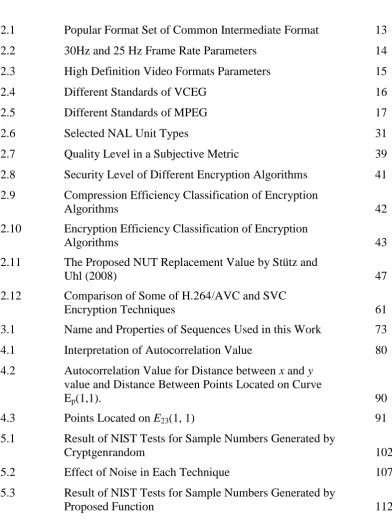
LIST OF TABLES
TABLE NO. TITLE PAGE
2.1 Popular Format Set of Common Intermediate Format 13
2.2 30Hz and 25 Hz Frame Rate Parameters 14
2.3 High Definition Video Formats Parameters 15
2.4 Different Standards of VCEG 16
2.5 Different Standards of MPEG 17
2.6 Selected NAL Unit Types 31
2.7 Quality Level in a Subjective Metric 39
2.8 Security Level of Different Encryption Algorithms 41 2.9 Compression Efficiency Classification of Encryption
Algorithms 42
2.10 Encryption Efficiency Classification of Encryption
Algorithms 43
2.11 The Proposed NUT Replacement Value by Stütz and
Uhl (2008) 47
2.12 Comparison of Some of H.264/AVC and SVC
Encryption Techniques 61
3.1 Name and Properties of Sequences Used in this Work 73
4.1 Interpretation of Autocorrelation Value 80
4.2 Autocorrelation Value for Distance between x and y value and Distance Between Points Located on Curve
Ep(1,1). 90
4.3 Points Located on E23(1, 1) 91
5.1 Result of NIST Tests for Sample Numbers Generated by
Cryptgenrandom 102
5.2 Effect of Noise in Each Technique 107
5.3 Result of NIST Tests for Sample Numbers Generated by
5.4 Required Time for Producing All Points Located on
EP(1, 1) 113
5.5 Maximun, Minimun and Average Time Between Generating of Two Sequential Point for different Curve
LIST OF FIGURES
FIGURE NO. TITLE PAGE
1.1 Immersive Teleconferencing 5
2.1 Research Area 10
2.2 4:2:0, 4:2:2 and 4:4:4 Sampling Patterns by Richardson
(2010) 12
2.3 Standards Definition and High Definition Video Formats
by Richardson (2010) 15
2.4 Overall Procedures of Encoders and Decoders of H.264
Formats by Richardson (2010) 18
2.5 H.264 Video Coding and Decoding Process Formats by
Richardson (2010) 19
2.6 Typical H.264 Encoder Formats by Richardson (2010) 20 2.7 Prediction Flow Diagram of H.264 Encoder Formats by
Richardson (2010) 21
2.8 Intra-Prediction Formats by Richardson (2010) 21 2.9 Inter-Prediction Formats by Richardson (2010) 22 2.10 Forward Transform Formats by Richardson (2010) 23 2.11 Quantization Example, QP = 8 Formats by Richardson
(2010) 23
2.12 Typical H.264 Decoder Formats by Richardson (2010) 24 2.13 Rescaling of Quantized Numbers Formats by Richardson
(2010) 25
2.14 Inverse Transform Formats by Richardson (2010) 26 2.15 Reconstruction Flow Diagram of H.264 Decoder Formats
by Richardson (2010) 27
2.16 H.264 Syntax Overview Formats by Richardson (2010) 29 2.17 H.264 Syntax Overview Formats by Richardson (2010) 30 2.18 NAL Unit Header Structure Formats by Richardson
2.19 SVC Extension NAL Unit Header Stütz and UHL (2012) 31 2.20 A Sample of H.264 Svc Bitstream Stütz and UHL (2012) 32 2.21 Example of MVC Nalu Stütz and UHL (2012) 34 2.22 Histograms of Plain-Image and Cipher-Image by Lian
(2009) 39
2.23 Original Image with Its Different Quality Level
Ciphertext by Lian (2009) 41
2.24 Effect of Noise in Techniques without Synchronization
Mechanism 46
2.25 Encryption Scheme Proposed by Park and Shin (2008) 48 2.26 Encryption Scheme Proposed by Lei, Lo and Lei (2010) 49 2.27 Encryption Scheme Proposed by Mian, Jia and Lei (2007) 50 2.28 Proposed Encryption Scheme by Thomas, Bull and
Redmill (2009) 51
2.29 Encryption Flowchart Proposed by Wei, Et Al. (2012) 52 2.30 Decryption Flowchart Proposed by Wei, Et Al. (2012) 52
2.31 Intra-Prediction Mode Encryption Proposed by Li, Yuan
and Zhong (2009) 53
2.32 Sign Encryption Proposed by Li, Yuan and Zhong (2009) 53 2.33 Temporal Layer Encryption Proposed by Li, Yuan and
Zhong (2009) 54
2.34 Spatial/Snr Layer Encryption Proposed by Li, Yuan And
Zhong (2009) 54
2.35 Encryption Process for Ipm and Mv Proposed by Varlakshmi, Sudha, And Jaikishan (2012) 55 2.36 Texture Encryption Proposed by Varlakshmi,Sudha, and
Jaikishan (2012) 55
2.37 Enhancement Layer Encryption Proposed by Varlakshmi,
Sudha, and Jaikishan (2012) 56
2.38 Proposed Encryption Algorithm by Boztok Algin and
Tunali (2011) 57
2.39 Proposed Synchronization Mechanism by Boztok Algin
and Tunali (2011) 58
2.40 Encryption Scheme Proposed by Arachchi Et Al. (2009) 59 2.41 Decryption Scheme Proposed by Arachchi Et Al. (2009) 60 2.42 Encryption Scheme Proposed by Won, Bae and Ro
(2009) 61
3.1 Operational Framework 68
3.3 First View to 8th View of Exit Video Stream 74 3.4 First View to 8th View of Vassar Video Stream 75
4.1 SIN(5) Function 82
4.2 Correlogram of SIN(5) 82
4.3 A Pseudo-Random Series 83
4.4 Correlogram of A Pseudo-Random Series 83
4.5 Difference Between X Values of Sequential Points on
E1162099(1, 1) 85
4.6 Correlogram of Difference Between X Values of
Sequential Points on E1162099(1, 1) 86
4.7 Difference Between Y Values of Sequential Points on
E1162099(1, 1) 87
4.8 Correlogram of Difference Between Y Values of
Sequential Points on E1162099(1, 1) 88
4.9 Distance Between Sequential Points on E1162099(1, 1) 89 4.10 Correlogram of Distance Between Sequential Points on
E1162099(1, 1) 90
4.11 General Framework 93
4.12 Technique without Synchronization 94
4.13 Technique that Adds Hash Value of Seed to Bitstream 95
4.14 Proposed Seed Generator Technique 96
5.1 General Outline of Seed Generator Function 98 5.2 Internal Operation of Seed Generator Function 99 5.3 Pseudo Code Used to Make Noise in Video Stream 102 5.4 Sample of Numbers Generated by Cryptgenrandom 103 5.5 PSNR Result for Y Value of Exit Video Stream for the
Three Techniques 104
5.6 PSNR Result for U Value of Exit Video Stream for the
Three Techniques 104
5.7 PSNR Result for V Value of Exit Video Stream for the
Three Techniques 105
5.8 PSNR Result for Y Value of Vassar Video Stream for
the Three Techniques 105
5.9 PSNR Result for U Value of Vassar Video Stream for
the Three Techniques 106
5.10 PSNR Result for V Value of Vassar Video Stream for
the Three Techniques 106
5.12 PSNR Result Of Noise Effect At 26th Frame for Vassar
Video Stream 109
5.13 PSNR Result of Noise Effect at 26th Frame for Exit
Video Stream 109
5.14 PSNR Result of Noise Effect at 50th Frame for Vassar
Video Stream 110
5.15 PSNR Result of Noise Effect at 50th Frame for Exit
Video Stream 110
LIST OF ABBREVIATION
4CIF 4× CIF
AES Advanced Encryption Standard
ATSC Advanced Television Systems Committee AVC Advanced Video Coding
CABAC Context-Adaptive Binary Arithmetic Coding CAVLC Context-Adaptive Variable-Length Coding CBC Cipher Block Chaining
CCR Changed Compression Ratio CFB Cipher Feedback
CIF Common Intermediate Format
CSPRNG Cryptographically Secured Pseudo Random Number Generator DCT Discrete Cosine Transform
DES Data Encryption Standard DID Dependency ID
DVB-C Digital Video Broadcasting - Cable DVB-S Digital Video Broadcasting - Satellite
DVB-S2 Digital Video Broadcasting - Satellite - Second Generation DVB-T Digital Video Broadcasting - Terrestrial
DVB-T2 Digital Video Broadcasting – Terrestrial - Second Generation DVD Digital Versatile Disc
ECB Electronic Codebook ETR Encryption Time Ratio GOP Group Of Pictures HD High-Definition Video HDTV High-Definition Television HVS Human Visual System
IEC International Electrotechnical Commission IPM Intra Prediction Mode
ISDB-T Integrated Services Digital Broadcasting-Terrestrial ISO International Organization for Standardization
ITU-R International Telecommunication UnionRadiocommunication Sector ITU-T International Telecommunication UnionTelecommunication
Standardization Sector IV Initial Vector
JMVC Joint Multiview Video Coding MPEG Moving Expert Picture Group MV Motion Vector
MVC Multiview Video Coding MVD Motion Vector Difference NAL Network Abstraction Layer NALU Network Abstraction Layer Unit
NIST National Institute of Standards and Technology NTSC National Television System Committee
NUT Network Abstraction Layer Unit Type PAL Phase Alternating Line
QID Quality ID
QP Quantization Parameter SD Standard Definition
SECAM SéquentielCouleur À Mémoire(Sequential Color with Memory) SNR Signal-to-Noise Ratio
SPS Sequence Parameter Sets SVC Scalable Video Coding TID Temporal ID
LIST OF APPENDIX
NO. TITLE PAGE
CHAPTER 1
INTRODUCTION
1.1 Introduction
Video-conferencing has become one of the favorite communication technologies in recent years especially by increasing the popularity and bandwidth of internet connection around the world. One of the new progresses in this area is Immersive Teleconferencing. Immersive Teleconferencing allows users to see multiple partners in the conference simultaneously or watch a unique event from different views. For confidential and top secret cases like governmental, military and medical cases keeping the contents of conversations hidden from adversaries is critical, though it is necessary to encrypt them. Therefore the security of the applied encryption technique should be high enough while imposing low encryption overhead to the video stream to avoid packet size increasing in the transmission. One of the issues in this subject is synchronization between two parties especially in lossy or noisy environments which causes packet-error and packet-loss during transmission.
1.2 Background of the Problem
ITU-T Video Coding Expert Groups (VCEG) and ISO/IEC joint working group, Moving Expert Picture Group (MPEG), developed the H.264/MPEG-4 AVC standard as a well-defined structure codec (ITU-T recommendation for H.264, series h). H.264/AVC converts the video source to a series of blocks which are compressed based on dependencies between pixels in a frame and pixels between other frames and also motion prediction. It has a wide range of coverage from low-bit to high definition formats and is widely used in digital TV, Blue-ray Discs, You-Tube, Mobile TV, Adobe Flash Player, videoconferencing, Microsoft Silverlight, online video streaming, terrestrial HDTV, satellite HDTV and etc. (Richardson, 2010).
Later ITU-T and ISO/IEC joint group developed a scalable extension for H.264/AVC which is called Scalable Video Coding (ITU-T recommendation for H.264, series h). SVC adds subset bitstreams to AVC that present different scalability based on users’ hardware and network bandwidth. This scalability could be temporal (frame rate), spatial (resolution) and/or SNR (quality) (Schwarz, Marpe and Wiegand, 2007).
Recently ITU-T and ISO/IEC joint group developed Multiview Video Coding (MVC) as another extension of H.264/MPEG-4 AVC (ITU-T recommendation for H.264, series h). Like SVC, MVC adds subset bitstreams to AVC that present different views on a unique video stream. These views could be from a same scene/object or from different scenes or objects. It can be used for applications such as 3D video application, free-viewpoint video, immersive teleconferencing (Vetro, Wiegand and Sullivan, 2011).
i. Before Compression Encryption ii. Compression Integrated Encryption iii. Bitstream Encryption
Before Compression Encryption schemes encrypt the whole video stream, and then the encoder starts to compress the encrypted bitstream. The compression procedures of encoders are based on the relationship between adjacent blocks of each frame and also relationship between different frames. Encrypting the bitstream before compression disturbs these relationships and has a great negative influence on compression performance. Therefore this kind of encryption is suitable for hiding especial part of the video and is not appropriate to apply to the whole bitstream (Carrillo, Kalva, and Magliveras, 2008). Accordingly this kind of encryption is not suitable for real-time video applications like video-conferencing.
Compression Integrated Encryption schemes are applied to the video stream while encoder is compressing the original bitstream. There are eight kinds of compression integrated encryption scheme: Intra-Prediction, Inter-Prediction, Motion Vector, Secret Transform, DCT Coefficient, Secret Scan Order, Joint Encryption and CAVLC and Joint Encryption and CABAC. Bitstream or After Compression Encryptionschemes are applied to the compressed video stream after encoding. There are three kinds of bitstream encryption scheme: NALU Encryption, Container-Formats and Partial/Selective Encryption (Stützand Uhl, 2012). Different techniques for mentioned encryption scheme kinds have been proposed.
The proposed During Compression or After Compression encryption techniques for real-time application have some weaknesses in synchronization performance in lossy or noisy environments. Some techniques suggest using a unique key for the whole conversation to avoid losing synchronization. Using only one key makes the cipher vulnerable against some attacks such as known plaintext and chosen plaintext (Boztok Algin and Tunali, 2011). Some techniques send the encryption seed/key or its hash value for each group of packets to maintain synchronization during transmission. These methods do not have sufficient resilience against high lossy networks and also impose overhead to the bitstream (Boztok Algin and Tunali, 2011).
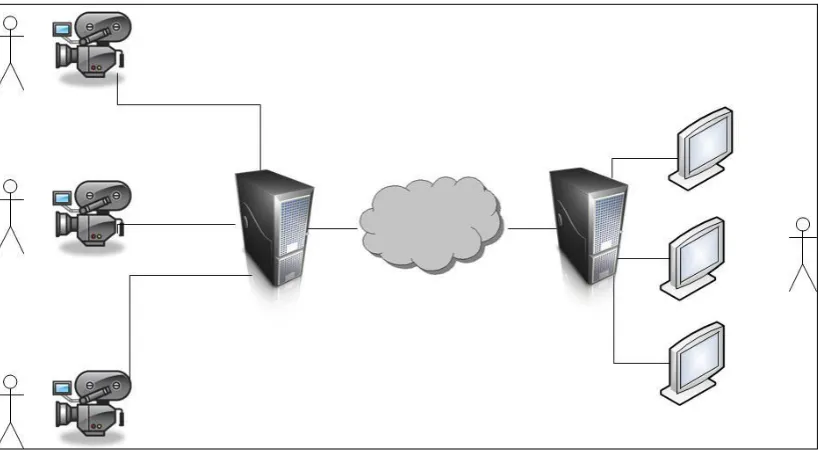
Immersive teleconferencing allows the user to see multiple partners simultaneously as shown in Figure 1.1. Pictures taken by multiple cameras are merged together by encoder and sent as a unique bitstream to the other side via network. In the other side the decoder separates the bitstream to multiple views. In some cases of immersive teleconferencing application such as governmental, military, medical and secret business conferencing, security and keeping the contents of conversation confidential is very important. H.264/MVC is one of the progressive standards for immersive teleconferencing applications development. In MVC different pictures from different cameras joint with each other and make a single bitstream. Therefore the size of the bitstream for a particular duration may be far bigger than AVC or even SVC, though a lightweight encryption scheme with very high security is needed. Because for a fraction of time there are more frames in a MVC bitstream than AVC or SVC’s, the scheme should not impose a high level of overhead to the bitstream. Also both sides of conversation should be able to synchronize with each other in case of packet-error or packet-loss especially in lossy or noisy environment. The existing schemes for real-time AVC and SVC video encryption have some weaknesses in synchronization performance.
Figure 1.1: Immersive Teleconferencing
1.3 Statement of the Problem
1.4 Research Questions
This study will answer to the following questions:
i. What parameters are required to have a synchronization performance in secured real time video application?
ii. How could be an enhanced seed generation scheme that has suitable synchronization performance?
1.5 Purpose of the Study
The purpose of this study is to propose a seed generation and sharing scheme for multimedia encryption based on MVC extension of H.264 standard for immersive teleconferencing. This research proposes a seed generation and sharing scheme to have suitable synchronization performance in noisy or lossy environments while preserving the security of encryption with low encryption overhead imposition. Moreover this research compares existing real-time encryption schemes for H.264/AVC and SVC with the recommended scheme in terms of synchronization performance.
1.6 Objectives of the Study
Here are the objectives of the study:
ii. To propose and implement a seed generation scheme based on H.264/MVC to cover the current weaknesses in synchronization performance for real-time application.
iii. To validate and evaluate synchronization performance based on the proposed seed generation scheme.
1.7 Scope of the Study
This research presents the requirement and technical points of view of a seed generation and sharing technique for immersive teleconferencing encryption and outlines the implementation of this scheme with following specifications:
i. The technique is based on the MVC extension of H.264 standard. ii. The technique is for peer-to-peer teleconferencing.
iii. The software program which is used in this research is designed with Microsoft Visual Studio C++.
iv. JMVC (Joint Multiview Video Coding) reference program willbeused for some security performance parameters evaluation.
1.8 Significance of the Study
The scheme may be used for confidential and top secret immersive teleconferencing such as governmental, military or medical cases.
1.9 Thesis Organization
REFERENCES
Arachchi, H. K., Perramon, X., Dogan, S. and Kondoz, A. M., 2009, Adaptation–
Aware Encryption of Scalable H.264/AVC Video for Content Security, Signal
Processing: Image Communication, 24(6), 468-483.
Bergeron, C. and Lamy-Bergor, C., 2005, Compliant Selective Encryption For
H.264/Avc Video Streams, In Proceedings of the IEEE Workshop on
Multimedia Signal Processing, MMSP’05, pages 1–4, October 2005.
Box, G. E., Jenkins, G. M. and Reinsel, G. C., 2011, Time Series Analysis:
Forecasting and Control, (Vol. 734), Wiley.
Boztok Algin, G. and Tunali, E. T., 2011, Scalable Video Encryption of H. 264 SVC
Codec, Journal of Visual Communication and Image Representation, 22(4),
353-364.
Carrillo, P., Kalva, H., and Magliveras, S., 2008, Compression Independent Object
Encryption for Ensuring Privacy in Video Surveillance. In Proceedings of
International Conference on Multimedia & Expo, ICME’08, pages 273–276. IEEE, June 2008.
Dufaux, F. and Ebrahimi, T., 2008, H.264/Avc Video Scrambling for Privacy
Protection, In Proceedings of the IEEE International Conference on Image
Processing, ICIP ’08, San Diego, CA, USA, October 2008.
Engel, D., Stütz, T. and Uhl, A., 2009, A Survey on JPEG2000 Encryption. Multimedia Systems, 15(4):243–270, 2009.
European Broadcasting Union (EBU) Technical Report 3299, 2004, High Definition
Image Formats for Television Broadcasting, Geneva, 2004.
Forouzan, B. A., 2007, Cryptography & Network Security, McGraw-Hill, Inc..
Hai-Wei, S. and Jin-Ping, L., 2009, A Novel Stream Cipher for Video Compressed by
H. 264, In Computer Science-Technology and Applications, IFCSTA'09.
Hellwagner, H., Kuschnig, R., Stütz, T. and Uhl, A., 2009, Efficient In-Network
Adaptation of Encrypted H.264/Svc Content, Elsevier Journal on Signal
Processing: Image Communication, 24(9):740 – 758, July 2009.
Iqbal, R., Shirmohammadi, S., Saddik, A. and Zhao, J.,2008, Compressed-Domain
Video Processing for Adaptation, Encryption, and Authentication. IEEE
Multimedia, 15(2):38–50, April 2008.
Iqbal, R., Shirmohammadi, S., Saddik, A., 2007, A Framework for MPEG-21 DIA
Based Adaptation and Perceptual Encryption of H.264 Video. In Roger
Zimmermann, and Carsten Griwodz,editors, Proceedings of SPIE, Multimedia Computing and Networking 2007, volume 6504. SPIE, 2007. Iqbal, R., Shirmohammadi, S., Saddik, A., 2006, Secured MPEG-21 Digital Item
Adaptation for H.264 Video. In Proceedings of International Conference on
Multimedia & Expo, ICME ’06, pages 2181–2184, Toronto, Canada, July 2006, IEEE.
ITU-T, Joint Collaborative Team on Video Coding - JCT-VC, Available at:
http://www.itu.int/ITU-T/studygroups/com16/jct-vc/ [Accessed Sep. 2012]
ITU-T, Telecommunication Standardization Sector of ITU, 2012, Series H: Audiovisual and Multimedia Systems, Infrastructure of Audiovisual Services
– Coding of Moving Video, Advanced Video Coding for Generic Audiovisual
Services, Recommendation ITU-T H.264 (Jan. 2012).
Kapotas, S. K. and Skodras, A. N., 2010, Rate Control of H.264 Encoded Sequences
by Dropping Frames in the Compressed Domain, IEEE 20th International
Conference on Pattern Recognition (ICPR)
Kodikara Arachchi, H., Perramon, X., Dogan, S. and Kondoz, A.M., 2009, Adaptation-Aware Encryption of Scalable H.264/Avc Video for Content
Security. Signal Processing: Image Communication, 24(6):468–483,2009.
Scalable Coded Media beyond Compression.
Lei, B. Y., Lo, K. T. and Lei, H., 2010, A New H.264 Video Encryption Scheme
Based on Chaotic Cipher. In Communications, Circuits and Systems
(ICCCAS), 2010 International Conference on (pp. 373-377).IEEE.
Li C., Yuan, C. and Zhong, Y., 2009, Layered Encryption for Scalable Video
Li, Y., Liang, L., Su, Z. and Jiang, J., 2005, A New Video Encryption Algorithm for
H.264, In Proceedings of the Fifth International Conference on Information,
Communications and Signal Processing, ICICS’05, pages 1121– 1124. IEEE, December 2005.
Lian, Sh., 2009, Multimedia Content Encryption: Techniques and Application, 1st ed., Taylor and Francis Group, Boca Raton. London, New York, 2009.
Lian, S., Sun, J., Liu, G. and Wang, Z., 2008, Efficient Video Encryption Scheme
Based on Advanced Video Coding, Multimedia Tools and Applications,
38(1):75–89, March 2008.
Lian, S., Liu Z., Ren, Z. and Wang, H., 2006, Secure Advanced Video Coding Based
on Selective Encryption Algorithms, IEEE Transactions on Consumer
Electronics, 52(2):621–629, 2006.
Lian, S., Liu, Z., Ren, Z. and Wang, Z., 2005, Selective Video Encryption Based on
Advanced Video Coding, In Proceedings of the Pacific-Rim Conference on
Multimedia, Advances in Multimedia Information Processing, PCM ’05, volume 3768 of Lecture Notes in Computer Science, pages 281–290. Springer, 2005.
Majumder, A., Gopi, M., Seales, B., & Fuchs, H., 1999, Immersive Teleconferencing: A New Algorithm to Generate Seamless Panoramic Video
Imagery. In Proceedings of the seventh ACM international conference on
Multimedia, pp. 169–178.
Marion, A., 1991, An Introduction to Image Processing. London, Chapman and Hall.
Mian, C., Jia, J. and Lei, Y., 2007, An H.264 Video Encryption Algorithm Based on
Entropy Coding. In Proceedings of the Third International Conference on
International Information Hiding and Multimedia Signal Processing, IIH-MSP’07, pages 41–44, Washington, DC, USA, 2007. IEEE Computer Society.
Park, S.W. and Shin, S.U., 2008, Efficient Selective Encryption Scheme for the
H.264/Scalable Video Coding (SVC), NCM 2008, Sept. 2008, pp. 371-376.
Recommendation ITU-T H.264 | ISO/IEC 14496-10:2009, Advanced Video Coding
Richardson, I. E., 2010, The H.264 Advanced Video Compression Standard, Wiley, Second Edition.
Schwarz, H., Marpe, D. and Wiegand, T., 2007, Overview of the Scalable Video
Coding Extension of the H.264/AVC Standard, IEEE Transactions on Circuits
and Systems for Video Technology
Shah, J. and Saxena, V., 2011, Video Encryption: A Survey, IJCSI International Journal of Computer Science Issues, Vol. 8, Issue 2, March 2011
Shahid, Z., Chaumont, M. and Puech, W, 2009,Fast Protection of H.264/AVC by
Selective Encryption of CABAC, In Proceedings of the IEEE International
Conference on Multimedia & Expo, ICME ’09, Cancun, Mexico, June 2009. Shannon, C. E., 1949, Communication Theory of Secrecy Systems, Bell Syst. Tech. J. 28, 656–715 (1949).
Shparlinski, I. E., 2009, Pseudorandom Number Generators from Elliptic Curves, Recent Trends in Cryptography: UIMP-RSME Santaló Summer School, July 11-15, 2005, Universidad Internacional Menéndez Pelayo, Santander, Spain, 477.
Spinsante, S., Chiaraluce, F. and Gambi, E., 2005, Masking Video Information by
Partial Encryption of H.264/AVC Coding Parameters, In Proceedings of the
13th European Signal Processing Conference, EUSIPCO’05. EURASIP, September 2005.
Stütz, T. and Uhl, A., 2008, Format-Compliant Encryption of H.264/AVC and SVC, Tenth IEEE International Symposium on Multimedia
Stütz, T. and Uhl, A., 2012, A Survey of H.264 AVC/SVC Encryption, IEEE Transactions on Circuits and Systems for Video Technology, March 2012 Su, P., Hsu, C. and Wu, C., 2010, A Practical Design Of Content Protection For
H.264/AVC Compressed Videos By Selective Encryption And Fingerprinting, Multimedia Tools and Applications, January 2010.
Thomas, T., Bull, D. and Redmill, D., 2009, A Novel H.264 Svc Encryption Scheme
for Secure Bit-Rate Transcoding, In Proceedings of15the Picture Coding
Symposium, PCS’09, Chicago, IL, USA, May 2009.IEEE.
Tong, L., Dai, F., Zhang, Y. and Li, J., 2010, Prediction Restricted H.264/AVC Video
Scrambling for Privacy Protection. Electronic Letters, 46(1):47–49, January
Varlakshmi, L. M., Sudha, G., and Jaikishan, G., 2012,An Efficient Scalable Video
Encryption Scheme for Real time applications, Procedia Engineering, 30,
852-860.
Vetro, A., Wiegand, T. and Sullivan, G. J., 2011, Overview of the Stereo and Multiview Video Coding Extensions of the H.264/MPEG-4 AVC Standard. Proceeding of the IEEE, Vol. 99, No. 4, April 2011
Voydock, V. L. and Kent, S. T., 1983, Security Mechanisms in High-Level Network
Protocols. ACM Computing Surveys (CSUR), 15(2), 135-171.
Watkinson, J., 2012, The MPEG Handbook, Elsevier.
Wei, Z., Wu, Y., Ding, X. and Deng, R. H., 2012, A Scalable and Format-Compliant
Encryption Scheme for H.264/Svc Bitstreams, Signal Processing: Image
Communication Volume 27, Issue 9, October 2012, Pages 1011–1024
Wiegand, T., Sullivan G. J., Bjontegaard, G. and Luthra, A., 2003, Overview of the
H.264/Avc Video Coding Standard, IEEE Transactions on Circuits and
Systems for Video Technology, vol. 13, no. 7, pp. 560–576.
Wikipedia, 2012, Peak Signal-to-Noise Ratio (PSNR), Available at:http://en.wikipedia.org/wiki/Peak_signal-to-noise_ratio [Accessed Sep. 2012]
Won, Y. G., Bae, T. M. and Ro, Y. M., 2006, Scalable Protection and Access
Control in Full Scalable Video Coding, Springer-Verlag Berlin Heidelberg
Yeung, S. A., Zhu, S. and Zeng, B., 2009, Partial Video Encryption Based on
Alternating Transforms, IEEE Signal Processing Letters, 16(10):893–896,
October 2009.
Zou, D. and Bloom, J., 2010,H.264 Stream Replacement Watermarking with CABAC
Encoding, In Proceedings of the IEEE International Conferenceon