iv
ACKNOWLEDGEMENT
First and foremost, I would like to thank Almighty Allah; the creator, and protector of mankind for giving us the strength to accomplish this work.
I owe my deepest gratitude to my supervisor, Dr. Noorminshah A Iahad for her great guidance, advices, encouragement, motivation, and endless support through my master study.
I would like to thank my parents, from the bottom of my heart for their love and faith upon me.
I am heartily thankful my brother Saif Elnasr, my sisters Aisha and Alia, who never left my side, for their continued and great support and encouragement.
Finally, I owe my deepest gratitude to my brother Ammar, who was always beside me, supporting me by all ways.
ABSTRACT
vi
ABSTRAK
TABLE OF CONTENTS
CHAPTER TITLE PAGE
DECLARATION DEDICATION
ACKNOWLEDGEMENT
ii iii iv ABSTRACT
ABSTRAK
v vi
TABLE OF CONTENTS vii
LIST OF TABLES xii
LIST OF FIGURES xiii
LIST OF APPENDICES xv
1 PROJECT OVERVIEW
1.1 Introduction 1
1.2 Project Process 3
1.3 Problem Background 4
1.4 Problem Statement 5
1.5 Project objectives 5
1.6 Project Scope 6
1.7 Importance of project 6
viii
2 LITERATURE REVIEW
2.1 Introduction 8
2.2 Collaborative learning
2.2.1 Computer-supported collaborative learning 2.2.1.1 Online Collaboration tools
2.2.2 Teacher‟s Role
10 11 12 13 2.3 Group Based Learning
2.3.1 Group-based learning Dimensions 2.3.2 Group-based Active Interactive Collaborative Learning
2.3.3 The Benefits Of GBAICL
13 15
16 17
2.4 Project-based learning 18
2.4.1 Benefits of Project Based Learning 19
2.4.2 Three key competences 20
2.4.3 Central tasks of project based learning 21 2.4.4 Characteristics of Appropriate Projects for PBL 22 2.4.5 Software Support System for Project Based learning 24
2.4.5.1 Software Support Requirements 2.4.5.2 CommSy Software
2.4.5.3 Support for communication and organizing the project
25 26
28 2.4.5.4 Support for handling working material 29 2.4.6 The Project-Based Learning Support System 30
2.4.6.1 What is the Project-Based Learning Support
System 30
2.4.6.2 The PBLSS Support Architecture 31
2.4.7 Project Management Methodologies 31
2.5 Chapter Summary 33
3 METHODOLOGY
3.1 Introduction 34
3.2 Research Design 35
3.3.1 Phase 1: Initial Planning 37
3.3.1.1 Threshold study 37
3.3.1.2 Writing proposal 37
3.3.2 Phase 2: Analysis 38
3.3.2.1 Literature Review 38
3.3.2.2 Survey and data collection 39
3.3.2.3 Collected Data analysis 42
3.3.2.4 SPSS Software 44
3.3.3 Phase 3: Modeling 44
3.3.3.1 Design Framework 44
3.3.4 Phase 4: Evaluate the Framework 45
3.3.4.1 Apply and Evaluate the Framework 45
3.3.4.2 Report Writing 46
3.4 Project Schedule 46
3.5 Chapter Summary 47
4 INITIAL FINDINGS
4.1 Introduction 48
4.2 Data Collection 49
4.3 Findings from Internet 49
4.3.1 Some available communication and collaboration Tools 49
4.4 Pre-questionnaire 54
4.4.1 Pre-questionnaire questions and their objectives 54
4.4.2 Findings from Pre-questionnaire 48
4.5 Proposed Framework 64
4.5.1 Initiation phase 66
4.5.2 Working phase 67
4.5.3 Closing phase 68
4.6 Chapter Summary 68
5 ANALYSIS
5.1 Introduction 69
x
5.2.1 Interviews Analysis 71
5.2.2 Interviews‟ Conclusion 73
5.3 Pre Questionnaire 74
5.3.1 Pre Questionnaire Objectives 75
5.3.2 Pre Questionnaire Findings and Analysis 76
5.3.3 Pre Questionnaire Conclusion 83
5.4 IT Tools Have Been Nominated To Be used for Collaboration
and Communication 83
5.4.1 Stixy Tool 83
5.4.2 BaseCamp Tool 84
5.4.3 Google Docs 84
5.4.4 Justification Why Use Stixy Tool 85
5.5 Applying The Framework 86
5.5.1 Initial Phase 87
5.5.2 Working Phase 87
5.5.3 Closing Phase 89
5.5.4 Tools Used Through The Three Phases 90
5.5.5 Benefits Of Using IT Mediums 91
5.5.5.1 Some Students‟ Quotes About Using Stixy 92
5.6 Post Questionnaire 94
5.6.1 Post Questionnaire Objectives 94
5.6.2 Post Questionnaire Findings and Analysis 97
5.6.3 Effectiveness Of The Framework 107
5.6.4 Post Questionnaire Conclusion 108
5.7 Chapter Summary 109
6 DISCUSSION AND CONCLUSION
6.1 Introduction 110
6.2 Achievements 111
6.3 Constrains and challenges 113
6.4 Recommendations 114
6.5 Aspirations 115
REFERENCES 117
xii
LIST OF TABLES
TABLE NO. TITLE PAGE
Table 4.1 Classification of Tools 53
Table 4.2 Members Number Per Group 59
LIST OF FIGURES
FIGURE NO TITLE PAGE
Figure 1.1 Project Process 3
Figure 2.1 Literature review structure 9
Figure 3.1 Project Methodology 36
Figure 4.1 Students Projects Participating 58
Figure 4.2 Face-to-Face and Online Meetings 59
Figure 4.3 Used Tools 60
Figure 4.4 Effectiveness and useful of Tools 61 Figure 4.5 Synchronous vs. Asynchronous Tools 62 Figure 4.6 Impact of Participating in Projects 63
Figure 4.7 Proposed Framework 65
Figure 5.1 Previous student‟s group projects number 77
Figure 5.2 Face-to-Face and Online Meetings 78
Figure 5.3 Used Tools 79
Figure 5.4 Students perspective about used tools in terms of sharing of resources and collaboration
80
Figure 5.5 Students perspective about used tools in terms of communication
80
Figure 5.8 Synchronous V Asynchronous Tools 82 Figure 5.9 Framework Applying and Analysis Structure 86
Figure 5.10 The ease of Stixy use and handle 97
Figure 5.11 Project performed effectively in terms of sharing
recourses 98
Figure 5.12 Project performed effectively in terms of collaboration
and communication 99
Figure 5.13 The effect of using Stixy in manage time 100 Figure 5.14 Effect of using IT medium in group members‟
participation 101
LIST OF APPENDIXES
APPENDIX TITLE PAGE
APPENDIX A Pre-questionnaire for students 120
APPENDIX B Lecturers‟ Interview 124
APPENDIX C Pre Questionnaire for class students 125 APPENDIX D Students‟ Project Activities Description 128 APPENDIX E Post Questionnaire for class students 131 APPENDIX F Gant Chart IT supported project based learning
framework project I 133
APPENDIX G Gant Chart IT supported project based learning
CHAPTER 1
PROJECT OVERVIEW
1.1 Introduction
textbook centered learning. In addition, students develop confidence and self-direction as they move through both team based and independent work. the big development and grow of technologies, communication, internet and the availability of information through it, increased the use of this approach, the Internet adds valuable dimensions to a PBL and it created new roles for students and teachers, it plays significant role in facilitating the communication between the peers and with constructor.
There are many and variety of available online collaborative tools and communication channels that Student use such as emails, white boards, and video conferences and so on to communicate and share recourses with the peers. The availability, ease of use and access, features and capabilities of these online tools communication channels it has effective role in project success. Selecting appropriate combination of technology tools and communication channels it‟s the most significant role in project success and gain overall objectives of the subject. Also applying these technologies tools to the students project support the performance of complex, authentic tasks and provide experiences that prepare students for the real workplace. Furthermore the degree of student and instructors mastering of these tools communication channels is effect the project progress, flow of information and materials between the peers, and the management of the projects.
3
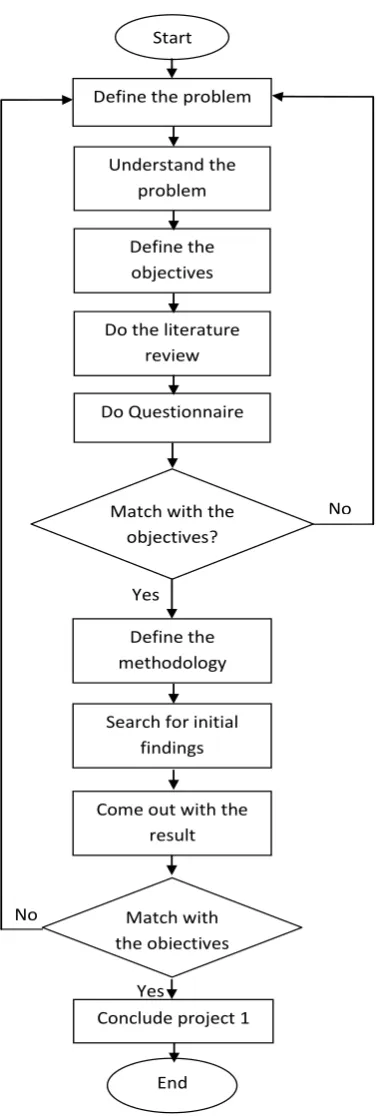
1.2 Project Process
Start
Define the problem
Understand the problem
Define the objectives
Do the literature review
Do Questionnaire
Match with the objectives?
Define the methodology
Search for initial findings
Come out with the result
Match with the objectives
Conclude project 1
End
No
Yes
Yes No
1.3 Problem Background
5
1.4 Problem Statement
The problem statement for this project is:
“How and in what aspects IT can facilitate and support effective project based learning?”
There are other questions rises while conducting this study:
1. What are the tools that are available and can support project based learning? 2. How can we integrate variety of available tools to support effective project
based learning?
3. What are the requirements of tools to supporting project based learning? 4. What is the best usage of tools for effective project based learning?
1.5 Project objectives
The project objectives are:
1. To investigate the tools that support communication and collaboration.
2. To identify the different tools that are currently used in project based learning. 3. To develop framework to guide for best usage of tools for effective project
based learning.
1.6 Project Scope
This research will consider the available communication and collaboration Tools that can support PBL and not developing new Tools.
The framework will applied in course projects in class SCM2473, Database Marketing for Faculty of Management and Human Resource Development (FPPSM) students majoring in Marketing, and will be evaluated depending on the outcomes of these projects.
1.7 Importance of project
117
REFERENCES
Adair, D. (1995). Building Object-Oriented Frameworks (Part 1). AIXpert. February.
Andreatos, Antonios (2007). “On Evaluating the Quality of Computer-Supported Collaborative Learning”. Proceedings of the EDEN Annual Conference,
Naples, Italy.
Bower, Matt (2007). “Independent, synchronous and asynchronous an analysis of approaches to online concept formation”. ITiCSE '07: Proceedings of the
12th Annual SIGCSE, Conference on Innovation and Technology in Computer Science Education.
Bower, Matt (2007). “Groupwork activities in synchronous online classroom spaces”, ACM SIGCSE Bulletin 39 (1) (2007), 91-95.
Chih Ming Chen , Ming Chuan Chen (2009), “Mobile formative assessment tool based on data mining techniques for supporting web-based learning”,
Computers & Education, v.52 n.1, p.256-273, January, 2009
Cho, Hichang, Geri Gay, Barry Davidson and Anthony Ingraffea (2007). “Social networks, communication styles, and learning performance in a CSCL
community”, Computers & Education 49 (2) (2007), 309-329.
Collaborative Learning:
http://www.gdrc.org/kmgmt/c-learn/index.html
Grossman, Cheryl R. Sturko (2007), “Information Brief, Project-Based Learning”, learning work (2007)
Dillenbourg P. (1999) “What do you mean by collaborative leraning?”. In P. Dillenbourg (Ed) Collaborative-learning: Cognitive and Computational Approaches. (pp.1-19). Oxford: Elsevier
Doppelt, Yaron (, 2003), “Implementation and Assessment of Project-Based Learning in a Flexible Environment”. International Journal of Technology
and Design Education13, 255–272, 2003. Kluwer Academic Publishers. Printed in the Netherlands.
Google Docs: http://docs.google.com/#all
Hrastinski, Stefan (2009), “A theory of online learning as online participation”, Computers & Education, v.52 n.1, p.78-82, January, 2009. Uppsala
University, Computer and Systems Science, Department of Information Science.
Internet Tools That Support On-line Project-Based Learning: http://www.teachnology.com/tutorials/online_project_based/ Introduction to Problem-Based Learning : History of PBL:
http://www.uc.edu/pbl/intro_history.shtml Introduction to Project-Based Learning:
http://www.gsn.org/Web/pbl/
James Laffey, Thomas Tupper, Dale Musser, John Wedman. (1998), “A
computer-mediated support system for project-based learning.”
Jason Charvat (2003) “Project Management Methodologies”. NJ: Wily.
John R. Savery & Thomas M. Duffy, “Problem Based Learning: An
instructional model and its constructivist framework”, June 2001, Center for
Research on Learning and Technology
Johnson, D.W., R.T. Johnson and K.A. Smith, “Cooperative Learning:
Increasing College Faculty Instructional Productivity”, ASHE-ERIC Higher
Education Report No. 4, George Washington University, 1991.
Leedy, Paul. D, and Ormrod, Jeanne E. (2001). “Practical Research: Planning and Design. (7th Ed.)”. Upper Saddle River, NJ: Merrill Prentice Hall. Marco Lazzari (2009), “Creative use of podcasting in higher education and its
effect on competitive agency”, Computers & Education 52 (2009) 27–3,
119
Michael Janneck, Wolf-Gideon Bleek, Iver Jackewitz, Bernd Pape: “Software Requirements for Project-Based Learning - CommSy as an Exemplary
Approach.”, HICSS 2002
Miguel Nussbaum, Claudio Alvarez, Angela McFarlane, Florencia Gomez, Susana Claro, and Darinka Radovic, (2009). “Technology as small group face-to-face Collaborative Scaffolding”, Computers & Education 52 (2009)
147–153, January, 2009.
Project Management Life Cycle Methodology: http://www.method123.com/project-lifecycle.php
Project Management, Collaboration, and Task Software: Basecamp: http://basecamphq.com/
Stixy For Flexible Online Creation Collaboration and Sharing: http://www.stixy.com/
Thomas and MacGregor,(2005). “Online project-based learning: How collaborative strategies and problem-solving processes impact
performance.” Journal of Interactive Learning Research. v16 i1. 83-107. Thomas, J.W. (2000). “A review of research on project-based learning”. San
Rafael, CA: Autodesk. What is Project Based Learning :
http://www.gsn.org/Web/pbl/whatis.htm
Williams van Rooij, Shahron (2009) “Scaffolding project-based learning with the project management body of knowledge (PMBOK®)”. Computers &