MODEL FOR SIMULTANEOUS LOCALIZATION AND MAPPING PROBLEMS
MOHSEN MAHRAMI
A thesis submitted in fulfilment of the requirements for the award of the degree of
Doctor of Philosophy (computer science)
Faculty of Computing Universiti Teknologi Malaysia
ACKNOWLEDGMENT
In the name of Allah the Most Gracious and the Most Merciful, I thank thee with all my heart for granting Thy Servant immeasurable help during this study.
I would like to express my gratitude to my supervisor Prof. Dr. Habibollah Haron for his guidance and encouragement in completing this work also I am thank full to my co-supervisor Dr. Azurah Bt. Abu Samah for her cooperation during this research.
My sincere thank also goes to UTM, Faculty of Computing and RMC for supporting this study, researchers, and academicians for their contribution towards my understanding and thoughts.
ABSTRACT
ABSTRAK
CHAPTER TITLE PAGE
DECLARATION ii
DEDICATION iii
ACKNOWLEDGMENT iv
ABSTRACT v
ABSTRAK vi
TABLE OF CONTENTS vii
LIST OF TABLES xi
LIST OF FIGURES xiv
LIST OF ABBREVIATIONS xix
LIST OF APPENDICES xx
1 INTRODUCTION 1
1.1 Overview 1
1.2 Problem Background 4
1.3 Problem Statement 6
1.4 Purpose of Study 8
1.5 Objectives 8
1.6 Research Scope 8
1.7 Significance of Research 9
1.8 Thesis Overview 10
2 LITERATURE REVIEW 12
2.1 Introduction 12
2.2 Effective Parameters in SLAM 13
2.2.1 Sensor Uncertainty 13
2.2.2 Correspondence Issue 14
2.2.3 Loop Closing 15
2.2.4 Computational Complexity 16
2.2.5 Dynamic Environment 16
2.3 Models of Map in Robotic 16
2.3.1 Metric Map 17
2.3.2 Topologic Map 18
2.3.3 Conceptual Map 19
2.3.4 Cognitive Map 19
2.4 Tools in Solving SLAM 20
2.4.1 Extended Kalman Filter (EKF) 20
2.4.2 Particle Filter 24
2.4.3 Particle Swarm Optimization (PSO) 27
2.4.4 Genetic Algorithm 27
2.5 Previous Solutions for Solving SLAM 35 2.5.1 Traditional Solutions for Solving SLAM 35 2.5.2 Heuristic Solutions for Solving SLAM 38 2.6 Discussion of SLAM and GA Performance 43
2.7 Finding from Literature 46
2.8 Summary 47
3 RESEARCH METHODOLOGY 49
3.1 Introduction 49
3.2 Research Methodology 50
3.3 Literature Review and Problem Analysis 53 3.4 Design the Simulation Model and Experimental
Setup 53
3.4.1 Procedure of Design the Map and
Implementation 53
3.4.2 Procedure and Functions of Experimental
Setup 57
3.5 Development of Optimization Models 62
and Particle Filter 62 3.5.3 Line-Based Genetic Algorithm
Optimization Model 63
3.6 Implementation and Evaluations 63
3.7 Summary 64
NEW REPRESENTATION OF OCCUPANCY GRID BASED ON GENETIC ALGORITHM AND
PARAMETERS TUNING 65
4.1 Introduction 65
4.1.1 Occupancy Grid Representation 67
4.2 Proposed Model 68
4.2.1 GA-Based Algorithm for Increase the
Accuracy 70
4.2.2 Layer 1 Model 75
4.2.3 Layer 2 Model 76
4.3 Results and Discussion 77
4.3.1 Results and Discussion for 1 Layer Model 77 4.3.2 Results and Discussion for 2 Layers Model 87
4.4 Chapter Summary 99
A HYBRID OPTIMIZATION MODEL BASED ON GENETIC ALGORITHM AND PARTICLE
FILTER 101
5.1 Introduction 101
5.2 Hybrid Model 102
5.3 Result and Discussion 109
5.3.1 1st Experiment: Evaluation of Epsilon
Parameter in Mutation 108
5.3.2 2th Experiment: Evaluation of Nmutation
& Popsize Parameters 115
5.4 Comparison and Conclusion 122
5.5 Summary 122
4
A LINE-BASED GENETIC ALGORITHM
OPTIMIZATION MODEL (LBGAOM) 124
6.1 Introduction 124
6.2 Design the Parameters of Proposed Algorithm 125
6.2.1 Chromosome Design 127
6.2.2 Fitness Function 129
6.2.3 Selection 131
6.2.4 Mutation 131
6.3 New Genetic Algorithm Development Based on
Line Extraction 131
6.4 Simulation and Evaluation 132
6.4.1 Results and Discussion 134
6.5 Chapter Summary and Conclusion 145
6
7 SUMMARY AND CONCLUSION 147
7.1 Research Summary 147
7.2 Research Contributions 149
7.3 Limitations and Future works 150
REFERENCES Appendices A -D
LIST OF TABLES
TABLE NO. TITLE PAGE
2.1 Comparison between the useable methods in SLAM
based on common parameters 34
2.2 Comparison between current solutions for SLAM 42 2.3 Comparison between heuristic solutions based on their
operations 43
3.1 Correlation between Research Questions, Objectives,
and Optimization Model Developments 52
4.1 The evaluated values for generation number and
population size in experiment 1 78
4.2 The best fitness of each run and average of those in Test
1 79
4.3 The comparison between best fitness of all Tests in
experiment 1 80
4.4 The evaluated values for p mutation in experiment 2 80 4.5 The best fitness of each run and average of those in Test
9 81
4.6 The comparison between best fitness of all Tests in
experiment 2 82
4.7 The evaluated values for p crossover in experiment 3 82 4.8 The best fitness of each run and average of those in Test
15 83
4.9 The comparison between best fitness of all Tests in
experiment 3 84
4.11 The best fitness of each run and average of those in Test
21 86
4.12 The comparison between best fitness of all Tests in
experiment 4 86
4.13 The evaluated values for generation number &
population size in experiment 5 87
4.14 The comparison between best fitness of all Tests in
experiment 5 89
4.15 The evaluated values for p mutation in experiment 6 89 4.16 The comparison between best fitness of all Tests in
experiment 6 91
4.17 The evaluated values for p crossover in experiment 7 92 4.18 The comparison between best fitness of all Tests in
experiment 7 93
4.19 The evaluated values for q tournament in experiment 8 94 4.20 The comparison between best fitness of all Tests in
experiment 8 96
4.21 The evaluated values for w1 and w2 in experiment 9 96 4.22 The comparison between best fitness of all Tests in
experiment 9 99
5.1 1st Test main parameters 108
5.2 The best fit and average for 1st Test in 4 runs 109
5.3 2nd Test main parameters 110
5.4 The best fit and average for 2nd Test in 3 runs 110
5.5 3rd Test main parameters 111
5.6 The best fit and average for 3rd Test in 3 runs 111
5.7 4th Test main parameters 112
5.8 The best fit and average for 4th Test in 3 runs 112
5.9 5th Test main parameters 113
5.10 The best fit and average for 5th test in 4 runs 114 5.11 comparison between best fitness in all tests in 1th
experiment 115
5.12 6th Test main parameters 116
5.15 The best fit and average for 7th Test in 3 runs 117
5.16 8th Test main parameters 118
5.17 The best fit and average for 8th Test in 3 runs 119
5.18 9th Test main parameters 120
5.19 The best fit and average for 9th Test in 3 runs 120 5.20 comparison between best fitness in all tests in 2th
experiment 121
5.21 Comparison between the best fitness value in original
GA and hybrid model of GA and particle filter 122
6.1 1st Experiment main parameters 135
6.2 Algorithm run fitness per iterations in experiment 1
based on 10 runs 135
6.3 2th Experiment main parameters 137
6.4 Algorithm run fitness per iterations in experiment 2
based on 10 runs 138
6.5 3rd Experiment main parameters 139
6.6 Algorithm run fitness per iterations in experiment 3
based on 30 runs 140
6.7 Comparison between all 3 experiments 143
FIGURE NO. TITLE PAGE
1.1 Activities that must be performed to obtain an accurate
model of the environment. 3
1.2 Model extraction by robot based on features (doors) and
transfer to uni-modal Gaussian diagram for use in EKF. 5 1.3 Model extraction by robot based on features and
showing the number of particles in high probability
places 5
2.1 Some effective parameters in SLAM. 13
2.2 A sample of error in map representation because of
uncertainty in input data of robot. 14
2.3 Correspondence is where the robot moves in a loop. 15
2.4 An example of closing the loop. 15
2.5 Kind of map representation in robotic 17
2.6 Occupancy grid as a metric map. 18
2.7 Topologic map: a graph of nodes and links. 18
2.8 The hierarchical structure of a conceptual map. On the left side, the geometric information is collected by the
robot and the right side contains semantic information. 19
2.9 Tools and methods for using in SLAM. 20
2.10 Representation of probability distribution by group of
particles. 24
2.11 Particle filter re-sampling 25
2.12 Particle filter in update step 26
2.14 2.15 3.1 3.2 3.3 3.4 3.5 3.6 3.7 3.8 4.1 4.2 4.3 4.4 4.5 4.6 4.7 4.8 4.9 4.10 4.11 4.12 4.13
Previous solutions for SLAM. 35
One example of ancestry tree for update the maps in DP-
SLAM. 37
The Research Methodology Framework. 51
The overall procedure of initial setup 54
procedure of setup a map 55
A sample of map and robot movement in this map. the
red points are obstacles and blue line is the robot path. 56
Pseudo code of makegrid function. 58
Pseudo code of robotmove function. 58
Pseudo code of obstacle function. 60
Pseudo code of lasserDirection function. 61
the first representation model of occupancy grid 67 the second representation model of occupancy grid 68 Parameters for determine the position of obstacle from
robot 69
three different collected map from one instant part in
three step 72
difference between real path and reported map 73
chromosome model design based on path 74
A schema of two layers model of occupancy grid. 76 Comparison between average fitness from all tests in
experiment 1 79
Comparison between average fitness from all tests in
experiment 2 81
Comparison between average fitness from all tests in
experiment 3 83
Comparison between average fitness from all tests in
experiment 4 85
Comparison between average fitness from all tests in
experiment 5 88
Comparison between average fitness1 from all tests in
4.14 4.15 4.16 4.17 4.18 4.19 4.20 4.21 4.22 4.23 4.24 4.25 4.26 5.1 5.3 5.4
Comparison between average fitness2 from all tests in
experiment 5 88
Comparison between average fitness from all tests in
experiment 6 90
Comparison between average fitness1 from all tests in
experiment 6 90
Comparison between average fitness2 from all tests in
experiment 6 91
Comparison between average fitness from all tests in
experiment 7 92
Comparison between average fitness1 from all tests in
experiment 7 93
Comparison between average fitness 2 from all tests in
experiment 7 93
Comparison between average fitness from all tests in
experiment 8 95
Comparison between average fitness1 from all tests in
experiment 8 95
Comparison between average fitness2 from all tests in
experiment 8 95
Comparison between average fitness from all tests in
experiment 9 97
Comparison between average fitness1 from all tests in
experiment 9 97
Comparison between average fitness2 from all tests in
experiment 9 98
The scheme of hybrid Particle filter and genetic
algorithm 104
A diagram of an equation and some selected points for
finding the highest point of diagram. 106
Addition of a fixed value in common mutation operation
selected point in new model of mutation operation in
original genetic algorithm. 107
5.6 Average of best fit in 1st test with 100 generation 109 5.7 Average of best fit in 2nd test with 100 generations 110 5.8 Average of best fit in 3rd test with 100 generations 111 5.9 Average of best fit in 4th test with 100 generations 113 5.10 Average of best fit in 5th test with 100 generations 114 5.11 Comparison between averages of best fit in 5 tests with
100 generations 114
5.12 Average of best fit in 6th test with 100 generations 116 5.13 Average of best fit in 7th test with 100 generations 118 5.14 Average of best fit in 8th test with 100 generations 119 5.15 Average of best fit in 9th test with 100 generations 120 5.16 Comparison between averages of best fitness in 4 tests
with 100 generations 121
6.1 Overview of flowchart of proposed procedure. 126
6.2 The real map 127
6.3 The map obtained by the robot 127
6.4 Pre-processing of the map obtained by the robot by lines 128
6.5 Presented chromosome model for LBGAOM 129
6.6 Overview of proposed algorithm 132
6.7 Base map 133
6.8 Robot observation 133
6.9 A sample map before correction 134
6.10 The map after correction by algorithm. 134
6.11 The 1st Experiment : the robot navigation path 136 6.12 The average of best cost (fitness) of population based on
running the algorithm ten iterations in 10 consecutive
generations 137
6.13 The 2st Experiment : the robot navigation path 138 6.14 The average of best cost (fitness) of population based on
running the algorithm ten times (iteration) in 10
6.15 The 3st Experiment : the robot navigation path 141 6.16 The average of best cost (fitness) of population based on
running the algorithm ten times (iterations) in 10
consecutive generations 142
6.17 The comparison between three experiments based on the average of best cost (fitness) of populations in 10
algorithm runs (iterations) in 30 consecutive generations 143
6.18 observed map by robot 144
6.19 The average of best cost (fitness) of populations based on running the algorithm ten times (iterations) in 30
LIST OF ABBREVIATIONS
DP-SLAM - Distributed Particle Simultaneous Localization and Mapping
EA - Evolutionary Algorithm
EKF - Extended Kalman Filter
ELF - Evolutionary Localization Filter
GA - Genetic Algorithm
HOM - Hybrid Optimization Model
KF - Kalman Filter
LBGAOM - Line-Based Genetic Algorithm Optimization Model
PF - Particle Filter
PSO - Particle Swarm Optimization
LIST OF APPENDICES
APPENDIX TITLE PAGE
A The big image of text file created by software 162
B Robot movement and observation output file 165
C Some functions matlab code 195
INTRODUCTION
1.1 Overview
With current technological advances in the science of robotics, we have seen robots built to work autonomously on other planets, under seas and oceans and other unknown environments. Considering that the robots do not have any information about the environment, they should have the ability to build an environment map on the move and to estimate its location on that map correctly.
Mapping is to obtain a model of the robot environment, and localization is to estimate the position of robot in obtained map. For building map, we need to acknowledge the location of robot and for localization we need to map (chicken and egg problem) so solving these problems simultaneously is reasonable: simultaneous localization and mapping (SLAM) (Thrun, 2003; Bailey, et al., 2006; Thrun, 2008).
methods (Thrun, 2003; Frese, 2006). In order to perform their duties, robot need to identify their surroundings and estimate their location with high precision. This action is called simultaneous localization and mapping (SLAM). Because robot do not have any information about environment that they have entered, they begin to construct a map and to find its location in that map using of its odometer and sensor data (Durrant- Whyte, et al., 2006).
It is natural that in such a case we are faced with a large search space. For exact performance of the robot and with reasonable speed, we need a solution that the robot can use to cover a large search space in shortest possible time and in the best way. Mapping has a long history. In the 80's and early 90’s, mapping was mostly divided in two categories: metric and topologic. One example of the first category is occupancy grid that represents the map with a network of some full as well as empty cells. The topologic maps represent the environment with a list of important locations that are connected by some arcs. These arcs contain information about how robot navigate between different locations (Thrun, et al., 1998; Thrun, 2003).
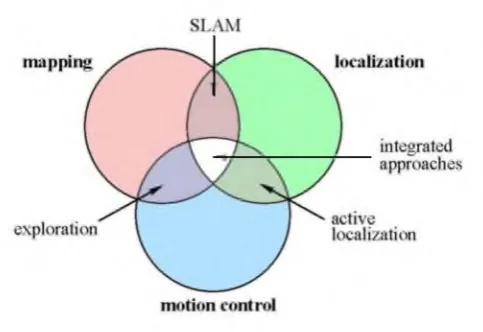
In simultaneous localization and mapping, the mobile robot captures data from the environment with own sensors, interprets this date and after building an appropriate map, determines its location in that map. Obtaining an unknown environment model must respond to three activities: mapping, localization and motion control. Mapping is shaping the collected data from robot sensors to the desired form. Localization is estimating the robot position and motion control answers this question; how to navigate the robot to favourite location or proposed path (Huang, et al., 2004; Dissanayake, et al., 2001).
Figure 1.1 Activities that must be performed to obtain an accurate model of the environment (Makarenko, 2002).
Note that the robot should do the localization and mapping simultaneously, and should determine its path during the mapping. Typically the robot motion operation is called exploration. Although it is easy to move around a completely modelled environment, the explorer robots are face uncertainties and inefficient models. Thus each successful exploration process should have the ability to deal with unpredictable and unexpected situations, thus the issues in this case should be solved with heuristic solutions. The correct position estimation is necessary for data correct correlation. It means that we should determine if the measurements that have been done up to now match with our built map. So building maps are necessary for robot navigation in unknown environments, is needed for other activities such as localization, path planning, interaction with manipulators, and interaction with operator. As said before, this activity is called SLAM and it is a hard problem because the same, noisy sensor data must be used for both mapping and localization (Carrillo, et al., 2012; Blanco, et al., 2008). Sources of uncertainty in solving this problem can be divided in to two
major categories:
2. The synthetic problem of data association (e.g., landmark extractions, feature recognition, place labelling, etc.) in which a correspondence must be detected between sensor measurements and observed features in the map.
Most of current solutions for solving the SLAM problem consider only the first category of uncertainty, and assume that the data association problem will be solved when observations are integrated into the map (e.g., it is typical to assume that all landmarks can be identified uniquely). However, this assumption is doomed to fail sooner or later for modern robots activities in unknown environments (Kang, et al., 2012). In brief, failure in data association will input error in localization, which can lead to catastrophic errors in the map. Otherwise, the robot must somehow doing the search in space of possible maps. So the SLAM problem can be defined as a global optimization problem in which the objective is to search the space of possible robot maps (Duckett, 2003; Pegden, et al., 1980; Kollar, et al., 2008).
1.2 Problem Background
SLAM is the process by which a mobile robot can build a map of an environment and at the same time use this map to compute its own location. The past decade has seen rapid and exciting progress in solving the SLAM problem together with many compelling implementations of SLAM methods. Two famous and useful methods are extended Kalman filter (EKF) and particle filter.
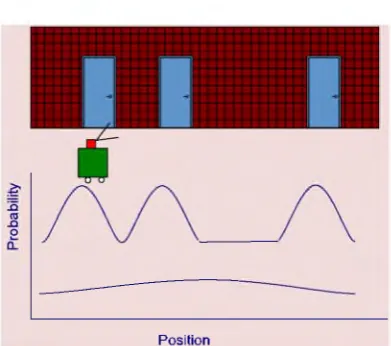
Position
Figure 1.2 Model extraction by robot based on features (doors) and transfer to uni-modal Gaussian diagram for use in EKF.
Another method for solving the SLAM problem is particle filter. Particle filter represents probability distribution as a set of discrete particles which occupy the state space. This method can represent multi-modal distributions.
I I
WWW** W W wm W w ww
•m v t •• •• v t
• • • • • # * # : ••••"•z
Position
Figure 1.3 Model extraction by robot based on features (doors) and showing the number of particles in high probability places
One of the major approaches to solve the SLAM problem is the approach based on evolutionary algorithm like Genetic Algorithm (GA). The proposed optimization model in this study is in the same category. GA is a class of search algorithm that inspired by the style evolution of living beings have arisen. The main advantage of the evolutionary algorithm is that these algorithms can be used to search space which is too large to be used with high convergence. A number of solutions are using the GA for solving the SLAM problem like Duckett solution, Begum solution or Shiry solution. Each of these solutions has some problems and drawbacks that are explained by detail in Chapter 2. Generally the main problem of solutions based on GA is connected to high computational complexity and time complexity (Begum, et al., 2006; Begum, et al., 2007). GA has three kind of operators for keeping the diversity and variety which are selection, mutation and crossover. Each of these operators also have some kind or model of implementations like uniform and two point model for crossover operation or Roulette wheel and Q-tournament model for selection operation. Choosing the appreciate model for each operators is very effective in time and computational complexity based on desired optimization problem. So for increase the speed of GA and decrease the time and computational complexity of that, the new ideas and contributions should be applied in these operators or have contribution in procedure of GA based on fitness function and other parameters of GA. The most important operator is mutation because if the pattern of response doesn’t exists in initial population, the GA couldn’t coverage to optimal answer. In original mutation selection of a gen for mutation is completely random and this is one on the problems of mutation because there is not any control in selection of gen and it is completely random. So because this operation is not targeted, the searching time will be increased and the speed of GA will be decreased consequently (Duckett, 2003).
1.3 Problem Statement
to convert non-linear equations to linear equations using for example Taylor series which causes additional errors to the system. In the particle filter, the main problem is the high memory and computation time required when increasing the number of particles. Although genetic algorithm demonstrates very good performance with large search spaces, it has some weaknesses and drawbacks such as computational and time complexity which result in low speed. There are two main causes of low speed in GA: the first is untargeted search involving replacement or adding a fixed value for mutation operation and the second is large search space. In brief, the problem can be stated as below:
“Low speed and accuracy in solutions based on Genetic Algorithm fo r
solving the SLAM problem in mobile robots "
For study on solving the SLAM problem in mobile robots, a map representation as experimental setup and test bed is needed as preprocessing. Thus a new representation model based on Genetic Algorithm should first be designed and developed for implementation of new models and then comparison of the obtained results. For this propose, in each step the best values for GA parameters should be found (parameter tuning) for better comparison of original GA and hybrid optimization model.
The following research questions will be answered in this research:
I. How can a new representation model based on occupancy grid be modified for represent the robot and its environment?
II. How can the genetic algorithm be hybrid with particle filter by increasing the accuracy perspective?
1.4 Purpose of Study
To propose new optimization model in increase the speed and accuracy of SLAM problem using new hybrid of particle filter and GA algorithm for avoidance of random selection in mutation step.
To increase the speed of optimization model with a line based GA and a new representation of occupancy grid for decrease the search space.
1.5 Objectives
Objectives of this research are as follows:
1. To propose and design simulation model of new representation model of occupancy grid based on Genetic algorithm.
2. To develop a hybrid optimization model (HOM) of GA and Particle filter on the proposed representation model.
3. To develop a line based genetic algorithm optimization model (LBGAOM) on the proposed representation model.
1.6 Research Scope
and received data from its laser sensors in a static environment which obstacles are static.
2. In the new representation model of occupancy grid, the map representation performance will be checked with presented fitness functions.
3. The hybrid optimization model (HOB) target is to investigate the increased convergence and speed.
4. The proposed LBGA optimization model is for working in indoor environments only.
5. The new optimization model will be implemented on some simulated maps and the accuracy of model will be evaluated with presented fitness functions.
6. MATLAB software and some related software are used for simulation.
1.7 Significance of Research
The significance of this project is to propose an enhanced optimization model for solving the simultaneous localization and mapping (SLAM) problem by covering the weaknesses of representation of occupancy grid. Another significance of this project is that the solutions based on Kalman filter are highly dependent on the motion model while in this study the presented optimization model is completely independent from motion model. Thus the benefit of this research is the increase in accuracy of SLAM algorithm and improved performance of occupancy grid for map representation. In detail, some significant algorithms are listed below:
2. An hybrid optimization model (HOM) based on genetic algorithm and particle filter are presented and new chromosome model and desired fitness function for use in model are designed and presented also.
3. A Line-based genetic algorithm optimization model (LBGAOM) for reduce the search space and increase the speed is presented and new chromosome model and desired fitness function for use in model are designed and presented also.
1.8 Thesis Overview
This research consists of seven chapters. In Chapter 1 an introduction, problem background, problem statement, Purpose of Study, objectives, scope and significant of this research are presented.
In Chapter 2, some basic background about SLAM is presented then some mapping models and localization algorithms are presented. The effective parameters and existing methods and tools for solving the SLAM problem are introduced and compared. Finally the existing solutions based on each methods or hybrid of some methods are presented and compared.
In Chapter 3 methodology which is used in this research discussed.
In Chapter 4 a development of a new representation of occupancy grid based on GA and tune the parameters for comparison in other Chapters, is presented. In this chapter a new representation model with a new fitness function is presented which has best performance in increase the accuracy.
chromosome.
Angeline, P. J., Saunders, G. M. and Pollack, J. B. (1994). An evolutionary algorithm that constructs recurrent neural networks. IEEE Transactions on Neural Networks, 5(1), 54-65.
Back, T. (1994). Selective pressure in evolutionary algorithms: A characterization of selection mechanisms. Proceedings o f the First IEEE Conference on World Congress on Computational Intelligence, 57-62.
Back, T. (1995). Generalized Convergence Models for Tournament-and (^, lambda)- Selection.
Back, T., Fogel, D. B. and Michalewicz, Z. (1997). Handbook o f evolutionary computation: IOP Publishing Ltd.
Back, T., Fogel, D. B. and Michalewicz, Z. (2000). Evolutionary computation 1: Basic algorithms and operators (Vol. 1): CRC Press.
Bailey, T. and Durrant-Whyte, H. (2006). Simultaneous localization and mapping (SLAM): Part II. IEEE Robotics & Automation Magazine, 13(3), 108-117. Baker, J. E. (1987). Reducing bias and inefficiency in the selection algorithm.
Proceedings o f the second international conference on genetic algorithms,
14-21.
Bayindir, L. and Sahin, E. (2007). A review of studies in swarm robotics. Turkish Journal o f Electrical Engineering & Computer Sciences, 15(2), 115-147.
Beasley, J. E. and Chu, P. C. (1996). A genetic algorithm for the set covering problem. European Journal o f Operational Research, 94(2), 392-404.
simultaneous localization and mapping (SLAM) of mobile robots. Advanced Robotics, 21(9), 1031-1050.
Bibby, C. and Reid, I. (2007). Simultaneous localisation and mapping in dynamic environments (SLAMIDE) with reversible data association. Proceedings o f Robotics: Science and Systems.
Blanco, J.-L., Fernandez-Madrigal, J.-A. and Gonzalez, J. (2008). A Novel Measure of Uncertainty for Mobile Robot SLAM with Rao—Blackwellized Particle Filters. The International Journal o f Robotics Research, 27(1), 73-89.
Blickle, T. and Thiele, L. (1995). A comparison of selection schemes used in genetic algorithms: TIK-Report.
Blickle, T. and Thiele, L. (1996). A comparison of selection schemes used in evolutionary algorithms. Evolutionary Computation, 4(4), 361-394.
Boada, B., Blanco, D., Castejon, C. and Moreno, L. (2003). A genetic solution for the slam problem. Proceedings o f the 11th International Conference on Advanced Robotics (ICAR’03), Coimbra, Portugal, 270-275
Boada, B. L., Blanco, D. and Moreno, L. (2002). Localization and modelling approach using topo-geometric maps. Proceedings o f the IEEE/RSJ International Conference on Intelligent Robots and Systems.484-489.
Bosse, M., Newman, P., Leonard, J., Soika, M., Feiten, W. and Teller, S. (2003). An Atlas framework for scalable mapping. ICRA'03. Proceedings o f the IEEE International Conference on Robotics and Automation, 2003, 1899-1906.
Branke, J. (1998). Creating robust solutions by means of evolutionary algorithms. Proceedings o f the Parallel Problem Solving from Nature—PPSN V, 119
128.
Carrillo, H., Reid, I. and Castellanos, J. A. (2012). On the comparison of uncertainty criteria for active SLAM. Proceedings o f the IEEE International Conference on Robotics and Automation (ICRA), 2080-2087.
Castellanos, J. A., Neira, J. and Tardos, J. D. (2004). Limits to the consistency of EKF-based SLAM 1. 5th Sympusium On Intelligent Autonomous Vehicles, Lisboa, Portigal, 7-13.
CHEN, B., CAI, Z. and Yuan, C. (2009). Mobile robot SLAM method based on particle swarm optimization. Robot, 31 (6), 513-517
Choset, H. and Nagatani, K. (2001). Topological simultaneous localization and mapping (SLAM): toward exact localization without explicit localization. IEEE Transactions on Robotics and Automation, 17(2), 125-137.
Coello Coello, C. A. (2012). Constraint-handling techniques used with evolutionary algorithms. Proceedings o f the fourteenth international conference on Genetic and evolutionary computation conference companion, 849-872.
Davis, L. (1991). Handbook o f genetic algorithms (Vol. 115): Van Nostrand Reinhold New York.
Deb, K. and Agrawal, R. B. (1995). Simulated binary crossover for continuous search space. Complex systems, 9(2), 115-148.
Deb, K., Pratap, A., Agarwal, S. and Meyarivan, T. (2002). A fast and elitist multiobjective genetic algorithm: NSGA-II. IEEE Transactions on Evolutionary Computation, 6(2), 182-197.
Diosi, A. and Kleeman, L. (2004). Advanced sonar and laser range finder fusion for simultaneous localization and mapping. Proceedings o f the IEEE/RSJ International Conference on Intelligent Robots and Systems. (IROS 2004),
1854-1859.
Dissanayake, M. G., Newman, P., Clark, S., Durrant-Whyte, H. F. and Csorba, M. (2001). A solution to the simultaneous localization and map building (SLAM) problem. IEEE Transactions on Robotics and Automation, 17(3), 229-241.
Duckett, T. (2003). A genetic algorithm for simultaneous localization and mapping. Proceedings o f the IEEE International Conference on Robotics and
Automation, 434-439.
Dudek, G., Jenkin, M., Milios, E. and Wilkes, D. (1993). A taxonomy for swarm robots. Proceedings o f the IEEE/RSJ International Conference on Intelligent Robots and Systems’ 93, IROS’93, 441-447.
Durrant-Whyte, H. and Bailey, T. (2006). Simultaneous localization and mapping: part I. IEEE Robotics & Automation Magazine, 13(2), 99-110.
applications and resources. Proceedings o f the Congress on the 2001 Evolutionary Computation, 81-86.
Eiben, A. E., Hinterding, R. and Michalewicz, Z. (1999). Parameter control in evolutionary algorithms. IEEE Transactions on Evolutionary Computation, 3(2), 124-141.
Elfes, A. (1989). Using occupancy grids for mobile robot perception and navigation. Computer, 22(6), 46-57.
Eliazar, A. and Parr, R. (2003). DP-SLAM: Fast, robust simultaneous localization and mapping without predetermined landmarks. Proceedings o f the International Joint Conference on Artificial Intelligence, 1135-1142.
Eliazar, A. I. and Parr, R. (2004). DP-SLAM 2.0. Proceedings o f the IEEE International Conference on Robotics and Automation ICRA’04, 1314-1320.
Engelbrecht, A. P. (2007). Computational intelligence: an introduction (Book) John Wiley & Sons publication, London, England.
Feng, D. J., Wijesoma, S. and Shacklock, A. P. (2006). Genetic algorithmic filter approach to mobile robot simultaneous localization and mapping. Proceedings o f the 9th International Conference on Control, Automation,
Robotics and Vision, 2006. ICARCV'06, Singapore, 1-6.
Fogarty, T. C. (1989). Varying the probability of mutation in the genetic algorithm. Proceedings o f the third international conference on Genetic algorithms,
104-109.
Frese, U. (2006). A discussion of simultaneous localization and mapping. Autonomous Robots, 20(1), 25-42.
Frese, U. and Hirzinger, G. (2001). Simultaneous localization and mapping-a discussion. Proceedings o f the IJCAI Workshop on Reasoning with
Uncertainty in Robotics, 17-26.
Gen, M. and Cheng, R. (2000). Genetic algorithms and engineering optimization (Vol. 7): John Wiley & Sons.
Goldberg, D. E. (2006). Genetic algorithms: Pearson Education India.
Grefenstette, J. J. (2013). Genetic Algorithms and Their Applications. Proceedings o f the Second International Conference on Genetic Algorithms, Psychology
Press.
Gustafsson, F. (2010). Particle filter theory and practice with positioning applications. IEEE Aerospace and Electronic Systems Magazine, 25(7), 53 82.
Havangi, R., Nekoui, M., Teshnehlab, M. and Taghirad, H. (2013). A SLAM based on auxiliary marginalised particle filter and differential evolution. International Journal o f Systems Science, (ahead-of-print), 1-14.
Higuchi, T. (1997). Monte Carlo filter using the genetic algorithm operators. Journal o f Statistical Computation and Simulation, 59(1), 1-23.
Holmes, S. A., Klein, G. and Murray, D. W. (2009). An O (N2) Square Root Unscented Kalman Filter for Visual Simultaneous Localization and Mapping. IEEE Transactions on Pattern Analysis and Machine Intelligence, 31(7), 1251-1263.
Houck, C. R., Joines, J. and Kay, M. G. (1995). A genetic algorithm for function optimization: a Matlab implementation, (Book) North Carolina State University, USA, NCSU-IE TR, 95(09).
Huang, S. and Dissanayake, G. (2007). Convergence and consistency analysis for extended Kalman filter based SLAM. IEEE Transactions on Robotics, 23(5),
1036-1049.
Huang, S., Wang, Z. and Dissanayake, G. (2004). Time optimal robot motion control in simultaneous localization and map building (SLAM) problem. Proceedings o f the IEEE/RSJ International Conference on Intelligent Robots
and Systems, 2004 (IROS 2004). 3110-3115.
Hui-Ping, L., De-Min, X., ZHANG, F.-B. and Yao, Y. (2009). Consistency analysis of EKF-based SLAM by measurement noise and observation times. Acta Automatica Sinica, 35(9), 1177-1184.
optimization with approximate fitness functions. IEEE Transactions on Evolutionary Computation, 6(5), 481-494.
Kang, J.-G., Kim, S., An, S.-Y. and Oh, S.-Y. (2012). A new approach to simultaneous localization and map building with implicit model learning using neuro evolutionary optimization. Applied Intelligence, 36(1), 242-269. Karlsson, L. N. (2010). Robust sensor fusion for mapping and localization in a
simultaneous localization and mapping (SLAM) system: Google Patents. Karlsson, N., Di Bernardo, E., Ostrowski, J., Goncalves, L., Pirjanian, P. and
Munich, M. E. (2005). The vSLAM algorithm for robust localization and mapping. Proceedings o f the IEEE International Conference on the Robotics and Automation ICRA 2005, 24-29.
Kennedy, J. and Eberhart, R. (1995). Particle swarm optimization. Proceedings o f the IEEE International Conference on Neural Networks, 1942-1948.
Kollar, T. and Roy, N. (2008). Efficient Optimization of Information-Theoretic Exploration in SLAM. Proceedings o f the AAAI, 1369-1375.
Konolige, K. (1997). Improved occupancy grids for map building. Autonomous Robots, 4(4), 351-367.
Kwok, N., Fang, G. and Zhou, W. (2005). Evolutionary particle filter: re-sampling from the genetic algorithm perspective. Proceedings o f the IEEE/RSJ International Conference on Intelligent Robots and Systems (IROS 2005),
2935-2940.
Kwok, N. and Rad, A. (2006). A modified particle filter for simultaneous localization and mapping. Journal o f Intelligent and Robotic Systems, 46(4), 365-382. Leonard, J., Durrant-Whyte, H. and Cox, I. J. (1990). Dynamic map building for
autonomous mobile robot. Proceedings o f the IEEE International Workshop on Intelligent Robots and Systems.'Towards a New Frontier o f Applications'
IROS’90, 89-96.
Liu, Z., Chen, D. and von Wichert, G. (2012). 2D Semantic Mapping on Occupancy Grids. Proceedings o f the 7th German Conference on Robotics, Proceedings o f ROBOTIK 2012, 1-6.
Montemerlo, M., Thrun, S., Koller, D. and Wegbreit, B. (2002). FastSLAM: A factored solution to the simultaneous localization and mapping problem. Proceedings o f the National conference on Artificial Intelligence, 593-598.
Montemerlo, M., Thrun, S., Koller, D. and Wegbreit, B. (2003). FastSLAM 2.0: An improved particle filtering algorithm for simultaneous localization and mapping that provably converges. Proceedings o f the International Joint Conference on Artificial Intelligence, 1151-1156.
Montemerlo, M., Thrun, S. and Siciliano, B. (2007). FastSLAM: A scalable method fo r the simultaneous localization and mapping problem in robotic (Book),
Springer Verlag Berlin Germany, (Vol. 27).
Moreno, L., Garrido, S., Blanco, D. and Munoz, M. L. (2009). Differential evolution solution to the SLAM problem. Robotics and Autonomous Systems, 57(4), 441-450.
Moreno, L., Garrido, S. and Munoz, M. L. (2006). Evolutionary filter for robust mobile robot global localization. Robotics and Autonomous Systems, 54(7), 590-600.
Mozos, O. M., Stachniss, C., Rottmann, A. and Burgard, W. (2007). Using adaboost for place labeling and topological map building Robotics Research, Springer Book, Volume 28, pp 453-472
Nagla, K., Uddin, M. and Singh, D. (2012). Improved occupancy grid mapping in specular environment. Robotics and Autonomous Systems.
Newman, P. (1999). On the structure and solution of the simultaneous localisation and map building problem. Doctoral diss., University of Sydney.
Omranpour, H. and Shiry, S. (2009). A Heuristic Algorithm for Simultaneous Localization and Mapping in Mobile Robots. Proceedings o f the 2009 Iran Open Symposium, Tehran, 4-9.
Omranpour, H. and Shiry, S. (2012). Reduced Search Space Algorithm for Simultaneous Localization and Mapping in Mobile Robots. IAES International Journal o f Robotics and Automation (IJRA), 1(1), 49-63.
Paz, L. M. and Neira, J. (2006). Optimal local map size for EKF-based SLAM. 2006 IEEE/RSJ International Conference on Proceedings of the 2006 Intelligent
Robots and Systems, 5019-5025.
Simulation, 34(1), 18-25.
Pronobis, A., Jensfelt, P., Sjoo, K., Zender, H., Kruijff, G.-J. M., Mozos, O. M., et al. (2010). Semantic modelling of space. Cognitive Systems, 165-221.
Ranganathan, A. and Dellaert, F. (2007). Semantic modeling of places using objects. Proceedings o f the Robotics: Science and Systems Conference, 27-30.
Reif, K. and Unbehauen, R. (1999). The extended Kalman filter as an exponential observer for nonlinear systems. IEEE Transactions on Signal Processing, 47(8), 2324-2328.
Remolina, E. and Kuipers, B. (2004). Towards a general theory of topological maps. Artificial Intelligence, 152(1), 47-104.
Rudnick, E. M., Patel, J. H., Greenstein, G. S. and Niermann, T. M. (1994). Sequential circuit test generation in a genetic algorithm framework. Proceedings o f the 31st annual Design Automation Conference, 698-704.
Rudol, E. (1960). Kalman. A new approach to linear filtering and prediction problem. Journal of Basic Engineering, 82(1), 35-45.
Rudolph, G. (1994). Convergence analysis of canonical genetic algorithms. IEEE Transactions on Neural Networks, 5(1), 96-101.
Sasaki, H., Kubota, N. and Taniguchi, K. (2008). Evolutionary computation for simultaneous localization and mapping based on topological map of a mobile robot. Intelligent Robotics and Applications, 883-891.
Sastry, K., Goldberg, D. and Kendall, G. (2005). Genetic algorithms, Search methodologies Book, Springer, USA, (pp. 97-125)
Schaffer, J. D. and Morishima, A. (1987). An adaptive crossover distribution mechanism for genetic algorithms. Proceedings o f the o f the Second International Conference on Genetic Algorithms and their Applications, 36
40.
Schmitt, L. M. (2001). Theory of genetic algorithms. Theoretical Computer Science, 259(1), 1-61.
Sim, R., Elinas, P., Griffin, M. and Little, J. J. (2005). Vision-based SLAM using the Rao-Blackwellised particle filter. Proceedings o f the IJCAI Workshop on Reasoning with Uncertainty in Robotics, 9-16.
Simhon, S. and Dudek, G. (1998). A global topological map formed by local metric maps. Proceedings o f the IEEE/RSJ International Conference on Intelligent Robots and Systems, Victoria, BC, Canada, (3), 1708-1714.
Spears, W. M. (1995). Adapting Crossover in Evolutionary Algorithms. Proceedings o f the Evolutionary programming, 367-384.
Spero, D. J. and Jarvis, R. A. (2007). A review of robotic SLAM.
Srinivas, M. and Patnaik, L. M. (1994). Adaptive probabilities of crossover and mutation in genetic algorithms. IEEE Transactions on Systems, Man and Cybernetics, 24(4), 656-667.
Stachniss, C., Hahnel, D. and Burgard, W. (2004). Exploration with active loop- closing for FastSLAM. Proceedings o f the IEEE/RSJ International Conference on Intelligent Robots and Systems(IROS 2004), 1505-1510.
Syswerda, G. (1989). Uniform crossover in genetic algorithms.
Thrun, S. (2001). A probabilistic on-line mapping algorithm for teams of mobile robots. The International Journal o f Robotics Research, 20(5), 335-363. Thrun, S. (2002). Particle filters in robotics. Proceedings o f the Eighteenth
conference on Uncertainty in artificial intelligence, 511-518.
Thrun, S. (2003). Robotic mapping: A survey. Exploring artificial intelligence in the new millennium, 1, 1-35.
Thrun, S. (2008). Simultaneous localization and mapping. Robotics and cognitive approaches to spatial mapping (pp. 13-41): Springer.
Thrun, S. (2012). Particle Filters in Robotics (Invited Talk). arXiv preprint arXiv:1301.0607.
Thrun, S. and Bucken, A. (1996). Learning Maps for Indoor Mobile Robot Navigation, Technical report, Carnegie-Mellon University, school of computer science, Pittsburgh, USA.
Thrun, S., Bucken, A., Burgard, W., Fox, D., Frohlinghaus, T., Hennig, D., et al. (1998). Map learning and high-speed navigation in RHINO. AI-based Mobile Robots: Case studies o f successful robot systems. M IT Press, Cambridge,
press Cambridge.
Thrun, S., Fox, D. and Burgard, W. (1998). Probabilistic mapping of an environment by a mobile robot. Proceedings o f the IEEE International Conference on Robotics and Automation, 1546-1551.
Thrun, S., Fox, D., Burgard, W. and Dellaert, F. (2001). Robust Monte Carlo localization for mobile robots. Artificial intelligence, 128(1), 99-141.
Thrun, S., Montemerlo, M., Koller, D., Wegbreit, B., Nieto, J. and Nebot, E. (2004). Fastslam: An efficient solution to the simultaneous localization and mapping problem with unknown data association. Journal o f Machine Learning Research, 4(3), 380-407.
Todor, B. and Darabos, D. (2005). Simultaneous localization and mapping with particle swarm localization. Proceedings o f the Intelligent Data Acquisition and Advanced Computing Systems: Technology and Applications (IDAACS
2005), 216-221.
Tomatis, N., Nourbakhsh, I. and Siegwart, R. (2001). Simultaneous localization and map building: A global topological model with local metric maps. Proceedings o f the IEEE/RSJ International Conference on Intelligent Robots
and Systems, 421-426.
Tomatis, N., Nourbakhsh, I. and Siegwart, R. (2003). Hybrid simultaneous localization and map building: a natural integration of topological and metric. Robotics and Autonomous systems, 44(1), 3-14.
Tornqvist, D., Schon, T. B., Karlsson, R. and Gustafsson, F. (2009). Particle filter SLAM with high dimensional vehicle model. Journal o f Intelligent and Robotic Systems, 55(4-5), 249-266.
Vasudevan, S., Gachter, S., Nguyen, V. and Siegwart, R. (2007). Cognitive maps for mobile robots—an object based approach. Robotics and Autonomous Systems, 55(5), 359-371.
Viswanathan, P., Meger, D., Southey, T., Little, J. J. and Mackworth, A. K. (2009). Automated spatial-semantic modeling with applications to place labeling and informed search. Proceedings o f the Canadian Conference on Computer and Robot Vision, 2009. CRV’09. 284-291.
Wang, C.-C. and Thorpe, C. (2002). Simultaneous localization and mapping with detection and tracking of moving objects. Proceedings o f the IEEE International Conference on Robotics and Automation (ICRA'02), 2918
2924.
Weile, D. S. and Michielssen, E. (1997). Genetic algorithm optimization applied to electromagnetics: A review. IEEE Transactions on Antennas and Propagation, 45(3), 343-353.
Welch, G. and Bishop, G. (1995). An introduction to the Kalman filter.
Whitley, L. D. (1989). The GENITOR Algorithm and Selection Pressure: Why Rank-Based Allocation of Reproductive Trials is Best. Proceedings o f the ICGA, 116-123.
Wright, A. H. (1991). Genetic algorithms for real parameter optimization. Foundations o f genetic algorithms, 1, 205-218.
Yamauchi, B., Langley, P., Schultz, A. C., Grefenstette, J. and Adams, W. (1998). MAGELLAN: An Integrated Adaptive Architecture for Mobile Robotics: DTIC Document.
Zender, H., Martinez Mozos, O., Jensfelt, P., Kruijff, G.-J. and Burgard, W. (2008). Conceptual spatial representations for indoor mobile robots. Robotics and Autonomous Systems, 56(6), 493-502.