PROPERTY COMPOSITION AND OTHER
CONSTRUCTS TO SUPPORT IDENTITY IN OWL
Robert M. Colomb
Department of Information Systems
Faculty of Computer Science and Information Systems University of Technology Malaysia
Abstract: This paper presents proposals for augmenting OWL Full with constructs necessary
for supporting identity, an essential facility for ontologies governing interoperating
information systems. These constructs include declaration that a property is one-to-one, a
representation of the image of a property, and composition of properties. Using definitions
from Category theory, property composition allows definition of Cartesian product without
requiring that an individual have any internal structure. Category theory-style definitions and
reasoning work entirely with properties, therefore are not affected by the open world
semantics of OWL. The definitions permit representation of n-ary relations, association
classes, parameterised families of properties and indexed families of classes.
Keywords: OWL, information systems interoperation, ontology
1. INTRODUCTION
OWL as a knowledge/ontology representation language has a rich set of constructs, but is
very limited in expressive power compared for example with Common Logic or even SQL.
There are many applications for which the expressive power of OWL is insufficient. But
extensions to OWL are best if they respect the basic structure of OWL, founded on classes,
properties, and the absence of the unique names assumption. This paper argues for a number
of extensions based on property composition, which it argues fit well into the OWL way of
doing things.
OWL has a set of base constructs: class and property. Properties have domain and range.
There are special kinds of properties: functional, inverse functional, transitive, symmetric. In
addition, it is possible to construct restriction classes using a number of conditions on
properties (allValuesFrom, someValuesFrom, hasValue, minCardinality, maxCardinality).
There is a limited ability to construct derived properties using inverseOj Further, there is a
limited facility for property composition, in that composition of a transitive property results in
the same property; and a limited algebra of operators on properties: inverseOf applied to
inverseOf is the identity, and inverseOf is the identity on a symmetric property. Finally, in
OWL individuals by default fail to satisfy the unique names assumption, but properties and
2. IDENTITY
AgentA2
Jurnal Teknologi Maklumat L
Figure 1. Interoperating Agents Agent Al
Jilid 20, Bi!. 4 (Disember 2008)
An ontology is a representation of a world shared among a community of agents. This
world consists of a collection of objects organized into classes and related through properties.
A key requirement for two agents to interoperate is the ability to tell if they are working with
the same object. In other words they need to be able to agree on the identification of the
objects they share. Consider the situation in Figure 1.
classes by default do satisfy the assumption. Of course classes can be declared to be
equivalent, as can properties, but they are by default assumed to be distinct.
In this paper, we argue for a more complete facility for property composition, a richer
facility for construction of classes, and the use of aggregation for deriving classes and
properties. Some of the proposals are informed by category theory, which suggests definitions
that do not require instance-level reasoning so are compatible with the absence of the unique
names assumption. All of the proposals are informed by well-established requirements of
large information systems, and in some cases borrow from facilities of SQL designed to serve
these requirements.
We first consider the problem of identity, which requires that properties be declared to be
injective and surjective, and also the construction of derived classes using Cartesian product.
These lead to the need for property composition, which allows the definition of Cartesian
product without requiring a class to have internal structure, instance-independent definitions
of surjection and injection, and a class of integrity constraint called the principle of consistent
dependency useful in information systems applications. These new constructs are applied to
the representation of n-ary properties, to association classes and to correlations among
classes. They are further applied to structures useful for large ontologies, namely
parameterised families of properties and indexed families of classes. Finally, a proposal is
made for declaration of local closed worlds permitting the definition of aggregation functions
used in data warehousing applications. The proposals are fmally summarized in a table, and
the issue of placement in OWL Full rather than OWL DL is addressed.
Ontology C
The ontology consists of a concept C which is the in the domain of a property p whose
range instance is a single literal L. The ontology supports a group of interoperating agents,
including agents Al and A2. Each agent maintains an internal representation of concept C as
Cl and C2 respectively. But CI is not visible to any observer outside AI, and similarly C2 is
not visible to any observer outside A2.
The agents communicate using messages constructed out of literals. So if agent A I wants to
communicate with A2 about concept C, the message will contain the literal L. A I finds L by
navigating from CI to L via p, while A2 must find C by navigating from L to C2. This implies
a property whose range includes C and whose domain includes L. The property p carries
identity for the class including C.
OWL has a very weak concept of identity. Individuals can have names, but names do not
necessarily satisfy the unique name assumption. Names may be synonymous. The fact that
two names are synonymous may not be known, so two distinctly named individuals may not
necessarily be distinct objects.
Literals do satisfy the unique name assumption, in that for example two distinct strings are
different. If there were a one-to-one property whose domain was a class of individuals and
whose range was a class of literals, it could be identifying. But it is impossible to declare such
a property in OWL DL. One can declare a property to be functional, and that its inverse is
also functional, but a property cannot have a class of literals as its domain. OWL Full allows
the declaration of a property whose range can be a class of literals to be both functional and
inverse functional, but there is still no property whose domain is a class of literals.
There are many applications like Figure I where a community of autonomous agents
interoperate in a closed world. Electronic commerce exchanges are an obvious example.
These can have tens of thousands of autonomous players, but they must all be members of the
exchange and must all commit to the ontology. These agents need identity, and the
representations they have to work with are restricted to collections of literals.
Besides its use in the interoperation of information systems, identity is a central concern of
the OntoClean [4] method for validating the subclass structure of an ontology. The properties
used to identify instances of a superclass must also be capable of identifying instances of all
subclasses.
SQL systems represent identity by allowing columns of tables to declared keys. Entity
Relationship models and UML models have cardinality/multiplicity constraints on all ends of
relationships/associations, so in particular can declare one-to-one constraints.
An equivalent facility in OWL would be the inclusion of an additional restriction class on a
property, namely the subset of its domain which is in one-to-one correspondence with a
subclass of its range. We might call this new restriction isOneToOneTo. But such a restriction
class is different from other restriction classes in OWL. The other restriction classes are all predicates which can be satisfied or refuted by a single individual, so that it is possible to compute the restriction class by testing all individuals, putting those satisfying the predicate into the restriction class, and leaving the others out. The proposed restriction isOneToOneTo
can't be computed this way.
2.1 Restrictions: Injection and Surjection
The restriction isOneToOne is more naturally evaluated by testing the individuals in the range of the property. Each instance of the range corresponding to a single instance of the domain determines an instance of the domain belonging to the restriction class. So
isOneToOneTo can be defined as a restriction for an objectProperty. But we would also like
isOneToOneTo to apply to a datatypeProperty. This is more difficult, because literal datatypes are generally not finite classes.
OWL has a construct owl:DataRange, which is defined as a subclass of literals. The only constructor for owl:DataRange is the ability to construct an enumerated class of literal instances using owl:oneOf. A datatypeProperty whose range is an owl:DataRange can support our definition ofisOneToOneTo.
A possible representation in RDF of isOneToOneTo (restriction(ID isOneToOneTo (required))) along the lines of [8] is
_:x rdf:type owl:Restriction . _:x rdf:type owl:Class [opt] _:x rdf:type rdfs:Class [opt] _:x owl:onProperty T(ID) _:x owl:isOneToOne T(required)
ID and required are parameter variables, ID a property and required a class. The [opt] annotation means that the OWL reasoner can infer this (a Restriction is by defmition an OWL class, which is by definition an RDFS class.) The notation TO refers to a translation of the parameter to an RDF object.
A DataRange defined using owl:oneOfhas an extent defined a priori and explicitly. This is inconvenient for many common situations. For example, suppose we have a datatypeProperty studentlD whose domain is Student and whose range is xsd:string, and want to know which strings are actually associated with instances of Student in that class' extent at a particular time. To this end, we propose a derived class imageofclass C from property P, or C imageO!
P
'-t~
:~*_owl:1
. ':xrdf:typo
rdfs, ,. ,'''''' ,Vt ':x ow: I onPr'opel~'''T<m)
rdf:type 0 .., 'T(requiJ'ed) rdf~
T(ID) rdfs:domai T(required) rdfs:: :x owl:image01 - imageOf(requiJ
n :x rdf:type owl:
-:x rdf:type rdfs:
-:x owl:onPrope
T(IO) rdf:type o
T(required) rdf:t . T(ID) rdfs:doma T(required) rdfs
_:x
owl:imageOlass T ofR ona Sl
I imageOf S onl
T rdfs:subclassOf the restriction
isOneToOneTo T
ally
S rdfs:subClass01
On
class must be , now have a propo:e, and hence an i
datarange(imageOf(required) onProperty(ID)) _:x rdf:type owl:DataRange
_:x rdf:type rdfs:Class [opt] _:x owl:onProperty T(ID)
T(ID) rdf:type owl:datatypeProperty T(required) rdf:type owl:Class T(ID) rdfs:domain D
T(required) rdfs:subclassOf D _:x owl:imageOfT(required) and class(imageOf(required) onProperty(ID))
_:x rdf:type owl:Class _:x rdf:type rdfs:Class [opt] _:x owl:onProperty T(ID) T(ID) rdf:type owl:objectProperty T(required) rdf:type owl:Class T(ID) rdfs:domain D
T(required) rdfs:subclassOf D _:X owl:imageOfT(required)
So if we have a property P with domain D and range R, and want to say that P is injective
to a subclass T of R on a subclass S of D, we can first declare
I imageOf S onProperty P then
T rdfs:subclassOf I then the restriction
isOneToOneTo T onProperty P and fmally
S rdfs:subClassOf restriction
An identifier for S must also satisfy the restriction cardinality = 1, since every instance of the domain class must be identified.
We now have a proposal for OWL constructs supporting the restriction that a property be
injective, and hence an identifier. But along the way we have also proposed a construct that
can be used to declare that a property is surjective, since a property is by definition surjective
if it is range restricted to any subclass of its image.
2.2 Cartesian Product
But a single property is often not sufficient for identification. Relational systems make
great use of compoun~sreflecting the need to identify objects in particular applications by combinations of attributes. For example, in RDF, a non-reified statement in a named graph
is identified by the combination of four properties subject, predicate, object and graph. So we
need to be able to designate a combination of properties as carrying identity for a class.
One way to do this, analogous to the way compound keys are handled in relational systems,
is to allow a new class to be derived as the Cartesian product of a number of existing classes.
In relational systems, a Cartesian product is defined as a set of tuples, but in category theory
(see eg [I
D,
a Cartesian product is defined without specifying the internal structure of the derived class. Instead, the construction includes a collection of total functional projectionproperties whose domain is the Cartesian product and whose range is one of the classes from
which the product is derived. This latter approach is probably more suited to OWL, since
individuals in OWL have no internal structure.
If a collection of properties is together identifying for a class, it is equivalent to a single
property whose range is the Cartesian product of the ranges of the original properties. The
original range classes can be reached using the projection properties.
Cartesian product can be defined in a way analogous to the definition of class intersection
in [8], using blank nodes. First we define the product itself
cartesianProduct(description 1... descriptionn) _:x rdf:type owl:Class
_:x rdf:type rdfs:Class [opt]
_:x owl:cartesianProduct T(SEQ descriptionl ... descriptionn) then the projections
projection(description, description i) i = I ... n _:x rdf:type owl:functionalProperty _:x rdf:type rdf:Property [opt]
_:x owl:projection T(SEQ description, descriptioni) _:x rdfs:domain T(description)
_:x rdfs:range T(descriptioni)
T(description) rdfs:subClassOf T(restrictionrjx, minCardinality( 1»)
where the first description is the product and descriptioni is one of the components of the
product. The projection property has minimum cardinality 1 on the product.
This definition is somewhat ambiguous, but will be augmented below.
3. COMPOSITION OF PROPERTIES
A property in OWL associates each individual with zero or more individuals. So if we have
two properties P1 and P2, with P1 associating individual 11 with 12 and P2 associating 12
with 13, then the composition P2.P 1 associates 11 with 13, and is semantically a property in
OWL. It would seem reasonable therefore for OWL to have a syntactic mechanism for
property composition. We propose the construct composedWith for this purpose, where P2
composedWith P1 = P2.P 1 as above. The construct composedWith can be defined in the same
sort of way as intersectionof and unionOf, connecting the construct to the type rdf:Property
via a blank node.
_:x rdf:type owl:ObjectProperty . _:x rdf.type rdf:Property . [opt]
_:x owl:composedWith P(SEQ propertyl...propertyn)
where propertyl ... propertyn are all object properties.
We need rules to derive the domain and range of a property composition given the domains
and ranges of the properties composed. Since property composition is associative, we need
only look at the case of composition of two properties, P1 and P2. Let Dl, D2 be respectively
the domain of P1, P2 and similarly Rl, R2 the range of P1, P2. Let P be P1 composed with
P2, with domain D and range R. Clearly,
D=DI
Further,
R = imageOf (R I intersect D2) onProperty P2
Property composition is a very useful tool. One very common use is to present aspects of an
ontology to a player in a form appropriate to their participation in the application supported
by the ontology. In relational database implemented information systems, this facility is
called a view. For example, suppose we have a class Wine which is the domain ofa property
availablehrom whose range is WineStore, and that WineStore is the domain of a property
situatedln whose range is Suburb. Ifwe have a menu planning application, it might want only
to know which suburb a wine is available in, abstracting away from the stores. We can create
a property availableln with domain Wine and range Suburb as an equiva/entProperty to
situatedln composedWith availab/eFrom.
A second kind of use for composition is constructing derived properties in semantically
dense networks of base properties. A very familiar example is family relationships. Ifwe have
parentOj we can define grandParentOj as an equivalentl'roperty to parentOj composedWith
parent/If If we have chi/dOj as inverseOj parentOf, we can define sib/ingOj as
equiva/entProperty to childOjcomposedWith parentof. Similarly for uncles, cousins, in-laws
and so on.
Note by the way that the construction of composedWith results in a blank node, which can
be named with subPropertyOj as well as equivalentl'roperty, so that for example recursive
properties can be defined.
3.1 Application to Cartesian Product
We can complete the definition of Cartesian product of classes with a more technical use of
property composition. As noted above, in category theory, Cartesian product of classes is
defined without reference to any internal structure of the product class by defining the product
class in terms of properties. Class C is the product of classes A and B with projections
respectively pa and pb if given any properties a and b with domain D and range respectively A and B, there is a unique property c with domain D and range C such that a is c composed with pa and b is c composed with pb. It is customary to illustrate this with a diagram, as in Figure 1.
B A
Figure 1 Diagram of Cartesian product
In this diagram, it makes sense to think of property c as the product of a and b. If a and b together carry identity for D, then we can say that c carries the compound identity.
3.2 Principle of Consistent Dependency
That for example pa composedWith c is equivalentProperty to a is called in category theory that the diagram commutes. That two property compositions with the same domain and range commute gives an important kind of integrity constraint called principle of consistent
dependency by Dampney (see [2]). For example, suppose our menu planner creates a plan for
a client. The client is located in a suburb via a composition of properties, and the wines are available in a suburb via a composition of different properties. We might want to stipulate that the wines must be available in the same suburb that the client lives in. Declaring that the two compositions commute (in OWL terminology that the two composed properties are
equivalentProperty) expresses that constraint.
Situations where the principle of consistent dependency is a useful integrity constraint are extremely common: we want a delivery of a product in respect of an order to be the same product as that ordered; we want the institution granting a degree to a student to be the same institution as offered the courses the student takes; we want the destination of a flight taken with a ticket to be the same as the destination on the ticket. That the constraint is seldom made explicit is partly due to lack of a language to do so, and partly to the fact that these sorts of constraints are taken for granted in single information systems. Where systems are built using cooperating autonomous agents, failures are more likely and have greater consequences.
It is therefore more important that commitment to the ontology include commitment to constraints like these.
3.3 Reasoning on Properties Only: Monomorphisms and Epimorphisms
Notice that the property c in Figure 1 is defined without regard for any instances of either D
or C, unlike our earlier definitions of injective and surjective properties. This is an advantage, since the default open world semantics for OWL makes reasoning at the individual level
problematic. For example, if we have a restriction on property P that cardinality == I, and have the triples
il P j I il P j2
we can't conclude that the restriction is violated unless we further know
j I differentFrom j2
similarly, we can not conclude from the absence of a triple whose subject is i1 and whose predicate is P that the constraint is violated. We simply may not know the object ofthe triple,
so can't represent it.
In Category Theory, there is a generalization of injective, called monomorphism, and a
generalization of surjective, called epimorphism, defined solely in terms of commuting
diagrams. We will refer to Figure 2
g
f )
>
y
---:>~ Tx
)
j h
Figure 2 Diagrams for monomorphism and epimorphism
A property
f
with domain S and range T is a monomorphism (injective) iff for everyproperties i and j with domain Y and range S, equivalentProperty(j composedWith i,
f
composedWith j) implies equivalentProperty(i, j).Similarly, a property fwith domain S and range T is an epimorphism (surjective) iff for
every properties g and h with domain Tand range X, equivalentProperty(g composedWithj, h composedWithjJ implies equivalentProperty(g, h).
These definitions may be more convenient for reasoning in OWL engines.
4. ApPLICATION OF THE CONSTRUCTS: N-ARY RELATIONS AND ASSOCIATION CLASSES Suppose we wanted to say that Ian Thorpe won a gold medal for the 400 metre freestyle in
the 2004 Olympics. This is easily expressed as a 4-ary relation
<Ian Thorpe, 2004, 400m Freestyle, gold>
UML, Object Role modelling, and many dialects of Entity-Relationship modelling have
constructs permitting this to be directly expressed (respectively n-ary association, n-ary fact
type, n-ary relationship).
Jurnal Teknologi Maklumat awarded
Jilid 20, Bi\. 4 (Disember 2008)
enrolment
Figure 3: Example of association class in augmented OWL
The original property is enrolment. We represent it as the class Enrolment, identified by id
whose range is the Cartesian product Student x Course with projections ps and pc. The
property s is equivalentProperty to ps composedWith id, c is equivalentProperty to pc
composedWith id, and si is inverseOf s. We can defme enrolment as equtvalentProperty to c
composedWith si, Finally Enrolment is the domain of the property awarded.
Note that we need never materialize the Cartesian product nor the projections ps and pc. It
is used solely as a constraint on the triples representing the properties s and c.
N-ary properties can be represented in a similar way, as illustrated in Figure 4. The notation
is the same as Figure 3, with the addition of the arrow with a solid head denoting Outcome
rdfs:subClassOf CxExOxM. To avoid clutter, the projection properties are not shown.
The quaternary property is represented by the class Outcome. As a subclass of CxExOxM, si
Further, it is often convenient to consider that something modelled as a binary relation has
an attribute, or participates in a relation. For example, if we represent the fact that a student is
enrolled in a course as a 2-relation <Student, Course>, it makes sense to represent the
students' grades as also a 2-relation «Student, Course>, Grade>. Or we might want to
represent that a student's enrolment is managed by a Faculty. UML has a facility called
association class to model this representation, and Object-Role modelling has a facility called
reification of fact types. It is also supported by some dialects of ER modelling.
The two can be combined. We can represent that a person is booked on a flight on a date as
a ternary association, and represent the seat allocated as an attribute on that association seen
as an association class.
On the other hand, many modelling and knowledge representation tools do not provide one,
or indeed either, of these facilities. In particular, OWL provides neither.
It happens, though, that the machinery already introduced provides a good facility for
representing both. First, the association class, as in Figure 3. The Figure uses a UML-style notation. The rectangles denote classes, the arrows properties with range at the end with the
I
MedalI
Jurnal Teknologi Maklumat
I
OlympiadI
I
EventI
Figure 4: Example ofn-ary property
I
CompetitorI
5. CORRELATION AMONG CLASSES
WorkItem
Suppose we have two classes, each a subclass of the domain of a property whose range they
share. There are often constraints on the ontology involving correlation of instances of the
domains as they are associated with instances of the range. For example, we might be a motor
vehicle service establishment with an ontology fragment as shown in Figure 5. WorkItem is a
charge for labor of a particular specialist, while Partltem is a charge for parts. In both cases
the class Product has price, tax rate and other such general properties. We want there to be no
instance of Product which the object of both laborFor and partFor. That is, no Workltem
refers to a part and no Part/tem refers to a kind of labor.
Outcome inherits the projection properties. Outcome can be identified in two different ways.
Given Event, Olympiad and Competitor, we know Medal. Given Event, Olympiad and Medal,
we know Competitor. These identifications are represented by the two properties idl and id2.
laborFor
Jilid 20, Bil.4(Disember 2008)
Figure 5: Ontology fragment where range instances not shared
On the other hand, there are applications where we want every instance of the range to be
the target of links from both domains, as in the ontology fragment shown in Figure 6. Here,
Skill is a class of specific skill needed for problem solving. Problem is a class of standard
problem situations, and neededFor links problem situations to the skills needed to solve them.
Staffis a class of staff members. Each staff member has some skills. We want the constraint
6. PARAMETERIZED FAMILIES OF PROPERTIES
Jumal Teknologi Maklumat Jilid 20, Bil. 4 (Disember 2008)
Figure 7. Binary property derived from quaternary association
So n-ary associations can be viewed as properties in a number of ways, but these neededFor
Problem
N-ary associations can be conveniently represented as classes, as in Figure 4. But note that
it is possible to derive binary properties from the n-ary, as in Figure 7. The property
competedln equivalenti'roperty po composedWith ci, with ci inverseOj pc, is a perfectly
normal property, associating every instance of Competitor with the instances of Olympiad in
which they competed in any event. It works because pc is a total property, so its inverse is
surjective. Any of the pairs of classes can be associated with a derived property of this kind.
competedln
Figure 6: Ontology fragment where all range instances are shared
Finally, we might be interested in the subclass of skills for which there is both a problem
and a staff member, not a constraint but what amounts to a query.
We can define these constraints (or create these classes) by intersection of images, in the
same sort of way that we can intersect restriction classes. In the first example, if the images of
laborFor and partFor are disjoint, then no instance of Product is linked to both a WorkItem
and a Partltem. This can be made a constraint by defining the intersection as a subclass of
Nothing, the built-in empty class.
That every instance of Skill is neededFor an instance of Problem and some instance of Staff
has that skill can be specified as a constraint by defining Skill as a subclass of the intersection
of the images of neededFor and has.
Finally, the query is a defined class obtained by declaring the intersection of the images to
be equivalentClass to a desired class name.
and that staff members only record skills potentially needed for solving standard problem
associations are complex and often need to be analysed. For example, we might want to restrict attention in Figure 4 to the outcomes in a particular event, say Mens' 400 metre freestyle, so we can see the medals awarded to competitors in Olympiads for just that event. We can do this by creating a restriction class has Value the particular event, in the normal way.
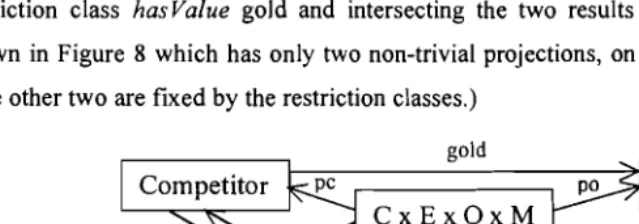
We might then want to look at the result using properties. For example, we might want the Olympiads in which a competitor won a particular medal, say gold. Creating a further restriction class has Value gold and intersecting the two results in an association class as shown in Figure 8 which has only two non-trivial projections, on Competitor and Olympiad.
(The other two are fixed by the restriction classes.)
hasValue gold
hasValue
menOs400m gold
Freestyle
Figure 8 Quaternary association of Figure 4 reduced to a parameterised property
The notation we have been using for the diagram begins to fail us, but Figure 8 is intended to read that the domain of the properties c and 0 is the intersection of Outcome with the two restriction classes. The property ci is inverseOf c, and gold is 0 composedWith ci. The property gold is therefore the property sought, linking instances of Competitor to instances of
Olympiad in which the competitor won a gold medal (for the nominated event).
Notice that we can create a property corresponding to each of the (in this case three) instances of Medal. Each of these is a subproperty of the property competedfn of Figure 7, indexed by instances of Medal. Further, since OWL Full allows objects to be both Individuals and Properties, there is nothing to stop us using the URI of the medal instance to name the subproperty, as has been done in the diagram.
Note that we can use the family of subproperties indexed by Medal for the result of any restriction on Event in the diagram, since the result is to associate competitors with Olympiads
in which they have been awarded medals of the kind named by the property. So the subproperty of competedfn indexed by the Medal instance gold can be analysed further into a family of subproperties indexed by instances of Event. Of course the naming trick cannot be repeated since the URI notation does not support an algebra of combinations.
7. INDEXED FAMILIES OF CLASSES
If indexes families of properties can be useful, so can indexed families of classes. Many ontologies have very large numbers of classes organized into deep hierarchies of subclasses. Probably the largest ontology is the Linnean system for organizing biological species, of which there are many millions. This system is complicated, but has a basic organizing principle that there is a small number of most general superclasses which are indexed by the term kingdom. Each kingdom is divided into a number of direct subclasses, all of which are indexed by the term phylum. Phyla in tum are subdivided into direct subclasses indexed by
class, each class by order, each order by family, each family by genus and each genus by
species. Wikipedia gives the example.':
As an example, consider the Linnaean classification for modem humans:
• Kingdom: Animalia (with eukaryotic cells having cell membrane but lacking cell wall, multicellular, heterotrophic)
• Phylum: Chordata (all animals with a notochord)
• Class: Mammalia (vertebrates with mammary glands that in females secrete milk to nourish young, hair, warm-blooded, bears live young)
• Order; Primates (collar bone, eyes face forward, grasping hands with fingers, two types of teeth: incisors and molars)
• Family: Hominidae (upright posture, large brain, stereoscopic vision, flat face, hands and feet have different specializations)
• Genus: Homo (s-curved spine, "man")
• Species: Homo sapiens (high forehead, well-developed chin, skull bones thin) An individual human is therefore an instance of the increasingly general subclasses of biological organism: Homo sapiens, Homo, Hominidae, Primates, Mammalia, Chordata and Animalia.
Many other systems have this sort of organization. The Standard Industrial Classification system (SIC) maintained by the US Department of Labor consists of about 10,000 classes indexed by the increasingly specific terms division, major group, industry group and industry.
The company Google.com is an instance of the increasingly general subclasses Information Retrieval Services; Computer Programming, Data Processing and Related Services; Business
Services and Services.
It is usual for a user to navigate among these subclasses by passing from a more specific to a more general class (rolling up) or from a more general to a more specific class (drilling down). This can be done in OWL either by following the rdfs;subClassOf links among the classes or by following a link from one class to the index object, following links among the
I http://en.wikipedia.org/wikiILinnaean_taxonomy#Example_classification:_humans
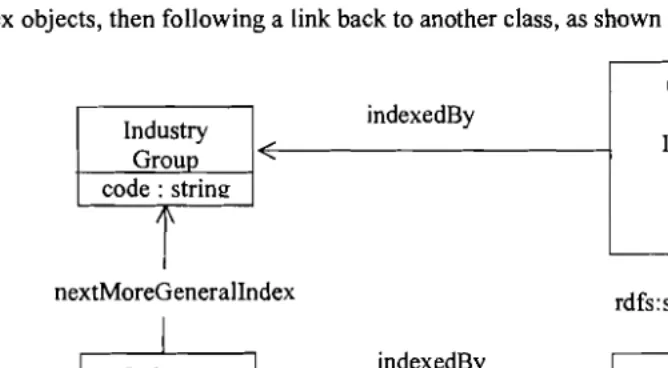
index objects, then following a link back to another class, as shown in Figure 9.
Classes Industry indexedBy at
Group Industry
code: strinz Group
r
Level!]\ nextMoreGeneralIndex rdfs:subClassOf
I
IIndustry . indexedBy Classes
-... at
code: strinz Industry Level
Figure 9 Indexed System of Classes
In Figure 9, the classes IndustryGroup and Industry have instances which are individuals, and are the domain of a datatype property code whose range is xsd:string. The other two classes have instances which are themselves classes (whose instances in turn are individual companies).
The property nextMoreGeneralIndex whose domain is Industry and range IndustryGroup is equivalent to the composition of the subproperty of the inverse of indexedBy whose range is
Industry, rdft:subClassOfand the subproperty of indexedBy whose range is IndustryGroup.
Some systems have a different organization. For example, SNOMEDz is a system of hundreds of thousands of concepts used to classify medical records. The concepts are divided into 19 hierarchies. Concepts in each hierarchy are disjoint from concepts in all other hierarchies. An individual record can be an instance of concepts in many of the hierarchies.
This sort of system is called afaceted system in the library community [9], and is probably most familiar as the stereotypical oriental noodle restaurant menu: choose one type of noodle, one type of protein ingredient and one type of sauce. Each root concept in SNOMED de'fines
afacet containing all its subconcepts.
OWL Full has facilities for specifying indexed collections of classes. Since Class and Individual are not disjoint, it is possible to defme a property say classIndex whose domain is rdfs:Class and whose range is a class containing the index terms.
OWL DL can be used to represent faceted systems, since an individual can be an instance of several classes, even though representation of the class systems themselves requires OWL Full.
It is common to have a faceted system each facet of which is an indexed system (although
2 http://www.snomed.org/
SNOMED is not organized this way). The whole field of data warehousing is based on systems of this kind. A fact table (for example sales in USD) is classified by a number of dimensions including time, product and store. Each dimension is an indexed system of subclasses. The most specific classes for time might be days, which are aggregated to weeks, months, quarters and years. The most specific classes for product are bar codes, which are aggregated into increasingly general classes of product. The most specific classes for store are the individual stores, which are generally aggregated into increasingly larger groups of store by geographic region.
Consider the collection of objects consisting of individual athletes completing events in the Olympics. This collection is classified by Olympiad (Beijing will be the 29th) , by gender
(men, women, mixed), by event (301 at the Athens Olympics) aggregated by Discipline (Swimming, Track) then Sport (Aquatics, Athletics, 28 in total), by country (202) which can be aggregated by region, and by finishing position, which can be aggregated by medal vs non medal.
In these systems the indexing properties would be naturally represented as an indexed system of subproperties as described in the preceding section.
8. AGGREGATION
If we are going to have individuals like Olympic athletes organized into systems of subclasses, an obvious question is to ask how many individuals there are in a given class. Query languages like SQL support a number of standard aggregation functions:
• Count: the cardinality of a class
• Sum: the sum of the values of a numerically valued datatype property of instances of a class
• Average: the average of the values of a numerically valued datatype property of instances of a class (average = sum/count)
• Max: the maximum of the values of a numerically valued datatype property of instances of a class
• Min: the minimum of the values of a numerically valued datatype property of instances of a class
Not all logical systems can support aggregation. One requirement is that the extents of classes must be finite, and another is that the individuals in the extent of a class satisfy the unique name assumption. OWL satisfies the first requirement but not the second. OWL does have a construct owl:alIDifferent, with which the user can declare a specified list of individuals to be different.
The reason OWL does not default the unique names assumption (like SQL does) is that OWL defaults the open world assumption (SQL defaults the closed world assumption).
However, there are ontologies in which the extents of the classes are known definitively. The
Olympics ontology is of this kind. The set of athletes who competed in the 2004 Athens
Olympics is known for certain, and the list kept by the International Olympic Committee is
definitive. Every individual who competed is on that list, and all the individuals are uniquely
identified. Also, every event is known, as is every medal won. This is the case because the
International Olympic Committee (lOC) commissioned the Athens Organizing Committee for
the Olympic Games (AOCOG), the AOCOG registered the athletes, organized the events,
created the results in speech acts and kept the official records of the results, then turned the
set of records over to the IOC.
The same is true of the classlist my University gives me of students enrolled in a course I
am assigned to teach. If a student is not on that classlist, they are not enrolled, even though
they may be attending classes. Conversely, a student on that classlist is enrolled in the course,
even if they never attend, even if they have died. The list of zip codes in the US is kept
definitively by the US Postal Service. The list of member nations of the United Nations is
definitively kept by the UN Secretariat. The list of states of the United States is definitively
kept by the US Government. All these are examples of collections of institutional facts [10]
which are records of decisions made by specific institutions created in order to make such
decisions. The closed world assumption can safely be made for all these classes as published
by their respective institutions, if not to copies kept by other organizations such as Wikipedia
whose records are not necessarily definitive.
It would be convenient for cases where the closed world assumption applies for
owl:allDifferent to apply to a class. This would separate the definition of the class and its
characteristics from population of its extent. Aggregation functions could then apply to these
classes. The count function itself could be defined as a datatype property whose domain was
owl:Class. The other aggregation functions from SQL could be defined in a way parallel to
the defmition of restriction classes.
A restriction class is
restriction (an anonymous class) onProperty (a property)
restriction kind (maxCardinality, hasValue, aliValuesFrom, ... ) range (literal, individual, class)
where restriction is a subclass of the domain of the property designated by onProperty.
An aggregation is
aggregation (an anonymous datatype property) onClass(a class, domain of the aggregation) aggregation kind (sum, average, max, min) of (a datatype property P).
where the range of the anonymous aggregation property is the same as the range of P.
It is common to want a collection of aggregations on an indexed system of classes (eg count
of gold, silver and bronze medal winners). In SQL this is achieved using a GROUP BY
clause. In OWL it would.be possible to use a collection of indexing properties on the one/ass
to index the aggregation datatype properties in an aggregation definition.
9. SUMMARY
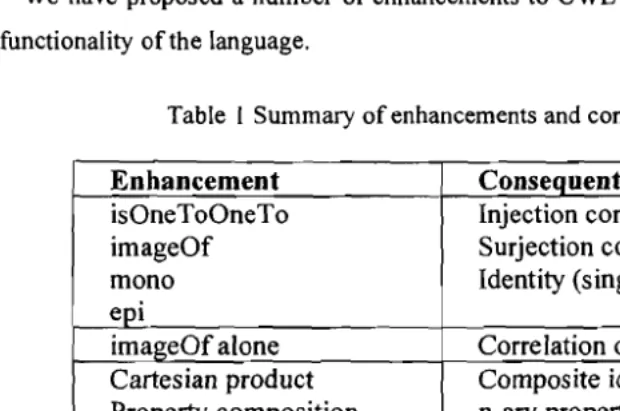
We have proposed a number of enhancements to OWL which can be used to increase the
functionality ofthe language.
Table I Summary of enhancements and consequent functionality
Enhancement
Consequent functionality
isOneToOneTo imageOf mono epi
Injection constraint Surjection constraint Identity (single property)
Correlation of classes Composite identity imageOf alone
Cartesian product
Property composition n-ary property property class
parameterised families of properties
Derived properties
Principle of consistent dependency Indexed families of classes
Aggregations
Indexed families of aggregations Property composition alone
allDifferent to a class Aggregation
10. DISCUSSION AND CONCLUSION
The proposals in this paper need to be considered in the context of a variety of proposals to
address weaknesses in the expressivity of OWL made in recent years.
In particular, the concept of role composition is well known in description logics (Baader et
al. 2003). Roles in DL are properties in OWL, but DLs including role composition are generally not decidable (e.g. [3]). Therefore only very restricted property composition has
been proposed for OWL [5]. So the present proposal for property composition, and its
consequences, would be features of OWL Full not included in OWL DL.
On the other hand, property composition is implicit in the logic programming extensions proposed for OWL, including SWRL [6] and the proposals of [7]. These proposals are
definitely not decidable [7].
Further, the rule language proposals for OWL do not carry with them the data-oriented
implementations SQL and datalog, since the open world semantics of OWL requires blank nodes, which are existentially quantified variables. For example, the well known ancestor
predicate does not necessarily terminate in SWRL. If we define parent, then ancestor as
either parent or parent composed with ancestor, and include the constraint that every person
has a parent, then given a seed person, say bob, an SWRL adaption of the datalog evaluation
algorithm must generate the non-terminating sequence ancestor(bob, _1), ancestor(bob, j),
ancestor/bob, _3), and so on. So implementations are limited to Prolog at best unless closed
world constraints along the lines ofthis proposal are included.
That the present proposals are not decidable should not automatically rule them out. In particular, OWL Full exists. Further, the kinds of applications motivating the present proposals are interoperating information systems. Information systems typically are represented in systems in which subsumption is either NP-hard (in the case of SQL [12] or undecidable (in the case of datalog) [II]. However, satisfiability is decidable for datalog [II] and hence for SQL. Information systems applications are typically focussed on query evaluation, for which both SQL and datalog have good implementations. The present proposals are all straightforward translations of datalog and SQL constructs. For closed world applications, adaptations of these can be used.
The present proposals have a number of advantages over the rule language proposals. First, no new kinds of constructs are introduced, while rule languages introduce the (universally quantified) variable. Second, the category theory style reasoning used does not depend on individual-level reasoning at all so is not affected by open world semantics. Third, the present proposals address the problem of identity, essential for information systems applications but which is not addressed at all by the rule language proposals. Further, the present proposals include as applications parameterised families of properties, indexed families of classes, and aggregations, which are not addressed by the existing rule language proposals.
REFERENCES
[1] Michael Barr and Charles Wells. Category Theory for Computer Scientists. Prentice-Hall,
1990.
[2] Robert Colomb, Kit Dampney and Michael Johnson. Category-Theoretic Fibration as an Abstraction Mechanism in Information Systems. Acta Informatica 38:1-44,2001. [3] Fabio Grandi. On Expressive Description Logics With Composition of Roles in Number
Restrictions. in Matthias Baaz and Andrei Voronkov, editors, LPAR 2002, Springer
LNAI 2514, pages 202-215, 2002.
62
[4] Nicola Guarino and Chris Welty. Evaluating Ontological Decisions with OntoClean.
Communications ofthe ACM, 45(2):61-65, 2002.
[5] Ian Horrocks, Oliver Kutz and Ulrike Sattler. The Even More Irresistible SROIQ. in
Proceedings ojthe 10f" International Conference on Knowledge Representation and
Reasoning (KR2006), AAAI Press, pages 57-67, 2006.
[6J Ian Horrocks, Peter Patel-Schneider, Harold Boley, Said Tabet, Benjamin Grosof and Mike Dean. SWRL: A Semantic Web Rule Language Combining OWL and RuleML.
W3C member submission 21 May 2004, latest version http://www/w3/org/Submission/SWRL, 2004.
[7] Boris Motik, Ian Horrocks, Riccardo Rosati and Ulrike Sattler. Can OWL and Logic Programming Live Together Happily Ever After? in Isabel Cruz et aI., editors, ISWC 2006. Springer LNCS 4273, pages 50 I-514,2006.
[8J Peter Patel-Schneider, Patrick Hayes and Ian Horrocks, editors, OWL Web Ontology Language Semantics and Abstract Syntax. W3C Recommendation 10 February 2004, Latest version is available at http://www.w3.org/TRlowl-semantics, 2004.
[9] Jennifer Rowley and John Farrow. Organizing Knowledge: An Introduction to Managing Access to Information. Gower Publishing Company 3rd edition, 2000.
[10] John Searle. The Construction ofSocial Reality. The Free Press, New York, 1995.
[II] Oded Shmueli. Equivalence of Datalog Queries is Undecidable. Journal ofLogic Programming, 15(3):231-241, 1993.
[12] Jeffrey Ullman. Principles of Database and Knowledge-Base Systems. Volume II,
Computer Science Press, Rockville, MD, USA, 1989.
COMPREHENSIVE
EFFICIENCY SP
FF
lAb Faculty 01
Email:
Abstract: The rapid develc speaker recognition to becoi
from speech signal rernai
recognition system, includir
speaker recognition researc processing problems. Due t system, this research focus model from front end to ba:
the front end process, we i signal. Whereas, for the b: quantization techniques to processing time. Fxperir yielded better improvemen this paper, a new, robu: technique for speaker id intended to develop a f
modeling.
Keywords: Speaker Ide] Hybrid Vector Quantizat
"! Jilid 20, Hi!. 4 (Disembei