
TRAFFIC-SIGNAGE DETECTION AND RECOGNITION BASED ON K-MEANS CLUSTERING AND SUPPORT VECTOR MACHINE CLASSIFICATION
KELVIN QUEK WEI LUO
TRAFFIC-SIGNAGE DETECTION AND RECOGNITION BASED ON K-MEANS CLUSTERING AND SUPPORT VECTOR MACHINE CLASSIFICATION
KELVIN QUEK WEI LUO
A project report submitted in partial fulfilment of the requirements for the award of the degree of
Master of Engineering (Electrical - Computer & Microelectronic System)
Faculty of Electrical Engineering Universiti Teknologi Malaysia
iii
iv
ACKNOWLEDGEMENT
Many people have made this thesis possible. I would like to take this opportunity to express my profound sense of gratitude and respect to all who has helped me through the duration of this thesis. First of all, I would like to thank my supervisor, Associate Professor Dr. Muhammad Nadzir bin Marsono, whose guidance has helped me to address every problem I faced. This work would not have been possible without the encouragement and teaching from him. Most of the novel ideas and solutions found in this thesis are the result of our numerous stimulating discussions. Dr. Nadzir’s feedback and editorial comments were also invaluable for the writing of this thesis.
I would like to thank my parents, wife, and sister for their constant support and love throughout my schooling. Without their sacrifices and support, I would not be the person I am today.
v
ABSTRACT
vi
ABSTRAK
vii
TABLE OF CONTENTS
CHAPTER TITLE PAGE
DECLARATION ii
DEDICATION iii
ACKNOWLEDGEMENT iv
ABSTRACT v
ABSTRAK vi
TABLE OF CONTENTS vii
LIST OF TABLES ix
LIST OF FIGURES x
LIST OF ABBREVIATIONS xii
LIST OF APPENDICES xiii
1 INTRODUCTION 1
1.1 Problem Background 1
1.2 State-of-the-Arts 3
1.3 Problem Statement 4
1.4 Objective and Scope 5
1.5 Scope of Work 6
1.6 Organization 8
2 LITERATURE REVIEW 9
2.1 Background Theories 9
2.1.1 K-means 11
2.1.2 Support Vector Machine (SVM) 13
2.2 Traffic Signage Detection 15
2.2.1 Shadow and Highlight Invariant Color
Segmentation Algorithm 16
2.2.2 Thresholding on HSI Color Space 16 2.2.3 L*a*b Color Space for Color Image
viii
2.3 Traffic Signage Recognition 18
2.3.1 SVM Classification Using Direct Binary
Representation 19
2.3.2 Shape Classification 19
2.4 Chapter Summary 20
3 RESEARCH METHODOLOGY 22
3.1 Top-level View 22
3.2 Proposed TSDR 24
3.2.1 Region of Interest (ROI) Extraction 25
3.2.2 Image Re-sizing 27
3.2.3 Dimension Reduction - Principle
Compo-nent Analysis (PCA) 30
3.2.4 Classification - Support Vector Machine
(SVM) 32
3.3 Chapter Summary 35
4 RESULTS AND DISCUSSIONS 37
4.1 Experimental Setup 37
4.2 Simulation Results 39
4.2.1 Traffic Signage Detection 39
4.2.2 Traffic Signage Recognition with Gray
Scale Representation 41
4.2.3 SVM Classification with Eigen Vector
Representation 43
4.2.4 Classification with RBF Kernel 46
4.3 Chapter Summary 47
5 CONCLUSION 49
5.1 Research Outcomes 49
5.2 Future Works 50
REFERENCES 51
ix
LIST OF TABLES
TABLE NO. TITLE PAGE
1.1 Characteristics of TSDR. 2
2.1 Different shapes and colors of Swedish traffic signage. 10 4.1 Desired output classes of traffic signage shapes. 39 4.2 Desired output classes of speed limit traffic signage. 39 4.3 Detection results based on k-means clustering in L*a*b color
space. 40
4.4 Example of traffic signage detection. 40
4.5 Failure analysis of 2 examples that were not able to detect the
stopsignage. 41
4.6 Classification results of traffic signage shapes on 3 pairs of
training and testing data set with gray scale representation. 42 4.7 Classification results of speed limit signage on 2 pairs of
training and testing data set with gray scale representation. 42 4.8 Stopsignage images that were classified incorrectly with gray
scale representation. 43
4.9 Speed limit signage images that were classified incorrectly
with eigen vector representation. 43
4.10 Classification results of traffic signage shapes on 3 pairs of
training and testing data set with eigen vector representation. 44 4.11 Classification results of speed limit signage on 2 pairs of
training and testing data set with eigen vector representation. 44
4.12 SVM classification run time analysis. 44
4.13 SVM classification memory usage analysis. 45
4.14 The correct classification rate of traffic signage shapes using
x
LIST OF FIGURES
FIGURE NO. TITLE PAGE
1.1 TSDR system on BMW heads-up display and
Mercedes-Benz. 1
1.2 High level overview of proposed TSDR. 4
1.3 Speed limit traffic signage. 4
1.4 Sequence of TSDR system. 7
1.5 Swedish road traffic signage - warning signage. 7 1.6 Swedish road traffic signage - prohibitory signage. 8 2.1 The traffic signage detection and recognition system. 11 2.2 Clustering process using the standard k-means algorithm. 12
2.3 Block diagram of supervised learning. 13
2.4 An overview of SVM process. 14
2.5 Linear classification for two-dimensional input vectors. 15
2.6 Hue-Saturation histogram. 17
2.7 DtBs for a triangular shape (from the left: D1, D2, D3, D4). 20
3.1 A block diagram of the wrapper function. 22
3.2 (a) The captured image, (b) Color segmented image with the
ROI preserved, (c) The re-sized image. Database obtained
from (H. Fleyeh 2011). 23
3.3 A structure of TSDR based on artificial intelligence and
image processing technology. 24
3.4 An example of color segmentation. 26
3.5 Illustration of color segmentation. (a) Original image (b)
L*a*b color space (c), (d), (e), (f), (g), (h), (i), and (j) are
the output images generated from k-means clustering. 27 3.6 Different signage dimensions captured from various
dis-tances. 28
3.7 (a) Extracted traffic signage (640×480) (b) Re-sized traffic
signage (191x191). 30
3.8 Overview of PCA process. 31
xi
3.10 Overview of image precessing. 36
4.1 Examples of detected traffic signage and their corresponding
categories of signage for recognition. 38
4.2 Amount of information per number of eigen vectors for data
reduction. 45
xii
LIST OF ABBREVIATIONS
ADAC - Allgemeiner Deutscher Automobil-Club
AI - Artificial Intelligent
ANN - Artificial Neural Network
DtB - Distance to Blob
GPS - Global Positioning System
HSV - Hue, Saturation, and Value
Lab - Luminosity, Chromaticity-layer a, and Chromaticity-layer b
PCA - Principle Component Analysis
RBF - Radial Basis Function
RGB - Red, Green, and Blue
ROI - Region of Interest
SVM - Support Vector Machine
xiii
LIST OF APPENDICES
APPENDIX TITLE PAGE
CHAPTER 1
INTRODUCTION
1.1 Problem Background
Intelligent traffic signage detection and recognition (TSDR) is an essential component in modern vehicles, providing drivers with safety and precaution information. The visibility of traffic signage is important for driver’s safety to indicate the state of the road, guiding and warning drivers. The first TSDR system was appeared in late 2008 on the redesigned BMW 7-Series, and the following year on the Mercedes-Benz S-Class (Figure 1.1). At that time, these systems were only able to detect the round speed limit signage found all across Europe [1] using a combination of cameras and maps. Objects detected by the cameras are matched with navigation-system maps for confirmation. Second generation systems are improved to detect no overtaking signage. The system is available on the 2011 Volkswagen Phaeton and 2012 Volvo, as a technology called traffic signage information.
Figure 1.1: TSDR system on BMW heads-up display and Mercedes-Benz [2].
2
US Census Bureau in 2009 alone, 10.8 million motor vehicle accidents occurred resulting in almost 36 thousand fatalities. Hence, research on different types of TSDR solutions is very important in developing an accurate, reliable and cost effective traffic signage recognition system. Due to the complex outdoor environment, variations in weather, lighting conditions, and partial occlusions remain as the greatest challenge in vision based traffic signage recognition system. A test has been carried out by Allgemeiner Deutscher Automobil-Club (ADAC) on several existing TSDR systems. Results show that all systems are having problems with variable speed-limit signage that are increasingly used on major highways [2].
TSDR system can varies in two different ways based on the technology applies:
1. Distributed computing. A software based system that can be located on a network communication system by passing messages. The components interact with each other to obtain the traffic signage information.
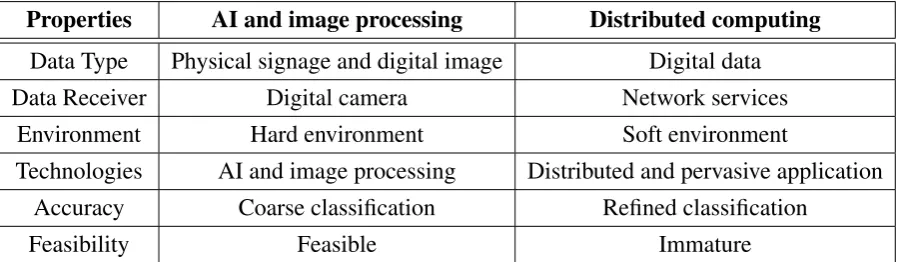
2. Artificial intelligent (AI) and image processing. A hardware system that uses digital camera to detect physical signage and transforms the image to a recognizable feature via image processing.
Table 1.1 shows the characteristics of TSDR based on different technologies.
Table 1.1: Characteristics of TSDR.
Properties AI and image processing Distributed computing
Data Type Physical signage and digital image Digital data
Data Receiver Digital camera Network services
Environment Hard environment Soft environment
Technologies AI and image processing Distributed and pervasive application Accuracy Coarse classification Refined classification
Feasibility Feasible Immature
3
of this project is mainly on the detection and recognition of signage. traffic signage classification uses SVM [3] for new instances and k-means clustering on L*a*b color space [4] for traffic signage detection are proposed.
Both detection and recognition algorithms are computationally expensive. Traffic signage detection usually needs to deal with very large and complex data sets (gigabytes or terabytes). This requires data mining algorithm that can cluster large amount of numeric and categorical values. To address this problem, k-means clustering algorithm is proposed [5]. On the other hand, Support Vector Machines work by translating non-linearly classifiable feature data into a higher-dimensional hyperplane where it is possible to classify the data in a simple, linear manner. The SVM classification suffers from linear dependencies on the number of support vectors and the problem’s dimensionality. For large-scale problem like traffic signage image, the classification task can become very time consuming and have real-time constraints. Therefore, feature extraction or dimension reduction is essential to reduce the classification time while maintaining good accuracy.
1.2 State-of-the-Arts
4
Figure 1.2: High level overview of proposed TSDR.
1.3 Problem Statement
Traffic signage present in unique colors and shapes to attract driver’s attention and both characteristics determine the meaning of each traffic signage. Practically, traffic signage normally appears at the side of or above the roads as shown in Figure 1.3.
5
Traffic signage detection and recognition involves classification phase to identify the content of the extracted traffic signage using various data mining techniques. The captured images for recognition may contains shading, occlusion, under-illumination, over-illumination, noise, and undesired background that can result in failure of traffic signage recognition if the detection algorithm is not robust. Thus, taking advanced method to precisely pre-process the traffic signage information is essential to be able to extract the region of interest (ROI) and preserve the information for recognition in the later stage.
Color segmentation by shadow and highlight invariant algorithm is a widely used approach in TSDR [6] in which RGB image is converted to HSV color space . On the other hand, a method based on color information using fuzzy detection of the relevant hue and saturation components is proposed [7]. These algorithms work well on normal illumination conditions but deteriorate in low lighting conditions such as images obtained from night driving.
Apart from segmentation, classification is another major challenge in TSDR systems. The major issue of classification lies in learning of finding an optimal separation between classes and nearest neighbor approach to seek for similar training samples on huge number of attributes. Increasing of data size per training set and testing set requires expensive computation cost where it stretches the computational time significantly. On a limited processing capacity system, accuracy and efficiency have becoming a major problem in real-time application. Fixed size block of 28×28 pixels in gray-scale is used for candidate image [8]. This means the amount of attributes per training set and testing set is as many as 961. There is a need to reduce the feature vector dimension in order to improve the processing time. Motivated by both problems and advantages, this leads to develop a strategy to optimize the detection and recognition process.
1.4 Objective and Scope
1. To design a TSDR system that is able to detect and identify different signage over a considerable database. The system is expected to be able to accept a 640×480 RGB image and transform it into a form of data that is usable for classification. 2. To study and optimize the processing time of the proposed TSDR system. One
6
in millisecond, for gray scale representation. The test time is compared with simplified data set known as eigen vector representation. The results are analyzed to identify the compute-intensive component.
3. To analyze the overall accuracy and compare the proposed TSDR system with relevant published researches in term of accuracy. The traffic signage images generated from the detection model is tested on various SVM recognition model to compare the performance difference from various aspects. Besides, the overall detection rate of the k-means clustering is studied to understand the invariance properties of the proposed color space.
1.5 Scope of Work
In this project, a traffic signage detection and recognition system is developed. The system consists of 3 stages as shown in Figure 1.4
1. Traffic regulatory signage detection by color segmentation using k-means clustering to extract the targeted color of the specific traffic signage. Color is a distinct property of traffic signage making them easily distinguish from other objects, thus color information is used for signage detection.
2. SVM is a compute-intensive algorithm, instead of testing and training a full scaled image, feature extraction by Principle Component Analysis (PCA) is applied to reduce the size of the data for SVM classifier in order to achieve higher throughput in shorter time.
7
Figure 1.4: Sequence of TSDR system.
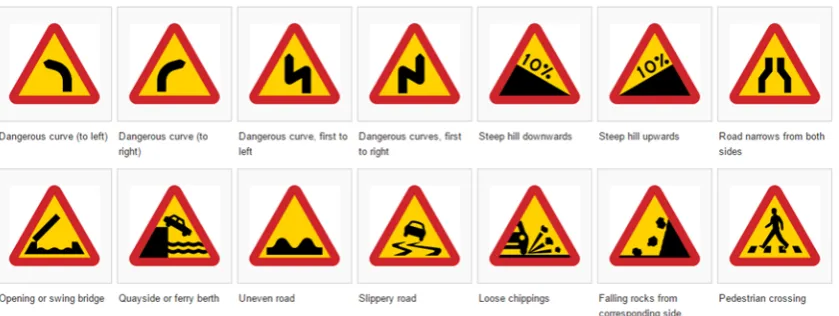
The experiments is conducted on European traffic signage in the form of triangle, octagon, and circle. The traffic signage in each image is extracted by exploiting color segmentation algorithm. Next, the extracted signage are sent for classification and the output is analyzed the to assess the overall accuracy. As for the performance analysis, reduced dimension method is used to train and test the SVM recognition model. The output of the SVM decision function is analyzed and compared with the existing designs. Figure 1.5 and Figure 1.6 shows the some example of Swedish road traffic regulatory signage.
8
Figure 1.6: Swedish road traffic signage - prohibitory signage [9].
1.6 Organization
This thesis consists of five chapters. The first chapter gives an overview of the project as well as the problem statements and objectives of the project.
Chapter 2 covers the literature review and discuss on the researches of k-means and SVM algorithm.
Chapter 3 covers the system overview of this project. It describes the various modules development and basic operation of each module. All two modules and enhancement will be described briefly in this chapter.
Chapter 4 will discuss on the system architecture and research methodology. Detection and recognition modules development and basic operation of each module will be explained in detail.
Chapter 5 explains the results and analysis of each experiment. The improvement in system performance is also discussed in this chapter.
REFERENCES
1. M. L. Eichner and T. P. Breckon, “Integrated Speed Limit Detection and Recognition from Real-Time Video,” IEEE Intelligent Vehicles Symposium, no. 10220151, pp. 626–631, 2008.
2. “ADAC: Car IT,” December 2010.
3. S. Maldonado-Bascon, S. Lafuente-Arroyo, P. Gil-Jimenez, H. Gomez-Moreno, and F. Lopez-Ferreras, “Road-Sign Detection and Recognition Based on Support Vector Machines,”IEEE Intelligent Transportation Systems, no. 9490284, pp. 264–278, 2007.
4. G. Siogkas and E. Dermatas, “Detection, Tracking and Classification of Road Signs in Adverse Conditions,” IEEE Electrotechnical Conference, no. 9075001, pp. 537–540, 2006.
5. Z. Huang, “Extensions to the k-Means Algorithm for Clustering Large Data Sets with Categorical Values,”Data Mining and Knowledge Discovery, vol. 2, pp. 283–304, 1998.
6. H. Fleyeh, “Shadow And Highlight Invariant Colour Segmentation Algorithm For Traffic Signs,” IEEE Cybernetics and Intelligent Systems, no. 9220901, pp. 1–7, 2006.
7. C. Paulo, “Automatic Detection and Classification of Traffic Signs,” IEEE Image Analysis for Multimedia Interactive Services, no. 9863768, p. 11, 2007.
8. S. Perez-Perez, S. Gonzalez-Reyna, S. Ledesma-Orozco, and J. Avina-Cervantes, “Principal component analysis for speed limit Traffic Sign Recognition,”IEEE Power, Electronics and Computing, no. 14026194, pp. 1– 5, 2013.
9. “Wiki: Road signs in Sweden.”
10. H. Fleyeh, “Road and Traffic Sign Detection and Recognition,” Proc. 10th EWGT Meet./16th Mini-EURO Conf., pp. 644–653, 2005.
52
and Machine Intelligence, vol. 24, no. 7324832, pp. 881–892, 2002.
12. V. Faber, “Clustering and the continuous k-means algorithm,” Los Alamos Science, pp. 138–144, 1994.
13. M. Shi, W. Haifeng, and H. Fleyeh, “Support Vector Machines for Traffic Signs Recognition,” IEEE Neural Networks, IEEE World Congress on Computational Intelligence, no. 10365646, pp. 3820–3827, 2008.
14. “Wiki: Support Vector Machine.”
15. “H. Fleyeh. Traffic Signs Database [Online],” November.
16. S. Vij, I. Amritsar, S. Sharma, and C. Marwaha, “Performance Evaluation of Color Image Segmentation Using K means Clustering and Watershed Technique,” IEEE Computing, Communications and Networking Technologies, no. 14063478, pp. 1–4, 2013.
17. L. Chengjun, “Gabor-based Kernel PCA with Fractional Power Polynomial Models for Face Recognition,” IEEE Pattern Analysis and Machine Intelligence, vol. 26, no. 8004314, pp. 572–581, 2004.
18. M. Turk, “Eigenfaces for Recognition,”IEEE Cognitive Neuroscience, vol. 3, no. 0898-929X, pp. 71–86, 1991.
![Figure 1.1: TSDR system on BMW heads-up display and Mercedes-Benz [2].](https://thumb-us.123doks.com/thumbv2/123dok_us/1209480.1151907/14.595.138.506.537.648/figure-tsdr-bmw-heads-display-mercedes-benz.webp)

![Figure 1.6: Swedish road traffic signage - prohibitory signage [9].](https://thumb-us.123doks.com/thumbv2/123dok_us/1209480.1151907/21.595.117.539.67.231/figure-swedish-road-trafc-signage-prohibitory-signage.webp)