FREE VIBRATION OF LAMINATED COMPOSITE SHELL STRUCTURES FILLED WITH FLUID
NURUL IZYAN BINTI MAT DAUD
FREE VIBRATION OF LAMINATED COMPOSITE SHELL STRUCTURES FILLED WITH FLUID
NURUL IZYAN BINTI MAT DAUD
A thesis submitted in fulfilment of the requirements for the award of the degree of
Doctor of Philosophy (Mathematics)
Faculty of Science Universiti Teknologi Malaysia
DEDICATION
To my beloved Father and Mother,
Mat Daud bin Hamat and Wan Azizah binti Wan Ibrahim for their everlasting love, and endless support, throughout my life.
ACKNOWLEDGEMENTS
In the Name of Allah, the Most Gracious, the Most Merciful. Praise to Allah for giving me the strength in completing this thesis.
I would like to express a special thanks of gratitude to my supervisors, Assoc. Prof. Dr. K. K. Viswanathan for his countless hours of guidance, encouragement and most of all for his patience throughout the entire process in completing this research and Prof. Dr. Zainal Bin Abdul Aziz for his help, guidance as well as his understanding and support towards me.
Also, I would like to show gratitude as well as appreciation to the Ministry of Higher Education for the award of MyBrain15 fellowship. I also would like to acknowledge and thank the staff members of the Department of Mathematical Sciences, Faculty of Science, Universiti Teknologi Malaysia (UTM) for their help. The UTM library also deserves special thanks for supplying the relevant literatures for this research.
ABSTRACT
ABSTRAK
TABLE OF CONTENTS
CHAPTER TITLE PAGE
DECLARATION ii
DEDICATION iii
ACKNOWLEDGEMENTS iv
ABSTRACT v
ABSTRAK vi
TABLE OF CONTENTS vii
LIST OF TABLES xii
LIST OF FIGURES xiv
LIST OF ABBREVIATIONS xxii
LIST OF SYMBOLS xxiii
LIST OF APPENDICES xxvi
1 INTRODUCTION 1
1.1 Background of the Study 1
1.2 Problem Statement 6
1.3 Objectives 7
1.4 Scope of the Study 8
1.5 Significance of the Study 9
1.6 Research Methodology 9
2 LITERATURE REVIEW 13
2.1 Introduction 13
2.2 Definitions of the Shell Theories 13
2.2.1 Classical Shell Theory 13
2.2.2 First Order Shear Deformation Theory (FSDT) 16
2.3 Literature Survey on Conical Shells 17
2.3.1 Empty Conical Shells 18
2.3.2 Effects of Fluid on Conical Shells 20 2.4 Literature Survey on Cylindrical Shells 24
2.4.1 Empty Cylindrical Shells 24
2.4.2 Effects of Fluid on Cylindrical Shells 27
2.5 General Definition of Spline 41
3 MATHEMATICAL FORMULATION 46
3.1 Introduction 46
3.2 Formulation 46
3.2.1 Love’s First Approximation Theory 46 3.2.2 First Order Shear Deformation Theory 49
3.3 Spline Collocation Procedure 53
3.3.1 Love’s First Approximation Theory 54 3.3.2 First Order Shear Deformation Theory 55
3.3.3 Eigenvalue Problem 57
4 FREE VIBRATION OF LAYERED TRUNCATED CONICAL
60 SHELLS FILLED WITH FLUID
4.1 Introduction 60
4.2 Problem Formulation 61
4.2.2 Formulation 65
4.3 Solution Procedure 74
4.4 Results and Discussion 77
4.4.1 Convergence and Comparative Studies 77
4.4.2 Analysis 78
4.5 Conclusion 96
5 FREE VIBRATION OF LAYERED CYLINDRICAL SHELLS
FILLED WITH FLUID 97
5.1 Introduction 97
5.2 Problem Formulation 98
5.2.1 Fluid Term 99
5.2.2 Formulation 101
5.3 Solution Procedure 107
5.4 Results and Discussion 110
5.4.1 Convergence and Comparative Studies 110
5.4.2 Analysis 112
5.4.2.1 C-C Boundary Conditions 113 5.4.2.2 S-S Boundary Conditions 121
5.5 Conclusion 127
6 FREE VIBRATION OF CROSS-PLY LAMINATED
COMPOSITE CIRCULAR CYLINDRICAL SHELLS FILLED WITH QUIESCENT FLUID UNDER FIRST ORDER SHEAR
DEFORMATION THEORY 128
6.1 Introduction 128
6.2 Problem Formulation 129
6.4 Results and Discussion 139
6.4.1 Comparative Study 139
6.4.2 Analysis 140
6.5 Conclusion 147
7 FREE VIBRATION OF ANTI-SYMMETRIC ANGLE-PLY
LAMINATED COMPOSITE CIRCULAR CYLINDRICAL SHELLS FILLED WITH QUIESCENT FLUID UNDER FIRST
ORDER SHEAR DEFORMATION THEORY 149
7.1 Introduction 149
7.2 Problem Formulation 150
7.3 Solution Procedure 155
7.4 Results and Discussion 158
7.4.1 Comparative Study 158
7.4.2 Analysis 159
7.5 Conclusion 170
8 FREE VIBRATION OF SYMMETRIC ANGLE-PLY
LAMINATED COMPOSITE CIRCULAR CYLINDRICAL SHELLS FILLED WITH QUIESCENT FLUID UNDER FIRST
ORDER SHEAR DEFORMATION THEORY 171
8.1 Introduction 171
8.2 Problem Formulation 172
8.3 Solution Procedure 176
8.4 Results and Discussion 178
8.4.1 Convergence and Comparative Studies 178
8.4.2 Analysis 179
9 CONCLUSION AND RECOMMENDATION 191
9.1 Introduction 191
9.2 Conclusion 192
9.3 Suggestions for Future Research 194
REFERENCES 196
LIST OF TABLES
TABLE NO. TITLE PAGE
4.1 Convergence study of conical shell filled with fluid under
C-C boundary conditions 77
4.2 Comparison of the frequencies (Hz) of conical shell filled with fluid under C-C boundary conditions (
30 )78 4.3 Material properties of layers (Elishakoff and Stavsky,
1979) 79
5.1 Convergence study for two-layered cylindrical shell filled
with fluid under C-C boundary condition 111
5.2 Comparison of frequency for isotropic cylindrical shell filled with fluid under C-C boundary conditions
(
L
20,
R
1,
h
0.01)
1115.3 Comparison of natural frequencies for cylindrical shell
under C-C boundary conditions 112
6.1 Free vibration (Hz) of a cylindrical shell with simply
supported at both ends (n1) 139
6.2 Free vibration (Hz) of a cylindrical shell filled with fluid
with simply supported at both ends (n1) 139 6.3 Elastic properties of various materials considered (Young’s
moduli and shear moduli are in GPa; Eand EX are the Young’s moduli; GXZ,GZ,GX are the shear moduli
(Bhimaraddi, 1993) 140
shells; 30 / 30 / 30 / 30 and 60 / 60 / 60 / 60
under C-C boundary conditions 158
7.2 The frequency variation of four layered anti-symmetric angle-ply shell with respect to thickness parameter under S-S boundary conditions. Layer materials:
KGE-AGE-KGE-KGE-AGE-KGE. n2,L2 166
7.3 The frequency variation of six layered anti-symmetric angle-ply shell with respect to thickness parameter under S-S boundary conditions. Layer materials:
LIST OF FIGURES
FIGURE NO. TITLE PAGE
1.1 Laminated composite material (Ye, 2002) 2
1.2 Examples of (a) angle-ply and (b) cross-ply laminates 3 2.1 Undeformed and deformed geometries of a plated edge
based on the Kirchhoff assumptions (Reddy, 2004) 14 2.2 Undeformed and deformed geometries of an edge of a
plate under the assumptions of the first-order plate theory
(Reddy, 2004) 17
2.3 An empty truncated conical shell (Viswanathan et al.
2015a) 18
2.4 An empty circular cylindrical shell (Viswanathan and
Navaneethakrishnan, 2003) 25
4.1 A geometry and coordinate system of a truncated conical shell filled with fluid
61 4.2 Variation of frequency parameter with respect to relative
layer thickness and the effect of coupling for C-C boundary conditions. n2,30 , 0.5, 0.05.
(a)HSG-SGE, (b)HSG-PRD, (c)St-Al, (d)St-SGE 84 4.3 Variation of frequency parameter with respect to relative
layer thickness and the effect of coupling for C-C boundary conditions. n2,30 , 0.5, 0.05.
(a)HSG-SGE, (b)HSG-PRD, (c)St-Al, (d)St-SGE 85 4.4 Effect of cone angle on frequency parameter for C-C
boundary conditions. HSG-SGE materials. 0.5, 0.05
(c)n4, 0.4. (d) n4, 0.7 86 4.5 Effect of cone angle on frequency parameter for C-C
boundary conditions. HSG-PRD materials. 0.5, 0.05
. (a)n2, 0.4. (b) n2, 0.7.
(c)n4, 0.4. (d) n4, 0.7 87 4.6 Effect of length ratio on frequency parameter for C-C
boundary conditions. HSG-SGE materials. n4, 0.05 .(a)30 , 0.4. (b)60 , 0.4. (c)30 ,
0.7
. (d)60 , 0.7 88
4.7 Effect of length ratio on frequency parameter for C-C boundary conditions. HSG-PRD materials.
4, 0.05
n . (a) 10 , 0.4. (b) 60 , 0.4
. (c)10 , 0.7. (d)60 , 0.7 89 4.8 Variation of frequency parameter with respect to relative
layer thickness and the effect of coupling for C-F boundary conditions. n2, 30 , 0.5, 0.05.
(a) HSG-SGE. (b) HSG-PRD. (c) St-Al. (d) St-SGE 90 4.9 Variation of frequency parameter with respect to relative
layer thickness and the effect of coupling for C-F boundary conditions. n2,60 , 0.5, 0.05.
(a)HSG-SGE. (b)HSG-PRD. (c) St-Al. (d) St-SGE 91 4.10 Effect of cone angle on frequency parameter for C-F
boundary conditions. HSG-SGE materials. 0.5, 0.05
. (a)n2, 0.4. (b)n2, 0.7.
(c)n4, 0.4. (d)n4, 0.7 92 4.11 Effect of cone angle on frequency parameter for C-F
boundary conditions. HSG-PRD materials. 0.5, 0.05
. (a)n2, 0.4. (b)n2, 0.7.
(c)n4, 0.4. (d)n4, 0.7 93 4.12 Effect of length ratio on frequency parameter for C-F
(a)30 , 0.4. (b)60 , 0.4. (c) 30 , 0.7
. (d) 60 , 0.7 94
4.13 Effect of length ratio on frequency parameter for C-F boundary conditions. St-Al materials. n4, 0.05. (a)
10 , 0.4
. (b) 60 , 0.4(c)10 , 0.7.
(d)60 , 0.7 95
5.1 A geometry and coordinate system of a circular
cylindrical shell filled with fluid 98
5.2 Effect of length parameter on angular frequency of two layered shells under C-C boundary conditions. Layer
materials: HSG-PRD. n2, H 0.02, 0.4 113 5.3 Variation of frequency parameter with respect to relative
layer thickness for C-C boundary conditions. HSG-PRD materials for n2. (a)H0.02, L1.5. (b) H0.02,
2
L . (c)H 0.05,L1.5. (d) H 0.05, L2 115 5.4 Variation of frequency parameter with respect to relative
layer thickness for C-C boundary conditions. HSG-SGE
materials for n4, H0.02. (a) L1. (b) L1.5 116 5.5 Effect of length on the angular frequency for C-C
boundary conditions. HSG-SGE materials for 0.02, 0.4
H . (a)n2. (b) n4 117
5.6 Effect of thickness parameter on the frequency parameter for C-C boundary conditions. HSG-SGE materials for
0.4, L 1.25
. (a)n2. (b) n4 118
5.7 Variation of frequency parameter with respect to circumferential node number for C-C boundary conditions. HSG-SGE materials for L1.25, 0.4: (a)H0.02. (b)H0.05 and HSG-PRD materials for
1.25, 0.4
L : (c)H0.02. (d) H 0.05 120
2
L . (c)H 0.05,L1.5. (d) H 0.05, L2 123 5.9 Variation of frequency parameter with respect to relative
layer thickness for S-S boundary conditions. HSG-SGE
materials for n2,H 0.05. (a) L1. (b)L1.5 124 5.10 Effect of length on the angular frequency for S-S
boundary conditions. HSG-SGE materials for 0.02, 0.4
H . (a) n2. (b) n4 124
5.11 Effect of thickness parameter on the frequency parameter for S-S boundary conditions. HSG-SGE materials for
0.4, L 1.25
. (a) n2. (b) n4 125
5.12 Variation of frequency parameter with respect to circumferential node number for S-S boundary conditions. HSG-SGE materials for L1.25, 0.4.
(a)H 0.02. (b)H 0.05 126
6.1 Effect of length parameter on angular frequency of three layered symmetric cross-ply shells under C-C boundary conditions. Layer materials: KGE-AGE-KGE.
90 / 0 / 90 . n2, H 0.02 141
6.2 Effect of thickness parameter on frequency parameter of three layered symmetric cross-ply shells under C-C boundary conditions. Layer materials: KGE-AGE-KGE.
90 / 0 / 90 . n2, L1 141
6.3 Effect of thickness parameter and boundary conditions on frequency parameter of two layered anti-symmetric cross-ply shells. Layer materials: KGE-KGE. 90 / 0 .
4, 2
n L . (a) C-C boundary conditions. (b) S-S
boundary conditions 143
6.4 Effect of thickness parameter and boundary conditions on frequency parameter of three layered symmetric cross-ply shells. Layer materials: KGE-AGE-KGE. 90 / 0 / 90 .
4, 2
n L . (a) C-C boundary conditions. (b) S-S
6.5 Effect of thickness parameter and boundary conditions on frequency parameter of four layered anti-symmetric cross-ply shells. Layer materials: KGE-AGE-AGE-KGE. 90 / 0 / 90 / 0 . n4, L2. (a) C-C boundary
conditions. (b) S-S boundary conditions 144 6.6 Effect of length parameter and boundary conditions on
angular frequency of two layered anti-symmetric cross-ply shells. Layer materials: KGE-KGE. 90 / 0 .
4, 0.02
n H . (a) C-C boundary conditions. (b) S-S
boundary conditions 145
6.7 Effect of length parameter and boundary conditions on angular frequency of three layered symmetric cross-ply shells. Layer materials: KGE-AGE-KGE. 90 / 0 / 90 .
4, 0.02
n H . (a) C-C boundary conditions. (b) S-S
boundary conditions 146
6.8 Effect of length parameter and boundary conditions on angular frequency of four layered anti-symmetric cross-ply shells. Layer materials: KGE-AGE-AGE-KGE.
90 / 0 / 90 / 0 . n4, H 0.02. (a) C-C boundary
conditions. (b) S-S boundary conditions 147 7.1 Effect of thickness parameter on frequency parameter of
four layered anti-symmetric angle-ply shells under C-C boundary conditions. Layer materials:
KGE-AGE-AGE-KGE. 30 / 30 / 30 / 30 . n2, L2 159 7.2 The frequency variation of four layered anti-symmetric
angle-ply shell with respect to thickness parameter under C-C boundary conditions. Layer materials: KGE-AGE-AGE-KGE.n2, L2. (a) 30 / 30 / 30 / 30 .
(b) 45 / 30 / 30 / 45 . (c)60 / 45 / 45 / 60 162 7.3 The frequency variation of six layered anti-symmetric
materials:KGE-AGE-KGE-KGE-AGE-KGE.n2, L2.
(a)30 / 30 / 30 / 30 / 30 / 30 .
(b)45 / 45 / 45 / 45 / 45 / 45 .
(c) 60 / 60 / 60 / 60 / 60 / 60 163
7.4 The angular frequency variation of four layered anti-symmetric angle-ply shell with respect to length parameter under C-C boundary conditions. Layer materials: KGE-AGE-AGE-KGE. n2,H 0.01. (a) 30 / 30 / 30 / 30 . (b) 60 / 30 / 30 / 60 .
(c)60 / 60 / 60 / 60 164
7.5 The angular frequency variation of six layered anti-symmetric angle-ply shell with respect to length parameter under C-C boundary conditions. Layer materials:KGE-AGE-KGE-KGE-AGE-KGE.
2, 0.01
n H . (a) 30 / 30 / 30 / 30 / 30 / 30 . (b)30 / 45 / 60 / 60 / 45 / 30 .
(c) 60 / 60 / 60 / 60 / 60 / 60 165
7.6 The angular frequency variation of four layered anti-symmetric angle-ply shell with respect to length parameter under S-S boundary conditions. Layer materials: KGE-AGE-AGE-KGE. n2,H 0.01. (a) 30 / 30 / 30 / 30 . (b) 45 / 30 / 30 / 45 .
(c) 45 / 45 / 45 / 45 168
7.7 The angular frequency variation of six layered anti-symmetric angle-ply shell with respect to length parameter under S-S boundary conditions. Layer materials:KGE-AGE-KGE-KGE-AGE-KGE.
2, 0.01
n H . (a) 30 / 30 / 30 / 30 / 30 / 30 .
(b)45 / 45 / 45 / 45 / 45 / 45 .
(c) 30 / 45 / 60 / 60 / 45 / 30 169
conditions. Layer materials: KGE-AGE-KGE. 2, 0.02, 30 / 0 / 30
n H 179
8.2 Effect of length parameter on angular frequency of three layered symmetric angle-ply shells under C-C boundary conditions. Layer materials: KGE-AGE-KGE.
4, 0.015
n H . (a) 30 / 0 / 30 . (b) 45 / 0 / 45 . (c) 60 / 0 / 60
181 8.3 Effect of length parameter on angular frequency of three
layered symmetric angle-ply shells under S-S boundary conditions. Layer materials: KGE-AGE-KGE.
4, 0.015
n H . (a) 30 / 0 / 30 . (b) 45 / 0 / 45 .
(c) 60 / 0 / 60 182
8.4 Effect of length parameter on angular frequency of five layered symmetric angle-ply shells under C-C boundary conditions. Layer materials: KGE-AGE-KGE-AGE-KGE.
4, 0.02
n H . (a) 45 / 30 / 0 / 30 / 45 .
(b) 30 / 45 / 0 / 45 / 30 . (c) 60 / 30 / 0 / 30 / 60 183 8.5 Effect of length parameter on angular frequency of five
layered symmetric angle-ply shells under S-S boundary conditions. Layer materials: KGE-AGE-KGE-AGE-KGE.
4, 0.02
n H . (a) 45 / 30 / 0 / 30 / 45 .
(b) 30 / 45 / 0 / 45 / 30 . (c) 60 / 30 / 0 / 30 / 60 184 8.6 Effect of thickness parameter on frequency of three
layered symmetric angle-ply shells under C-C boundary conditions. Layer materials: KGE-AGE-KGE.
4, 1.5
n L . (a) 30 / 0 / 30 . (b) 45 / 0 / 45 .
(c) 60 / 0 / 60 186
8.7 Effect of thickness parameter on frequency of three layered symmetric angle-ply shells under S-S boundary conditions. Layer materials: KGE-AGE-KGE.
4, 1.5
(c) 60 / 0 / 60 187 8.8 Effect of thickness parameter on frequency of five
layered symmetric angle-ply shells under C-C boundary conditions. Layer materials: KGE-AGE-KGE-AGE-KGE.
4, 1
n L . (a) 45 / 30 / 0 / 30 / 45 .
(b) 30 / 45 / 0 / 45 / 30 . (c) 60 / 30 / 0 / 30 / 60 188 8.9 Effect of thickness parameter on frequency of five
layered symmetric angle-ply shells under S-S boundary conditions. Layer materials: KGE-AGE-KGE-AGE-KGE.
4, 1
n L . (a) 45 / 30 / 0 / 30 / 45 .
(b) 30 / 45 / 0 / 45 / 30 . (c) 60 / 30 / 0 / 30 / 60 189
B.1 Reference surface (Soedel, 2004) 213
B.2 Distance between two points on the reference surface
(Soedel, 2004) 215
B.3 Illustration of the Love assumption (Soedel, 2004) 218
LIST OF ABBREVIATIONS
AGE - AS4/3501-6 Graphite/Epoxy
Al - Aluminium
C-C - Both ends are clamped
C-F - One end is clamped and the other end is free CST - Classical Shell Theory
FSDT - First order Shear Deformation Theory HSG - High Strength Graphite Epoxy
KGE - Kevler-49 Epoxy
PRD - PRD-490 III Epoxy
SGE - S-Glass Epoxy
S-S - Both ends are simply supported
LIST OF SYMBOLS
ij
A - Elastic coefficients representing the extensional rigidity
ij
B
-
Elastic coefficients representing the bending-stretching
coupling rigidity
ij
D
- Elastic coefficients representing the bending rigidity( )k x
E - Young’s modulus along directions of the k-th layer
( )k
E - Young’s modulus along directions of the k-th layer
( ) ( ) ( )
, ,
k k k
xz x z
G G G - Shear modulus in the respective directions of the k-th layer
H - Thickness parameter
( j)
H XX - The Heaviside step function
1
I - Normal inertia coefficient
3
I - Rotary inertia coefficients
K - Shear correction factor
L - Length parameter
*
,
ij ij
L L
- Differential operator occurring in the equations of motion, ,
x x
M M M - Moment resultants in the respective directions of the shell
, ,
x x
N N N - Stress resultants in the respective directions of the shell
N - Number of intervals of spline interpolation
( )k ij
Q
- Elements of the stiffness matrix for the material of k-th layer( )k ij
Q
-
Elements of the transformed stiffness matrix for the material
of k-th layer
,
xz z
Q Q - Transverse shear resultants in the respective directions of the
shell
( )
0
R - Inertial coefficient of a layered shell
, ,
U V W
- Displacement functions in x,,zdirection, ,
U V W - Non-dimensionalised displacement functions in x,,z
direction
X - Non-dimensionalised meridional distance coordinate
s
X - The equally spaced knots of spline interpolation
,
a b - Distance of the small and large ends of the conical shell from the vertex (or centre)
i i i i i a c e g l , j j j j j b d f p q
- Spline coefficients
, ,
x x
e e e - Strain components at an arbitrary point of the shell
h - Thickness of the shell
k
h - Thickness of the k-th layer of the shell
, ,
i j k
- Summation or general indices- Length of the shell
n - Circumferential node number
r - Radius of reference surface of shell at a general point
,
a b
r r - The radius at the small and the large end of the cone ij
S - Coefficients in the equations of motion
t - Time coordinate
, ,
u v w - Displacements in x,,zdirection 0, 0
u v - The in-plane displacements of the reference surface of the shell
( )
y
x
- Cubic spline function, ,
x
z
- Axial, circumferential and normal coordinates of any point on the shellk
z - Distance of the top of the k-th layer from the reference surface of the shell
- length ratio /a b of the conical shell
k
- Relative layer thickness of the k-th layer ,x
- Normal strain components of the reference surface of the shell - Ratio of the constant thickness to radius of small end of the cone
- Ratio of the constant thickness to the distance of small end from vertex of the cone, ,
x xz z
- Shear strain of the reference surface , ,
x x
- Change in curvature on the reference surface of the shell - Non-dimensional frequency parameter, x x
- Poison’s ratio
- Angular frequency
,
x
- Shear rotational functions of the shell ,
x
- Shear rotations of any point on the middle surface of the shell,
X
- Non-dimensionalised shear rotationa functions of the shell
-
Mass density of the material of the shell
,
x
- Normal stress in the respective directions of shells
, ,
x z xz
- Shear stress in the respective directions of shells
LIST OF APPENDICES
APPENDIX TITLE PAGE
A Elements of the stiffness matrix for the material of k-th layer
of shell 211
B Geometry of the shells and strain displacement relations 213
C The derivation of governing equations of motion 219
D Flowchart of algorithm 233
E The coefficients of ij
S
234F The derivation of wave equation for inviscid compressible
liquids 235
G Publications 239
CHAPTER 1
INTRODUCTION
1.1 Background of the Study
A composite structure consists of two or more constituent materials with different physical or chemical properties combined which results into a material with the characteristics that is definitely different from the individual components. Composite structures are commonly composed of reinforcing and matrix materials (Soedel, 2004).
The reinforcing materials mostly exist in the form of fibres and act as reinforcer or load-carrying agent. Fibre materials can be metals like iron, aluminum, copper, titanium, steel, and nickel, or organic materials such as graphite, glass, carbon, and boron. The functions of matrix materials are important to support and seal the fibres. The matrix can be among of organic, ceramic, or metallic materials (George, 1999).
through repeated processes of folding and reshaping in order to form a multi-layered composite (George, 1999).
Composite structures offer high strength and stiffness as well as lightweight characteristics as major advantageous. Composite structure can be designed to be far stronger than steel as it can be engineered to be strong in a specific direction. Light in weight is also one of the factor for composite structure as to be used in many industries such as automotive and aircraft since lightweight indicates better fuel efficiency. In addition, composite structures also have the characteristics of corrosion resistance as well as better damping and shock absorbance. Swimming pool and bathtub are two other examples related to composite materials application.
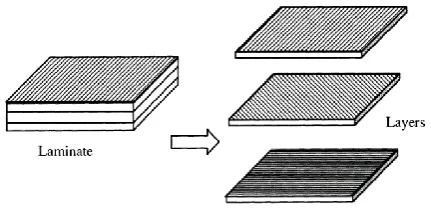
In general, composite materials can be classified into three categories, namely fibre, particle, and laminated composites. If the reinforcement is made of fibre, then it is called as fibre composite. The reinforcement is in the form of particle for particle composites. Concrete is one familiar example of particle composites. Laminated composite consists of layers that is combined together to form a laminate, in which each of the layer is made from the first two types of composites. Each layer is called a ply or lamina. The lamina is the fundamental building block of laminated composite materials (Reddy, 2004; Ye, 2002). Figure 1.1 illustrates the laminated composite material.
A fibre-reinforced composite lamina consists of many fibres embedded in a matrix material. The fibre usually comes in the form of continuous and discontinuous, woven, unidirectional, bidirectional, or randomly distributed. The laminated composite has an interesting criteria which enables users to choose and design the right material combination and fibre orientation for an optimum design. Variation of fibre direction in each layer enables the different strength and stiffness in various direction to be tailored. This variation is the reason of the popular usage of laminated composite in most composites. For example, a unidirectional fibre-reinforced lamina have strong strengh in the direction of fibre but poor strength in the transverse direction of the fibre (Reddy, 2004). A unidirectional laminate has the form 0 for all plies (Vinson and Sierakowski, 2008).
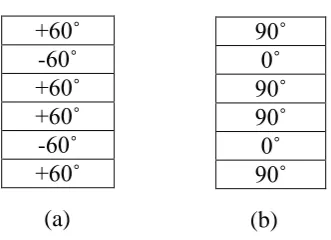
Other types of laminates are angle-ply and cross-ply. Angle-ply laminates have lamina orientations of either +θ or −θ at 0 90 , meanwhile cross-ply laminates use only 0 and 90 plies orientations in order to make a laminate. The examples for angle-ply and cross-ply laminates are shown in Figure 1.2.
Figure 1.2 Examples of (a) angle-ply and (b) cross-ply laminates
Shell structure is used tremendously in designing a modern structure because of its strength and stiffness characteristics due to its curvature, which is greatly significant in resisting the external forces (Ventsel and Krauthammer, 2001). Cylindrical and conical shell structures are noticeable in aviation, ship, building,
90˚ 0˚ 90˚ 90˚ 0˚ 90˚ +60˚
-60˚ +60˚ +60˚ -60˚ +60˚
missiles, and pressure vessel. Apart from that, the application of shell structure with the interaction of fluid can be found in many engineering applications such as containers, reservoirs, silos, nuclear power reactors, and pipe systems. In addition to that, the structures may have quiescent or flowing fluid, partially filled fluid, filled with fluid or submerged in a fluid.
Commonly, there are two types of vibration, namely force vibration and free vibration. By definition, a force vibration occur due to time-dependent external loads (Kraus, 1967). In other words, the vibration is produced when force is exerted by the external loads and the vibration will stop as the external loads is released from the system. Meanwhile, free vibration occurs in the absence of external load and it is initiated by some initial and boundary conditions (Ventsel and Krauthammer, 2001), which will give a continuous vibration with the same amplitude. The frequency of free vibration is known as natural frequency, and such frequency only depends on the geometric and material of the shell (Ventsel and Krauthammer, 2001). The natural frequencies need to be acknowledged in order to avoid the destructive effect of weather and the resonance which created by oscillating equipment or adjacent rotating (such as electrical machinery, jet and reciprocating aircraft engine, marine turbines) (Ventsel and Krauthammer, 2001; Kraus, 1967). Hence, it is essential to understand the vibrational characteristics of shell structure for industrial application.
works on the composite material are accessible in Soedel (2004), Ye (2002), George (1999), Gibson (1994). Extensive studies on the development of theory and methods have been reviewed by Kraus (1967), Leissa (1973), Qatu, (2004) and Reddy (2004). Most of the studies were firstly applied onto isotropic shells, and were subsequently extended to a study related to the laminated composite ones.
In this study, free vibration of shell structures (truncated conical and circular cylindrical shell) filled with quiescent fluid using spline method is presented. The spline method applies a lower order approximation which is simple and effective in terms of its accuracy (Bickley, 1968). For the case of truncated conical shell, the equations of motion used are based on the Love’s thin shell theory. The effects of relative layer thickness, cone angle, length ratio, type of materials and boundary conditions on the frequencies of two layered of shells are presented in this study.
For the case of circular cylindrical shell, the equations of motion are derived using two theories, which are Love’s thin shell theory and First Order Shear Deformation Theory (FSDT). The first case study refers to the two layered of circular cylindrical shell based on Love’s thin shell theory. Parametric studies are performed to analyse the frequency response of the shell with reference to the relative layer thickness, length parameter, thickness parameter, circumferential node number, type of materials, and boundary conditions.
1.2 Problem Statement
High demands on composite structures in industry fields lead to further analysis on composite structures. In fact, popular usage of composite can be seen in automotive, building, and aircrafts industries. It is a necessity to find the natural frequency of the structures in order to avoid the destructive effect of weather and resonance due to adjacent rotating or oscillating equipment. Geometric parameters, angle orientations, and boundary conditions affect the frequencies of the composite structures (Asadi and Qatu, 2012).
In addition, Viswanathan and Navaneethakrishnan (2003) considered the free vibration of an empty cylindrical shell by using spline method. Furthermore, the method has been successfully used in solving the free vibration of an empty layered cylindrical shell. The spline method is one of the collocation methods and uses low degree polynomials in each of the interval compared to high degree polynomials, which does not suffer from Runge’s phenomenon, which is a problem of oscillation using polynomial interpolation with polynomials of high degree.
1.3 Objectives
The purpose of this research is to investigate the free vibration of laminated composite shell structures filled with fluid. This involves the mathematical formulation which included the derivation of the governing differential equations of motion and the transformation of the resulting governing equations into non-dimensional ordinary differential equations. The non-non-dimensional ordinary differential equations are approximated by using the spline method and resulted in an eigenvalue problem. The eigenvalue problem is solved for frequency parameters. This research embarks on the following objectives:
1. To obtain the frequency parameter values for various fixed parameters of layered truncated conical shell filled with fluid under Love’s first approximation theory.
2. To determine the frequency parameter values for various fixed parameters of layered circular cylindrical shell filled with fluid under Love’s first approximation theory.
3. To acquire the frequency parameter values for various fixed parameters of cross-ply laminated composite circular cylindrical shell filled with fluid under first order shear deformation theory.
4. To generate the frequency parameter values for various fixed parameters of anti-symmetric angle-ply laminated composite circular cylindrical shell filled with fluid under first order shear deformation theory.
1.4 Scope of the Study
This study aims to investigate the free vibration of laminated composite shell structure including circular cylindrical and truncated conical shell structure by using the spline approximation technique. The equations of motion of shell structure based on Love’s first approximation theory and First Order Shear Deformation Theory (FSDT) are used in the problem. The shell structure is completely filled with fluid. It is assumed that the fluid is inviscid and quiescent throughout the problem. Quiescent fluid is known as the fluid with zero velocity. Hence, the effect of the fluid is introduced as added mass to the shell.
For the first problem, two layered truncated conical shell filled with quiescent fluid based on Love’s first approximation theory is investigated. By applying the same theory, two layered circular cylindrical shell filled with fluid is solved. Then, cross-ply, anti-symmetric angle-ply, and symmetric angle-ply of laminated composite circular cylindrical shell filled with fluid based on FSDT is investigated.
shell, ply orientations, material properties, layer of materials, and boundary conditions are made according to the problem.
1.5 Significance of the Study
The study of the free vibration of shell structures filled with fluid lead the researchers to a better understanding on the characteristics of the shell structure and enhanced knowledge in finding the natural frequencies of the shell.
The characteristic of the composite such as lightweight, high strength, and high stiffness provides superiority in designing any structure in engineering field as it can be engineered and designed to be strong in a specific direction. Instead of using unidirectional lamina as a structural element, each lamina is oriented at different angles or direction to strengthen the structures. This is due to the poor transverse property of the unidirectional lamina.
Shell structure which containing inviscid and quiescent fluid is significantly affecting the frequency of the structure by lowering its frequency. Hence, the effect of the fluid cannot be ignored as it influences the vibration of the structure.
1.6 Research Methodology
equations of motion which are coupled in displacement and rotations are obtained by substituting strain-displacement relations and stress-strain relations into the equations of motion. Then, by assuming the solution in separable form, a system of ordinary differential equation in terms of the longitudinal, circumferential, transverse displacement functions for the case of Love’s first approximation theory and rotational functions included in the case of FSDT problem is obtained.
Next, the equations are non-dimensionalised. Together with the boundary conditions, it is approximated by Bickley-type spline method that resulting into a generalised eigenvalue problem. Thus, it is numerically solved by using power method. The eigenvalue problem is solved for frequency parameters and the corresponding eigenvectors.
Parameter studies with respect to geometry of the shell, material properties, layer of materials, ply orientations, and boundary conditions are considered to obtain the frequency of the shell. Convergence study is carried out to check the number of interval that used in the problem. The results are compared with literature results in order to validate the present method. Extensive parameter studies are conducted with respect to each problem and only suitable and reliable results are presented in this research. The results are presented in graphs and tables.
1.7 Thesis Outline
Chapter 1 introduces the background of the study, problem statement, objectives of the study, scope of the study, significance of the study and the research methodology. Chapter organisation is discussed at the end of this chapter. In Chapter 2, the definitions of shell theories, the review on the previous work of various researchers regarding to the vibrational behaviour of empty conical and cylindrical shell, as well as the shells interact with fluid are discussed. Then, the method of spline is presented.
Chapter 3 presents the mathematical formulation of shell structures under two different shell theories. Further, the spline method is implemented onto the problem. Next, the equations are reduced to the form of generalised eigenvalue problem. The power method is used to determine the frequency parameters and associated eigenvectors.
The first problem of this thesis discusses on the free vibration of two layered truncated conical shell filled with fluid under the Love’s first approximation theory is given in Chapter 4. The effects of relative layer thickness, semi cone angle, and length ratio under Clamped-Clamped (C-C) and Clamped-Free (C-F) boundary conditions on the frequencies are presented. Different combination of material such as S-Glass Epoxy (SGE), High Strength Graphite Epoxy (HSG), and PRD-490 III Epoxy (PRD), aluminium (Al) and steel (St) is used.
Chapter 6 discusses the free vibration of cross-ply laminated composite circular cylindrical shell filled with fluid. The formulation follows the First Order Shear Deformation theory (FSDT). The effects of shell geometry (thickness-to-radius ratio and length-to-(thickness-to-radius ratio), material properties, boundary conditions, ply orientations and layer of the materials on frequencies are studied. Two materials which are Kevler-49 epoxy (KGE) and AS4/3501-6 Graphite/epoxy (AGE) are used respectively. The shell is constrained with C-C and S-S boundary conditions. The problem is analysed for two, three and four layered shell.
The following Chapter 7 discusses the free vibration also but for anti-symmetric angle-ply laminated composite circular cylindrical shell filled with fluid. Four and six layered shells composed of two types of material; KGE and AGE materials are used under C-C and S-S boundary conditions. Parametric studies with respect to thickness to radius ratio, length to radius ratio, material properties, ply angles and number of layers are carried out to analyse the frequencies.
Next, the free vibration of symmetric angle-ply laminated composite circular cylindrical shell filled with fluid by considering FSDT is presented in Chapter 8. Three and five layered with combination of two materials namely KGE and AGE is analysed under C-C and S-S boundary conditions. Parametric studies are made in analysing the frequencies of the shell with respect to the shell geometry, material properties, boundary conditions, ply-orientation and layer of the materials.
REFERENCES
Ahlberg, J. H., and Nilson, E. N. (1963). Convergence Properties of the Spline Fit. Journal of the Society for Industrial and Applied Mathematics. 11(1), 95-104. Ahlberg, J. H., Nilson, E. N. and Walsh, J. L. (1967). The Theory of Splines and
Their Applications. New York: Academic Press.
Akbari, M., Kiani, Y., Aghdam, M. M., and Eslami, M. R. (2014). Free Vibration of FGM Levy Conical Panels. Composite Structures. 116, 732-746.
Amabili, M. (1996). Free Vibration of Partially Filled, Horizontal Cylindrical Shells. Journal of Sound and Vibration. 191(5), 757-780.
Amabili, M., Dalpiaz, G. (1998). Vibrations of Base Plates in Annular Cylindrical Tanks: Theory and Experiments. Journal of Sound and Vibration. 210 (3), 329-350.
Amabili, M. (2000). Eigenvalue Problems for Vibrating Structures Coupled with Quiescent Fluids with Free Surface. Journal of Sound and Vibration. 231(1), 79-97.
Arnold, R. N., and Warburton, G. B. (1949). Flexural Vibrations of the Walls of Thin Cylindrical Shells having Freely Supported Ends. Proceedings of the Royal Society A: Mathematical, Physical and Engineering Science. 197, 238-256. Asadi, E. and Qatu, M. S. (2012). Free Vibration of Thick Laminated Cylindrical
Shells with Different Boundary Conditions using General Differential Quadrature. Journal of Vibration andControl. 19(3), 356-366.
Au-Yang, M. K. (1978). Natural Frequencies of Cylindrical Shells and Panels in Vacuum and in a Fluid. Journal of Sound and Vibration. 57 (3), 341-355.
Beckett, R., and Hurt, J. (1967). Numerical Calculations and Algorithms. New York: McGraw-Hill.
Angle-Ply Laminated Plates. Journal of Sound and Vibration. 162 (3).457-470. Bickley, W. G. (1968). Piecewise Cubic Interpolation and Two Point Boundary
Problems. Computer Journal. 11, 206-208.
Budak, V. D., Grigorenko, A. Y., and Puzyrov, S. V. (2010). Free Vibrations of the Non-Circular Cylindrical Shells. Modern Building Materials, Structures and Techniques. 874-879.
Caresta, M., and Kessissoglou, N. J. (2008). Vibration of Fluid Loaded Conical Shells. Journal of the Acoustical Society of America. 124(4), 2068-2077.
Carrera, E. (2002). Theories and Finite Elements for Multilayered, Anisotropic, Composite Plates and Shells. Archives of Computational Methods in Engineering. 9(2), 87-140.
Chang, J. S., and Chiou, W. J. (1995). Natural Frequencies and Critical Velocities of Fixed-fixed Laminated Circular Cylindrical Shells Conveying Fluids. Computers and Structures. 57 (5), 929-939.
Chen, W. Q., Ding, H. J., Guo, Y. M., and Yang, Q. D. (1997). Free Vibrations of Fluid-Filled Orthotropic Cylindrical Shells. Journal of Engineering Mechanics. 123, 1130-1133.
Chen, W. Q., and Ding, H. J. (1999). Natural Frequencies of Fluid-Filled Transversely Isotropic Cylindrical Shells. International Journal of Mechanical Sciences. 41, 677-684.
Chen, W. Q., and Bian, Z. G., and Ding, H. J. (2004). Three-Dimensional Vibration Analysis of Fluid-filled Orthotropic FGM Cylindrical Shells. International Journal of Mechanical Sciences. 46, 159-171.
Chiba, M., Yamaki, N., and Tani, J.(1984). Free Vibration of a Clamped-Free Circular Cylindrical Shell Partially Filled with Liquid-Part I: Theoretical Analysis. Thin-Walled Structures. 2, 265-284.
Chiba, M., Yamaki, N., and Tani, J. (1984). Free Vibration of a Clamped-Free Circular Cylindrical Shell Partially Filled with Liquid-Part II: Numerical Results. Thin-Walled Structures. 2, 307-324.
Chiba, M., Yamaki, N., and Tani, J. (1985). Free Vibration of a Clamped-Free Circular Cylindrical Shell Partially Filled with Liquid-Part III: Experimental Results. Thin-Walled Structures. 3, 1-14.
Approach. Journal of Computational Applied Mathematics. 205, 251-271. De Boor, C. (1978). A Practical Guide to Splines. New York: Springer Verlag. Dong, S. B. (1968). Free Vibration of Laminated Orthotropic Cylindrical Shells.
Journal of the Acoustical Society of America. 44, 1628-1635.
Dong, S. B., and Tso, F. K. W. (1972). On a Laminated Orthotropic Shell Theory Including Transverse Shear Deformation. Journal of Applied Mechanics. 39, 1091-1097.
Elishakoff, L., and Stavsky, Y. (1979). Asymmetric Vibrations of Polar Orthotropic Laminated Annular Plates. AIAA Journal. 17(5), 507-513.
Ergin, A., and Temarel, P. (2002). Free Vibration of a Partially Liquid-Filled and Submerged, Horizontal Cylindrical Shell. Journal of Sound and Vibration. 254 (5), 951-965.
Ferreira, A. J. M., Roque, C. M. C., and Jorge, R. M. N. (2007). Natural Frequencies of FSDT Cross-ply Composite Shells by Multiquadrics. Composite Structures.77(3), 296–305.
Firouz-Abadi, R. D., Haddadpour, H., and Kouchakzadeh, M. A. (2009). Free Vibrations of Composite Tanks Partially Filled with Fluid. Thin-Walled Structures. 47, 1567-1574.
Fuller, C. R., and Fahy, F. J. (1982). Characteristics of Wave Propagation and Energy Distributions in Cylindrical Elastic Shells Filled with Fluid. Journal of Sound and Vibration. 81(4), 501-518.
George, H. S. (1999). Laminar Composites. USA: Butterworth-Heinemann Publications.
Ghasemi, F. A., Ansari, R., and Paskiaby, R. B. (2012). Free Vibration Analysis of Truncated Conical Composite Shells using the Galerkin Method. Journal of Applied Science. 12(7), 698-701.
Ghasemi, M. (2017). High Order Approximations using Spline-Based Differential Quadrature Method: Implementation to the Multi-Dimensional PDEs. Applied Mathematical Modelling. 46, 63-80.
Gibson, R. F. (1994). Principles of Composite Material Mechanics. New York: McGraw-Hill.
Greville, T. N. E. (1969). Theory and Applications of Spline Functions. New York: Academic Press.
of Free Vibrations of Non Thin Cylindrical Shells of Variable Thickness by the Spline-Collocation Method. Journal of Mathematical Sciences. 181 (4), 506-519.
Gunawan, T., Mikami, T., Kanie, S., and Sato, M. (2005). Free Vibrations of Fluid-Filled Cylindrical Shells on Elastic Foundations. Thin-Walled Structures. 43, 1746-1762.
Goncalves, P. B., Frederico, M. A. da Silva, and Zenon, J. G. N. del Prado. (2006). Transient Stability of Empty and Fluid Filled Cylindrical Shells. Journal of the Brazil Society of Mechanical Sciences and Engineering. 28(3), 331-338.
Goncalves, P. B., and Batista, R. C. (1987). Frequency Response of Cylindrical Shells Partially Submerged or Filled with Liquid. Journal of Sound and Vibration, 113(1), 59-70.
Gupta, R. K., and Hutchinson, G. L. (1988). Free Vibration Analysis of Liquid Storage Tanks. Journal of Sound and Vibration.122(3), 491-506.
Gupta, R. K. (1995). Free Vibrations of Partially Filled Cylindrical Tanks. Engineering Structures. 17(3), 221-230.
Han, R. P. S. and Liu, J. D. (1994). Free Vibration Analysis of a Fluid-Loaded Variable Thickness Cylindrical Tank. Journal of Sound and Vibration. 176(2), 235-253.
Heydarpour, Y., Aghdam, M. M., and Malekzadeh, P. (2014). Free Vibration Analysis of Rotating Functionally Graded Carbon Nanotube-Reinforced Composite Truncated Conical Shells. Composite Structures. 117, 187-200. Hu, H. T., and Ou, S. C. (2001). Maximization of the Fundamental Frequencies of
Laminated Truncated Conical Shells with Respect to Fiber Orientations. Composite Structures. 52, 265-275.
Hua, L. (2000). Frequency Characteristics of a Rotating Truncated Circular Layered Conical Shell. Composite Structures. 50(1), 59-68.
Hufenbach, W., Holste, C., and Kroll, L. (2002). Vibration and Damping Behaviour of Multi-Layered Composite Cylindrical Shells. Composite Structures. 58, 165-174.
Iqbal Z., Naeem, M. N., Sultana, N. (2009a). Vibration Characteristics of FGM Circular Cylindrical Shells using Wave Propagation Approach. Acta Mechanicca. 208, 237-248.
Vibration Characteristics of FGM Circular Cylindrical Shells Filled with Fluid using Wave Propagation Approach. Applied Mathematics and Mechanis. 30(11), 1393-1404.
Irie, T., Yamada, G., and Kaneko, Y. (1982). Free Vibration of a Conical Shell with Variable Thickness. Journal of Sound and Vibration. 82(1), 83-94.
Jain, R. K. (1974). Vibration of Fluid-Filled Orthotropic Cylindrical Shells. Journal of Sound and Vibration, 37 (3), 379-388.
Javidpoor, S., Ali, N. A., and Kabi, A. (2016). Time Integration of Rectangular Membrane Free Vibration using Spline-based Differential Quadrature. Journal of Applied and Computational Mechanics. 2(2), 74-79.
Jeong, K. H., and Lee, S. C. (1998). Hydroelastic Vibration of a Liquid-Filled Circular Cylindrical Shell. Computers and Structures. 66(2-3), 173-185. Jhung, M. J., Jo, J. C., and Jeong, K. H. (2006). Modal Analysis of Conical Shell
Filled with Fluid. Journal of Mechanical Science and Technology. 20(11), 1848-1862.
Jin, G., Ye, T., Chen, Y., Su, Z., and Yan, Yu. (2013). An Exact Solution for the Free Vibration Analysis of Laminated Composite Cylindrical Shells with General Elastic Boundary Conditions. Composite Structures. 106, 114-127.
Jin, G. Y., Su, Z., Ye, T.G., and Jia, X. Z. (2014a). Three-Dimensional Vibration Analysis of Isotropic and Orthotropic Conical Shells with Elastic Boundary Restraints. International Journal of Mechanical Sciences. 89, 207-221.
Jin, G., Xie, X., and Liu, Z. (2014b). The Haar Wavelet Method for Free Vibration Analysis of Functionally Graded Cylindrical Shells Based on the Shear Deformation Theory. Composite Structures. 108, 435-448.
Kadoli, R., and Ganesan, N. (2003). Free Vibration and Buckling Analysis of Composite Cylindrical Shells Conveying Hot Fluid. Composite Structures. 60, 19-32.
Kerboua, Y., Lakis, A. A., and Hmila, M. (2010). Vibration Analysis of Truncated Conical Shells Subjected to Flowing Fluid. Applied Mathematical Modelling. 34(3), 791-809.
Kharab, A., and Guenther, R. B. (2006). An Introduction to Numerical Methods; A Matlab Approach. New York: Chapman and Hall/CRC.
276, 869-897.
Kochupillai, J., Ganesan, N,. and Padmanabhan, C. (2002a). A Semi-Analytical Coupled Finite Element Formulation for Shells Conveying Fluids. Computers and Structures. 80, 271-286.
Kochupillai, J., Ganesan, N,. and Padmanabhan, C. (2002b). A Semi-Analytical Coupled Finite Element Formulation for Composite Shells Conveying Fluids. Journal of Sound and Vibration. 258 (2), 287-207.
Kraus, H. (1967). Thin Elastic Shells: An Introduction to the Theoretical Foundations and the Analysis of Their Static and Dynamic Behaviour. New York: John Wiley and Sons, Inc.
Krishna, B. V., and Ganesan, N. (2006). Polynomial Approach for Calculating Added Mass for Fluid-Filled Cylindrical Shells. Journal of Sound and Vibration. 291, 1221-1228.
Krowiak, A. (2006). Symbolic Computing in Spline-based Differential Quadrature Method. Communications in Numerical Methods in Engineering. 22,1097-1107. Kumar, S. D., and Ganesan, N. (2008). Dynamic Analysis of Conical Shells
Conveying Fluid. Journal of Sound and Vibration. 310, 38-57.
Lakis, A. A., and Paidoussis, M. P. (1971). Free Vibration of Cylindrical Shells Partially Filled with Liquid. Journal of Sound and Vibration. 19(1), 1-15.
Lakis, A. A. and Laveau, A. (1991). Non-Linear Dynamic Analysis of Anisotropic Cylindrical Shells Containing a Flowing Fluid. International Journal of Solids and Structures. 28(9), 1079-1094.
Lakis, A. A., Dyke, P. V., and Ouriche, H. (1992). Dynamic Analysis of Anisotropic Fluid-Filled Conical Shells. Journal of Fluids and Structures. 6, 135-162. Lakis, A. A., and Sinno, M. (1992). Free Vibration of Axisymmetric and Beam-like
Cylindrical Shells, Partially Filled with Liquid. International Journal of Numerical Methods in Engineering. 33, 235-268.
Lakis, A. A. and Neagu, S. (1997). Free Surface Effects on the Dynamics of Cylindrical Shells Partially Filled with Liquid .Journal of Sound and Vibration. 207(2), 175-205.
Lakis, A. A., Bursuc, G., and Toorani, M. H. (2009). Sloshing Effect on the Dynamic Behaviour of Horizontal Cylindrical Shells. Nuclear Engineering and Design. 239, 1193-1206.
(2011).Theory, Analysis and Design of Fluid-Shell Structures. Tech Science Press. 6(3), 155-185.
Lam, K. Y., and Loy, C. T. (1995a). Analysis of Rotation Laminated Cylindrical Shells by Different Thin Shell Theories. Journal of Sound and Vibration. 186 (1), 23-35.
Lam, K. Y., and Loy, C. T. (1995b). Influence of Boundary Conditions and Fibre Orientation on the Natural Frequencies of Thin Orthotropic Laminated Cylindrical shells. Composite Structures. 31(1), 21-30.
Lam, K. Y., and Wu, Q. (2000). Free Vibration of Symmetric Angle-Ply Thick Laminated Composite Cylindrical Shells. Composites: Part B. 31, 345-354. Lam, K. Y., Li, H., Ng, T. Y., and Chua, C. F. (2002). Generalized Differential
Quadrature Method for the Free Vibration of Truncated Conical Panels. Journal of Sound and Vibration. 251(2), 329-348.
Lee, L. T., and Lu, J. C. (1995). Free Vibration of Cylindrical Shells Filled with Liquid. Computers and Structures. 54 (5), 997-1001.
Leissa, A.W. (1973). Vibration of Shells. Washington: NASA SP-288.
Li, X. B. (2008). Study on Free Vibration Analysis of Circular Cylindrical Shells using Wave Propagation. Journal of Sound and Vibration. 311, 667-682.
Liu, B., Xing, Y. F., Qatu, M. S., and Ferreira, A. J. M. (2012). Exact Characteristic Equations for Free Vibrations of Thin Orthotropic Circular Cylindrical Shells. Composite Structures. 94, 484-493.
Liu, M. Liu, J., and Cheng, Y. S. (2014). Free Vibration of a Fluid Loaded Ring-Stiffened Conical Shell with Variable Thickness. Journal of Vibration and Acoustics. 136(5), 1-10.
Lopatin, A. V., and Morozov, E. V. (2015). Fundamental Frequency of a Cantilever Composite Cylindrical Shell. Composite Structures. 119, 638-647.
Love, A. E. H. (1888). On the Small Free Vibrations and Deformations of Thin Elastic Shells. Philosophical Transactions of the Royal Society A. 179, 491-546. Love, A. E. H. (1944). A Treatise on the Mathematical Theory of Elasticity. 6th
edition. New York: Dover Publications.
Loy, C. T., Lam, K. Y., and Reddy, J. N. (1999). Vibration of Functionally Graded Cylindrical Shells. International Journal of Mechanical Sciences. 41, 309-324. Madhumangal, P. (2007). Numerical Analysis for Scientists and Engineers; Theory
Mahdi, S., and Abdolreza, O. (2009). Vibrations of Partially Fluid-Filled Functionally Graded Cylindrical Shells. Proceedings of the ASME 2009 International Mechanical Engineering Congress & Exposition. November 13-19. Florida, USA: ASME, 377-387.
Mazuch T., Horacek, J., Trnka J., And Vesely. J. (1996). Natural Modes and Frequencies of a Thin Clamped–Free Steel Cylindrical Storage Tank Partially Filled with Water: FEM and Measurement. Journal of Sound and Vibration. 193(3), 669-690.
Mindlin, R. D. (1986). Flexural Vibrations of Rectangular Plates with Free Edges. Mechanics Research Communications. 13(6), 349-357.
Mizusawa, T., and Kito, H. (1995). Vibration of Cross-Ply Laminated Cylindrical Panels by the Spline Strip Method. Computers and Structures. 57(2), 253-265. Natsuki, T., Ni, Q. Q., and Endo, M. (2008). Vibrational Analysis of Fluid-Filled
Carbon Nanotubes using the Wave Propagation Approach. Applied Physics A. 90, 441-445.
Ng, T. Y., Hua, L., and Lam, K. Y. (2003). Generalized Differential Quadrature for Free Vibration of Rotating Composite Laminated Conical Shell with Various Boundary Conditions. International Journal of Mechanical Sciences. 45, 567-587.
Ning, W., Zhang, D. S., and Jia, J. L. (2014). Free Vibration Analysis of Stiffened Conical Shell with Variable Thickness Distribution. Applied Mechanics and Materials. 614, 7-11.
Niordson, F. I. (1953).Vibrations of a Cylindrical Tube Containing Flowing Fluid. Stockholm: Elanders Boktr.
Nosier, A., and Reddy, J. N. (1992). Vibration and Stability Analyses of Cross-Ply Laminated Circular Cylindrical Shells. Journal of Sound and Vibration. 157(1), 139-159.
Paak, M., Paidoussis, M. P. and Misra, A. K. (2014). Nonlinear Vibrations of Cantilevered Circular Cylindrical Shells in Contact with Quiescent Fluid. Journal of Fluids and Structures. 49, 283-302.
Pai, P. F. (1995). A New Look at the Shear Correction Factors and Warping Functions of Anisotropic Laminates. International Journal of Solids and Structures. 32, 2295-2313.
Energy-Consistent Beam Theory. International Journal of Solids and Structures. 36, 1523-1540.
Paidoussis, M. P., and Denise, J. P. (1972). Flutter of Thin Cylindrical Shells Conveying Fluid. Journal of Sound and Vibration. 20(1), 9-26.
Pozrikidis, C. (1998). Numerical Computation in Science and Engineering. New York: Oxford University Press.
Qatu, M. S. (2004).Vibration of Laminated Shells and Plates. London: Academic Press.
Rahmanian, M., Firouz-Abadi, R. D., and Cigeroglu, E. (2016). Free Vibrations of Moderately Thick Truncated Conical Shells Filled with Quiescent Fluid. Journal of Fluids and Structures. 63, 280-301.
Ramasamy, R., and Ganesan, N. (1999). Vibration and Damping Analysis of Fluid Filled Orthotropic Cylindrical Shells with Constrained Viscoelastic Damping. Computers and Structures. 70, 363-376.
Ravikiran, K., and Ganesan, N. (2003). Free Vibration and Buckling Analysis of Composite Cylindrical Shells Conveying Hot Fuid. Composite Structures. 60, 19-32.
Reddy, J. N. (1984). Exact Solutions of Moderately Thick Laminated Shells. Journal of Engineering Mechanics. 110(5), 794-809.
Reddy, J. N. (2004). Mechanics of Laminated Composite Plates and Shells; Theory and Analysis. 2nd edition. London: CRC Press.
Reddy, J. N. (2007). Theory and Analysis of Elastic Plates and Shells. 2nd edition. London: CRC Press.
Reissner, E. (1975). On Transverse Bending of Plates, Including the Effect of Transverse Shear Deformation. International Journal of Solids and Structures. 11, 569-573.
Sabri, F., and Lakis, A. A. (2010). Hybrid Finite Element Method Applied to Supersonic Flutter of an Empty or Partially Liquid-Filled Truncated Conical Shell. Journal of Sound and Vibration. 329, 302-316.
Sankaranarayanan, N., Chandrasekaran, K., and Ramaiyan, G. (1988). Free Vibrations of Laminated Conical Shells of Variable Thickness. Journal of Sound and Vibration. 123(2), 357-371.
45-99.
Schoenberg, I. J. and Whitney, A. (1953). On Polya Frequency Functions III, The Positivity of Translation Determinants with an Application to the Interpolation Problem by Spline Curves. Transactions of the American MathematicalSociety. 74, 246-259.
Selmane, A., and Lakis, A. A. (1997). Vibration Analysis of Anisotropic Open Cylindrical Shells Subjected to a Flowing Fluid. Journal of Fluids and Structures. 11, 111-134.
Seo, Y. S., Jeong, W. B., and Yoo, W. S. (2005). Frequency Response Analysis of Cylindrical Shells Conveying Fluid using Finite Element Method. Journal of Mechanical Science and Technology. 19(2), 625-633.
Shah, A. G., Mahmood, T., Naeem, M. N., and Arshad, S. H. (2011a). Vibration Characteristics of Fluid Filled Cylindrical Shells based on Elastic Foundations. Acta Mechanica. 216, 17-28.
Shah, A. G., Mahmood, T., Naeem, M. N., and Arshad, S. H. (2011b). Vibrational Study of Fluid-Filled Functionally Graded Cylindrical Shells Resting on Elastic Foundations. International Scholarly Research Network (ISRN) Mechanical Engineering. 1-13.
Sharma, C. B., Darvizeh, M., and Darvizeh, A. (1996). Free Vibration Response of Multilayered Orthotropic Fluid-Filled Circular Cylindrical Shells. Composite Structures. 34, 349-355.
Sharma, C. B., Darvizeh, M., and Darvizeh, A. (1998). Natural Frequency Response of Vertical Cantilever Composite Shells Containing Fluid. Engineering Structures. 20(8), 732-737.
Sheng, G.G., and Wang, X. (2008). Thermomechanical Vibration Analysis of a Functionally Graded Shell with Flowing Fluid. European Journal of Mechanics A/Solids. 27, 1075-1087.
Shu C. (1996). Free Vibration Analysis of Composite Laminated Conical Shells by Generalised Differential Quadrature. Journal of Sound and Vibration. 194(4), 587-604.
Sivadas, K. R., and Ganesan, N. (1991). Free Vibration of Circular Cylindrical Shells with Axially Varying Thickness. Journal of Sound and Vibration. 147(1), 73-85.
Shells. Journal of Aeronautics and Astronautics. 6(4), 720–721.
Soedel, W. (2004). Vibration of Shells and Plates. 3rd edition. New York: Marcel Dekker, Inc.
Song, X., Han, Q., and Zhai, J. (2015). Vibration Analyses of Symmetrically Laminated Composite Cylindrical Shells with Arbitrary Boundaries Conditions via Rayleigh-Ritz Method. Composite Structures. 134, 820-830.
Srinivasan, R. S., and Sankaran, S. (1975). Vibration of Cantilever Cylindrical Shells. Journal of Sound and Vibration. 40(3), 425-430.
Srinivasan, R.S., Krishnan, P. A. (1987). Free Vibration of Conical Shell Panels. Journal of Sound and Vibration. 117(1), 153-160.
Staab, G. H. (1999). Laminar Composites. Woburn: Butterworth-Heinemann Publications.
Stillman, W. E. (1973). Free Vibration of Cylinders Containing Liquid. Journal of Sound and Vibration. 30(4) 509-524.
Sun, C. T., and Whitney, J. M. (1974). Axisymmetric Vibrations of Laminated Composite Cylindrical Shells. Journal of the Acoustical Society of America. 55, 1238-1246.
Sweedan, A. M. I., and El Damatty, A. A. (2003). Experimental Identification of the Vibration Modes of Liquid-Filled Conical Tanks and Validation of a Numerical Model. Earthquake Engineering and Structural Dynamics. 32, 1407-1430. Talebitooti, M. (2013). Three-Dimensional Free Vibration Analysis of Rotating
Laminated Conical Shells: Layerwise Differential Quadrature (LW-DQ) Method. Architecture Applied Mechanics. 83, 765-781.
Tatsuzo, K., and Mutsumi, T. (1990). Breathing Vibrations of a Liquid-Filled Circular Cylindrical Shell. International Journal Solids Structures. 26(9/10), 1005-1015.
Timoshenko, S. (1921). On the Correction for Shear of the Differential Equation for Transverse Vibration of Prismatic Bars. Philosophical Magazine. 41, 744. Tong, L. (1994). Free Vibration of Laminated Conical Shells Including Transverse
Shear Deformation. International Journal of Solids and Structures. 31(4), 443-456.