INTEGRATING ALGEBRAIC THINKING IN PROBLEM-BASED LEARNING AMONG SECONDARY SCHOOL STUDENTS
NAJIHAH BINTI MUSTAFFA
A thesis submitted in fulfilment of the requirements for the award of the degree of Doctor of Philosophy (Mathematics Education)
Faculty of Education Universiti Teknologi Malaysia
DEDICATION
My beloved Papaku Mustaffa bin Long, Mamaku Hasna @ Suriya binti Hj Hasan, my siblings Norhuda binti Mustaffa, Amiri bin Mustaffa and Nadirah binti Mustaffa and my family. My beloved best friend Nadira binti Ismail and Makcik Hairunnahar
ACKNOWLEDGEMENT
In the name of Allah, the Beneficent, the Merciful. Praise be to Allah, Lord of the Worlds.
I must first utter my gratitude to Allah Almighty for showing His mercy in giving me strength and help to complete the implementation of the study and the writing of this thesis.
Full appreciation specifically for my beloved supervisors, Associate Professor Dr Zaleha binti Ismail, Dr Mohd Nihra Haruzuan bin Mohamad Said and Professor Dr Zaidatun binti Tasir, who have always provided guidance, support, constructive criticism and encouragement. I could have never completed this work without their unconditional support. My sincere appreciation also extends to the experts and researchers whom I contacted during my study. Their ideas and recommendations have been very useful indeed.
Thanks to my beloved PhD colleagues and friends, Azlina binti Ab Rahman, Nur Hazwani binti Zakaria, Norulbiah binti Ngah, Zuriati binti Sabidin, Rohani binti Abdul Wahab, Kartini binti Abdul Fatah, Siti Khadijah binti Mohamad and my friends from Synergy, who have struggled together.
ABSTRACT
ABSTRAK
Pemikiran algebra adalah kemahiran yang sangat penting yang harus dikuasai oleh pelajar pada tahap awal sebelum mempelajari algebra. Walau bagaimanapun, pemikiran algebra tidak ditekankan dalam pembelajaran algebra. Oleh itu, kajian ini bertujuan untuk membangunkan satu rangka kerja yang mengintegrasikan pemikiran algebra pelajar dalam proses pembelajaran berasaskan masalah (PBL). Tiga pendekatan pembelajaran yang berbeza; pendekatan konvensional (CA), integrasi pemikiran algebra (AT) dan pendekatan PBL dengan integrasi pemikiran algebra (ATPBL) telah dilaksanakan di tiga buah sekolah berasrama penuh (SBP) yang berbeza yang melibatkan 85 orang pelajar dalam kajian kuasi-eksperimen. Dapatan menunjukkan bahawa proses pemikiran algebra pelajar dalam sesi ATPBL dipertingkatkan. Ujian parametrik menggunakan MANCOVA menunjukkan bahawa pencapaian pelajar dari kumpulan ATPBL meningkat dalam meneroka hubungan, generalisasi dan formalisasi, pemikiran tentang perwakilan dan menggunakan algebra sebagai alat berbanding dengan pelajar dari kumpulan AT. Kumpulan ATPBL menunjukkan prestasi yang lebih baik dalam manipulasi simbol dan prosedur, meneroka hubungan, generalisasi dan formalisasi, pemikiran tentang perwakilan dan menggunakan algebra sebagai alat berbanding dengan pelajar dari kumpulan CA. Seterusnya, terdapat perbezaan yang signifikan dalam pemikiran algebra pelajar dalam kumpulan AT berbanding dengan kumpulan CA. Data kualitatif dari tugasan pembelajaran iaitu PBMAThinking (yang terdiri daripada nota pengajaran, pembacaan kendiri, refleksi, penilaian kendiri, penilaian masalah senario, transkrip temu bual berasaskan tugasan, dan nota temu bual berasaskan tugasan) telah digunakan untuk meneroka pemerolehan pemikiran algebra ke dalam kumpulan ATPBL. Secara ringkasnya, kajian ini menunjukkan pendekatan PBL dengan integrasi pemikiran algebra dapat meningkatkan pemikiran algebra dalam kalangan pelajar SBP di peringkat menengah rendah. Sehubungan itu, rangka kerja yang mengintergrasi pemikiran algebra dalam kalangan pelajar melalui PBL dijangka dapat membantu guru dalam meningkatkan keberkesanan pengajaran dan pembelajaran algebra serta berfungsi untuk membangunkan pemikiran algebra dalam kalangan pelajar SBP khususnya di peringkat menengah rendah. Oleh yang demikian, pemikiran algebra haruslah diberi penekanan dalam proses pembelajaran dan pengajaran algebra.
TABLE OF CONTENTS
CHAPTER TITLE PAGE
DECLARATION ii
DEDICATION iii
ACKNOWLEDGEMENT iv
ABSTRACT v
ABSTRAK vi
TABLE OF CONTENTS vii
LIST OF TABLES xiv
LIST OF FIGURES xvii
LIST OF ABBREVIATIONS xviii
LIST OF SYMBOLS xix
LIST OF APPENDICES xx
1 INTRODUCTION 1
1.1 Introduction 1
1.2 Research Background 3
1.2.1 Algebraic Thinking 7
1.2.2 Problem-based Learning (PBL) 9
1.2.3 Boarding schools (SBP) 12
1.3 Problem Statement 13
1.4 Research Objectives 16
1.5 Research Questions 17
1.6 Hypotheses 18
1.7 Theoretical Framework 19
1.8 Conceptual Framework 21
1.10 Scope of the Study 25
1.11 Limitations of the Study 26
1.12 Operational Definitions 27
1.12.1 Algebra 27
1.12.2 Algebraic thinking 28
1.12.3 Conventional Approach (CA) 28
1.12.4 Integration of Algebraic Thinking (AT) 29 1.12.5 Learning Task Integration of Algebraic
Thinking (AThinking) 29
1.12.6 Problem-Based Learning (PBL) 29
1.12.7 Problem-Based Learning (PBL) Approach with the Integration of Algebraic Thinking
(ATPBL) 30
1.12.8 Scenario Problem 30
1.12.9 Learning Task through Problem-Based Learning (PBL) Approach with the Integration of Algebraic Thinking (ATPBL)
(PBMAThinking) 31
1.12.10 Boarding School (Sekolah Berasrama Penuh)
(SBP) 31
1.12.11 Lower Secondary School Students 32 1.12.12 Characteristics of Algebraic Thinking 32
1.13 Summary 33
2 LITERATURE REVIEW 35
2.1 Introduction 35
2.2 Learning Theories 35
2.2.1 Cognitive Development Theory 36
2.2.2 Social Constructivism Theory 38
2.3 Algebra 40
2.4 Learning Algebra 42
2.5 Algebraic Thinking 48
2.6 Problem-Based Learning (PBL) 64 2.6.1 Application of Problem-Based Learning
(PBL) across fields 65
2.6.2 Characteristics of Problem-Based Learning
(PBL) 67
2.6.3 Models of Problem-Based Learning (PBL) 73 2.6.4 Problem-Based Learning (PBL) in
Mathematics 74
2.6.5 Implementation of Problem-Based Learning (PBL) in Teaching and Learning
Mathematics in Malaysia 77
2.6.6 The Impact of Problem-Based Learning
(PBL) on the Cognitive Domain 78
2.7 Study on Boarding School (SBP) Students 80
2.8 Summary 82
3 METHODOLOGY 84
3.1 Introduction 84
3.2 Research Design 84
3.2.1 Handling the Threats of Validity 88
3.3 Population and Samples 93
3.3.1 Sampling 93
3.4 Research Procedure for the Study 94
3.4.1 Research Procedures for Conventional
Approach (CA) Group 94
3.4.2 Experimental Procedures for Integration of
Algebraic Thinking (AT) Group 97
3.4.3 Experimental Procedures for Problem-Based Learning (PBL) Approach with the Integration of Algebraic Thinking (ATPBL)
Group 101
3.4.4 Summary of the Research Procedures of
Three Groups 110
3.5.1 Algebraic Thinking Test 113 3.5.2 Scenario Problems of Problem-Based
Learning (PBL) 119
3.5.3 Task-Based Interview Protocol 120 3.5.4 Learning Task Integration of Algebraic
Thinking (AT) (AThinking) 121
3.5.5 Learning Task Problem-Based Learning (PBL) Approach with the Integration of
Algebraic Thinking (ATPBL)
(PBMAThinking) 123
3.6 The Pilot Study 126
3.6.1 Reliability of Instrument 127
3.6.1.1 Algebraic Thinking Test 127 3.6.1.2 Learning Task of Integration of
Algebraic Thinking (AT)
(AThinking) 128
3.6.1.3 Learning Task of Problem-Based Learning (PBL) Approach with the Integration of Algebraic Thinking
(ATPBL) (PBMAThinking) 129
3.6.2 Inter-rater Reliability 130
3.6.3 Validity of Instruments 132
3.6.3.1 Content Validity Ratio 139
3.7 Data Analysis 140
3.7.1 Analysis of Characteristics of Algebraic
Thinking 140
3.7.2 Analysis of Characteristics of Algebraic Thinking Before and After Taught with
Different Approach 141
3.7.3 Analysis of Characteristics of Algebraic
Thinking Among Groups 141
(PBL) Approach and Formulating the
Framework 143
3.7.4.1 Process of Analyzing Data 150
3.7.5 Triangulation 154
3.8 Summary 154
4 DATA ANALYSIS AND RESULTS 155
4.1 Introduction 155
4.2 Participants’ Demographic Details 155
4.3 Characteristics of Algebraic Thinking of Students in
Learning Algebra 156
4.4 Assumption for Running Inferential Statistics 160 4.4.1 Assumption for Running T-Test 160 4.4.2 Assumptions for Running MANCOVA 161
4.5 Differences in Algebraic Thinking 165
4.5.1 Difference in Algebraic Thinking in Students before and After Being Taught
Using the Conventional Approach (CA) 166 4.5.2 Difference in Algebraic Thinking in Students
before and After Being Taught Using the
Integration of Algebraic Thinking (AT) 167 4.5.3 Difference in Algebraic Thinking in Students
Before and After Being Taught Using the Problem-Based Learning (PBL) Approach with the Integration of Algebraic Thinking
(ATPBL) 168
4.6 Students’ Algebraic Thinking in Learning Algebra Using the Conventional Approach (CA) compared to
the Integration of Algebraic Thinking (AT) 169 4.7 Difference in Algebraic Thinking for Students Taught
Using the Conventional Approach (CA) Compared to the Problem-Based Learning (PBL) Approach with
4.8 Difference in Algebraic Thinking in Students Taught Using the Integration of Algebraic Thinking (AT) Compared to the Problem-Based Learning (PBL) Approach with the Integration of Algebraic Thinking
(ATPBL) 170
4.9 Students’ Algebraic Thinking among Three Groups; the Conventional Approach (CA), the Integration of Algebraic Thinking (AT) and the Problem-Based Learning (PBL) Approach with the Integration of
Algebraic Thinking (ATPBL) Groups 171
4.9.1 Overall Result on Students’ Algebraic
Thinking among Groups 174
4.10 Students Think Algebraically while Learning Algebra
through Problem-Based Learning (PBL) 176 4.10.1 Analysis Based on Participants 177 4.10.2 Summary of Analysis Based on Participants 203 4.10.3 Analysis Based on the Phase in
Problem-Based Learning (PBL) Process 205
4.10.4 Summary of Analysis Based on the Phase in
Problem-Based Learning (PBL) Process 219 4.10.5 Conclusion to the Integrating Algebraic
Thinking through Problem-Based Learning
(PBL) Process 220
4.10.6 Framework for Integrating Students’ Algebraic Thinking Through the
Problem-Based Learning (PBL) Approach 221
4.11 Summary 228
5 DISCUSSIONS, CONCLUSIONS, AND
RECOMMENDATIONS 229
5.1 Introduction 229
5.2 Overview of the Study 229
5.4 The Differences in Students’ Algebraic Thinking in
All Groups 234
5.5 Difference in Students’ Algebraic Thinking among
Approaches 237
5.6 Students’ way of thinking while learning Algebra through the Problem-Based Learning (PBL) Approach with the Integration of Algebraic Thinking
(ATPBL) 239
5.7 A Framework that Integrates Students’ Algebraic Thinking into the Problem-Based Learning (PBL)
Process 242
5.8 Conclusion 246
5.9 Contributions to the Body of Knowledge and Closing
the Research Gap 248
5.10 Implications of the Study 249
5.10.1 Students 250
5.10.2 Teachers 251
5.10.3 Ministry of Education 252
5.10.4 Other educators 252
5.11 Limitations of the Study 252
5.12 Recommendations for Future Study 253
5.13 Summary 255
REFERENCES 256
LIST OF TABLES
TABLE NO. TITLE PAGE
2.1 Framework of algebraic thinking Walkoe (2013) 53 2.2 Framework of algebraic thinking Driscoll et al. (2003). 53 2.3 Framework of algebraic thinking Lins (1992). 54 2.4 Framework of algebraic thinking Kieran (1996). 55 2.5 Comparison of the frameworks of algebraic thinking 56 2.6 Various approaches to develop algebraic thinking 61 2.7 Topics in mathematics implemented through PBL 75 2.8 Study on PBL in Teaching and Learning in mathematics
in Malaysia 77
2.9 The impact to cognitive domain through PBL 79
2.10 Chronology of the establishment boarding schools (SBP) 81
3.1 Research design 86
3.2 Suggestions for controlling extraneous variables 92
3.3 A KNL template 109
3.4 Summary of the research procedures of three groups 111
3.5 The research objectives and instruments 112
3.6a Validation of questions for algebraic thinking test before
being finalized (Manipulation of symbols and procedures) 114 3.6b Validation of questions for algebraic thinking test before
being finalized (Exploring relationships) 114 3.6c Validation of questions for algebraic thinking test before
being finalized (Generalizing and formalizing) 114 3.6d Validation of questions for algebraic thinking test before
being finalized (Using algebra as a tool) 114 115
3.6e Validation of questions for algebraic thinking test before being finalized (Reasoning about and with
representations) 114
3.6f Validation of questions for algebraic thinking test before
being finalized (Connecting representations) 114
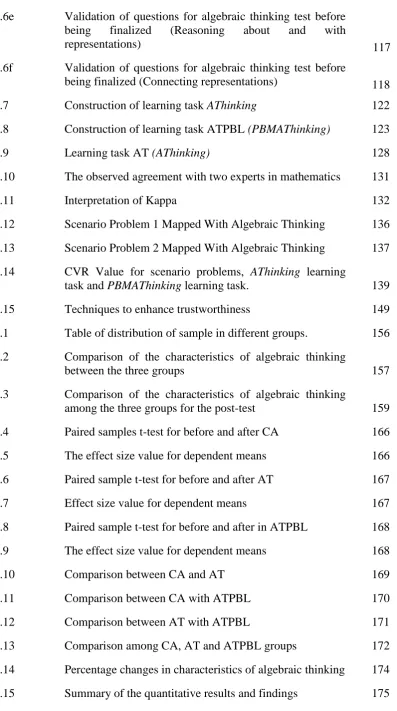
3.7 Construction of learning task AThinking 122
3.8 Construction of learning task ATPBL (PBMAThinking) 123
3.9 Learning task AT (AThinking) 128
3.10 The observed agreement with two experts in mathematics 131
3.11 Interpretation of Kappa 132
3.12 Scenario Problem 1 Mapped With Algebraic Thinking 136 3.13 Scenario Problem 2 Mapped With Algebraic Thinking 137 3.14 CVR Value for scenario problems, AThinking learning
task and PBMAThinking learning task. 139
3.15 Techniques to enhance trustworthiness 149
4.1 Table of distribution of sample in different groups. 156 4.2 Comparison of the characteristics of algebraic thinking
between the three groups 157
4.3 Comparison of the characteristics of algebraic thinking
among the three groups for the post-test 159 4.4 Paired samples t-test for before and after CA 166
4.5 The effect size value for dependent means 166
4.6 Paired sample t-test for before and after AT 167
4.7 Effect size value for dependent means 167
4.8 Paired sample t-test for before and after in ATPBL 168
4.9 The effect size value for dependent means 168
4.10 Comparison between CA and AT 169
4.11 Comparison between CA with ATPBL 170
4.12 Comparison between AT with ATPBL 171
4.13 Comparison among CA, AT and ATPBL groups 172
4.14 Percentage changes in characteristics of algebraic thinking 174 4.15 Summary of the quantitative results and findings 175 117
4.16 Algebraic thinking of four participants in PBMAThinking, task based interview transcript and task based interview
notes 205
4.17 Characteristics of algebraic thinking in Scenario Problem
1 222
4.18 Characteristics of algebraic thinking in Scenario Problem
LIST OF FIGURES
FIGURE NO. TITLE PAGE
1.1 Theoretical Framework 21
1.2 Conceptual Framework 23
2.1 Example of a question from the Form Two textbook in
Malaysia 44
2.2 Example of a word problem from the Malaysian Form
Two textbook. 45
3.1 Summary of research procedures in CA group 97
3.2 Summary of procedures for experiment in AT group 100 3.3 The learning process of PBL based on the model
developed by Tan (2003) 102
3.4 Summary of procedures for experiment in ATPBL 107
3.5 First Draft of Scenario Problem 1 134
3.6 The second draft of Scenario Problem 1 135
3.7 Excerpt from Scenario Problem 2 137
3.8 Process of analyzing the data that led to the formulation of a framework to integrate students’ algebraic thinking into
the PBL learning process. 153
4.1 The learning task ATPBL according to phase and learning
process 206
4.2 Learning process of PBL based on two scenario problems 225 4.3 Framework for integrating students’ algebraic thinking
through the PBL process 227
5.1 Framework for implementing ATPBL among different
LIST OF ABBREVIATIONS
CA - Conventional Approach
AT - Integration of algebraic thinking
ATPBL - Problem-based learning approach with the integration of algebraic thinking
SBP - Sekolah Berasrama Penuh/ Boarding School RPH - Rancangan Pengajaran Harian
MSP - Manipulation of symbols and procedures ER - Exploring relationships
GF - Generalizing and formalizing UA - Using Algebra as a tool
RA - Reasoning about and with representations CR - Connecting representations
JU - Jurulatih Utama
BMI - Body Mass Index
PBL - Problem-based learning
TIMSS - Trends in International Mathematics and Science Study UPSR - Ujian Penilaian Sekolah Rendah
PMR - Penilaian Menengah Rendah PT3 - Pentaksiran Tingkatan 3
LIST OF SYMBOLS
𝑃
𝑜 - Observed Agreement𝑃𝑒 - Expected Agreement
M - Mass
σ - Variance
LIST OF APPENDICES
APPENDIX TITLE PAGE
A1 Letter of permission from the EPRD 291
A2 Letter of permission from Perak State Education
Department 292
A3 Letter of permission from management department
of boarding schools 293
B Algebraic Thinking Test 294
C Statutory Review of Task based Interview Transcript; Task based Interview Notes and Students work in Learning Task ATPBL for
Reliability Indices Cohen Kappa 301
D1 Validation of Algebraic Thinking Test 302
D2 Validation of Learning Task AT (AThinking) 305
D3 Validation of Learning Task ATPBL
(PBMAThinking) 308
D4 Validation of Scenario Problems 310
E Statutory Review of Translation Bahasa Melayu to English; Task based Interview Transcript, Task based Interview Notes and Students work in
Learning Task ATPBL 315
F1 Results Pre-test and Post-test for CA Group 316
F2 Results Pre-test and Post-test for AT Group 317
F3 Results Pre-test and Post-test for ATPBL Group 318
G1 Results for MANCOVA Multivariate Tests 319
Effects 320
G3 Assumptions of MANCOVA analysis 322
G4 Tests of normality 324
H1 Scenario Problem 1 325
H2 Scenario Problem 2 328
I1 Patterns of algebraic thinking Sina 329
I2 Patterns of algebraic thinking Fira 330
I3 Patterns of algebraic thinking Finah 331
I4 Patterns of algebraic thinking Ariamuh 332
J Task-based Interview Protocol Senario Masalah 1
dan 2 333
K Participants checking the validity 335
L Sample of Analysis of Interview Data 336
M1 Sample of Analysis of of Students’ work Learning
Task ATPBL (PBMAThinking) 338
M2 The codebook used for coding data 339
N Models of PBL 343
O1 The final version of the algebraic thinking test 345
O2 Comparison of specifications for PBL problems 346
P Overview of research questions, instruments,
design and data analysis 347
Q Algebraic thinking in every phase for both scenario
problems 348
CHAPTER 1
1 INTRODUCTION
1.1 Introduction
Algebra is an important topic in mathematics at all levels, from elementary school to university (Booker and Windsor, 2010; Cai, Lew, Morris, Moyer, Ng, and Schmittau, 2005; Eccius-Wellmann, 2012; Napaphun, 2012; Walkoe, 2013). Algebra is widely applied in various fields, such as economics, food and beverages, banking, business, chemistry and many other areas (Eccius-Wellmann, 2012; Grandau, 2013). It is interrelated with other mathematical topics such as statistics and geometry. It is also the gateway for entering university and is the foundation of advanced mathematics (Barbosa and Vale, 2015; Cai and Knuth, 2011; Drijvers, Doorman, Kirschner, Hoogveld and Boon, 2014; Walkoe, 2013). Algebra is required to develop science, technology, art and humanity as well as to solve everyday problems (Abonyi and Nweke, 2014). Reforming the teaching and learning of algebra, which started at least 4,000 years ago, is a major challenge that involves all levels of education worldwide (Katz, 1997). Therefore, it is important for students to understand the concept and application of algebra as well as its current development.
loans, as well as in the calculation of annual taxable income (Egodawatte, 2011). However, for decades, algebra has been presented as a set of procedures and principles that are isolated from the rest of mathematics. This has led to misconceptions among students that algebra is not related to the solving of daily problems (Fendel, Resek, Fraser and Alper, 1997).
In algebra, variables can be applied to represent, analyze, and perform calculation problems (Abonyi and Nweke, 2014). Algebra has been used as a tool to generalize patterns, as well as to justify and manipulate symbols (Banerjee, 2011). However, the reasons for difficulties in learning algebra are concentrated in the manipulation of symbols and procedures as well as understanding conceptual of content of algebra (Chazan, 1996). Furthermore, students’ achievement in algebra is still low and poor knowledge has been demonstrated in simplifying algebraic expressions (Abonyi and Nweke, 2014). In addition, most students fail to connect arithmetic with algebra (Alagic and Emery, 2003; Alghtani and Abdulhamied, 2010; Banerjee, 2011; Cai and Moyer, 2008; Napaphun, 2012; Noyce Foundation, 2009; Witzel, 2005; Wang, 2015).
The mathematics curriculum plays a significant role in the formation of basic algebraic concepts and the development of algebraic thinking (Dikkartin and Uyangor, 2012). Students can understand algebraic symbolism in the early development of algebraic thinking (Cai and Knuth, 2011). Algebraic thinking is a process by which the students express and build mathematical relationships practically (Soares, Blanton and Kaput, 2006). According to Kieran (2004), algebraic thinking is a way for students to focus on relations, operations, alphanumeric characters, representing and solving problems as well as refocusing the meaning of the equals sign. The foundation of algebraic thinking is developed as the student becomes able to make connections of patterns with the real world (McGarvey, 2012). This is aligned with the principles of problem-based learning (PBL). According to Mason, Graham and Johnston-Wilder (2005), algebraic thinking develops through the combination of four strands of algebra with mathematical themes and mathematical powers within conjecture conditions. Korea, China, the USA, and Canada are among the countries that have their own curriculum for algebraic thinking skills, which leads to better performance in algebra compared to Malaysia. The mathematics curriculum in Malaysia is only focused on thinking and reasoning in general. However, some elements of algebraic thinking do exist. Therefore, study is required to identify the appropriate strategy to make the learning of algebra more comprehensive and effective (Cai, Lew, Morris, Moyer, Ng and Schmittau, 2005). To encourage students to practice such thinking, proper teaching and learning activities should be designed, and one potential strategy is PBL. PBL is the one of the best approaches that emphasizes problem as a starting point, followed by student-centered and teacher as a facilitator in the learning process. It is also proven that PBL provide positive impact in student’s achievement in mathematics. However, there are scarce of studies pertaining algebraic thinking in PBL, whereby algebraic thinking is important as a foundation of success in learning algebra.
1.2 Research Background
cognitive gap, teaching issues, learning matters and transition knowledge. Students have difficulties in representing an unknown quantity in an equation using a letter. Furthermore, students are unable to generalize in algebra based on given arithmetical rules and operations. They often misinterpret the equals sign as a formal symbol for equivalence (e.g. 3 + 4 = 2 + 5). The students thought that the answer is in the right side, which is 2 + 5. Moreover, students are unable to solve word problems. They find it difficult to formulate an equation from a word problem. This shows that the difficulties of learning algebra are still being studied.
Study by Alibali, Stephens, Brown, Kao and Nathan (2014) reported that their participants were fairly successful in solving algebraic equations. They found that the students found it difficult to integrate the mathematical operations and were weak in multiplication of equations. Their findings also reported that the students had difficulties in solving and symbolizing multiple operations in problem solving. These Walkoes (2013) emphasized these characteristics in manipulation of symbols and procedures and connecting representations. The most important part of teaching and learning is that the knowledge taught is relevant and is retained by the learner, and this places emphasis on the role of the teacher to accomplish the learning outcomes (Adu and Olaoye, 2015). They simply require correct answers from the students instead of revealing the beauty of mathematics, especially algebra. Furthermore, they do not encourage the students to think algebraically. Hence, the students would not fully understand the transition from arithmetic to algebra.
Based on previous studies, algebraic thinking focuses more on the achievement of algebra itself. This does not represent the true understanding concept of algebra. Furthermore, the finding does not entail all the characteristics of algebraic thinking. Most of the studies promote to enhance the ability of the students to make generalizations. Generalization and justification commonly influences each other (Ellis, 2007) as mentioned in the framework ofWalkoes. However, it is explicitly introduced in the KSSM syllabus for Malaysian students. It involves addition, subtraction, division, and multiplication of integers. Conversely, generalizations in patterns should be emphasized (Callejo and Zapatera, 2017). Patterns play an important role in introducing algebra (Zazkis and Liljedahl, 2002). More significantly, algebraic thinking is about finding and using generalization in patterns that should be introduced in elementary years (Tirosh, Tsamir, Levenson, Barkai, and Tabach, 2017).
problems, justify, and prove mathematically as emphasized based on the framework of Walkoe.
Examination results provide an indicator of how students learn algebra. The result of the Sijil Pelajaran Malaysia (SPM) shows that many students fail to perform algebraic manipulations (Lembaga Peperiksaan Malaysia, 2003a, 2003b, 2008, 2010a). The ability of performing algebraic manipulation is related to the characteristics of algebraic thinking based on Walkoe’s framework, which is the manipulation of symbols and procedures. Yet there is no specific measurement to characterise algebraic thinking. In addition, achievement in algebra has been decreasing, as shown in the results of the Trends in International Mathematics and Science Study (TIMSS) in 2011 (Mullis, Martin, Foy, and Arora, 2011) and 2015 (Mullis, Martin, Foy and Arora, 2015) and the Programme for International Student Assessment (PISA) in 2012. Therefore, this study focuses on algebra as the subject matter. Malaysian teachers apply drill and practice in teaching mathematics (Sam, 2003; Sam and Yong, 2006; Saleh and Hussin, 2011). They believe that this approach is the most efficient due to familiarization with repeated routine problems (Zanzali, 2012). Therefore, students are unable to think analytically to solve problems (Jing, Tarmizi, Bakar and Aralas, 2017). Hence, teachers should work towards adopting various teaching and learning approaches instead of teaching at a fast pace to cover the syllabus. Moreover, teachers also need to encourage the students to use thinking and reasoning in solving problems.
Nowadays, teachers should choose the appropriate method to enhance multiple competencies, especially algebraic thinking among students. Many studies (Booker and Windsor, 2010; Windsor and Norton, 2011; Windsor, 2008) have been concerned with the development of algebraic thinking through the problem-solving approach. In real settings in schools, algebraic thinking is assessed through tests and examinations. However, thinking skills should be assessed while the students are learning. The best approach should be on in which the teachers are able to fulfil the syllabus requirements and develop students’ behaviour (Idris, 2001). Some teachers regard problem-solving as an alternative teaching approach to develop algebraic thinking in the classroom.
1.2.1 Algebraic Thinking
Based on previous study, teachers are only able to identify the students’ thinking in general, instead of identifying it in specific mathematical domains. This limits teachers’ ability to identify the level of students’ algebraic thinking (Walkoe, 2013). Therefore, there is a need to identify the particular mathematical domains, such as characteristics of algebraic thinking.
concrete value. However, in finding patterns, it is not necessarily a value. It can be a variable in the same sequence, which is highlighted in exploring the relationships of characteristics as stated in Walkoe’s framework.
According to Booker and Windsor (2010), algebraic thinking engages students across all strands of mathematics. Therefore, it should be implemented at middle and upper primary level. This enables students to obtain concrete algebraic thinking in secondary school when they are exposed to practical problems using models and situations at early stages of learning. However, according to Kieran (2004), algebraic thinking should start in earlier grades and should involve analyzing and exploring the relationship, justifying, problem-solving, predicting, and generalizing. Furthermore, algebraic thinking is part of a school subject that can be connected to students’ everyday lives and materials with mathematical symbols (Soares, Blanton and Kaput, 2006).
In Malaysia, there are still very few empirical studies of algebraic thinking in middle school. Siew et al. (2016) reported that 8th grade students achieved significantly higher mean scores in algebraic thinking compared to a control group using DragonBox 12. Furthermore, the researchers observed pre-algebraic thinking. Findings from a study by Gan (2008) in Malaysia investigated how primary school pupils solve pre-algebraic problems and identified their pre-algebraic thinking based on their solution processes. Moreover, Lian and Yew (2011) proposed a framework for pre-algebraic thinking to enhance generalization. However, study by Lian, Meng and Idris (2009) reported that pre-service teachers performed lower at the relational
Other than that, using problems in PBL may involve reasoning and making generalizations, which is aligned with Walkoe’s point of view that focus should be on algebraic thinking and reasoning (Kalaivani and Tarmizi, 2014).
Algebraic thinking consists of three components; general activities of algebra; transformational (“rule-based”) activities; and global, meta-level, mathematical activities (Kieran, 1996). In 2013, Walkoe expanded Kieran’s model to encompass manipulating symbols and procedures, exploring relationships, generalizing and formalizing, using algebra as a tool, reasoning about and with representations, and connecting representations. Exploring relationships involves examining how structures or quantities relate to each other as well as to conjunctions.
Generalizing and formalizing are components of the general activities of algebra. However, exploring relationship is separated from generalizing and formalizing. The extensions in Walkoe’s framework include functions and their representations. An example of category generalizing and formalizing is that the student is able to identify and find a formula for the linear pattern. Meanwhile, students’ ability to think about the relationship of independent and dependent variables of the function falls within the category of exploring relationships. However, there is a need for students to be able to reason across the representation or to make a connection with the representation especially the ability to connect patterns with real world. This is related to one of the characteristics of PBL. Walkoe’s extension of Kieran’s work demonstrates more specifically the features of algebraic thinking.
1.2.2 Problem-based Learning (PBL)
problem-solving skills, and group processes (Tan, 2009). PBL is practice-based; the students must practice solving problems and not just learn about the problem-solving itself (Jonassen, 2011).
In a PBL process, scaffolding helps to develop cognitive connections such as analytical thinking (Tan, 2003). PBL applies real life problems to improve students’ analytical thinking, higher level thinking abilities, and problem solving (Hatısaru and Küçükturan, 2009a). These real life problems have specific answers and PBL is concerned with how the students interpret, plot, and plan to solve the problems in groups. Teachers often discover that students accomplish meaningful and permanent learning when solving real life problems. A study conducted by Kalaivani and Tarmizi (2014) applied the algebra domain and reviewed higher order thinking skills, and the researchers suggested that teachers should focus on algebraic thinking in order to empower the teaching and learning of algebra.
PBL has the ability to construct students’ knowledge and understanding of any particular concept. In addition, it can enhance higher order thinking skills. Problem solving and the PBL approach are in parallel with the characteristics of algebraic thinking. However, the components of algebraic thinking embraces algebra as a tool for functions and mathematical modelling; these components seek, express, and generalize patterns and rules in real world contexts, and apply them in the problem-based learning process. Furthermore, PBL provides multidisciplinary learning and life skills in addition to problem-solving skills.
Multidisciplinary learning consists of interconnecting disciplines, while life skills consist of self-direct learning, information mining, collaborative learning, reflective thinking, peer teaching, and evaluation. The process of PBL helps the students in enhancing connectivity between prior knowledge or experience and the real-world context, theories, other people’s perceptions, as well as new facts and ideas. However, to achieve these skills, facilitating, coaching, and mediating are indispensable (Tan, 2003). Moreover, questions arise as to what the students have learnt in PBL and how they learn during group discussion and self-directed learning (Yew and Schmidt, 2012), specifically in learning algebra. Furthermore, PBL is still not widely practiced in secondary schools in Malaysia (Nasir, 2016). Moreover, Kalaivani and Tarmizi (2014) suggest the need to focus on algebraic thinking using PBL approach.
1.2.3 Boarding schools (SBP)
Boarding schools (Sekolah Berasrama Penuh: SBP) in Malaysia are schools at which the students are fully residential in hostels. They have fixed schedules for students’ activities from early morning until bedtime. Boarding school entry is under the management of the Ministry of Education (Kementerian Pelajaran Malaysia: KPM). It is based on excellent academic achievement in the Ujian Penilaian Sekolah Rendah (UPSR) to enter at Form One level and in the Penilaian Menengah Rendah (PMR) or Pentaksiran Tingkatan 3 (PT3) to enter at Form Four level and is supported by co-academic achievements such as debate or scrabble or related to achievements in academic or co-curriculum activities such as badminton, soccer or other sports (Ilias, 2012; Khalidah, Rohani and Mashitah, 2014; Muhriz, Abidin, Abdullah and Jan, 2011).
Many studies have been done involving boarding school (SBP) students, including examining their levels of anxiety, depression (Mahfar, Aslan, Noah, Ahmad and Jaafar, 2014), perceptions towards good teachers, and attitudes towards Physics (Daud, Karim, Hassan and Rahman, 2015), as well as study in the affective domain (Ghani, Yaacob, Ahmad, Aman and Isa, 2010; Mokhtar, Mohd Jailani, Tamuri and Abdul Ghani, 2011). However, there has been a lack of study that explores cognitive ability in SBP students, specifically in terms of mathematics and algebraic thinking. SBP students are highly able in terms of cognitive skills and excellent academic performance. However, their characteristics of thinking, such as algebraic thinking, have not yet been explored in detail.
that required them to use algebra as a tool to explore relationships as stated in Walkoes’ framework. More importantly, the students were unable to answer the questions that required them to use reasoning (Mustaffa, Ismail, Tasir and Said, 2016). Therefore, there is a need to implement this study among SBP students.
1.3 Problem Statement
Study on mathematics education has reported that many students perceive algebra as difficult (Egodawatte, 2011; Kalaivani and Tarmizi, 2014) and abstract (Booth, Barbieri, Eyer and Paré-Blagoev, 2014; Puteh and Khalin, 2016; Xin, Zhang, Park, Tom, Whipple and Si, 2011). Students have also demonstrated misconceptions in solving problems that involve variables (Booth et al., 2014; Egodawatte, 2011; Wasserman, 2014; Yantz, 2013). Algebra is one of the components in mathematics that deal with operations or manipulation of symbols and variables. Algebra requires students to solve equations procedurally instead of emphasizing their thinking process (Wong, 2005). In particular, students learning algebra are unable to connect arithmetic with algebra (Banerjee, 2011; Khalid and Noor, 2012; Zeller and Barzel, 2010). Students are unable to perform successfully in learning algebra through the conventional approach (Abonyi and Nweke, 2014), as this approach prevents them from developing the ability to think towards solving algebraic problems (Wong, 2005).
A number of researchers have investigated the algebraic thinking of middle school students (Adni, 2012; Ayalon and Even, 2013; Booth et al., 2014; Hitt, Saboya and Cortés Zavala, 2015; Johanning, 2004; Lee and Freiman, 2006; Lew, 2004; Li, Peng, and Song, 2011; Noss et al., 2012; Siew et al., 2016; Steele and Johanning, 2004; Trezise and Reeve, 2014; Walkowiak, 2014; Zeller and Barzel, 2010). However, not all the characteristics of algebraic thinking have been demonstrated among students. Early algebra emphasizes algebraic thinking, which involves the understanding of arithmetic relationships, generalizing and recognizing variable structure. Early algebra should be differentiated from typical algebra in terms of contents, subjects, and teaching methods (Lee and Pang, 2012). The development of algebraic thinking requires students to (1) help themselves to make a smooth transition between arithmetic and algebra and (2) appreciate the usefulness of generalized algebraic approach in solving various problems (Cai and Moyer, 2008; Cai et al., 2005).
Study on algebraic thinking should be conducted to all students including high achievers specifically boarding school students. There has been a lack of study on the implementation of algebraic thinking among boarding school students. Boarding schools select students who demonstrate excellent academic and co-academic abilities. All boarding school students are required to stay in the hostels provided and their food and drinks are provided for them. These students are assets to the country; they are being sponsored and are closely monitored so that they can help the country in return when they have successfully completed their studies and gained powerful positions.
thinking. Mathematics teachers should have alternative ways to teach algebra; for example, by conducting real-life activities to diminish the disconnection of arithmetic with algebra (Alghtani and Abdulhamied, 2010). Another strategy, as indicated by the literature, is to use PBL, an approach that focuses on the development of thinking. This method has been perceived to be able to facilitate students’ knowledge construction and reasoning skills because it uses real-world problems as the starting point in the learning process.
specifically in the field of algebraic thinking. Given the above points, the researcher intends to integrate algebraic thinking through PBL. The cohesion between the two strategies is expected to have positive effects in improving students’ thoughts about learning algebra.
1.4 Research Objectives
The objectives of the study are as follows;
(i) To analyze the characteristics of algebraic thinking of lower secondary boarding school (SBP) students in learning algebra;
(a) through the conventional approach (CA). (b) with the integration of algebraic thinking (AT).
(c) through the problem-based learning (PBL) approach with the integration of algebraic thinking (ATPBL).
(ii) To compare the characteristics of students’ algebraic thinking in learning algebra between;
(a) CA and AT. (b) CA and ATPBL. (c) AT and ATPBL.
(iii) To determine the students’ way of thinking algebraically while learning algebra through the ATPBL.
1.5 Research Questions
The study is conducted to investigate;
(i) What are the characteristics of algebraic thinking of lower secondary boarding school (SBP) students in learning algebra;
(a) through the conventional approach (CA)?
(b) with the integration of algebraic thinking (AT) before and after the intervention?
(c) through the PBL approach with the integration of algebraic thinking (ATPBL)?
(ii) Is there any significant difference in algebraic thinking for SBP students before and after being taught;
(a) by the conventional approach (CA)?
(b) with the integration of algebraic thinking (AT)?
(c) through the PBL approach with the integration of algebraic thinking (ATPBL)?
(iii) Is there any significant difference in algebraic thinking for SBP students taught;
(a) by the conventional approach (CA) compared to the integration of algebraic thinking (AT)?
(b) by conventional approach (CA) compared to the PBL approach with the integration of algebraic thinking (ATPBL)? (c) with the integration of algebraic thinking (AT) compared to
the PBL approach with the integration algebraic thinking (ATPBL)?
(v) What is the framework that integrates students’ algebraic thinking with the PBL learning process?
1.6 Hypotheses
Based on the research questions, the researcher has put forward several null hypotheses (H0) built on the significance level α = 0.05 as follows;
H01 There is no significant difference in students’ algebraic thinking before and
after being taught using CA.
H02 There is no significant difference in students’ algebraic thinking before and
after being taught using AT.
H03 There is no significant difference in students’ algebraic thinking before and
after being taught using ATPBL.
H04 There is no significant difference in students’ algebraic thinking after being
taught using CA compared to AT.
H05 There is no significant difference in students’ algebraic thinking after being
taught using CA compared to ATPBL.
H06 There is no significant difference in students’ algebraic thinking after being
1.7 Theoretical Framework
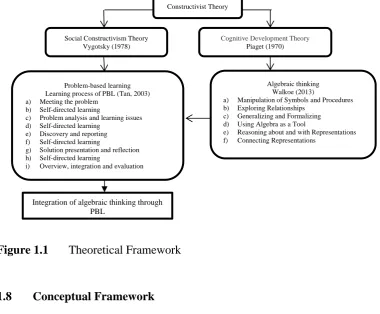
Constructivism consists of various theories that assimilate the behaviourist and cognitivist theories (Amineh and Asl, 2015). Constructivism functions as a theory of education in which the teacher encourages students to construct their own knowledge and implement it practically (Mvududu and Thiel-Burgess, 2012). Constructivism supports the cognitive development and social constructivism theory in this study. There are various theories that support the learning of algebra, such as Piaget’s cognitive development theory, Bruner’s stages of representation, Diene’s six–stage theory, Gagne’s theory of instruction and Ausubel’s meaningful verbal learning. However, this study applies Piaget’s (1970) cognitive development theory. Piaget stated that children aged 12 to 18 years old are within the formal operational stage. They are able to think inductively and deductively in proving mathematical theorems and rules and making generalizations or conclusions. In this stage, children also are able to use mathematical concepts to represent abstract concepts, solve and justify problems and relate certain concepts with other concepts.
This study focuses on identifying the characteristics of algebraic thinking in learning algebra. The characteristics of algebraic thinking are based on the framework developed by Walkoe (2013), which is based on Piaget’s cognitive development theory. The characteristics of algebraic thinking are the manipulation of symbols and procedures, exploring relationships, generalizing and formalizing, using algebra as a tool, reasoning about and with representations and connecting representations. The characteristics of algebraic thinking relate to the formal operational stage in Piaget’s theory, since this study was carried out for Form Two students (aged 14 years).
alternately throughout life (Powell and Kalina, 2009; Huitt and Hummel, 2003; Saad, 2002). In these two processes, students are able to transfer their knowledge of algebra into arithmetic. They are also able to solve problems through procedural thinking and to think algebraically.
Constructivism is the process of learning that explains how knowledge is constructed in the human mind. Teachers are unable to transfer knowledge to students in a perfect situation. Therefore, students need to construct their own knowledge according to their own experiences and abilities. According to Cottrill (2003), a person constructs knowledge himself or herself in the same environment. However, not all students are able to construct knowledge by themselves. They need teachers and peers to help them with some tasks. Scaffolding is a process that occurs when a learner is unable to solve a problem; an adult or an experienced peer helps the learner with some tasks until he or she is able to work independently (Moalosi, 2013). Learning algebra focuses more on mathematical symbols and the rules for manipulating these symbols. It also focuses on solving equations and expressions. Therefore, there is a need for a proper learning approach to assist in the process of learning algebra to enhance students’ algebraic thinking.
learning process of PBL is based on the work of Tan (2003). All the characteristics of algebraic thinking are integrated into the PBL learning process.
Figure 1.1 Theoretical Framework
1.8 Conceptual Framework
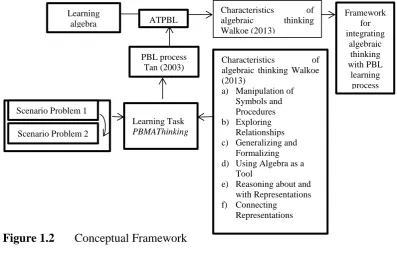
The conceptual framework for this study serves to show how all the theories are organized to achieve the study objectives. This study analyzed students’ algebraic thinking using three different approaches, namely the conventional approach (CA), integration of algebraic thinking (AT) and the PBL approach with integration of algebraic thinking (ATPBL). The two study interventions are first the integration of algebraic thinking, and second, the PBL approach with integration of algebraic thinking. The framework of algebraic thinking put forward by Walkoe (2013) was adopted in both interventions because its description of algebraic thinking is sufficiently detailed and comprehensive to be implemented for secondary level students. Furthermore, it is suitable for the syllabus of Form Two students in Malaysia. Most of the characteristics of algebraic thinking in Walkoe’s (2013) framework, namely the manipulation of symbols and procedures, exploring relationships, using algebra as a tool, reasoning about and with representations and
Integration of algebraic thinking through PBL
Social Constructivism Theory Vygotsky (1978)
Algebraic thinking Walkoe (2013)
a) Manipulation of Symbols and Procedures b) Exploring Relationships
c) Generalizing and Formalizing d) Using Algebra as a Tool
e) Reasoning about and with Representations f) Connecting Representations
Cognitive Development Theory Piaget (1970)
Problem-based learning Learning process of PBL (Tan, 2003) a) Meeting the problem
b) Self-directed learning
c) Problem analysis and learning issues d) Self-directed learning
e) Discovery and reporting f) Self-directed learning
g) Solution presentation and reflection h) Self-directed learning
i) Overview, integration and evaluation
connecting representations, are explicitly taught to Form Two students, the only exceptions being generalizing and formalizing. However, not all of these construct are addressed explicitly, such as justifying, proving, thinking about or with representations of functions such as graphs, table and situations and using one representation to reason about another. The strength of Walkoe’s (2013) framework is it expansion and extension of the framework developed by Kieran (1996).
Walkoe’s (2013) framework is applicable for secondary school students’ manipulation of symbols and procedures, using algebra as a tool and connecting representations. However, reasoning about and with representations, exploring relationships and generalizing and formalizing can be further enhanced through a suitable approach. It is important to identify the characteristics of algebraic thinking among students as well as guidance provided by teachers and discussion with peers. This can lead the students to make connections between arithmetic and algebra as well as to think algebraically rather than focusing on computational fluency. Walkoe’s (2013) framework consists of manipulation of symbols and procedures, exploring relationships, generalizing and formalizing, using algebra as a tool, reasoning about and with representations and connecting representations.
about diet for male and female students aged fourteen. It involved the construction of a menu to encourage healthy eating habits to reduce obesity among students, which required the integration of algebraic thinking (See Appendix H2). Solving this scenario problem required the knowledge of dietary needs and linear equations.
The results showed that the biggest impact occurred through the PBL approach with integration of algebraic thinking. Therefore, the integration of algebraic thinking in the learning process of PBL leads to the formulation of a framework for developing algebraic thinking in PBL. The framework integrates students’ algebraic thinking with the PBL learning process to improve characteristics of algebraic thinking among lower secondary boarding school (SBP) students in the learning process of algebra. In comparison, the other frameworks emphasized on generalization that does not involve most of the characteristics, and does not identify the process to gain the characteristics of algebraic thinking.
Figure 1.2 Conceptual Framework
1.9 Importance of Study
This study proposes a framework that integrates students’ algebraic thinking into the PBL learning process. This proposed framework will help teachers to enhance students’ algebraic thinking. To achieve high scores in algebraic thinking
Learning
algebra ATPBL
Framework for integrating algebraic thinking with PBL learning process Characteristics of
algebraic thinking Walkoe (2013)
a) Manipulation of Symbols and Procedures b) Exploring
Relationships c) Generalizing and
Formalizing d) Using Algebra as a
Tool
e) Reasoning about and with Representations f) Connecting Representations PBL process Tan (2003) Learning Task PBMAThinking Scenario Problem 1
Scenario Problem 2
tests, algebraic thinking through PBL has to be emphasized from the outset and in every phase in PBL. Students who are new to the PBL process would be unable to succeed in scenario problem one. To enhance algebraic thinking in PBL, there should be training at an early stage. Students with medium or high algebraic thinking are able to manage in PBL, and their algebraic thinking will be improved. If students have low algebraic thinking and are newly exposed to the learning process of PBL, it will take time. In summary, PBL is able to enhance algebraic thinking. However, the students have to work through more than one scenario problem. The proposed framework integrates students’ algebraic thinking (manipulation of symbols and procedures, exploring relationships, generalizing and formalizing, using algebra as a tool, reasoning about and with representations and connecting representations) into every phase of the PBL learning process.
Furthermore, teaching and learning algebra using an approach that emphasizes algebraic thinking helps teachers and students to notice the characteristics of algebraic thinking in the algebra domain. Hence, teachers can provide appropriate teaching aids.
Students are able to connect arithmetic to algebra through the PBL approach with the integration of algebraic thinking. This is due to how the students think algebraically. Furthermore, the students are able to connect algebra with real-life situations. Therefore, the students will realize that learning algebra is meaningful and applicable to real life.
The findings of this study will demonstrate the effectiveness of teaching and learning algebra from different approaches. In addition, it will also contribute to the learning process to be implemented in mathematics, especially in algebra, through various teaching and learning approaches.
thinking. This study also contributes to the existing literature on PBL and potentially has an impact on algebraic thinking in mathematics.
The theoretical framework, research methodology, and findings can be used as guidelines and references as well as ideas for other researchers who are interested in algebraic thinking and PBL. It will also be beneficial for higher education institutes, mathematics educations and other relevant parties to implement algebraic thinking through PBL. Furthermore, it offers guidelines for the curriculum in Malaysia to develop its own characteristics of algebraic thinking.
1.10 Scope of the Study
This study aims to derive a framework for integrating algebraic thinking through PBL that incorporates the characteristics of algebraic thinking and the learning process of PBL. It is designed to provide a learning environment of algebraic thinking through PBL.
In this study, the characteristics of algebraic thinking of lower secondary boarding school (SBP) students have been identified with respect to;
i. Manipulation of symbols and procedures ii. Exploring relationships
iii. Generalizing and formalizing iv. Using algebra as a tool
v. Reasoning about and with representations vi. Connecting representations
within three learning approaches; the conventional approach (CA), the integration of algebraic thinking (AT) and the PBL approach with integration of algebraic thinking (ATPBL). The PBL approach is widely discussed in the literature. It starts the learning process with problems and requires the use of facilitation and scaffolding. In terms of sample and population, this study involved Form Two boarding school (SBP) students in Perak. Three different schools were selected to form a control group consisting of twenty-five students and two experimental groups; the AT group and the ATPBL group, each comprizing thirty students. The topic studied was algebra, specifically Linear Equations.
1.11 Limitations of the Study
This study used techniques which involved collecting and analyzing verbal protocols. The data was obtained from the students’ work during the PBMAThinking learning tasks. One limitation of this method is that the process of collecting, coding, and analyzing the verbal protocol data requires a lot of work (Cai, 1995; Gan and Ghazali, 2007). Therefore, the involvement of a large number of participants is not feasible for this study. Hence, the results of this study are merely indicative and can only be used to describe the patterns of the participants involved in this study.
The second limitation is the limited scope of the algebra topic, since only the Linear Equations topic was used in this study to suit the ability of lower secondary school students, as discussed in the problem statement. Therefore, it is important to recognize that the practical transferability (or generalizability) of the findings is constrained by the nature of the algebra topic chosen to be included in the study instrument.
Moreover, the time allocated in the curriculum to cover Linear Equations is only five weeks. In this study, only two scenario problems were used in the learning process, because giving too many problems might tire the students and thus affect their thought processes (Payne, 1994).
The fourth limitation is related to the methodology of this study, particularly verbal protocol analysis, which involved the use of participants’ own verbal reports as data. The validity of verbal reports as data may be doubted, as they inevitably involve selectivity and interpretation by the researcher. The interpretation is subjective and depends on the researcher’s skill. Thus, the researcher must be very cautious and impartial in interpreting verbal reports. The protocol data must be integrated with more objective measures to achieve credibility (or validity) of the data. In this study, participants checked the transcripts of their task-based interview and triangulation was used to achieve credibility of data. In addition, experts were requested to verify part of the data analysis to ensure objectivity of the analysis.
1.12 Operational Definitions
The following sections define the terminology used in this study.
1.12.1 Algebra
domains of mathematics and is related to other topical domains (Eddy et al., 2015). In the context of the Malaysia curriculum, algebra consists of Indices and Logarithms, functions, quadratic equations, quadratic functions, simultaneous equations, progressions, and linear laws, referred to within additional mathematics. Additional mathematics is the subject extension of mathematics for students aged 16 and 17. In this study, the researcher focused on the Linear Equations topic from the syllabus for Form Two students in Malaysia’s Integrated Curriculum for Secondary Schools.
1.12.2 Algebraic thinking
Algebraic thinking is a type of mathematical thinking. It is used to solve complex problems which consist of all mathematics strands and is formed based on conceptual understanding of computational fluency and numbers, reasoning using geometry and processes of measurement and statistics (Windsor and Norton, 2011). In this study, algebraic thinking consists of manipulation of symbols and procedures, exploring relationships, generalizing and formalizing, using algebra as a tool, reasoning about and with representations and connecting representations (Walkoe, 2013).
1.12.3 Conventional Approach (CA)
1.12.4 Integration of Algebraic Thinking (AT)
In this study, AT refers to learning algebra with the integration of algebraic thinking, which emphasizes six key characteristics of algebraic thinking, namely the manipulation of symbols and procedures, exploring relationships, generalizing and formalizing, using algebra as a tool, reasoning about and with representations and connecting representations. Learning algebra also encourages the teacher to pose and discuss questions in the classroom to encourage students’ algebraic thinking in terms of these characteristics. In this study, the teacher and students were provided with learning tasks that integrated algebraic thinking (AThinking) during the teaching and learning process.
1.12.5 Learning Task Integration of Algebraic Thinking (AThinking)
The AT learning task (AThinking) was employed in the learning process as guidance for teacher and students. It consisted of eleven Daily Lesson Plans (RPH 1 to RPH 11). Each RPH involved two worksheets with reflection and evaluation questions respectively. Details of the learning tasks are provided in Chapter 3.
1.12.6 Problem-Based Learning (PBL)
1.12.7 Problem-Based Learning (PBL) Approach with the Integration of Algebraic Thinking (ATPBL)
Learning algebra through PBL with the integration of algebraic thinking emphasizes the manipulation of symbols and procedures, exploring relationships, generalizing and formalizing, using algebra as a tool, reasoning about and with representations and connecting representations. Algebra learning implemented the PBL process of learning. Learning algebra also encourages the teacher to pose and discuss questions in the classroom to encourage students’ algebraic thinking. In this study, the teacher and students were provided with learning tasks that allowed the integration of algebraic thinking through PBL (PBMAThinking) during the teaching and learning process.
1.12.8 Scenario Problem
Problems is an important element in problem-based learning (PBL) role as to boost reasoning/thinking, able to organize the content and knowledge as well as motivation for learning process (Hung, 2006). According to Azer, Peterson, Guerrero and Edgren (2012), case scenarios are used to relate students’ learning with
real life, integrate the knowledge with clinical issues, stimulate reasoning and drive
students’ retention in long-term memory. Problems in PBL are referred as “ triggers”, “scenario” or “cases” aimed to trigger students in the learning process
1.12.9 Learning Task through Problem-Based Learning (PBL) Approach with the Integration of Algebraic Thinking (ATPBL) (PBMAThinking)
The ATPBL (PBMAThinking) learning task was employed in the learning process for PBL as guidance for teacher and students. It consists of daily lesson plans (RPH), two scenario problems, the process for the implementation of ATPBL, forms of teaching notes 1 and 2, forms of self-reading 1 and 2, forms of reflection 1 and 2, forms of self-evaluation 1 and 2, forms of evaluation Scenario Problem 1 and 2, forms of action plan 1 and 2, forms of KNL 1 and 2. However, only forms of teaching notes 1 and 2, forms of self-reading 1 and 2, forms of reflection 1 and 2, forms of self-evaluation 1 and 2, forms of evaluation of Scenario Problem 1 and 2 were used for data analysis. Details of the learning tasks are provided in Chapter 3.
1.12.10 Boarding School (Sekolah Berasrama Penuh) (SBP)
1.12.11 Lower Secondary School Students
In this study, lower secondary school students are Form Two students in boarding school (SBP) with an age of 14 years old.
1.12.12 Characteristics of Algebraic Thinking
The abilities that constitute the characteristics of algebraic thinking, according to Walkoe (2013), are examined below;
a) Manipulation of Symbols and Procedures
The ability to state or use a known definition such as x or y, or another letter, or a symbol such as a picture of a fruit, and to manipulate symbols and procedures, such as an equals sign or known definition such as x or y or another letter or another symbol such as a picture of a fruit.
b) Exploring Relationships
The ability to identify the structure of a relationship between variables, to find patterns and to know the changes of relationships between variables.
c) Generalizing and Formalizing
d) Using Algebra as a Tool
The ability to state an example for comparison, the relationship between equation and object, to solve problems, justify and prove mathematically.
e) Reasoning about and with Representations
The ability to relate variables with equations, graphs, tables and real situations.
f) Connecting Representations
The ability to form equations, connect two or more variables and use a variable in reasoning another variable.
This algebraic thinking framework was proposed by Walkoe (2013) to identify students’ algebraic thinking. It can be used to help teachers to identify lower secondary students’ algebraic thinking.
1.13 Summary
In this study, the integration of algebra thinking (AT) was tested to identify students’ algebraic thinking using the framework developed by Walkoe (2013). However, there are other issues that hinder the application of algebra in real situations. Many students think that it is meaningless to learn algebra and to think algebraically. Therefore, this study applied the PBL approach for the intervention, based on the learning process designed by Tan (2003).