MINOR DEFECTS AND PRACTICAL COMPLETION
FANI DHUHA
i
MINOR DEFECTS AND PRACTICAL COMPLETION
FANI DHUHA
A thesis submitted in fulfilment of the requirements for the award of the degree of Master of Science (Construction Contract Management)
Faculty of Built Environment Universiti Teknologi Malaysia
iii
To my beloved Wife, Dian Maria Ulfa, And my children, Syafiq and Ayaz.
iv
ACKNOWLEGDEMENT
In the name of Allah most gracious most merciful
A research of this nature may not be undertaken without help and support of others. First and foremost, I would like to extend my sincerest and most heartfelt appreciation to Encik Jamaludin Yaakob for his tireless supervision and guidance throughout the whole process of writing this thesis.
Extended thanks are also due to all my lecturers, without whom I would not have had the knowledge to proceed of writing this thesis.
I wish to thank Badan Pembinaan Konstruksi Kementerian Pekerjaan Umum and Government of Indonesia for awarding me the scholarship that enables me to study in this course.
Most of all, I wish to express my deep sense of gratitude to my family, especially to my parents, wife and children for their never-ending support, encouragement, help and smile.
v
ABSTRACT
vi
ABSTRAK
vii
TABLE OF CONTENTS
CHAPTER TITLE PAGE
TITLE i
DECLARATION ii
DEDICATION iii
ACKNOWLEDGEMENT iv
ABSTRACT v
ABSTRAK vi
TABLE OF CONTENTS vii
LIST OF TABLES xi
LIST OF FIGURES xii
LIST OF CASES xiii
1 INTRODUCTION 1
1.1 Background of Research 1
1.2 Problem Statement 3
1.3 Objective of Research 5
1.4 Scope and Limitation of Research 5
1.5 Significant of Research 5
1.6 Research Process and Methods of Approach 6 1.6.1 First Stage - Identify the Issue 6 1.6.2 Second Stage - Literature Review 7
1.6.3 Third Stage - Data Collection 7
1.6.4 Fourth Stage - Data Analysis 7
viii
Conclusion
1.7 Organization of Thesis 10
1.7.1 Chapter 1: Introduction 10
1.7.2 Chapter 2: Practical Completion 10
1.7.3 Chapter 3: Minor Defects 11
1.7.4 Chapter 4: Analysis and Results 11 1.7.5 Chapter 5: Conclusion and Recommendation 11
2 PRACTICAL COMPLETION 12
2.1 Introduction 12
2.2 Definition of Practical Completion 12
2.2.1 Definition of Practical Completion from Authors
13
2.2.2 Definition of Practical Completion from Judicial Decisions
15
2.3 Practical Completion in Standard Form of Construction Contract
18
2.3.1 P.W.D Form 203A (Rev.1/2010) 18
2.3.2 PAM Contract 2006 20
2.3.3 CIDB Standard Form of Contract For Building Works 2000
21
2.3.4 FIDIC Conditions of Contract For
Construction For Building and Engineering Works Designed by the Employer (FIDIC Red Book) 1999
22
2.4 Significance Of Practical Completion 23 2.4.1 Effect of the Issuance of CPC for
Construction Contract
24
2.4.2 Effect of the Issuance of CPC for Conveyancing Transactions
26
ix
Intended Purpose
2.5.3 Contract Administrator‟s Discretion 29
3 MINOR DEFECTS 31
3.1 Introduction 31
3.2 Defects in Construction Works 31
3.3 Types of Defects 34
3.4 Minor Defects 36
3.5 De-minimis Principle 37
3.6 The List of Minor Defects 39
3.7 Minor Defects at Practical Completion Stage 40
4 ANALYSIS OF LAW CASES 42
4.1 Introduction 42
4.2 Relevant Cases 42
4.3 How Minor Defects Affecting The Works From Achieving Practical Completion
44
4.3.1 Jarvis and Sons v Westminster City Council 44 4.3.2 P & M Kaye v Hosier & Dickinson Ltd 46 4.3.3 HW Nevill (Sunblest) Ltd v William Press &
Son Ltd
48
4.3.4 Emson Eastern Ltd (in Receivership) v E.M.E Developments Ltd
49
4.3.5 Birse Construction Ltd v Eastern Telegraph Company Ltd
51
4.3.6 Mariner International Hotels Ltd and anor v Atlas Ltd and anor
52
4.4 Identifying The Circumstances when Minor Defects Can or Cannot Delaying the Works From Being Awarded with Practically Completed
55
4.4.1 Sarah Constructions P/L v Phillips 55 4.4.2 Aberdeen Joinery Windows And Doors
Limited v A Salaam
x
4.4.3 Uniphone Telecommunications Bhd v Bridgecon Engineering Sdn. Bhd & Anor
59
4.4.4 Walter Lilly & Co Ltd v Mackay and another company
61
4.5 Conclusion 63
4.5.1 How Minor Defects Affecting the Works from Achieving Practical Completion
63
4.5.2 Identifying the Circumstances When Minor Defects Can or Cannot Delaying the Works from Being Regarded with Practically Completed
66
5 CONCLUSION 75
5.1 Introduction 75
5.2 Summary of Research Findings 75
5.3 Research Constraints 76
5.4 Recommendation for Further Research 77
5.5 Conclusion 77
xi
LIST OF TABLES
TABLE NO. TITLE PAGE
xii
LIST OF FIGURES
FIGURE NO TITLE PAGE
xiii
LIST OF CASES
CASES PAGE
Aberdeen Joinery Windows And Doors Limited v A Salaam
[2009] Scot (D) 18/5
43, 57, 67, 68, 74
Birse Construction Ltd v Eastern Telegraph Co Ltd [2004] EWHC 2512 (TCC)
36, 39, 43, 51, 65, 72
Bolton v Mahadeva [1972] 2 ALL ER 1322 68
Emson Eastern Ltd v. E.M.E. Developments Ltd (1991) 55 BLR 114
3, 17, 36, 40, 43, 49, 52, 54,
65, 72
George Fischer Holding Ltd v Multi Design Consultants Ltd
[1998] 61 ConLR 85
68
H.W Nevill (Sunblest) Ltd v. William Press & Sons Ltd
(1981) 20 BLR 78
2, 16, 30, 38, 43, 48, 54, 64,
71
Jarvis & Sons v. Westminster Corp [1968] 118 New LJ 590 (at first instance), [1969] 1 WLR1448, CA, [1970] 1 WLR 637
xiv
CASES PAGE
Mariner International Hotels Ltd v Atlas Ltd (2007) 1 HKLRD 413 (CFA (HK))
29, 43, 52, 65, 73
P & M Kaye Ltd v Hosier & Dickinson Ltd [1972] 1 WLR 146.
43, 46, 54, 64, 71
Phoenix Property Investors Ltd v Grange Securities Ltd
[2011] EWHC 1131 (Ch)
39
Rea v Wellington City Council [2007] NZRMA 449 38
Ruxley Electronics and Construction Ltd v Forsyth;
Laddingford Enclosures Ltd v Forsyth [1995] 3 All ER 268
32
Sarah Constructions P/L v. Phillips [2007] SADC 137 37, 41, 43, 55, 66, 73
Tate v. Latham and Son [1897] 1 QB 502 32
Uniphone Telecommunications Bhd v Bridgecon
Engineering Sdn Bhd & Anor (2011) 5 MLJ 875
4, 44, 59, 67, 74
Vigour Limited v Hyundai Engineering And Construction
Company Limited HCCT 24/2008
64
Walter Lilly & Co Ltd v Mackay and another company
(2012) EWHC 1773 (TCC)
4, 44, 61, 67, 74
1
CHAPTER 1
INT.RODUCTION
1.1 Background of Research
Nowadays, construction industry has different stages in terms of completion; they are “substantial completion” or “practical completion” and “final completion”. The difference of “practical completion” and “final completion” as stated by Chow Kok Fong in the Construction Contracts Dictionary1: l
“…it does mean t.hat the works have reached a state l of read.iness for l use or
occupation byl the owner with the exception of trivial omissions or defects.
This state of completion would thus allow for the completion of minor
out.standing works and rectification of defects w.hich l do not detract from the
enjoymentl or l utility of the l facility by the owner. Practical or substantial
completion should be distinguished from the expression “final completion”.
The latter is used to describe a state when all patent defects related to the
completed works have been satisfactorily remedied and the works have
received the appropriate statutory clearances…”
2
When the works is awarded with practically completed, it brings some consequences related to contract matter. Among them are, it l marks the end of
contractor‟s liabilities in l respect of his contractual oblig.ations except for his liability to l m.ake good l defect which l occur dur.ing the Defect l Liability Period (such as set out
at clause 15.5 PAM 2006 Contract), the contractor‟s license to occupy the site comes to an end (such as set out at clause clause 15.2 PAM 2006 Contract) and the contractor‟s liability to p.ay or to allow to the em.ployer deduct liquidated damages ends (such as set out at clause clause 22.1 PAM 2006 Contract)2.
The consequences of the works have been awarded with practically completed can also affecting another contracts, such as triggering the sale and pur.chase agreement in conveyancing transactions. The purchaser then has to make any payment to the developer regarding the purchase of the premises.
With practical completion brings so many consequences, the contract administrator needs to ensure that the works really deserve to be awarded with practically completed. When the contractor feels that his works already can be awarded with practically completed, the contract administrator will do some tests on completion/ site inspections where one of the tests is related to find out whether there are any defects. One of the purposes of this test is to observe whether the defects are major defects or merely minor.
When it found from the test/inspection that there are some minor defects in the works, contract administrator, however, still can issue a l Certificate of Practical
Completion. l In H.W Ne.vill (Sunblest Ltd) v. l William Press & Son Ltd
3
, Judge Newey said:
“…I thinkl that the w.ord „practically‟ in l Clause 15(1) [JCT „63]l gave the
architect a disc.retion to certify l that William Press had l fu.lfilled its obligation
underl Cla.use 21(1), where minor or de minimisl work had n.ot been carried
out. But that if there we.re any patent l defects in what William Press had done
the ar.chitect could nothave given a ce.rtificate of l practical completion…”
2
Sundra Rajoo et.al (2010). The PAM 2006 Standard Form of Building Contract. Lexis Nexis. p.233
3
One of the reasons why practical com.pletion can be awarded even though there are minor defects is because minor defects should be regarded as normal condition in practical completion stage. It is almost a certainty there will not be a single construction project can be completed perfectly without any defective works. It is because construction projects are so complex, involving many parties, materials with specific specifications, and wide range of construction works, thus it is almost impossible to finish the project perfectly as the detail drawings and specification without any single mistaken works. In the c.ase of l Emson Eastern Ltd v. E.M.E.
Developments Ltd4, Judge John Newey said:
“lbuilding l const.ruction is not like the l manufacture of goods in a factory. The
size of the project, site l conditions, use of many mat.erials and l employment of
various l types of oper.atives make it l virtually impossible to l achieve the same
degree of perfection as l can a manufacturer. It m.ust be a rare new building
in which eve.ry screw and every l brush of paint is absolutely correct.”
1.2 Problem Statement
As described previously, pract.ical completion can be awarded notwithstanding there may be works of minor defects. The contract administrator has discretion to consider whether or not practical completion can be awarded if there are defective works on minor nature. However, the awarded of practical completion when there are minor defects in the contractor‟s works, can bring into situations where the awarding being challenged. Sundra Rajoo (2006) said5:
“…the use of the adjective „minor‟ for the outstanding works and defects
introduces another foreseeable area of disputes and possibly abuse in
practices…”
4
(1991) 55 BLR 114
4
Such concern may occur in conveyancing transactions. A developer may want practical completion to be certified quickly notwithstanding there are some defective or incomplete works, since the issuance of CPCs can trigger Sale and Purchase Agreement between the developer and purchaser. Once the CPCs is issued, developer can ask the financial l institutions from l which the buyers l have taken loans
to release the l progress payments l faster to the l developer basedl on the contract
administrator‟s certificate of completion6 .
An example of how minor defects in practical completion stage can bring dispute can be seen in next cases. In case of Uniphone Telecommunications Bhd v Bridgecon Engineering Sdn Bhd & Anor7, the CPC was being challenged by the purchaser. According to the respondents, the defects were not serious in nature. In other words, the defects were only minor or cosmetic in nature. The appellant, on the other hand, contends that the incomplete works and defects were serious and substantial. Thus, to the appellant, the purported CPC was issued “ostensibly to meet the date set in the said assignment”. In other words, the issuance of the CPC was not bona fide.
In Walter Lilly & Co Ltd v Mackay and another company8, the employer wanted to create what they called as "dream home" for themselves and their two children. To ensure their “dream home” was built perfectly, the employer then listing out some list of hundreds minor defects, and argued that the works from can be awarded with practically completed only when the minor defects has been rectified.
Therefore, the questions that need to be answered and be the foundation of this research are does the works can be regarded with practically completed when there are any minor defects? What are the circumstances that make the practical completion can or cannot be awarded when there are minor defects? Can practical completion be delayed if the works have minor defects?
6 Airing Woes Of House Buyers. (2001, 30 June). The Star. p.19 7
[2011] 5 MLJ 875
5
1.3 Objective of Research
Based on the problem statements that have been described previously, the objective of this research is to identify the circumstances when minor defects can lead to delayed the awarded of practical completion or make the awarding of practical completion become invalid.
1.4 Scope and Limitation of Research
Based on the objective, the approach adopted in this research is based on case law which covers the following areas:
1. The area of research is within construction contracts.
2. Court cases referred in this research are collected through the web of Lexis Nexis and another sources from the web. Only the construction cases from commonwealth jurisdiction are used for this research.
1.5 Significant of Researchl
6
This research also may assist especially for contract administrator to increase his awareness when giving his discretion relating to issuance of CPC when there are minor defects in the works.
1.6 Research Process and Methods of Approach
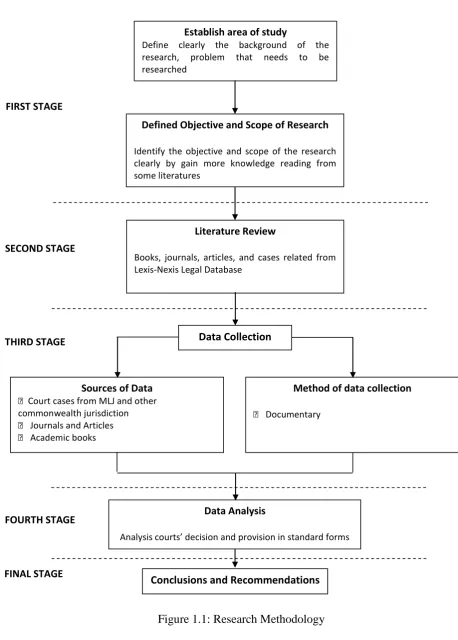
To make a proper research, it is important to prepare a research process methodology on how to gain more knowledge on the research‟s issue, to collect data, and how to analysis the data. In order to achieve the objective of this research, it involves extensive literature review. Figure 1.1 shows the research methodology established for the research.
1.6.1 First Stagel - Identify the Issuel
7
1.6.2 Seco.nd Stage - Literature Review
Literature review is the stage where the res.earch title is further explained and discussed incorporating various types of data and information that are gathered through books, articles, magazines, journals, newspapers. Besides of these sources, reported court cases from different sources such as Malayan Law Journal is referred too. This phase is vital to support and strengthen the research before the research proceeded to other stages.
1.6.3 Third Stage - Data Collection
In order to be able to make an analysis, it required data collections in the form of legal cases that have occurred. Most of the data obtain from university‟s library online e-database via the Lexis-Nexis website. The other sources such as articles, journals, textbooks and related websites, are also studied and analysed to complement the main sources.
1.6.4 Fourth Stage - Data Analysis
8
1.6.5 Final Stage - Recommendations and Conclusion
9
Figure 1.1: Research Methodology
Establish area of study
Define clearly the background of the research, problem that needs to be researched
Defined Objective and Scope of Research
Identify the objective and scope of the research clearly by gain more knowledge reading from some literatures
Literature Review
Books, journals, articles, and cases related from Lexis-Nexis Legal Database
Data Collection
Sources of Data
Court cases from MLJ and other commonwealth jurisdiction Journals and Articles Academic books
Method of data collection
Documentary
Data Analysis
Analysis courts’ decision and provision in standard forms
Conclusions and Recommendations
FIRST STAGE
SECOND STAGE
THIRD STAGE
FOURTH STAGE
10
1.7 Organ.ization of Thesis
The thesis cons.ists of five chapters. Thel brief descriptions of leach chapter are as follows:
1.7.1 Chapter 1: Int.roduction
Chapter 1 is the introduction chapter for the research. It contains the background of the research, the pro.blem statement, the objective of the research, scope and limitationl of research, the signi.ficance of research, methodologyl and the organization of thesis chapters.
1.7.2 Chapter 2: Practical Completion
This chapter explores the l literal meaningl and the l principles of practical
completionl that has been described by some authors, by judicial decisions and as
11
1.7.3 Chapter 3: Minor Defects
This chapter seeks to establish an understanding of defects, the meaning and types of defects, through a literature review of some books, published research and case law. The focus of this chapter is to provide an understanding particularly on minor defects and to highlight the position of minor defects in construction industry.
1.7.4 Chapter 4: Analysis and Results
This chapter analyses the data that have been collected before. It discusses the judicial decisions that have been made by the court regarding the presence of minor defects in practical completion stage. Attempts are made to state the legal principle there from. This chapter seeks as much as possible to find answers to questions as set out in the first chapter under problem statement.
1.7.5 Chapter 5: Conclusion
79
REFERENCES
Airing Woes Of House Buyers. (2001, 30 June). The Star
Alhajeri, Dr. Mashael A. Defects And Events Giving Rise To Decennial Liability In Building And Construction Contracts. Proceedings of the 2008 The Construction, Building and Real Estate Research Conference of the Royal
Institution of Chartered Surveyors. September 04-05, 2008. Dublin Institute of Technology, Dublin: RICS. 2008.
Atkinson, Daniel (1999a, January 01). Defects. Atkinson Law. Retrieved July 23, 2012, from http://www.atkinson-law.com/library/article.php?id=134
Atkinson, Daniel (1999b, January 01). Measure of Damages for defects. Atkinson Law. Retrieved July 23, 2012, from http://www.atkinson-law.com/library/article.php?id=200
Atkinson, Daniel (2002, November 21). Delay and Disruption - Completion. Atkinson Law. Retrieved on March 28, 2012, from http:// http://www.atkinson-law.com/library/article.php?id=136
Barret, Kevin (2008). Defective Construction Work. Wiley-Blackwell.
Binchy, Owen et al. (2008). Conveyancing Volume 1 & 2 – 4th Edition, Oxford University Press, United States.
80
Cama, J. (2004). Who Pays to Fix Building Defects? American Systems USA inc. Berrymans Legal Consultants.Chan.
Chow Kok Fong (2006). Construction Contracts Dictionary. Sweet & Maxwell Asia. Singapore.
Cohen, Lewis. Building Defects; The Legal Position! Blake-Turner & Co Solicitors. Retrieved July 24, 2012, from http://www.blaketurner.com/documents/Blake-Turner%20Construction%20Article%20-%20Building%20Defects.pdf
Contract Killers – Part 4: Guidance on Practical Completion (2008) Retrieved July 10, 2012, from http://www.robinsimonllp.com/upload/ pub/Contract%20Killers%20%20Part%204%20-%20Guidance%20on% 20Practical%20Completion%202008-03-14-10-17-35.pdf
Defective Work In Construction Projects (2011, August) Retrieved July 25, 2012, from http://www.out-law.com/en/topics/projects--construction/construction-claims/defective-work-in-construction-projects/
Eggleston, Brian (2008). ICE Conditions of Contract, Seventh Edition. Wiley-Blackwell Publishing.
Eggleston, Brian (2008). Liquidated Damages and Extensions of Time: in Construction Contracts, 3rd edition, Wiley-Blackwell Publishing.
Glover, Jeremy (2008, April 23). Liability for Defects in Construction Contracts - who pays and how much? Fenwick Elliot. Retrieved July 24, 2012, from http://www.fenwickelliott.com/files/Contract%2010%20-%20Liability%20 for%20Defects.pdf
Goldring, John (1998). Consumer Protection Law Fifth Edition. Federation Press
81
J. Georgiou, P.E.D. Love, J. Smith, (1999). A comparison of defects in houses constructed by owners and registered builders in the Australian State of
Victoria. Structural Survey, Vol. 17.
JUBM (2010, October). Defective Works – Definition & Mitigation. Construction
News & Views. Retrieved July 23, 2012, from
http://www.dlsqs.com/ice/index.jsp?mod=newsview&showmodonly=newsvi ew&op=showimgs&nresponse=true&ctid=524&showimgs=1&imgname=52 4_JUBMNewsletterIssue4.pdf
Knowles, Roger (2005). 150 Contractual Problems and Their Solutions, Second Edition. John Wiley & Sons.
Lal, Hamish (2011). Practical Completion In TRETTDigest Issue 36. TRETT Consulting.
May, Anthony (Ed.) (1991). Keating on Building Contracts. fifth Revised ed. Sweet & Maxwell.
Mills, Anthony., Love, Peter E. D., and Williams, Peter (2009). Defect Costs in Residential Construction. In Journal Of Construction Engineering And Management. ASCE.
Moore, Penny (2010). Practical Completion: A guide for developers, Real Estate Update Journals. Nabarro.
Murdoch, J and Hughes, W (2000). Construction Contracts, Third Ed. Spon Press, New York
82
Ojo, Ayodeji S. Defect Liability Period: Employer‟s Right and Contractor‟s Liabilities Examined. Proceedings of the 2010 The Construction, Building and Real Estate Research Conference of the Royal Institution of Chartered
Surveyors. September 02-03, 2010. Dauphine Université, Paris: RICS. 2010.
Oon Chee Kheng. Extension Of Time And Liquidated Damages In Construction Contracts. Proceedings of The Institution of Engineers, Malaysia on Construction Contracts And Arbitration. October 18, 2003. Ipoh: CK Oon & Co.. 2003.
Regjo, Eric Franco (2009). Minor Defects in Construction Project. In Construction Law Journal No. 5, Thomson Reuters (Legal) Limited and Contributors.
Sundra Rajoo, Dato‟., WSW Davidson, and Ir.Harbans Singh KS. (2010). The PAM 2006 Standard Form of Building Contract. Lexis Nexis.
Tate, Rob. How practical can completion be? The Legal Beagle. Retrieved July 29, 2012, from http://www.publicarchitecture.co.uk/knowledge-base/ files/practical_ completion.pdf
Thomas, H. Randolph et al (1995). Have I Reached Substantial Completion? In Journal Of Construction Engineering And Management Vol. 121, No. I, ASCE.
Tim Hallworth, Associate. Complete or Not Complete, That is the Question.
Proceedings of the Lighthouse Club Seminar on Contract Management. June 19, 2010.
Uff, John (2002). Construction Law Eighth Revised ed. Sweet & Maxwell
83
Wallace, I.D, Duncan, Wallace (1995). Hudson's Building and Engineering Contracts Eleventh ed. Sweet & Maxwell.
What Are The Obligations Of The Contractor During Defect Liability Period?