Journal ofChemical and Natural Resources Engineering,Special Edition:28-35 ©FKKKSA,Universiti Teknologi Malaysia
AN OPTIMIZATION IN MANAGEMENT OF INVENTORY SYSTEM FOR PIPELINE - A CASE STUDY
A. MOHD ARSHAD1,A.MOHD DAKIR2 ABSTRACT
This study was designed to investigate the issues contributing to the inventory shortages that keep on arise faced by local oil service company located in Terengganu. These problems resulted in various setbacks that influenced the overall performance of the piping service. These setbacks are categorized to three; risk,fiscal and reputation. In this study, statistical analysis was performed on the historical inventory records dated from 1'st January of 2004 till 1'st January 2008 obtained from the company. The output retrieved is the period of each project and the lead time distribution over the extent of 12 months, which is presented in the form of "descriptive statistics". In addition to that, interview sessions were conducted with the managerial and personnel involved in the project to determine the factors contributing to the inventory issue. As a result of this study, forecast of future project plan is forwarded on ARIMA, a Time Series forecasting technique, in order for improving the efficiency in inventory management.
Key Words: Pipeline, inventory system,project management.
1.0 INTRODUCTION
According to Tersine, inventory refers to idle goods or materials that are held by an organization for use some time in the future [1]. Items carried as inventory include raw materials,purchased parts, components, subassemblies, finished goods, work-in-process,
and supplies. One major reason why organizations maintain inventory is that, it is impossible to predict sales levels, production times, demand,and, usage levels accurately. Thus inventory serves as a buffer against uncertain and fluctuating usage and keeps a supply of items available in case the items are needed by the organization or its clients.
Inventory management plays a vital role in any organization. Management of inventory involves the acquirement, disposition, and control of resources and inventory that are necessary for the attainment of organizational objectives
[21.
In another perspective, the management of inventory concerns the flow of inventory to, within and from the organization [3]. The expenses associated with financing and maintaining inventories contributes to substantial part of the cost of doing business. Therefore efficiency as well as efficacy of inventory flow can substantially influence costs,revenue generation and thus hold solemn implications on other sub organizational divisions within a company.The efficient management of inventory requires a balance between excesses and shortages in an uncertain environment. Therefore it's important to incorporate strategic
AN OPTIMIZAnON IN MANAGEMENT OF INVENTORY SYSTEM
planning and forecasting elements in the management of the organization [3]. This is easier said to be done, as it reconciles two almost contradictory tasks; visionary planning with short term responsiveness. The ability to create sound strategic plans which is able to respond to environmental changes is a very important criterion.
1.1 Background of Study
An incident that occurred during the third quarter of 2003 in which the company ran out of few of its equipment was something not foreseen by its management. This shortage in inventory resulted in both fiscal and non-fiscal losses on the service company's behalf.
The ran out of copper nickel occurred within the company's piping segment. This piping segment generates more than 70 percent of the overall revenue for the company (2003). This probed the author to investigate the problem as losses faced within this segment would greatly influence the company's revenue.
1.2 Objectives of Study
The objectives of this study are:
1. To analyze and investigate the factors contributing to the shortages faced with copper nickel and pressure relief valves.
2. To forward recommendations for implementation within the management of the service company to correct the problem.
1.3 Scope of Study
The scope of this study are:
1. Analyze a 6-year period MO and MR historical data (Inventory Records) on Piping materials.
2. Two variables are investigated in this study; quantity of materials/items ordered and the shipment duration.
2.0 METHODOLOGY
To accomplish the objectives of this study, a series of methods were used. These are explained in the following sections.
2.1 Industrial Training
The co-author underwent a three-month internship with this service company. It was during this period that the co-author came across a series of incidents involving inventory shortages. These shortages occurred for a number of materials but only materials involved in the piping services are studied. These materials are copper nickel and pressure relief valves.
A. MOHD ARSHAD, A. MOHD DAKIR
2.2 Data Collection
In this study, two methods were used to collect the required information. These methods are the observational and survey methods. Each of these methods is explained in the following sections.
a. Observational Method
Observe here refers to see, watch or study attentively [4]. According to Chava Nachmias [5], The main virtue of observation is itsdirectness. In this study, indirect observations are utilized as a primary method of data collection. According to Ellis [6], "Indirect observations are data that the researcher performing analysis was not responsible for collecting". These data may be obtained from a variety of sources, but the main suppliers are governmental, educational, medical, religious, and business agencies [7]. There are also cases in which indirect observations are collected via questionnaires or contained in published documents.
b. Historical Data
For this study, the historical data on inventory is analyzed. These data consists of the Material Order (MO) and Material Received (MR) record. This data provides information on the date when an order is placed for a specific material, the quantity of materials ordered, type of material, the costs on the materials ordered, and the date when the materials arrived on location. Location here would refer to the service company. As previously stated in the introductory section of the study, materials investigated in this study are limited to copper nickel and pressure relief valves. The historical data used is governs a period of 4 years; IstJanuary 2004 till IstJanuary 2008.
2.3 Survey Method
The term survey is applied to any research study that examines some pragmatic without essentially disconcerting it [6]. This term is especially suitable if the objective of the study is to determine the occurrence of some phenomenon within a population over a specified time frame. Surveys are self-report measuring instruments [8]. Surveys can be classified into two categories according to the method it is administered and by the physical format of its item. The mode can either be inoral or written form. Oral surveys are known as "interviews", meanwhile written surveys are known as "questionnaires". The physical format of item elements may either bestructured or unstructured. Structure is desirable when consistency is required across situations. This is true if the researcher's objective is to combine data from a large number of respondents, in polling, arid to make comparisons across groups.
2.4 Statistical Analysis
AN OPTIMIZATION IN MANAGEMENT OF INVENTORY SYSTEM
used to forecast future consumption. In addition to that, based on the shipping duration extracted from the M.O and M.R historical data, the frequency distribution of shipping duration can be classified according to materials type and supplier. From here, conclusions on supplier reliability, total consumption and etc can be concluded.
3.0 DATA ANALYSIS AND DISCUSSION
This section compiles all the results obtained for each of the research methods used. The results of this study are categorized to three sections according to the method utilized. They are statistical Analysis, Forecasts, and Interview Analysis.
3.1 Statistical Analysis
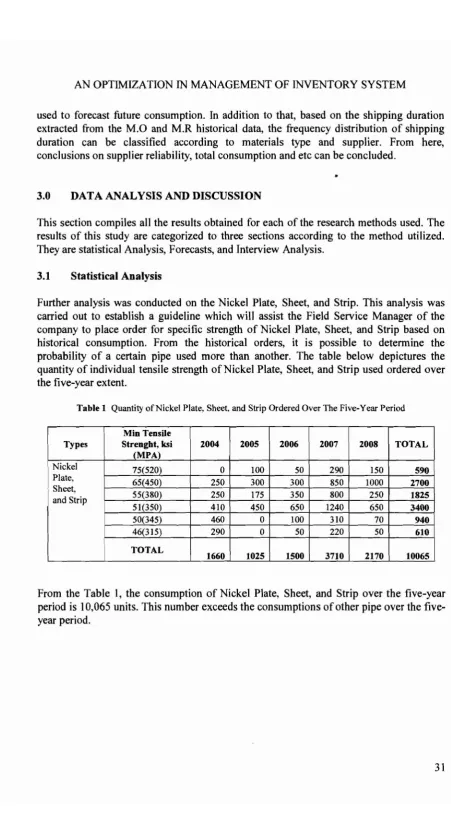
Further analysis was conducted on the Nickel Plate, Sheet, and Strip. This analysis was carried out to establish a guideline which will assist the Field Service Manager of the company to place order for specific strength of Nickel Plate, Sheet, and Strip based on historical consumption. From the historical orders, it is possible to determine the probability of a certain pipe used more than another. The table below depictures the quantity of individual tensile strength of Nickel Plate, Sheet, and Strip used ordered over the five-year extent.
Table 1 Quantity of Nickel Plate, Sheet, and Strip Ordered Over The Five-Year Period
Min Tensile
Types Strenght, ksi 2004 2005 2006 2007 2008 TOTAL (MPA)
INickel 75(520) 0 100 50 290 150 590
Plate,
65(450) 250 300 300 850 1000 2700
Sheet,
55(380) 250 175 350 800 250 1825
and Strip
51(350) 410 450 650 1240 650 3400
50(345) 460 0 100 310 70 940
46(315) 290 0 50 220 50 610
II TOTAL
1660 1025 1500 3710 2170 10065
A. MOHO ARSHAD, A. MOHO OAKIR .
1%
8% 2% 2%
.,
••
03 O •
••
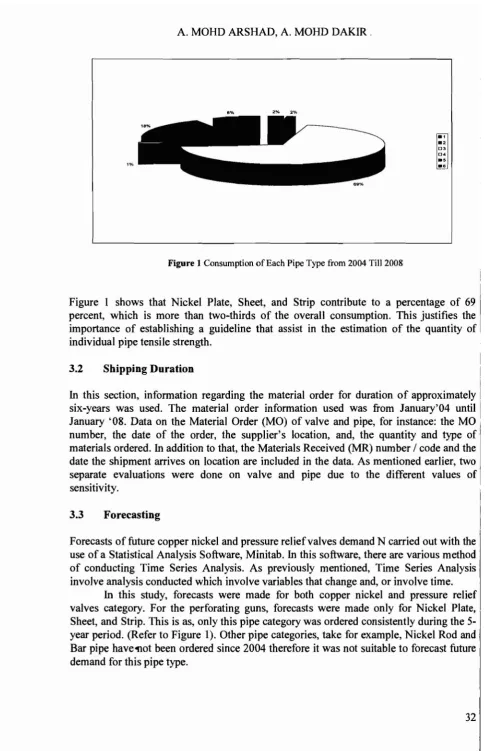
••Figure 1 Consumption of Each Pipe Type from 2004 Till 2008
Figure 1 shows that Nickel Plate, Sheet, and Strip contribute to a percentage of 69 percent, which is more than two-thirds of the overall consumption. This justifies the importance of establishing a guideline that assist in the estimation of the quantity of individual pipe tensile strength.
3.2 Shipping Duration
In this section, information regarding the material order for duration of approximately six-years was used. The material order information used was from January'04 until January '08. Data on the Material Order (MO) of valve and pipe, for instance: the MO number, the date of the order, the supplier's location, and, the quantity and type of materials ordered.Inaddition to that, the Materials Received (MR) number / code and the date the shipment arrives on location are included in the data. As mentioned earlier, two separate evaluations were done on valve and pipe due to the different values of sensitivity.
3.3 Forecasting
Forecasts of future copper nickel and pressure relief valves demand N carried out with the use of a Statistical Analysis Software, Minitab.In this software, there are various method of conducting Time Series Analysis. As previously mentioned, Time Series Analysis involve analysis conducted which involve variables that change and, or involve time.
AN OPTIMIZATION IN MANAGEMENT OF INVENTORY SYSTEM
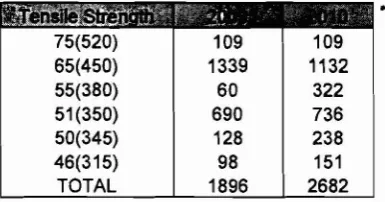
Table 2 below summarizes the output from the software.
Table 2 Forecast of Nickel Plate, Sheet, and Strip Pipe
75(520) 65(450) 55(380) 51(350) 50(345) 46(315) TOTAL
109 1339
60 690 128 98 1896
109 1132
322 736 238 151 2682
The predicted demand of Nickel Plate, Sheet, and Strip pipe is not equal to the total of individual forecasts of each pipe's tensile strength. This is as in most forecasts conducted for total group forecasts are more precise when compared to individual forecasts of each component within the group. This is as, through total forecasts, the effect of fluctuations for single items is minimized.
3.4 Interview Analysis
A series of interviews were carried out to identify the factors contributing to the shortages in inventory. Personnel involved directly as well as indirectly with the Piping Services were interviewed. From the interview, the following reasons/factors have been concluded:
1. Inaccurate Inventory Records
Approximately 98 percent ofthe respondents stated that this factor contributed greatly to the inventory shortages faced. In addition to that, personnel involved directly with the Piping Operations believed that the task of updating the current Inventory Audit Sheet is a tedious routine that consumes a large amount of time. The lack of understanding on the significance of accurate inventory record also contributes to the problem.
2. Communication Breakdown
Communication breakdown refers to inaccurate understanding or deliverability of information from one party to another.
3. No Specific Forecasting Model to Predict Demand
Currently, the method used to predict future demand is merely based on client's requirement. Although the demand of copper nickel and pressure relief valves is dependant on the service requirements provided by the client, this is not sufficient enough.
3.5 Recommendations
A. MOHO ARSHAD, A. MOHO OAKIR
a. Guideline
This guideline is created based on historical data on the consumption of copper nickel pipe. The Nickel Plate, Sheet, and Strip are used in the study as:
I. The consumption of Nickel Plate, Sheet,and Strip for the five year period is 10,065
units. This contributes to approximately 69 percent from the total units of pipe ordered during the five year period.
2. Nickel Plate, Sheet,and Strip is able toperform multiple tasks.
b. Concepts Implemented Within the Company's Management
The suggestions forwarded in this section are more towards concepts that can be implemented within the service company's management. The objective of these suggestions is to improve the efficiency of inventory management. In addition to that, through improved inventory management, an increased accuracy of inventory records which is the foundation for forecasting, ordering, tracking, and vendor evaluation are I
obtained.
c. Principles ofEffective Inventory Control
Personnel should also be exposed to the principles of effective inventory control. Inventory control here refers to the process of organizing inventory. It is a subset of inventory management. There are a few measures that can be taken, and they are as follows:
I. Accountability and Inventory by Location. 2. Training and Performance Measurements.
3.6 Measures Based on Case Analysis
Based on the problem identified through interview sessions, the following measures suitable for improving the standard of inventory management in this service company are:
I. Avoid communication breakdown
2. Identify specifically the client's requirement 3. Supplier specialization
4.0 CONCLUSIONS
From statistical and interview analysis, several conclusions can be made.
I. The decreasing quantity of copper nickel pipe and pressure relief valves from year 2004 till year 2008 indicates a drop in the number of piping operations. In year 2005 onwards, the amount of services increased but not to the initial state as in year 2004.
It is determined that the drop in piping services is due to lack of demand from the client.
AN OPTIMIZATION IN MANAGEMENT OF INVENTORY SYSTEM
3. Approximately 65 percent of the pressure relief valves arrive within the lead time anticipated by the FSM. This is better when compared to the duration for copper nickel which is only 30 percent. This is due to the license factor which results in stricter scheduling for valves material than when compared to copper nickel.
4. The factors contributing to the shortages in inventory faced by this service company are as inaccurate inventory records, communication breakdown, and no specific model is utilized to assist in predicting future demand.
5. Inaccurate inventory records are the main factor contributing to the inventory shortages faced by this service company.
ACKNOWLEDGEMENT
The authors wish to express their foremost gratitude to In addition to Mr Khairil, the Senior Project Engineer of Intraline Resources Sdn. Bhd. for the permission to utilize the inventory records that was a crucial element in this study. A special thanks also goes toward all the personnel of IRSB TCOT who cooperated effortlessly during the course of the research.
REFERENCES
[1] Peter Baily and David Farmer. 1972.Managing Materials In Industry Britain. Gower Press Limited.
[2] Shah, N.M. An Integrated Concept of Materials Management. New Delhi: Tata McGraw-Hili Publishing Company Limited. 1988.
[3] Andrew, C. H. 1993. Time Series Models. 2 in 1 Edition. Hertfordshire, Great Britain.: Harvester Wheatsheaf. 114 -119.
[4] Joyce, M. H., J. Weston, and C.SJulia. 1999.The Oxford Study Dictionary. Great Britain.: Oxford University Press.
[5] Chava and Nachmias, David. 1981. Research Methods in Social Sciences. Great Britain-Anthony Rove Limited.
[6] Ellis, L.1994. Research Methods In the Social Sciences. US:C Brown Communications, 6-50.
[7] Thomas C. H., M.L.Douglas and P.V.Monica.1990. Implementing An Effective Inventory Management System