ABSTRACT
CHAKRABORTY, ARNAB. Contributions to Spatial Statistics and Big Data Analytics. (Under the direction of Soumendra Nath Lahiri).
With the proliferation of sensor-related technologies and advancement of global
po-sitioning system in recent years, large-scale weather data can be captured through the
microsensors installed in mobile devices. As this information is gathered by various
mo-bile applications, e.g. WeatherSignal, AccuWeather, DarkSky etc., often this type of data
is referred as ‘crowdsourced’ weather data, i.e. information collected through users of
var-ious mobile applications. Though these datasets has the potential to be used for weather
analysis, especially in ‘hyper-local’ regions around population centers, due to the
ama-teur quality of the micro-sensors, non-laboratory environement, indoor-outdoor activity
of the users and many such reasons, the quality of the observations is compromised.
Hence, a robust scalable statistical methodology to analyze these varying-quality spatial
data is needed which, along with the variety and velocity of the big-data, incorporates
the veracity of the information as well.
In Chapter 2, a method of veracity scoring has been introduced for geostatistical data.
In addition, a statistical methodology to analyze noisy spatial data has been proposed
which takes the veracity information of the observations into account and thus,
pro-vides robust inference and prediction. The advantage of the proposed method has been
showcased through simulations and several case-studies involving crowdsourced ambient
temperature data over the contiguous USA. Chapter 3 extends the discussion of veracity
score based methods in more theoretical details. Large sample properties of the veracity
score based parameter estimators has been analyzed and their asymptotic efficiency as
attentions has been shifted to anisotropic covariance modeling which is one of the most
important research area of interest in spatial statistics. A copula-based method has been
proposed that incorporates the directional variogram analysis to construct an admissible
joint covariance over the space. Finally, the large sample properties of the covariance
©Copyright 2019 by Arnab Chakraborty
Contributions to Spatial Statistics and Big Data Analytics
by
Arnab Chakraborty
A dissertation submitted to the Graduate Faculty of North Carolina State University
in partial fulfillment of the requirements for the Degree of
Doctor of Philosophy
Statistics
Raleigh, North Carolina
2019
APPROVED BY:
Alyson Wilson Donald Martin
William Boettcher Soumendra Nath Lahiri
DEDICATION
To Maa, Baba, and Priyanka
BIOGRAPHY
Arnab Chakraborty was born on September 13, 1992 in Chinsurah, West Bengal,
In-dia. He completed his secondary education (till 10th standard) in 2008 and his higher
secondary education in 2010 from Hooghly Collegiate School, Chinsurah. Having keen
interest in mathematical sciences, Arnab joined Indian Statistical Institute (ISI), Kolkata
among the top 40 students from all over India for his undergraduate study in Statistics
and Mathematics. In 2013, he received B.Stat (Hons.) degree in First Division with
Dis-tinction from ISI, Kolkata. He continued to pursue his master’s degree in Statistics at
ISI, Kolkata and graduated with M.Stat with First Division in 2015. Arnab then joined
the Department of Statistics at North Carolina State University as a graduate student
in 2015. Under the guidance of Dr. Soumendra Nath Lahiri, he successfully earned his
ACKNOWLEDGEMENTS
It has taken me four years to finish this dissertation and it would not have been possible
without the support and guidance of a bunch of lovely people, whom I really feel fortunate
to have in my life. Though I can never thank them enough for their contributions to my
accomplishments, I want to acknowledge their efforts briefly in this section.
First of all, I want to thank my family members for their constant love and support
throughout my life. I think I owe all my accomplishments to my parents, Mr. Amit
Kumar Chakraborty and Mrs. Lakshmi Chakraborty. Their efforts since my childhood
have helped me stay focused towards achieving my goals. Next, I want to mention my
lovely girlfriend and my partner in life, Priyanka. Every time I have fallen down, either
mentally or physically, even being nearly 9000 miles away from me, she has always been
there for me. She has encouraged me through every hurdle of my life in the last three
years and has always believed in me, when at times, even I did not believe in myself.
The person I want to thank the most for this dissertation is my advisor Dr. Soumendra
Nath Lahiri. I am indebted to him for his care, guidance and encouragement as well as
his patience with me. Often I was stuck with doubts about my research and he always
clarified those in a way that was best for me to comprehend. His approach of tackling any
mathematical or statistical research problem is something that I have always tried to learn
and will continue to follow in my future. Apart from his guidance in my research, I am
grateful for his teachings in two of the advanced courses that I took in the first two years of
my graduate curriculum. It was his way of teaching a very complicated topic fairly simply
that made me interested to work in spatial statistics under his supervision. I also want
to thank Dr. Alyson Wilson, Dr. Donald Martin and Dr. William Boettcher for agreeing
helped improve this dissertation significantly. Apart from my advisory committee, I want
to thank Dr. Eric Laber, Dr. Eric Chi, Dr. Jason Osborne, Dr. Leonard Stefanksi and
Dr. Marie Davidian for teaching me important concepts and topics in Statistics during
the course of my stay at NC State. I also want to thank our staff at the Department
of Statistics, especially Lanakila and Alison, for helping me out with official issues, as
well as Terry and Chris for being patient with my computational issues that I have faced
during my doctoral degree program.
Before coming to NC State, back in India, I was fortunate to have great teachers and
I am indebted to each and every one of them. I want to particularly thank Nimai Kundu,
Amitabha Pal and Tapan Kumar, whose teachings in my high school days helped me grow
an interest to pursue Mathematics and Statistics in my higher studies. I am and forever
will be immensely grateful to Padma Shri Prof. Jayanta K. Ghosh for his care, guidance
and encouragement during my summer internship at Department of Statistics in Purdue
University. I also want to thank Dr. Sourabh Bhattacharya, Dr. Arijit Chakraborty and
Dr. Ayan Basu for their teachings that have helped me get a rigorous training in Statistics
during my bachelor’s and master’s degree program.
In these four years of my life I have come across a bunch of people who has made my
stay at Raleigh smooth and enjoyable. First, I want to thank Dr. Indranil Sahoo (Sahoo
Da), Dr. Arnab Hazra (Hazra Da), Salil Koner and Dhrubajyoti Ghosh (DjG) – who are
probably the best roommates to live with. I think the things that I have enjoyed the
most during these four years are things like watching movies or TV series with them,
long discussions or debates with them on all types of topics, arranging our regional
festivals and departmental events together etc. Their companionship and encouragement
have made me get through many tight situations over the years and never made me feel
(Ghoshal), Rahul Chak, Pulama Di, Moumita Di, Debraj Da, Priyam Da (Ala Da),
Souvik Da for making my life more enjoyable in Raleigh. Special thanks goes to Jim,
Michele, Yun Hee and John for welcoming me to their life, which made me realize I got a
home, so far away from home. Not to forget some of my friends from undergraduate and
graduate years in ISI, Kolkata: Atanu, Indranil (U), Diganta, Arnab (Chow), Debojyoti
Da, Sourav (Chhutku), Sandipan (Mamba), Indrayudh who made the transition of my
life from childhood to adulthood smooth and enjoyable.
Finally, I want to thank the Department of Statistics at NC State for giving me the
opportunity to pursue a doctoral degree in the topic of my interest and their constant
TABLE OF CONTENTS
List of Tables . . . ix
List of Figures . . . xi
Chapter 1 Introduction . . . 1
Chapter 2 A Statistical Analysis of Noisy Crowdsourced Weather Data 6 2.1 Introduction . . . 6
2.1.1 WeatherSignal and NOAA ground-station data . . . 7
2.1.2 The challenge in analyzing crowdsourced mobile-sensor data . . . 10
2.2 Defining and Measuring Veracity . . . 13
2.2.1 Motivation for veracity scoring . . . 13
2.2.2 Preliminaries . . . 14
2.2.3 Veracity score: formulation and properties . . . 15
2.3 Veracity Score Methods . . . 20
2.3.1 Review of standard analysis of spatial data . . . 20
2.3.2 Veracity score-based estimation of the mean function . . . 23
2.3.3 Veracity score-based estimation of the covariance structure . . . . 24
2.3.4 Veracity score-based spatial prediction . . . 27
2.4 Simulation Study . . . 28
2.4.1 Without reference data . . . 28
2.4.2 With reference data . . . 34
2.5 Case Study: Spatial Analysis of WeatherSignal Data . . . 36
2.5.1 Building hyper-local prediction surfaces . . . 36
2.5.2 Validation at the ground-stations . . . 45
2.6 Summary and Conclusions . . . 47
Chapter 3 Large Sample Properties of VS-based Estimation . . . 50
3.1 Introduction . . . 50
3.2 Review of Veracity Score (VS) Methods . . . 53
3.2.1 Formulation of VS . . . 53
3.2.2 VS-based estimation in spatial regression . . . 55
3.3 Asymptotic Properties of the VS-based Regression Estimator . . . 58
3.3.1 Model specification . . . 58
3.3.2 Spatial framework and notations . . . 60
3.3.3 Consistency of the VS-based regression parameter estimator . . . 62
3.3.4 Asymptotic efficiency of VS-based estimators . . . 67
3.4 Simulation Study . . . 69
3.4.2 Results . . . 72
3.5 Example: coalash data . . . 76
3.6 Conclusion . . . 80
3.7 Proofs . . . 82
Chapter 4 Anisotropic Covariance Modeling Using Marginal Variograms: A Copula-based Approach. . . 96
4.1 Introduction . . . 96
4.2 Review of Anisotropic Covariance Models . . . 99
4.3 Anisotropy Modeling: A Copula-based Approach . . . 102
4.3.1 Copula-based covariance specification . . . 102
4.3.2 Spatial covariance modeling . . . 106
4.3.3 Asymptotic properties of the covariance estimator . . . 109
4.4 Illustration: Bivariate Covariance Modeling Using Directional Variograms 115 4.4.1 Normal copula based covariance models . . . 115
4.4.2 Other choices of copulas . . . 121
4.5 Simulation Study . . . 125
4.6 Concluding Remarks . . . 129
4.7 Proofs . . . 130
Chapter 5 Appendix . . . 137
5.1 Supplementary Material for Chapter 2 . . . 137
5.1.1 Additional data description . . . 137
5.1.2 Additional details of VS-based methodology . . . 138
5.1.3 Additional details of the simulation study . . . 139
LIST OF TABLES
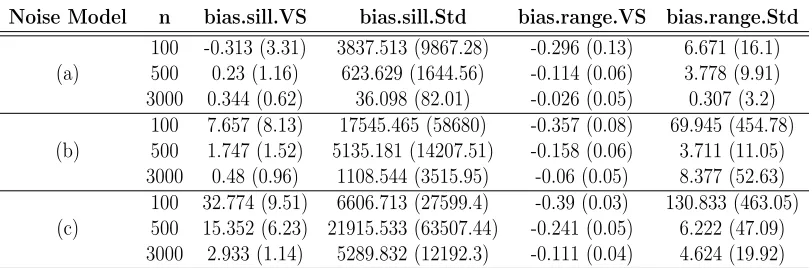
Table 2.1 Performance of the VS-based methodology and standard approach in
estimating covariance parameters on varying-quality observations. . . . 32
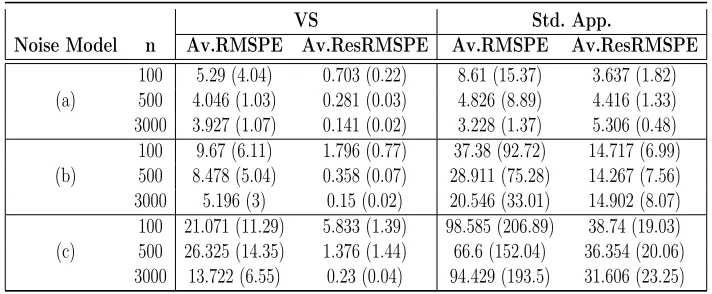
Table 2.2 Prediction performance of the VS-based methodology and standard
ap-proach on varying-quality observations without any reference data. . . . 34
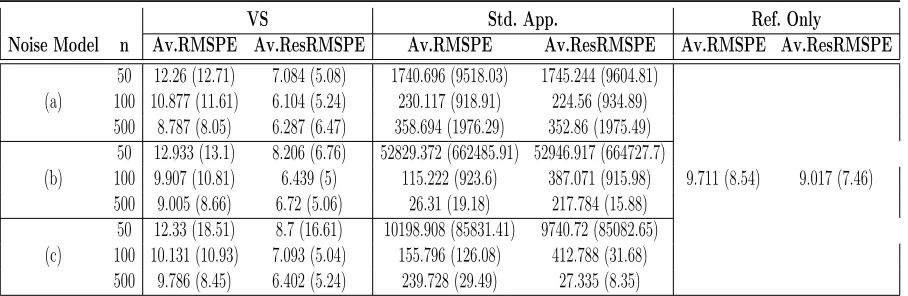
Table 2.3 Performance of hyper-local predictions using the VS-based methodology,
the standard approach and global predictions using reference data only. For these simulations we used reference data with sample sizem= 100. 35
Table 2.4 Estimated Mat´ern parameters. . . 38
Table 2.5 Predictions using both the VS-based and standard approach at the
ground-stations with crowdsourced observations in proximity. . . 46
Table 3.1 Empirical mean squared errors (MSE) of the VS-based and least squares
(LS) based regression parameter estimator; relative efficiency (R.E.) of the Median-VS estimator with respect to that of OLS estimator – for varying noise model parameters (σA, σM, qe) and varying sample sizes
(n). For each sub-table, the other noise parameters are fixed at their first value, e.g. for the sub-table (top) with varyingσA, the other parameters
are fixed atσm= 0.447 and qe = 0.95. . . 73
Table 3.2 Empirical mean squared errors (MSE) of the VS-based and weighted
least squares (WLS) based covariance parameter (psill : σ2, range : ρ) estimator for varying noise model parameters (σA, σM, qe) and varying
sample sizes (n). For each sub-table, the other noise parameters are fixed at their first value, e.g. for the sub-table (top) with varyingσA, the other
parameters are fixed atσm= 0.447 and qe= 0.95. . . 75
Table 3.3 Estimated Mat´ern parameters. . . 78
Table 3.4 Time comparison between VS-based and robust-REML. Machine
con-figuration: DELL R7425 Dual Processor AMD Epyc 32 core 2.2 GHz machines with 512GB RAM each running 64Bit Ubuntu Linux Version 18.04. . . 80
Table 4.1 Empirical mean squared errors (MSE) of the WLS-based covariance
pa-rameters estimators for the Exponential-Gaussian Bivariate Normal Copula-based model. The true values of the parameters are: αe = 2, αg = 4,
ρ= 0.5 andσ2 = 3. . . 126
Table 4.2 Performance under correct model: Spherical-Gaussian-Normal-Copula. . 127
LIST OF FIGURES
Figure 2.1 Spatial plots of the crowdsourced and NOAA ground-station data.
(c) - (f) show zoomed hyper-local versions of the crowdsourced
WeatherSignal (c - d) and NOAA station data (e - f). . . 9
Figure 2.2 Empirical distribution of the crowdsourced average temperatures
in the regions from Figure 2.1 for Brooklyn, NY (left) and Detroit, MI (right). Blue vertical lines represent the average ground-station
values in the considered regions. . . 10
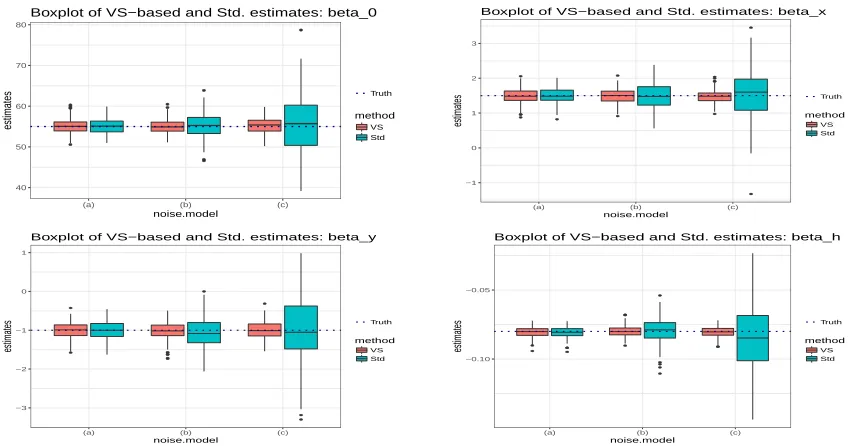
Figure 2.3 Performance of the VS-based and standard regression parameter
estimators for analyzing varying-quality observations (sample size
n= 500) without reference data. . . 31
Figure 2.4 Example sampling points for the simulations. . . 33
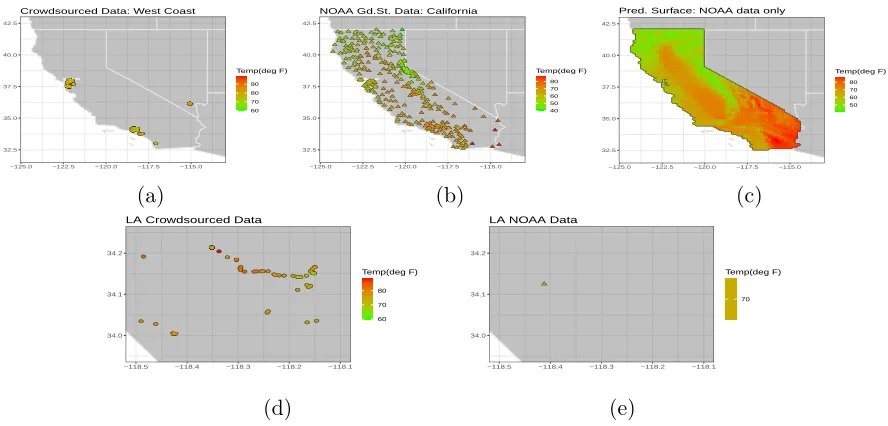
Figure 2.5 (a) Crowdsourced observations in CA; (b) Available ground-station
ob-servations; (c) Prediction surface using the standard approach on the ground-station data; (d) Crowdsourced observations in a hyper-local region around Los Angeles; (e) ground-station observations in a hyper-local region around Los Angeles. . . 37
Figure 2.6 Variogram estimation. . . 38
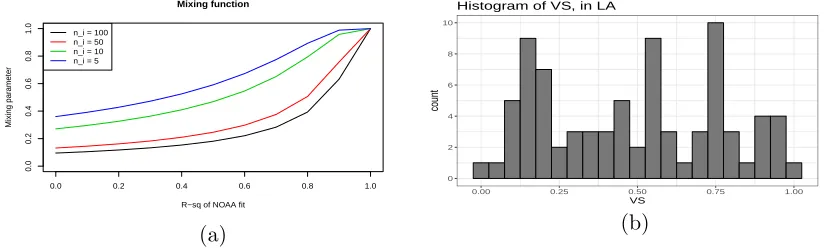
Figure 2.7 Mixing function (a) and the histogram of the veracity scores (b) for the
crowdsourced observations in Los Angeles. . . 39
Figure 2.8 Histograms of the observed residuals (a) and VS-based smoothed
resid-uals (b) and the VS-based variogram fitting (c) for optimal q= 0.8. . . 40
Figure 2.9 (a) Hyper-local version of the same surface as in Figure 2.5c; (b)
Predic-tion surface obtained by the VS-based technique on the crowdsourced data in Los Angeles; (c) Residual kriging variance for the predictions using NOAA data only (d) Residual kriging variance for the predictions using the VS-based predictions with crowdsourced data; (e) the % in-crease in the margin of error for the VS-based predictions as compared to the predictions with NOAA data . . . 41
Figure 2.10 (a) Ground-station observations in the selected hyper-local region; (b)
Crowdsourced observations in the same region (c) Prediction surface ob-tained by standard analysis of NOAA ground-station data; (d) Predic-tion surface obtained by the VS-based technique on the crowdsourced data; (e) Residual kriging variance for predictions using NOAA data only; (f) Residual kriging variances for the predictions using the crowd-sourced data; (g) Percent increase in the margin of error for the VS-based predictions compared to the predictions with NOAA data. . . . 44
Figure 2.11 The increase in margin of error for the standard approach in hyper-local
Figure 3.1 Spatial plots of the coalash data (a) and VS of the observations (b). 76
Figure 3.2 VS-based smoothing of residuals: histogram of observed residuals
from VS-based regression (a), histogram of smoothed residuals (b),
qqplot of observed residuals (c), qqplot of smoothed residuals (d). 78
Figure 3.3 Variogram estimation. . . 78
Figure 3.4 Prediction comparison between VS and robust-REML: histogram of
prediction errors of VS-based (a) and robust-REML (b) approach; empirical c.d.f. of prediction errors (c) and relative efficiency in
terms of margin of prediction errors of VS w.r.t. robust-REML (d). 79
Figure 4.1 Illustration of the covariance functions obtained by combining univariate
Exponential and Gaussian covariances. . . 118
Figure 4.2 Illustration of the covariance functions obtained by combining two
uni-variate Mat´ern covariances.. . . 120
Figure 4.3 Illustration of the covariance functions obtained by combining univariate
Spherical and Gaussian covariances. . . 121
Figure 4.4 Illustration of the covariance functions obtained by combining univariate
Exponential and Gaussian covariances using FGM copula.. . . 122
Figure 5.1 In this figure we plotted the hourly averages of the real-time temperature
readings for two selected locations and showed how spline regression is fitted to estimate the hourly pattern for that particular day. The x-axis is shifted−5 hours to make the plot look reasonable as the temperature pattern is cyclical over the hours. . . 138
Figure 5.2 Possible choices of theφ-function in the definition of VS. . . 139
Figure 5.3 VS-based smoothing of the observed residuals.q= 1.5 for the smoothed
Chapter 1
Introduction
Spatial statistics is a field of science that is concerned with the theory and applications
re-lated to spatially indexed physical processes such as ambient temperature, precipitation,
humidity, air pollution, soil acidity, soil quality etc. Introduced as a statistical
method-ology to predict ore reserve in mining engineering in early 1960s, in the last 50 years
spatial statistics has emerged as a hybrid discipline of statistics, mathematics, geology
and computer science with lots of applications in forestry, agriculture, climatology,
me-teorology, weather analysis, epidemiology, economics, image processing and many other
related fields. In the last two decades, a handful number of works have been added to
the literature of spatial statistics, and a significant number of these researches are
per-tained to meteorology with a major focus on weather analysis. Weather analysis involves
structure exploration of the key atmospheric features – for example temperature, wind
velocity, air pressure etc. – and prediction of the key weather elements based on the
information collected at the meteorological stations or through satellite images. Though
prediction of weather conditions in future based on the information in past – which is
weather-related processes has similar importance as temporal prediction because, as
men-tioned by Cressie (1993), “spatial prediction is just as important as temporal prediction,
because people living those cities and rural districts without monitoring stations have the
same right to know how little or how much their water or their air is polluted.” Most of
the spatial prediction of weather-related processes are based on data collected by
high-performance sensors at meteorological stations or images captured by high-resolution
cameras in satellites. Recently, with the advancement of mobile sensor-related technology,
geo-tagged weather information is being collected by micro-sensors installed in mobile
devices and gathered by mobile weather applications like AccuWeather, WeatherSignal
etc. These datasets are often referred as ‘crowdsourced’ weather data as the information
is coming from the mobile application users. Standard methodologies in geostatistics
or spatial statistics is not directly applicable to these mobile sensor-generated data as
quality of the observations are often hampered in crowdsourced datatsets due to several
factors: the low-quality of the sensors, indoor-outdoor user activity, influence of
exter-nal and interexter-nal processes etc. to name a few. Developing data-driven robust as well as
scalable methodologies to analyze noisy spatial data like crowdsourced weather data is
broad focus of this dissertation.
In today’s big-data scenario, where the data is being collected by automated systems
and sensors, in addition to the velocity and variety of the data, veracity of the observations
is emerging as one of the most important area of research. Though there are recent
works in news, media and communication sciences (for example, see Conroy et al. 2015;
Rendon et al. 2018) where veracity of the information is the focus of the research, quality
assessment of the observations in spatial statistics is not that common. The standard
approach to analyze geostatistical observations involves least squares-based estimation of
Cressie (1993) proposed some basic techniques based on explanatory analysis to detect
aberrant observations or ‘outliers’ in spatial data. There are works in spatial statistics
literature which incorporate robust estimation of the mean and covariance structure of
the process, for example, Cressie and Douglas (1980), Genton (1998), K¨unsch et al.
(2011) etc. But none of these studies discuses any methodology to provide quantitative
assessment of the veracity of the spatial observations.
In Chapter 2, we consider a varying-quality crowdsourced weather data, with the
aim to improve accuracy of the spatial prediction of the ambient temperature process in
‘hyper-local’ resolution. In this work, to deal with the noisy nature of the dataset, we
introduce a reliability metric, namely Veracity Score (VS), to assess the quality of the
crowdsourced observations using a coarser, but high-quality, reference data coming from
ground weather stations. In addition, we propose a methodology to analyze noisy spatial
data which can incorporate the reliability assessment and thus produce much robust
inference and prediction. We refer this approach of analysing geostatistical data as
VS-based method. Extensive simulation studies demonstrate the advantage of the VS-VS-based
approach over standard practice when some of the observations are associated with high
noise. Finally, the merits of the proposed methodology are illustrated through several
case studies analyzing crowdsourced daily average ambient temperature readings for one
day in the contiguous United States. Additional supplementary materials to this work to
support the understanding of the readers have been provided in Chapter 5.
Chapter 3 extends our discussion of veracity scores and VS-based methods to more
detailed theoretical analysis. In Chapter 2 – in the analysis of ambient temperature from
crowdsourced data – the definition of VS uses a high-quality weather station data as
ref-erence which is often not available in practice. Hence, Chapter 3 considers the proposed
provides theoretical justification using spatial asymptotics. In this chapter, we discuss the
spatial asymptotic frameworks and assumptions on the underlying spatial process under
which the VS-based regression parameter estimators are consistent. Moreover, the mean
squared error in the VS-based estimation has been shown to be approximately
indepen-dent of the high-noise variances associated with the ‘bad’ observations. But, the accuracy
of the VS-based estimation is affected if the proportion of low-quality observations
in-creases. The merits of the VS-based technique have been evaluated through extensive
simulation studies and a real-data example involving analysis of coalash (Gomez and
Hazen 1970) data.
In Chapter 4, we shift our attention to estimation of the dependence structure of the
spatial process. Watson (1972) pointed out that in spatial analysis, it is imperative to
consider the small-scale variation of the process which is often included in the model
through the second-order structure of the de-trended process. For modeling second-order
stationary covariance structure often it is assumed that the underlying process isisotropic
in nature. This is assumption is restrictive in real-data scenario and misspecification of
this assumption may lead to wrong inference and prediction. In practice, presence of
anisotropy is ensured through directional variogram analysis: if the marginal variograms
along finitely-many different directions behave differently then it is assumed that the
underlying covariance structure is anisotropic. But, the directional variograms do not
straightforwardly provide an admissible joint covariance over the space. Hence, modeling
of anisotropic covariances are mainly restricted to geometric or zonal anisotropy models
at the exception of the non-geometric range anisotropy by Ecker and Gelfand (2003),
nested modeling by Eriksson and Siska (2000), general range anisotropy model by Allard
et al. (2016) etc. But, none of these methods incorporates the directional variogram
have introduced a copula-based approach to combine the directional variograms for two
specified directions to construct a valid anisotropic covariance over R2. How marginally
fitted variograms for more than two directions can be incorporated to estimate the joint
anisotropic covariance is discussed and the consistency and asymptotic normality of the
covariance parameter estimators have been established. Finally, the proposed method has
Chapter 2
A Statistical Analysis of Noisy
Crowdsourced Weather Data
2.1
Introduction
In recent years there has been a proliferation of weather-related applications for mobile
devices such as cellphones, iPods, and laptops. These applications not only provide service
to the user but also collect and share spatial data on location, ambient temperature,
barometric pressure, humidity, etc., captured by the small-scale sensors installed in the
devices. Analyzing and understanding these crowdsourced data sets is becoming an area
of increasing interest.
One use of the mobile sensor-generated data is to analyze and understand atmospheric
processes at very fine spatial resolution. Most of the methodologies in literature for
spa-tial prediction of weather elements are based on global images coming from satellites or
measurements taken at meteorological stations on the ground (for example, see Thornton
the variability of the process can be analyzed in hyper-local regions. For instance, the
ground-stations are generally situated away from localities e.g. at airports or national
parks etc. Hence, weather-related analysis solely based on ground-station data does not
often provide correct assessment of the variation of the underlying process in the
lo-calities. However, in disaster detection, traffic management, and many defense-related
activities, prediction of the process in a very localized region (hyper-local) is often more
important than the global imputation of the process over a bigger region. Crowdsourced
data captured by mobile sensors can serve as a potential source in these scenarios
espe-cially in regions where the ground weather stations are sparse but the population density
and hence the density of the mobile-devices like cellphones, iPads etc. is relatively high.
In a recent article, Sosko and Dalyot (2017) have used a crowdsourced mobile-sensor data
in forest fire detection to densify the static geo-sensor network (SGN), which is
primar-ily comprised of meteorological stations with high-performance sensors. In this work, we
show that more efficient and reasonable prediction surfaces can be created in hyper-local
regions with denser but noisy crowdsourced data as compared to a global prediction
surface obtained from high-quality but coarser ground-station data.
2.1.1
WeatherSignal and NOAA ground-station data
We analyze a static crowdsourced data set consisting of geo-coded daily average ambient
temperature readings over the continental United States on April 30, 2013. These data
were gathered by a cellphone application named WeatherSignal, available both for iOS
and Android. In addition to providing information on current weather and forecasts, the
app also gathers geographic and weather information using cellphone sensors, leading
WeatherSignalapplication is operated by an organization named OpenSignal. Through
the research partnership program of OpenSignal, we were provided real-time (in
millisec-onds) ambient temperature readings captured by various mobile phones for the
above-mentioned day. For each spatial location, we have temporally aggregated the temperature
readings to the daily average by taking mean of the regionally estimated hourly
temper-atures throughout the day. The details of the aggregation are explained elaborately in
Section 5.1.1.1 in Chapter 5. After the aggregation, we have the crowdsourced daily
average temperature readings at 1879 spatial locations in the United States, as shown
in Figure 2.1a. From the figure, it can be seen that the crowdsourced observations are
clumped together in high-population density regions like Detroit, Chicago, New York,
and Los Angeles etc. In Figure 2.1c and 2.1d we show hyper-local versions of the
Weath-erSignal data for two nearly square regions at Brooklyn, NY and Detroit, MI.
Along with the crowdsourced data from the WeatherSignal app, we also have
ground-station data on the daily average ambient temperature from the National Oceanic and
Atmospheric Administration (NOAA). We used the Global Historical Climate Network
Daily (GHCND) data access tool to retrieve the daily ambient temperature summaries
for April 30, 2013 from 2094 stations in the continental United States. We have plotted
the ground-station observations in Figure 2.1b.
Comparing Figure 2.1a and Figure 2.1b, we can see that the NOAA ground-station
data provides much more spatial coverage than the crowdsourced data in the entire
United States or large parts of United States like east-coast, mid-west etc. are considered
and hence for global modeling or building a global prediction surface of the ambient
temperature, the ground-station data is clearly a better choice. However, for hyper-local
prediction of the spatial process, we believe that crowdsourced data has the potential
● ● ● ● ● ● ● ● ● ● ● ● ● ● ● ● ● ● ● ● ● ● ● ● ● ● ● ● ● ● ● ● ● ● ● ● ● ● ● ● ● ● ● ● ● ● ● ● ● ● ● ● ● ● ● ● ● ● ● ● ● ● ● ● ● ● ● ● ● ● ● ● ●●●●●● ● ● ● ● ● ● ● ● ● ●●●●●●●●●●●●●●●●●●●●●●●●●●●●●●●●●●●●●●●●●●●●●●●●●●●●●●●●●●●●●●●●●●●●●●●●●●●●● ● ● ● ● ● ● ● ● ● ● ● ● ● ● ● ● ● ● ● ● ● ● ● ● ● ● ● ● ● ● ● ● ● ● ● ● ● ● ● ● ● ● ● ● ● ● ● ● ● ● ● ● ● ● ● ● ● ● ● ●●●● ● ● ● ● ● ● ● ● ● ● ● ● ● ● ● ● ● ● ● ● ● ● ● ● ● ● ● ● ● ● ● ● ● ● ● ● ● ● ● ● ● ● ● ● ● ● ● ● ● ● ● ● ● ● ● ● ● ● ● ● ● ● ● ● ● ● ● ● ● ● ● ● ● ● ● ● ● ● ● ●●●●●●●●●●●●●●●●●●●●●●●●●●●●●●●●●●●●●●●●●●●●●● ● ●● ● ● ● ● ● ● ● ● ● ● ● ● ● ● ● ● ● ● ● ● ● ● ●●●●●●●●●●●●●●●●●●● ● ● ● ● ● ● ● ● ● ● ● ● ● ● ●●●●●●●●●●●●●●●●●●●●●●●●●●●●●●●●●●●●●●●●●●●●●●●●●●●●●●●●●●●●●●●●●●●●●●●●●●●●●●●●●●●●●●●●●●●●●●●●●●●●●●●●●●●●●●●●●●●●●●●●●●●●●●●●●●●●●●●●●●●●●●●●●●●●●●●●●●●●●●●●●●●●● ● ● ● ● ● ● ● ● ● ● ● ● ● ● ●●●●●●●●●●●●●●●●●●●●●●●●●●● ● ● ● ● ● ● ● ● ● ● ● ● ● ● ● ● ● ● ● ● ● ● ● ● ● ●●●●●●●●●●●●●●●●●●●●●●●●●●●●●●● ●●●●●●●●●●●●●●●●●●●●●●●●●●●●●●●●●●●●●●●●●●●●●●●●●●●●●●●●●●●●●●●●●●●●●●●●●●●●●●●●●●●●●●●●●●●●●●●●●●●●●●●●●●●●●●●●●●●●●●●●●●●●●●●●●●●●●●●●●●●●●●●●●●●●●●●●●●●●●●●●●●●●●●●●●●●●●●●●●●●●●●●●●●●●●●●●●●●●●●●●●●●●●●●●●●●●●●●●●●●●●●●●●●●●●●●●●●●●●●●●●●●●●●●●●●●●●●●●●●●●●●●●●●●●●●●●●●●●●●●●●●●●●●●●●●●●●●●●●●●●●●●●●●●●●●●●●●●●●●●●●●●●●●●●●●●●●●●●●●●●●●●●●●●●●●●●●●●●●●●●●●●●●●●●●●●●●●●●●●●●●●●●●●●●●●●●●●●●●●●●●●●●●●●●●●●●●●●●●●●●●●●●●●●●●●●●●●●●●●●●●●●●●●●●●●●●●●●●●●●●●●●●●●●●●●●●●●●●●●●●●●●●●●●●●●●●●●●●●●●●●●●●●●●●●●●●●●●●●●●●●●●●●●●●●●●●●●●●●●●●●●●●●●●●●●●●●●●●●●●●●●●●●●●●●●●●●●●●●●●●●●●●●●●●●●●●●●●●●●●●●●●●●●●●●●●●●●●●●●●●●●●●●●●●●●●●●●●●●●●●●●●●●●●●●●●●●●●●●●●●●●●●●●●●●●●●●●●●●●●●●●●●●●●●●● ● ● ● ● ● ● ● ● ● ● ● ● ● ● ● ● ● ● ● ● ● ● ● ● ● ● ● ● ● ● ● ● ● ● ● ● ● ● ● ● ● ● ● ● ● ● ● ● ● ● ● ● ● ● ● ● ● ● ● ● ●●●●●●●●●●●●●●●●●●●●●●●●●●●●●●●●●●●●●●●●●●●●●●●●●●●●●●●●●●●●●●●●●●●●●●●● ● ●●●●●●●●●● ● ● ● ● ● ● ● ● ● ● ● ● ● ● ● ● ● ● ● ● ● ● ● ● ● ● ● ● ● ● ● ● ● ● ● ● ● ● ● ● ● ● ● ● ● ● ● ● ● ● ● ● ● ● ● ● ● ● ● ● ● ● ● ● ● ● ● ● ● ● ● ● ● ● ● ● ●●●●●●●●●●●●●●●●●● ● ● ● ● ● ● ●●●●●●●●●●●●●●●●●●●●●●●●●●●●●●●●●●●●●●●●●●●● ● ● ● ● ● ● ● ● ● ● ● ● ● ● ●●●●● ● ● ● ● ● ● ● ● ● ● ● ● ● ● ● ●●●● ● ● ● ● ● ● ● ● ● ● ● ● ● ● ● ●●●●●●●●●●●●●●●●●●●●●●●●●●●●●●●●●●●●●●●●●●●●●●●●●●●●●●●●●●●●●●●●●●●●●●●●●●●●●●●●●●●●● ● ● ● ● ● ● ● ● ● ● ● ● ● ● ● ● ● ● ● ●●●●●●●●●●●●●●●●●●●●●●●●●●●●●●●●●●●●●●●●●●●●●●●●●●●● ● ● ● ● ● ● ● ● ● ● ● ● ● ● ● ● ● ● ● ●● ● ● ● ● ● ● ● ● ● ● ● ● ● ● ● ● ● ● ● ● ● ● ● ● ● ● ● ● ● ● ● ● ● ● ● ● ● ● ● ● ● ● ●● ● ● ● ● ● ● ● ● ● ● ● ● ● ● ● ● ● ● ● ● ● ● ● ● ● ● ● ● ● ● ● ● ● ● ● ● ● ● ● ● ● ● ● ● ● ● ● ● ● ● ● ● ● ● ● ● ● ● ● ● ● ● ● ● ● ● ● ● ● ● ● ● ● ● ● ● ● ● ● ● ● ● ● ● ●●●●●●●●●●●●●●●●●●●●●●●●●●●●●●●●●● ● ● ● ● ● ● ● ● ● ● ● ● ● ● ● ● ● ● ● ● ● ● ● ●●●●●●●●●●●●●●●●●●●●●●●●●●●●●●●●●●●●● ● ●●●● ● ● ● ● ● ● ● ● ● ● ● ● ● ● ● ● ● ● ● ● ● ● ● ● ● ● ● ● ● ● ● ● ● ● ● ● ● ● ● ● ● ● ● ● ● ● ● ● ● ● ● ● ● ● ● ● ● ● ● ● ● ● ● ● ● ● ● ● ● ● ● ● ● ● ● ● ● ● ● ●●●● ● ● ● ● ● ● ● ● ● ● ● ● ● ● ● ● ● ● ● ● ● ● ● ● ● ● ● ● ● ● ● ● ● ● ● ● ● ● ● ● ● ● ● ● ● ● ● ● ● ● ● ● ● ● ● ● ● ● ● ● ● ● ● ● ● ● ● ● ● ● ● ● ● ● ● ● ● ● ● ● ● ● ●●●● ● ● ● ● ● ● ● ● ● ● ● ● ● ● ●●●●●●●●●●●●●●●●●●●●●●●●●●●●●●●●●●●●●●●●●●●●●●●●●●●●●●●●●●●●●●●●●●●●●●●●●●●●●●●●●●●●●●●●●●●●●●●●●●●●●●●●●●●●●●●●●●●●●●●●●●●●●●●●●●●●●●●●●●●●●●●●●●●●●●●●●●●●●●●●●●●●● ● ● ● ● ● ● ● ● ● ● ● ● ● ● ● ● ● ● ● ●●●●●●●●●●●●●●●●●●●●●● ● ● ● ● ● ● ● ● ● ● ● ● ● ● ● ● ● ● ● ●●●●●●●●●●●●●●●●●●●●●●●●●●●●●●●●●●●●●●●●●●●●●●●●●●●●●●●●●●●●●●●●●●●●●●●●●●●●●●●●●●●●●●●●●●●●●●●●●●●●●●●●●●●●●●●●●●●●●●●●●●●●●●●●●●●●●●●●●●●●●●●●●●●●●●●●●●●●●●●●●●●●●●●●●●●●●●●●●●●●●●●●●●●●●●●●●●●●●●●●●●●●●●●●●●●●●●●●●●●●●●●●●●●●●●●●●●●●●●●●●●●●●●●●●●●●●●●●●●●●●●●●●●●●●●●●●●●●●●●●●●●●●●●●●●●●●●●●●●●●●●●●●●●●●●●●●●●●●●●●●●●●●●●●●●●●●●●●●●●●●●●●●●●●●●●●●●●●●●●●●●●●●●●●●●●●●●●●●●●●●●●●●●●●●●●●●●●●●●●●●●●●●●●●●●●●●●●●●●●●●●●●●●●●●●●●●●●●●●●●●●●●●●●●●●●●●●●●●●●●●●●●●●●●●●●●●●●●●●●●●●●●●●●●●●●●●●●●●●●●●●●●●●●●●●●●●●●●●●●●●●●●●●●●●●●●●●●●●●●●●●●●●●●●●●●●●●●●●●●●●●●●●●●●●●●●●●●●●●●●●●●●●●●●●●●●●●●●●●●●●●●●●●●●●●●●●●●●●●●●●●●●●●●●●●●●●●●●●●●●●●●●●●●●●●●●●●●●●●●●●●●●●●●●●●●●●●●●●●●●●●●●●●●●●●●●●●●●●●●●●●●●●●●●●●●●●●●●●●●●●●●●●●● ● ● ● ● ● ● ● ● ● ● ● ● ● ● ● ● ● ● ● ● ● ● ● ● ● ● ● ● ● ● ● ● ● ● ● ● ● ● ● ● ● ● ● ● ● ● ● ● ● ● ● ● ● ● ● ● ● ● ● ● ● ● ● ● ● ● ● ● ● ● ● ● ● ● ● ● ● ● ● ● ● ● ● ● ● ● ● ● ● ● ● ● ● ● ● ● ● ● ● ● ● ● ●●●●●●●●●●●●●●●●●●●● ● ● ● ● ● ●●●●● ● ● ● ● ● ● ● ● ● ● ● ● ● ● ● ● ● ● ● ● ● ● ● ● ● ● ● ● ● ● ● ● ● ● ● ● ● ● ● ● ● ● ● ● ● ● ● ● ● ● ● ● ● ● ● ● ● ● ● ● ● ● ● ● ● ● ● ● ● ● ● ● ● ● ● ● ● ● ● ● ● ● ●●● ● ● ● ● ● ● ● ● ● ● ● ● ● ● ● ● ●●●● ● ● ● ●●●●●●●●●●●●●●●●●●●●●●●●●●●●●●●●●●●●●●●●●●●●●●● ● ● ● ● ● ● ● ● ● ● ● ● ● ● ● ● ● ● ● ● ● ● ● ● ● ● ● ● ● ●●● ● ● ● ● ● ● ● ● ● ● ● ● ● ● ● ● ● ● ● ● ● ●●●●●●●●●●●●●●●●●●●●●●●●●●●●●●●●●●●●●●●●●●●●●●●●●●●●●●●●●●●●●● ● ● ● ● ● ● ● ● ● ● ● ● ● ● ● ● ● ● ● ● ● ● ● ● ● ● ● ● ● ● ● ● ● ● ● ● ● ● ● ● ●●●●●●●●●●●●●●●●●●●●●●●●● ● ● ● ● ● ● ● ● ● ● ● ● ● ● ● ● ● ● ● ● ● ● ● ● ● ● ● ● ● ●●●●●●●●●●●●●●●●●●●●● 25 30 35 40 45 50
−120 −100 −80
60 70 80 90 100 Temp.(deg F)
Crowdsourced Ambient Temperature Data over USA
(a) WeatherSignal (WS) data
25 30 35 40 45 50
−120 −100 −80
30 40 50 60 70 80 Temp.(deg F)
NOAA Gr. St. Ambient Temperature Data over USA
(b) NOAA station data
● ● ● ● ●●● ●●●●●●●●●●●●●●●●●●●●●● ● ● ● ● ● ● ● ● ● ● ● ● ● ● ● ● ● ●●●●● ●●● ● ● ● ●●●●● ● ● ● ● ●● ●● ●●● ●●●●● ● ● ● ●●●●● ● ● ●● ●●●●● ● ●●●●●● ● ●● ● ●●●●●●●●●●● ●●● ●● ● ●● ●●● ● ●● ● 40.6 40.7 40.8 40.9
−74.0 −73.9 −73.8 −73.7 −73.6
70 75 80 85 Temp.(deg F)
Brooklyn, NY Crowdsourced data
(c) WS, Brooklyn
● ● ● ● ● ● ● ● ●●●●●●●●●●●●●●●●●● ● ● ●● ● ● ●●●●●●●● ● ● ●● ● ● ● ●●● ● ●●●●●●●●●●●●●●●●●●● ● ● ●● ● ● ●●●●●●●●● ●●● 42.2 42.3 42.4 42.5 42.6
−83.6 −83.4 −83.2 −83.0
75 80 85 90 95 Temp.(deg F) Detroit, MI Crowdsourced Data
(d) WS, Detroit
40.6 40.7 40.8 40.9
−74.0 −73.9 −73.8 −73.7 −73.6
72 Temp.(deg F)
Brooklyn, NY NOAA Gr. St. Data
(e) NOAA, Brooklyn
42.2 42.3 42.4 42.5 42.6
−83.6 −83.4 −83.2 −83.0
76 Temp.(deg F) Detroit, MI NOAA Gr. St. Data
(f) NOAA, Detroit
Figure 2.1: Spatial plots of the crowdsourced and NOAA ground-station data. (c) - (f) show zoomed hyper-local versions of the crowdsourced WeatherSignal (c - d) and NOAA station data (e - f).
Figure 2.1e and 2.1f we have plotted the available ground-station observations in the
same square neighborhoods as the crowdsourced data in Figure 2.1c and 2.1d. In the
area around Brooklyn, NY, there are approximately 90 crowdsourced observations
avail-able, where as the number of ground-station observations is only one. Motivated by
this observation, in this chapter, we propose a method to improve the accuracy of the
hyper-local predictions using the available crowdsourced information in addition to the
0.0 2.5 5.0 7.5 10.0
65 70 75 80 85
Daily Avg. Ambient Temp. (deg F)
count
Histogram of crowdsourced data: Brooklyn, NY
0 5 10 15 20
70 80 90
Daily Avg. Ambient Temp. (deg F)
count
Histogram of crowdsourced data: Detroit, MI
Figure 2.2: Empirical distribution of the crowdsourced average temperatures in the re-gions from Figure 2.1 for Brooklyn, NY (left) and Detroit, MI (right). Blue vertical lines represent the average ground-station values in the considered regions.
2.1.2
The challenge in analyzing crowdsourced mobile-sensor
data
The challenge in analyzing mobile sensor-generated crowdsourced data lies in the low
quality and hence poor reliability of an unknown proportion of the data. When data
are collected from mobile applications, the readings are prone to contamination for
var-ious reasons. The inaccurate observations can occur due external factors, low-resolution
sensors, or a combination of these factors. For instance, the temperature readings can
be affected by battery temperature, whether the user is inside or outside, the proximity
of the device to a hot or cold object, the heterogeneity of the sensors used by different
devices, and many other unknown processes.
To illustrate the varying quality of the observations in the WeatherSignal data,
Fig-ure 2.2 shows the temperatFig-ure distribution for the two hyper-local regions shown in
Figure 2.1c and 2.1d. The regions are rectangular blocks with the larger side less than
or equal to 25 miles. The daily average temperature values in the crowdsourced data set
vary from 65◦F to 90◦F in the Brooklyn region, and from 70◦F to 100◦F in the region
These temperature distributions show the nature of the noise involved in the
crowd-sourced data. Due to the factors associated with the data collection process, a portion of
the observations in the crowdsourced data are either contaminated or not representative
of the ambient temperature, which is the outdoor air temperature close to the earth’s
surface. Comparing the histograms with the single ground-station observation in both
the regions, we can see that although there are large deviations, a good proportion of the
crowdsourced observations are ‘close’ to the corresponding ground-station observations
(72◦F in the Brooklyn and 76◦F in Detroit), which are collected in laboratory
environ-ment with high-quality sensors maintaining World Meteorological Organization (WMO)
standards.
Building models based on the noisy crowdsourced data that ignore the reliability
of the sensor-generated observations can lead to erroneous prediction. For instance, we
used leave-one-out prediction of the observations in the regional block around Brooklyn
(Figure 2.1c) using standard techniques of spatial analysis, with a reasonable mean and
covariance model (discussed in Section 2.3.1), and the errors in the predictions ranged
from -30◦F to 40◦F. These first-stage analyses motivated us to take the quality of the
observations in the WeatherSignal data into consideration. Though “absurd” observations
can be identified using existing spatial outlier detection techniques (for example, see
Chapter 1 of Cressie 1993; Harris et al. 2014 etc.) and can be omitted from the analysis,
it is not straightforward to address observations with small to moderate measurement
errors. For instance, using a too strict threshold on the measurement error may lead to
deletion of significant number of observations, resulting in a complete loss of information
for specific locations.
The new methodology should address the three following challenges. First, in addition
the observations in a geostatistical setting is needed. Second, the definition of veracity
should take into account the behavior of the process in the study region so that the
“misleading” observations can be detected. Third, the veracity assessment of the
obser-vations should be incorporated into the subsequent analysis to allow for robust inference
and efficient prediction. Though there are studies (for example, Allahbakhsh et al. 2013)
in the literature on quality assessment of crowdsourced data coming from volunteers or
paid participants, assessment of sensor-generated data quality is not common. Sosko and
Dalyot (2017) mention an elementary root mean squared error approach for accuracy
measurement using a reference data set from Israeli Meteorological Stations. However,
neither of these papers provide full geostatistical inference and prediction using noisy
crowdsourced data.
In this chapter, we make several contributions. First, we introduce a Veracity Score
(VS) to measure the reliability of crowdsourced observations using a reference data set.
Second, we propose a VS-based methodology to incorporate the veracity assessment into
standard spatial analysis so that the effect of noisy and misleading observations is
re-duced, hence making the estimation and prediction more robust and efficient. Third,
we show that using the VS-based technique in hyper-local regions with relatively higher
number of crowdsourced observations can produce a more accurate and efficient
predic-tion surface as compared to the global predicpredic-tion surface obtained through the analysis of
ground-station data alone. This chapter is organized as follows. In Section 2.2, we
intro-duce the veracity score and describe its elementary properties in a relevant geostatistical
setting. Section 2.3 includes a brief description of the standard approach for analyzing
geostatistical data, followed by a detailed description of the VS-based methodology for
estimation and prediction. In Section 2.4, we describe simulation studies to justify the
crowdsourced data. In Section 2.5, we provide details of the analysis, estimation and
hyper-local prediction in a case study. Finally, Section 2.6 summarizes our effort and
discusses limitations and possible future works.
2.2
Defining and Measuring Veracity
In this section, we provide the intuition and motivation for veracity scoring. We the
sample size asn, constants by C, C1, C2, . . ., and constants except the parameters in the
argument by C(·). We denote the volume of a set A ⊂ R2 as |A|, i.e., the Lebesgue
measure ofA if it has nonzero volume and the cardinality of A if A is finite.
2.2.1
Motivation for veracity scoring
To provide motivation for veracity scoring, consider a very simple yet practical example.
Example 2.1. Let Z1, . . . , Zn be independent noisy observations with E(Zi) = µ and
Var (Zi) = σ2i fori∈ {1, . . . , n}. The usual sample mean, which is also the o.l.s. estimator
for µ, is given by ˆµols = ¯Zn =n−1
Pn
i=1Zi, withE(ˆµols) = µand Var (ˆµols) =
1 n
Pn
i σ 2 i. If
we assume σ2
i =C·ib we have
Var (ˆµols) = C(b)·nb,
for some constant C(b). Instead of the generic sample, consider a weighted average of
the observations given by ˆµ= (Pn
i=1viZi)/(
Pn
i=1vi), where the weights vi =i−a, i.e. are
inversely proportional to the variance of the noisy observations. Then
for some constant C(a, b). A significant gain in efficiency can be achieved by assigning lower weights to high variance observations.
If we can find a formulation of the veracity score that is inversely related to the
observation noise variance, we can use it to reduce the effect of the noise in the inference
and achieve a more accurate and efficient estimator.
2.2.2
Preliminaries
Let {Z(s1), . . . Z(sn)} be the varying-quality observations – for example, the
crowd-sourced data from cellphone sensors – which are observed at irregularly spaced locations
Sn := {s1, . . . ,sn} ⊂ R2. In addition, at spatial locations Tm := {t1, . . . ,tm} ⊂ R2,
as-sume that we have {Y(t1), . . . , Y(tm)}, which are high-quality, reliable observations of
the spatial process – for example, measurements from the ground-stations. It is common
to assume (Cressie 1993, Gelfand et al. 2010) that the spatial random field of interest
{Y(s) :s∈R2} can be represented as
Y(s) =µ(s) +(s), (2.2.1)
whereµ(s) is a deterministic smooth mean function capturing the large scale variation of
the process, i.e., E(Y(s)) = µ(s). Here, (s) is a mean zero spatially correlated residual
process which addresses the small-scale variations over the space. For the varying-quality
Z-process, we write the decomposition in Equation 2.2.1 as
where w(s) is the aggregated noise associated with the observation Z(s). For example, if we assume that the varying-quality observations arise from an additive-multiplicative
noise model as
Z(si) = MiY(si) +Ai(si), (2.2.3)
then the associatedw-process will have the formw(si) = Mi(µ(si)−1) +Mi(si) +Ai. If
there is no multiplicative componentMi in the contamination, thenw(si) =(si)+Ai. In
the next subsection, we define a score to assess the quality or reliability of the observation
Z(si), namely veracity score.
2.2.3
Veracity score: formulation and properties
A good measure of veracity should not only identify “absurd” observations, but also
provide a score for each observation on a continuous scale, so that the effect of the
“bad” observations can be reduced automatically, making inference robust against the
low-quality observations. Our goal is to formulate a continuous scoring procedure to
measure the veracity of the observations in two different scenarios. The first scenario
assumes a reference data set containing observations with high-quality but low-density
in the concerned regions is available. The second scenario assumes that we do not have
any high-quality reference information available.
2.2.3.1 Veracity Score with reference data
Consider a hyper-local regional block like those in Figure 2.1c or 2.1d, and denote it by
R ⊂R2. The observation vector with locations insideRis given asZ:= (Z(s
1), . . . , Z(sn))
0 .
Consider another regional block D such that R ⊂ D ⊂R2 and |R|<< |D|. Let the
ref-erence data vector with locations inside D be denoted as Y := (Y(t1), . . . , Y(tm))
0 . The
reference dataYis high-quality and hence reliable representation of the spatial process of
interest, but it has low data-coverage in the hyper-local region of interestR. So, to get a
reasonable sample size for the reference data, we need to consider the larger regionD. We
denote aδ-neighborhood around a spatial points∈R2asB
δ(s), withBδ(s) := (s−δ,s+δ]
for some δ∈R+, where the subtraction and addition is component-wise.
Define the VS of the observation Z(si) as
V(si) = φ
|
Z(si)−ξ(si)|
α+D(ξi)
, (2.2.4)
whereφ:R+∪{0} →R+∪{0}is some non-increasing function such that supx φ(x)<∞.
We callφ(·) the veracity function withα∈R+as a regularity parameter. Byξ(si) we
de-note a reasonable benchmark for the target process atsi, and ξi :=
ξ(si1), . . . , ξ(sin(i))
0
where nsi1, . . . ,sin(i) o
is the set of observation locations in the small δ-neighborhood
Bδ(si). Finally, D(x) denotes a robust measure of dispersion of the observations in the
vector x.
Now consider the benchmark value,ξ(s), for the target at location s. If we have
high-quality observations of theY-process from the reference data at the varying-quality data
sites{s1, . . . ,sn}, then the obvious choice is to takeξ(si) =Y(si). In practice, as we see in
Figure 2.1c to 2.1f, the locations of the ground-station measurements (reference data) and
the crowdsourced data (varying-quality observations) almost always differ significantly.
Hence to define the benchmark at location si, we propose to compute a kriging surface,
n
as
ξ(si) = ˆY(si) + (1−ν)C
Zi−Yˆi
, (2.2.5)
where Zi :=
Z(si1), . . . , Z(sin(i))
0
and ˆYi :=
ˆ
Y(si1), . . . ,Yˆ(sin(i))
0
. Here C(x) is a
robust measure of central tendency of the values in the vectorxandν ∈[0,1] is a mixing
parameter that we discuss in detail later.
If we have a reasonable benchmark, ξ(si), for the spatial process of interest at the
location si, the definition of the VS in Equation 2.2.4 is a transformed measure of the
scaled deviation of the observation Z(si) from the benchmark value. In the definition
of VS, the measure of dispersion, D(ξi), in the denominator takes the variability in
the δ-neighborhood into account. For example, in the analysis of ambient temperature,
the variation in a small neighborhood in the mountains is likely to be higher than an
area close to the sea-level. Hence, the statistic |Z(si)−ξ(si)|
α+D(ξi) measures the deviation of the
observation from its benchmark relative to the local variability. In the following sections,
we use interquartile range (i.e. D(x) = IQR(x)) as the robust measure of dispersion in
equation 2.2.4 and the sample median (i.e. C(x) = Q2(x), where Qj is the j-th sample
quartile) as the robust measure of central tendency in equation 2.2.5. There are other
robust choices as well, but we use the sample quantile based statistic because it is familiar
to the practitioners and easy to interpret. Also, these choices are theoretically justified as
the sample quantiles are asymptotically consistent under dependence (Ghosh 1971, Sun
and Lahiri 2006). The parameter α determines the baseline of the deviation. For lower
values ofα we penalize more, and for higher values we allow for a larger deviation from
the benchmark. We call α the baseline deviation of the VS, and its unit is same as the
We require the veracity function φ to have the following properties:
1. φ(·) is a non-increasing function with bounded range, φ(x)≤φ(0)<∞.
2. φ(x)↓0 as x→ ∞.
With this formulation, lower values of the VS correspond to the low-quality or less
re-liable observations and high values of the VS correspond to the better quality of the
observations. We use φ(x) = exp (−x) for our analysis in the subsequent sections. The
advantage of this function is that the VS lies naturally in [0,1], and it penalizes
expo-nentially as the scaled deviation from the benchmark value increases. We discuss other
possible choices in Section 5.1.2.1 in Chapter 5.
Now we try to interpret the mixing parameter ν in the definition of VS. Under the
assumption that the estimated mean process ˆµ(s) is smooth and the kriged-residual
process ˆ(s) is a spatially correlated second-order stationary mean-zero process, for a
small enoughδ >0, we can writeQ2
ˆ
Yi
≈Yˆ(si), as the variation of the kriged process
ˆ
Y(s) inside the δ-neighborhood is negligible. Hence, we can approximately rewrite the
benchmark as
ξ(si)≈ν Yˆ(si) + (1−ν)Q2(Zi).
Here, to get a possible approximation the spatial process at location si, instead of just
using the estimated value ˆY(si) from the high-quality reference data over a bigger
sur-rounding, we want to leverage the available varying-quality observations in the hyper-local
region. We propose to use a mixture of an approximation of the spatial process coming
from the reference data over a bigger region D, i.e. ˆY(si) and a robust local estimate
coming from the varying-quality observations in the small δ-neighborhood Bδ(si) around
residual process, the spatial observations in a “small” neighborhood are likely to behave
“similarly.” Therefore, it is sensible to use a robust estimate of the central tendency of the
varying-quality observations in that small neighborhood as the locally estimated
approx-imation of the spatial process at si. The same approach has been used to detect outliers
in literature (e.g., Chapter 1 of Cressie (1993) and Papritz (2018b)). We prefer sample
median due to its robustness and asymptotic efficiency (see Sen 1968) as an estimator of
location compared to the sample mean when there are outliers present in the data. The
mixing parameterν decides the weight of mixing between the estimated process from the
reference data and the local approximation from the varying-quality observations. The
optimal ν balances the error in estimation from the reference data and the error in the
approximation of the spatial process using the sample median in the δ-neighborhood.
2.2.3.2 Veracity Score without reference data
We propose a similar definition of the VS when we do not have any high-quality reference
observations available. In this scenario our definition of VS is
V(si) =φ
|Z(si)− C(Zi)|
α+D(Zi)
. (2.2.6)
The idea behind the definition given in Equation 2.2.6 is similar to that in Section 2.2.3.1.
As we do not have information available from a high-quality reference data set, we use only
the locally estimated central tendency as the proxy of the target and the local variation
in the denominator to take the regional variability into account. Note that the definition
of the VS in Equation 2.2.4 approximately equals the VS as given in Equation 2.2.6 if
we take ν = 0.
is a positive scalar equal to half of the length of the neighborhoodBδ(si) used to estimate
the center and dispersion locally. The choice ofδshould be such that theδ-neighborhood
Bδ(si) is small as compared to the region of interest R, but at the same time large
enough to have sufficient sample size to provide a good assessment of the quality of the
observations. To make the formulation of VS as well-defined, we need the number of
points in the δ-neighborhood, n(i), larger than 2 for each i ∈ {1,2, . . . , n}. If we do not
have enough data points to compute the measure of dispersion for an observation, we say
that the VS is undefined for those observations.
2.3
Veracity Score Methods
Before going to the VS-based version of the spatial analysis, we briefly describe the
standard approach of geostatistical analyses.
2.3.1
Review of standard analysis of spatial data
For this section, we use the model specified in Equations 2.2.1 and 2.2.2 as well as the
notations stated in Section 2.2.2. In geostatistics, often the smooth deterministic mean
process {µ(·)}is modeled under a spatial regression framework where the mean function
is assumed to have a linear form, µ(s) = x(s)0β, where x(·) = (x1(·), ..., xp(·))
0
is a p
-dimensional deterministic vector process of known covariates andβdenotes the unknown
regression parameter vector. To make the inference feasible from only one replication of
the process over the space, some stationarity assumption on the second-order structure
of the residual process{(s)}is required. One of the most commonly used assumptions is
that{(s)}is an intrinsically stationary process with an admissible parametric variogram
For now, the description of the analysis is given without taking the noisy nature of the
observations into account, so {w(s)} is assumed to be identically equal to {(s)}. Since
the covariance parameter is unknown, the standard analysis starts with the estimation of
the regression parameters in the linear mean model using ordinary least squares (o.l.s.).
ˆ
βols= argmin
β
n
X
i=1
{Z(si)−x(si)0β}
2
= (X0X)−1X0Z,
whereX:= (x(s1), . . . ,x(sn))
0
. Next, the residual vector is computed using the estimated
mean model as ˆ =Z−Xβˆols, and these are used to estimate the covariance structure
or variogram of the process. In practice, the variogram is estimated in two steps: first,
a nonparametric empirical estimator is computed for discrete lags, e.g. the classical or
method-of-moments semivariogram estimator proposed by Matheron (1962); then the
covariance parameterθ is estimated using a least squares-based variogram model fitting
techniques (Cressie 1993). Under the assumption that the semivariogram function γ(h)
has a parametric form, i.e.γ(h)≡γ(h;θ) – for example, the Mat´ern covariance (Gelfand
et al. 2010) – the parameterθ is estimated using weighted least squares (w.l.s.) as
ˆ
θwls = argmin
θ
k
X
j=1
wj{γˆ(hj)−γ(hj;θ)}2, (2.3.1)
where ˆγ is the empirical semivariogram estimator. For the parametric class of variograms,
Mat´ern is a popular choice as it provides a rich class of variograms to choose from
(Haskard 2007). Other valid parametric models for variograms can be found in Cressie
(1993) and Gneiting (2013).
Once the covariance structure is estimated, one can try to improve the mean
X0Σˆ−1X−1X0Σˆ−1Z, where ˆΣ is the estimated variance of= ((s
1), . . . , (sn))
0
.
How-ever, this introduces additional variability due to using the estimated covariance
param-eters in the mean estimator and is not necessarily more efficient than the o.l.s. estimator.
The most commonly used method to predict the process at new locations is to predict
the -process at the given locations by the best linear unbiased predictor (BLUP) given
the observed residual vector ˆ, also known as ordinary kriging estimator (Cressie 1993,
p. 122). The standard predictor of Y(s0) is
ˆ
Ystd(s0) = x(s0)0βˆols+ ˆok(s0), (2.3.2)
where ˆok(s0) is the ordinary kriging predictor for (s0).
The stationarity assumption on the random error process can be relaxed using regional
stationary models (for example Fuentes 2001, Paciorek and Schervish 2006). Another
way to fit the spatial regression model to the geostatistical data is using likelihood-based
model estimation (Cressie 1993), but that requires additional distributional assumption
on the -process.
The standard approach for estimation and prediction explained is not reliable for
analyzing noisy spatial observations, as both the least squares-based mean parameter
estimators (Huber and Ronchetti 2009) and the method-of-moments empirical
semivar-iogram estimator are highly sensitive to the noise (Cressie and Douglas 1980) in the
2.3.2
Veracity score-based estimation of the mean function
In the standard approach, as described in Section 2.3.1, the regression parameter vector
β is estimated using the o.l.s. method. For our approach, instead of simple squared
error loss, motivated by Ex. 2.1, we propose to minimize a weighted version of the loss
function with the veracity scores as the corresponding weights. The VS-based estimator
of the mean parameter β is given as
ˆ
βvs= argmin
β
n
X
i=1
V(si)L(Z(si),x(si)0β). (2.3.3)
For least squares-based estimators, we have L(y, u) = (y−u)2, the squared-error loss
function. The locally estimated veracity scores lessen the effects of “absurd” observations
in the objective function and thus make the estimation of the mean function less sensitive
to the noise. The VS-based approach is adaptive to the quality of the observations and
thus lessens the impact of outliers in the data. To make the estimation more robust
to contamination, one can use any robust loss function instead of squared-error loss in
Equation 2.3.3. As an example, consider Huber’s loss function (Huber and Ronchetti
2009), L(·,·;k), given by
L(y, u;k) =
1
2(y−u)
2 for |y−u| ≤k,
k(|y−u| −k
2), otherwise.
(2.3.4)
We have used an MM-type estimator with a linear quadratic quadratic ψ-function for
the robust regression as discussed in Koller and Stahel (2011). The advantage of using
this estimator is that in addition to penalizing less for high residuals, the parameters