A Survey of Statistical Source Models for Variable
Bit-Rate Compressed Video
Michael R. Izquierdo
†and Douglas S. Reeves
‡†
IBM Corporation, Research Triangle Park, NC 27709
‡North Carolina State University, Raleigh, NC 27695
Abstract
It is predicted that in the near future, the transport of compressed video will pervade computer
networks. Variable bit-rate (VBR) encoded video is expected to become a significant source of
network traffic, due to its advantages in statistical multiplexing gain and consistent video quality.
Both systems analysts and developers need to assess and study the impact these sources will have
on their networks and networking products. To this end, suitable statistical source models are
required to analyze performance metrics such as packet loss, delay and jitter.
This paper provides a survey of VBR source models which can be used to drive network
sim-ulations. The models are categorized into four groups: Markov Chain and Autoregressive, TES,
Self-Similar and i.i.d/Analytical. We present models which have been used for VBR sources
con-taining moderate to significant scene changes and moderate to full motion. A description of each
model is given along with corresponding advantages and shortcomings. Comparisons are made
based on the complexity of each model.
Keywords: Video Modeling, VBR, Variable Bit Rate, MPEG, H.261, TES, Self-Similar.
1 Introduction
The recent development of standards for digital video compression, such as H.261 [3],
H.263, [21] MPEG-1 [19] and MPEG-2 [20], has made it feasible to transport video data
over computer communications networks. It is predicted that in the near future,
transport-ing video over computer networks will become commonplace. Classical models based on
a Poisson arrival process, traditionally used in the analysis of telephony networks, are not
adequate to model video traffic. This is due to the fact that the Poisson process assumes
that arrivals are independent, whereas for compressed video they are not. In consequence,
new models are needed to describe compressed video sources, and derive attendant
perfor-mance measures.
Raw compressed video is a traffic source which can have high peak-to-mean ratios and
significantly high autocorrelations. This type of source can be deleterious to networks,
since it can cause severe data loss if network resources are not properly allocated. One
way to ameliorate this difficulty is to control the output bit-rate of the encoder. This is
referred to as Constant bit-rate (CBR) encoding. A CBR encoder’s output bit-rate is nearly
constant, making it possible to transport its output using a fixed-rate channel. This makes
bandwidth allocation simpler and also renders the video source more amenable to traffic
policing. However, CBR encoding has the drawback that video quality (distortion) varies
significantly in order to maintain a constant bit-rate. Also, the desired bit-rate needs to be
determined up-front which for some applications, such as the real-time encoding of a live
sporting event, might not be optimal since a worst case bit-rate might be chosen.
An alternative to CBR encoding is Variable Bit Rate (VBR) encoding. VBR does not
attempt to control the output bit-rate of the encoder, so distortion1 does not vary signifi-cantly. One way to accomplish this is to keep the quantizer step size fixed. However, this
makes the output bit-rate of VBR encoders vary considerably, making bandwidth
tion difficult. On the other hand, this variability increases the opportunity for
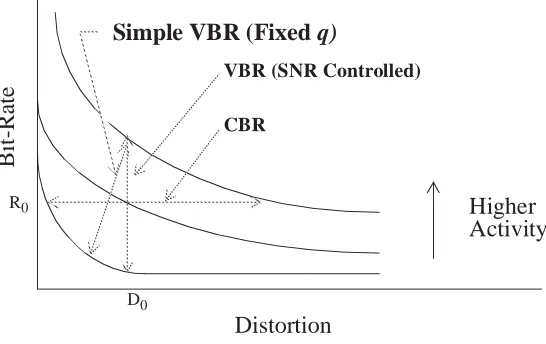
improve-ments in statistical multiplexing gain (SMG2). Figure 1 depicts the basic trade-off between distortion versus bit-rate for compressed video. We observe that distortion varies as an
encoder controls the rate (CBR), but if the encoder controls distortion (VBR), then
bit-rate varies. This behavior highlights the basic differences between CBR and VBR
encod-ing.
Increases in SMG occurs due to the fact that the likelihood of multiple bursty sources
simultaneously transmitting at their peak bit-rates is small. One of the first investigations
regarding the SMG of encoded video was done by Haskell, who found that a 2:1 gain was
achievable when multiplexing the outputs of several AT&T Picturephone encoders [10].
The SMG of VBR sources has been further quantified in early works by Kishino [24],
Morrison [38] and Verbiest [45], where gains of up to 4:1 were obtained for simple
sequences.
2. In the literature, definitions of SMG has arisen. One is the ratio of the multiplexer output link utilization for N VBR sources compared to only one source, given the same packet (cell) loss prob-ability. The second defines SMG as the ratio of the number of VBR sources to the number of CBR sources (preferably encoded using the same source material; however, this is often not the case and
AA AA AA AA AA AA AA AA AA AA AA AA AA AA AA AA AA AA AA AA AA AA AA AA AA AA AA AA AA AA AA AA AA AAA AAA AAA AAA AAA AAA AAA AAA AA AA AA AA A A AA AA AAAA AAAA AAAA AAAA AAAA AAAA AAAA AAAA AAAA AAAA AAAA AAAA AA AA B it-R ate Distortion Higher Activity R0 D0
Figure 1. Distortion versus bit-rate curves for compressed video. VBR (SNR Controlled)
AAA AAA AAA AAA AA AA AA AA AA AAAA AAAA AAAA AAAA AAAA AAAA AAAA AAAA AAAA AAAA AAAA AAAA AAAA AAAA AAAA AAAA AAAA AAAA AAAA AAAA AAAA AAAA AAAA AAAA AAAA AAAA AAAA AAAA AAAA AAAA AAAA AAAA AAAA AAAA AAAA AAAA AAAA AAAA AAAA CBR AA AA AAA AA AA AA A AAAA AAAA AAAA AAAA AAAA AAAA AAAA AAAA AAAA AAAA AAAA AAAA AAAA AAAA AAAA AAAA AAAA AAAA AA AA AAA AAA AA AA AA A A AA AA AA AA A A AAAA AAAA AAAA AAAA AAAA AAAA AAAA AAAA AAAA AAAA AAAA AAAA AAAA A A A A A A A A A A A A A
Simple VBR (Fixed q)
One drawback to multiplexing VBR sources is the increased possibility of packet loss.
Such losses result when multiple independent VBR sources cause the multiplexing buffer
to overflow. Analyzing the multiplexer buffer occupancy behavior is a major concern for
researchers. Simulation studies are often used in order to quantify the amount of loss,
since analytic methods are often intractable. In order to run these simulations, source
mod-els are used to provide input stimulus to the system under study. While actual video traces
may be used in place of a source model, this limits the input to a finite realization of the
underlying stochastic process, which reduces the generality of the simulation results.
In this paper, we survey statistical source models for VBR video which have been
pro-posed for both video conferencing and movie sequences. We define video conference
models as those being encoded using either H.261 or MPEG without B frames. A movie
sequence is one which is encoded using MPEG with I, B and P frames. Some examples of
models presented for movie sequences are: Star Wars,3 Last Action Hero,4 and The Wizard of Oz.5 Only MPEG-1 models were covered in this survey since a viable MPEG-2 model had not been published by the time this survey was concluded. For the most part, the
mod-els covered in this survey should apply to MPEG-2 equally as well. For introductory
mate-rial on the encoding standards H.261 and MPEG-1, refer to [31] and [28], respectively.
The motivation underlying the choice of these particular models is to present a
repre-sentative sampling of current VBR source models. The models are grouped into four
cate-gories (AR/Markov, TES, Self-Similar, Analytical/i.i.d.) and then presented in
chronological order. This was done so that the evolution of VBR modeling was readily
discernible. We provide detailed descriptions of each model, where necessary, and discuss
the motivations and merits of each model. We also describe how each model was validated
and the number of parameters used by the model.
The paper is organized as follows. Section 2 discusses on statistical modeling and
model validation. Section 3 covers models based on Markov Chains and Autoregressive
processes (AR). Section 4 covers models based on the TES process. Section 5 describes
models based on self-similar processes. Section 6 presents analytical and non-Markovian
models which are based on i.i.d. processes. Section 7 summarizes the paper, including a
comparison of the number of parameters required by each model in this survey.
Recom-mendations and issues relating to model selection are also discussed, as well as
2 Statistical Modeling and Model Validation
A good model is one which can accurately predict performance measures (statistics) of
a stochastic system. For example, if the researcher is interested in the cell loss probability
for an ATM buffer with VBR sources, then a good source model is one which produces a
sample path which can accurately predict this performance measure, when the system is
simulated. In most cases the validity or “goodness” of a model is determined by
compar-ing model predictions (e.g. simulation statistics uscompar-ing the empirical data as the traffic
source) and the corresponding statistics using the model as the traffic source. It is possible
for a model to predict one metric accurately and another inaccurately. For example, a
model may provide accurate predictions for cell loss probability, and be inaccurate
pre-dicting mean cell delay. The researcher must decide beforehand what the desired system
metrics should be, and select a model which can accurately predict these metrics.
There are reasons to argue that the validation of a source model requires that its
distri-bution and autocorrelation function match well their empirical counterparts, while using
as few parameters as possible6. Typically, one tries to fit the empirical data with a classical distribution such as Log-Normal or Gamma, but whether or not a good fit is found, the
empirical distribution (say, histogram) is a good fit by default. A common method used to
match distributions is the QQ plot. Matching the autocorrelation function is a more
diffi-cult task. The autocorrelation function is a proxy for the temporal (linear) dependence
within a stochastic process. Generally, stochastic processes may be classified into three
types: independent, short-range dependent (SRD) and long-range dependent (LRD). An
independent source is always uncorrelated, i.e., is identically zero for positive lags; the
converse is false, namely, lack of correlation does not imply independence. If the
autocor-relation function is summable (e.g. when it decays exponentially fast), then it is referred to
as an SRD process, but if it is not summable (e.g., when it decays hyperbolically), then the
source is referred to as an LRD process. The requirement to use few parameters is
moti-vated by the fact that they must be estimated from the empirical data. Each estimate incurs
a certain amount of error which tends to reduce the accuracy of the model as the number
of parameters increases (although those errors may occasionally cancel out).
In this survey, we classify the models into two types: hierarchical and
non-hierarchi-cal. Models which capture scene changes explicitly are referred to as hierarchical models.
A scene change process aims to model the relative frequency of individual scene types
over longer time scale (minutes or hours) than the bit-rate process (milliseconds). Scene
changes occur when the mean of the bit-rate process changes significantly as a result of a
considerable change in picture content (camera cuts).
The parsimony of a model is determined by the number of parameters it requires and
its complexity by the amount of computer time and memory required to generate a sample.
Models which require many parameters generally require many calculations in order to
generate a sample, but there are exceptions (e.g., TES). On the other hand, some models
require few parameters, but take a long time to generate each sample, since each sample is
calculated from all previous samples (e.g. LRD and self-similar models). It is desirable to
develop a model of minimal complexity which provides sufficiently accurate predictions
3 Models Based on Markov Chains and Autoregressive Processes
We provide a brief review of Markov Chains and Autoregressive (AR) processes since
many of the VBR source models are based on them. Both processes incorporate temporal
dependence. AR processes, in most case, use Gaussian random variables, producing
sequences which are Normally distributed. Markov Chains, those achieving steady-state,
can produce a wide variety of distributions.
3.1 Review of Markov process
Models based on a Markov process use states to represent bit-rate regimes (roughly a
range of bit-rates of a video sequence). A stochastic process {Xk}, k=1,2,... with state
space S={1,2,3,...} is Markovian if for every n and all states i1,i2,...,where it
satis-fies the Markov property,
Simply put, the current state of a Markov process depends only on its previous state
and not on any additional previous states. A stochastic process is called a Markov Chain if
the state space is countably infinite or finite.
As an example, a continuous-time discrete-state Markov process behaves as follows: it
enters a state and remains there for an exponential period of time whose parameter λi
depends on the state i. At the end of this period, the process moves to a different state
gov-erned by the Markov property. Transitions between states are controlled by a transition
probability matrix; corresponding transition probabilities are estimated from the actual
video trace. Steady-state distributions, if any, are determined from the transition matrix.
For a more complete discussion of Markov Chains, see [18].
in∈S
Markov Chains are often used to modulate other processes such as Bernoulli, Poisson
or AR. The state of the Markov Chain represents a different set of parameters for the
par-ticular process. While in a parpar-ticular state, the model generates samples according to the
particular process (Bernoulli, etc.), at the specific parameter settings. This is done for a
period of time until the process switches to a different state, generating samples using a
different set of parameters. Models of this type are referred to as Markov modulated or
Markov modified models. Some examples of such models are the Markov Modulated
Ber-noulli Process (MMBP) and the Markov Modulated Poisson Process (MMPP). We will
show many examples of video models which use Markov modulation.
3.2 Review of autoregressive process
In an AR process, the current value is a function of a weighted linear combination of
past values. Formally, it is expressed as
where a0 is called the intercept and {a1,a2,...,ap} are AR coefficients, p is the order of the
AR process and e(n) are the residuals, commonly assumed uncorrelated and Normally
dis-tributed. The AR coefficients can be determined using the recursive Levinson-Durbin
algorithm [40, Appendix 2A]. AR processes of order p are denoted by AR(p). A special
case of (2) is the AR(1) process
where a1 is the autocorrelation coefficient at lag-1 when the sequence is stationary. Note
that (3) can be seen as a continuous-state, discrete-time Markov process. A model of this
form was presented in [32].
x n( ) a0 ai
i=1
p
∑
+ x n( –i)+e n( ),
= (2)
The AR process is a special case of the autoregressive moving average process
(ARMA) which adds a moving average process (MA) giving
The ARMA process is typically stated as ARMA(p,q) where p is the order of the AR part
and q is the order of the MA part. Determining the coefficients, bj, is a bit more involved
than an AR process and usually requires some form of spectral analysis. [9]
3.3 ATM cell-level model using ARMA
Grunenfelder, et al. [9] developed a model, from a four second video conference
sequence, for the ATM cell interarrival process from a video encoder using conditional
replenishment7. The model defined a fixed time interval of 64 slots, where 1 slot equaled the time to transmit a 36 byte cell. The random process, {Xi}, defined the number of cells
generated by the encoder within this interval, where
where is white noise. The parameters for the model were estimated from the long-term
mean, variance and autocovariance of the empirical sequence. The coefficients, hk, of the
MA part were determined using Fourier analysis. The ARMA process was referred to as a
colored-Gaussian process with zero mean, unit variance which implies that the
autocorre-lation function is not from a pure Gaussian process.
7. Encoders using conditional replenishment only transmit the difference in the pixel areas between a reference and current frame. This is done using differential pulse code modulation (DPCM). Areas which do not change are run length coded (RLC). When this difference becomes
x n( ) a0 ai
i=1
p
∑
+ x n( –i) bje n( )
j=0
q
∑
,+
= (4)
Xi = g(αZi–m+Yi+νi)
Yi hkεi–k
k=–m 2⁄ m 2⁄
∑
=
α <1
(5)
In digital signal processing terms, the ARMA sequence is generated using the ARMA
filter with white noise as input. Since the original sequence is not a zero mean process, the
output of the filter, {Vi}, is transformed using a zero-mean nonlinearity (ZMNL) function,
g(.), of the form aVi+b.
This model requires 10,003 parameters, (α,a,b,h1,h2,...h10,000), where the MA
coeffi-cients cover approximately seven frames. Model parameters were estimated from four
sec-onds of video. This model can be viewed as modeling the video sequence at the sub-frame
layer (slice/GOB) and it matches the pseudo-periodic autocorrelation function, typical of
these sequences, quite well.
3.4 Video conference model using Markov Chain
Heyman, et al. [13] developed a frame level8 ATM model of a 30 minute video confer-ence sequconfer-ence with no scene changes and moderate motion. The model defines the
num-ber of ATM cells per frame, Xn, and the state of the Markov Chain, Yn, where
9. The transition probability matrix, P=[p
ij], was estimated using,
This model requires many parameters due to the transition probability matrix. In order
to reduce the number of parameters, the authors used the Discrete Autoregressive Process
(DAR) which estimates the transition probabilities by using the empirical marginal
distri-bution and autocorrelation coefficient. The transition matrix is given by
8. The frame level corresponds to MPEG or H.261 pictures.
Yn = Xn⁄10
pij number of transitions from state i to state j
number of transitions out of state i ---.
= (6)
where ρ is the autocorrelation at lag 1, I is the identity matrix, and each row of Q consists
of the marginal probability distribution function (pdf) of the empirical data. Since the
empirical data was found to fit a negative-binomial distribution, each row in Q contained
the probabilities defined by,
where the parameters r and p are estimated from the empirical data, and K is the maximum
number of cells in a frame. By using DAR the number of parameters was reduced to only
four: peak, mean, variance, and autocorrelation at lag 1.
Interestingly, this model gave rise to better bit-rate predictions than a second order AR
process which was also proposed at the time. This model is suitable for video conferences
with no significant scene changes, since it does not model the scene changes explicitly.
The model does rely on the use of a classical distribution (negative-binomial) in DAR;
however, the empirical distribution could be used.
Lucantoni, et al. [27] proposed a model using a discrete-state, continuous-time
Markov Renewal Process (MRP), which they compared to the DAR model. This model is
of the same vein as MMPP, but instead the bit-rate is fixed, not probabilistic. They divided
the range of possible rates into 40 equidistant levels and assigned a state in the Markov
Chain to each level. One, and sometimes two, geometric distribution were fitted to sojourn
time at each level. Sample paths generated by the model are strikingly similar in
appear-ance to the empirical trace data. They compared the leaky bucket contour curves,
gener-ated using both models, and found that MRP was better than DAR in approximating the
results produced when using the empirical sequence.
f0, , , ,f1 … fK fKc
( )
fk k+ +r 1 k
pr
1–p
( )k
=
fKc fk
k>K
∑
=
3.5 Hierarchical model using composite AR processes and Markov Chain
Ramamurthy and Sengupta [41] proposed a hierarchical model which uses a Markov
Chain to capture the effects of a scene change. The model consists of two AR processes
where the first attempts to match the autocorrelation function at short lags and the second,
the autocorrelation at long lags. The third process is a Markov process which is used for
scene changes. Combining the three processes gives the final model
where
Equation (10) is used to generate a sequence whose autocorrelation function matches
that of the emprical sequence at short lags while (11) matches it at long lags. Bothh
equa-tions are AR(1) processes, where Ai and Bi are normally distributed with means: µ1, µ2
and standard deviations: σ1, σ2. Equation (12) is used to generate the extra bits needed
when a scene change occurs, where Ki represents the state of the Markov Chain and Ci is a
normally distributed random variable whose mean and variance depends on Ki. The
num-ber of parameters required for Ci is reduced from four to two by making the mean and
variance a function of α and β, where µ=α, σ=β when Ki=2 and µ=α/2, σ=β/2 when
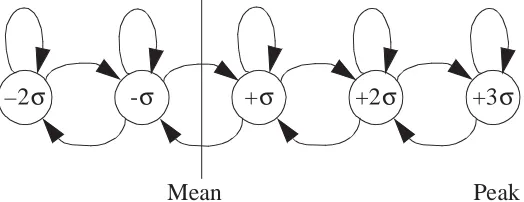
Ki=1. The basic premise behind the use of the Markov Chain, shown in Figure 2, is to
generate the extra bits needed in the two frames following a scene change. We will see
later a model proposed by Heyman and Lakshman which also takes into consideration the
Ti = Xi+Yi+Zi (9)
Xi = a1Xi–1+Ai, (10)
Yi = a2Yi–1+Bi and (11)
first two frames after a scene change. This model requires a total of eight parameters
(a1,µ1,σ1,a2,µ2,σ2,α,β).
3.6 MPEG frame and slice layer models using Markov Chains
Pancha and El Zarki [39] proposed an MPEG frame and slice layer Markov Chain
model for a 3 minute, 40 second sequence of the movie Star Wars. This model differs
from Heyman’s model in that rather than each state representing the number of cells in a
frame, each state represents a bit-rate change of one standard deviation. This is illustrated
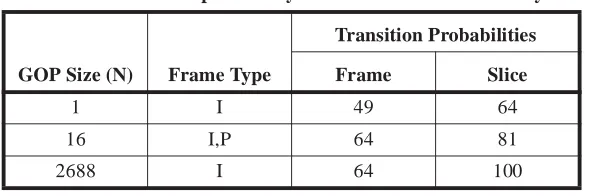
in Figure 3. Transition matrices were given for different GOP sizes and, in general, the
larger the GOP size the more states required in the Markov Chain. Also, the slice layer
required more states than the frame layer. The number of parameters required by the
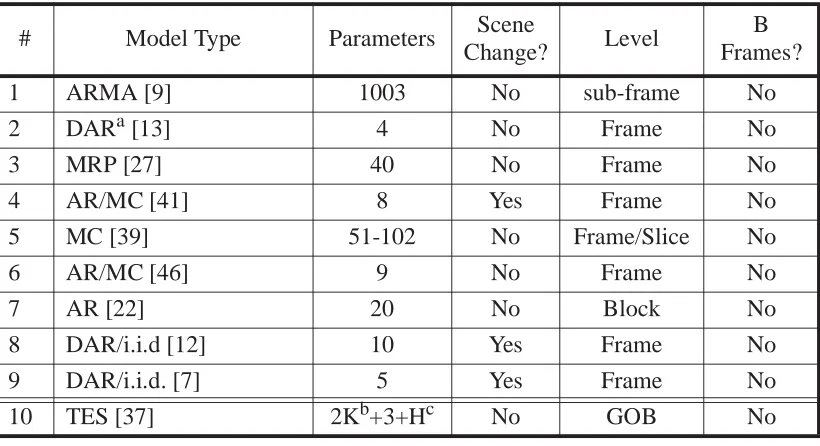
mod-els ranged from 51 for the frame layer to 102 for the slice layer, where the mean and
stan-dard deviation was estimated from the empirical trace data and added to the number of
transition probabilities which we summarize in Table 1.
Ki=0 Ki=1 Ki=2
p 1-p
1 1
Figure 2. Markov Chain of scene change process.
Ci(µ=α,σ=β) Ci(µ=α/2, σ=β/2)
+σ +2σ +3σ
2σ
– -σ
Mean Peak
3.7 Video conference model using composite AR processes
Yegenoglu, et al. [46] analyzed a full-motion color video sequence of 500 frames
encoded by discrete cosine transform (DCT), differential pulse code modulation (DPCM)
and motion compensation. The picture resolution was 720x480 pixels with 16 bits per
pixel and the rate was 30 frames per second. The primary motivation of this model was to
produce a multi-modal probability density function (in this case, Gaussian). Previous
work indicated that the probability density functions of VBR video conference streams
appeared to consist of a combination of probability distribution functions; indeed the
model did produce a multimodal probability density function.
The model is based on an AR process whose parameters are modulated by a Markov
Chain. The model quantizes bit-rates into N levels where a quantization level loosely
cor-responds to a scene class. The Markov Chain defines the transition process between
quan-tization levels, where a single distinct AR(1) process is defined for each state of the
Markov Chain. When the bit-rate crosses a quantization level, the first frame of the new
quantization level is sampled from an i.i.d. Gaussian random variable.
The state of the Markov Chain at a particular time instant, t, is defined as xt, where
signifies a state change has occurred. For each state, i, there are a unique set of
Table 1. Transition probability count for frame and slice layer models.
GOP Size (N) Frame Type
Transition Probabilities
Frame Slice
1 I 49 64
16 I,P 64 81
2688 I 64 100
coefficients which is used to determine the number of bits per frame, yt, given by the
regressive relation,
where G(.) is a Gaussian random variable and a(i) is the autocorrelation coefficient at lag
one at state i. When a state transition occurs, a sample is drawn from ,
where the mean and variance of the bit-rate process is conditioned on the state of the
Markov Chain, i. The parameters for (13) are calculated using the following constraints
where
is the conditioned expected square difference of the bit-rates in adjacent frames. This
parameter allows for the empirical data to be characterized in one pass, rather than the two
passes it would have otherwise required. The values , and are estimated
from the empirical data.
yt a i( )yt–1 G µ( ) σi ( )i
2
,
( ),
+
G(η( ) νi , ( )i ),
= if xt = xt–1 = i
if xt≠xt–1; xt = i (13)
G(η( ) νi , ( )i )
a i( ) 1 D
2
i ( )
2ν( )i
---, –
= (14)
µ( )i η( )i D
2
i ( )
( )
2v i( ) ---,
= (15)
σ( )i 2 D2( )i 1 D
2
i ( )
4ν( )i
---–
,
= (16)
D2( )i = E y[( t–yt–1)2 xt = xt–1 = i] (17)
The probability density function, fY(y), of the number of bits per frame, yt, is
approxi-mated by a combination of N Gaussian densities
where pi is the steady-state probability of state i in the underlying Markov Chain.
Three states were used to represent the quantizations (0,44), (44,55) and (55,∞) kbits/
sec, resulting in good agreement between the distributions of the model and empirical data
using the Kolmogorov-Smirnov test. The model captured the first, second and fourth
moments of the actual data; however, the third moment in one particular state differed
sig-nificantly. This was due to the fact that the actual data was not symmetrical about the mean
beyond 55 kbits/sec.
This model requires a total of nine parameters, three for each quantization level
where i={1,2,3}. It is useful for video conference sequences with small
to moderate motion and scene changes. The tricky part is to determine the appropriate
quantization levels, a task that requires visual inspection of the empirical bit-rate
distribu-tion.
3.8 Block-based video conference model using AR processes
Jabbari et al. [22] developed a block-based bit-rate model of a video encoder which
adhered to the general MPEG syntax. The encoder differs from the recommended MPEG
implementation in that the resolution is CCIR (720x480 pixels/frame) instead of SIF
(360x240 pixels/field). Interlaced scanning is used, producing two fields for every frame.
In most aspects, the encoder is more similar to MPEG-2 than to MPEG-1. The statistics of
encoded blocks contained within I and P frames were estimated for a sequence of 350
fields (175 frames) (the model does not account for B frames). The model divides each
fY( )y pifG(η( ) νi, ( )i )( )y i=1
N
∑
= (18)
D2( ) ηi , ( )i ,v i( )
Type 0 blocks are encoded using DPCM and are used for sequences with very little
motion. Type 1 blocks use motion compensation on sequences containing moderate
motion. Type 2 blocks use DCT on sequences with high motion. I frames contain only
type 2 blocks while, P frames contain all three types.
The model consists of a vector-valued sequence
whose components represent the number of Type 0, 1 and 2 blocks in each frame, n is the
frame index and ei(n) is a Gaussian random variable with mean and variance for
i=0,1 and 2. The determination of the parameters for (19) is involved and is not included
here; but details can be found in [22].
The average number of bits for block type i, within frame n, is given by
where ci is the first order AR coefficient and gi is a Gaussian random variable. This is used
to find the total bits per block type i within frame n given as
The final model for the total number of bits per frame, uT(n), is therefore,
The model produced sample data which was shown to match the distribution of the
actual data well via a QQ-plot. However, the model was not used in the simulation of a
multiplexer and the autocorrelation function of uT was not given. A total of 20 parameters
are required for this model, of which
x0( )n = a0x0(n–1)+e0( )n ,
x1( )n = a1x1(n–1)+b0x0( )n +b2x2( )n +e1( )n ,
x2( )n = a2x2(n–1)+e2( )n ,
(19)
µi σi2
ri( )n = ciri(n–1)+gi( )n , (20)
ui( )n = ri( )xn i( )n . i = 0 1 and 2, , (21)
are used for the number blocks per frame, and , i={0,1,2}, are used for the
num-ber of bits per block.
3.9 Hierarchical model using the DAR process
Heyman and Lakshman [12] proposed an ATM frame layer model for sequences
gen-erated using a DPCM codec (motion compensation was not used) consisting of three
dif-ferent stochastic processes: (1) Scene length, (2) Size of the first frame after a scene
change, and (3) Size of frames within a scene. Scene change boundaries were determined
using the second difference
where Xi is the number of bits in frame i. A scene change is defined to occur when ∆i is
large and negative (m was heuristically determined). The scene change process was
deter-mined to be uncorrelated; consequently, matching the distribution was sufficient. The first
frame after a scene change was found to follow a different stochastic process since the
scene content completely changes causing the frame to be regenerated. It was found that
scene length distributions fit Weibull, Gamma and Pareto distributions well while the
number of cells within a scene change frame fit Weibull, Gamma, and in one case Normal
distributions (some sequences, however, did not appear to fit any distribution). The frame
following a scene change frame was generated using linear prediction of the form
where a and b are fixed coefficients and ει is white noise.
a0µ0,σ0,a1,b0,b2,µ1,σ1,a2,µ2,σ2
{ , }
ci,µi,σi
( )
∆i (Xi+1–Xi)–(Xi–Xi–1)
1
m
---- Xi–k
k=1
m
∑
---= (23)
Since the frame size within a scene is correlated, a Markov Chain was used where each
state represented the integer part of and the transition probability matrix was
parsi-moniously determined using DAR. Each row of the matrix Q consisted of the
negative-binomial probabilities of the process (refer to Section 3.4 on page 10). The
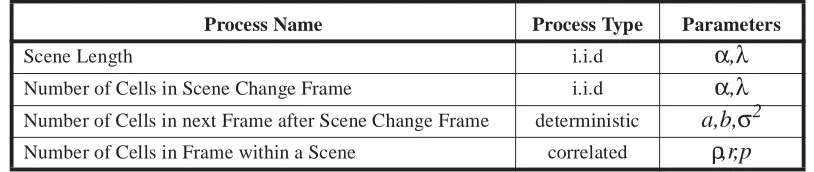
final model requires a total of ten parameters, which we summarize in Table 2.
Frater, et al. [7] proposed a similar model; however, the scene change boundaries were
determined in a slightly different way and processes for the first two frames after a scene
change were not considered. Scene change boundaries were determined by detecting a
large difference in the output of combination median, averaging filters. The scene length
pdf was found to be of the form
where a and b are constants, and n is estimated from the empirical sequence.
This model also used the DAR process and the negative-binomial distribution for the
frame size process; thereby, requiring a total of five parameters (ρ,r,p,b,n). Even though
the scene change frame process was not modeled, cell loss simulation results did appear to
match well the results produced when using empirical trace data.
Table 2. Process summary of hierarchical model.
Process Name Process Type Parameters
Scene Length i.i.d α,λ
Number of Cells in Scene Change Frame i.i.d α,λ Number of Cells in next Frame after Scene Change Frame deterministic a,b,σ2 Number of Cells in Frame within a Scene correlated ρ,r,p
Xi⁄50
Xi⁄50
{ }
p x( ) a
xn+b2
4 Models Based on the TES Process
TES processes are designed to fit simultaneously both the marginal distribution and
the autocorrelation function of the empirical data. It is a general method in that it can
match any marginal distribution exactly and simultaneously approximate a wide variety of
autocorrelation functions. A software package called TEStool supports TES modeling via
a graphical user interface which facilitates both algorithms and interactive searches for
TES models [14]. Recently, Jelenkovic and Melamed [23] have developed an algorithm
which largely automates the search process and invariably leads to a more accurate model
than those obtained via human interaction.
TES’s ability to match marginal distributions exactly and approximate many
autocor-relation functions makes it an excellent choice for constructing a source model. We give a
brief overview of TES processes; however, for more in-depth information, the reader is
referred to [35].
4.1 Overview of TES Process
TES defines a method for generating an auxiliary background process, {Un}, which
allows one to vary the nature of dependence among the target random variables {Xn}. The
process {Xn} is referred to as the foreground process and is generated from {Un} by using a
suitable transformation. The process {Un} defines a random walk on the unit circle
(cir-cumference 1) based on the modulo-1 (fractional part) operator, defined as
10.
x
Specifically, TES background processes come in two flavors, {U+} and {Un- }, defined
as,
wherethe initial value U0 is uniformly distributed on the interval [0,1) and {Vn}, called the
innovation sequence, consists of a sequence of i.i.d. random variables which are
indepen-dent of U0. The background process {U+} can generate both negative decaying or
oscilla-tory autocorrelation functions while {U-} generates autocorrelations which alternate in
polarity between odd and even lags.
In general, {Vn} is obtained from the innovation density fV, which is typically restricted
to step-functions in order to simplify the parameter search. In the simplest non-trivial case
of uniform innovations, {Vn} is determined by two parameters L and R where
is generally referred to as the single-step innovation function, Zn are i.i.d. and uniformly
distributed on the interval [0,1) and . The parameterization (L,R) is
equivalent to the parameterization (α,φ) where
The (α,φ) parameterization is convenient for calculating the autocorrelation function. The
parameter α controls the magnitude of the autocorrelation function and φ controls its
oscil-lations.
Once the background process is determined, the next step is to define the desired
fore-ground process {Xn}. This is done by applying a transformation called the distortion
func-tion, to or . A common distortion is of the form , where is
Un+
U0,
Un+–1+Vn
〈 〉,
= Un
-Un+,
1–Un+,
= (26)
n even
n odd n = 0
n>0
Vn = L+(R–L)Zn. (27)
0.5
– ≤L< <R 0.5
α = R–L,
φ = R---.R+–LL
(28)
Un+
the inverse of the cumulative histogram of the empirical data and is a stitching
trans-form. A stitching transformation is used, parameterized by a stitching parameter
where
is an intermediate step designed to “smooth” the sample paths of and
when crossing the origin. In most cases, a value at or near 0.5 is selected for ξ. Finally, the
requisite foreground TES sequence is defined by,
4.2 H.261 GOB video conference model using a TES process
Melamed, et al. [37] developed a model for the number of bits per group-of-blocks
(GOB) for H.261-encoded video. In H.261, each frame (352x288 pixels, Common
Inter-face Format, CIF) consists of 12 GOBs, each containing 33 Macroblocks. A Macroblock
contains four luminance blocks (block=8x8 pixels) and two chrominance blocks. The
sim-ulated system was an 802.3 LAN driven by multiple video sources. Each data packet
con-sisted of one or more GOBs.
They observed that the bit-rate data, at the GOB level, contained a significant periodic
component. The reason for this is that each GOB retains significant correlations between
the same blocks in successive frames since a block encodes the same portion of a frame
and scene content changes slowly over time (seconds). They removed this component
from the sample data, and then applied TES to the residual process, Rn. The periodic
com-Sξ
0≤ ≤ξ 1
Sξ( )y
y ξ
--1–y
1–ξ
---
=
0≤ ≤y ξ
ξ≤y<1
(29)
Sξ {Un+} { }Un
ponent was determined by using periodogram analysis to estimate the parameters K, ωi, Ai
and Bi. These parameters are used to model the periodic component as
The residual process is then,
A single-step innovation density with α=0.50 and φ=0.30 was determined for Rn
(using the TEStool software) and the stitching parameter, , was set to 0.5. The periodic
process was added to the TES process yielding the final foreground process
The parameters for the model are then where i=1,2...K. The model
pro-duced an autocorrelation which matched its empirical data counterpart up to a lag of 100
frames. It then was compared to an earlier AR model which did not extract the periodic
component, but distributed the bits within a frame equally across GOBs. Simulation
showed the TES model produced lower packet loss and delay given the same throughput
when compared to results using the AR model.
4.3 Frame and Slice layer models using a generalized TES (G-TES) process
Lazar et al. [26] developed both a frame and slice layer models for a DCT encoded
version of the movie Star Wars. They used a generalized TES process in which the
innova-tion process is not i.i.d. Each scene was modeled as a stainnova-tionary process and scene lengths
followed a geometric distribution with parameter
Pn (Aicosωin
i=1
K
∑
= +Bisinωin). (31)
Rn = Xn–Pn. (32)
ξ
Xn = HY-1(S0.5(U+n))+Pn. (33)
α φ ξ, ,Ai,Bi
{ , }
p 1
1+E L[ ]n
---,
where E[Ln]is the expected value of the duration of a scene, Ln. Scene change boundaries
were determined using the absolute difference in bit-rates of adjacent frames. The model
attempts to capture the large change in bit-rate magnitude observed at scene change
boundaries. The scene change process was incorporated into the innovation process as
where {Zn} is a sequence of i.i.d. random variables with uniform marginals in the interval
[0,1), and {Wn} is a sequence of i.i.d. Bernoulli random variables signaling that a scene
change occurred. The GTES parameters were determined heuristically to be
and R=-L=0.001. The average scene length, E[Ln], was found to be about 100 frames.
The same innovation process, with only a slight modification, was used for the slice
layer model. In order to replicate the pseudo-periodic behavior of the autocorrelation
func-tion, they added a modulating function an. The background process was then defined as
where
with s being the number of slices per frame and % is the modulo operator.
The value of E[Ln] must now be expressed in terms of slices, so a scale transformation
changed it from 100 frames to 3000 slices (30 slices per frame). The parameters L and R
were set to 0.003 and 0.008 respectively, while αcwas left intact.
The final model for both the frame and slice layer was
where an=1 for the frame layer model, and an is given by (37) for the slice layer model.
Vn (1–Wn)(L+(R–L)Zn) Wn αc
2
---– +αcZn
,
+
= (35)
αc = 0.28
Un = 〈Un–1+anVn〉, (36)
an
1 if 0 n%s s
2 ---–1,
≤ ≤
1 if s 2
---≤n%s≤s–1, –
= (37)
The parameters for the model are for the frame layer and
for the slice layer. The frame layer model matched the autocorrelation function of the
empirical data well up to a lag of about 300 frames, but thereafter it dropped below its
empirical counterpart. The slice layer model matched the autocorrelation well up to a lag
of 100 frames. The pseudo-periodic behavior was captured, but the model appeared to
underestimate the peaks in the autocorrelation function. The attractiveness of the GTES
approach, is that it provides a way to model VBR video at two different time scales (slice
and frame), while directly incorporating a scene change mechanism. This is the first model
considered to be of the hierarchical type. The model was used in simulations to determine
the bandwidth allocation required for sources of different service types.
4.4 MPEG Frame layer model using a composite-TES (C-TES) processes
Reininger, et al. [42] developed a model for MPEG sequences containing I, B and P
frames. The model uses the background process for I, B frames and for P
frames giving the background sequences, , and . The scene change
process was not taken into account in this model.
An interesting point regarding this model is that the number of bits in B and P frames,
within a Group Of Pictures (GOP), depends on the I frame located at the beginning of a
GOP. Recall that in MPEG, a GOP consists of a set of I, B and P frames arranged in a
deterministic pattern which repeats throughout the sequence. For example, given a frame
sequence {...I2B3B4P2B5B6P3B7B8I3...} where the subscript is the index number of the
associated frame type, the background sequence variates for B3 and P2 are set equal to the
background sequence variate for I2 . This makes intuitive sense,
because both B and P frames, within a GOP, reference the I frame in the encoding process.
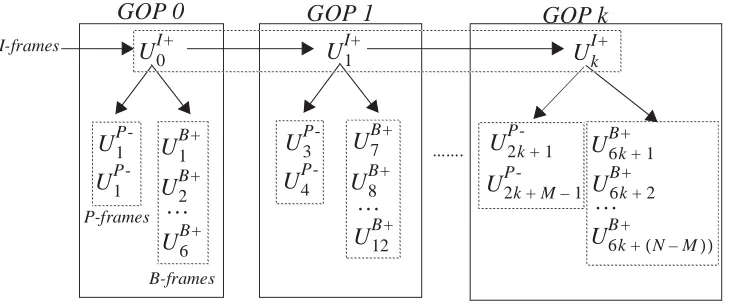
An illustration of the relationship of the background sequences for I, P and B frames is
αsαc,ξ,p
{ , } { ,αsαc,ξ,p a, n}
U+
{ } { }U
-UI+
{ } {UB+} {UP-}
U2I+ = U3B+ = U2
The final model is composed of a deterministic combination of each frame type
pro-cess. Process selection is determined by the GOP frame sequence pattern, defined by the
MPEG encoding parameters N and M, which are the I frame and P frame distances
respec-tively. The three random processes are defined as,
The model requires nine parameters, , three for each frame type. One
point of interest here is that MPEG sequences with IBP frames exhibited a
pseudo-peri-odic autocorrelation function similar to that produced by slice layer sequences. This
behavior is caused by the deterministic sequencing of IBP frames and is captured well by
this model.
4.5 Frame layer model using a Markov modulated TES (MRMT) process
Melamed and Pendarakis [36] developed a model for a DCT encoded version of the
movie Star Wars (this is the same sequence used in Section 4.3) and takes scene changes
AAAAAAA A A A A A A A A A A A A AAAAAAA A A A A A A A A A A A A AAAAAAA A A A A A A A A A A A A A A A A A A A AAAAAAAA AA AA AA AA AA AA AA AA AA AA AA AA AA AA AA AA AA AA AA AAAA AAAA AAA AAA A A A A A A A A A A A AAAAAAA A A A A A A A A A A A A AAAA AAAA AAAA AAAA A A A A A A A A A A A A A A A A A A A A AAAA AAAA AAAA AAAA A A A A A A A A A A A A A A A A A A A
GOP 0 GOP 1
I-frames ... AAAAAAAAAAAAAAA A A A A A A A A A A A A AAAAAAAAAAAAAAA A A A A A A A A A A A A AAAAAAAAAAAAAAAAAAA AA AA AA AA AA AA AA AA AA AA AA AA AA AA AA AA AA AA AA AAAAAAAAAAAAAAAAAAA A A A A A A A A A A A A A A A A A A A GOP k
Figure 4. Generation of background processes for I, P and B frames in relation to the GOP sequence.
AAAAAAAAAAAAAAAAAAAAAAAAAAAAAAAAAAAAAAAAAAAAAAAAAAAAAAAAAAAAAAAAA A A A A A A AAAAAAAAAAAAAAAAAAAAAAAAAAAAAAAAAAAAAAAAAAAAAAAAAAAAAAAAAAAAAAAAA A A A A A A
U1
P-U1
P-U1B+
U2B+
U6B+ …
U0I+ U1I+ UkI+
U3
P-U4
P-U7B+
U12B+ U8B+ …
U2kP-+1
U2kP-+M–1
U6kB++1
U6kB ++(N–M)) U6kB++2
… P-frames
B-frames
XnI+ HY I
1 –
Sξ I Un
I+
( )
( ),
=
(39)
XnB+ HY B
1 –
Sξ B Un
B+
( )
( ),
=
XnP- HY P
1 –
Sξ P Un
P-( )
( ).
=
α φ ξ, ,
change process is not assumed to be i.i.d, but Markovian. The first task was then to
seg-ment the video sequence into individual scene segseg-ments and classify each segseg-ment. Scene
boundaries were detected by measuring the sustained absolute difference of the bit-rates
between a series of successive frames, again, similar to the technique was used in Section
4.311.
Once the video sequence is segmented, each segment is classified using a clustering
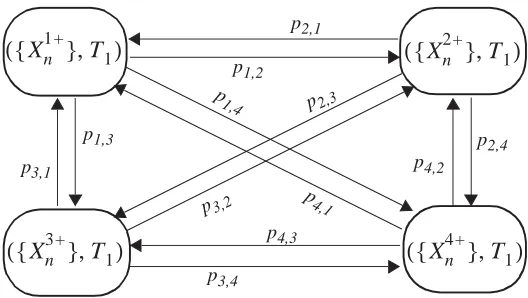
algorithm based on the minimum Euclidean distance between mean bit-rates. Four clusters
were sufficient to categorize the video sequence into four scene classes. A TES model was
then created for each scene class where each class was mapped to a state of a Markov
Chain, illustrated in Figure 5, whence the name Markov Renewal Modulated TES (MRMT)
process. Scene durations were class dependent; however, its autocorrelation function was
practically zero for lags greater than five frames, so it was assumed to be i.i.d. random
variable, represented by {Ti}, where i = 1,2,3,4 is the class index. Although it is not
explic-itly stated that the scene duration distribution is geometric, the video sequence is the same
as that used in [26] where its form is stated explicitly.
The final model consists of four TES processes, one for each class,
as well as four renewal processes for the corresponding scene durations.
The parameters for the model are , where i is the class index and
transition probability matrix. This yields 12 parameters for the matrix, and 3
for each TES process giving a total of 24 parameters. The model was used to generate
171,000 samples and the attendant sample path, histogram, autocorrelation function and
spectral density were compared to their empirical counterparts. In all cases excellent
11. It should be noted, that sequences containing I, B and P frames will require different methods to determine scene change boundaries. It seems feasible that, in this case, this technique could be
Xni+ HY i
-1
Sξ i Un
i+ (
( ) )
= i = 1 2 3 4, , , (40)
αiφi,ξi,P
{ , }
matches were achieved. This model produced better matches to the autocorrelation
func-tion at long lags since the Markov Chain captures the longer-term scene change behavior.
p1,2
p2,4 p2,1
p3,1 p1,3
p4,3
p3,4 p
1,4
p 4,1
p2,3
p3,2
Figure 5. The modulating Markov Chain which controls TES process selection and scene duration based on class type. Transition probabilities, pij, from class i to class j are determined from the empirical data of scene transitions. The amount of time spent in a particular state, Ti, is sampled from the empirical distribution of class i scene durations. {Xni +} represents the TES process for scene class i.
p4,2 Xn1+
{ },T1
( )
Xn3+ { },T1
( )
Xn2+ { },T1
( )
Xn4+ { },T1
5 Models Based on Self-Similar Processes
Loosely speaking, a process is said to be self-similar if the samples for that process
appears “similar”, regardless of the duration of the sampling interval (time scale). One of
the important characteristics of a self-similar processes is that it is long-range dependent
(LRD) which means that: (1) The autocorrelation function is not summable, (2) The power
spectrum at low frequencies is unbounded and approaches infinity as the frequency
approaches zero (DC component). This behavior differs from short-range dependent
(SRD) processes whose autocorrelation functions are summable and power spectrums are
bounded at low frequencies. Recent work by Beran, et al. [2] has shown that long-range
dependence is intrinsic to VBR sequences, and given that there is some evidence that LRD
processes can negatively affect multiplexing performance [1,30], source models which
capture this characteristic were developed. We present a brief overview of LRD; however,
for more information the reader should see [2].
5.1 Overview of Long-Range Dependence
It has been found that LRD processes occurs quite often in nature. Natural phenomena
such as rainfall, the annual growth of tree rings, river levels and discharges are often
described as self-similar processes. Hurst first discovered this property by investigating
the amount of storage required in the Great Lakes of the Nile river basin [17]. He found
that the expected value of the quantity (rescaled adjusted range statistic R/
S), asymptotically followed a power law
R n( )⁄S n( )
where c is a positive constant independent of n, is the adjusted range, is the
sample standard deviation, and H is the Hurst Parameter with range 0.5 < H < 1. The
rescaled adjusted range is calculated using
where
and Xi is the empirical sequence.
The value is calculated for different values of n and plotted in a Pox
diagram where is plotted on the y axis and is plotted on the
x axis. Linear regression is then used to estimate the Hurst parameter where
Typical values of H for various sequences are given in Table 3. Note that the value of
H for i.i.d random processes is 0.5, while for computer traffic it is approximately 1. Figure
6 shows the effect of the value of H on a random sequence. We plotted samples generated
using a fractional ARIMA process for four different values of H. We see that as H
increases, a noticeable low frequency oscillation is evident in the sequence envelope.
Once H is estimated, a processes such as Fractional ARIMA, or Fast Fractional
Gaus-sian Noise (ffGn) is used to create a background sequence, which may be used in turn to
generate the foreground sequence using the desired empirical marginal bit-rate
distribu-tion. Other methods can be used to estimate H in addition to R/S analysis such as
Vari-R n( ) S n( )
R n( ) S n( )
--- max 0 W( , 1,W2,…Wn)–min 0 0 W( , , 1,W2,…Wn)
S n( )
---= (42)
W0 = 0,
Wk Xi–kX n( )
i=1
n
∑
= k = 1 2, , ,… n
(43)
E R n[ ( )⁄S n( )]
E R n[ ( )⁄S n( )]
( )
log log( )n
H logE R n[ ( )⁄S n( )] n
log
---.
5.2 Frame layer model using a fractional ARIMA (f-ARIMA) process
Garrett and Willinger [8] developed a model a DCT encoding of the movie Star Wars
Table 3. Hurst parameters of various traffic types.
TRAFFIC TYPE H
Computer Traffic [29] ≈1
CNN [4] 0.90
Star Wars (Motion JPEG) [4] 0.88
Star Wars (MPEG IBP) [4] 0.86
Star Wars (B/W, DCT) [8] 0.83
Video Conference [2] 0.6-0.75
i.i.d [6,33] 0.5
0 500 1000
−2 0 2 4 6 8 10 H=0.99
0 500 1000
−6 −4 −2 0 2 4 6 H=0.90
0 500 1000
−4 −2 0 2 4 H=0.70
0 500 1000
−4 −2 0 2 4 H=0.50
0 500 1000
0 0.5 1
H=0.50
0 500 1000
0 0.5 1
0 500 1000
−0.5 0 0.5 1
H=0.90
0 500 1000
−0.5 0 0.5 1
H=0.99
Figure 6. Comparison of the Hurst effect on random process (a) samples generated using fractional ARIMA process (x-axis = sample, y-axis = magnitude) (b) corresponding empirical autocorrelation functions (x-axis = correlation coefficient, y-axis = lag).
(a)
(b)
tribution they used a hybrid distribution, , which consisted of a concatenation of a
Gamma distribution for the left tail and a Pareto distribution for the right tail. Right tail
matching is particularly important because it describes the probabilities of high bit-rates
which can significantly affect queueing performance.
The model uses a fractional ARIMA(0,d,0) process to generate the background
sequence, where d=H-0.5, and its autocorrelation function is given by
The background process, {Uk}, is generated using Hosking’s algorithm12 [15] which is
an o(n2) algorithm. Each Uk is Gaussian with mean and variance which are given by
the function φ, defined recursively by
where
and the initial values are N0=0 and D0=1. The mean and variance is then
12. One interesting feature of this algorithm is that, given a discrete autocorrelation sequence, ρk, a sample path can be generated whose autocorrelation matches it. We will see this technique used
FΓ⁄P
ρk d 1( +d)…(k–1+d)
1–d
( )(2–d)…(k–d)
---.
= (45)
µk σk2
φkj = φk–1 j, –φkkφk–1 k, –j, j = 1, ,… k–1 (46)
φkk = (Nk⁄Dk), (47)
Nk ρk φk–1 j, ρk–j,
j=1
k–1
∑
–
= (48)
Dk = Dk–1–(Nk2–1⁄Dk–1). (49)
σk2
1–φkk2
( )σk2–1
,
where the random variable, X0, is sampled from a standard normal distribution. Finally,
the number of bits per frame is represented by the foreground sequence, {Yk}, which is
generated using the transformation
where FN is the standard normal cumulative distribution function and is the
inverse of the aforementioned hybrid Gamma/Pareto cumulative distribution function.
Note that the LRD property is still preserved when transforming from Uk to Xk.
The parameters required by the model are where and are the
mean and variance of the Gamma distribution and mT is the slope of the line which best
fits the tail of the Pareto distribution. The model parsimoniously captures the LRD aspect
in this sequence using a single parameter.
5.3 Frame layer model using a fast fractional Gaussian Noise (ffGN) approximation
Enssle [5] developed a VBR model for an MPEG version of Star Wars containing I,B
and P frames. The model used the fast fractional Gaussian Noise (ffGN) algorithm to
gen-erate the background sequence. This method is an approximation to the fractional
Gauss-ian noise process and has a computational complexity of o(n). Consequently, ffGN
provides a faster way to generate the background sequence as compared to fractional
ARIMA.
The background process, {Us(t)}, was generated using ffGN. The Hurst parameter, H,
was estimated to be 0.856, using Periodogram and R/S analysis, which compares well
with the value 0.83 found in [8]. The ffGN algorithm requires two additional parameters
besides H, called the base, B, and quality, Q. Selecting a value for B in the range
µk φkjXk–j,
j=1
k
∑
= (50)
Yk = FΓ–1⁄P(FN( )Uk ). k>0 (52)
FΓ–1⁄P( ).
µΓ,σΓ,mT,H
(This was heuristically determined). The background process, {Us(t,H)}, consists of high
and low frequency components,
The low frequency component is a weighted sum of independent Markov-Gauss
pro-cesses,
The number of Markov-Gauss processes is
where n is the length of the time series and the weight factors are
The lag-1 covariance is given by
which is used in the Markov-Gauss process
where Gk(t) is standard normal.
Us(t H, ) = Ul(t H, )+Uh(t H, ). (53)
Ul(t H, ) WkG t r( , k),
k=1
N
∑
= (54)
N = ln(Qn)⁄ln( )B , (55)
Wk H 2H( –1) B
1–H
BH–1
–
( )(B–2k 1( –H)) Γ(3–2H)
---.
= (56)
rk e B k
–
–
= (57)
G t r( , k)
Gk( )1 ,
rkG t( –1 r, k)+ (1–rk2)Gk( )t ,
= (58)
t = 1
The high frequency component of (53) is
where G(t) is standard normal.
Each frame type has an corresponding distribution for the number of bits per frame,
which was determined to fit the Lognormal distribution well. The background process,
Us(t,H), is then distorted using the transformation of the frame type distribution, , to
give
which translates to the following
where and i is the frame type I, B and P.
The model requires three parameters: B, Q and H for the background process and six
parameters: , , for the Lognormal distributions, for a total of nine
parame-ters. The model basically operates as follows. At time t, the frame type i, which is
prede-termined by the MPEG GOP pattern (IBBPBBP...), is used to select one of the three
transform functions: XI(t), XB(t) and XP(t). A sample is then generated of {Us(t,H)} which
is used in the selected transform function. Time is then incremented to determine the next
frame type and the process continues for the duration of the video sequence.
Uh(t H, ) 1 B
H–1
4 1( –H)Γ(–2H)
---– G t( )
= (59)
Fi–1
(60)
Xi( )t = Fi–1(Us( )t ), i = 1 2, , ,… n
Xi( )t ln 1( +Φ)Xs( )t lnE X[ ]i 1 2
---ln(1+Φ ) –
+ ,
exp
= (61)
Φ = (Var X[ ]i )⁄E X[ ]i 2
5.4 Frame layer SRD/LRD model using a f-ARIMA process
Huang, et al. [16] developed a model for an MPEG encoding of the movie Last Action
Hero, which contains I, B and P frames. It is referred to as a unified model because it uses
a hybrid function in order to match the autocorrelation function at both the short-term and
long-term lags. The Hurst parameter, H, was used to generate the LRD part of the
autocor-relation function, and a weighted sum of exponentials was used to match the SRD part.
These parts were then combined yielding the hybrid autocorrelation function
where Kt is the boundary between the SRD and LRD parts. The Hurst parameter was
determined using both R/S and Variance-time analysis and the SRD parameters were
determined by using regression analysis. Once the autocorrelation function was
deter-mined, Hosking’s algorithm was used to define the background process, {Un}. Individual
histograms were constructed for each frame type and the attendant background process
was then transformed for each frame type via
Histograms were used since the authors determined that the empirical distributions did not
seem to fit any of the existing classical distributions.
The model requires four parameters to estimate ρk, the Hurst parameter H, and one
parameter for each cell in the frame type histogram. Samples were produced which
matched the autocorrelation function well for lags up to 500 frames. The portion of the
autocorrelation function up to lag Kt ~ 75 is fitted well by the exponential function. This is
probably the most accurate model to date in terms of matching the autocorrelation
func-tion for both short and long lags.
ρk e
0.00565k –
1.59k–0.2
= k<Kt
k≥Kt
(62)