STUDENTS’ EXPERIENCES,
LEARNING OUTCOMES AND
SATISFACTION IN E-LEARNING
Chin Fei Goh
1, Choi Meng Leong
2,
Kalsum Kasmin
1, Puong Koh Hii
1,
Owee Kowang Tan
11 Faculty of Management, Universiti Teknologi Malaysia, Johor, Malaysia
2 UCSI University Kuching Campus, Kuching, Sarawak, Malaysia. [email protected]
Keywords: Course design, Interaction with the instructor, Interaction with peer students, Learning outcomes, Learning satisfaction.
This study was aimed to examine whether students’ experiences in e-learning are related to learning outcomes and satisfaction. Three learning experiences, which are course design, interaction with the instructor and interaction with peer students were identified as the predictors of learning outcomes and satisfaction. Self-administered questionnaire was adopted. The paper questionnaires were distributed to students at a university in Malaysia. In total, 670 valid responses were obtained. Exploratory factor analysis was performed to confirm the underlying factor structure for the observed variables. Regression analyses indicated that course design, interaction with the instructor and interaction with peer students are positively related to the learning outcomes and satisfaction. Among all learning experiences, interaction with peer students make the strongest contributions to learning outcomes and satisfaction. This study demonstrates the importance for University administrators and instructors to design e-learning course to for citations:
Journal of e-Learning and Knowledge Society
Je-LKS
The Italian e-Learning Association Journal
Goh C., Leong C., Kasmin K., Hii P., Tan O. (2017), Students’ Experiences, Learning Outcomes and Satisfaction in e-Learning, Journal of e-Learning and Knowledge Society, v.13, n.2, 117-128. ISSN: 1826-6223, e-ISSN:1971-8829
optimal students’ experiences to enhance their learning outcomes and satisfaction.
1 Introduction
The traditional face-to-face teaching relies on the instructors to control and regulate the course contents and teaching effectiveness (Horton, 2001). In these two decades, the evolvement of information systems has provided an alternative way on teaching delivery through e-learning. E-learning is a method that adopts technology to complement traditional teaching practices. E-learning can take place without some restrictions such as geographical location and time (Richardson & Swan, 2003).
Instructors can use e-learning to enhance teaching effectiveness (Al-Adwan et al., 2013). For example, learning materials can be updated regularly, and students can access the latest materials instantly. E-learning also offers a collaborative learning environment to enhance richer learning experiences and learning process. E-learning represents a vehicle for educational industry to transform traditional face-to-face teaching to flexible individual-based learning.
It is important to note that most of the higher-education institutions in Malaysia have incorporated e-learning as part of teaching vehicle in two ways (Hussin et al., 2009). First, some Malaysian higher-education institutions have introduced full e-learning courses. Second, many higher-education institutions have adopted blended learning by combining the traditional teaching with the e-learning (Hung & Chou, 2015).
To date, there are limited studies available to examine the effectiveness of e-learning implementation in the Malaysian higher-education context (Embi et al., 2011; Oye et al., 2012; Al-rahmi et al., 2015). Previous studies have investigated learning satisfaction of using e-learning (Ramayah & Lee, 2012), e-learning continuance intention (Ismail et al., 2012), the effectiveness of e-learning (Al-rahmi et al., 2015). However, there is lack of study on perceived learning outcomes and satisfaction among students using e-learning in the Malaysian higher-education context. There is also lack of studies to investigate the impact of learning experiences on both learning outcomes and satisfaction in the e-learning context. Thus, this study aims to examine whether learning experiences contribute to learning outcomes and satisfaction. This study also intends to identify the relative impact of predictors on learning outcomes and satisfaction. Therefore, the following research questions are formulated:
1. Do learning experiences relate to learning outcomes? 2. Do learning experiences relate to learning satisfaction?
3. Which learning experiences are significant predictors of learning outcomes?
satisfaction?
2 Literature Review
The framework of students’ experiences in e-learning is rooted in the work by Moore et al. (1996). Such students’ experience can be classified as three type of interactions, which are interaction with course content, interaction with the instructor, interaction with peer students (Moore, 1989; Moore et al., 1996). These interactions are believed to close the transactional distance in the e-learning context. Experience with course design is viewed as interaction with course content and learning material (Paechter & Maier, 2010). The researchers believe that these three types of experiences can provide insights with regard to the learning outcomes and satisfaction in e-learning.
2.1 Experiences concerning course design
Interaction with course content typically refer to the total of time spent with the course content and learning material, such as textbooks, PowerPoint, Web pages and discussion forums (Su et al., 2005). Kuo et al. (2014) assert that a good course design will ensure course content be presented in a well-organized manner while it is easy to be accessed by students. Experiences concerning course design is a one-way communication. It can be understood to be the student’s internal conversation to comprehend course content (Moore, 1989). That is, students interact with information and knowledge from the course content (Kuo et al., 2014). Students will intricate, systematize, and demonstrate the new knowledge from the cognitive perspective by synthesizing the previous knowledge (Moore & Kearsley, 1996). Thus, course design and learning material is a major factor to enable meaningful learning among students.
2.2 Interaction with the instructor
e-learning (Bolliger, 2004; Lee et al., 2011). Such interaction will boost the social relationship between students and an instructor and eventually lead to socio-emotional exchange (Paechter & Maier, 2010). It will also influence students’ intrinsic and extrinsic motivation in the learning process (Paechter et al., 2010).
2.3 Interaction with peer students
Peer interaction refers to peer support which students actively support each other during learning process. Peer interaction can foster an active learning process through collaborative knowledge sharing, for example, group discussions and group based projects, where communication can take place through many channels such as emails, chat groups or newsgroup (Sher, 2009). Paechter et al. (2010) argue that interaction with peer students enable students to exchange information concerning course contents and to form socio-emotional support. Students are expected to enhance learning effectiveness in such a positive environment. For example, students who involve in group work can enhance their learning in a cohesive learning environment (Paechter & Maier, 2010). The study by Hussin et al. (2009) also shows that an effective learning environment is based on whether a meaningful interaction happens among students. Thus, interaction with peer students is likely to represent a contributor to learning outcomes and satisfaction (Broadbent & Poon, 2015).
2.4 Learning outcomes and satisfaction
Learning outcomes measure whether students attain competences in their learning (Weinert, 2001). The competence aspects comprise of factual and conceptual knowledge, methodical knowledge, social and personal competences as well as media competence (Paechter & Maier, 2010; Paechter et al., 2010). It typically represents the cognitive side of the course outcomes, and thus it is important to be evaluated in e-learning context. On the contrary, learning satisfaction represents the attitudinal construct and it measures the affective aspect. A satisfied student typically has positive learning experiences in e-learning.
2.5 Conceptual Framework and Hypotheses
This study identified three important predictors in learning outcomes and satisfaction in the e-learning context. These predictors are experience with course design, interaction with the instructor and interaction with peer students. Three hypotheses are formulated to address the research objectives:
H1B: Course design is positively related to learning satisfaction. H2A: Interaction with the instructor is positively related to learning outcomes.
H2B: Interaction with the instructor is positively related to learning satisfaction.
H3A: Interaction with peer students is positively related to learning outcomes.
H3B: Interaction with peer students is positively related to learning satisfaction.
3 Method
3.1 Measures
In this study, self-administered questionnaire was used to collect the data from students who enrolled into e-learning courses. The researchers developed the survey instruments based on the prior literature. In total, there are 5 survey instruments in the questionnaire, which are course design, interaction with the instructor, interaction with peer students, learning outcomes and learning satisfaction. The survey instruments were adapted from prior studies that relate to e-learning (Kuo et al., 2014; Paechter & Maier, 2010; Paechter et al., 2010).
The survey instrument for course design (4 items) measures the curiculum components and learning material in the learning environment. Course design instrument measures whether online course materials help students to understand the class content, stimulate students’ learning interest and relate students’ personal expeirence to new knowledge as well as ease of access to the materials. Interaction with the instructor (6 items) measures the two-way communication between instructor and students. This includes the frequency of interactions between students and instructors via various electronic means and whether students receive enough feedback from instructors. Interaction with peer students instrument (8 items) measures two-way reciprocated communication among students. Such interaction covers feedback, sharing and comment on the course content through class projects, group activities via different electronice means. Learning outcomes instrument (6 items) measures whether students acquire subject-specific conceptual and methodical knowledge, social, personal and media competences. Finally, learning satisfaction (5 items) measures to what extent students are satisfied with the class and course contribution to their educational and professional development.
was used to measure respondents’ perception on the survey questions.
3.2 Sample
In total, 700 questionnaires were distributed to undergraduate students in a Malaysian university. The researchers managed to collect 690 questionnaires, which indicates a 98.6% response rate. During screening, 10 incomplete questionnaires were discarded, and another 10 questionnaires were excluded due to the presence of extreme outliers. The researchers used Statistical Package for the Social Science (SPSS) 18.0 to perform Pearson correlation, exploratory factor analysis and multiple regression in this study.
4 Findings
4.1 Descritpive and Correlation Analyss
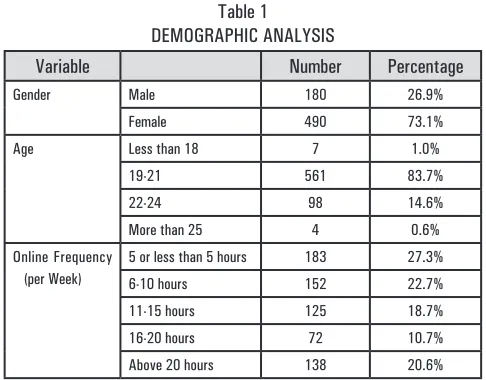
Table 1 presents the demographic statistics the valid responses (670 respondents) in this study. The results show that females represent the majority (73.15%) in the sample. Most participants are between 19-21 years old. Furthermore, most students spend more than 6 hours online based on online frequency results.
Table 1
DEMOGRAPHIC ANALYSIS
Variable Number Percentage
Gender Male 180 26.9%
Female 490 73.1%
Age Less than 18 7 1.0%
19-21 561 83.7%
22-24 98 14.6%
More than 25 4 0.6%
Online Frequency (per Week)
5 or less than 5 hours 183 27.3%
6-10 hours 152 22.7%
11-15 hours 125 18.7%
16-20 hours 72 10.7%
Above 20 hours 138 20.6%
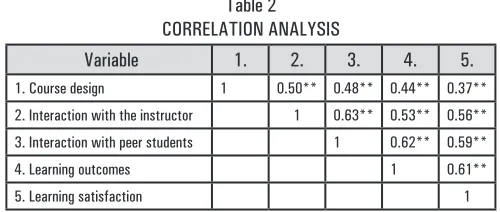
are positively correlated (p < 0.01). Interaction with the instructor and interaction with peer students have strong correlation with learning outcomes and learning satisfaction because the correlation coefficients are greater than 0.5.
Table 2 CORRELATION ANALYSIS
Variable 1. 2. 3. 4. 5.
1. Course design 1 0.50** 0.48** 0.44** 0.37** 2. Interaction with the instructor 1 0.63** 0.53** 0.56** 3. Interaction with peer students 1 0.62** 0.59**
4. Learning outcomes 1 0.61**
5. Learning satisfaction 1
4.2 Exploratory factor analysis
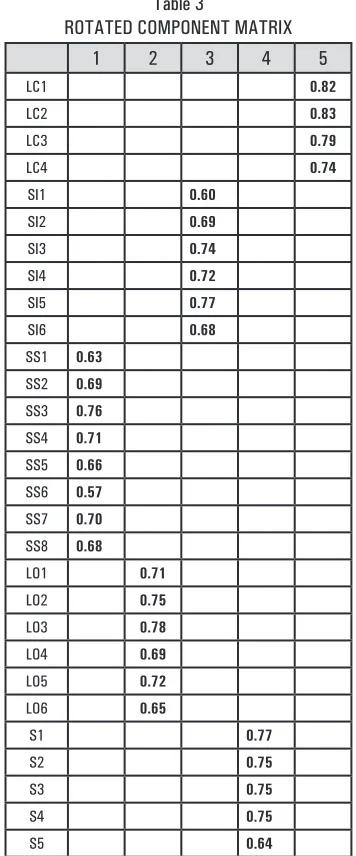
Exploratory factor analysis (EFA) was performed to the survey instruments, i.e., 29 questions from 5 variables in the questionnaire. EFA is a statistical technique to identify the underlying factor structure for the observed variables. It is observed that KMO value is 0.943 and the Barlett’s test (p < 0.01), which suggesting the data in this study is suitable for further analysis. The communality analysis shows that the community of all items are greater than 0.5, suggesting these items can be classified into respective groups.
Table 3
ROTATED COMPONENT MATRIX
1 2 3 4 5
LC1 0.82
LC2 0.83
LC3 0.79
LC4 0.74
SI1 0.60
SI2 0.69
SI3 0.74
SI4 0.72
SI5 0.77
SI6 0.68
SS1 0.63
SS2 0.69
SS3 0.76
SS4 0.71
SS5 0.66
SS6 0.57
SS7 0.70
SS8 0.68
LO1 0.71
LO2 0.75
LO3 0.78
LO4 0.69
LO5 0.72
LO6 0.65
S1 0.77
S2 0.75
S3 0.75
S4 0.75
S5 0.64
In addition to EFA, internal reliability test was performed. The results show that Cronbach’s Alpha for all variables exceeds the minimum threshold of 0.7, indicating sufficient internal reliability.
4.3 Multiple Regression Analysis
design, interaction with the instructor, interaction with peer students affect learning outcomes and learning satisfaction.
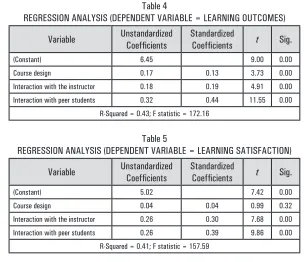
Two multiple regression models were applied to examine the impact of course design, interaction with the instructor, interaction with peer students on learning outcomes and learning satisfaction (see Tables 4 and 5). The F statistic values for both regression analyses are significant (p < 0.001), confirm the validity of the regression models. Furthermore, the variance inflation factor (VIF) for all independent variables are less than 3, suggesting the absence of multicollinearity in both regression models. The normal P-P plot shows that all points lie in a reasonable straight diagonal line and thus the normality assumption is fulfilled for both regression models.
Table 4
REGRESSION ANALYSIS (DEPENDENT VARIABLE = LEARNING OUTCOMES)
Variable Unstandardized Coefficients Standardized Coefficients t Sig.
(Constant) 6.45 9.00 0.00
Course design 0.17 0.13 3.73 0.00
Interaction with the instructor 0.18 0.19 4.91 0.00 Interaction with peer students 0.32 0.44 11.55 0.00
R-Squared = 0.43; F statistic = 172.16
Table 5
REGRESSION ANALYSIS (DEPENDENT VARIABLE = LEARNING SATISFACTION)
Variable Unstandardized Coefficients Standardized Coefficients t Sig.
(Constant) 5.02 7.42 0.00
Course design 0.04 0.04 0.99 0.32
Interaction with the instructor 0.26 0.30 7.68 0.00 Interaction with peer students 0.26 0.39 9.86 0.00
R-Squared = 0.41; F statistic = 157.59
5 Discussions
Multiple regression analyses show that interaction with the instructor and interaction with peer students are positively related to learning outcomes and learning satisfaction, respectively. As a result, the hypotheses of H1A, H2A, H3A,
H2B and H3B are supported. First, the positive effect of course design suggests
interaction with the instructor is positively related to learning outcomes and satisfaction. That is, students seem able to interact with instructors and get feedback from the instructor through internet mediated tools for an e-learning course (Eom et al., 2006; Lee et al., 2011; Paechter & Maier, 2010; Paechter et al., 2010). Third, interaction with peer students is positively related to learning outcomes and satisfaction. This indicates that e-learning environment allows students to exchange information and sharing knowledge, which leads to better learning outcomes and satisfaction. This finding is consistent with prior studies (Broadbent & Poon, 2015; Paechter & Maier, 2010; Paechter et al., 2010). Overall, the study suggests that students’ learning experiences, i.e., course design, interaction with the instructor, interaction with peer students, are important considerations in planning e-learning courses.
Standardised coefficients in multiple regression were examined to identify relative contribution in explaining the learning outcomes and satisfaction. The largest beta coefficient denotes that the independent variable has the strongest contribution to the dependent variable. The results show that interaction with peer students is the most important predictor of learning outcomes and satisfaction. This denotes that peer interaction is important in an e-learning course because peer interaction not only facilitates learning process among students, but also provides socioemotional supports in a computer-mediated learning environment.
Conclusion
The purpose of this study is to examine whether course design, interaction with the instructor, interaction with peer students affect learning outcomes and satisfaction in e-learning courses. This study confirms that such students’ experiences are salient predictors on learning outcomes and satisfaction in e-learning. This study provides empirical evidence to the e-learning literature by investigating learning outcomes and satisfaction (Paechter & Maier, 2010; Paechter et al., 2010). University administrators should recognize that interactions are the crucial constructs in determining the quality of e-learning courses. Interactive teaching styles should be adopted by an instructor in e-learning courses. Course design and learning material are equally important. Furthermore, instructor should design a teaching plan that can encourage peer interaction among students in e-learning courses.
Acknowledgements
REFERENCES
Al-Adwan, A., Al-Adwan, A., & Smedley, J. (2013), Exploring students acceptance of e-learning using Technology Acceptance Model in Jordanian universities, International Journal of Education and Development using Information and Communication Technology, 9(2), 4.
Al-rahmi, W. M., Othman, M. S., & Yusuf, L. M. (2015), The effectiveness of using e-learning in Malaysian higher education: A case study Universiti Teknologi Malaysia, Mediterranean Journal of Social Sciences, 6(5), 625.
Bolliger, D. U. (2004), Key factors for determining student satisfaction in online courses, International Journal on E-learning, 3(1), 61-67.
Broadbent, J., & Poon, W. L. (2015), Self-regulated learning strategies & academic achievement in online higher education learning environments: A systematic review,
The Internet and Higher Education, 27, 1-13. doi: http://dx.doi.org/10.1016/j.
iheduc.2015.04.007
Eom, S. B., Wen, H. J., & Ashill, N. (2006), The determinants of students’ perceived learning outcomes and satisfaction in university online education: An empirical investigation, Decision Sciences Journal of Innovative Education, 4(2), 215-235. doi: 10.1111/j.1540-4609.2006.00114.x
Embi, M.A., Abdul Wahab, Z., Sulaiman, A.H., Atan, H., Ismail, M., & Mohd Nordin, N. (2011), E-learning in Malaysian higher education institutions: Status, trends & challenges, Kuala Lumpur, Malaysia: Department of Higher Education, Ministry of Higher Education Malaysia.
Garrison, D. R., Anderson, T., & Archer, W. (1999), Critical inquiry in a text-based environment: Computer conferencing in higher education, The Internet and Higher Education, 2(2–3), 87-105. doi: http://dx.doi.org/10.1016/S1096-7516(00)00016-6
Horton, W. K. (2001), Leading e-learning, Alexandria, VA: American Society for
Training and Development.
Hussin, H., Bunyarit, F., & Hussein, R. (2009), Instructional design and e-learning: Examining learners’ perspective in Malaysian institutions of higher learning, Campus-Wide Information Systems, 26(1), 4-19. doi: 10.1108/10650740910921537
Ismail, N., Razak, M., Zakariah, Z., Alias, N., & Aziz, M. (2012), E-learning
continuance intention among higher learning institution students, Procedia-Social and Behavioral Sciences, 67, 409–415.
Kuo, Y.-C., Walker, A. E., Schroder, K. E. E., & Belland, B. R. (2014), Interaction, Internet self-efficacy, and self-regulated learning as predictors of student satisfaction in online education courses, The Internet and Higher Education, 20, 35-50. doi: http://dx.doi.org/10.1016/j.iheduc.2013.10.001
Moore, M. (1989), Three types of interaction, The American Journal of Distance Education, 3(2), 1-6.
Moore, M. G., Kearsley, G., & Scriven, B. (1996), Distance education: A systems view, Distance Education, 17(2), 412-412.
Oye, N., Iahad, N., Madar, M., & Rahim, N. (2012), The impact of e-learning on students’ performance in tertiary institutions, International Journal of Computer Networks and Wireless Communications, 2(2), 121-130.
Paechter, M., & Maier, B. (2010), Online or face-to-face? Students’ experiences and preferences in e-learning, The Internet and Higher Education, 13(4), 292-297. doi:
http://dx.doi.org/10.1016/j.iheduc.2010.09.004
Paechter, M., Maier, B., & Macher, D. (2010), Students’ expectations of, and experiences in e-learning: Their relation to learning achievements and course satisfaction,
Computers & Education, 54(1), 222-229. doi: http://dx.doi.org/10.1016/j.
compedu.2009.08.005
Ramayah, T., & Lee, J. W. C. (2012), System characteristics, satisfaction and e-learning usage: A structural equation model (SEM), TOJET: The Turkish Online Journal of Educational Technology, 11(2), 196-206.
Richardson, J., & Swan, K. (2003), Examining social presence in online courses in relation to students’ perceived learning and satisfaction, Journal of Asynchronous Learning Networks, 7(1), 1-21.
Sher, A. (2009), Assessing the relationship of student-instructor and student-student interaction to student learning and satisfaction in web-based online learning environment, Journal of Interactive Online Learning, 8(2), 102-120.
Su, B., Bonk, C. J., Magjuka, R. J., Liu, X., & Lee, S.-h. (2005), The importance of interaction in web-based education: A program-level case study of online MBA courses, Journal of Interactive Online Learning, 4(1), 1-19.