Code Switching In Informal Interaction Among A Group Of 4 th
Year Tesl Students Of Utm
Mohamad Hassan Zakaria & Rebecca Ida Anak Stephen Kalong Faculty Of Educational
Universiti Teknologi Malaysia
Abstract: Code-switching is the use of more than one language in a conversation. It is a common daily practice among people in the world for various reasons and usually an unconscious activity. This language switching might not be the whole sentence, but also can occur in brief phrases or words. Therefore, in this paper, the types and reasons of code switching will be focused on. The data for this study were collected through an audio recording of 4 TESL students of UTM while having informal conversation in their room. The findings suggest that the speakers code switched for solidarity, as well as to signal group membership and local identification. The findings also show that there are four types of code switching: intra – sentential, inter – sentential, situational and metaphorical. This paper argues that the use of more than one particular code at a time must be used judiciously as it may lead to negative feelings among speakers.
Abstrak: Penukaran kod merupakan penggunaan lebih daripada satu bahasa dalam sesuatu perbualan. Ia merupakan amalan biasa harian yang dilakukan oleh kebanyakan orang di dalam dunia atas pelbagai sebab dan selalunya ia adalah aktiviti yang dilakukan secara tidak sedar oleh penutur. Penukaran bahasa ini tidak semestinya berlaku dalam satu ayat yang penuh, tetapi ia juga boleh berlaku di dalam frasa singkat atau perkataan. Oleh itu, di dalam kajian ini, jenis – jenis dan sebab – sebab penukaran kod akan difokuskan Data bagi kajian ini telah dikumpulkan melalui rakaman audio 4 pelajar TESL dari UTM sewaktu bertutur secara informal di dalam bilik salah seorang daripada pelajar tersebut. Di dalam penemuan, didapati penukaran kod berlaku untuk tujuan kesatuan dan untuk menandakan keahlian kumpulan dan identity tempatan. Di dalam penemuan juga, didapati terdapat empat jenis penukaran kod iaitu “intra – sentential”, “inter – sentential”, penukaran kod bersituasi dan penukaran kod secara kiasan. Kajian ini mencadangkan agar penggunaan lebih dari dua kod dilakukan dengan berhati – hati kerana ia boleh juga menimbulkan perasaan negatif dalam kalangan penutur.
Keywords: Code-switching, language, conversation
Introduction
Code switching is a normal phenomenon seen in our country as we live in multilingual and multicultural communities. Code switching happens when we use more than one language continuously and interchangeably in a conversation. It happens more frequently during an informal conversation. Most of the time, people will code switch while having a conversation with others for example with their friends, their neighbours, their spouse or even with the man who is selling nasi lemak at the stall!
Statement of Problem
loss of fluency in the target language. In this case, TESL students are in a big risk in facing this problem as the more frequent they use CS, the bigger chance for them to face fluency loss in mastering English.
Other than that, TESL students might face demotivation in learning English as they use code switching in most of their study years. This might lead to some of the undesired behaviours among the students. The students might lose their interest in teaching and learning English in the future as they sometimes use their mother tongue to communicate in most of their daily lives either during class or outside the class. As mentioned by Sert (2005), a learner might lose his or her interest in learning the target language as he or she knows that he or she will always get the chance to code switch and this might result negative academic consequences as the learner does not learn the target language appropriately. In this case, some of the TESL students might feel demotivated to learn English and this might lead to the production of the less proficient and less motivated English teachers in the future.
Moreover, the use of English without code switching might affect the solidarity and sense of belonging among TESL students especially between those who are very proficient in English and those who are less proficient in English. This might lead to the division of the students into two groups; the proficient ones and the less proficient ones. Therefore, it might affect the relationship and refrain the students from being closer.
To sum up, there are many possible effects on the TESL students proficiency in English. Furthermore, they are the future English teachers who are going to teach the younger generations once they graduated. In this study, the possible reasons of applying code switch among final year TESL students are investigated.
Objectives of the Study
The study has the following objectives:
1. To find out the reasons of code switching occured during an informal conversation among a group of TESL students.
2. To identify the types of code switching occurred during an informal conversation among a group of TESL students.
Significance of the Study
This study is important to the users of code switching as it tells them the reasons and types of code switching that can occur in conversations. It is useful to know that some aspects of code switching can help foster positive rapport and effective communication among speakers.
This study is also important to teachers of English as code switching can both facilitate and hinder the learning of English. There are classroom situations where code switching can be used to assist weak learners of English. However, overuse of the native language may deprive learners of the needed input.
using good English frequently and less code switch. However, code switching can promote effective communication between teachers and students or even students with students.
Scope of the Study
This study will involve a group of final year TESL students of UTM. The data will be collected via audio recording. This recording will be transcribed into written form and will be analyzed according to the objectives of this study.
Methodology
Research Instruments
This study was carried out by recording a 47-minutes conversation among a group of TESL students in one of the students’ room which was then transcribed. The transcription is used by the researcher to examine the occurance of code switching among the four participants.
Respondents of the Study
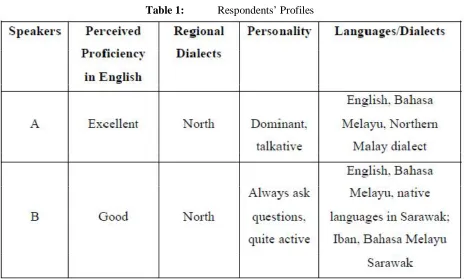
The respondents of this study were four final year TESL students of UTM. The respondents were chosen randomly. The 47-minutes recording was carried out while the respondents were watching television in one of the students’ room. The topics that involved were mainly about beauty products, beauty care and relationship of one of the respondents. Below are the profiles of each respondent:
RESPONDENTS’ PROFILES
These students were chosen to be the responsdents for this study because they are in the same clique and close friends for four years. Therefore, it is easier for them to simply talk about anything and the degree of the formality also low to indicate that they are close. Moreover, all the speakers are course mates and it is easy for them to communicate with each other and would make the code switch process from Bahasa Melayu to English easier to happen and to be understood by all of them.
Result
This study has shown that the types of code switching identified were intra – sentential code switching, inter – sentential code switching, situational code switching and metaphorical code switching. Code switching was used for several of reasons. It was be used to elaborate details, to emphasize and to specify an addressee. Code switching also was used when the speakers shared common values and norms and established solidarity with group members in a casual manner.
Discussion
A) Types of Code Switching (Bahasa Melayu to English)
The first type of code switching identified was intra – sentential code switching. According to K. Chidambaram (2006), code switching involved two types of code switching which are intra –sentential and inter – sentential code switching. Intra – sentential is the type of code switching which happens in the sentences itself. It can be the switch of a word, a clause, a phrase or even a sentence. In excerpt 1 and 2, it showed the examples of intra – sentential code switching which happened in the transcription. In excerpt 1, the insertion of single lexical items such as noun and verb were involved. In the excerpt, the speakers changed the word of “rumpai laut” to “seaweed” maybe due to their familiarity with the words better in English. It was also showed that speaker B had switched the word “cuba” in Bahasa Melayu to “try” in English as she might have more familiar with the word “try” as she is a TESL students which is of course, had been exposed to such words for years in her study years.
The second type of code switching that took place was inter – sentential code switching where switching process involved between the sentences. In excerpt 3 and 4, this type of code switching is involved where the code switching happened between the sentences uttered by the speakers. In excerpt 3, it was found that at first, speaker C asked speak A to play a game by using Bahasa Melayu. Then, in her next sentence, she switched to English as she explained the rules and procedure of the game. The same goes to excerpt 4 where the speakers were talking about speaker A’s relationship with her partner and it involved the code switching between sentences happened. Speaker A switched from Bahasa Melayu to English as she explained on how her condition with her partner where they would not be more than friends. In this excerpt, speaker B tended to respond in English as speaker A initiated the conversation first in English. Therefore, in order to maintain the flow of the conversation and to promote the mood, speaker B also responded in English.
The third type of code switching found in the transcription was situational code switching where the speakers changed their code from Bahasa Melayu to English depending on the situation and the topic at that time. In excerpt 5 and 6, it shows the examples of situational code switching. In excerpt 5, speaker A tended to code switch from Bahasa Melayu to English as she explained about the services that she handled during convocation fair. Both speaker B and C responded in English according to the situation at that time. This is because English is the most appropriate code to use as it felt that the meaning of the details delivered is more effective. Moreover, the speakers were exposed to the terms used more often in English rather than in Bahasa Melayu such as “depends”, “heartbeat”, “services”, “blood” and “confirm”. In excerpt 6, speaker A was talking about her relationship with her partner. When she conversed with speaker D, the code used was Bahasa Melayu. Then, speaker A switched her code to English as she explained more on her relationship with her partner. The code switching process depends on the situation at that time as both speaker Band C conversed in English, speaker A also chose to communicate in English
The final type of code switching identified in the findings was metaphorical code switching where the speakers switched to English to add more effect to their communication. In excerpt 7 and 8, both excerpts showed the examples of methaphorical code switching. In the transcription, metaphorical code switching is used frequently in order to add additional effect to the communication. For example, in excerpt 7, speaker C claimed seaweed as “best” and “serious best” to indicate that the seaweed that she had eaten was so delicious and she wanted the rest of the speakers to know the taste of the seaweed. In excerpt 8, both speaker B and C used “Oh my God” to add more effect and expression to their remarks. It either shows that they were disgusted, surprised or even amazed at something.
For this section, it was found that code switching was used extensively in the conversation. Even though there was a variety of codes to choose from, English was the host language, considering the fact that they have used different dialects at home. TESL students tended to use more code switching when they were talking to each other compared to when they were talking to other students who are not their course mates. This is because, TESL students knew that their course mates would be able to understand their speech better than anyone else no matter when and where they wanted to switch the code they were using.
B) Reasons of Code Switching
This part shows the examples of the reasons of code switching that could be identified in the transcription.
and closer as they code switched to English. According to Sert (2005), code switching is quite handy in a relationship especially when it comes to build a friendly and close bond among the members of the group. It is also one way to show solidarity between those people who share same ethno – cultural identity. A study done by Tay (1989 as cited in Haesook Han Chung, 2006), code switching is seen as a good communicative strategy in order to form the identity of a group and to build the solidarity and rapport among the group members. Therefore, as to mark that they are TESL students, these speakers code switched more to English instead of Bahasa Melayu. Both excerpt 9 and 10 show the examples of this reason. In excerpt 9 and 10, the speakers tended to use familiar terms which they familiar with for example “present”, “group”, “remind” and “download”. Instead of saying these words in Bahasa Melayu, the speakers chose to say these words in English as they have been exposed to these words more frequent in English rather than in Bahasa Melayu.
The second reason of code switching was to signal group membership and local identification as clamied by Avarez-Caccamo (1990). In order to signify the group identity, code switching can be used. In the transcription, there were two kinds of groups identified to represent the speakers: a group of TESL students and a group of northern speakers. In excerpt 11, it showed the example of signifying the group of TESL students where they used more English terms in their conversation such as “present” and “group”. These two words were used commonly among TESL students and they signalled the speakers as TESL students. In excerpt 12, it shows the example of identifying a group of northern speakers as they used the word “biaq” and “hang” in northern dialect when they were conversing among each other.
The third reason of code switching was to elaborate details. According to Huerta-Macias (1992), elaboration happened when the speaker wanted to add extra information or details on a topic in another language, and for this study, in English. In excerpt 13, speaker A code switched to English as she elaborated on the services that she handled during convocation fair. She tended to code switch to English as it was more effective to explain and elaborate details to TESL students in English as the majority of their medium is English. Therefore, in order to make her details effectively conveyed, speaker A switched to English rather than making explanation and elaboration in Bahasa Melayu.
The fourth reason of code switching was to emphasize the details to the speakers. In excerpt 14, it was found that speaker C emphasized her explanation of the rules and procedures of the game to speaker A in English. The reason of code switching while emphasizing was also the same with the reason of code switching while elaborating. This is because of the familiarity and the effectiveness of conveying information in English.
The last reason of code switching identified in the findings was to specify the addressee according to Huerta-Macias (1992). In excerpt 15, it was found that speaker D switched to northern language as she conversing with speaker A, for example, the use of “hang” instead of “you” and “ko”. This is because both speaker A and D shared the same northern background. However, it was different when speaker D conversed with speaker B as she addressed speaker B as “ko” instead of “hang” as speaker B is not from the north.
This section describes the reasons for code switching. They tended to code switch more from Bahasa Melayu to English as to make sure that the message that they are trying to deliver is received correctly and meaningful to the listeners.
Conclusion
could lead to the ‘bahasa rojak’ which can abuse the rules of language and could corrupt and affect the maintenance of the first language.
However, from the findings we can see that it is very useful for us to apply code switching in our everyday conversation. Code switching may not be the best and flawless way to communicate, but through code switching, we can deliver and understand better other’s message and their meanings. Take for an example, when a group of students who share the same background, eg. TESL students, communicate, for sure they will code switch from Bahasa Melayu to English and the other way around because they share the same languages which are English and Bahasa Melayu. Moreover, through code switching, it is easier for these students to deliver messages to others which do not share the same cultural backgrounds.
We live in this wonderful country with different cultures and religions. It is a common thing for us to know various kinds of languages and dialects in this kind of society. We can speak Bahasa Melayu, English, Mandarin and even Tamil just to communicate with different people. Sometimes we do have difficulties in communication, for example, in situations when we do know the words in Bahasa Melayu but not their English equivalents which force us to code switch the words to Bahasa Melayu.
Even as TESL students, a lot of them code switch when it comes to communicating with people from other ethnicities and cultures in order to maintain a good relationship among them. Sert’s (2005) maintains that code switching could help in building an intimate and close interpersonal relationship among the members of the bilingual community. Code switch also gives a gain in “reflecting social structure and group identification” (Caccamo, 1990) as in this study, the same thing has also been discovered where code switch is used to indicate the identity of the speakers when the speakers started to speak in northern language.
Sometimes we code switch without even realizing we are actually doing it. Be it code switch from English to Bahasa Melayu or likewise. It is more frequent for the speakers to code switch especially when it “involves levels of competence in both languages although the speaker’s bilingual fluency has not established” (Valdes – Fallis, 1977 in Duran, 1994). This means even though we are not fluent enough in a certain language, we are able to code switch due to our competence in both languages, in this case English and Bahasa Melayu.
Code switching might be seen as the barrier in mastering the good communication skills, however personally, I think through code switching, we can learn to have good communication skills as we tend to be more confident while having conversation with others. We should not be embarrassed and afraid to use both languages at the same time as we are still learning to have good command in English.
References
Alvarez-Caccamo, C. (1990). Rethinking conversational code-switching: codes, speech, varieties and contextualization. Available at: online http://www.udc.es/dep/lx/cac/artigos/bls 90.pdf
Ayeomoni, M.O. (2006). Code-Switching and Code-Mixing: sTyle of Language Use In Childhood in Yoruba Speech Community. Nordic Journal of African Studies, 15(1):90 – 99
Duran, L. (1994). Toward a Better Understanding of Code Switching and Interlangauge in Bilinguality: Implications for Bilingual Instruction. The Journal of Educational Issues of Langauge Minority Students, 14: 69 – 88
Haesook Han Chung. (2006). Code Switching as a Communicative Strategy: A Case Study of Korean – English Bilinguals. Bilinguals Research Journal, 30. Available at: online http://brj.asu.edu/vol30_no2/art3.pdf
Heredia, R.R. & Altarriba, J. (2001). Bilingual Language Mixing: Why Do Bilinguals Code-Switch?
Current Directions in Psychological Science, 10(5): 164
Huerta-Macias, A. & Quintero, E. (1992). Code-Switching, Bilingualism, Biliteracy : A Case Study.
Bilingual Research Journal, 16: 3&4
Jacobson, R. (2002). Language Mixing in Multilingual Malaysia. Available at: online http://www.crisaps.org/newsletter/backissue/Rodolfo%20Jacobson_summer2004.pdf
K. Chidambaram. (2006). Language in India: A Socio-Linguistic Study of Code Switching Among the Cochin Tamils. Available at: online http://www.languageinindia.com/jan2006/cochintamils1.html
Namba, K. (2000). What is Code-Switching. Available at: online http://www.senri.ed.jp/research/re10/Namba.pdf