ISSN: 2590-4043 (online) CODEN : AEMCDV
ARTICLE DETAILS
Article History:
Received 12 November 2017 Accepted 12 December 2017 Available online 1 January 2018
ABSTRACT
This Information Technology Club Management System is built to assist the IT staff of the Information Technology team to manage the club systematically and more effectively. The objective of this system is to develop and develop an online information technology club management system. In addition, this system is developed to generate more systematic and effective activities and programs. This system also helps not only members of the staff but also ordinary members, as well as ordinary members can interact and communicate with members of the post. The system is also able to provide systematic and efficient working advantages. Use of e-mail, as well as short messaging services, are also used in this system to facilitate the affairs of the power of affiliation. To achieve that objective, developers use a prototype method to develop and improve as a key to this system's revolt. In conclusion, this system reduces data filing on paper to be recorded using a computerized system. System developers use Adobe Dreamweaver and MYSQL applications and other applications like Adobe Photoshop to develop this system. KEYWORDS
Information Technology, management system, Adobe Dreamweaver, MYSQL, Adobe Photoshop.
1. INTRODUCTION
Information Technology Club was established in 2007 under the Faculty of Computer Science and Information Technology. In this regard, a description of the development of the Information Technology Club Management System has been discussed in this introduction. Subsequently, the problem statement section outlines the problems in Information Technology Club. In this respect, in the objective part, several objectives have been set up and need to be achieved within the stipulated time. Subsequently, the scope of the project has been discussed regarding users who will use this system as well as who will test the system. In the system part of the system's expected results, the discussion of the final decision will take place if the system is ready for use. The significance of this project is to discuss the benefits available if the system is implemented.
2. LITERATURE REVIEW
Literature review study and research in detail to satisfy the needs include studies on processes that apply to the current system as well as important aspects of related techniques required. In this regard, from advance background information technology Club, technology system development, programming, technology study on the equivalent system, comparison between equivalent system and until this literature review conclusion has been fully resolved.
2.1 Technology Development of Information Technology Club Management system
Information technology Club management system that has been developed, the provide system development technologies that can help to relay information to the ordinary members or members of the Committee information technology Club. Development technologies used as online technology and technology short message service.
2.1.1 Online Technology
Research on online technology needs to be done because the Internet is one of the technologies used in the development of a system. The Information Technology Club Management System has been developed online in which it can establish links between committee members and ordinary members for information and activities and programs to be run by the FSKTM or Information Technology Club itself. Applications in this system can be done using the internet, among which is email. Email is a service where users can communicate with each other. In addition, emails can help users upload and share files, data, pictures and more. The email also has replaced a more effective mail system. The email was introduced by Ray Tomlinson at the end of 1971 under the Advanced Research Projects Agency Network (ARPANET) or now known as Defense Advanced Research Projects Agency (DARPA) [1]. The first email sent between two computers actually sits next to each other and the first message sent is 'QWERTYUIOP'. According to a quote as saying 'Mostly because it seemed like a neat idea.' [2]. Popular email providers like Gmail, Yahoo, Hotmail, iCloud mail, Aim Mail and so on.
Accordingly, the advantages of email are that it is faster than sending a letter. It's electronic and modern. In today's era, email is very important for the interconnection of the relationship between humans as it is possible to connect with one another far apart from each other. It reduces the cost of deliveries as compared to letters that use shipping charges as well as service taxes. In addition to information or orders, emails can also send other things like pictures, files, music and so on. The shortcomings in the e-mail are in the reach of internet services in areas where there is no internet service because successful email delivery will be via internet service before the email is sent to other users. The email sent will go through processes such as Mail user agent (MUA), Mail transfer agent (MTA), Mail delivery agent (MDA) and Mail retrieval agent (MRA) and as shown in figure 1 [3].
Acta Electronica Malaysia (AEM)
DOI : http://doi.org/10.26480/aem.02.2018.01.05
INFORMATION TECHNOLOGY CLUB MANAGEMENT SYSTEM
Mohd Shukri Ibrahim1, Shahreen Kasim1*, Rohayanti Hassan2, Hairulnizam Mahdin1, Azizul Azhar Ramli1, Mohd Farhan Md Fudzee1, Mohamad Aizi Salamat1
1Faculty of Computer Science and Information Technology, Universiti Tun Hussein Onn Malaysia, Johor, Malaysia. 2Faculty of Computing, Universiti Teknologi Malaysia, Skudai, Johor, Malaysia.
*Corresponding author email: [email protected]
Cite The Article: Mohd Shukri Ibrahim , Shahreen Kasim , Rohayanti Hassan , Hairulnizam Mahdin , Azizul Azhar Ramli , Mohd Fa rhan Md Fudzee , Mohamad Aizi Salamat (2018). Information Technology Club Management System .Acta Electronica Malaysia , 2(2) : 01-05.
Figure 1: Email Delivery Process [3]
Therefore, the Club has been using information technology email service that allows Committee members to send information programmes or activities to the ordinary members in a very short time and in the form of digitals such as documents or images. In addition, most online Club shirts can also be done when the members of the Committee who are responsible for getting the information about the opening of the Club shirt sales.
2.1.2 Short Message Service Technology
Short Messaging Service (Short Message Service) is a service offered by mobile phones to send or receive short orders. Initially, SMS was planned as part of GSM, but at present, the service is offered by other mobile networks including UMTS networks. SMS is the most widely used application, with an estimated 3.5 billion active users, or about 80% of all mobile phone subscribers by the end of 2010 [4]. SMS is a very popular service among mobile phone users in our country. SMS was launched commercially in Malaysia for the first time in 1995 [5]. In the early days of its emergence, communication via channels only involved two parties (senders and recipients) and SMS can only be read on the phone screen [6]. But now, along with the development of communication technology, SMS originally can only be sent from one mobile phone to one another, and can only be read through the phone screen, is no longer so.
Therefore, the advantages of this SMS are the transmission mechanism in which the message center is responsible for sending and receiving texts. They also try to send back messages if they fail in the first attempt. Compared to the Multimedia Message Service (MMS) where the message will be sent to the message centre and then sent to the recipient via the internet if the phone supports the MMS format. Otherwise, MMS can be viewed in a web browser. On the challenge of SMS is Spoofing and spamming compared with MMS is like Spamming, content adaptation, distribution lists and the lack of cell phone capability. In addition, the advantages of SMS were that in 2008, a total of 4.1 trillion text messages were sent to worldwide users and generated an estimated 81 billion dollars in America. Meanwhile, for MMS in 2008 1.3 billion active users, 50 billion MMS messages and collects only $26 billion [7].
Thus, the use of a concise ordering system (SMS) in this system is to facilitate the authority of the proxy office to declare to the ordinary expert on the activities and programs to be carried out. Additionally, this compact order system may also declare ordinary experts to update personal information before accompanying any program or activity to be performed.
2.2 Programming Technology
The Information Technology Club Management System has been developed using a programming language or computational language. This language is the standard communication technique to explain instructions to the computer. It is a set of synthetic rules and cents used to produce programs. Therefore, the research done on selected Internet programming technology is PHP. PHP was built in 1994 by Rasmus Lerdorf has written in C programming language [8]. He rewrote the scripts in C for performance reasons, to add the ability to work with web forms and to communicate with the database. PHP is a server-side scripting language designed for web development but is also used as a common programming language. PHP is now installed on over 244 million sites and 2.1 million webservers [9]. Accordingly, there are several
advantages and disadvantages of PHP in comparison with another programming such as HTML, VB.net, Asp.net and so on. The advantages of PHP and its deficiencies can be assessed through table 1.
Table 1: Differences between PHP, HTML and ASP.net.
PHP 4 PHP 5 ASP.net
Software price free free free
Platform price free free $$
Speed strong strong weak
Efficiency strong strong weak
Security strong strong strong
Platform strong strong weak (IIS only)
Platform
any any win32 (IIS only) Source
yes yes no
available
Exceptions no yes yes
OOP weak strong strong
2.3 Study on Equivalent System
A study of the equivalent system is a study of existing systems that have been implemented. A review of the equivalent system was carried out to facilitate the process of analyzing the form of needs and comparing the processes that took place between these management systems. The following are some of the systems that are closely linked to the Information Technology Club Management System that will be developed with existing systems and have been reviewed such as the SMK Rapat Setia Teachers and Staff Club Management, Ipoh Perak, Speech Club Club Management System and Upin and Ipin Club Systems.
2.4 Comparison between equivalent systems
Table 2 shows comparisons of the results of the study on the existing system of the Teacher's and Staff Club's System of SMK Meetings, Ipoh Perak, Prime Speech Club Management System and Upin and Ipin Company System. The comparison is based on technology, password, system activity, and the weakness of the system.
Table 2: Comparison between three existing systems
Perbandingan Kelab Guru Kelab Kelab Upin Sistem dan Staf Pidato Dan Ipin
SMK Rapat Perdana Setia
Log In No No Yes
Technology No No Yes
SMS No No No
Penyimpanan Tiada Tiada Ada
Data penyimpanan Penyimpanan Penyimpanan
data data Data
Laporan Tiada Tiada Tiada
Aktiviti laporan laporan Laporan
aktiviti aktiviti Aktiviti
Pendaftaran Tiada Tiada Pendaftaran Pendaftaran pendaftaran Dilakukan
oleh penguna
pronounced than the three systems equivalent to it.
This system will have several advantages such as Logins, email technology, short messaging system technology, data storage, activity reports and new member registration. Compared to the non-logged in Teacher's and Staff Club's management system, no email technology, no short messaging system, no data storage, no activity reports and no registration for new members. Meanwhile, Prime Speech Club management system also has no login, no email technology, no short messaging system, no data storage, no activity reports and no registration for new members. In addition, for Upin and Ipin Club management systems have login, email technology, no short messaging system, data storage, no activity report and registration for new members are done by their own users.
3. METHODOLOGY
The choice of the right methodology is very important because it is an important element in the development of a project. Appropriate selection can produce a system to meet the needs of users. Therefore, the model chosen for application in the developed system is Evolution Model or Prototype. Through the prototype construction, users can understand and identify the required needs in the system that has been developed. Figure 2 shows the development of a system using a prototype approach which refers to the framework for the prototype modeled [10].
Figure 2: Prototype Model [10]
4. ANALYSIS AND DESIGN
The design phase is carried out after the problem analysis process and user needs as well as other requirements performed during the analysis phase. System design is an important process to ensure that the system that you want to develop achieves the goals and objectives of its development and meets the needs of users.
An analysis of system requirements in which it aims to fully understand the system environment, document all existing system functions and determine the new system requirements. To analyze the system requirements that will be developed, it will be described in two parts: Data Flow Chart (DFD) and Entity Relationship Diagram (ERD). 4.1 Flowchart
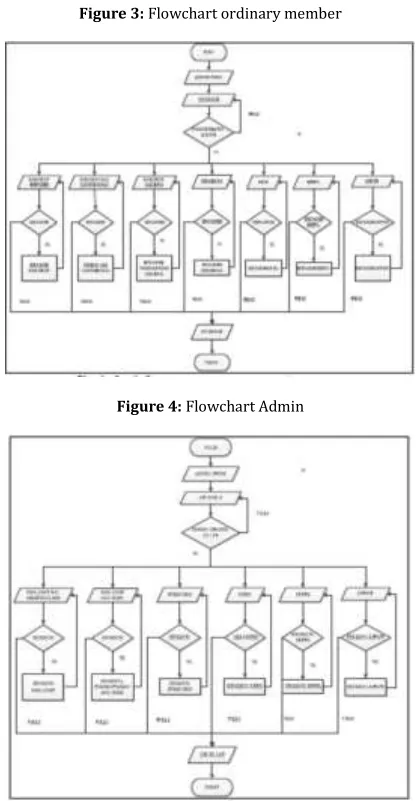
Flow charts are general diagrams that represent the process of user movement of a system, Flow Chart also shows the steps on how a data flow process takes place, and how the processes relate to one another. The data is displayed in the box, and the arrows that connect them represent the flow or direction of the data. Flowcharts are used in analyzing, planning, documenting and managing processes or programs in various fields. Here's a chart to show the movement between visitors, delegates, administrators and members of the post.
Figure 3: Flowchart ordinary member
Figure 4: Flowchart Admin
Figure 5: Flow Chart of Power Committee Members
4.2 Data Flow Diagram (DFD)
Data flow diagram (DFD) is a process flow that shows the process that would occur in the system that has been developed. Here is a flow diagram that have been identified:
Cite The Article: Mohd Shukri Ibrahim , Shahreen Kasim , Rohayanti Hassan , Hairulnizam Mahdin , Azizul Azhar Ramli , Mohd Fa rhan Md Fudzee , Mohamad Aizi Salamat (2018). Information Technology Club Management System .Acta Electronica Malaysia , 2(2) : 01-05.
Figure 6: Figure Level Zero
Figure 7 shows the figure zero levels. it shows the key processes involved in information technology Club Management System.
Figure 7: Figure Level Zero
Figure 8 figure is one level. It is the details of the key processes involved in information technology Club Management System.
Figure 8: Figure Level One
4.3 Entity Relationship Diagram (ERD)
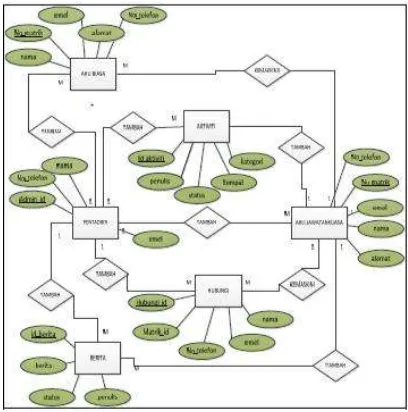
Entity Relationship Diagrams (2006 4) is a data modelling technique is a representation of logical and detailed graphics about entities and the relationship between other entities. For Club information technology management systems there are a few key components involved, namely, the entities, properties, and relationships as shown in Figure 9. There are six entities in the entity relationship diagram that is ordinary members, activities, administrator, Member of the Committee, news and contact. It connects to each other. The relationship between identify is a lot of ordinary members is registered by an administrator or a member of the committees, many activities added by an administrator or a member of the committees and any news that is displayed will be added by an administrator or a member of the committees. Each linked entity has a primary key. For each contact that occurs between the entities, are going through a foreign key as an intermediary. Each linked entity there are some attributes that vary.
Figure 9: Entity Relationship Diagram (ERD)
4.4 Interface Design
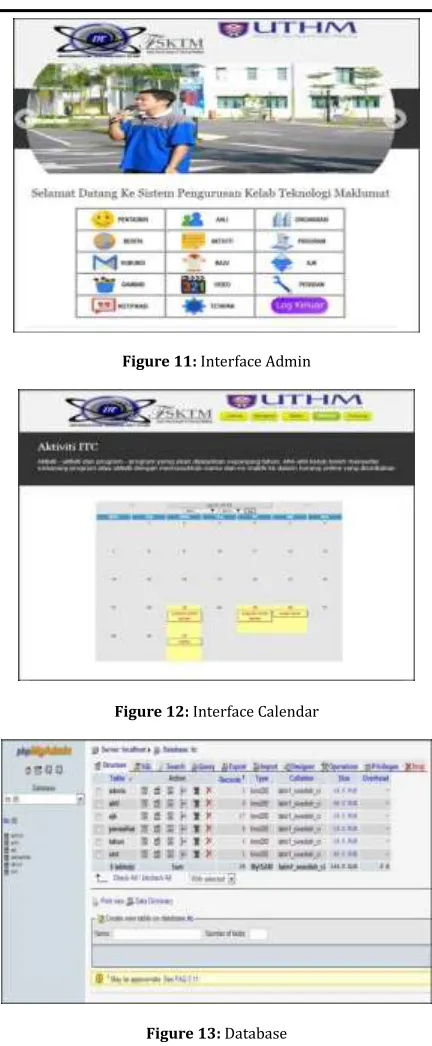
The design is a task based on the reports that have been generated based on an analysis of IT Information Technology management needs. The purpose of this design is to design and display the control of the system. This step should be implemented to look at the flow pattern of data-data up to the information that the system delivers. In order to accomplish this design process, system developers should design the system interface and the database used for this system to be developed. The information that will be displayed will be useful information for users throughout the system.
Figure 11: Interface Admin
Figure 12: Interface Calendar
Figure 13: Database
5. IMPLIMENTATIO AND TESTING
Implementation and testing are the last phases of the process of building a system. In this phase, all the activities translate and develop the system with the proposed programming language in line with the production of the analysis phase and system design. The testing phase is very important because through this phase, will reveal the status of success or failure of such a system. Users involved in this testing phase are the chairman, deputy treasurer, vice secretary and Bureau of Information Technology Club. In addition, some typical experts will test this system. All menu and programming languages will be assessed for the level of effectiveness and functionality you want to convey [11]. Through this testing phase, goals and objectives outlined during the planning phase process will be measured in the level of achievement.
This system is implemented in accordance with the original design and design that has been specified at the initial stage of the project. This process involves activities software installation, system development that includes programming for the creation of modules in this system as well as system controls. In order to implement the previously designed design, appropriate software should be installed such as Adobe Dreamweaver CS6, XAMPP version 1.7.4 and used to implement this system interface. For the process of modifying the images used in the system is to use Adobe
Photoshop CS4 software. This implementation process requires the system builder to know the language programming used PHP (Hypertext Pre-processor). System testing is a process that is run after system development. The testing phase was implemented to prove that all the planning of the Information Technology Club Management System that has been made in the previous phases was achieved or vice versa [12]. Information Technology Club Management System has been through two types of system testing namely testing of functionality and user acceptance testing.
Functional testing aims to ensure all modules can interact correctly or vice versa to produce a system that can work according to the desired criteria. This test is also done on each module to identify the shortcomings and errors that may cause the system to not function properly [13]. The Information Technology Club Management System has undergone a test conducted on the modules contained in this system by testing the links on each system interface.
6. CONCLUSION
The conclusions can be taken throughout the development of the Information Technology Club Management System with a few suggestions and insights on the achievement of overall objectives, improvements, advantages, and disadvantages of the system. Additionally, suggestions for improving this system in the future are also highlighted. Overall objective achievement is satisfactory based on the results of the testing of the Information Technology Club Management System. All the modules developed in this system work well and achieve the objectives and scope of the project. The system development objective is to design and develop an information technology club management system to replace the existing manual system. In addition, it is to develop systems that can generate more systematic and effective activities and programs. REFERENCE
[1] DARPA. 1999. History - 2.3.4. Di capai pada Oktober 20, 2013, daripada http://www.darpa.mil/About/History/History.aspx
[2] Bellis, M. 2012. History of Email. Di capai pada Oktober 21, 2013, daripada http://inventors.about.com/od/estartinventions/a/email. htm [3] Wood, D. 1999. Programming Internet Email. Edi O'Reilly Media, Inc. [4] Ahonen, T.T. 2011. Time to Confirm some Mobile User Numbers: SMS,
MMS, Mobile Internet,
M-http://communitiesdominate.blogs.com/brands/2011/0 1/time to-confirm-some-mobile-user-numbers-sms-mms-
[5] Dewan Bahasa dan Pustaka. 2008. Panduan Singkatan, Khidmat Pesanan Ringkas (SMS), Bahasa Melayu. Dicapai pada Oktober 19, 2013, daripada http://www.dbp.gov.my/khidmatsms.pdf
[6] Informa Telecoms & Media. 2012. 20 years of sms. Di capai pada
Oktober19,2013, daripada
http://www.ericsson.com/res/docs/2012/20-years-sms-infographic.pdf
[7] Labordere, A.H. 2004. SMS and MMS Interworking in Mobile Networks. Artech House.
[8] C7 Data Center. 2013. History of PHP. Di capai pada Oktober 22, 2013, daripada http://us3.php.net/manual/en/history.php.php
[9] Ide, A. 2013. PHP just grows & grows. Dicapai pada Oktober 22, 2013, Daripada http://news.netcraft.com/archives/2013/01/31/php-just-grows-grows. html
[10] Dennis, A., Wixom, B.H., Roth, R. 2009. Systems Analysis and Design 3rd Edition. John Wiley & Sons, Inc.
[11] Kelab Guru Dan Staf SMK RapatSetia, Ipoh, perak. 2011. Halaman Utama. DicapaipadaOktober 22, 2013, daripada http://kelabgurusmkrs.blogspot.com
[12] Kelab Pidato Perdana. 2009. Halaman Utama. Di capai pada Oktober 23, 2013, daripada http://www.pidatoperdana.com/
![Figure 1: Email Delivery Process [3]](https://thumb-us.123doks.com/thumbv2/123dok_us/1287892.1161321/2.596.126.207.39.221/figure-email-delivery-process.webp)