ABSTRACT
REININGER, TAYLOR JACOB. Biomimicry of Learning Complex Movements by Coordination of Simple Least-Effort Parts. (Under the direction of Dr. Larry Silverberg).
This thesis explores the introduction of a biomimicry technique in which simple, least effort
movements are coordinated together to create highly complex and useful movements
mimicking those found in nature. The method described in this paper provides an intuitive
approach for creating high efficiency movements while achieving complex goals, thus
mimicking the learning process.
The approach breaks down the movements of a physical system into the most elementary
components and parameterizes the movements to allow for manipulation. By optimizing the
movements, least effort solutions can be obtained. Higher levels of complexity can be created
by coordinating multiple movements of lower complexity levels.
To demonstrate the suggested approach, a specific example is used. A two linkage simulation
is created in MATLAB® to mimic a human arm. The human arm is taught to produce
movements of increasing complexity, while striving for least effort solutions. Four levels of
complexity are observed to illustrate the method for constructing movements of increasing
complexity. To further analyze the results of this experiment, a comparison of gaits is created
to observe the methodology of path selection and further verify the accuracy of the obtained
results.
It is found that this method provides a solution for creating a variety of movements of
varying complexity. It is also discovered that the movements created by this method appear
life-like and are aesthetically pleasing, and tend to behave similarly to the systems they are
intended to mimic. Furthermore, it is observed that gait selection through this method is
© Copyright 2016 by Taylor Jacob Reininger
Biomimicry of Learning Complex Movements by Coordination of Simple Least-Effort Parts
by
Taylor Jacob Reininger
A Thesis submitted to the Graduate Faculty of North Carolina State University
in partial fulfillment of the requirements for the degree of
Master of Science
Mechanical Engineering
Raleigh, North Carolina
2016
APPROVED BY:
_______________________________ _______________________________
Dr. Larry Silverberg Dr. Chih-Hao Chang
Committee Chair
_______________________________ _______________________________
ii DEDICATION
This thesis is dedicated to my two loving parents, Ken and Jacquie, whose love, support, and
iii BIOGRAPHY
Taylor was born in Syracuse, New York to parents Ken and Jacquie Reininger. At age 3,
Taylor’s family moved to Asheboro, North Carolina where his parents began home schooling
him, and continued to do so until he graduated high school. Taylor has always had a passion
for sports, science, and the NC State Wolfpack! During his time at NC State, Taylor rushed
the court multiple times at rivalry basketball games, was voted Faculty Senior Scholar by the
iv ACKNOWLEDGMENTS
First, I would like to thank my incredible parents for giving me so many opportunities to
succeed and supporting me every step of the way. It is to their emphasis on personal
excellence and taking pride in one’s work that I attribute my successes.
I would like to thank Dr. Larry Silverberg for encouraging me to attend graduate school and
for being my mentor for so many years, and agreeing to serve as my committee chair. I
would also like to thank Dr. Chau Tran, Dr. Chih-Hao Chang, and Dr. Edgar Lobaton for
helping me find my path over the last 6 years and for serving as committee members for this
thesis.
I would also like to thank Thomas Powers, Chris Yoder and Dr. James Kribs, without whom
I would not have made it through grad school, and for the many brainstorming sessions over
the years.
I also want to thank my girlfriend, Beth May, who was always there for me through all the
ups and downs of one of the hardest, and most rewarding, times of my life.
v TABLE OF CONTENTS
LIST OF TABLES ... vii
LIST OF FIGURES ... viii
DEFINITIONS ... ix
1. Introduction ...1
1.1. Overview ...1
1.2. Topic ...1
1.3. Literature ...1
2. Method ...2
2.1. Overview ...2
2.2. Elementary Movements ...2
2.3. Parameterization...3
2.4. Optimization ...3
2.5. Control Theory ...3
2.6. Coordination ...5
2.6.1. Level 1 ...5
2.6.2. Level 2 ...6
2.6.3. Higher Levels ...8
2.7. Defining Success ...8
3. Results ...9
3.1. Overview ...9
3.2. Incremental Learning ... 10
3.2.1. Level 1 ... 10
3.2.2. Level 2 ... 10
3.2.3. Level 3 ... 10
3.2.4. Level 4 ... 13
3.2.5. Comparison ... 14
4. Conclusion... 17
4.1. Incremental Learning ... 17
4.2. Gaits ... 17
4.3. Future Work ... 18
4.3.1. New Limbs ... 18
4.3.2. Increased Degrees-of-Freedom ... 18
4.3.3. Three Dimensions ... 18
4.3.4. Higher Motion Complexity ... 19
REFERENCES... 20
APPENDICES ... 21
Appendix A : Parameterization ... 22
Gauss Error Function ... 22
Appendix B : Optimization ... 24
Cost Function ... 24
Steepest Descent ... 26
Appendix C : Control ... 27
vii LIST OF TABLES
Table 1: Path 1 & 2 Cost Comparison, Five Second Completion Time ... 15
Table 2: Path 1 & 2 Cost Comparison, Ten Second Completion Time ... 15
Table 3: Path 1 & 2 Comparison, Many Completion Times ... 16
Table 4: Level 1, Modes ... 23
Table 5: Level 2, Movements ... 24
Table 6: Cost Function ... 26
Table 7: Controller Terminology ... 27
Table 8: Tracking and Regulation ... 27
Table 9: Shifting and Scaling Design Variables ... 29
Table 10: State Variables ... 31
Table 11: Linkage Positions at Ends ... 31
Table 12: Linkage Velocities at Ends... 32
Table 13: Joint Constraints ... 32
Table 14: Linkage Joint Relative Position and Velocity ... 32
Table 15: Reaction Forces on Linkages ... 33
Table 16: Reaction Moments ... 33
Table 17: State Equations ... 33
viii LIST OF FIGURES
Figure 1: Two-Linkage Arm ...2
Figure 2: Loose Controller Gains ...4
Figure 3: Tight Controller Gains ...4
Figure 4: Increasing Complexity ...5
Figure 5: Gaussian Error Function Plot ...6
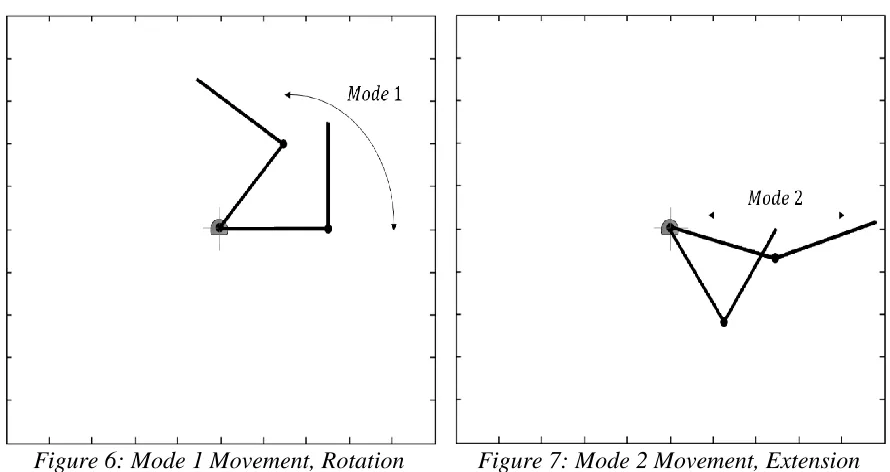
Figure 6: Mode 1 Movement, Rotation ...7
Figure 7: Mode 2 Movement, Extension ...7
Figure 8: Mode 1 Theta vs. Time ...7
Figure 9: Mode 2 Theta vs. Time ...7
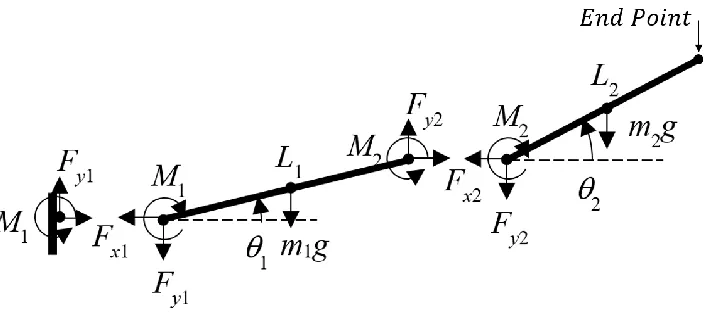
Figure 10: Free Body Diagram of Linkages ...9
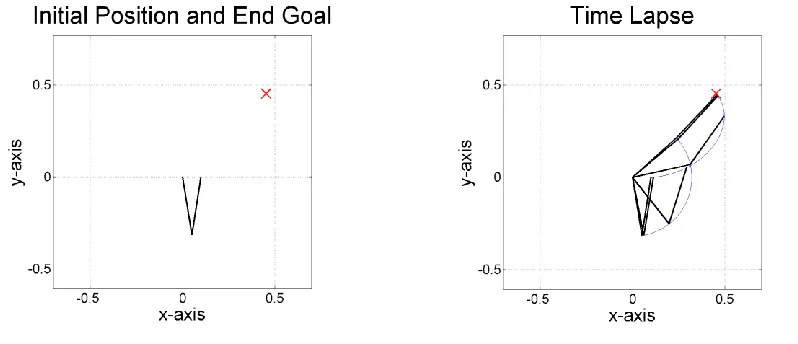
Figure 11: Goal Level 3, Movement 1 ... 11
Figure 12: Time Lapse Level 3, Movement 1 ... 11
Figure 13: Goal Level 3, Movement 2 ... 11
Figure 14: Time Lapse Level 3, Movement 2 ... 11
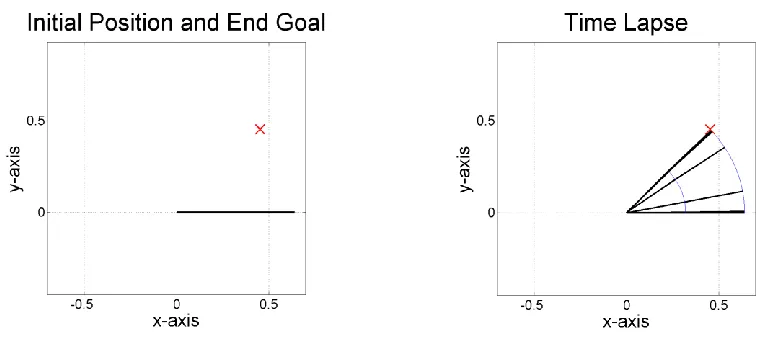
Figure 15: Goal Level 3, Movement 3 ... 12
Figure 16: Time Lapse Level 3, Movement 3 ... 12
Figure 17: Goal Level 3, Movement 4 ... 12
Figure 18: Time Lapse Level 3, Movement 4 ... 12
Figure 19: Level 4 Start Position and Goal ... 13
Figure 20: Time Lapse Level 4 Path 1 ... 14
Figure 21: Time Lapse Level 4 Path 2 ... 14
Figure 22: Time Lapse of Path 1 at Ten Seconds ... 15
Figure 23: Time Lapse of Path 2 at Ten Seconds ... 15
Figure 24: Path 1 & 2 at Various Times ... 16
Figure 25: Gauss Error Function with Varying Magnitude ... 22
Figure 26: Gauss Error Function with Varying Smoothness ... 22
Figure 27: Gauss Error Function with Varying Time ... 23
Figure 28: Error Function Scaled and Shifted ... 24
Figure 29: Level 3 Movement 1 ... 30
Figure 30: Level 3 Movement 2 ... 30
ix DEFINITIONS
Name Definition
𝑘 Motion Sharpness
𝑇 Motion Time
𝑀 Motion Magnitude
Linkages The members that make up the simulation
End Point The location of the free end of the second linkage
Initial Position The position of the linkages at the beginning of a movement Final Position The position of the linkages at the completion of a movement Completion Time The amount of time a simulation is given to complete a movement End Goal The assignment for the end point to reach by the completion time Level A hierarchy used to designate the complexity of movements during
the learning process
Path The total prescribed motion regardless of which level it falls in Simple Movement A relative term denoting parts to be coordinated into complex
movements, the lower of two Levels
Complex Movement A relative term for the result of coordinating two simple movements, the higher of two Levels
1
1.
Introduction
1.1.
Overview
Biomimicry has long been a source of innovation for engineering applications. Many
engineering challenges have been solved by drawing from the nearly four billion years of
evolution and problem solving of biology. Applications include mimicking materials,
motions (biomechanics), and even natural selection itself [1,2]. This paper studies the
concept of motion learning as a biomimicry technique for creating complex movements by
coordinating a number of simple movements together.
1.2.
Topic
The natural movement of articulating members can be complex, as well as beautiful. The
necessity for complex motion is evident in daily life, though the creation of such motion is
difficult to construct. As humans, these motions are learned from a young age, starting with
simple motions, like extending a leg away from the body or grabbing an object. As simple
motions are mastered, more complex movements are developed, like crawling or waving.
Each movement is learned by recalling past movements and is iteratively improved upon for
future uses. The concept of using simple parts to construct more complex parts is a common
theme in biology and society. This topic builds upon research by Passino which outlines
cascaded path planning with increasing complexity and other methods for reducing effort [3].
1.3.
Literature
There are many current uses for this type of technology that span a wide range of
applications. Boston Dynamics has created a number of robots that mimic biology. Boston
Dynamics’ Cheetah robot mimics the running motion of a four legged animal and the Atlas
robot mimics a human with bipedal walking, lifting objects, and manipulating the
environment around it [4]. Johns Hopkins Applied Physics Laboratory is currently
developing human arm prosthetics that closely emulate natural movement with intent to
enhanced user compatibility in their Revolutionizing Prosthetics program [5]. ABB
Automation makes robotic arms for manufacturing that are capable of highly complex
motion [6]. All of these industries draw from biomechanics and could benefit from the
2
2.
Method
2.1.
Overview
This paper explores the method of training robotic motion through the use of coordination.
The concept is to construct any number of complex movements with a combination of simple
movements that have already been learned. It is theorized that this will provide intuitive,
efficient, and aesthetically pleasing results, much like those found in nature. This method
may prove to allow for highly sophisticated movements, such as those that require both range
and precision, since simple motions are optimized individually and cascaded together to
create the required complex motions. It is also theorized that many levels of complexity will
exist, ranging from elementary to highly complex.
2.2.
Elementary Movements
To begin this process, it is first necessary to identify the most elementary of movements. The
most elementary movements a system is capable of will vary in quantity and nature
depending on the system at hand. To illustrate this concept, it is helpful to use an example.
Take the case of a two linkage system, representing the upper and lower components of a
human arm with gravity acting in the negative y-direction, as is customary. The first linkage
is pinned to the origin at one end and to the second linkage at the other end, thus creating a
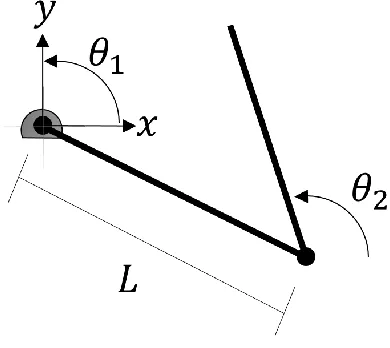
chain of length two. Figure 1 shows the components of the two linkage arm example.
Figure 1: Two-Linkage Arm
The system should be controllable in order to produce motion, so consider the case in which
3 at each joint to produce rotation in the linkages. Thus by the method outlined in this topic,
there are two elementary movements the system is capable of. The first involves only the
motor at the origin, or the “shoulder joint”. The second elementary movement involves only
the motor where the linkages are connected, or the elbow joint. Both elementary movements
can move only once and in only one direction.
2.3.
Parameterization
Once the most elementary movements of the system are identified, they must be
parameterized. Values must be defined which will influence the movement so that it can
easily be modified. It is necessary to identify parameters in both time and space, though it is
possible to decouple the two, thus reducing the complexity of the movement. For the
example with the two-linkage arm, three parameters are identified for each elementary
movement. The three parameters are: how much the linkage moves, when the movement
occurs, and how long the movement takes. These parameters allow for simple manipulation
of the elementary movement, and are crucial building blocks for subsequent steps. More
information on the parameterization process for this research can be found in Appendix A.
2.4.
Optimization
From previous research, it is clear that biological processes strive to minimize effort
[3][7][8]. Everything from crowd patterns to communication methods include some level of
least-effort solutions. It is, therefore, beneficial to attempt to minimize effort in the desired
movements to further mimic the methods of biological learning. This can easily be done
through the use of optimization techniques. Optimization of any movement requires a
balance between achieving the end goal while exerting the least amount of effort possible.
The optimization function adjusts the variables used to parameterize the elementary
movements to create a desirable solution. The manipulation of the movement through
optimization serves to automate the process of finding the least effort solutions. More
information on the optimization process for this research can be found in Appendix B.
2.5.
Control Theory
In order to create motion in the system, a path is prescribed to each linkage as a function of
time. The controller manipulates the motors in an attempt to follow the prescribed path. For
this simulation, a Linear Quadratic Regulator is selected as the control method for the
4 [9]. The Linear Quadratic Regulator used during this experiment implemented tracking and
regulation control to manipulate the linkages [10]. This method divides the control into two
distinct tasks. The tracking portion of the controller uses the moment of inertia of the
linkages and the required angular acceleration to calculate the moment necessary to induce
the desired motion. This portion of the controller requires previous knowledge of the system
parameters in order to calculate the moment of inertia. The tracking component does not
account for disturbances resulting from gravity or other external forces and moments, such as
those imposed by the other linkage. The regulation portion of the controller is tasked with
maintaining the desired path despite external disturbances to the system. This functions much
like a classic Proportional-Derivative controller in that it regulates the angular position and
angular velocity to match the desired position and velocity, respectively. This task also
requires sensors to determine the actual position of the linkages, something that is simplified
by a simulation. The regulation control also requires gains for the sensitivity to position and
velocity error, and tuning of these gains is necessary to create a stable and functional
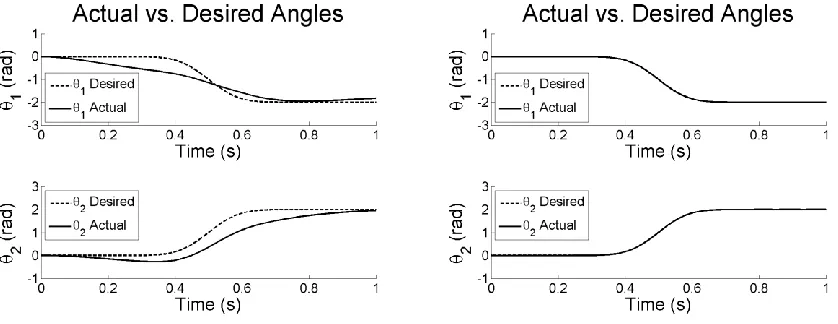
controller. Figure 2 and Figure 3 show a comparison of controller behavior with different
gains.
Figure 2: Loose Controller Gains Figure 3: Tight Controller Gains
Notice that in Figure 3, the desired path and actual path are nearly indistinguishable. For the
remainder of the paper, the desired paths will not be shown, as the controller is tuned to
follow the prescribed path. The effort of the motion is determined from the power consumed
by the motors during the movement. Therefore, the effort of the movement is directly
affected by the prescribed path. More information on the control process for this research can
5
2.6.
Coordination
After optimizing the elementary movements, it is possible to construct movements of higher
complexity. To construct a movement of higher complexity, two simpler movements are
combined. At the lowest level of complexity, the simple movements are the elementary
movements. The process of combining two elementary movements to create a complex
movement is called coordination. For the two linkage example, one elementary movement is
bending the arm at the elbow and the other is rotating the arm at the shoulder. By
coordinating these two simple movements, a complex movement is created which involves
both rotating the shoulder and bending the elbow. The resultant movement is then
parameterized, and the process can continue to create increasingly complex movements.
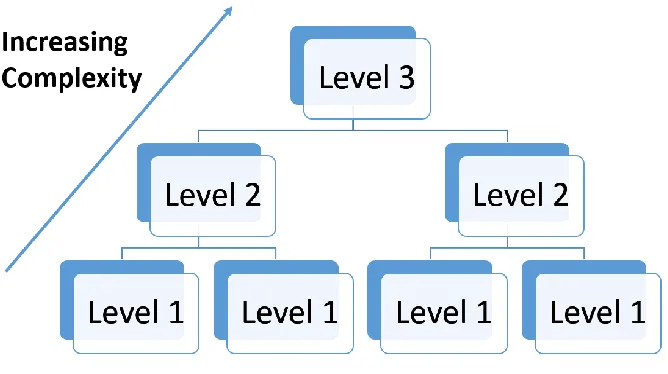
Figure 4 shows simple movements being coordinated to create more complex movements at
two consecutive levels.
Figure 4: Increasing Complexity
It is possible to continue this approach indefinitely, though it becomes clear that highly
sophisticated and lifelike movements are achievable after only three or four levels of
coordination.
2.6.1. Level 1
In order to create motion, a path must be prescribed. The Gaussian Error Function (erf) is
ideal for creating a path that both starts and ends at rest [11]. For the sake of simplifying the
simulation, all motions in this study have been limited to those that meet this criteria, and do
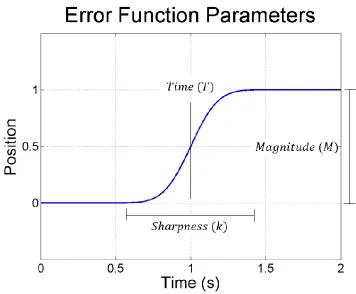
6 denoted as the completion time. Another benefit of the Gaussian Error Function is that it can
be easily manipulated in three ways by modifying the variables in the function. A sample
Gaussian Error Function (erf) equation can be seen in Equation (1).
𝐺𝐸𝐹(𝑡) = M
2erf(𝑘(𝑡 − T)) (1)
Where 𝑡 is time, 𝑀 is the magnitude of the motion, 𝑘 is the sharpness of the transition, and 𝑇
is the moment in time that the motion is centered about. 𝐺𝐸𝐹 is a path as a function of time
that both starts and ends at rest. A sample Gaussian Error Function plot is shown below in
Figure 5.
Figure 5: Gaussian Error Function Plot
With control over the magnitude of the motion, sharpness of the motion, and time at which
the motion occurs, the linkage can be made to perform a variety of elementary movements.
2.6.2. Level 2
Level 2 movements are created by coordinating two Level 1 movements. For this
coordination, Level 1 movements are considered simple and Level 2 movements are
considered complex. When selecting the Level 2 movements, it is important to plan ahead
7 the Level 2 movements created. To achieve this, orthogonal movements can be created to
encompass the largest range of motion with the least number of coordinations. For the
example of the two linkage arm, the selected Level 2 movements are extension or retraction
of the end point in the radial direction (r) and rotation of the arm in the angular direction (𝜃),
thus creating polar coordinates for the end point. For the duration of this paper, these Level 2
movements are called modes since they correlate to orthogonal movements. In the
simulation, prescribing the first mode will create the motion in Figure 6, and prescribing the
second mode will create the motion in Figure 7.
Figure 6: Mode 1 Movement, Rotation Figure 7: Mode 2 Movement, Extension
Figure 8 shows a path prescribed by the first mode and Figure 9 shows a path prescribed by
the second mode.
8 These movements are complex relative to the elementary movements in Level 1, but are still
quite basic.
2.6.3. Higher Levels
The method for coordinating higher levels is similar to that used in creating Level 2
movements in that the two simple movements are combined to create one complex
movement. The biggest difference higher levels have from lower levels is that there are a
much greater number of possible movements. For example, in the two linkage arm case,
Level 2 movements can be characterized into Mode 1 and Mode 2, thus covering the entire
capability of the system at Level 2. It is much more difficult to use the same approach on
Level 3, because the capability of the system is much greater. Attempting to categorize all
possible movements becomes increasingly more difficult as the levels progress, thus making
the approach undesirable. Therefore, it is decided that movements at Level 3 and higher
should be selected based on the specific needs of the user, and with the end goal in mind,
rather than attempting to encompass the entire realm of possible movements. More
information on the coordination process for this research can be found in Appendix D.
2.7.
Defining Success
In order to create the desired movements, it is first important to define the characteristics of
success. As defined by the researcher, the ultimate goal of any motion is to touch the end
point to a desired position in Cartesian coordinates. This goal serves many purposes since it
is relatively precise and pertains to many industrial applications. It is interesting to note that a
large portion of the motions carried out by living organisms can be considered a combination
of simple end point assignments. Another key element to a successful motion is to consume
the least amount of effort possible. By conserving effort, the motion becomes less costly on
the system in terms of wear and fuel usage [12]. In addition to achieving the desired end goal
and conserving effort, other markers of success include completing the motion in a timely
manner and re-establishing rest at the final position. For this reason, every simulation has a
completion time in which the motion is required to be completed, and the linkages are to
return to rest.
It is important to note that in a two link system, any end point assignment will produce, at
9 the final configuration contains an infinite number of possibilities. Thus, it is the goal of this
research to study the path with which success is achieved rather than the final position.
3.
Results
3.1.
Overview
The results of this research are based on the two linkage arm example. The two linkage case
is simple to model and intuitive to observe, yet elaborate enough to construct highly complex
movements. A two linkage arm is simulated to mimic the mass and dimensions of the arm of
a human arm. For this experiment, the free end of the second linkage is considered the point
of interest, as this would be the location of a hand. All tasks involving an end goal will
impose position requirements on the free end of the second linkage, which from now on will
be referred to as the end point. A free-body diagram of the two linkage arm is shown in
Figure 10.
Figure 10: Free Body Diagram of Linkages
In order to make the system controllable, a motor is simulated at each pin and is used to
modify the angle of the respective linkage. The angle at 𝜃1 is controlled by applying a
shoulder-like point moment at the origin. The angle at 𝜃2 is controlled by applying an
elbow-like point moment at the joint between linkage one and linkage two. To simplify the
simulation, no limitation in the range of motion of the two joints is applied. More
10
3.2.
Incremental Learning
3.2.1. Level 1
Level 1 movements are constructed with the same method outlined in Section 2.6.1. Gaussian
Error Functions are used to change the position of a single member. For the example of the
two linkage arm simulation, these paths correlate to the angle of each linkage in radians, as a
function of time.
3.2.2. Level 2
Level 2 movements are constructed with the same method outlined in Section 2.6.2. For the
example of the two linkage arm simulation, the two modes consist of moving the end point in
and out from the shoulder radially, and rotating the entire system as one about the shoulder.
These two modes provide a strong foundation for creating movements of higher complexity.
3.2.3. Level 3
The third level of complexity involves coordinating two Level 2 movements together to
create a Level 3 movement. This is the same process as creating Level 2 movements from
Level 1 movements, except there are no longer obvious choices for which movements to
create. Level 3 movements are more sophisticated, thus allowing more useful motions to be
created, so it is more important to create useful Level 3 movements than to create every
conceivable movement at this level. For this research, several tasks are constructed that
humans use every day, including bringing the end point in close to the body or raising it
above the shoulder. A library of the movements achievable at Level 3 can be created; four
distinct Level 3 movements are created for this example.
The first movement starts from an initial position which holds the arm out straight at -45
degrees from the positive x-axis. The movement then brings the end point up and in towards
the shoulder by using both Mode 1 and Mode 2. Figure 11 shows the initial position and the
end goal of this movement, denoted by a red “x”, and Figure 12 shows the time lapse of the
11
Figure 11: Goal Level 3, Movement 1 Figure 12: Time Lapse Level 3, Movement 1
The second movement starts at a similar position to the one that movement 1 ended at. The
end point begins near the shoulder before lifting out and above the origin to hold the arm
straight out at +45 degrees from the positive x-axis. Figure 13 shows the initial position and
end goal of this movement, and Figure 14 shows the time lapse of the least effort motion
prescribed by this movement.
Figure 13: Goal Level 3, Movement 2 Figure 14: Time Lapse Level 3, Movement 2
The third movement starts with the initial position straight out from the shoulder at -45
degrees from the positive x-axis, just like the first movement. The movement then places the
end point level with the shoulder with the arm straight out on the positive x-axis. Figure 15
shows the initial position and end goal of this movement and Figure 16 shows the time lapse
12
Figure 15: Goal Level 3, Movement 3 Figure 16: Time Lapse Level 3, Movement 3
It is interesting to note that the chosen path for the third movement almost completely
neglects to utilize Mode 2, since the end point begins at the desired radius from the shoulder.
The forth movement initial position consists of the arm held straight out on the positive
x-axis, similar to where the third movement ended. The movement then places the end point
out and away from the origin to hold the arm straight out at +45 degrees from the positive
x-axis. This is the same end point as prescribed in the second movement. Figure 17 shows the
initial position and end goal of this movement and Figure 18 shows the time lapse of the least
effort motion prescribed by this movement.
Figure 17: Goal Level 3, Movement 4 Figure 18: Time Lapse Level 3, Movement 4
It is, again, interesting to note that this movement neglects to utilize much of Mode 2, since
the initial radius begins near the desired radius of the end point.
These movements have been chosen to create a specific set of tasks in Level 4 as described in
13 3.2.4. Level 4
Level 4 movements continue the trend by combining two Level 3 movements to create an
even higher level of complexity. At this point, there is very little the arm is incapable of
doing, so it is possible to construct very intuitive movements. For this reason, this level
allows for the comparison of gaits which seek to identify the advantages and disadvantages
of a particular path, even if the same end goal is achieved [13]. The study of gaits explores
the manner in which the goal is achieved, making it a useful topic of exploration. The use of
gaits to compare movements provides further insight into why biomimicry is such a useful
method for creating complex movements.
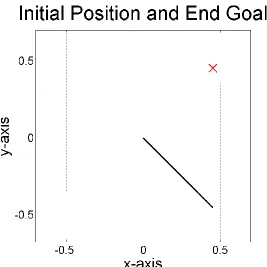
To do this, two identical goals are achieved through two different means. The goal is to lift
the arm from a straight out position at -45 degrees to a straight out position at +45 degrees
from the positive x-axis with a five second completion time. Path 1 brings the end point in
towards the shoulder to reduce gravitational forces before moving it out and upward to the
end goal. Path 2 rotates the end point out horizontally, without bringing the end point in
towards the shoulder, before continuing upward to the end goal. Figure 19 shows the initial
position and end goal for both cases.
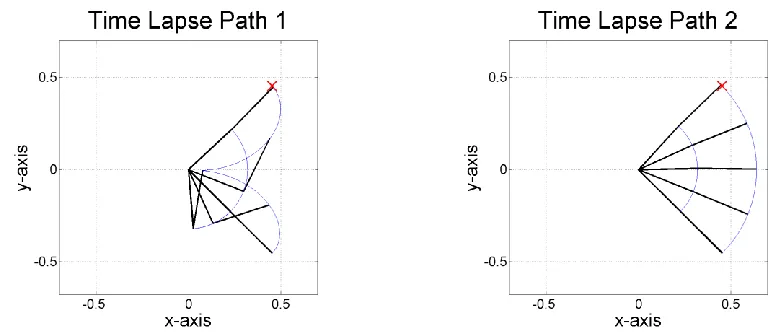
14 The movement for Path 1 combines the movements created at Level 3 shown in Figure 12
and Figure 14. The initial position of the movement is straight out, at -45 degrees from the
positive x-axis. The movement then brings the end point in towards the shoulder as done in
Level 3, movement 1. The movement then continues to place the end point out and above the
origin to straight out, at +45 degrees from the positive x-axis.
The path taken for Path 2 combines the movements created at Level 3 shown in Figure 16
and Figure 18. The initial position of the movement is straight out, at -45 degrees from the
positive x-axis. The movement then places the end point level to the shoulder with the arm
straight out on the positive x-axis, as done in Level 3, movement 3. The movement then
continues to place the end point out and away from the origin to hold the arm straight out, at
+45 degrees from the positive x-axis. This is the same end point as prescribed by the Path 1
movement.
Figure 20 shows the time lapse of the motion prescribed by Path 1, and Figure 21 shows the
time lapse of the motion prescribed by Path 2.
Figure 20: Time Lapse Level 4 Path 1 Figure 21: Time Lapse Level 4 Path 2
It is interesting to note that Path 2 is considerably more direct than Path 1, while both achieve
the same outcome.
3.2.5. Comparison
By observing the two gaits, a comparison of the paths can be made. In this comparison, all
Level 3 movements have one second completion times and all Level 4 movements have five
15
Table 1: Path 1 & 2 Cost Comparison, Five Second Completion Time
Path 1 Path 2
Level 3 Movement 1 1352.41 323.08
Level 3 Movement 2 892.34 246.59
Level 4 Movement 931.76 381.97
It is clear that both the Level 3 and Level 4 movements are less costly in Path 2. This is not
surprising because the path is quite direct. Through observation of the human body, however,
it is evident that sometimes Path 1 is chosen over Path 2. Intuition suggests that the choice of
paths may be dependent on how fast the movement is to be executed. To investigate the
effect that completion time has on path selection, the same Level 3 movements are used to
create similar Level 4 movements, but with ten second completion times instead of five. The
time lapse for Path 1 can be seen in Figure 22, and the time lapse for Path 2 can be seen in
Figure 23.
Figure 22: Time Lapse of Path 1 at Ten Seconds
Figure 23: Time Lapse of Path 2 at Ten Seconds
Table 2 shows the design variables and costs of the two paths at ten seconds.
Table 2: Path 1 & 2 Cost Comparison, Ten Second Completion Time
Path 1 Path 2 456.15 829.28
It is seen that with a ten second completion time, Path 1 proves to be the least costly solution.
This finding makes it clear that the chosen path depends greatly on the total time of the
16 performed ranging from 1-15 seconds. The results from the comparisons are summarized in
Table 3.
Table 3: Path 1 & 2 Cost Comparison, Many Completion Times
Time Path 1 Path 2
1.00 5530.36 1223.44 2.00 2366.81 471.76 3.00 1464.72 326.25
5.00 931.76 381.97
7.75 572.27 575.61
10.00 456.15 829.28
15.00 698.78 1312.35
The data from Table 3 is plotted in Figure 24.
Figure 24: Path 1 & 2 at Various Times
It can be seen that Path 2 has a distinct advantage over Path 1 when the time of the
movement is relatively short. This is due to the fact that the movement is direct, thus
reducing the amount of acceleration required to complete the task within the completion
time. It can also be seen that Path 1 has a distinct advantage over Path 2 when the completion
17 closer to the shoulder, thus reducing the moment applied to the arm by gravitational
acceleration.
It is also interesting to note that the cost increases rapidly for both paths as the completion
time approaches zero. This can be attributed to the acceleration required to produce the
desired results in a very short time span. It is also interesting to note that the cost of both
paths increases steadily as the completion time increases beyond ten seconds. This can be
attributed to the greater time over which the motors must overcome gravity to keep the arm
up.
4.
Conclusion
4.1.
Incremental Learning
This study provides an in-depth analysis of a method for training advanced locomotive skills
through incremental learning. It is concluded that the method outlined in this paper can be a
useful technique for methodically creating complex movements. By providing least effort
solutions through the method of optimized coordination, biomimicry is achieved. It is also
clear from the results that predictable and intuitive solutions can be obtained. These results
closely mimic the behavior of natural movement by humans and other animals, thus
providing possible uses in prosthetics or other industries in which human interaction with the
device may be required. It can be concluded that part based learning with increasing
complexity can create efficient, reliable solutions in various applications of path planning.
Furthermore, incremental learning may provide advantages over other methods of path
planning with respect to computational power and memory storage requirements. It should
also be noted that this concept could be extrapolated to other applications that involve motion
planning such as walking, running, or throwing.
4.2.
Gaits
The study of gaits in this topic serves to provide insight into decision making in motion
planning based on the given constraints in time and space. The example results confirm that
reducing the effect of gravitational acceleration is superior over long periods of time while
increasing the directness of the movement is superior over short periods of time. The results
found that both paths examined produce similar costs at the completion time of 7.75 seconds.
18 and greater than 10 seconds, begin penalizing the motion for power consumption
requirements. This serves to provide further insight into completion time selections for real
human motion, and builds confidence in the results.
It is useful to compare the results of the simulation with those of humans, since the
specifications of the simulation closely resemble those of a real arm. It is intuitive to observe
how closely the upper level movements mimic the preferences of highly trained human
motion. It can be seen that mimicking the learning behavior of natural beings unlocks one of
the many benefits of biomimicry in motion planning.
4.3.
Future Work
Several areas of research are suggested to further expand upon this topic. While the method
itself is broad and may pertain to a large number of applications, the specific examples used
to demonstrate this method have, thus far, been limited.
4.3.1. New Limbs
The example used in this research is limited to the simulation of a human arm. It may be
interesting to observe the usefulness of the outlined approach with applications to legs,
hands, or other limbs, such as the tail of a fish. It is predicted that effort conservation will be
a main driving force for the path planning of any system and may provide insight into many
motions of higher complexity, thus allowing for greater engineering opportunities.
4.3.2. Increased Degrees-of-Freedom
The system modeled in this research topic includes only two degrees-of-freedom. This
proved sufficient for demonstrating the method of incremental learning and for the
observation of gaits. With two linkage systems, there are only two final positions that will
touch the end point to the desired location. But by using a three or more degrees-of-freedom
system, the final positions of the linkages will not be obvious. This will allow for greater
freedom on behalf of the simulation and could mimic biomechanics even more closely.
4.3.3. Three Dimensions
The system modeled in this research topic is two-dimensional. Two dimensions are sufficient
for demonstrating path planning and incremental learning, but this limitation severely
restricts the kinds of paths that can be created. By adding the third dimension, the range of
19 4.3.4. Higher Motion Complexity
In this research topic, the highest level of movement complexity observed is Level 4. While
the complexity of these movements are relatively high, there is no limit to the level of
complexity that the method can obtain. Level 5 movements would provide even greater
opportunities to the system, and the process can continue until the desired complexity is
20 REFERENCES
[1] Lurie-Luke, E., 2014, “Product and technology innovation: What can biomimicry inspire?,” Biotechnol. Adv., 32(8), pp. 1494–1505.
[2] Qin, Q., Cheng, S., Zhang, Q., Li, L., and Shi, Y., 2015, “Biomimicry of parasitic behavior in a coevolutionary particle swarm optimization algorithm for global optimization,” Appl. Soft Comput., 32, pp. 224–240.
[3] Passino, K. M., 2006, Biomimicry for Optimization, Control and Automation.
[4] Boston Dynamics, 2016, “Robots” [Online]. Available:
http://www.bostondynamics.com/index.html. [Accessed: 03-Jan-2016].
[5] Johns Hopkins Applied Physics Laboratory, 2016, “Prosthetics” [Online]. Available: http://www.jhuapl.edu/prosthetics/. [Accessed: 03-Jan-2016].
[6] ABB, 2016, “ABB Robotics” [Online]. Available:
http://new.abb.com/products/robotics. [Accessed: 03-Jan-2016].
[7] Guy, S. J., Curtis, S., Lin, M. C., and Manocha, D., 2012, “Least-effort trajectories lead to emergent crowd behaviors,” Phys. Rev. E - Stat. Nonlinear, Soft Matter Phys., 85(1), pp. 1–7.
[8] Prokopenko, M., Ay, N., Obst, O., and Polani, D., 2010, “Phase transitions in least-effort communications,” J. Stat. Mech. Theory Exp., 2010(11), p. P11025.
[9] Capron, B. D. O., and Odloak, D., 2015, “An extended Linear Quadratic Regulator with zone control and input targets,” J. Process Control, 29, pp. 33–44.
[10] Mackunis, W., Gans, N., Parikh, A., and Dixon, W. E., 2014, “UNIFIED TRACKING AND REGULATION VISUAL SERVO CONTROL FOR WHEELED MOBILE ROBOTS,” 16(3), pp. 669–678.
[11] Chaudhuri, S., and Solar-Lezama, A., 2010, “Smooth interpretation,” ACM SIGPLAN Not., 45(6), p. 279.
[12] Donelan, J. M., Kram, R., and Kuo, A. D., 2001, “Mechanical and metabolic determinants of the preferred step width in human walking.,” Proc. Biol. Sci., 268(1480), pp. 1985–92.
[13] Römer, U., Fidlin, A., and Seemann, W., 2015, “Investigation of optimal bipedal walking gaits subject to different energy-based objective functions,” Pamm, 15(1), pp. 69–70.
[14] De Leva, P., 1996, “Adjustments to zatsiorsky-seluyanov’s segment inertia parameters,” J. Biomech., 29(9), pp. 1223–1230.
[15] National Aeronautics and Space Administration, 1995, “HUMAN PERFORMANCE CAPABILITIES,” Man-Systems Integr. Stand., 1 [Online]. Available:
22
Appendix A: Parameterization
Gauss Error Function
With control over the magnitude and sharpness of the motion, and the time at which the
motion occurs, the linkage can be made to perform a variety of movements. Figure 25 shows
the effect of varying the magnitude of the Gauss Error Function.
Figure 25: Gauss Error Function with Varying Magnitude
Figure 26 shows the effect of varying the sharpness of the Gauss Error Function.
23 Figure 27 shows the effect of varying the time at which the Gauss Error Function occurs.
Figure 27: Gauss Error Function with Varying Time
Equations for the two modes of movement can be found in Table 4.
Table 4: Level 1, Modes
Function Equation Mode 1 𝑞1(𝑡) = 𝑀1
2 erf(𝑘1(𝑡 − 𝑇1))
Mode 2 𝑞2(𝑡) =𝑀2
24
Figure 28: Error Function Scaled and Shifted
To ensure the prescribed path of the movement starts where the simulation begins at 𝑡 = 0,
the Gauss Error Function is shifted upward to start at zero, the magnitude is scaled down by a
factor of two, and the initial angles of each linkage (𝛽) are added to the equation.
Table 5: Level 2, Movements
Function Equation Shift 1 (𝑞1(0)) 𝑠ℎ𝑖𝑓𝑡1 = 𝑀1
2 erf(−𝑘1𝑇1)
Shift 2 (𝑞2(0)) 𝑠ℎ𝑖𝑓𝑡2 = 𝑀2
2 erf(−𝑘2𝑇2)
Shifted Mode 1 𝑄1(𝑡) = 𝑞1(𝑡) − 𝑠ℎ𝑖𝑓𝑡1 Shifted Mode 2 𝑄1(𝑡) = 𝑞2(𝑡) − 𝑠ℎ𝑖𝑓𝑡2 Motion 1 𝜃𝑑1(𝑡) = 𝑄1(𝑡) + 𝑄2(𝑡) + 𝛽1 Motion 2 𝜃𝑑2(𝑡) = 𝑄1(𝑡) − 𝑄2(𝑡) + 𝛽2
Appendix B: Optimization
Cost Function
A cost function is a unit-less measure of the quality of a particular solution. By
mathematically representing the requirements for success, a cost function is used to assign a
numerical value to the quality of a particular solution. Each simulation results in a cost value,
and can be compared to other results in order to mathematically determine the relative
successfulness of each solution. Smaller cost values denote higher quality solutions. Any
undesirable behavior of the solution will incur a penalty proportional to the level of deviation
25 The cost function is the most subjective component of any optimization problem. The user
determines which characteristics denote success and how heavily they should be valued.
These markers of success and their respective weights greatly alter the behavior of the
optimization tools being utilized, and are subjective to personal preference. For this research
project, the cost function is designed to mimic the markers for success and respective
priorities of human motion.
It is deemed that the end point location should be the most highly weighted component since
failure to complete this marker produces meaningless data. Any end point value within a
small radius around the desired end point is considered a complete success and incurs no
penalty. This ensures success is achievable and very small errors will not distort the
measurement of success. Any end point value outside the radius incurs a penalty proportional
to the distance from the desired end point [3].
Second, the simulation must re-establish stillness at the completion time. Any velocity
present at the completion time indicates that the motion is not finished and the solution is
penalized accordingly.
The third priority is to minimize the effort of the motion. The effort is represented by the
power fraction and is proportional to the moments applied by the motors. The power fraction
is the most indicative marker of the quality of the motion path since the heavy weighting on
the end point and velocity constraints quickly eliminate all solutions that don’t achieve the
end goal. Once the end goal is achieved, the simulation can begin to optimize the path. By
optimizing the path to conserve effort, elegant solutions begin to appear. This phenomenon is
one of the most important concepts in this research topic.
Finally, a fourth variable is added to the cost function, called a proximity penalty, which
penalizes the solution for being very far from the desired end point. While poor solutions
would already be penalized in other ways, the proximity penalty quickly eliminates solutions
that are very far from the desired end point, such as those in other quadrants. This drastically
speeds up the time required by the optimization code to begin producing feasible solutions.
26
Table 6: Cost Function
Cost Function 𝐹𝑖𝑡𝑛𝑒𝑠𝑠 = 𝑊𝑡(𝑊𝑝𝑃 + 𝑊𝑒𝑝𝐸 + 𝑊𝑒𝑣𝐸̇ + 𝑊𝑥X)
Where: 𝑊𝑡 = 𝑇𝑜𝑡𝑎𝑙𝑊𝑒𝑖𝑔ℎ𝑡
𝑊𝑒𝑝 = 𝐸𝑟𝑟𝑜𝑟𝑖𝑛𝑃𝑜𝑠𝑖𝑡𝑖𝑜𝑛𝑊𝑒𝑖𝑔ℎ𝑡
𝑊𝑒𝑣 = 𝐸𝑟𝑟𝑜𝑟𝑖𝑛𝑉𝑒𝑙𝑜𝑐𝑖𝑡𝑦𝑊𝑒𝑖𝑔ℎ𝑡
𝑊𝑥 = 𝑃𝑟𝑜𝑥𝑖𝑚𝑖𝑡𝑦𝑃𝑒𝑛𝑎𝑙𝑡𝑦𝑊𝑒𝑖𝑔ℎ𝑡
𝑃 = 𝐸𝑓𝑓𝑜𝑟𝑡
𝐸 = 𝐸𝑟𝑟𝑜𝑟𝑖𝑛𝐹𝑖𝑛𝑎𝑙𝑃𝑜𝑠𝑖𝑡𝑖𝑜𝑛
𝐸̇ = 𝐸𝑟𝑟𝑜𝑟𝑖𝑛𝐹𝑖𝑛𝑎𝑙𝑉𝑒𝑙𝑜𝑐𝑖𝑡𝑦
X = 𝐼𝑛𝑓𝑖𝑛𝑖𝑡𝑒𝐵𝑎𝑟𝑟𝑖𝑒𝑟𝑃𝑒𝑛𝑎𝑙𝑡𝑦𝑎𝑡𝑟𝑎𝑑𝑖𝑖𝑔𝑟𝑒𝑎𝑡𝑒𝑟𝑡ℎ𝑎𝑛𝐿
Steepest Descent
A steepest descent optimization function is used to create motions autonomously. Steepest
descent optimization is a gradient based optimization approach in which initial conditions are
assigned to the design variables which are then adjusted iteratively to reduce the value of the
cost function. For this experiment, the six design variables are the magnitude, sharpness, and
time of each of the two linkage paths. The steepest descent function runs the simulation with
the initial conditions and records the cost of the solution. It then makes small changes to each
of the design variables, one at a time, and records the resulting costs. These values are used
to determine a gradient of the design variables and steps are taken along the gradient, or
steepest descent, until the cost is no longer improving. At this point, a new gradient will be
determined and the procedure will continue. The process will continue until either no more
improvements can be made or the program has reached a previously assigned iteration limit.
Steepest descent optimization has many advantages. Since it is a gradient based optimization
tool, there are no randomization effects, thus the results are repeatable. This is very important
when comparing solutions of many different motions because a randomization effect may
cause unpredictable and even misleading results. Another benefit to using steepest descent
over a heuristic method is the speed at which solutions are achieved. In a practical scenario,
the system should not be asked to perform thousands of tasks to find a feasible solution. With
steepest descent, reasonable solutions can begin appearing after only one or two gradients, or
about 10-20 iterations for this case. In addition to repeatability and speed of convergence,
steepest descent optimization is incredibly robust. Steepest descent will always converge to a
local minimum, making it ideal for situations that include multiple solutions, as a solution is
27 There are also disadvantages of using steepest descent compared to using other optimization
techniques. The largest disadvantage is the weakness the process has to local minima. Local
minima are areas of the design space in which the cost is the lowest point within a small
radius. Any small change in design variables in any direction will produce more costly
results, thus the optimization is finished. This local minimum may not be the best solution
but there is no way for the optimization process to find a better one. This phenomenon is
entirely dependent on the initial conditions of the design variable. For this reason, it may be
necessary to adapt the initial conditions of the design variables if the steepest descent
solution is undesirable in any way. The concept of choosing appropriate initial conditions
could be an entire research topic of its own.
Appendix C: Control
To more accurately mimic a human arm, the motors are limited in the maximum moment that
can be applied. The maximum moment values are similar to those found in shoulder and
elbow muscles [15]. Terminology for the controller can be seen in Table 7, below.
Table 7: Controller Terminology
Controller Terminology Variable
Desired angle of link 1 𝜃𝑑1
Desired angle of link 2 𝜃𝑑2
Actual angle of link 1 𝜃𝑎1
Actual angle of link 2 𝜃𝑎2
Regulation gain for position of link 1 𝑔1
Regulation gain for position of link 2 𝑔2
Regulation gain for velocity of link 1 ℎ1
Regulation gain for velocity of link 2 ℎ2
The maximum torque allowed by motor 1 𝑐𝑙𝑖𝑝1
The maximum torque allowed by motor 2 𝑐𝑙𝑖𝑝2
Equations for the moments applied by the controller can be seen in Table 8, below.
Table 8: Tracking and Regulation
Function Equation
Moment of Inertia for link 1 𝐼1 = 1 12𝑚1𝐿
2
Moment of Inertia for link 2 𝐼2 = 1
12𝑚2𝐿 2
Tracking Moment for link 1 𝑀𝑡1 = 𝐼1𝜃̈𝑑1
28 Regulation Moment for link 1 𝑀𝑟1 = 𝑔1(𝜃𝑑1 − 𝜃𝑎1) + ℎ1(𝜃̇𝑑1− 𝜃𝑎1̇ )
Regulation Moment for link 2 𝑀𝑟2 = 𝑔2(𝜃𝑑2− 𝜃𝑎2) + ℎ2(𝜃̇𝑑2 − 𝜃𝑎2̇ )
Moment applied by controller at joint 1 𝑀𝑎𝑝𝑝𝑙𝑖𝑒𝑑1 = 𝑀𝑡1+ 𝑀𝑟1
Moment applied by controller at joint 2 𝑀𝑎𝑝𝑝𝑙𝑖𝑒𝑑2 = 𝑀𝑡2+ 𝑀𝑟2
Power Fraction of controller (squared) 𝑃 = (𝑀𝑎𝑝𝑝𝑙𝑖𝑒𝑑1
𝑐𝑙𝑖𝑝1 ) 2
+ (𝑀𝑎𝑝𝑝𝑙𝑖𝑒𝑑2
𝑐𝑙𝑖𝑝2 ) 2
Appendix D: Coordination
For coordinating movements at Level 4, it is necessary to be able to stretch and shift the
Level 3 movements to preserve the general shape while adjusting the movement for the
coordination process. Three parameters are created to serve as the high level equivalents of
the 𝑇, 𝑘, and 𝑀 variables from the Gauss Error Function (see Appendix A). These new
variables consist of: 𝑠𝑐𝑎𝑙𝑒𝑡 which shifts the time of the entire simple movement, 𝑠𝑐𝑎𝑙𝑒𝑠
which scales the sharpness of the simple movement, and 𝑠𝑐𝑎𝑙𝑒𝑚 which scales the magnitude
of the simple movement. Manipulating the three new variables will modify the shape of the
simple movement by producing new values for 𝑇, 𝑘, and 𝑀. Table 9 shows the governing
29
Table 9: Shifting and Scaling Design Variables
Variable Definition
𝑡𝑖𝑚𝑒𝑠𝑖𝑚𝑝 The time of the simple movement
𝑠ℎ𝑎𝑟𝑝𝑠𝑖𝑚𝑝 The sharpness of the simple movement
𝑚𝑎𝑔𝑠𝑖𝑚𝑝 The magnitude of the simple movement
𝑠𝑐𝑎𝑙𝑒𝑡 The amount that the time is scaled
𝑠𝑐𝑎𝑙𝑒𝑠 The amount that the sharpness is scaled
𝑠𝑐𝑎𝑙𝑒𝑚 The amount that the magnitude is scaled
𝑔𝑎𝑝 𝑔𝑎𝑝 = {
𝑡𝑖𝑚𝑒2𝑠𝑖𝑚𝑝−𝑡𝑖𝑚𝑒1𝑠𝑖𝑚𝑝
𝑠𝑐𝑎𝑙𝑒𝑠1 𝑖𝑓𝑡𝑖𝑚𝑒1𝑠𝑖𝑚𝑝 < 𝑡𝑖𝑚𝑒2𝑠𝑖𝑚𝑝
𝑡𝑖𝑚𝑒1𝑠𝑖𝑚𝑝−𝑡𝑖𝑚𝑒2𝑠𝑖𝑚𝑝
𝑠𝑐𝑎𝑙𝑒𝑠1 𝑖𝑓𝑡𝑖𝑚𝑒1𝑠𝑖𝑚𝑝 > 𝑡𝑖𝑚𝑒2𝑠𝑖𝑚𝑝
𝑐𝑒𝑛𝑡𝑒𝑟 𝑐𝑒𝑛𝑡𝑒𝑟 =𝑡𝑖𝑚𝑒1𝑠𝑖𝑚𝑝+𝑡𝑖𝑚𝑒2𝑠𝑖𝑚𝑝
2
𝑡𝑖𝑚𝑒𝑠ℎ𝑖𝑓𝑡1 𝑡𝑖𝑚𝑒𝑠ℎ𝑖𝑓𝑡1 = {
𝑐𝑒𝑛𝑡𝑒𝑟
2 −
𝑔𝑎𝑝
2 𝑖𝑓𝑡𝑖𝑚𝑒1𝑠𝑖𝑚𝑝 < 𝑡𝑖𝑚𝑒2𝑠𝑖𝑚𝑝 𝑐𝑒𝑛𝑡𝑒𝑟
2 +
𝑔𝑎𝑝
2 𝑖𝑓𝑡𝑖𝑚𝑒1𝑠𝑖𝑚𝑝 > 𝑡𝑖𝑚𝑒2𝑠𝑖𝑚𝑝
𝑡𝑖𝑚𝑒𝑠ℎ𝑖𝑓𝑡2 𝑡𝑖𝑚𝑒𝑠ℎ𝑖𝑓𝑡2 = {
𝑐𝑒𝑛𝑡𝑒𝑟
2 +
𝑔𝑎𝑝
2 𝑖𝑓𝑡𝑖𝑚𝑒1𝑠𝑖𝑚𝑝 < 𝑡𝑖𝑚𝑒2𝑠𝑖𝑚𝑝 𝑐𝑒𝑛𝑡𝑒𝑟
2 −
𝑔𝑎𝑝
2 𝑖𝑓𝑡𝑖𝑚𝑒1𝑠𝑖𝑚𝑝 > 𝑡𝑖𝑚𝑒2𝑠𝑖𝑚𝑝
𝑡𝑖𝑚𝑒1𝑐𝑜𝑚𝑝 𝑡𝑖𝑚𝑒1𝑐𝑜𝑚𝑝 = 𝑡𝑖𝑚𝑒𝑠ℎ𝑖𝑓𝑡1+ 𝑠𝑐𝑎𝑙𝑒𝑡1
𝑡𝑖𝑚𝑒2𝑐𝑜𝑚𝑝 𝑡𝑖𝑚𝑒2𝑐𝑜𝑚𝑝 = 𝑡𝑖𝑚𝑒𝑠ℎ𝑖𝑓𝑡2+ 𝑠𝑐𝑎𝑙𝑒𝑡2
𝑠ℎ𝑎𝑟𝑝1𝑐𝑜𝑚𝑝 𝑠ℎ𝑎𝑟𝑝1𝑐𝑜𝑚𝑝 = 𝑠ℎ𝑎𝑟𝑝1𝑠𝑖𝑚𝑝 ∙ 𝑠𝑐𝑎𝑙𝑒𝑠1
𝑠ℎ𝑎𝑟𝑝2𝑐𝑜𝑚𝑝 𝑠ℎ𝑎𝑟𝑝2𝑐𝑜𝑚𝑝 = 𝑠ℎ𝑎𝑟𝑝2𝑠𝑖𝑚𝑝 ∙ 𝑠𝑐𝑎𝑙𝑒𝑠2
𝑚𝑎𝑔1𝑐𝑜𝑚𝑝 𝑚𝑎𝑔1𝑐𝑜𝑚𝑝 = 𝑚𝑎𝑔1𝑠𝑖𝑚𝑝∙ 𝑠𝑐𝑎𝑙𝑒𝑚1
𝑚𝑎𝑔2𝑐𝑜𝑚𝑝 𝑚𝑎𝑔2𝑐𝑜𝑚𝑝 = 𝑚𝑎𝑔2𝑠𝑖𝑚𝑝∙ 𝑠𝑐𝑎𝑙𝑒𝑚2
An example of scaling and shifting the simple movements can be seen in Figure 29 through
30
Figure 29: Level 3 Movement 1 Figure 30: Level 3 Movement 2
Figure 31: Level 4 Movement Shifted and Scaled
Observe how the Level 4 movement contains the shapes of both Level 3 movements, yet
31
Appendix E: Modeling
The modeling of the example used in this research is based on the free-body-diagram found
in Figure 10.
Numerical Integration
To simulate the system in MATLAB®, a numerical solution to the system is required. A
Runge-Kutta numerical integrator is used to create the position and velocity of the linkages
as a function of time over a series of very small time steps. This is done by converting the
equations of motion to the state space. Each linkage is represented by the parameters at the
center of mass of the linkage. Table 10 shows the state variables and their definitions.
Table 10: State Variables
Definition State Variable Parameter
𝑥-coordinate of Linkage 1 𝑧1 𝑥1
𝑦-coordinate of Linkage 1 𝑧2 𝑦1
Angle of Linkage 1 𝑧3 𝜃1
𝑥-velocity of Linkage 1 𝑧4 𝑥̇1
𝑦-velocity of Linkage 1 𝑧5 𝑦̇1
Angular velocity of Linkage 1 𝑧6 𝜃̇1
𝑥-coordinate of Linkage 2 𝑧7 𝑥2
𝑦-coordinate of Linkage 2 𝑧8 𝑦2
Angle of Linkage 2 𝑧9 𝜃2
𝑥-velocity of Linkage 2 𝑧10 𝑥̇2
𝑦-velocity of Linkage 2 𝑧11 𝑦̇2
Angular velocity of Linkage 2 𝑧12 𝜃̇2
To calculate the effects of the linkages on each other, the end point parameters of each
linkage must be found. Table 11 and Table 12 show the equations for finding the parameters
at the ends of the linkages based on the state variables.
Table 11: Linkage Positions at Ends
x-positions of End Points y-positions of End Points
𝑥11 = 𝑧1−𝐿
2cos(𝑧3) 𝑦11 = 𝑧2− 𝐿
2𝑠𝑖𝑛(𝑧3)
𝑥12 = 𝑧1+𝐿
2cos(𝑧3) 𝑦12 = 𝑧2+ 𝐿
2𝑠𝑖𝑛(𝑧3)
𝑥21 = 𝑧7 −𝐿
2cos(𝑧9) 𝑦21 = 𝑧8− 𝐿
2𝑠𝑖𝑛(𝑧9)
𝑥22 = 𝑧7 + 𝐿
2cos(𝑧9) 𝑦22 = 𝑧8+ 𝐿
32
Table 12: Linkage Velocities at Ends
x-velocity of End Points y-velocity of End Points
𝑥̇11 = 𝑧4+𝐿
2sin(𝑧3) 𝑧6 𝑦̇11 = 𝑧5− 𝐿
2𝑐𝑜 𝑠(𝑧3) 𝑧6
𝑥̇12 = 𝑧4− 𝐿
2sin(𝑧3) 𝑧6 𝑦̇12 = 𝑧5+ 𝐿
2𝑐𝑜 𝑠(𝑧3) 𝑧6
𝑥̇21 = 𝑧10+𝐿
2sin(𝑧9) 𝑧12 𝑦̇21 = 𝑧11 − 𝐿
2𝑐𝑜 𝑠(𝑧9) 𝑧12
𝑥̇22 = 𝑧10−𝐿
2sin(𝑧9) 𝑧12 𝑦̇22 = 𝑧11 + 𝐿
2𝑐𝑜 𝑠(𝑧9) 𝑧12
Joint Constraints
The joints of the system are modeled with translational and rotational springs and dampers.
This allows the system to more accurately model real life joints and also increases the
stability of the simulation. The values for the constants in the simulation can be found in
Table 13.
Table 13: Joint Constraints
Property Variable Value
Translational Springs 𝐾𝑡 37,000𝑁/𝑚 Rotational Springs 𝐾𝑟 0.1𝑁 ∙ 𝑚/𝑟𝑎𝑑 Translational Damper 1 𝐶𝑡1 200𝑁 ∙ 𝑠/𝑚 Translational Damper 2 𝐶𝑡2 100𝑁 ∙ 𝑠/𝑚 Rotational Dampers 𝐶𝑟 0.5𝑁 ∙ 𝑚 ∙ 𝑠/𝑟𝑎𝑑
It is important to note that no range-of-motion limits are present in the example simulation.
At one point during the experiment, the range-of-motion of the human elbow was included,
but served little benefit for demonstrating the method of incremental learning. The joints
serve to create spring and damper forces on the limbs depending on the relative position and
velocity of the linkages, called Stretch. Table 14 shows the relative position (𝑆) and velocity
(𝑆̇) of the linkage joints.
Table 14: Linkage Joint Relative Position and Velocity
Stretch Position & Velocity 1 Stretch Position & Velocity 2
𝑆1 = √(𝑥11− 0)2+ (𝑦
11 − 0)2 𝑆2 = √(𝑥21− 𝑥12)2+ (𝑦21− 𝑦12)2
𝑆̇1 =𝑥11𝑥̇11+𝑦11𝑦̇11
𝑆1 𝑆̇2 =
(𝑥21−𝑥12)(𝑥̇21−𝑥̇12)+(𝑦21−𝑦12)(𝑦̇21−𝑦̇12)
𝑆2
33
Table 15: Reaction Forces on Linkages
Stretch Components in x-direction Stretch Components in y-direction
𝑒1𝑥 = −(𝑥11−0)
𝑆1 𝑒1𝑦 = −
(𝑦11−0)
𝑆1
𝑒2𝑥 =(𝑥21−𝑥12)
𝑆2 𝑒2𝑦 =
(𝑦21−𝑦12)
𝑆2
Forces Due to Joints Damped Moments at Joints
𝐹1 = 𝐾𝑡1𝑆1 + 𝐶𝑡1𝑆̇1 𝑀1 = 𝐶𝑟1𝑧6
𝐹2 = 𝐾𝑡2𝑆2+ 𝐶𝑡2𝑆̇2 𝑀2 = 𝐶𝑟2(𝑧12 − 𝑧6)
Vector Components at Joint 1 Vector Components at Joint 2
𝐹𝑥1 = 𝐹1𝑒1𝑥 𝐹𝑥2= 𝐹2𝑒2𝑥
𝐹𝑦1 = 𝐹1𝑒1𝑦 𝑅𝑦2 = 𝐹2𝑒2𝑦
Reaction Forces and Moments at Joint 1 Reaction Forces and Moments at Joint 2
𝑅𝑥1 = 𝐹𝑥1+ 𝐹𝑥2 𝑅𝑥2= −𝐹𝑥2
𝑅𝑦1 = 𝐹𝑦1+ 𝐹𝑦2 𝑅𝑦2 = −𝐹𝑦2
Reaction moments are also applied to the linkages according to the equations in Table 16.
Table 16: Reaction Moments
Total Moment at Joint 1 (Including Controller) 𝑅𝑡1 =
𝐿
2[−cos(𝑧3) 𝐹𝑦1+ sin(𝑧3) 𝐹𝑥1+ cos(𝑧3) 𝐹𝑦2− sin(𝑧3) 𝐹𝑥2] − 𝑀1+ 𝑀2+ 𝑀𝑎𝑝𝑝𝑙𝑖𝑒𝑑1
Total Moment at Joint 2 (Including Controller) 𝑅𝑡2 =
𝐿
2[cos(𝑧9) 𝐹𝑦2− sin(𝑧9) 𝐹𝑥2] − 𝑀2+ 𝑀𝑎𝑝𝑝𝑙𝑖𝑒𝑑2
From the reaction forces and moments, the state equations can be created in Table 17.
Table 17: State Equations
State Function Equation
Velocity of link1 in x 𝑓1 = 𝑧4 Velocity of link1 in y 𝑓2 = 𝑧5
Angular Velocity of link1 𝑓3 = 𝑧6
Acceleration of link1 in x 𝑓4 = 1 𝑚1𝑅𝑥1 Acceleration of link1 in y 𝑓5 =
1
𝑚1𝑅𝑦1 − 𝑔 Angular Acceleration of link1 𝑓6 =
1 𝐼1𝑅𝑡1 Velocity of link2 in x 𝑓7 = 𝑧10 Velocity of link2 in y 𝑓8 = 𝑧11 Angular Velocity of link2 𝑓9 = 𝑧12
Acceleration of link2 in x 𝑓10 = 1 𝑚2𝑅𝑥2 Acceleration of link2 in y 𝑓11 =
1
𝑚2𝑅𝑦2− 𝑔 Angular Acceleration of link2 𝑓12 =
34 All the parameters of the simulation are based on values typically found in a real human arm.
Table 18 shows the values for length, mass, and maximum moments applied by the motors
on the linkages [14], [15].
Table 18: Simulation Mass and Length Values
Property Variable Value
Length of Linkages 𝐿 0.32 m Mass of Linkage 1 𝑚1 2.3602 kg Mass of Linkage 2 𝑚2 1.9421 kg