DEVELOPING CHANGE MANAGEMENT CAPABILITY MATURITY FRAMEWORK FOR ASSESSING AND IMPROVING CONTRACTING ORGANIZATION’S COST PERFORMANCE IN BUILDING PROJECTS
1 *Arowosegbe A. Ajayi 2 Dr. Sarajul F. Mohamed
Department of Quantity Surveying, Faculty of Built Environment Universiti Teknologi Malaysia (UTM), 81300 Skudai, Johor Bahru Johor, Malaysia
1*
[email protected] , [email protected]
*Corresponding author
Abstract
The fragmentation of design and construction process has made project changes and change orders almost inevitable situation in construction projects. Common consequences of changes include time and cost overruns, quality defects, conflict and safety issues. Hence, the need to assess the management capability maturity of contracting organizations in managing project changes has largely come into focus. The idea behind this is to improve organization’s performance in terms of cost overrun reduction in construction projects. Therefore, this paper presents a change management capability maturity framework for assessing and improving contracting organization’s capability in dealing with contract changes. Based on review of literature, a survey approach that adopts questionnaire survey mechanism for data collection and a fuzzy synthetic evaluation technique was used. Hence, a change management capability maturity assessment framework is developed by adopting capability maturity model (CMM) principles. The framework defines three basic components of; determining the overall change management capability maturity level (CMCML); establishment of relationship between CMCML and cost overrun, and general review of organization’s performance for continuous improvement. The overall CMCML is found to be ‘matured’ and inversely related to cost; an indication that cost overrun is having significant impact on CMCML (increase in CMCML with associated cost overrun reduction). It is concluded that the framework is suitable for contracting organizations to assess their performance in terms of their capability in dealing with the problem of project changes together with its attendance consequence of cost overrun.
Keywords: Capability assessment framework, change management, capability, Fuzzy synthetic, project cost,
Project change
1.0 INTRODUCTION
change management. Based on this scenario, previous studies have over the years proposed theoretical models and IT support systems to facilitate change management in construction. Certainly, this development has enhanced change management processes but they are not intended to assess the change management capability maturity level (CMCML) of contracting organization and improve organizational performance in terms of cost overrun reduction in construction projects. Based on process improvement methodologies that was originally launched in the software industry, capability assessment and improvement has been principally based on capability maturity models (CMM). Therefore, this paper adopts the concept of CMM to presents a systematic framework for the assessment and continuous improvement of contracting organization’s CMCML and cost performance in building projects.
2.00 CHANGE MANAGEMENT IN CONSTRUCTION
Changes in construction projects remained unavoidable in both the design and construction phases; hence inconsistent management of its process can result in many disruptive effects. Change management can be linked with project planning techniques and change management processes. It seeks to forecast possible changes; identify changes that have occurred; plan preventive impacts and coordinate changes across the entire project Motawa et al (2007). Research on change process in construction has tended to focus on process improvement and this has resulted in extensive mapping and modelling of the change management process. Examples of such modelling includes: an advanced project change management system Ibbs et al (2001), a systematic change process model Motawa et al (2003), and a generic change process model Hao et al (2008). However, emphasis on unique method for process
improvement within the software industryled to the development of capability maturity models (CMM) and following the concept of CMM a number of generic frameworks were developed for the construction industry within the last decade Sun et al (2009). These include the CMM model of Prosci (2007) and change management capability maturity model of Sun et al (2009).Several of these models and frameworks actually support change management in construction but they do not provide for an assessment via framework of the change
management capability maturity and consequently, cannot be regarded as a basis for systematic assessment for contracting organization. Therefore, the paragraphs hereunder describe the process of developing the proposed systematic change management capability maturity assessment framework for contracting organizations.
4.00 DEVELOPMENT PRINCIPLES OF THE FRAMEWORK
A framework is a prescribe set of things to do Yusof and Aspinwall (2000). Systematic framework of decision making process is made up of some key characteristics such as presence of prescriptive and descriptive process, addressing the entire decision making
overrun data and a performance review process. The description of these will be covered in more details later in this paper.
5.00 RESEARCH METHODOLOGY
To achieve the set objective of this study, an extensive review of literature was conducted and this was complemented with a survey approach that uses questionnaire survey to rate the identified capability areas Xu et al (2010). The questionnaire was initially piloted to ensure that the research instrument establishes the most productive form of data analysis. However, a total of 85 refined questionnaires were eventually administered to directors, project
managers, contract managers, and project quantity surveyors within every contracting
organization that adopts some sort of change management processes selected for the study in south west geo-political zone of Nigeria. Section A of the questionnaire profiled the
respondents and their organizations while section B asked respondents to rate the states of change management capability maturity level of their organizations based on the identified evaluation factors, using Likert scale of 1 – 5 representing very low to very high. In addition, respondents were further asked to provide details of completed building projects that suffered cost overrun in terms of approximate percentage of cost overrun attributable to change orders. With a sample size of 85 based on grade – 1 contracting organizations only, a total of 40 validly completed questionnaires was retrieved out of the 85, thus representing 47% response rate which was above the normal norm of 20 – 30% of most questionnaire survey Fellow and Liu (2008). Data collected were analysed using normalization method to extract the
significant factors and fuzzy synthetic evaluation method through which fuzzification of the evaluation factors were conducted.
6.00 RESULT AND DISCUSSIONS
The analyses of the survey shows a greater percentage of the respondents (97%) to have had requisite academic qualifications ranging between HND (Higher National Diploma) and PhD and have acquired wide experience in construction with an average of about 20years. This thus ensures that the data provided by the respondents can be relied upon for the purposes of analysis. The analyses also shows the current rating of overall change management capability maturity level (CMCML) of contracting organization as ‘moderate’ and not far from maturity if measured against the five level maturity scale. However, the result further presents a regression model that shows a significant inverse relationship between the CMCML and cost overrun i.e increase in CMCML with associated decrease in cost overrun. This is an
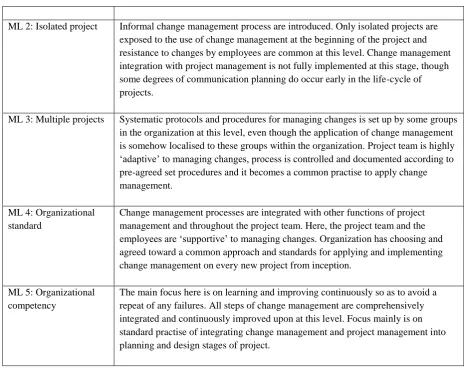
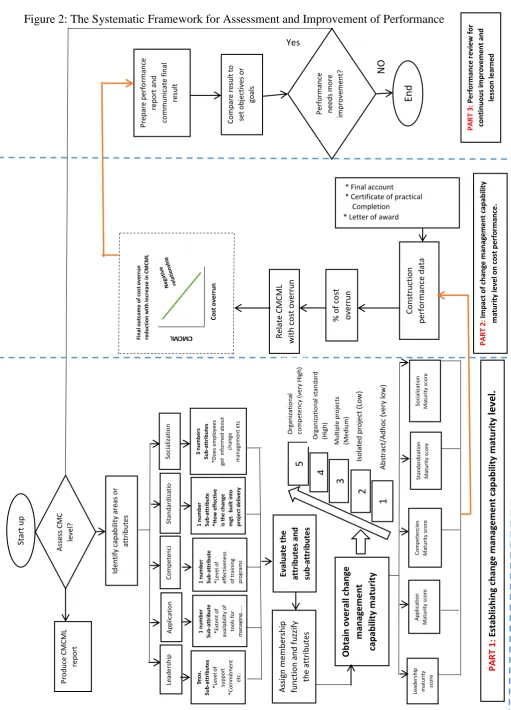
indication of cost overrun having significant impact on CMCML. Tables 1, 2 and figure 2 presents detail description of the framework that has three main components.
Table 1: Maturity levels and their descriptions
Maturity levels Descriptions
ML 2: Isolated project Informal change management process are introduced. Only isolated projects are exposed to the use of change management at the beginning of the project and resistance to changes by employees are common at this level. Change management integration with project management is not fully implemented at this stage, though some degrees of communication planning do occur early in the life-cycle of projects.
ML 3: Multiple projects Systematic protocols and procedures for managing changes is set up by some groups in the organization at this level, even though the application of change management is somehow localised to these groups within the organization. Project team is highly ‘adaptive’ to managing changes, process is controlled and documented according to pre-agreed set procedures and it becomes a common practise to apply change management.
ML 4: Organizational standard
Change management processes are integrated with other functions of project management and throughout the project team. Here, the project team and the employees are ‘supportive’ to managing changes. Organization has choosing and agreed toward a common approach and standards for applying and implementing change management on every new project from inception.
ML 5: Organizational competency
The main focus here is on learning and improving continuously so as to avoid a repeat of any failures. All steps of change management are comprehensively integrated and continuously improved upon at this level. Focus mainly is on standard practise of integrating change management and project management into planning and design stages of project.
Table 2: Meaning of capability areas
Key capability areas Descriptions
KCA 1: Leadership . This capability measures the level of involvement and commitment of senior management of the organization in preparing their staff to deal with project changes. Leaders are required to ensure that the project team has the required skills to perform the project tasks effectively and provide necessary training. Other factors to be considered here include leadership accessibility, decision making and leader’s engagement with project team.
KCA 2: Application The main objectives of this capability area is to assess the degree of adoption of change management practices in project implementation as well as the extent to which fund is made available for sponsoring the application of change management in the
organization. KCA 3:
Competencies
Collaborative efforts of both the top management staff and other organisational members in implementing change management are assessed by this capability. Organizations must establish good training programs for all ‘executors’ of change management for them to be referenced to have done well in this attribute.
KCA 4: Standardization
This capability seeks for full integration of change management processes with project management and inclusion of change management in other improvement approaches. However, leadership forms a critical criterion for stabilizing standardization as a capability area.
and buy-in to achieve successful change implementation. Attaining top management’s commitment will enhance successful change implementation, Motwani et al (2005) and adjustment to embrace change will be very low if not completely rejected if
employees’ experience low psychological commitment Robbins et al (2007).
6.01 Assessment process of the framework
The framework consists of three principal component parts. However, each component is hereunder described:
The first component part of the framework aimed at establishing and assessing the overall CMCML of contracting organization. Consequently, five key capability areas of leadership; application; competencies; standardization; and socialization earlier identified used.
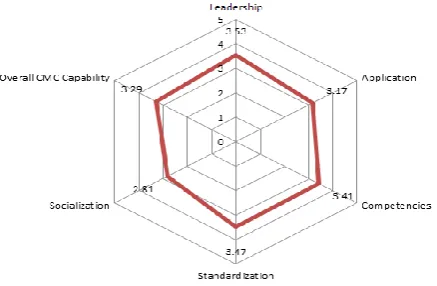
However, each of the five identified capability areas has its own maturity level which presents the characteristics of an organization (see figure 1). The lowest value is considered the weakest link of the change management capability for which improvement is prioritized. Similarly, the overall maturity of an organization’s change management capability is also defined based on the result of survey conducted (see figure 1). Against this background, an organization with no change management process programme is usually at the lowest level of the maturity rating – level 1 (see figure 2). As the organization adopts the appropriate goals and practices of change management processes defined at higher levels through continuous review of their performance, the organization progresses through the maturity hierarchy until achieving the highest maturity level 5 rating. At this point, the organization is expected to have continuous improvement processes.
The second component of the framework shows a significant amount of impact which cost overrun has on CMCML. The impact is assessed in terms of inverse relationship between the two i. e increase in CMCML with associated cost overrun reduction (see figure 2 ) the
framework). However, this trend depends on contracting organization’s level of improvement in the identified change management capability areas. Therefore, organizations must ensure effective performance in the identified capability areas in order to enhance their scores in overall capability which will undoubtedly have an impact of cost overrun reduction. However, the third component part is about having continuous feedback by reviewing the organization’s performance so as to identify causes and evaluate possible areas that should be improved upon. Having organizational members to understand the root causes of an
organization’s current performance level is highly significant for improving the
Figure 1: Change management capability maturity level results
7.00 VALIDATION OF THE FRAMEWORK
The framework was rated and commented on by a group of experienced eight (8)
construction industry experts in a Delphi survey approach. The experts are from building construction organizations and academic community and they have more than 20years
experience in the construction industry. The applicability, layout structure, clarity and content and systematic process of the framework was validated based on comments gathered from the group. All respondents felt the contents of the framework were easy to understand and
interpret; respondents thought the model covered all relevant aspects of change management capability maturity. The experts were generally satisfied with the layout, clarity and contents, applicability and appropriateness of the evaluation criteria of the framework.
8.00 CONCLUSION
The research results reveals that as organization progresses through the maturity hierarchy level, its capability maturity level also gets higher thus leading to better and consistent performance in terms of cost. It is therefore concluded that the framework is comprehensive, users friendly and easy to interpret. However, it is found suitable for contracting
Figure 2: The Systematic Framework for Assessment and Improvement of Performance P ro du ce CMCML re po rt A ss ess CMC le ve l? Ide n ti fy c ap ab ili ty a re as o r at tr ibu te s Lea d e rs h ip A p p lic at io n Co m p e ten ci es St an d ar d iza ti o n So ci al iza ti o n 9 n os . Su b -a tt ri b u te s *Le vel o f su p p o rt * C o mmi tment et c. 1 n u m b e r Su b -a tt ri b u te *E xt en t o f av ai lab ili ty o f to o ls f o r man ag in g… .. 1 n u m b e r Su b -a tt ri b u te *Le vel o f eff ect iv en es s o f tr ai n in g p ro gr ams 3 n u m b e rs Su b -a tt ri b u te s *D o es em p lo yee s get i n fo rmed ab o u t ch an ge ma n ag em en t et c 1 n u m b e r Su b -a tt ri b u te *H ow e ff e ct iv e is th e ch an ge m gt . b u ilt in to p roj e ct d e liv e ry A ss ig n me m b ers h ip fu n cti o n an d f u zz ify th e attr ib u te s Ev al u ate th e attr ib u te s and sub -attr ib u te s Ob tain o ve ral l c h an ge m an ag e m e n t cap ab ili ty m atu ri ty 4 3 2 1 Lea d er sh ip mat u ri ty sc o re Ap p lic at io n M at u ri ty s co re C o mp et en ci es M at u ri ty s co re St an d ar d iz at io n M at u ri
ty s
co re So ci al iz at io n M at u ri ty s co re Start up PA R T 1: Estab lish in g c h an ge m an ag e m e n t cap ab ili ty m atu ri ty le ve l. 5 Co n str u cti o n p erfo rman ce d ata % o f co st o ve rr u n R el ate CMCML w ith c o st o ve rr u n P A R T 2: Im p act of cha ng e m anag em e nt ca pabi lit y m at ur it y l ev e l on co st per fo rm ance .
* Final account * Certificate of practical Completion * Letter of award
ACKNOWLEDGMENT
The author wishes to appreciate Dr. Sarajul F. Mohamed for his valuable contribution to the realisation of this paper. Finally the author is grateful to all those who have given
constructive comments and suggestions.
REFRENCES
Akintoye, A., Fitzgerald, E. (2000). Analysis of factors influencing project cost estimating
practice. Journal of construction management and economics, 18, 77-89.
Alsuliman, J., Bowles, G., Chen, Z. (2012). Current Practice of Variation Order Management in the Saudi Construction Industry In: Smith, S. D (ED) Proceeding 28th Annual
ARCOM Conference, 3-5 September 2012, Edinburgh, UK.
Arain, F. M., Pheng, L. S. (2006). Developers’ Views of Potential Causes of Variation Orders
for Institutional Buildings in Singapore, Architectural Science Review, 49(1), 59-74.
Fellows, R. and Liu, A. (2008). Research Methods for Construction. Blackwell Publishing,
Oxford.
Hao, Q., Shen, W., Neelamkavil, J., Thomas, R. (2008).Change management in construction
projects. International conference on information technology in construction, Santiago
Chile.
Ibbs, C. W., Wong, C. K., Kwak, Y. H. (2001). Project Change Management System, Journal of
Management in Engineering, ASCE, 17 (3), 159 –165.
Lee, S., Pena-Mora, F. and Park, M. (2005). Quality and Change Management Model for
Large Scale Concurrent Design and Construction Projects, Journal of Construction
Engineering and Management, 131(8), 890-902.
Motawa, I. A., Anumba, C. J., El-Hamalawi, A., Chung, P.W. H., Yeoh M. (2003). Modelling change processes within construction project, proceedings of the second International conference on structural and construction engineering (ISEC-02), 23-26 September, Rome, Italy, 2185-2190
Motawa, I. A., Anumba, C. J., Lee, S., Pena-Mora, F. (2007). An integrated system for change
management in construction. Automation in construction, 16, 368-377.
Motwani, J., Subramanian, R. and Gopalakrishna, P. (2005). Critical Factors Successful ERP
implementation: Exploratory Findings from Four Case Studies. Computers in Industry, 56, 529 – 544.
Paulk, M., Curtis, B., Chrissis, M., Weber,C. (1993), Capability maturity model for software, Verson 1.1 (CMU/SEI-93-TR-24, ADA 263403), Pittsburgh, P.A: Software engineering institute, Carnegie Mellon University.
Prosci, Inc. (2007), Change management maturity model Audi preparation guide, available
online at: www.proci.com/cmmma. Retrieved on 25th September, 2013.
Rayner, P., Reiss, G. (2002).The programme management maturity model. Wetherby: the
programme management group.
Education, New Jersey.
Sarshar, M, Haigh, R., Finnemore, M., Aouad, G., Barret, P., Baldry, D. and Sexton, M (2000),
SPICE: A business process diagnostic tool for construction projects. Engineering
construction and Architectural management journal 3 (3), 241 – 250.
Sun, M., Sexton, M., Aouad, G., Fleming, A., Senaratne, S., Anumba, C. (2004). Managing
Changes in Construction Projects, EPSRC Industrial Report
Sun, M., Vidalakis, C., Oza, T. (2009), A change management maturity model for
construction projects. In: Dainty, A. (Ed) Proceedings 25th Annual ARCOM Conference,
7-9 September, Nottingham, UK, Association of researchers in construction management, 803-812.
Xu, Y., Chan, A. P C., Yeung, J. F. Y., Chan, D. W. M., Wang, S., Ke, Y. (2010), Developing a
risk assessment model for PPP projects in China: a fuzzy synthetic evaluation approach
Journal of Automation. in Construction. 19 (7), 929-943
Yusof, S. & Aspinwall, E., (2000). Total Quality Management Implementation Frameworks: