Integrated Science in the UK, 1965-1996: its origins,
characteristics, implementation and subsequent absorption
into the National Curriculum in Science
Jenny Frost
Thesis submitted for the degree of
Doctor of Philosophy of the University of London
Institute of Education
University of London
Integrated Science in secondary schools in the UK, 1965-1996: its origins, characteristics, implementation and absorption into the National Curriculum in Science
Jenny Frost
Abstract
Integrated science courses for secondary schools were developed in the late 1960s and early 1970s. The rationale for the courses was the need to bridge the interface between school science and the personal lives of the students. so that they gained an understanding of themselves, and of the science and technology related issues that they would meet in their environment. There was also a wish to help students develop an awareness of the nature of science and of its limitations, so that if all the detail of courses was forgotten they held on to some idea about what science was and what it could do.
The author argues that while the ideal of integrated science was moulded by events much of the dynamic remains and can be found in a different guise in the science curriculum of the mid 1990s. The socialisation of science teachers into particular science disciplines, concerns about teacher expertise to teach such courses and the organisational features such as the need for unusual timetable slots were all factors which militated against the implementation of this ideal.
Acknowledgements
I should like to acknowledge the help of colleagues at the Institute who have at various stages helped with the supervision of this research; Professor Helen Simons who taught me how to conduct a case study; Professor Peter Gordon who took over as my second supervisor; and Professor Denis Lawton for guidance during the final stages of the research and preparation of the thesis.
I am indebted to the teachers in the case study schools who gave generously of their time to answer my questions, who allowed me to report on their day to day lives and who kindly read and commented on my reports; in particular the heads of science. My special thanks go to the head of science at Duckworth comprehensive school who so willingly assented to my request to follow the change at the school between 1977 and 1980. As teachers appear by pseudonym in the text, I cannot name them personally here.
I should like to thank Professor Jon Ogborn, Ralph Levinson, Alastair Cuthbertson, Marilyn Leask, John Bausor and Mike Coles for discussions, at various stages, about the significance of the findings. The advice received from Brian Woolnough and Jonathan Osborne has also been invaluable.
Contents
Title page 1
Abstract 2
Acknowledgements 3
Contents 4
List of Figures and Tables 6
Acronyms 9
11 The Origin of The Research Questions
a. Research questions
b. Motivation for the research Summary
The Study and Research Methods a. The approach to the research
b. Research Methods for the case studies of schools c. Literature reviewed
d. Interpretaton of the data Summary
Context of the Emergence of Integrated Science a. Changing System of Secondary Education
b. Science education in the 1950s in Secondary Schools c. Implications of Curriculum Integration
Summary Chapter 1
Chapter 2
Chapter 3
26
42
Chapter 4 The Emergence of Integrated Science Courses a. What was integrated science?
b. Integrated Science Courses in UK
c. Evaluation and Implementation of Integrated Science d. Patterns of courses in secondary schools
Summary
Chapter 5
Chapter 6
Integrated Science at Duckworth School, 1977-80 a. Changing the Pattern of Courses
b. The Effect of changing the pattern of courses on science departmental structure c. Reflections on the whole case study Summary
Integrated Science 1980 - 1996 a. 1980 - 1986
b. 1987 - 1996 Summary
105
148
Chapter 7 Integrated Science at Duckworth and Timburn Schools, 1996 178
Chapter 8 Outcome of the Research 199
a. What was integrated science?
b.What happened to integrated science and why? c. Summary: What dynamics were brought into play?
Chapter 9 Evaluation 218
a. Value of the study
b. Analysis of the integrated science story through Bernstein's concepts of integrated and collected codes
c. Limitations of the research d. Further questions
e. Personal Reflections References
References Books and articles 241
Bibliography Books and Articles 253
References SCISP 257
References Other Curriculum Projects and Textbooks 260
References SSCR 264
References In-house school documents 266
Appendices
Appendix 1 Letters to schools 1996 269
Appendix 2 Excerpts from SCISP and Nuffield Science 13-16 274 Appendix 3 Organisation and Management of Integrated
LIST OF FIGURES AND TABLES
Chapter 1
Figures
1.1 Pattern of Science Courses - Girls' Comprehensive, 1965/66 1.2 Pattern of Science Courses - Girls' Comprehensive, 1966/67
Chapter 2
Figures
2.1 Dates of visits for 1977/80 case studies
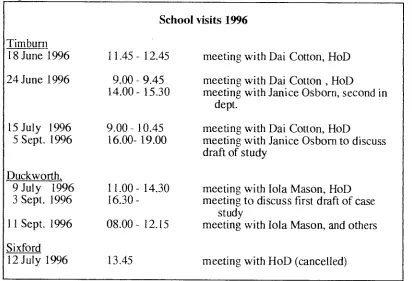
2.2 Questionnaire to all science teachers at Duckworth School, 1979 2.3 Dates and times of visits to schools in 1996
Chapter 3
Tables
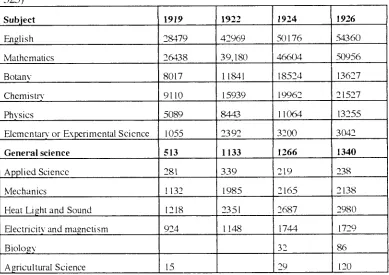
3.1 Numbers of candidates entering school certificate examinations in different science subjects (with English and Mathematics for comparison) ( BAAS, 1928, p 525)
3.2 Entries to Science Subjects in school certificate 1936 - 1942
3.3 The number of candidates entering for GCE 0 and A level examinations from modern schools in 1961
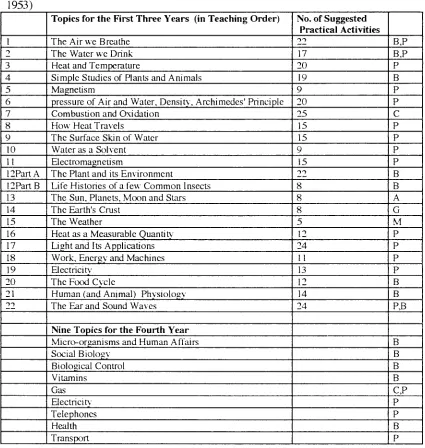
3.4 Suggestions for Science Course in Secondary Modern Schools (SMA. 1953)
Chapter 5
Figures
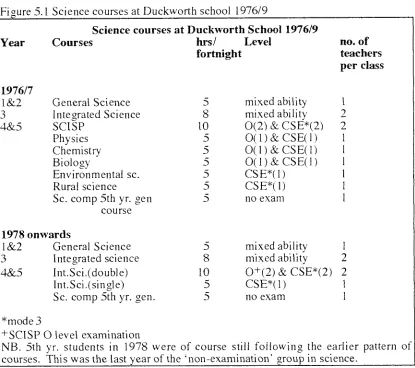
5.1 Science courses at Duckworth school 1976/9
5.2 Science Teaching Staff at Duckworth School 1976 - 1980
5.3 Responsibilities of science staff at Duckworth School in September 1977 5.4 3rd year science course in 1977/8 through to 1979/80
5.5 Progress made on preparing the double science course by September 1978 5.6 Mode 3 CSE integrated double science examination objectives
5.7 Weighting of objectives for CSE double integrated science course
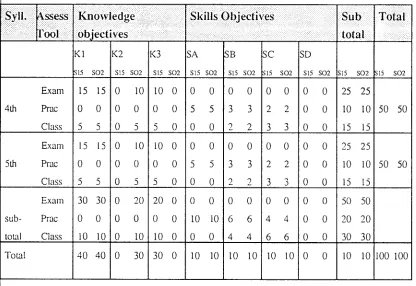
5.8 Assessment tools related to objectives for the double science course
[Integrated Science: Community Science (S 15) and Integrated Science: Problem Solving (S02)].
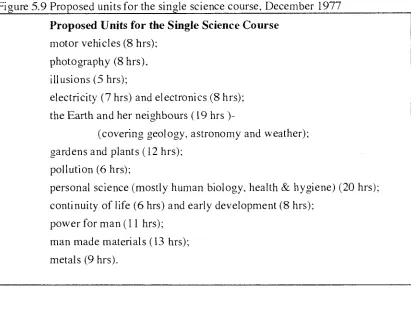
5.11 Assessment tools related to objectives for the single science course. 5.12 Grade criteria for the single science course
5.13 Science laboratories in Duckworth Upper School 1978 5.14 Science course for the first two years, 1978
5.15 Science department structure 1976/8
5.16 Subject grouping of staff within the science department January 1978 5.17 Science department structure 1978/9
5.18 Science department structure 1979/80
Chapter 6 Figures
6.1 Aims of the Secondary Science Curriculum review 6.2 Ten principles in Sc 5 - 16 a Statement of Policy
6.3 Summary of five versions of the National Curriculum in science
6.4 Weightings given by science working group to the four profile components in the national curriculum (DES, 1988)
Chapter 7 Figures
7.1 OLD science course units for KS3 to fit 1991 (2nd version of NC) 7.2 NEW science course units for KS3 to fit 1995 (3rd version of NC) 7.3 GCSE courses and syllabuses used at Duckworth, 1978-96
Appendix 1
A1.1 Letters sent to Duckworth and Timburn 1996 A1.2 Questionnaire sent to Duckwroth 1996
Appendix 2
A2.1 SCISP content written as a list of concepts and patterns (Patterns Teachers
Handbook, p64)
A2.2 Flow chart to indicate the interrelationship between problems, patterns, concepts and information in one section of the Patterns sample scheme
A2.3 Assessment criteria for SCISP aim 10b (willingness to search for and test patterns)
A2.4 Assessment criteria for SCISP aim 9b (ability to work in a group) A2.5 Two questions from 1974 SCISP Examination paper
A2.7 The contribution of the different modes of examination to the awards of Integrated science A (principles and problems) and B (principles and applications).
A2.8 Patterns Expansion
A2.9 Nuffield 13 - 16 plan of units to make up different courses
Appendix 3
A3.1 Faculties and departments at Timburn School 1980 A3.2 Science courses at Timburn School. before and after 1977 A3.3 Science staff Timburn School June 1980
A3.4 Diagram of the science and technology faculty at Timburn 1980 A3.5 Aims of the integrated science course, Timburn 1980
A3.6 Structure of the integrated science double certification mode 3, Timburn 1980
A3.7 Plan of science laboratories, Timburn School, 1980 A3.8 Faculty structure at Sixford School in 1980
Acronyms
ABET AEB ADEPT APSSM APSST APU ASE ASE 1 AST AT AUCET AWST BAAS BBC CAT CEE CESIS CSE DES DES/WO GASP GCE GCSE GNVQ HMI HMSO HoD ILEA INSET IS LAMP LEA LEATGS MEG NC NCCAssociation of Biology Education Tutors
Associated Examining Board
Association of Department of Education Physics Tutors
Association of Public School Science Masters
Association of Public School Science Teachers
Assessment of Performance Unit
Association for Science Education
Association of Science Education Tutors
Association of Science Teachers
Attainment Target (National Curriculum)
Association of University Chemistry Education Tutors
Association of Women Science Teachers
British Association for the Advancement of Science
British Broadcasting Corporation
Computerised Achievement Tests
Certificate of Extended Education
Curriculum and Examination System in Integrated Science
Certificate of Secondary Examination
Department of Education and Science
Department of Education and Science and Welsh Office
Graded Assessments in Science Project
General Certificate of Education
General Certificate of Secondary Education
General National Vocational Qualifications
Her Majesty's Inspectors
Her Majesty's Stationery Office
Head of Department
Inner London Education Authority
Inservice Education and Training
Integrated Science
(Science for) Less Academically Motivated Pupils
Local Education Authority
Local Education Authority Training Grants Scheme
Midland Examining Group
National Curriculum
NEAB Northern Examination and Assessment Board
Nf Nuffield Foundation
NQT Newly Qualified Teacher
NSI Non-Selective Intake
NSS Nuffield Secondary Science
OFSTED Office for Standards in Education
PE Physical Education
PGCE Post Graduate Certificate of Education
PoS Programme of Study (National Curriculum)
QCA Qualifications and Curriculum Authority
RE Religious Education
ROSLA Raising of the School Leaving Age (1973) `ROSLA Pupils'
SAPA Science A Process Approach
SATs Standard Attainment Tasks (later Tests) (National Curriculum)
SATIS Science and Technology in Society
SCAA Schools Curriculum and Assessment Authority
SCDC School Curriculum Development Council
SCISP Schools Council Integrated Science Project
SEG Southern Examining Group
SEN Special Educational Needs
SEREB South East Region Examining Board
SIMS Schools Information Management System
SMA Science Masters' Association
SMT Senior Management Team
SoA Statement of Attainment (National Curriculum)
SSCR Secondary Science Curriculum Review
SCUE Standing Committee on University Entrance
TGAT Task Group on Assessment and Testing
UNESCO United Nations Educational, Scientific and Cultural Organisation
CHAPTER 1
THE ORIGIN OF THE RESEARCH QUESTIONS
a. Research Questions
In 1965 I became a science teacher in one of the new comprehensive schools in South London. With the gusto and enthusiasm of many a young teacher I embraced new challenges and was soon a trials teacher for one of the 1960s curriculum development projects in science, Nuffield Secondary Science, an integrated science course intended initially for The Young School Leaver'. In 1970 I gained a lecturing post with responsibility for Integrated Science at the Institute of Education in London. In addition to my work there in initial teacher education, I provided support to the Schools Council Integrated Science Project from 1975 to 1988 and wrote and edited units for a project initially called Curriculum and Examinations System in Integrated Science. By the mid 1980s the term 'integrated science' was heard less and less. By 1995, it had virtually vanished.
This research is a retrospective look at integrated science of that period, with the hope of finding answers to:
• What was integrated science?
• Whatever integrated science was, what happened to it and why?
I have followed Goodson's advice that to ignore the history of curriculum subjects is to fail to understand curriculum (Goodson, 1985). I have also taken heed of the example of writers who have shown how the history of subjects within schools is inextricably linked to contemporary social and political ideas (Layton, 1984, 1973, Jenkins, 1979, Woolnou2h, 1988). The historical thread starts here with the history of my own involvement in science education, as a learner and as a teacher; within this lies the motivation for the research.
b. Motivation for the research
Primary School, South London suburbs, 1948-1954
school. I spent six years there, and learned to read. write and do arithmetic sufficiently well to pass the 11+ examination which gave me entry to a grammar school. Other subjects included history and geography, painting, needlework, physical education, rounders, races, how to do 'intelligence tests', perform in school plays, do the minuet and sing hymns in assembly. I am sure there was more to it than that but I cannot say with any certainty whether I studied nature study, some broader conception of science or no science at all. At age eleven those not going to the single sex grammar schools went to the single sex secondary modern schools. I really had little idea of the difference between the grammar and secondary modern schools despite the fact that both my parents taught in the latter, and they seemed keen for me to go to the former.
Secondary Grammar School, South London suburbs, 1954-1961
I moved to a girls grammar school in 1954 where my formal study of science began. The curriculum in the first two years included a general science course (taught by one teacher) along with a range of other subjects which I believe comprised English, mathematics, geography, history, Latin, French, art, needlework and games. Science in the third year was taught as three separate subjects (biology, chemistry and physics) by different 'specialist' teachers. I continued, in the fourth and fifth years, to study three separate sciences along with mathematics and five other subjects for GCE 0 level (taking the examinations in 1959). This choice in the fourth year enabled me to stop studying geography and history. I did not have to study all three sciences and there were others in the class who dropped one or more science to allow choice of other subjects. In the sixth form, which was divided into Arts and Science sections, I continued to study three sciences and mathematics at A level, (dropping biology at the end of the first year in order to take pure and applied mathematics separately) and physics and applied mathematics at S level. The S level was indicated only by whether a state scholarship had been won or not. Of the science teachers I had at school, (all women), the physics teacher had been called back out of retirement as there was no one to fill the post.
unlikely to go to University, an assumption which looks out of place today. In practice the Latin requirement had been dropped for most subjects (and certainly for science) by the time I went to university.
Higher Education, Manchester, 1961-1964
On applying for higher education in 1961, I faced considerable competition for a place on an honours physics course, ending up as one of six women out of a class of one hundred at the University of Manchester, where I graduated in 1964. The lecturers and professors on the course were all men.
Teaching in a mixed secondary school in Ghana, 1964-5
The year after graduation, 1964-5, was spent in a mixed secondary school in Ghana through VSO, Voluntary Service Overseas. My teaching was confined to physics and mathematics to both the 'science' and 'arts' sets in the fourth year (at the time the most senior year in the school) and mathematics lower down the school. The `science set' was composed entirely of boys. Not all children went to secondary school in Ghana. Primary schooling was available for all, but fees had to be paid for secondary education, or at least for the boarding element. It was not unusual to have people in the classes who were older than the normal school age as they had had to take time out to work to pay for their education. Some people received a secondary education through the training colleges which trained teachers for the primary schools.
Acquaintance with Nuffield 0 Level Physics, 1964 onwards
While in Ghana I attended a course for physics teachers in the Easter vacation, and met Ted Wenham, from the Nuffield Physics Project. What he was advocating seemed to me, at the time, to be very different particularly from the 'guide' I had taken with me, a traditional 0 level Physics text book. This influenced me to seek a post in a 'Nuffield' school when I returned in 1965 and was subsequently offered a place at a girls comprehensive school where the head of the science department (and of physics) was Beta Schofield, herself a trials teacher for Nuffield Physics. .
Girls Comprehensive School, South London, 1965-1970
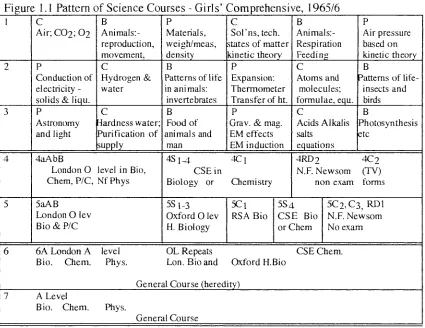
The pattern of science courses and examinations
implementation of a natural science course which covered a range of science.
Science was a component of every pupils' education up to the age of 15 or 16 or 17,
depending on leaving age.
Figure 1.1 Pattern of Science Courses - Girls' Comprehensive, 1965/6
1 C
Air; CO2; 02 B Animals:- reproduction, movement, P Materials, weigh/meas, density C Sol'ns, tech. states of matter kinetic theory B Animals:- Respiration Feeding P Air pressure based on kinetic theory
2 P
Conduction of electricity - solids & liqu.
C
Hydrogen & water
B
Patterns of life in animals:
invertebrates P
Expansion: Thermometer Transfer of ht.
C
Atoms and molecules; formulae, equ.
B
Patterns of life-insects and birds
3 P
Astronomy and light C Hardness water; Purification of supply B Food of animals and man P
Gray. & mag. EM effects EM induction C Acids Alkalis salts equations B Photosynthesis etc
4 4aAbB
London 0 level in Bio, Chem, P/C, Nf Phys
4S 1-4 4C i
CSE in
Biology or Chemistry
4RD 2 4C 2
N.F. Newsom (TV)
non exam forms
5 5aAB
London 0 lev Bio & P/C
551.3 Oxford 0 1ev H. Biology 5C1 RSA Bio 5S4 CSE Bio or Chem 5C2,C3, RD1 N.F. Newsom No exam
6 6A London A level OL Repeats CSE Chem.
Bio. Chem. Phys. Lon. Bio and Oxford H.Bio
General Course (heredity)
7 A Level
Bio. Chem. Phys.
General Course
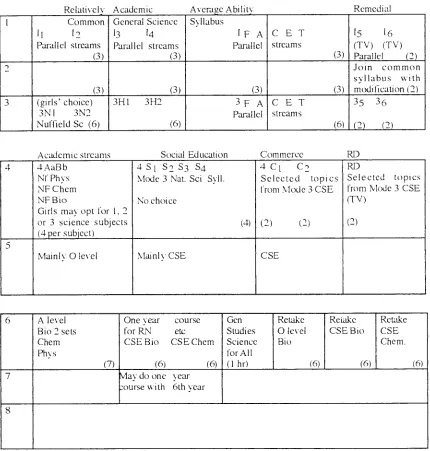
Streaming practices are evident from the labels 'Relatively academic': 'Average
ability': and 'Remedial' in figure 1.2. There was opportunity of movement between
streams. A common general science syllabus ran for years 1 & 2, with one teacher
per class. In the third year, most girls continued with a general science syllabus
(taught by one teacher), but the Nuffield 0 level Science Courses were started with
the top two streams and taught by specialist teachers. The girls themselves made this
choice, and we tended to steer those who thought they might take three sciences in
this direction. The 'academic stream' had the choice of one, two or three 0 level
science courses, the 'social band' had no choice, they did a Natural Science CSE
Mode 3 which the school had written. Courses in the sixth form included Advanced
level courses in physics, chemistry and biology; science as part of general studies,
and CSE in Biology and Chemistry for pre-nursing courses. The preference for
biology and to some extent chemistry, and the lack of uptake of physics can be seen
Figure 1.2 Pattern of Science Courses - Girls' Comprehensive, 1966/7
Relatively Academic Average Ability Remedial
1 Common
II I -) _ Parallel streams
General Science
13 14
Parallel streams Syllabus IPA Parallel CET streams
15 1 6
(TV) (TV)
(3) (3) (3) Parallel (2)
2 Join common
syllabus with
(3) (3) (3) (3) modification (2)
3 (girls' choice)
3N1 3N2
3H1 31-12 3 F A
Parallel
CET streams
35 3 6
Nuffield Sc (6) (6) (6) (2) (2)
Academic streams Social Education Commerce RD
4 4 AaBb
Ni Phys NF Chem NE Bio
Girls may opt for 1, 2 or 3 science subjects (4 per subject)
4 S 152 S3 S4 Mode 3 Nat. Sci Syll.
No choice
(4)
4 C1 C2
Selected topics
from Mode 3 CSE
(2) (2)
RD
Selected topics from Mode 3 CSE (TV)
(2)
5
Mainly 0 level Mainly CSE CSE
6 A level
Bio 2 sets Chem Phys
(7)
One year course
for RN etc
CSE Bio CSE Chem
(6) (6)
Gen Studies Science for All (1 hr) Retake 0 level Bio (6) Retake CSE Bio (6) Retake CSE Chem. (6)
7 May do one year
course with 6th year
8
The charts indicated the number of periods per week spent on science out of a forty period week. The first two years had 3 periods or 7.5% of curriculum time, the third year had six periods (15%) and the fourth and fifth years had a minimum of four periods (10%) and a maximum of twelve periods (30%) of curriculum time. Seven periods (17.5%) were devoted to each A level science.
teachers guides for the science courses for the first three years, so that all classes had the same programme and teachers had support outside their main specialism. Increasingly resources such as worksheets and other printed material were shared and filed centrally. The Nuffield 0 Level Physics teachers' guides were one of the most important resources to me at the time long winded but with invaluable information about 'If I were teaching this, this is how I would explain it...' throughout the text.
Trials teacher for Nuffield Secondary Science, 196618
In 1966 the school became a trials school for Nuffield Secondary Science (NSS) and I, and one other teacher, became trials teachers. Draft material was trialled with a `social education' group and a group leaving at age 15. As a trials teacher I attended regular conferences run by the project, allowing not only feedback from the teaching and discussion with other teachers, but opportunities to learn new science. I began to learn about such things as geology, animal husbandry, the science of musical instruments, and electronics. In teaching this course, I was expected to be teaching outside my specialism to the 14-16 age range - but not to the 'top sets' where I continued to teach just physics. The school leaving age was still only 15 but most pupils in these trial groups stayed until 16, and expected to take some examination. We wrote our own mode 3 CSE (Certificate of Secondary Education) science examinations to match the NSS course. The school, subsequently, became a member of a London consortium which wrote a mode 3 syllabus based on NSS. I believe it was in the context of Nuffield Secondary Science that I first became aware of the phrase `integrated science'.
In the academic year 1969/70 I remember a meeting at the school where a speaker was advocating Integrated Humanities for the first year at the school. There was considerable interest, but a word of caution was provided by the head of modern languages, who commented that she was happy to teach other subjects providing someone would supply a teacher to teach French in her place. I had left the school before any decision was made.
Institute of Education, 1970 to present
Integrated science department established in teacher education
department of integrated science started with its own group of students in 1969/70. Dr Clarke was a biologist and sought a physical science person to take a temporary post in the department. I filled that temporary post in January 1970, initially on a part time basis so that I could complete the courses for the 'examination classes' at the school. The department became its own empire, recruiting its own staff, having its own facilities, resources and technician, and competing with colleagues in the specialist physical sciences (physics and chemistry) and biological science departments for the recruitment of students. The three departments were located in different areas of the building representing the fact that science had been represented initially by just chemistry and physics, and that biology was added later and
integrated science later still.
I therefore, after five years teaching science and physics in a comprehensive school, took on the job of initial teacher education, only too aware that my own professional training had come through school teaching experience and through the inservice education of 'shredding meetings' for Nuffield Physics Questions and involvement in
Nuffield Secondary Science. As a graduate at the time, I was 'allowed' to enter the teaching profession without professional training. In 1972 I took the professional qualification (Post Graduate Certificate of Education, PGCE) as an external student.
Professional associations for tutors in science education
Three separate professional associations existed at the time for tutors in departments of education in universities, ADEPT, ABEL and AUCET (Association of Department of Education Physics Tutors, Association of Biology Education Tutors, and, Association of University Chemistry Education Tutors, respectively). It did not occur to me that these had only been set up a for short time, and that their designation could be queried. I merely commented that I did not seem to fit in any of them, but as I had a physics degree I received the papers for ADEPT's annual meeting. Neither did I think to comment that membership was restricted to teacher training in the universities. By 1971 the three associations had agreed to meet at the same time and in the same place for their annual meetings and to have some sessions in common. They eventually became a single association, ASET, with membership open to all universities, polytechnics and colleges of education.
Justifying integrated science
notes from that time, but did retain one paper which I wrote for the students in 1973 titled the 'Philosophy of Integrated Science'. I have to admit that the task was not easy, and I enlisted the help of my husband who was involved in developing science courses in adult education and the liberal studies movement in polytechnics. Some of the arguments for a scientifically literate population and for liberally educated, rather than narrowly vocationally trained, engineers and technicians, were similar to those found in advocacy of integrated science. There was not a coherent single argument that could be drawn on: more a cluster of different considerations, philosophical, pragmatic and social, and I think it was here that my difficulties lay.
Integrated Science for the 11-14 age range
I did not at the time think of integrated science as a label I would automatically attach to the courses for 11-13 year olds published from the late 1960s onwards. One of the first, Nuffield Combined Science, (1970) was constructed as a series of topics constructed from material drawn from the separate 0 level science courses. It was planned as an adequate base for the later separate science courses and could be used over a wider ability range than the original 0 levels. The expectation was that one teacher would teach the course, just as one teacher had taught the general science course at my grammar school and science teachers had taught the whole of the science courses at the comprehensive school. The publication, Scottish Integrated
Science, a course for 12-14 year olds, based on the Scottish Curriculum Paper 7
(Scottish Education Department, 1969), did carry the phrase 'integrated science' in the title, because the curriculum paper itself referred to it. The organisation of the
material, however, was probably better described as a series of discrete topics.
I believe that one of the reasons why I did not automatically think of the courses for the 11-13 year olds as part of integrated science, was that I rarely had to argue about these. An increasing number of schools had combined science courses of one sort or another taught by one teacher and this pattern was accepted as normal. Arguments became more acrimonious in discussion of courses for third year onwards when certification at age 16 was approaching, particularly for GCE 0 level. I think this is why the development of the Schools Council Integrated Science Project, SCISP, which started in 1969 was so significant. Success in the course conferred two GCE certificates, not one as with General Science, and with the unfamiliar titles
'Integrated Science - Principles' and 'Integrated Science - Applications'.
Integrated Science - an International Phenomenon
Science Education (Richmond, 1971, 1973, 1974: Cohen, 1977, Reay, 1978). Integrated science courses emerged in other countries, but many of them focused on courses for the start of secondary school and for primary. Several had similarities with the Scottish Integrated Science Course, where members of the Scottish writing team had been involved as consultants. Discussions at the conferences focused on the meaning of 'integration' and principles which could guide the construction of integrated science courses. A sixth conference, in 1988, reviewed the previous decade of integrated science, and showed a marked increase in the articles about primary science (Chisman, 1990).
Involvement in the after-care system for the Schools Council Integrated Science
Project (SCISP), 1975-1990
Closer involvement with developments in integrated science in schools occurred in 1975, when I took the opportunity to become an area co-ordinator for the support programme of SCISP for schools in south London (a small job, typical of outside work taken on by people in university faculties of education). I was keen to have a model of an 'academic' integrated science course to discuss with student teachers. My support role extended to the related examination process and to standardisation and moderation of the teacher assessed component. The support systems associated with SCISP originally included annual week-long inservice conferences, one of which I ran in 1976, but by 1978 these ceased for lack of recruitment. What I did retain for a few years were inservice courses on geology, organising weekend geology trips and lectures for science teachers for whom this subject was new. Project funding came to an end in 1984. Support was reduced to running the standardisation meetings, financed through the examination board. During the time I was involved with SCISP, there were two issues which dominated the biennial meetings of area co-ordinators: the acceptability of SCISP certification to Universities, post-16 Education establishments and Employment; and the need for related CSE courses many of which were being written by teachers in schools. The project devoted considerable time to both.
CESIS, Curriculum and Examination System in Integrated Science - more 16+
preparations
start of CESIS . She developed over the next few years a set of co-ordinated units that would allow for the whole ability range in the 14-16 age group to study integrated science. I wrote and edited several of the units (Frost, 1979).
Conference on Science in Schools - Which Way now?
In the summer of 1977 two colleagues ran a one-day conference for science teachers and science educators to discuss the recent HMI survey of secondary school science (HMI, 1977, January). The conference, which was part of the much wider debate (the so-called Great Debate) about what the curriculum in general education should be, addressed the future pattern and emphasis of science education given the diversity which existed, particularly in the fourth and fifth year. This diversity had been well documented in the report, the authors pointing out that science occurred almost entirely within the option systems and in some schools as many as 9 science courses
were on offer (HMI, 1977, p4).
The conference initiated two things of significance for this brief history. The first was the publication of Science in Schools - Which Way Now? (Ingle and Jennings. 1981). Included in this was a suggested 'core' for science education for all. My colleagues had asked me to write the physics section of the core, which I found impossible, on the grounds that any particular facts did not seem to me to be essential without some context and overall pattern. In the end someone else wrote the physics part and I submitted a more general summary of what science courses should achieve, (Frost, 1981, pp 97-99).
Case Study of a school in transition
The second outcome of the conference was the identification of a school, Duckworth, which was about to rationalise its science courses over the following two years and which was prepared to allow me to monitor the changes. This is the school became the focus of the case study described in chapter 5. It was a SCISP schools within my area, so I was acquainted with some of the teachers. This is essentially where the research began. I was hunting for a definition of integrated science which I hoped would emerge from the pragmatic engagement of teachers with the curriculum, rather than from a pencil and paper design from curriculum planners outside schools.
Articulation of a 'consensus' model for science education in secondary schools
technology). They avoided 'taking sides' on the issue of integration of the sciences, first by using the somewhat neutral word 'balanced' and by maintaining that there was a number of ways to construct courses within their guidelines. They focused on the technical issue of the time needed for science, suggesting that science should occupy 20% of the timetable (and no more) in years 4 & 5, 10% in years 1 & 2 and 15% in year 3. No-one should be allowed to drop science until the school leaving age of 16. They were presumably aware of the potentially controversial nature of their proposal by the tentative language of 'seem to be a satisfactory...' in:
...schools more commonly expected intending scientists to devote 4 (sometimes 5) periods a week to each of the three separate sciences. Yet 8, rather than 12 or more out of 40 would seem to be a satisfactory proportion of the timetable for this area of the curriculum (DES, 1979, p40).
It would be wrong to regard this as a consensus across the science teaching community, but it provided a framework, which would eliminate some of the decisions schools had hitherto had to make. For many schools a change to 20% of timetable time to be spent on science for all pupils throughout the 11-16 age range meant an increase in the number of hours devoted to science teaching and hence an increase to staffing in science departments. Concern about an adequate supply of science teachers had already prompted DES to fund conversion courses for teachers of other subjects and we ran one from 1977-1979.
Pressure for science in primary schools - development of inservice courses for primary teachers - 4/84 funding
The 1970s also saw a rise in the development of science in primary schools. When the PGCE primary course started at the Institute in 1983, science was an optional subject and for several years I ran the science component. HMI reported in their 1978 survey on primary education the generally better performance in schools which included science in the curriculum. Pressure for science in primary schools increased (DES, 1978). We developed an inservice diploma in Primary Science which began in 1983. To a large extent the development of primary science is only marginally part of the Integrated Science Story, but its increase over the next decade, its inclusion in the National Curriculum as a 'core' subject alongside English and Mathematics, meant that it had implications for the secondary curriculum.
Institute) to run 35 day courses for primary teachers and I took a major responsibility for this from 1984 onwards. After a few years these were reduced to 20 day courses. The 1990s showed a waning in inservice primary science work not only in the Institute, but in the country as a whole, as funds and time were devoted to inservice for literacy and numeracy. We ceased to run the primary science inservice courses in 1998/9.
Courses for head of science - management of science departments- 4184 fimding
Another area designated for GEST funding was management of science departments, in recognition that changes in the science curriculum would not be easy to manage. Providers were sought for such courses and one of my colleagues ran a 35 day course for heads, or potential heads of science departments from 1984 - 8.
Climate of collaboration - and consensus building - SSCR and 4/84 course providers
I experienced the early 1980s as a period in which collaboration, involvement and discussion were key elements. Vic Green as chief inspector for science played an important role in organising annual conferences for providers of 4/84 courses. We were able to discuss issues and progress with other providers across the country.
The Secondary Science Curriculum Review (SSCR) with its regional committees sought to involve as many teachers as possible in the implementation of the ASE's policy for science education (ASE, 1981). It adopted a 'periphery to centre' model as opposed to the centre to periphery model of the 1960s curriculum development. This added to the sense of a joint enterprise and the 'right' of science teachers to be involved in the shaping of national policy. The reports from the regions, the regular newsletters of SSCR, and the final set of publications Better Science (1987) provide a useful insight into the implications of a 20% timetable of science for all up to 16.
Policy document science 5-16
The first policy document from DES on science education was published in 1985 (DES/WO, 1985). The 20% timetable time for science and the requirement for balanced science courses for all began increasingly to look like a directive rather than an option. There was still an element of leaving 'options open' for schools to decide how they organised their science courses but implications for those who still retained marked independence of the three separate sciences were expressed as follows:
isolation from each other. Those schools which do continue to teach separate subjects will need to arrange much closer collaboration between the teachers of these subjects than is commonly found at present, to secure more orderly progression in the acquisition of knowledge and skills across the spectrum of science and to avoid unnecessary repetition or gaps. The reforms now needed require science departments to be united in philosophy and method. (DES/WO, 1985, p22).
Undoubtedly this document, along with previous HMI documents were highly supportive of SCISP as they advocated an organisation into which it readily fitted. Probably only too aware of the possibility of renewing old arguments about the virtues or otherwise of integrated science, Paul Black chose the occasion of his presidential lecture to the ASE annual conference in 1986 to address the issue of `Integrated or Co-ordinated?' (Black, 1986) in considering the implications of the 1985 policy document. He highlighted the epistemological problems with many of the claims of integration and indicated the virtues of a co-ordinated course under the
umbrella title of 'science'.
GCSE introduction
GCSE was finally introduced in 1986, first to be examined in 1988. A survey of GCSE provision by the ASE published under the simple title of Three into Two, (ASE, 1987), showed that all boards had some form of double science courses available, alongside the separate sciences. Many were based on co-ordinated science programmes, with the board which had originally examined SCISP (The Associated Examining Board, AEB) providing an integrated science course. The divergence between different syllabuses began to diminish with the development of national criteria for first, the separate sciences (DES, 1985 b) and then, for science (DES, 1985c).
The Introduction of the National Curriculum
How had these changes been reflected in the organisation and work of the science departments at the Institute?
The separateness of the departments (Integrated, Biological and Physical sciences) at the Institute of Education was slowly eroded and all were subsumed under one heading of 'Science'. This was facilitated by a move to a new building in 1976 where laboratory facilities and tutors' rooms were together, whereas in the old building they had been scattered at different places, and this had inhibited collaboration. There was successive and increased co-ordination of the initial teacher education programme for different science students and while we still, in 1998, recruit potential teachers under the headings of chemistry, physics, biology and 'science', the initial teacher education course is under one organisation and has been since the mid 1980s. As early as 1978 we had established a significant component of the courses which was taught in common and which addressed the need for teachers to be able to teach across the sciences at KS3. At the present time (1999), the retirement or resignation of other physics tutors, has left me, by default, as the only physics specialist and responsible for the physics component.
Summary
`Integrated Science' emerged in the 1960s in relation to specific curriculum projects and as the title of a post to which I was appointed. It was regarded as an entity in its own right, about which people argued, seeing it as the solution (or not) to questions about what science education should be. It could be found in the titles of a few GCSE syllabuses as late as the early 1990s but did not appear in National Curriculum documentation, and had faded almost entirely from science education by 1996.
When I started teaching, there was considerable euphoria about the transformations that integrated science courses would occasion. This was probably part of the wider sense of renewal which the large scale, well funded, curriculum developments of the 1960s promised. In this research, however, I have tried to single out the integrated science story, to understand its emergence, its implementation and its apparent disappearance.
CHAPTER 2
THE STUDY AND RESEARCH METHODS
a. The Approach to the Research
The research questions:
• What was integrated science?
• Whatever integrated science was, what happened to it and why?
were formulated late in the research.
The research began late in 1977 with the opportunity to follow the development
of integrated science courses at Duckworth school (see Chapter 1). The staff of
the science department had already made the decision to implement science for
all students up to the age of 16 by providing appropriate integrated science
courses and abandoning all other science courses. Planning the new courses
which were to start in September 1978 and be examined for GCE and CSE for the
first time in 1980, had already begun. I requested permission to follow the
development; this was granted and hence the research began. It focused almost
entirely on the 14-16 age range as this was where the changes were being made.
At the time I paid little attention to the 11-13 and the 13-14 science courses, even
though these were, broadly speaking, 'integrated science'.
My initial interest was in the nature of the science curriculum which would emerge during this development. I hoped to find answers to questions such as:
"How would the teachers interpret 'integrated science?"' and "Was their
interpretation one which could be used by others?". Early observations, however,
drew attention to the processes the staff went through in the transition to the new
courses and I began to collect information on the ramifications of the curriculum
change for other aspects of the life in the science department. What started,
therefore, with a question about the nature of integrated science, provided
information about the way the change to integrated science interacted with the
context in which it operated and how it affected that context. The process of
curriculum change remained the focus of the research for some time and hence
In order to validate the findings at Duckworth, I studied two other schools,
Timburn and Sixford in 1979/80. These two schools had already implemented
integrated science courses for all students up to the age of 16. I studied the nature
of the courses, the way in which the teaching was organised, and how the
departmental structure was designed to support the course arrangements.
There were other sources of information about change to integrated science
courses in the 14-16 age range and its interrelationship with context, which linked
with the research in the three schools. The 'aftercare' programme of the Schools
Council Integrated Science Project was one such source. My work in the
programme gave me intermittent contact with, and information about, twenty
schools in the south London area using SCISP. The twice yearly meetings with
other area co-ordinators gave access to information from similar schools across
the country. Another source was the Secondary Science Curriculum Review, set
up to support the implementation of 'science for all' up to the end of compulsory
schooling, based on the ASE (1981) policy document. While the brief of the
SSCR was not directly to implement 'integrated science' there was sufficient
overlap in the issues that schools were facing with those tackled by Duckworth
that its work was relevant.
The research, however, laid fallow for several years and when I returned to it in
1995, there was a need to bring it up to date. I returned to Duckworth to find out
what changes had taken place and also to Timbum. By this time GCSE had been
introduced as a common examination system for all at 16 and the national
curriculum was in place. There was much more central control of education than
there had been in the 1970s. The heads of science of the two schools provided
considerable information about changes, many of which concerned the need to
respond to directives from outside. I began therefore to develop a new theme for
the research which focused on the changing autonomy of science teachers in
matters of curriculum design and examination, between the two sets of case
studies. This focus for a while made a lot of sense, especially as the early case
studies were done when school based curriculum development was becoming a
dominant mechanism of curriculum change, and there was a lot of interest in how
it operated. It proved however too far from the original foci to draw the work together.
Eventually a retrospective view of the 'integrated science' movement was taken
studies had to be put into a wider perspective. This was done in several ways.
First the time span considered was increased, so that the case studies became part
of a longer story. Second, the contexts of the contemporary school and
examination systems were taken into account, because these and the changes in
them, may have had a considerable effect on the shape and form that integrated
science courses took. Third, Bernstein's commentary on the implications of
integration in the curriculum generally was used to interpret events in the
integrated science story. Fourth, other evaluations of integrated science curricula
and their implementation were used to extend the findings of the case studies.
Fifth, the original case studies focused on the 14-16 age range; the final thesis
addresses the whole of the 11-16 age range and gives some attention to the
developments in science education in primary schools.
I therefore answered 'What was integrated science?' by considering a range of
related questions about the contexts in which it emerged, what it was supposed to
replace, how it was conceptualised at first, how people talked about it, how it
manifested itself in courses in schools, what it was expected to achieve that
existing science courses could not.
I answered: 'Whatever integrated science was, what happened to it and why?'
through such questions as: What happened to curriculum materials when they
went into schools? How was the teaching organised and who taught the courses?
Where and to whom was it taught? What were the constraints on implementing
integrated science? What were teachers' attitudes to it? To what extent had the
`predictions' of Bernstein about integrated curricula, manifested themselves in the
case of integrated science; how had these impacted on its success of otherwise?
Was it only the name that had vanished? Had some of the ideas associated with it
in the 1960s survived? If so, which ones and where?
b. Research Methods for the case studies of schools
The initial study of Duckworth school took place over two to three years. I set
out just to observe and interpret events in the science department at the school,
with the hope of having little effect on what happened. My role was close to that
of a non-participant observer although my position within the aftercare system of
SCISP encouraged participants to use me as an adviser or at minimum as a
sounding board for ideas. My main method of working was to record
observations, to write fuller accounts from these records and then to use these
This approach was described by Cohen and Manion as follows:-
The purpose of such observations is to probe and to analyse intensively the multifarious phenomena that constitute the life cycle of the unit with a view to establishing generalisations about the wider population to which the unit belongs.
(Cohen and Manion 1985, p 131).
My attempt to generalise the findings from Duckworth School was done by
studying two other schools which were not dissimilar. The three schools were
mixed comprehensive schools; they all had some form of core curriculum for 4th
and 5th year pupils in which science was a component; the three science
departments were committed to providing only integrated science courses for 4th
and 5th year pupils; they used SCISP as the basis of the 0 level course entering candidates for the Associated Examining Board (AEB) examination; they wrote
mode 3 CSE courses to run parallel with the 0 level SCISP course. They had all
had links with trials of SCISP: Duckworth School had been a phase 1 trial school
in 1972; subsequently two members of the science staff moved to Sixford
School when it opened and a third to Timburn School, eventually to become head
of the science department.
There were, however, differences in events which had led to development of
integrated science courses in each school. Duckworth school had responded to,
amongst other things, the effect of falling rolls; Timburn had experienced a
`crisis' in the whole curriculum not only in science; and Sixford, being a new
school had developed integrated science courses from the start, as part of a
coherent curriculum plan for the whole school.
The study at Duckworth school was the most extensive and was conducted during
the development of new integrated science courses for the 4th and 5th year
students. The case studies at Timburn and Duckworth, on the other hand, were
conducted over a sixth month period, after integrated science courses for 4th and
5th year students had been implemented. The study at Duckworth was almost
Negotiating access to schools for 1977/80 case studies and dates of visits
Negotiations were relatively informal. I consulted the heads of the science
departments in the three schools, and sought permission to be in the schools for
the purpose of research from the respective head teachers; this was granted.
Nothing was put in writing and none of the head teachers asked to discuss the
purpose and methods of the research nor the implications for the school before I
started. I did subsequently meet head teachers as part of my work.
In addition at a science department meeting in December 1977 at Duckworth
School I explained that I wanted to follow changes as new courses were developed; that I would write interim reports for staff to comment on; that
individuals would be consulted before anything which might be confidential was
included and that staff could veto any sections. I assured the department that
articles about the school would not appear in publications such as the Times
Educational Supplement without consultation. These oral assurances were the
basis of the relationship between myself, as a researcher, and the staff. Similar
assurances were given to heads of department at the other two schools but not to
the whole department.
During the study at Ducworth I established patterns of working which were later
used at the other schools, so the Duckworth study is reported separately first
below. The dates of visits made to each school are given in figure 2.1.
The type of setting: Duckworth School, 1977-80
I was allowed to wander around the science department; to sit in preparation
rooms and observe the general life of people as they came in and out; to waylay
staff in corridors and laboratories, providing that I did not prevent them from
being in lessons on time and that I did not interrupt other work. I always asked
whether staff had time before engaging in a conversation or an interview. When
staff were busy they often indicated times later in the day when they would be
available.
One preparation room served as a tea and coffee room at morning break and at
the end of the school day so it was relatively easy to find everyone there. Science
staff used the main staff room before morning registration and at lunch time, in
DUCKWORTH
28 9 1977 14 12 1977 18 1 1978 6 2 1978
18 4 1978 9 5 1978 11 12 1978 25 6 1979 21 11 1979 17 12 1979 10 3 1980 21 4 1980
22 4 1980 24 4 1980 25 4 1980 1 5 1980 6 5 1980 14 5 1980 9 6 1980 19 6 1980 25 7 1980
TIMBURN
half day meeting with head of science sc. dept. meeting 16.00 -18.00
sc. dept. meeting 16.00 - 17.05
all day visit + after school meeting of course planning group
sc. dept. meeting 16.00 - 17.30 - first short account given day visit with PGCE students
all day all day all day all day half day
1st day of term; all day + after school meeting on assessment
all day; two lessons observed
most of day; assessments and lessons observed all day - long account (40 pages) given to staff 3 hours in the morning
2 hours in morning
mid morning to the end of school 1 hour visit
all day afternoon
13 6 1980 18 6 1980 29 10 1980 May 1981 and May
SIXFORD
4 9 1980 26 9 1980 October 1980/2/3; early 1983;
all day
report delivered to school
all day; school's half term (annotated reports returned) 1982 all day visits with PGCE students
meeting with head of science all day;
visits with PGCE students supervision of PGCE student
occasionally met teachers of other subjects. Nevertheless many teachers were
unaware that research was being done in the school.
Figure 2.1 Dates of visits for 1977/80 case studies
I never presumed to visit lessons without prior invitation and only did so on a few
occasions at the end of the study. On several occasions staff invited me to teach
classes 'to find out how it is going for yourself. I did not accept. I never arrived
unannounced. Permission to visit on a particular day was sought either in writing
or by telephone from the head of the science department, or was agreed on the
previous visit. This setting determined to a large extent the way observations
Talking with the staff: conversations and interviews: Duckworth School, 1977-80
Exchanges with teachers and technicians were often informal and unstructured,
but as they contributed, or had the potential to contribute to research data they are
better classified as interviews. Throughout exchanges I had a research focus and
hence my questions probed aspects which were relevant to the research.
In some interviews questions were open and designed to encourage respondents
to talk about what had been happening in the school. Examples of such questions
were: 'How are things going?' Has anything new happened since I was last in
the school?'. In these interviews questions were deepened as particular events
were reported in order to elicit further details of the events, to find out how the
events affected the respondent or to find out the respondent's attitude to them.
Other interviews were semi-structured. In these, questions were more specific
and had been prepared prior to the visit. Some of these questions followed up
particular issues, e.g. 'Have you resolved the problem that arose when some
pupils chose an inappropriate course?', 'How are funds for the greenhouse
coming along?'. Other questions were suggested by analysis of data, e.g.
`Everyone except you and two other members of staff have talked of the problem
of their new role in the department; had you noticed this; can you think why it
is?'. Later in the research, as staff could put events into some sort of perspective,
the science teachers and technicians were questioned more systematically:- 'Now
that the dust has settled, how has the curriculum change affected you and your
job?'.
There was a third type of exchange which occurred. I found that before long
some members of staff seemed to seek me out deliberately to make sure that I
heard their side of the story. Others rarely spoke unless I asked to talk with them.
There were probably a range of reasons for these behaviours, such as people
believing they had nothing of value to add. But whatever the reasons I soon
realised the necessity of finding questions for all members of staff, and
systematically talking to everyone.
`In-house' written material: Duckworth School, 1977-80
Staff made available relevant documents produced within the department. These
summaries of decisions taken, and papers relating to teaching and assessment of
the new courses. Some of these were in the form of charts and instructions
pinned on a central notice board. Analysis of these provided more information on
the effects of the change. They are listed in the references.
Using a questionnaire: Duckworth School, 1977-80
On one occasion a questionnaire, figure 2.2, was used to collect information
about the effects of change on teaching staff. This proved particularly useful
especially as completed papers were collected personally rather than received by
post, when staff added information orally. One teacher who had not previously
completed it, did so while I was present. He gave much more information orally
than he wrote on paper.
The findings were summarised in an interim report and circulated to staff in April
1978. Nothing had seemed particularly contentious but one person reminded me
of my agreement to check before statements were made public. The person
concerned reported that he would have 'worded it differently', in the
circumstances.
Making notes: Duckworth School, 1977-80
Staff became accustomed to my taking notes. Sometimes brief notes were made
during conversations but more often immediately afterwards. For instance notes
of discussions with a teacher during break were often made shortly afterwards
when the teacher went to take a class. Opportunities to write in isolation were
important. They enabled me to digest information and generate more questions
while on site thus saving time and reducing the need to return to the same point at
a later visit. I did not use tape recorders for interviews, but did use one to record
impressions of the day during the journey home. Within a week, preferably the
same night, I typed up notes as fully as possible.
These three activities, writing notes immediately in odd quiet times, recording
impressions on the way home and writing a fuller account within a few days
helped to bring to conscious level events observed but not seen to be significant
at the time. Odd comments and occurrences sometimes took on a possible new
meaning to be checked during a following meeting. The writing became the main
Figure 2.2 Questionnaire to all science teachers at Duckworth School, 1979 Questionnaire about involvement in teaching and writing, Duckworth
A. What courses have you taught (other than new I.S. courses in yr. 4&5)?
Level Subject no of years
A-level
6th form gen. studies 0 level
CSE
5th yr. gen. course 3rd yr. IS
2nd yr. GS 1st yr. GS other
B. What teaching have you done in the new 4th and 5th yr. courses?
Double science Single science
4th yr. 5th yr. 4th yr. 5th yr.
78/9, 79/80 78/9, 79/80 78/9, 79/80 78/9, 79/80
Top stream Middle stream Bottom stream
C. Before you became involved in writing units for either the single or the double science course, what experience had you of curriculum innovation? (e.g.. had you written other courses? written examinations or tests for colleagues? written worksheets for others etc.?)
D.(i) Did you find parts of the processes of developing a new course particularly difficult? (e.g.. writing lessons for others, finding suitable resources, writing tests that matched objectives). Please specify.
(ii) Did you find that you were particularly good at some of the processes involved in creating the new course? Please specify.
(iii) What skills did you develop during the development of the new courses?
(iv) If you feel you learnt new skills have you any idea how you learnt them? Are you conscious of having learnt them from anyone in particular. Please be as specific as possible.
E. What interests or skills do you have which have been useful in the science department but which are slightly outside academic science. (e.g. hobby activities, photography, gardening, car maintenance, philosophy of science, first aid etc.)
F. What responsibilities and tasks do you have in other parts of the school?
G How do other members of staff know you?! (e.g. just another member of the science department, or also as a form teacher, drama enthusiast, exams expert, games enthusiast, the man who keeps the chickens, youth wing leader etc.)
After a while notes began to read like an on-going account, or a serial, where I
attempted to pick up the story where it had been left on the previous occasion. At
times the case study had similarities with dreaming. In dreams events appear
plausible but coherence vanishes if they are related to others. Dreams do not
form a smooth narrative. Neither does life; but in life people usually have
reasons for their behaviours. When I found the 'story' revealed unexplained
actions and decisions I could return and enquire, often finding some antecedent
that nobody had thought necessary to mention.
At the end of the day he comes home with a wealth of information on a variety of points, but nothing conclusive on any one point. Over the weeks and months his evidence on a given point gradually accumulates and the various points start to fit together into a tentative pattern.
(Deising, quoted in Cohen and Manion, 1985, p 131)
Seeking significant issues in the account: Duckworth 1977-80
The accounts were searched for significant features related to the curriculum
change. These were things that the staff had talked about and seemed concerned
about on several occasions, or things which I thought were important. These are
discussed fully in chapter 5 but the following are examples:-
• Staff members attached importance to their roles, such as 'heads of chemistry, physics and biology' both within the department and school.
Areas of authority and responsibility were discussed frequently and
passionately as the separate science courses were removed from the 14-16
curriculum, revealing close links between departmental structure and courses
taught.
• The curriculum change involved collaboration and negotiation. Many staff meetings were held but formal meetings soon gave way to informal channels
of communication. This saved time, but some people were be left out of
discussions.
• Planning, managing and implementing the changes involved hard work. As
one member of staff said 'It is one thing to have ideas, it is another to have
them down on paper in a form that everyone can understand.' The health,
stamina and patience of staff were at a premium. Tensions arose amongst staff
• The 'hardware' of the department was organised to match the previous science courses. When the courses changed, resources had to be rearranged.
• Costly resources developed for previous courses were under-used in new courses. Discussions about scrapping them were particularly distressing to
those who had created them in the first place.
• Initially when staff decided to make changes there was sufficient expertise
amongst them. Worries appeared however when key people left, especially if
there had not been a way of passing on expertise to another member of the
team.
• A new structure of the science department emerged with hierarchies less tied
to separate subjects and more to roles concerned with co-ordination.
Writing accounts for the staff: Duckworth School 1977-80
In order to inform all concerned and to check the internal validity of observations
`accounts of accounts' were compiled. Reports of field notes were written into an
account of events against a developing analytical background. For example the
status and position of staff within the science department seemed to be significant
and hence observations of events were interpreted in terms of this issue.
Inevitably once these issues had been formulated they affected later observations.
The first short account was given to teaching staff in April 1978. The second
long (40 page) report of findings was given to teachers and technicians for critical
comment two years later in April 1980. Although an attempt had been made in
interviews to use open-ended questions, the selection, collection and
interpretation of data had been comparatively subjective and I had hoped that
when people had the report they would correct misinformation or make
alternative interpretations.
The short document produced considerable feedback, mainly factual, such as
corrections about:- courses, numbers in the school, finances, teaching
arrangements. The longer account produced less. Many people wrote nothing,
merely commenting: 'I found it very interesting'. They did not feel in a position
to add to what had been written. Many were intrigued to read an account of their
daily lives but treated the document as 'for information only'. Only one member
significant issues. This is consistent with what others have found; teachers do not
spontaneously adopt a research role. (Rudduck, 1982)
Generality: external validity: Case studies at Timburn and Sixford schools: 1980
To check whether the findings were specific to Duckworth school, I set out to
find whether the 'significant features' occurred in two other schools, Timburn and
Sixford. The types of settings in which I worked were similar. I was allowed to
wander around the science departments and talk with staff as appropriate. I wrote
accounts for the staff and again found that most people did not add much except
correction of detail.
There were, however, two important differences between the first study and these
two. The first difference was that the focus of the research had already been
determined at Duckworth school. Hence I started with a long list of questions I
wished to ask and information I wanted to collect. I therefore quickly collected
information on such things as departmental structure, organisation of courses,
distribution of teaching, constraints of the building, storage of written material,
and use of technicians. The second difference was that the implementation of
integrated science courses had taken place prior to the research and I had to rely
on people's memories to collect relevant information about the development
phase.
Studies at Duckworth and Timburn Schools in 1996
In 1996, I returned to two of the three schools, for relatively short periods of time
to talk with the heads of the science departments about changes since my visit.
There had, of course, been a large turn-over of staff since 1980 and only one or
two of the original teachers and technicians were still there.
I approached all three schools more formally than before by letter to the head of
science with a copy to the headteacher (see appendix 1, A1.1). I had a positive
response fairly quickly from Timburn, and made the first appointment by
telephone. In the cases of Duckworth and Sixford, after a suitable delay and no
reply, I rang the respective heads of department. In both cases they had cleared
the research with their colleagues but had not yet contacted me. I made
appointments to go to both schools. A few days before the meeting at Sixford,