Application, Testing and Analysis of Counting Mechanism for Small
Industries
Forum Bhutaiya1, Nikhil Bharambe2 and Yash Chaudhari3
1
Department of Mechanical Engineering, VIVA Institute of Technology, Mumbai University, Maharashtra, 401303, India
2
Department of Mechanical Engineering, VIVA Institute of Technology, Mumbai University, Maharashtra, 401303, India
3
Department of Mechanical Engineering, VIVA Institute of Technology, Mumbai University, Maharashtra, 401303, India
Abstract
Counting line plays a vital role in any production line. Before the packaging of the products especially mini products, they are counted and put into their respective boxes or packets. In large scale industries, there are machines using concepts of mechatronics i.e. machines having sensors and PLCs. Though these machines are mostly accurate, they are very costly. In concern with the small scale industries, use of such machines is not possible mainly due to its huge investment. So to fulfil the requirement of counting in small scale industries, human labour is appointed. When concerned to humans working on counting and packaging of such mini products, the time and labour required is quite considerable. In order to provide relaxation to the labours in small scale industries, we came with a simple mechanism which can be used instead of labours and the rate of counting and packaging of mini products can be increased.
Keywords: Transport mechanism, counting disc, double-crank mechanism, inclined rotating disc, semi-automation.
1. Introduction
Counting line is a part of the post-processing process i.e. production line, which is carried after the manufacturing process. This includes sorting or counting of small products and transporting it to the further process i.e. packaging and dispatching process.
It ranges according to the usage as in large scale industries or small scale industries. Large scale industries use automated counting line which includes the usage of various microcontrollers and sensors whereas in small scale industries semi- automatic mechanisms are used. When concerned to the packaging of the products, it is either done in terms of weight or count. When the products
are packed using weight, a weighing machine or a load cell & HX711 or even Force Sensitive Resistors (FSR) is used. But when the manufactured products are to be packed by count, it is either done by people or by machines.
Here in this paper, a counting line is designed especially for the small industries, where the people are currently completing the task. It can be easily replaced by this simple machine.
The whole counting line includes two main parts, rotating disc counter and transportation mechanism. The rotating disc counter is used for counting the small product and transportation mechanism which transports the box from one place to another. The counted or sorted products are dropped in the box at particular interval of time and the same box is transported further by the transportation mechanism
2. Mechanism of the Counting Line
The counting line is a part of post processing process, which is carried after the manufacturing of a product in a production line. This includes sorting or counting of products, and transporting it to the further process, that is, packaging and dispatching line.
This whole counting line includes of two main parts, rotating disc counter and transportation mechanism. The rotating disc counter is used for counting the small product and transportation mechanism which transports the box form one place to another. The counted or sorted products are dropped in the box at particular interval of time and the same box is transported further by the transportation mechanism
2.1.
Disc Counter Mechanism
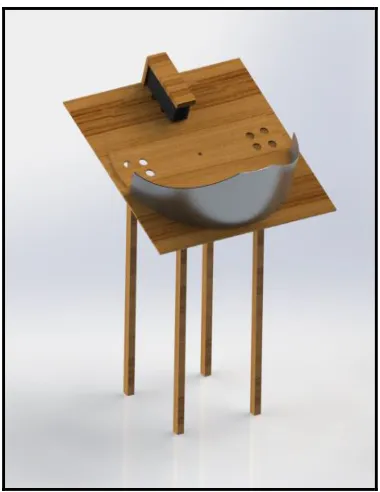
The disc counter mechanism includes; a. rotating disc
b. fixed plate c. support d. hopper e. brush f. motor
An inclination is provided to the support, thus to the fixed plate and the rotating disc. Shaft of the motor is directly connected to the rotating disc, considering no contact between the fixed plate and the shaft of the motor. At the down inclination of the fixed plate the hopper is attached. Four sets of slots are provided on the rotating disc. Brush is provided on the upper inclination of the fixed plate to avoid stacking. Wide slot or opening is provided in the fixed plate to disperse the product from the rotating disc. This is illustrated in fig. 1.
Figure 1: Disc Counter Mechanism
2.2.
Transportation Mechanism
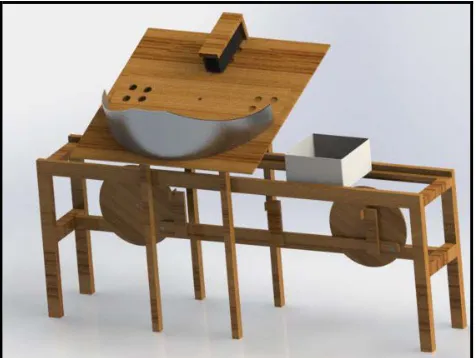
The transportation mechanism includes a. circular discs
b. linkage and cantilever beams c. boxes
d. support e. motors
The transportation mechanism transports the box from one place to another. It is based on the concept of double-crank mechanism. The dispersed products from the disc counter mechanism are carried forward to the next line with the help of boxes. At the start of the mechanism the empty boxes are piled up at one end. These empty boxes are then transported from that end to the opposite end and are filled up in way as the products fall from the counter mechanism.
The mechanism used is the double crank mechanism. Two motors are used and the crank links are directly connected to these motors. The main linkage, which has four cantilever beams, is connected to the crank links. Cantilever beams push the box in forward direction. All the links are connected with each other with the help of pins. The entire mechanism is rested upon a wooden support. This is illustrated in fig. 2.
Figure 2: Transportation Mechanism
3.
Selection of Materials
3.1. Linkages and Discs
The linkages, rotating disc, counting disc, fixed support are made using plywood due to desirable properties of strength like hardness and toughness. Use of plywood is done due to its easy availability and low cost. The linkages are hinged to the rolling wooden disc using automatic screws.
3.2. Dc motor
A windscreen wiper or windshield wiper is a device used to remove rain and debris from a windscreen or windshield. Almost all motor vehicles, including trains, watercraft, and some aircraft, are equipped with such wipers, which are usually a legal requirement. A wiper generally consists of an arm, pivoting at one end and with a long rubber blade attached to the other. The blade is swung back and forth over the glass, pushing water from its surface. The speed is normally adjustable, with several continuous speeds and often one or more "intermittent" settings. Most automobiles use two synchronised radial type arms, while many commercial vehicles use one or more pantograph arms.
3.3. Wooden Frame
The Wooden frame is a building technique with a "skeleton frame" of vertical wood columns and horizontal I-beams, constructed in a rectangular grid to support the floors, roof, and walls of a building which are all attached to the frame. The development of this technique made the construction of the skyscraper possible.
3.4. Brush
A brush with soft bristles is used. The bristles may be of a nylon material or silicon depending on the purpose. The brush is rigidly fixed upon the fixed wooden plate and so it would remain stationary at a place.
4.
Assembly
The entire mechanism is rigidly fixed using nut bolts and screws. The rotating discs are attached to the two motors and the linkage is attached fixed to the rotating disc such that a parallelogram frame is formed, viz., the distance between centre of the rotating disc and length of the linkage are equal. The motors are mounted on a different motor support. The counting disc is attached above the fixed plate. The fixed plate is fixed on the motor shaft. The arrangement for assembly of the counting disc is as shown in fig. 3(a) and 3(b).
Figure 3(a): Side view of counting assembly
Figure 3(b): Counting Assembly
An aluminium sheet is placed at the bottom end of the inclined disc assembly so as to provide stacking of the loose products for the counting. Brush is fixed on the top end to avoid excessive count of the products to come out at the output end.
A detailed assembly drawing of the entire mechanism is shown in Fig. 4.
5. Electric Motors – An Overview
Electric motors, both ac & dc motors, come in many shapes and sizes. Some are standardised electric motors for general-purpose applications. Other electric motors are intended for specific tasks. In any case, electric motors should be selected to satisfy the dynamic requirements of the machines on which they are applied without exceeding rated electric motor temperature. Thus, the first and most important step in electric motor selection is determining load characteristics -- torque and speed versus time. Electric motor selection is also based on mission goals, power available, and cost.
6. Power Source Description
The power supplies are designed to convert high voltage AC mains electricity to a suitable low voltage supply for electronic circuits and other devices. An RPS (Regulated Power Supply) is the Power Supply with Rectification, Filtering and Regulation being done on the AC mains to get a Regulated power supply for the devices being used. The motor used requires a supply of +12V DC, which is derived from the single phase supply of 230V AC.A power supply unit can by broken down into a series of blocks, each of which performs a particular function. A DC power supply which maintains the output voltage constant irrespective of AC mains fluctuations or load variations is known as Regulated D.C Power Supply.
7. Conclusion
The counting line mechanism plays a major role in industries. Initially, the process of transporting or shifting products from one place to another was to be maintained by conveyors only and the counting of the products was done manually. So we just successfully altered this with a box shifting mechanism using the rolling thin discs and a motor and the manual counting of the small products is replaced by the rotating disc. Implementing our basic mechanical knowledge and designing skills, we designed and fabricated this project successfully. Thus this paper might be useful in all industries especially where packaging of small products take place. In comparison with the automated machines, the mechanism used in this project is relatively cheaper and reliable. The new counting line system solves the issues of small scale industries as it requires lesser space and also the set-up required to install the entire system is less compared to the space and time required for human resource completing the same task.
8. Future Scope
When moving ahead to applying the system in the industry, the counting line can be easily modified as per the company’s requirements. Depending on the product size and the count of the products required to be packed in a box, the rotating disc needs to be modified. For an industry manufacturing small products of different sizes, just the rotating disc for packaging of each type of the product needs to be designed, while the rest of the system stay unchanged. In the entire system, it’s just the rotating disc that has slots for the products, that needs to be customized and would vary from product to product and industry to industry, while the rest of the system stays the same for all the industries.
The material used in manufacturing this model is teak wood and plywood. This can be substituted with metals like aluminium or stainless steel, depending on the industry’s requirement and the type of products manufactured. Use of metal would lead to more precise results and efficient working, although the cost would be relatively a bit more than the system made using wood. Also the wiper motor can be replaced by any induction motor, 3-phase motor or stepper motor, depending on the application and requirement.
Acknowledgments
We gratefully acknowledge to Mr. Chinmay Pingulkar, Mr. Omkar Joshi for contributing towards the development of this paper. It is under their guidance and knowledge that the entire paper was well completed.
References
[1] Mirthinti, D., Sahrawat, D., and Dang, R., "Investigation on Wiper Motor Noise and Measures for NVH Performance," SAE Technical Paper 2017-26-0207, 2017.
[2] Rashmi Ramesh Shanbhag, R. Sundararaj, H. C. Nagaveni, G. Vijayalakshmi, B. Lingappa, “Natural Resistance of Imported Timbers Against Termites and Fungi in Indian Condition—A Comparison”, Wood is Good, pp 243-250, Springer, Singapore, 2017.
[3] K.Sindhura, M.Sony, T.Shailaja, Y.Priyanka, G.Venkatesh, “Multiple operating machines using box moving mechanism”, International journal and magazine of engineering, technology, research and management, 2016.
International Research Journal of Engineering and Technology (IRJET), Volume 03, Issue 04, p-ISSN: 2395-0072, 2016.
[5] Phyoe Sandar Win, Myo Maung Maung, Hla Myo Tun, “Pharmaceutical Tablets Counting and Monitoring System”, International Journal of Science, Engineering and Technology Research (IJSETR), Volume 3, Issue 6, 2014.
[6] Mohd Tariq, Md. Tauquir Iqbal, “Power quality improvement by using multi-pulse AC-DC converters for DC drives: Modeling, simulation and its digital implementation”, Journal of Electrical Systems and Information Technology, 255–265, 2014.
[7]Sudeep Pyakuryal, Mohammad Matin, “Filter Design for AC to DC Converter”, International Refereed Journal of Engineering and Science (IRJES), ISSN (Online) 2319-183X, (Print) 2319-1821 Volume 2, Issue 6, PP. 42-49, 2013.
First Author: I am currently in my final year of Mechanical Engineering at VIVA Institute of Technology. I am a member of SAE INDIA and IETE. I have achieved second prize in INNOVISION 2017, National Level Project Competition for a working model based on this paper. Also a member of the team Artemis Racing India, BAJA SAEINDIA, since last 2 years.
Second Author: Nikhil Bharambe is a final year student of Mechanical Engineering at VIVA Institute of Technology. Secured second prize in INNOVISION 2017, National Level Project Competition for working model based on this paper.