_____________________________________________________________________________________________________
*Corresponding author: Email: [email protected];
ISSN: 2231-0614
SCIENCEDOMAIN international
www.sciencedomain.org
Evaluation of Occurrence of Medication Errors in
Liver Disease Patients
Sumbul Shamim
1*and Shumaila Shafique
21
Department of Pharmacology, Faculty of Pharmaceutical Sciences, Dow University of Health Sciences, Karachi, Sindh, Pakistan. 2
Department of Pharmaceutics, Faculty of Pharmaceutical Sciences, Dow University of Health Sciences, Karachi, Sindh, Pakistan.
Authors’ contributions
Both authors contributed equally in this study in terms of designing of study, collection of data, evaluation and analysis of data.Both authors read and approved the final manuscript.
Article Information
DOI: 10.9734/BJMMR/2015/17488
Editor(s):
(1) Chan-Min Liu, School of Life Science, Xuzhou Normal University, Xuzhou City, China.
Reviewers:
(1) Jaspinder Kaur, Department of Obstetrics & Gynaecology, Punjab Institute of Medical Sciences, Jalandhar, Punjab, India. (2)Anonymous, Hospital of Guiyang Medical College, China. (3)Anonymous, University of Florence, Italy. (4)Anonymous, Cairo University, Egypt. Complete Peer review History:http://sciencedomain.org/review-history/10458
Received 16th March 2015 Accepted 23rd July 2015 Published 9th August 2015
ABSTRACT
Aim:The aim of this study was to retrospectively review the patient profiles with liver diseases in order to determine the frequency of medication errors among patients with liver diseases.
Study Designed:Retrospective study was performed.
Place and Duration of Study:Abbasi Shaheed Hospital (ASH), Civil Hospital (CIVIL) and Dow University Hospital (DUH) Karachi Pakistan, conducted from April 2014 to June 2014.
Methodology: The retrospective study was conducted by evaluating 61 patient profiles. These patients were admitted in three different hospitals of Karachi city mentioned above. Toxic hepatitis or drug-induced liver injury comprises a spectrum of clinical diseases that initiates with mild biochemical abnormalities and extends to acute liver failure.In this study 61patient’s profiles were collected and evaluated. The patients were aged 25 years and above. A quantitative analysis and investigation of clinically significant drug-drug interactions, drug-disease interactions, inappropriate medication, over dose and sub therapeutic dose has been studied. Moreover these patients were
suffering from either hepatitis B, hepatitis C, hepatitis E, ascites, jaundice, liver abscess, hepatoma, chronic liver disease (CLD), cirrhosis, hepatic encephalopathy or acute hepatitis.
Results:A total 257 medication errors were observed, out of which 40% (n=102) were drug-drug interactions, 14.5% (n=37) were drug-disease interactions, 37.7% (n=97) were inappropriate medications, 7.05% (n=18) were related to over-dose and 1.17% (n=3) were identified as sub-therapeutic dose errors. The occurrence of different types of medication errors was significantly different among the named hospitals.
Conclusion: It can be concluded that a large number of medication errors in a minimal patient’s profiles were observed. This shows a high percentage of irrational prescribing practice among liver disease patients. Furthermore, there is a need to revise the proper structure of hospital and clinical pharmacies. Additionally, the proper prescribing patterns should be followed via employing computerized physician order entry system (CPOE).
Keywords: Medication errors; liver disease; drug interactions; pharmacist; CPOE system.
1. INTRODUCTION
The liver is a main organ of the body responsible to perform variety of functions including protein synthesis, detoxification, biochemical’s production necessary for digestion, metabolism and several other functions such as glycogen storage, decomposition of red blood cells [1]. Liver assists the functioning of almost every organ in the human body and is vital for the life. Liver is considered as the most sensitive organ for many diseases as it has a very particular location in human body and is responsible for a variety of functions to maintain the normal human physiology and also to prevent body from many infections. That mostly includes infections such as hepatitis A. B, C, E, fatty liver, cirrhosis, cancer, alcohol damage and drug induce liver damages. Most diseases of the liver are followed by jaundice associated with high levels of bilirubin in the system [2]. After drug reaches to the systemic circulation it could possibly suffer 3 fates namely, they may change spontaneously into other substances without the intervention of enzymes, they may be metabolized by enzymes or they may be excreted out unchanged from the body. Most of drugs undergo metabolism through enzymes [3].
“Medication errors, broadly defined as any error in the prescribing, dispensing, or administration of a drug”. They are found to be the single but preventable cause of patient illness although may or may not lead to severe consequences”. These errors can results in failure of therapy that can initiate or result in harmful effects to the patient [4,5,6]. These errors can be included as omission error, unauthorized drug error, incorrect dose error, incorrect route error, incorrect site error, improper rate error, incorrect dosage form error, incorrect frequency error, improper
preparation of a dose and due to incorrect administration techniques [4].
Medication errors are categories on the basis of stages, involved in the cycle of medication use (for example during prescribing a drug, during dispensing a dosage form of drug, or during administration of drug) but mistakes, slips, or lapses a latest classification of medication errors has been proposed. Frequency of medication errors vary widely, according to the development of variety of definitions used and emergence of different study methods [7].
Generally, the drug interactions are classified as contraindicated errors, major errors, moderate or minor errors according to the severity and interaction. Here major drug interactions are those interactions when different combinations of drugs produce potentially fatal toxic reactions. Whereas, minor drug interactions are those when different combination of drugs produces non- life threatening reactions of drugs [8].
The Center for Drug Evaluation and Research (CDER), the Division of Medication Error Prevention and Analysis (DMEPA) reviews medication error reports on marketed human drugs including prescription drugs, generic drugs, and over-the-counter drugs [5].
Some medication error associated with commonly used drugs in hepatic or related disease that may result in adverse consequences that includes.
Shamim and Shafique; BJMMR, 10(4): 1-8, 2015; Article no.BJMMR.17488
ethanol therapy or anesthetic medications requires monitoring of respiratory or CNS depression (sedation, lethargy, speech difficulties) and doses adjustment [8,9,10].
Acetaminophensshould be used with cautions in patients of hepatic disease, it should be given with low dose to avoid hepatic toxicity [9,11-13].
Ceftriaxone should be discontinued, in patients with gall bladder disease (Cholelithesias) due to risk to develop ceftriaxone calcium precipitates [8, 9,14,15].
The reconstitution of ceftriaxone sodium with diluents containing calcium such as Ringer's solution or Hartmann's solution can result in the formation of a ceftriaxone-calcium precipitate. [8,9].
The dose adjustment of loratidine should be done in patients with hepatic impairment because elimination half-life increases with severity of the disease. Adult dose should be 10 mg every other day [9].
Alprazolamin hepatic diseases like cirrhosis and jaundice should be reduced to 50-60 %, but abrupt discontinuation should be avoided. Daily dose should be decreased by 0.5 mg every three days. However some patients may require a slower reduction because it may lead to abnormal coordination, cognitive disorders, depression, drowsiness, fatigue and memory impairment [9].
Metronidazole should be use with cautions in patients with severe liver impairment due to potiental accumulation blood dyscrasias, history of seizures, CHF(congestive cardiac failure) or other sodium-retaining states [9,16].
Concurrent use of furosemide and streptomycin in hepatic disease patients may result in ototoxicity or nephrotoxicity because the levels /effects of streptomycin may be increased by Loop diuretics. And overdosage of streptomycin is present that may cause neurotoxicity, nephrotoxicity, neuromascular blockade and respiratory paralysis [8,9].
Concurrent use of Furosemide and Propranolol in liver patients may result in hypotension, bradycardia as significantly higher propranolol blood levels have been reported [8].
Lactulose should be given cautiously in hepatic patients with diabetes mellitus and taking anti-diabetic medication. Dose reduction is necessary if diarrhea occurs due to over dose [9].
Concurrent use of Spironolactone & Potassium chloridemay cause hyperkalemia in patients and requires close monitoring of potassium levels [9].
1.1 Study Limitation
This study is confined to all patients suffering from liver diseases; patients other than liver diseases were not included as a part of this study.
2. METHODS
A structured retrospective analysis of clinical records with medication order was carried out, after the approval process from Institutional review board (IRB). This study was conducted in a period of three months (April 2014-June 2014). For experimental purpose out of 200 patients’ population with liver diseases, sample size of 61 patients was calculated for their profiles. These profiles were randomly selected in three major hospitals of Karachi City. These patient profiles were associated with patients admitted in Abbasi Shaheed hospital (ASH) Karachi, Civil hospital (CIVIL) Karachi and Dow University Hospital (DUH) Karachi specifically in gastro intestinal tract and liver wards, where occurrence of different types of medication errors present in the profiles was quantified. Furthermore these orders were then analyzed for the drug’s related medication errors through the use of standard references including hand books e.g. British national formulary, Lexi-Com, and Micromedex. [8,9,10].
Moreover, by the use the above defined references rational dose, drug’s frequency, administration and duration of drug were evaluated and the percentages of the medication errors were analyzed.
2.1 Inclusion Criteria
3. RESULTS
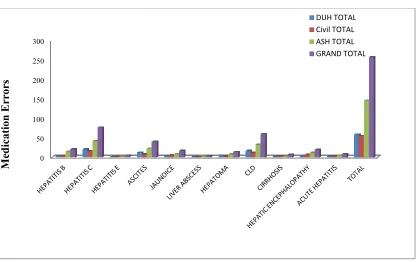
A total of 61 patient’s profiles were reviewed and then the available medications errors were identified in this study. A total of 257 errors were found associated with different liver diseases among three hospitals depicted in Fig
observed that the medication errors were
among Hepatitis C diseased patient, followed by chronic liver disease (CLD) and ascites, i.e. 75 > 58 >39 respectively.
The frequency of liver disease among three different hospitals was found to be significant i.e. P= 0.02, as shown in Table 1.
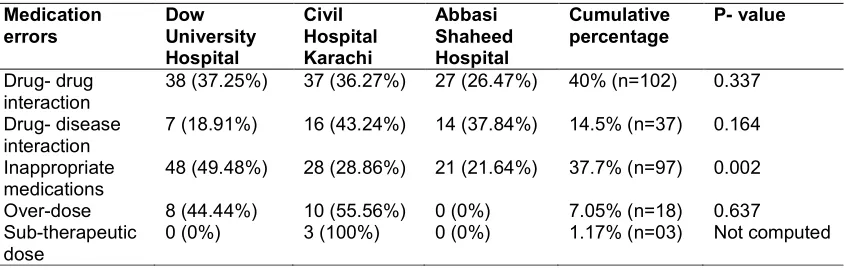
Out of 257 medication errors, 40% (n=102) were drug-drug interactions, 14.5% (n=37) were drug disease interaction, 37.7% (n=97) were associated with inappropriate medication, 7.05% (n=18) were related to over-dose of drug and 1.17% (n=3) were due to sub-therapeutic dose of drug, shown in Table 2.
In the 102 identified cases of
interactions, 25.5% (n=26) cases were associated with contraindicated drugs, 27.5%
Fig. 1. Total number of medication errors in different liver diseases found among different
0 50 100 150 200 250 300
M
ed
ic
a
ti
o
n
E
rr
o
rs
A total of 61 patient’s profiles were reviewed and then the available medications errors were identified in this study. A total of 257 errors were found associated with different liver diseases depicted in Fig. 1. It was the medication errors were highest among Hepatitis C diseased patient, followed by chronic liver disease (CLD) and ascites, i.e. 75 >
of liver disease among three different hospitals was found to be significant i.e.
Out of 257 medication errors, 40% (n=102) were drug interactions, 14.5% (n=37) were drug- disease interaction, 37.7% (n=97) were associated with inappropriate medication, 7.05% dose of drug and therapeutic dose of
In the 102 identified cases of drug-drug 25.5% (n=26) cases were associated with contraindicated drugs, 27.5%
(n=28) cases were associated with major interactions, while 47.05% (n=48) cases were moderate interactions.
Furthermore, 97 cases that were due to the inappropriate medications, consisting of 84.5% (n=82) cases of insufficient prescribing, whereas 7.37% (n=7) cases were found to be due to in appropriate-dosing and 8.24% (n=8) were associated with poly pharmacy cases
Moreover, it was found that the drug interactions, drug- disease interaction and over dose associated errors were non
p= 0.337, 0.164, 0.637 respectively among the hospitals. It means that these three medication errors were found irrespective of the services provided and reputation of the hospitals. However medication errors associated with inappropriate medications was found to be significantly different among the hospitals i.e. p= 0.02, whereas surprisingly two of the hospitals did not show medication errors associated with sub therapeutic dosing and one showed it occurrence as n= 3 therefore p value can’t be computed statistically for this medication error, mentioned in Table 2.
ication errors in different liver diseases found among different hospitals
DUH TOTAL Civil TOTAL ASH TOTAL GRAND TOTAL
(n=28) cases were associated with major 47.05% (n=48) cases were
97 cases that were due to the inappropriate medications, consisting of 84.5% (n=82) cases of insufficient prescribing, whereas 7.37% (n=7) cases were found to be due to in 8.24% (n=8) were ciated with poly pharmacy cases.
Moreover, it was found that the drug- drug disease interaction and over dose associated errors were non-significant i.e. p= 0.337, 0.164, 0.637 respectively among the hospitals. It means that these three medication espective of the services provided and reputation of the hospitals. However medication errors associated with inappropriate medications was found to be significantly different among the hospitals i.e. p= 0.02, whereas surprisingly two of the hospitals not show medication errors associated with sub therapeutic dosing and one showed it occurrence as n= 3 therefore p value can’t be computed statistically for this medication error,
ication errors in different liver diseases found among different
DUH TOTAL
Shamim and Shafique; BJMMR, 10(4): 1-8, 2015; Article no.BJMMR.17488
Table 1. Frequency of liver diseases among patients
Dow University Hospital
Civil Hospital Karachi
Abbasi Shaheed Hospital
Cumulative percentage
P- value
62 (47.7%) 36 (27.7%) 32 (24.6%) 50.6% (n=130) 0.02
Table 2. The types and number of medication errors observed in different hospitals among patients of liver diseases
Medication errors
Dow University Hospital
Civil Hospital Karachi
Abbasi Shaheed Hospital
Cumulative percentage
P- value
Drug- drug interaction
38 (37.25%) 37 (36.27%) 27 (26.47%) 40% (n=102) 0.337
Drug- disease interaction
7 (18.91%) 16 (43.24%) 14 (37.84%) 14.5% (n=37) 0.164
Inappropriate medications
48 (49.48%) 28 (28.86%) 21 (21.64%) 37.7% (n=97) 0.002
Over-dose 8 (44.44%) 10 (55.56%) 0 (0%) 7.05% (n=18) 0.637 Sub-therapeutic
dose
0 (0%) 3 (100%) 0 (0%) 1.17% (n=03) Not computed
4. DISSCUSSION
From our study, we have found that the occurrence of medication orders among liver diseases patients was quite high, as they are very common in practice in comparison to suggested by other reports, that relatively few resulted in adverse events, whereas some appears avoidable by the use of electronically system used by physician. The frequency of medication errors that we found, 257 in 61 patient profiles, is significantly higher than has been previously reported [17-28], however a survey study done by Michael R. Cohen et al. [29], revealed 951 serious errors were reported for 156 hospitals that submitted survey data.
Majority of medication errors occurs as a result of poor prescribing and often involve relatively inexperienced medical staff, responsible for irrational prescribing in the hospital. Our study has revealed high occurrence of drug – drug interactions i.e. 102 (40%) per 60 patient’s profiles, whereas related study shows, 4.8% were susceptible to a clinically significant Drug - drug interactions. However errors associated with inappropriate medications was found to be 37.7%, whereas previous study has shown 34.9% regularly [30], while another study done by “Svetlana Vladislavovna Doubova (Dubova) et al. [31],” has shown about 80.0% of patients had prescriptions implying one or more potential drug-drug interactions.
Current study has shown low percentages of drug- diseases interactions i.e. 14.5% among 61 patient’s profiles in comparison to the previous study done by “Svetlana Vladislavovna Doubova (Dubova) et al. [30],” where 64.0% of patients had prescriptions implying one or more potential drug disease interactions, moreover study carried out by “Catherine I Lindblad et al. [32],” resulted overall, 159 (40.1%) patients had one or more potential drug-disease interaction. The percentage of errors associated to over doses of drugs was found to be very less 7.05% as compare to a study done by “Michael R. Cohen,” that has shown 33.6% [29].
Our study has shown potential percentage of errors associated with the use of inappropriate medication i.e. 97%, in contrast to a study done by AD Calabrese et al. [33] that has presented 24% of errors related to inappropriate preparations, where total errors were found to be 132 in 26 patients.
requires a way of scientific investigation of preventable patient harm [7,34].
All healthcare professionals have a responsibility in identifying contributing factors to medication errors and explore the ways to further reduce their occurrence. A multidisciplinary approach to solving the problem of medication errors needs to be taken. Significant increases in the reporting of medication errors have been noted. Creating a culture of safety does not just mean eradicating the culture of blame but also involves changing the entire way one thinks about and approaches the work in the medication cycle. However, confidential, non-punitive reporting has its faults including the fact that the true number of medication errors will still not be known and that confidential reports may be difficult to validate. We must recognize that the current approaches to preventing medication errors. Medication use systems can be made safe by making them resistant to error and by adding important checks and controls. Unfortunately the difficulties associated with making systems failsafe explain the significant number of medication errors that continue to occur [7].
5. CONCLUSIONS
The result of our study shows high number of medication errors. The rate of medication errors can be minimized by inclusion of clinical pharmacists in hospitals because pharmacist can play a vital role in the identification and prevention of medication errors and can educate all health care professionals with up-to-date information related to drugs. Implementation of electronic based system like COPE system can be beneficial to minimize the chances of errors and it is also essential to educate the patients about their medications along with Staff orientation/development in order to reduce the possibility of these errors.
ACKNOWLEDGEMENTS
We are deeply thankful to Dr. Junaid Ashraf, Principal Dow University for his valuble suggestions.
It is important here to extend our sincere appreciation to Dr. Zahid Azam, Consultant, Dow University Hospital.
We are very grateful to Dr. Zain-ul-hasnain, Chief Pharmacist, Abbasi shaheed hospital Karachi, for his cooperation during research work.
This study would not be completed without generous help of Dr. Omer Mustapha, Ph.D Scholar, Hanyang University South Korea, by his on line assistance for resolving queries regarding the study.
CONSENT
It is not applicable.
ETHICAL APPROVAL
It is not applicable.
COMPETING INTERESTS
Authors have declared that no competing interests exist.
REFERENCES
1. Gille, Christoph, Christian Bölling, Andreas Hoppe, Sascha Bulik, Sabrina Hoffmann, et al. Hepat Net. A comprehensive metabolic reconstruction of the human hepatocyte for the analysis of liver physiology. Molecular Systems Biology. 2010;6(1):411.
2. Dardevet D, Moore MC, Remond D, Everett-Grueter CA, Cherrington AD. Regulation of hepatic metabolism by enteral delivery of nutrients. Nutrition Research Reviews. 2006;19(02):161-173. 3. Williams RT. Hepatic metabolism of drugs.
Gut. 1972;13(7):579-585.
4. Nadeem Irfan Bukhari. Hospital Pharmacy. 2000;106.
5. Medication Errors. FDA.
Available:www.fda.gov/drugs/drugsafety/m edicationerrors/default.htm
6. Martin Stephens. Hospital Pharmacy. 2003;127-128.
7. DJP Williams. Medication Errors. The Journal of the Royal College of Physicians of Edinburgh. 2007;37:343-346.
8. Micromedex gateway: Micromedex® 2.0 and Micromedex® 1.0 (Healthcare Series). 9. Charles F Lacy. Drug Information Handbook (A comprehensive resource for all clinicians and heath care professionals) LEXI-COMP. Edition 19th.2010-2011;1(2). 10. British National Formulary (BNF); 2011. 11. Benson GD, Koff RS, Tolman KG. The
Shamim and Shafique; BJMMR, 10(4): 1-8, 2015; Article no.BJMMR.17488
patients with liver disease. American Journal Of Therapeutics 2005;12(2):133-41.
12. Benson GD, Hepatotoxicity following the therapeutic use of antipyretic analgesics. The American Journal of Medicine. 1983; 75(5A):85-93.
13. Rossi S, Assis DN, Awsare M, Brunner M, Skole K, Rai J, et al. Use of over-the-counter analgesics in patients with chronic liver disease: Physicians' recommendations. Drug Safety. 2008;31 (3):261-270.
14. Kim YS, Kestell MF, Lee SP. Gall-bladder sludge: lessons from ceftriaxone. Journal of Gastroenterology and Hepatology. 1992;7(6):618-21.
15. Sajjad A, Mottershead M, Syn WK, Jones R, Smith S, Nwokolo CU. Ciprofloxacin suppresses bacterial overgrowth, increases fasting insulin but does not correct low acylated ghrelin concentration in non-alcoholic steatohepatitis. Alimentary Pharmacology and Therapeutics. 2005; 22(4):291-9.
16. Godfrey Mark S, Arkadiy Finn, Hadeel Zainah, Kwame Dapaah-Afriyie. Metronidazole-induced encephalopathy after prolonged metronidazole course for treatment of C. difficile colitis. BMJ Case Reports. 2015;2014-206162.
17. Pham Julius Cuong, Monica S. Aswani, Michael Rosen, Hee Won Lee, Matthew Huddle, Kristina Weeks, Peter J. Pronovost. Reducing medical errors and adverse events. Annual Review of Medicine 2012;63:447-463.
18. Budnitz Daniel S, Maribeth C Lovegrove, Nadine Shehab, Chesley L Richards. Emergency hospitalizations for adverse drug events in older Americans. New England Journal of Medicine. 2011; 365 (21):2002-2012.
19. Haw Camilla Malyn, Geoff Dickens, Jean Stubbs. A review of medication administration errors reported in a large psychiatric hospital in the United Kingdom. Psychiatric Services. 2005; 56(12):1610-1613.
20. Neville RG, Robertson F, Livingstone S, Crombie IK. A classification of prescription errors. The Journal of the Royal College of General Practitioners. 1989;39:110-2. 21. Kuo Grace M, Daniel R Touchette,
Jacqueline S. Marinac. Drug Errors and related interventions reported by United States clinical pharmacists: The American
College of Clinical Pharmacy Practice‐Based Research Network Medication Error Detection, Amelioration and Prevention Study. Pharmacotherapy: The Journal of Human Pharmacology and Drug Therapy. 2013;33(3):253-265. 22. Keers Richard N, Steven D Williams,
Jonathan Cooke, Darren M. Ashcroft. Prevalence and nature of medication administration errors in health care settings: a systematic review of direct observational evidence. Annals of Pharmacotherapy. 2013;47(2):237-256. 23. Winder Marquita B, Jeremy L Johnson,
Lourdes G Planas, Kimberly M Crosby, Brooke L Gildon, Linda A Oberst-Walsh. Impact of pharmacist-led educational and error notification interventions on prescribing errors in a family medicine clinic. Journal of the American Pharmacists Association. 2015;55(3): 238-245.
24. Anastasio GD, Sigmon JL Jr. Prescription-writing errors letter: comment. Journal of Family Practice. 1990;30:I08.
25. Oldland Alan, Larry Golightly, Sondra May, Gerard Barber, Nancy Stolpman. Electronic inventory systems and barcode technology. Impact on Pharmacy Technical Accuracy and Error Liability. Hospital Pharmacy. 2015;50 (1):034-041.
26. Berdot Sarah, Brigitte Sabatier, Florence Gillaizeau, Thibaut Caruba, Patrice Prognon, Pierre Durieux. Evaluation of drug administration errors in a teaching hospital. BMC Health Services Research. 2012;12(1):60.
27. Kazemi Alireza, Johan Ellenius, Faramarz Pourasghar, Shahram Tofighi, Aref Salehi, Ali Amanati, Uno GH Fors. The effect of computerized Physician order entry and decision support system on medication errors in the neonatal ward: Experiences from an Iranian teaching hospital. Journal of Medical Systems. 2011;35(1):25-37. 28. David W, Bates, MD, MSc, Deborah L.
Boyle, BA, Martha B. Vander Vliet, RN, James Schneider, RPh, Lucian Leape, MD. Relationship between medication errors and adverse drug events. Journal of General Internal Medicine. 1995;10(4): 199-205.
and common serious medication errors. Journal of Healthcare Risk Management. 1998;18(1):16-27.
30. Dr Helka MV. Hosia-Randell, Seija M. Muurinen, Kaisu H. Pitkälä. Exposure to potentially inappropriate drugs and drug-drug interactions in elderly nursing home residents in Helsinki, Finland. Drugs & Aging. 2008;25(8):683-692.
31. Svetlana Vladislavovna Doubova (Dubova), Hortensia Reyes Morales, Laura del Pilar Torres-Arreola, Magdalena Suárez-Ortega. Potential drug-drug and drug-disease interactions in prescriptions for ambulatory patients over 50 years of age in family medicine clinics in Mexico City. BMC Health Services Research. 2007;7(1):147.
32. Lindblad, Catherine I., Margaret B. Artz, Carl F. Pieper, Richard J. Sloane, Emily R. Hajjar, Christine M. Ruby, et al. Potential Drug—Disease Interactions in Frail, Hospitalized Elderly Veterans. Annals of Pharmacotherapy. 2005; 39(3):412-417.
33. AD Calabrese, BL Erstad, K Brandl, JF Barletta, Sandra L. Kane, Deb S. Sherman. Medication admini-stration errors in adult patients in the ICU Intensive Care Medicine. 2001;27(10): 1592-1598.
34. Karen Wilson, Mark Sullivan. Preventing medication errors with smart infusion technology. American Journal of Health System Pharmacy. 2004;61(2):177-183.
© 2015 Shamim and Shafique; This is an Open Access article distributed under the terms of the Creative Commons Attribution License (http://creativecommons.org/licenses/by/4.0), which permits unrestricted use, distribution, and reproduction in any medium, provided the original work is properly cited.
Peer-review history: