Remote data access in computational jobs on the ATLAS
data grid
VolodimirBegy1,2,∗,MartinBarisits1,MarioLassnig1, andErichSchikuta2 on behalf of the ATLAS Collaboration
1CERN, Geneva 23, Switzerland 2University of Vienna, Vienna, Austria
Abstract. This work describes the technique of remote data access from com-putational jobs on the ATLAS data grid. In comparison to traditional data move-ment and stage-in approaches it is well suited for data transfers which are asyn-chronous with respect to the job execution. Hence, it can be used for optimiza-tion of data access patterns based on various policies. In this study, remote data access is realized with the HTTP and WebDAV protocols, and is investigated in the context of intra- and inter-computing site data transfers. In both cases, the typical scenarios for application of remote data access are identified. The paper also presents an analysis of parameters influencing the data goodput between heterogeneous storage element - worker node pairs on the grid.
1 Introduction
The ATLAS Experiment at CERN [1] stores approximately 400 petabytes of data across more than 150 data centers within the Worldwide LHC Computing Grid (WLCG) [2, 3]. More than 5000 grid users submit analysis and production jobs. The data is accessed based on data placement, stage-in and remote access techniques. In practice, the data placement is typically employed for scheduled inter-storage element data transfers [4], while stage-in and remote access [5–7] are used by worker nodes locally within a single computing site. However, other data access profiles, such as direct reading from remote storage elements, or arbitrary combinations of the various access techniques within a single computational campaign are possible.
2 Remote data access
Consider a computational job scheduled to run at the computing siteS1. The job requires some fraction of a file persisted at the remote computing siteS2as input. According to the current data access policies of the ATLAS data grid, the complete file first needs to be placed from the remote storage element to the local one. Then, it can be accessed by the worker node in the stage-in manner. In this section, we refer to this procedure aslocal access. An alternative is to read the relevant fraction of the file directly from the remote storage element atS2. Here, we refer to this access profile asremote access.
2.1 Goodput break-even point
In this subsection we present hypothetical examples, demonstrating the suitability of lo-cal/remote data access profiles in various scenarios. The examples are based on a simplistic
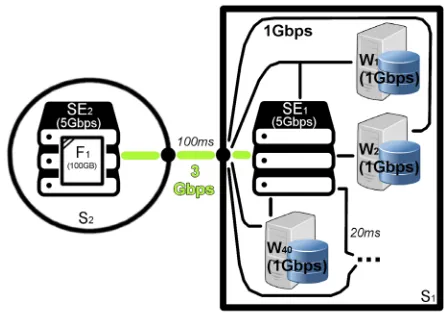
grid topology, depicted in figure 1. A grid comprises two sitesS1andS2. Jobs are scheduled
to run at the local siteS1, which consists of the storage elementSE1and 40 worker nodesw1, w2, . . . , w40. The second siteS2has a storage elementSE2(and neglected workers). All the
input data needed by computational jobsj1, j2, . . . , jnis stored in a single fileF1with a size of
100GB.F1is stored inSE2. The sitesS1andS2are connected over a 3Gbps WAN link. Each
of the storage elementsSE1andSE2is connected to the WAN link over a 3Gbps LAN link.
Each of the workersw1, w2, . . . , w40is connected to the local storage elementSE1and to the
WAN link over a 1Gbps LAN link. Each of the storage elementsSE1andSE2has a maximum
data throughput of 5Gbps. Each workerw1, w2, . . . , w40has a maximum data throughput of
1Gbps. In the demonstrated examples the same effect is reached, in case the storage element SE2has a maximum throughput of 3Gbps, while the WAN link has a bandwidth of>=3Gbps.
The one-way network latency accounts for the end-to-end delay. Between all local machines this latency is 20ms, between all remote machines it is 100ms. The grid employs a reliable data transfer protocol (thus, network latency has a direct impact on the overall data transfer time).
Figure 1.Example grid topology.
For the sake of simplicity, we assume that there is no slow-start phase in the data transfer protocol. We assume that packet switches are not slowing down the transfer process in any way. The packet size is set to 1MB (while the header bytes are neglected), the packet loss rate is 1% over WAN and 0.1% over LAN, while during the second attempt all the packets are guaranteed to be delivered. The protocol employs two asynchronous channels: a data channel and a control channel. The traffic needed for the transmission of control messages is
neglected. Every time a lost packet is detected and retransmitted by the sender, the transfer time is increased by the network latency. We assume that the maximum storage capacities of all the machines are not reached, and that there are always available CPU cores for the processing. We assume that storage elements share the maximum data throughput and the WAN link shares the bandwidth equally between all parallel data flows.
2.1 Goodput break-even point
In this subsection we present hypothetical examples, demonstrating the suitability of lo-cal/remote data access profiles in various scenarios. The examples are based on a simplistic
grid topology, depicted in figure 1. A grid comprises two sitesS1andS2. Jobs are scheduled
to run at the local siteS1, which consists of the storage elementSE1and 40 worker nodesw1, w2, . . . , w40. The second siteS2 has a storage elementSE2(and neglected workers). All the
input data needed by computational jobsj1, j2, . . . , jnis stored in a single fileF1with a size of
100GB.F1is stored inSE2. The sitesS1andS2are connected over a 3Gbps WAN link. Each
of the storage elementsSE1andSE2 is connected to the WAN link over a 3Gbps LAN link.
Each of the workersw1, w2, . . . , w40is connected to the local storage elementSE1and to the
WAN link over a 1Gbps LAN link. Each of the storage elementsSE1andSE2has a maximum
data throughput of 5Gbps. Each workerw1, w2, . . . , w40 has a maximum data throughput of
1Gbps. In the demonstrated examples the same effect is reached, in case the storage element SE2has a maximum throughput of 3Gbps, while the WAN link has a bandwidth of>=3Gbps.
The one-way network latency accounts for the end-to-end delay. Between all local machines this latency is 20ms, between all remote machines it is 100ms. The grid employs a reliable data transfer protocol (thus, network latency has a direct impact on the overall data transfer time).
Figure 1.Example grid topology.
For the sake of simplicity, we assume that there is no slow-start phase in the data transfer protocol. We assume that packet switches are not slowing down the transfer process in any way. The packet size is set to 1MB (while the header bytes are neglected), the packet loss rate is 1% over WAN and 0.1% over LAN, while during the second attempt all the packets are guaranteed to be delivered. The protocol employs two asynchronous channels: a data channel and a control channel. The traffic needed for the transmission of control messages is
neglected. Every time a lost packet is detected and retransmitted by the sender, the transfer time is increased by the network latency. We assume that the maximum storage capacities of all the machines are not reached, and that there are always available CPU cores for the processing. We assume that storage elements share the maximum data throughput and the WAN link shares the bandwidth equally between all parallel data flows.
In this highly abstracted calculation of the data transfer time [8] we only consider two dominant components: (1) the delay resulting from the first attempt to transfer all the packets;
(2) accumulated latencies resulting from the second attempt to transfer the lost packets. The general formula is:
tS→D=dtrans f er+l∗((F/P)∗Rloss)
wheretS→Dis the data transfer time from source to destination,dtransferis the aforementioned
first component,lis the concerned latency,Fis the size of the data being transferred,Pis the packet size,Rlossis the loss rate.
dtransferitself is also calculated on a high abstraction level, by
dtrans f er=F/T
whereTis the end-to-end throughput of the transfer, which is fairly determined considering the amount of parallel data flows and the physical limits of hardware.
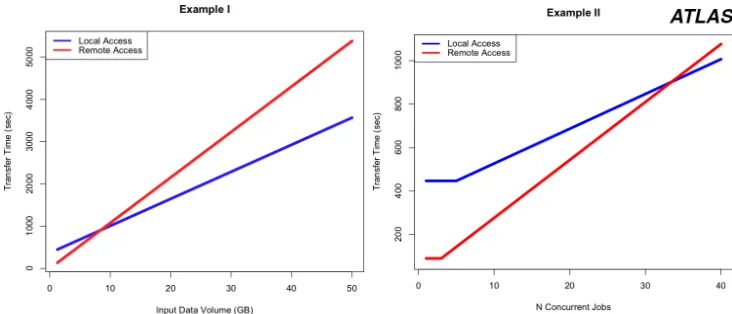
In the first example, each worker nodew1, w2, . . . , w40is assigned a single computational
jobj1, j2, . . . , j40respectively. Each jobj1, j2, . . . , j40requires a distinct fraction of the file F1, which is located at the remote storage elementSE2as input. The size of the requested file
fraction is varied from 1 to 50GB in 1GB steps (each neighboring pair of points in the plot is linearly interpolated). In the second example, a varied amount of worker nodes (1-40) is assigned a single computational job. Each job needs a distinct 10GB fraction of the fileF1as
input. Applying the above formula, we get the transfer times depicted in figure 2.
Figure 2.Transfer times.
We interpret the results as follows. Data caching by means of data-placement minimizes the limiting effects posed by large amounts of parallel data flows on throughput of network
links or storage elements. Remote data access helps to avoid increased cumulative latency due to transfer of redundant file fractions.
Furthermore, remote data access is beneficial for the following reasons:
• The data is transferred asynchronously with respect to the job execution. Thus, the resource utilization is maximized.
• Such access methodology can help to bypass limited disk space and quotas imposed by virtual organizations by streaming data in chunks without persisting it.
2.2 Observations in production
This section presents experiments conducted in the production grid in order to examine the behavior of remote data access. The data access is realized based on the reliable HTTP/WebDAV protocols. First, we examine the throughput bottleneck given a virtual link
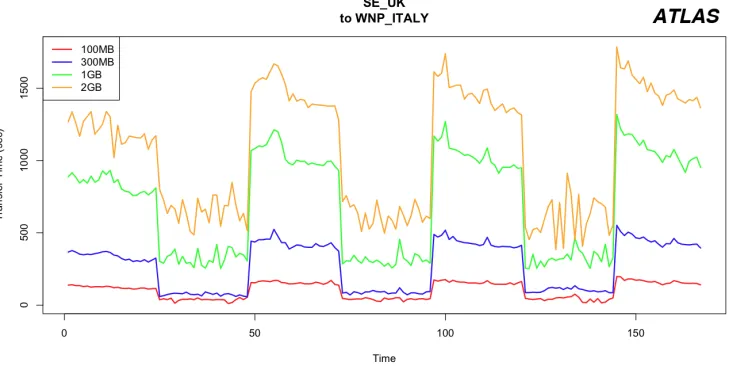
between a worker node pool and a storage element. For this purpose, we submit a computa-tional job to the worker node pool of an anonymous computing site in Italy, which we denote byWNP_ITALY. Every 30 minutes, 4 threads commence to concurrently read files of various sizes (100MB, 300MB, 1GB and 2GB) from an anonymous storage element located in the UK, denoted bySE_UK. A single thread reads a single file respectively. Once per sampling day, the job is re-submitted to a randomly selected worker node. The sampling day is divided into 2 phases of equal length. During the first phase, 10 other threads within the same job concurrently read other files of various sizes. During the second phase, only the initially mentioned threads are active. The goal is to test whether the group means of transfer times for the 4 initial files differ among the 2 sampling phases. If this is the case, then the
addition-ally imposed traffic during the first sampling phase causes a bottleneck effect on the given
virtual link. The resulting time series for the transfer times of the original files are depicted in figure 3.
Figure 3.Throughput bottleneck.
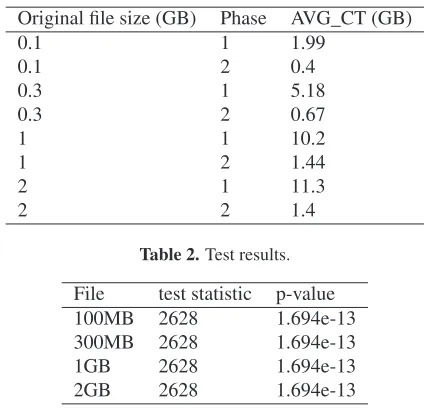
Given a single initial file and a single sampling phase, the estimated [9] average concur-rent traffic (AVG_CT) is reported in table 1.
To test whether the transfer times differ significantly among sampling phases [10], we
perform the non-parametric two-sided paired Wilcoxon Signed-Rank Test. Specifically, for each original file, we split the sampled transfer times into two different groups in accordance
to the sampling phase. The null hypothesis of the test states that the two samples are drawn from the same population. The test results are reported in table 2. According to the test results, the null hypothesis is rejected.
2.2 Observations in production
This section presents experiments conducted in the production grid in order to examine the behavior of remote data access. The data access is realized based on the reliable HTTP/WebDAV protocols. First, we examine the throughput bottleneck given a virtual link
between a worker node pool and a storage element. For this purpose, we submit a computa-tional job to the worker node pool of an anonymous computing site in Italy, which we denote byWNP_ITALY. Every 30 minutes, 4 threads commence to concurrently read files of various sizes (100MB, 300MB, 1GB and 2GB) from an anonymous storage element located in the UK, denoted bySE_UK. A single thread reads a single file respectively. Once per sampling day, the job is re-submitted to a randomly selected worker node. The sampling day is divided into 2 phases of equal length. During the first phase, 10 other threads within the same job concurrently read other files of various sizes. During the second phase, only the initially mentioned threads are active. The goal is to test whether the group means of transfer times for the 4 initial files differ among the 2 sampling phases. If this is the case, then the
addition-ally imposed traffic during the first sampling phase causes a bottleneck effect on the given
virtual link. The resulting time series for the transfer times of the original files are depicted in figure 3.
Figure 3.Throughput bottleneck.
Given a single initial file and a single sampling phase, the estimated [9] average concur-rent traffic (AVG_CT) is reported in table 1.
To test whether the transfer times differ significantly among sampling phases [10], we
perform the non-parametric two-sided paired Wilcoxon Signed-Rank Test. Specifically, for each original file, we split the sampled transfer times into two different groups in accordance
to the sampling phase. The null hypothesis of the test states that the two samples are drawn from the same population. The test results are reported in table 2. According to the test results, the null hypothesis is rejected.
Further, we investigate whether the detected bottleneck is arising on the side of the worker node or the storage element. The second experiment is performed in the context of other computing sites. The original computational job is submitted to a worker node pool in the USA,WNP_USA. Just like before, once per day the job is resubmitted to a random worker
Table 1.Estimated average concurrent traffic within the first experiment.
Original file size (GB) Phase AVG_CT (GB)
0.1 1 1.99
0.1 2 0.4
0.3 1 5.18
0.3 2 0.67
1 1 10.2
1 2 1.44
2 1 11.3
2 2 1.4
Table 2.Test results.
File test statistic p-value
100MB 2628 1.694e-13
300MB 2628 1.694e-13
1GB 2628 1.694e-13
2GB 2628 1.694e-13
node. Once per 30 minutes 4 threads within the job concurrently read files of various sizes (100MB, 300MB, 1GB and 2GB) from a storage element in Australia, SE_AUSTRALIA. A single thread reads a single respective file. However, this time there are no additional concurrent threads in the original job. Instead, at every second sampling step two computing jobs running in Australian (WNP_AUSTRALIA) and Italian (WNP_ITALY) worker node pools respectively commence to stream files of various sizes. Now the sampling phases alternate at every second time step. The resulting time series are presented in figure 4.
Figure 4.No bottleneck induced by the storage element.
Given a single original file and a single sampling phase, the estimated average concurrent traffic is reported in table 3. In this case we differentiate between within job concurrent traffic
(AVG_CT1) and cumulative concurrent traffic from the 2 other virtual links (AVG_CT2).
Table 3.Estimated average concurrent traffic within the second experiment.
Original file size (GB) Phase AVG_CT1 (GB) AVG_CT2 (GB)
0.1 1 0.58 0
0.1 2 0.57 1.02
0.3 1 1.06 0
0.3 2 1.07 2.41
1 1 1.62 0
1 2 1.62 5.68
2 1 1.38 0
2 2 1.39 8.57
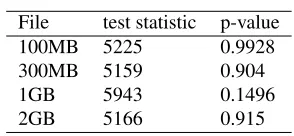
We have performed an analogous non-parametric two-sided paired Wilcoxon Signed-Rank Test, with the null hypothesis stating, that the transfer times of individual files do not differ among sampling phases. The results are depicted in table 4.
Table 4.Test results.
File test statistic p-value
100MB 5225 0.9928
300MB 5159 0.904
1GB 5943 0.1496
2GB 5166 0.915
Based on these test results the null hypothesis is clearly confirmed. Thus, we conclude, that the bottleneck detected in the first experiment originates in the network I/O of the worker
nodes.
3 Conclusions and Future Work
In this paper we have described the current state of the remote data access methodology in the ATLAS data grid. Furthermore, we have motivated its use for inter-computing site transfers, which is currently not deployed. The presented empirical experiments show that the I/O
bottlenecks for remote data access tend to be exclusively on the side of worker nodes (given practical workloads). Finally, we have detected the unstable throughput of certain network interface cards.
Currently we are working on the following aspects as part of the future work:
• Mathematical formalization and forecasting model for network throughput of all the data access profiles (remote data access, data placement and stage-in).
• Incorporation of the throughput formalization in a simulation model.
• Evolutionary optimization of hybrid data access profiles using memetic algorithms.
References
Given a single original file and a single sampling phase, the estimated average concurrent traffic is reported in table 3. In this case we differentiate between within job concurrent traffic
(AVG_CT1) and cumulative concurrent traffic from the 2 other virtual links (AVG_CT2).
Table 3.Estimated average concurrent traffic within the second experiment.
Original file size (GB) Phase AVG_CT1 (GB) AVG_CT2 (GB)
0.1 1 0.58 0
0.1 2 0.57 1.02
0.3 1 1.06 0
0.3 2 1.07 2.41
1 1 1.62 0
1 2 1.62 5.68
2 1 1.38 0
2 2 1.39 8.57
We have performed an analogous non-parametric two-sided paired Wilcoxon Signed-Rank Test, with the null hypothesis stating, that the transfer times of individual files do not differ among sampling phases. The results are depicted in table 4.
Table 4.Test results.
File test statistic p-value
100MB 5225 0.9928
300MB 5159 0.904
1GB 5943 0.1496
2GB 5166 0.915
Based on these test results the null hypothesis is clearly confirmed. Thus, we conclude, that the bottleneck detected in the first experiment originates in the network I/O of the worker
nodes.
3 Conclusions and Future Work
In this paper we have described the current state of the remote data access methodology in the ATLAS data grid. Furthermore, we have motivated its use for inter-computing site transfers, which is currently not deployed. The presented empirical experiments show that the I/O
bottlenecks for remote data access tend to be exclusively on the side of worker nodes (given practical workloads). Finally, we have detected the unstable throughput of certain network interface cards.
Currently we are working on the following aspects as part of the future work:
• Mathematical formalization and forecasting model for network throughput of all the data access profiles (remote data access, data placement and stage-in).
• Incorporation of the throughput formalization in a simulation model.
• Evolutionary optimization of hybrid data access profiles using memetic algorithms.
References
[1] ATLAS Collaboration, 2008 JINST 3 S08003.
[2] I. Bird, Annual Review of Nuclear and Particle Science 61, 99 (2011),
https://doi.org/10.1146/annurev-nucl-102010-130059
[3] I. Foster, I. Foster, C. Kesselman, E.I. Inc,The Grid 2: Blueprint for a New Computing Infrastructure, The Elsevier Series in Grid Computing (Elsevier Science, 2004), ISBN 9781558609334,https://books.google.ch/books?id=8-0BofIhoU0C
[4] V. Garonne et al on behalf of the ATLAS Collaboration, Journal of Physics: Conference Series513, 042021 (2014)
[5] G. Bernabeu, F. Martinez, E. Acción, A. Bria, M. Caubet, M. Delfino, X. Espinal, Journal of Physics: Conference Series331, 072003 (2011)
[6] R. Gardner et al on behalf of the ATLAS Collaboration, Journal of Physics: Conference Series513, 042049 (2014)
[7] J. Elmsheuser, R. Walker, C. Serfon, V. Garonne, S. Blunier, V. Lavorini, P. Nilsson, Journal of Physics: Conference Series664, 042014 (2015)
[8] J. Kurose, K. Ross, Computer Networking: A Top-Down Approach, Global Edition (Pearson Education Limited, 2017), ISBN 9781292153605,https://books.google. ch/books?id=IUh1DQAAQBAJ
[9] V. Begy et al on behalf of the ATLAS Collaboration, Tech. Rep. ATL-SOFT-PROC-2018-001, CERN, Geneva (2018),https://cds.cern.ch/record/2621616