Understanding
d
∗(2380)
in a chiral quark model
F. Huang1,2,∗, Y. B. Dong2,3,1, P. N. Shen2,3,4, and Z. Y. Zhang2,3,1
1School of Nuclear Science and Technology, University of Chinese Academy of Sciences, Beijing
100049, China
2Institute of High Energy Physics, Chinese Academy of Sciences, Beijing 100049, China
3Theoretical Physics Center for Science Facilities (TPCSF), Chinese Academy of Sciences, Beijing
100049, China
4College of Physics and Technology, Guangxi Normal University, Guilin 541004, China
Abstract.We review our recent progresses made in the study of the structure and decay properties of the newly observedd∗(2380) within a chiral constituent quark model. It is found that thed∗(2380) can be explained as a compact hexaquark-dominated exotic state with a fraction of hidden color components of about 2/3 in its configuration. Based on this scenario the single- and double-pionic partial decay widths are calculated and the corresponding numerical re-sults are in good agreement with the experimental data.
1 Introduction
So far most of the observed hadrons can be categorized into mesons and baryons, which are composed of a pair of constituent quark-antiquark and three constituent quarks, respectively. However, the fundamental theory of strong interactions, QCD, does not exclude the existence of the so-called exotic states which are color-singlet but cannot be attributed to the traditional mesons or baryons, e.g. glueballs, hybrids, molecules, and multiquark states. In systems with six constituent quarks, deuteron is for a few decades the only two-baryon molecule confirmed by experiments. Searching for other possible baryon-baryon molecules or hexaquark sates is a challenging and inspiring task for physicists in the community of hadron physics.
Recently a resonance with isospin (spin-parity)I(JP)=0(3+), massM≈2380 MeV and widthΓ≈70 MeV has been reported by the WASA-at-COSY Collaboration in an exclusive and kinematically complete measurement of the double pionic fusion reaction pn→ dπ0π0 [1]. Later the same resonance has also been observed in several other two-pion production reactions: pn → dπ+π−, pn → pnπ0π0,pn → ppπ−π0,pd → 3Heπ0π0, pd → 3Heπ+π−,
dd →4Heπ0π0anddd →4Heπ+π−[2–7]. In a partial wave analysis of the neutron-proton (np) scattering data performed by the WASA-at-COSY Collaboration and SAID Data Anal-ysis Group, a resonance pole at (2380±10)−i(40±5) MeV in the3D
3-3G3coupled-channel partial waves has been reported [8, 9] when the newly observed analyzing power data for the polarized⃗npscattering reaction has been incorporated into the old data base fornpscattering. Theoretically, the newly observed d∗(2380) is of particular interest. One of the major reasons is that it has an unusual narrow width. It is true that the mass ofd∗(2380) is about 80 MeV lower than the threshold of∆∆, but it is still much higher than the thresholds of
the∆Nπ,NNππandNNchannels. Naively, a rather wide decay width is expected since the ∆is very broad and moreover, thed∗(2380) can decay into∆Nπ,NNππandNN channels via strong interactions. However, the experimentally observed decay width is only about 70 MeV, which is even smaller than 1/3 of the width of two free∆s, implying that thed∗(2380) may have an unconventional structure involving new physical mechanisms.
When explainingd∗(2380) as a∆∆bound state, it is found that the calculated decay width is too large compared with data, even the mass can be reproduced properly [10]. Instead, there are two other explanations for the structure ofd∗(2380) which can reproduce both the mass and width simultaneously. One is claimed by our group [11–16], later mentioned by Bashkanov, Brodsky and Clement in Ref. [17], as a hexaquark-dominated exotic state. The other is claimed by Gal in Ref. [18] as a mixture of∆∆state and∆Nπresonance structure.
In this talk, we briefly review the scenario we proposed for the structure ofd∗(2380) and the calculation of the mass and decay ofd∗(2380) in this scenario. We refer the readers to our published works [12–16] for details.
2 Mass and structure of
d
∗(2380)
We use a chiral SU(3) quark model to study the∆∆-CC system. The total Hamiltonian for a 6-quark system can be written as
H=
6
∑
i=1
Ti−TG+
6
∑
j>i=1
(
Vi jOGE+Vi jconf+Vi jch), (1)
withTibeing the kinetic energy operator for thei-th quark,TGthe kinetic energy operator for
the center of mass motion of the whole system,Vi jOGE,Vi jconfandVi jchthe one-gluon-exchange (OGE) potential, the phenomenological confinement potential and the chiral fields induced effective interaction between thei-th and j-th quarks, respectively. In the chiral SU(3) quark model,Vch
i j reads
Vi jch =
8
∑
a=0
Vσa
i j +
8
∑
a=0
Vπa
i j, (2)
and in the extended chiral SU(3) quark model,Vch
i j reads
Vi jch =
8
∑
a=0
Vσa
i j +
8
∑
a=0
Vπa
i j +
8
∑
a=0
Vρa
i j, (3)
withσa,πa andρa (a =0,1,· · ·,8) being the scalar, pseudo-scalar and vector nonet fields,
respectively. The explicit expressions of those potentials can be found in Ref. [13]. All the model parameters are taken from our previous work [19, 20], and no additional parameters are introduced in the study of∆∆-CC system.
The resonating group method (RGM) is employed to investigate the interaction properties of the∆∆-CC system. The trial microscopic wave function of the whole 6-quark system can be written as
Ψ6q=A[ϕ∆(ξ1,ξ2)ϕ∆(ξ4,ξ5)η∆∆(r)+ϕC(ξ1,ξ2)ϕC(ξ4,ξ5)ηCC(r)]S=3,I=0,C=(00). (4)
HereAis the antisymmetrizer required by the Pauli exclusion principle,ϕ∆(C)the antisym-metrized internal wave functions of the (123) ((456)) 3-quark cluster withξi(i=1,2 (4,5))
motion of two clusters∆∆(CC) which is determined completely by the interaction dynamics of the whole six-quark system. Solving the RGM equation for a bound state problem,
⟨δΨ6q|H−E|Ψ6q⟩=0, (5)
one gets the binding energyEand the corresponding RGM 6-quark wave functionΨ6q.
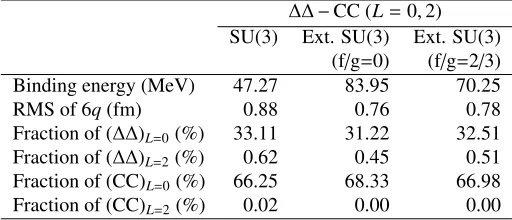
Table 1.Binding energy, root-mean-square radius (RMS), and fraction of each channel ind∗(2380).
∆∆−CC (L=0,2)
SU(3) Ext. SU(3) Ext. SU(3)
(f/g=0) (f/g=2/3)
Binding energy (MeV) 47.27 83.95 70.25
RMS of 6q(fm) 0.88 0.76 0.78
Fraction of (∆∆)L=0(%) 33.11 31.22 32.51
Fraction of (∆∆)L=2(%) 0.62 0.45 0.51
Fraction of (CC)L=0(%) 66.25 68.33 66.98
Fraction of (CC)L=2(%) 0.02 0.00 0.00
The calculated binding energies for ∆∆-CC system withI(JP)= 0(3+) are tabulated in
Table 1, where f/g means the ratio of tensor and vector couplings for vector meson exchanges in the extended chiral SU(3) quark model. One sees that the mass of the∆∆-CC bound state is about 2.38−2.42 GeV and the RMS is about 0.76−0.88 fm in various models, indicating thatd∗is a deeply bound and compact state. This distinctive feature can be easily understood if we notice that both the quark exchange effect and the short-range interaction of the∆∆with I(JP)=0(3+) are “attractive” [12, 13].
The microscopic RGM wave function in Eq. (4) for ∆∆ and CC are not orthogonal to each other due to the transition between these two channels, and thus it is not suitable to be used directly to clarify the components of∆∆and CC ind∗(2380). Instead, the channel wave function in the quark cluster model is introduced for∆∆and CC,
χ∆∆(CC)(r)≡
⟨
ˆ
ϕ∆(C)(ξ1,ξ2) ˆϕ∆(C)(ξ4,ξ5)Ψ6q
⟩
, (6)
with ˆϕ∆(C)being the antisymmetrized internal wave function for the cluster of∆(C). Then the wave function ofd∗can be simply abbreviated and expanded as
Ψd∗ =|∆∆⟩χ∆∆(r)+|CC⟩χCC(r). (7)
It is obvious that the∆∆and CC components ind∗as depicted in Eq. (7) are orthogonal to each other. By an integral of the square of the normalized relative wave functionsχ∆∆(CC), the fractions of each individual channel in total wave functions can be extracted, and the results are listed in Table 1. One sees that the fraction of the CC channel ind∗is about 66%−68%. Note that according to symmetry, a pure hexaquark state of the∆∆-CC system with isospin I=0 and spinS =3 reads
[6]orb[33]IS=03=
√
1
5|∆∆⟩IS=03+
√
4
5|CC⟩IS=03, (8)
Figure 1.Illustration ofd∗(2380)→dππdecay.
Figure 2.Illustration ofd∗(2380)→NNππdecay.
Figure 3.Illustration of
d∗(2380)→NNπdecay.
3 Decay width of
d
∗(2380)
As the CC component ind∗(2380) cannot result in a direct break-up decay, in the lowest order, we only need to consider the contributions from the∆∆components ind∗(2380) for its decay. Figure 1 illustrates the possible decay mechanisms ford∗ →dππin time-ordered perturbation theory (TOPT). There the decay occurs in such a way that each of the two∆’s ind∗emits a pion and the remaining two nucleons form a deuteron [14]. Figure 2 illustrates the possible decay mechanisms ford∗→NNππin TOPT. It differs fromd∗→dππin such a way that after the two∆’s ind∗emits two pions, the remaining two nucleons go out directly rather than form a deuteron [15]. Figure 3 illustrates the possible mechanisms ford∗→NNπ in TOPT. There one pion is emitted from one of the two∆’s ind∗, and the other pion, emitted from another∆ind∗, is absorbed by the system [16].
To calculate the transition matrix elements and further the partial decay width for the processes illustrated in Figs. 1-3, apart from the wave functions of∆andNthat are described by Gaussian wave functions in the model, one also needs the wave function of d∗ which is given by Eq. (7), the wave function of deuteron which is obtained by study of the NN interaction, and the quark-quark-pion interaction that in the non-relativistic approximation can be written as
Hqqπ=
gqqπ
(2π)3/2 √2ωπσ·kτ·ϕπ, (9)
withgqqπ being the effective coupling constant to be fixed by the experimental decay width
of∆→ Nπ,ϕπ the pion field, and kandωπ = √m2
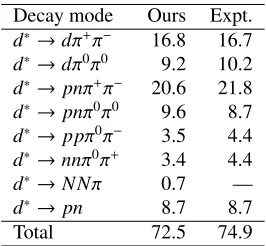
of pion, respectively. With these quantities provided, one can then calculate the decay width explicitly [14–16], and the results are listed in Table 2. Note that the decay width for the last moded∗→pnis estimated from the cross section ratio of theσd∗→pn/σd∗→dπ0π0.
Table 2.Calculated decay widths ofd∗(2380) (in MeV).
Decay mode Ours Expt.
d∗→dπ+π− 16.8 16.7 d∗→dπ0π0 9.2 10.2 d∗→ pnπ+π− 20.6 21.8 d∗→ pnπ0π0 9.6 8.7 d∗→ ppπ0π− 3.5 4.4 d∗→nnπ0π+ 3.4 4.4
d∗→NNπ 0.7 —
d∗→ pn 8.7 8.7
Total 72.5 74.9
From Table 2 one sees that all of our calculated partial decay widths are in good agree-ment with the data, and so does the total width. This justifies the scenario we proposed for d∗(2380), i.e. it has about 2/3 CC component and thus is a hexaquark-dominated exotic sate.
4 Summary
The structure and decay properties ofd∗(2380) have been detailedly investigated in both the chiral SU(3) quark model and the extended chiral SU(3) quark model. It is found that the d∗(2380) has a mass of about 2.38−2.42 GeV which is consistent with the experiment, a root-mean-square radius of about 0.76−0.88 fm, and a CC configuration in its wave function of about 66%−68%. Based on this scenario, the partial decay widths ofd∗→dπ+π−,d∗→ dπ0π0,d∗→pnπ+π−,d∗→ pnπ0π0,d∗→ ppπ0π−,d∗→nnπ0π+andd∗→NNπare further explicitly evaluated, and the numerical decay widths are in good agreement with the data. The consistency of our calculated mass and decay width compared with experiments supports the scenario we proposed for the structure ofd∗(2380), i.e. it is a hexaquark-dominated exotic state.
This work is supported by the National Natural Science Foundation of China under Grant Nos. 11475181, 11635009, 11475192, 11521505, 11565007, the Sino-German CRC 110 “Symmetries and the Emergence of Structure in QCD” project by NSFC under Grant No. 11621131001, the Key Re-search Program of Frontier Sciences, CAS, under Grant No. Y72926, and the IHEP Innovation Fund under Grant No. Y4545190Y2. F. Huang is grateful for the support of the Youth Innovation Promotion Association of CAS under Grant No. 2015358.
References
[7] S. Keletaet al.(WASA-at-COSY Collaboration), Nucl. Phys. A825, 71 (2009) [8] P. Adlarsonet al.(WASA-at-COSY Collaboration & SAID DAC), Phys. Rev. Lett.112,
202301 (2014)
[9] P. Adlarsonet al.(WASA-at-COSY Collaboration & SAID DAC), Phys. Rev. C90, 035204 (2014)
[10] H. X. Huang, J. L. Ping, and F. Wang, Phys. Rev. C89, 034001 (2014)
[11] X. Q. Yuan, Z. Y. Zhang, Y. W. Yu, and P. N. Shen, Phys. Rev. C60, 045203 (1999) [12] F. Huang, P. N. Shen, Z. Y. Zhang, and W. L. Wang, Chin. Phys. C39, 071001 (2015) [13] F. Huang, P. N. Shen, Y. B. Dong, and Z. Y. Zhang, Sci. China-Phys. Mech. Astron.59,
622002 (2016)
[14] Y. B. Dong, P. N. Shen, F. Huang, and Z. Y. Zhang, Phys. Rev. C91, 064002 (2015) [15] Y. B. Dong, F. Huang, P. N. Shen, and Z. Y. Zhang, Phys. Rev. C94, 014003 (2016) [16] Y. B. Dong, F. Huang, P. N. Shen, and Z. Y. Zhang, Phys. Lett. B769, 223 (2017) [17] M. Bashkanov, S. J. Brodsky, H. Clement, Phys. Lett. B727, 438 (2013)
[18] A. Gal, Phys. Lett. B769, 436 (2017)