This paper takes the case studies as its starting point, and steps
back to explore a longer term, broader canvas of ideas about
what the future might hold for recycled water. It uses the ‘Futures
Triangle’ to tease apart the forces that determine the set of
plausible futures for recycling: the pushes of the present, the
pull of the future, and the weight of history. What becomes clear
is that we are on the brink of very significant change, that very
different scenarios are possible, and that the diversity of water
services will increase noticeably.
Looking to the future
o the Future
About the Authors
The Institute for Sustainable Futures (ISF) is a flagship research institute at the University of Technology, Sydney. ISF’s mission is to create change toward sustainable futures through independent, project-based research with government, industry and community. For further information visit www.isf.uts.edu.au
Research team: Professor Cynthia Mitchell,
Joanne Chong, Andrea Turner, Monique Retamal, Naomi Carrard, and Janina Murta, assisted by Dr Pierre Mukheibir and Candice Moy.
Contact details: [email protected],
+61 (0)2 9514 4950
CitAtion
Please cite this document as: Institute for Sustainable Futures (2013), Looking to the future; Building Industry Capability to Make Recycled Water Investment Decisions. Prepared by the Institute for Sustainable Futures, University of Technology, Sydney for the Australian Water Recycling Centre of Excellence.
© Australian Water Recycling Centre of Excellence 2013
Apart from any use as permitted under the Copyright Act 1968, no part may be reproduced by any process without prior written permission. Requests and enquiries concerning reproduction and rights should be addressed to the Centre’s Knowledge Adoption Manager (www.australianwaterrecycling.com.au ).
DisCLAimer
The views expressed in this report are independent findings which are the responsibility of the authors alone, and do not necessarily reflect the views or opinions of our research partner organisations, the Australian Water Recycling Centre of Excellence, or the Commonwealth Government. The authors have used all due care and skill to ensure the material is accurate as at the date of publication. Responsibility for any loss that may arise by anyone relying upon its contents is disclaimed.
About the ProjeCt
This national collaborative research project entitled “Building industry capability to make recycled water investment decisions” sought to fill significant gaps in the Australian water sector’s knowledge by investigating and reporting on actual costs, benefits and risks of water recycling
as they are experienced in practice.
This project was undertaken with the support of the Australian Water Recycling Centre of Excellence by the Institute for Sustainable Futures (ISF) at the University of Technology Sydney (UTS), in collaboration with 12 partner organisations representing diverse interests, roles and responsibilities in water recycling. ISF is grateful for the generous cash and in-kind support from these partners: UTS, Sydney Water Corporation, Yarra Valley Water, Ku-ring-gai Council, NSW Office of Water, Lend Lease, Independent Pricing and Regulatory Tribunal (IPART), QLD Department Environment & Resource Management, Siemens, WJP Solutions, Sydney Coastal Councils Group, and Water Services Association of Australia (WSAA).
ISF also wishes to acknowledge the generous contributions of the project’s research participants – approximately 80 key informants from our 12 project partners and 30 other participating organisations.
Eight diverse water recycling schemes from across Australia were selected for detailed investigation via a participatory process with project partners. The depth of the case studies is complemented by six papers exploring cross-cutting themes that emerged from the detailed case studies, complemented by insights from outside the water sector.
For each case study and theme, data collection included semi-structured interviews with representatives of all key parties (e.g., regulators, owners/investors, operators, customers, etc) and document review. These inputs were analysed and documented in a case study narrative. In accordance with UTS ethics processes, research participants agreed to participate, and provided feedback on drafts and permission to release outputs. The specific details of the case studies and themes were then integrated into two synthesis documents targeting two distinct groups: policy makers and investors/planners.
The outcomes of the project include this paper and are documented in a suite of practical, accessible resources:
• 8 Case Studies
• 6 Cross-cutting Themes
• Policy Paper, and • Investment Guide.
For more information about the project, and to access the other resources visit www.waterrecyclinginvestment.com
navigating the institutional maze
Policy paper water investment decisionsMaking better recycled
saving water and spending energy?
Demand forecasting: a risky business
Matching treatment to risk
Public-private matters: how who is involved influences outcomes
looking to the future
Darling Quart
er
Y
atala Rose
ville
W
ide
b
ay W
at
er
W
illunga
b
asin W
at
er
R
osehill Wagga W
agga
A
ur
or
o the
F
uture
The day-to-day reality for most of us in the water sector is a relatively short term world: at one end, urgent deadlines or Ministerial briefings for the 24-hour news cycle; at the other, a 3-year political term or 5-year pricing path determination. At the same time, we are acutely aware that the life of our infrastructure is measured on a different scale. The aim of this theme is to help water planners and investors lift their gaze above the clamour of immediate issues, to consider the longer, broader view that is essential in resilient infrastructure planning.
What will the future hold
for recycled water?
When thinking about the future for urban water in general, and recycling in particular, there are many dimensions that matter, including some that have the potential to fundamentally disrupt the provision of water services as we now know them, such as:
• What impact will climate change have on both supply and demand?
• How will cross-sectoral connections, for example with energy and food production, impact on priorities and investments in the water sector
• How will the sector align short timeframes (e.g., political shifts) with long timeframes (e.g., infrastructure lifetimes)
• How much diversity will service providers need to offer beyond the traditional one size fits all? • What scales of production and service offerings
make most sense where?
• Where will we land along the public-private spectrum of delivery mechanisms and business models?
• How will political and societal risk perceptions impact on water services?
• What will disruptive technologies enable and disable?
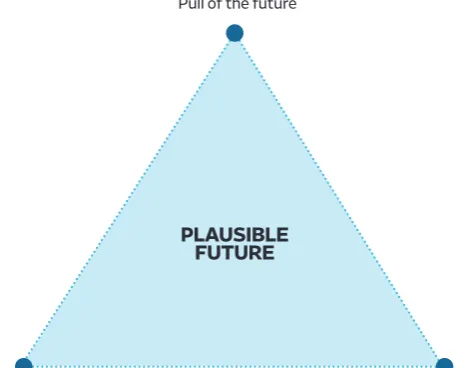
These are so wide-ranging that even working out where to start is challenging, but the field of futures thinking has tools that can help. Plausible futures are bounded by the weight of history, the push of the present, and the pull of the future (Inayatullah 2008) and the ‘Futures Triangle’ is a simple and clever means of teasing apart these influences (Figure 1). In this paper, we use the elements of the Futures Triangle to structure our analysis and discussion.
The pushes and
pressures of the present
The push of the present is about identifying current trends and drivers that are pushing either the water sector in general or specifically recycled water towards particular futures or that are changing what futures are plausible.
the private sector plays by different rules which could change the very fabric of water infrastructure
Private sector players are taking an expanding role in water recycling and want significant changes to the rules of engagement. In NSW, the Water Industry Competition Act (WICA) 2006 is formally under review, which has provided
Figure 1: The Futures Triangle
The concept shows how plausible futures take as their base the weight of history and the push of the present, and are extended by the pull of the future.
(source: Inayatullah 2008)
Pull of the future
PLAusibLe
Future
o the Future
the private sector with an opportunity to put forward their views, including calls for some quite fundamental shifts. For example, the Water Factory Company (now Flow Systems, see p6) submission (2013) to the review proposed the following key outcomes:
• A level playing field between public and private water utilities. The Water Factory listed many areas where there are inequities between private operators and public utilities, for example in the details of customer contracts, operator and supplier of last resort arrangements, licensing arrangements (area, rather than site), sourcing water from elsewhere, and community service obligations
• Independent Market Operator (IMO) to set water servicing strategies. This is a fundamental shift, restructuring the water market in a similar way to the energy and gas sectors. Significantly, the IMO would hold and control release of relevant data. • IMO to manage procurement processes. The
goal here, from Water Factory’s perspective, is fair, contestable, and competitive processes for all land releases above 500 lots.
• Government funding be available to both public and private water sectors
• Mandating recycled water. The Water Factory argue that the provision of recycled water should be mandated for all new developments, rather than being a decision of the relevant utility, constrained as they are by pricing and other regulators.
• Promotion and education of WIC Act and the new water market
Whilst this might seem like a strong set of demands, recent independent research demonstrates the need to move in this general direction to enable private sector provision of distributed recycling schemes. Watson et al., (2013a, 2013b) tease apart the drivers and constraints and show that there are significant cost, risk and institutional barriers that make it hard for small recycled systems to compete against conventional approaches. They list four key areas that limit private investment in these water services:
1) information asymmetry in planning processes; 2) complex and inconsistent regulations that
increase costs, delays and uncertainty; 3) regulatory pricing policies that limit viable
competition such as through pricing or inability to recover avoided costs; and
4) government policies that distort or restrict markets such as investments in large centralised supply options.
The stark distinctions between private and public sector approaches to water service provision that are demonstrated through this research could challenge the fundamental base of the sector. For example, when considering how to service the urban fringe, the private sector is likely to be fundamentally focused on servicing
the area which is about to be released, whereas the public utility’s focus is likely to be broader and longer term, and take in the surrounding area.
At first, this distinction might make the private sector approach sound short-sighted and problematic, but there could be profound advantages. For example, the private sector are less likely to take on demand risk, are not driven by other water security goals, and have less opportunity to cross-subsidise across other customer bases. That could mean that demand risk is managed down, which increases the economic efficiency of asset use. For the next development in the queue, this delays capital expenditure, increases flexibility in the timing of investment and opens opportunities for taking advantage of shifts in available technology. In addition, because private utilities are operating at a local scale, integrated into a development, they are better placed to take advantage of local value capture opportunities, improving their business bottom line.
Private sector provision at this small to moderate scale may act as a kind of Trojan horse, enabling a shift from wholly centralised modes of infrastructure to a different kind of patchwork – more of a mosaic – that has been proven through the Melbourne water supply demand strategy to improve resilience to long-term uncertaintites in climate and population as well as to reduce costs (Mukheibir and Mitchell in press).
Thus, at an aggregate level, private sector provision at small to moderate scale could have massive implications for the fundamental shape of urban water infrastructure as well as for the long-term distribution of costs and benefits amongst private providers, direct consumers, and the broader public.
government is moving: towards contestability, integrated planning, and customer choice, and away from direct engagement
State governments are implementing
fundamental shifts in the planning and delivery of infrastructure. The NSW Government’s White Paper (2013) has committed to introducing and expanding contestability of infrastructure. Growth Infrastructure Plans at the regional level will be enshrined in legislation, and should ensure a new level of integration between land use planning and infrastructure planning, seeking to avoid historical issues of development occurring in areas with inadequate access to service. The Growth Infrastructure Plans and the sub-regional Implementation Plans will provide the structure and certainty to open up opportunities earlier in the process: private sector will be able to bid for the design, construction and operation of infrastructure at regional and local levels, in greenfield and urban infill developments.
o the
F
uture
linkages between urban planning and water infrastructure planning. Their role (Office of Living Victoria 2012) is to ‘create generational change’ through leading a transformation in the way the water cycle is managed and how water cycle services are provided, away from highly centralised approaches towards the kind of multi-faceted mosaic noted earlier. Their plan is to achieve this through better integration between Precinct and Local Water Cycle Plans.
Finally, governments across Australia are stepping back, leaving the space wide open for industry to take a leadership role in innovative and diverse water products and services. In her keynote address to the urban water sector’s pre-eminent annual conference, the Chair of the National Water Commission (Maywald 2013a) made abundantly clear that the age of large-scale government investment, intervention and indeed, interest, in water is receding. Rather, government’s role in the near term is to ‘provide incentives and freedom for industry to innovate’ in urban water, specifically acknowledging the ‘real room and opportunity for diverse approaches’ and ‘ample opportunity for the industry to move towards genuine customer choice through more flexible, efficient and customer-driven products and services’. This last point echoes Sydney Water’s 2012 Annual Report, which notes ‘We know that customers want more than just standard services. We are diversifying to so we can give customers products and services that they value […]’ (p15).
Demands are shifting significantly, both up and down
New expectations and emerging technologies are both dramatically increasing and dramatically decreasing demands. For example, the move to include notions of ‘liveability’ in many urban water utility vision statements and the need to manage urban heat island effects will require much more water of a lower quality. Whilst many Australians know that 173 people were killed in the Black Saturday bushfires of January 2009, fewer people are aware that the excessive heatwave conditions that led to the fires have also been identified as the cause death of a further 374 people in and around Melbourne (Victorian Government Department of Human Services 2009).
Conversely, new technologies will dramatically reduce demand, such as the 90% water
reductions claimed by Xeros 1 with their bead
cleaning technology, or the waterless washing machines reportedly under development by global giant LG.2
In a speech in September of this year, the Chair of the National Water Commission on this topic in September 2013 (Maywald 2013b) noted cross-sectoral connections with food and energy as another potential source of significant shifts in urban and peri-urban water demand that could
particularly effect recycled water. This is further explored below in the pull of the future.
Potable reuse: to be or not to be?
Potable reuse is a very live question in Australian policy debates, with very different responses from politicians and the public in different states. Western Australia’s slow and steady approach to indirect potable reuse through aquifer recharge seems to be proving successful across the board, with broad support across government agencies, politicians and the community. In contrast, in 2013, Sydney Water was publically and loudly admonished by the State Premier when a tabloid newspaper ‘revealed’ Sydney Water had previously invested a small sum to remain abreast of a national, $10M research program around potable reuse.3
o the Future
The pull of the future
In Inayatullah’s (2008) Futures Triangle, the pull of the future is concerned with the compelling and competing images of the future – the big ideas that are pulling us toward particular futures. In this section, we present just a few of the many voices now arguing that we are in a period of massive change from which will arise a new economic epoch. Whilst the change and challenges that sit behind recent big ideas in urban water, like water sensitive cities cities (Wong and Brown 2009) and restorative water (Mitchell 2008) are considerable, the scale of change associated with this new epoch is even greater (see Figure 2).
Kondratieff was the first to notice the historical regularity of long-term boom and bust cycles – every 40 to 60 years, a significant economic upheaval occurs, and is associated with massive societal shifts. soon after, in the 1930s, the economist schumpeter took this ‘long Wave’ idea and linked it to his emerging theory of innovation as the central driver of economic development. In the ensuing decades, this view of economics was all but drowned out by the Keynesian schools of economic thought that still take precedence today, and that foreground the market and take price competition as the supreme determinant of economic behavior. Another of schumpeter’s insights that is relevant to the calls for a circular economy is his recognition that short-term optimisation does not lead to long-term optimisation.
box 1: the Long WAves oF
eConomiC ePoChs
We are on the cusp of a radically different economy
Many commentators and scholars believe we are now on the cusp of a new and profoundly different economic epoch. It turns out that shifts between economic epochs happen regularly (the ‘long wave’ concept – see Box 1). Over the last 250 years, long wave scholars (see, for example, Perez4 2009)
have identified five technological revolutions and associated epochs, beginning with the Industrial Revolution in 1771, and followed by the age of steam and railways (from 1829); the age of steel (from 1875); the age of the automobile, oil, and mass production (from 1908); and the age of IT and telecommunications (from 1971).
The step changes from one economic epoch to another are fuelled by shifts in technological innovation. They lead to ‘great surges of development’ (Perez 2009) with profound implications for both the economic and socio-institutional spheres of society. For example, each shift to a new economic epoch is characterised
by a new pattern of consumption and production that was previously unimaginable and is
particular to that age, such as, before the age of the automobile, oil, and mass production, fresh food was bought daily from specialised suppliers (the butcher, the baker etc.). With the advent of that age, refrigerated, frozen, packaged and preserved food is bought periodically from supermarkets (Perez 2009).
Figure 2: The scale of change
before us is enormous
(source: Mitchell et al., 2012)
Diffusion
of
inno
va
tion
Time
We are here
Significantly, for the shifts in epochs to occur, creative financing is required alongside the technological innovation. In 2007, Perez argued that we were at the point where finance needed to step in to back innovation in production. This is exactly what we are seeing now in the energy sector, with innovative financing mechanisms underwriting significant investment in new energy servicing concepts (see Box 2). Historical analysis also shows that powerful institutions from the previous age will block the shifts, so it is intriguing to note a new Greenpeace study that claims Origin Energy has been actively undermining distributed renewable energy production because cheaper, cleaner options threaten Origin’s investment strategy based on the continued dominance of gas and fossil fuels (Greenpeace Australia Pacific 2013).
This big idea about a new economic epoch has profound and fascinating relevance to and significance for recycled water provision, not least because the Schumpeterian view predicts precisely the kind of tensions the water sector is facing currently – business entrepreneurship through a combination of competition and collaboration.
o the
F
uture
important component of Flow System’s business model is enabled by recent technological innovations in other sectors: smartphone apps and cloud computing make innovative smart metering, billing and information provision arrangements possible. In March 2013, Flow Systems announced Brookfield Infrastructure had acquired a 51% shareholding. Brookfield Infrastructure is an arm of the global Brookfield Asset Management group, which has AU$175 billion of assets under management, 100 offices or locations, 600 investment professionals, and 24 000 operating employees (Brookfield Australia 2013). Brookfield Asset Management is undoubtedly what Perez would describe as an ‘old giant[s] already modernised’ (Perez 2007, p. 785).
Similarly, as part of its globally leading Sustainable Sydney 2030 program, the City of Sydney is preparing to go to market to implement its groundbreaking Decentralised Water Master Plan which includes a focus on substantial local sewage and stormwater recycling schemes.8
City of Sydney technically has no jurisdiction over water supply or demand, but alongside its Energy, Waste, and other plans, the City invested around AU$1M in a highly collaborative Water Master Plan with the goal of opening a different conversation about what might be possible. The Master Plan (see Appendix D of the Plan for details) showed clearly the importance of the financing mechanism for making these offerings viable, including new sources of investment for public infrastructure, new financial products, new de-risking arrangements, etc. Perez (2007) explains the necessary separation between production
capital and financial capital, where the former is path-dependent and reliant on existing expertise, and the latter is fundamentally footloose (p. 783). Agents the size of Brookfield Asset Management and Australia’s global banks can begin to bridge the gap between these two, and set up new possibilities in terms of infrastructure provision and service delivery.
the pull towards dematerialisation is gaining ground
The opportunity for and necessity of the economic paradigm shift explored above is for it to underpin a rapid dematerialisation of the global economy. Most of us are familiar with the concept that we are outstripping planetary resource limits – this idea was first popularised in the early 70s by Meadows et al (1972) and recently revisited by Rockstrom and 26 others (Rockstrom et al 2009). The inference is that dematerialising the economy, which means moving the focus of our attention to the service rather than the product (e.g., clean bodies and clothes, rather than water/ wastewater for a shower and washing machine), is the only way that the global population can achieve an acceptable level of development. The concept of the circular economy emerges as central to the solution.
The circular economy is a hot topic globally and increasingly mainstream. The Ellen Macarthur Foundation captured global attention at the Davos World Economic Forum in 2012 and again in 2013 with their groundbreaking reports, assisted by McKinsey, outlining the economic rationale and the scope and scale of this new way of doing business.9 The founding partners on this journey
are significant, product-oriented, global companies: CISCO, Renault, Kingfisher PLC, and Philips.
Here in Australia, innovators James Bradfield Moody and Bianca Nogrady, agree that the time is now. Their game-changing book, ‘The Sixth Wave’ (2010), uses the long wave, technical innovation frame introduced above to argue for and show how a shift to a ‘circular economy’ is both possible and vital. What it could mean for the water sector is significant. What if, for example, the textiles sector came up with new materials that did not need washing?
Disruptive technologies will emerge
Like the textiles example above, other new, disruptive technologies will emerge that will fundamentally shift key design and operational parameters for the water sector in general, and recycling in particular. One example that could be positive for water recycling is the emergence of LED as an alternative to UV for disinfection (Hayward 2013), because it dramatically reduces the energy and waste associated with disinfection. Another example is the emergence of lot-scale, independent, automatic micro-misting systems for fire-fighting in buildings. This technology is
new approaches to financing sustainable energy outcomes are increasingly well-established and are bringing together unlikely collaborators. low Carbon Australia pioneered new forms of investment in clean energy in Australia. set up as an independent company in 2011, it was transferred to the Clean Energy Finance Corporation (CEFC) as the Gillard government expanded its efforts to combat climate change. The CEFC takes a commercial financing approach, co-financing and investing, directly or indirectly, in renewables and energy efficiency. by way of example, Environmental upgrade Agreements are now legislated in various states across Australia and elsewhere, and essentially set the framework for how a private financier5 , a public institution with a sustainability imperative but no control6 , and a private sector proponent such as a building owner, can collaborate so that the building owner accesses de-risked capital to invest in the upgrades required to provide better environmental outcomes that result in operational savings for building tenants. For more, see Cityswitch7 , a national collaboration across capital city local government authorities that centralises the resources required and opportunities available to move down this path.
o the Future
already proven in Germany, and obviates the need to design and operate our water systems to meet the very high pressure and volume demands for current firefighting responses. In terms of impacts on recycled water, this technology could be either positive or negative. On the negative side, recycled water is often proposed as a source for fire-fighting demand but that demand is removed by this technology. On the positive side, this technology could inadvertently encourage distributed systems, and more local specialisation in terms of product choices, which could open up new opportunities for recycling.
societal expectations and responses to risk will shift
Societal responses to risk are fundamental to what constitutes a plausible future for water recycling. Risks, perceptions of risks, acceptability of risks, imposition of risks, etc are central to the discussion about recycled water in general and potable reuse in particular. Societal responses to risk are culturally determined, contextually specific (see, for example, the distinction between the publics of Western Australia and south-east Queensland with respect to potable reuse) and do change over time. Our current attitude towards risk in the water sector in Australia is quite conservative, but it may not always be so. In a world of different risk perceptions, one way to implement the concept of ‘designer’ water quality would be to provide a single supply of lower quality water and point-of-use technology where required. Exploring such seemingly unacceptable ideas may usefully inform thinking about the future.
Profound shifts will occur in the water-energy nexus
In a related but different component of the current conversation about epoch shifts, according to Paul Gilding10, author of ‘The Great
Disruption’ released in 2012, in 20 or so years, there will be no coal, oil or gas sectors. He cites massive downgrades in market capitalisation of those sectors as the strongest evidence to date. The nexus between the production and use of both energy and water is significant and spatially intricate, so if this scenario were to eventuate, it could have large ramifications for the water sector in general and recycling in particular. For example, centralised fossil-fuel powered energy production systems like Australia’s have very high local water demands, some of which are met through recycling (e.g., Eraring power station in the Hunter region of NSW). Those demands would disappear, potentially impacting on the viability of local water service providers and local water supply-demand balances.
Whether global water demands for energy production rise or fall is dependent on the replacement energy sources. A recent study by the European Environment Agency on the
ramifications of bioenergy futures reported that two of the three future energy scenarios investigated incurred significant negative outcomes for both water abstraction and quality (Stedman 2013). The only thing that is certain is that both the scale and location of water demands for energy production will significantly shift, and since recycled water is a likely source for this demand, the global demise of the coal, oil and gas sectors has local implications for recycled water.
Profound shifts will also occur in the water-energy-food nexus
Those of us who live in cities can do so now only because our food is produced elsewhere, but the need to reduce our resource footprint, to dematerialise, and to move to a circular economy could see massive shifts in our conceptions of agriculture, in terms of where food is grown, the distance to market, and the source of fertilisers. These pulls have direct linkages to the future of water recycling, in terms of shifts in urban demands for irrigation (which would also contribute to mitigating urban heat island effects) as well as shifts in perceptions of value in what are currently viewed as wastes, such as urine (Mitchell et al 2013). Urine is not only an extraordinary source of nutrients, but it is also the source of the majority of pharmaceuticals in our wastewater streams. Removing urine before it enters the wastewater stream therefore not only reduces the doses of anti-depressants, hormones, etc that are delivered on a daily basis to inhabitants of aquatic environments adjacent to urban centres, but also could conceivably impact on the necessary treatments required for high-quality end uses of recycled water.
Left-field uncertainties could be surprisingly significant
There are other ‘left-field’ uncertainties that could impinge on the structure of the water sector. For example, the rise of ‘stateless income’ has local and global ramifications for government revenue streams and therefore the state’s inherent capacity to fund public infrastructure. Stateless income is income which is not taxed either in the country that gave rise to its creation or in the parent company’s country, but rather in a third ‘tax haven’ country. Globally, this issue is sufficiently serious to have attracted attention and effort from the G20 and OECD. It is globally significant because the recent Starbucks UK controversy has shown11 this is not limited to
o the
F
uture
(Bradbury 2013) made clear that this risk is very real for Australian governments.
The weight of history
is substantial
Inayatullah’s futures triangle situates the weight of history as focused on that which resists change. For water recycling in Australia, that includes the intricate system of existing infrastructure, institutions, and institutional arrangements which together, strongly favour incremental additions to the status quo (Watson et al 2013b). It also includes the massive government-led investment in desalination across Australia in response to the Millenium drought, because it fundamentally shifts the basis for comparison of new supplies.
In addition, the sector has a long and respectable history of a ‘just in case’ approach to planning. Historically, Australia’s water forefathers recognised the inherent variability in our rainfall, so they made our storages bigger, just in case. That led to Australia having the largest per capita surface water storage in the world (Australian Bureau of Statistics 2010). However, this approach means that those assets are almost always performing poorly from an economic efficiency perspective, since they can only perform optimally when it is near its limit. Oversupply is at odds with an orthodox understanding of economic efficiency, so where oversupply was lauded in days gone by as a good insurance policy, it may not be so in the future. Much of the recent investment in desalination has been similarly questioned on these grounds, leading to calls to move away from ‘just in case’ to ‘just in time’.
Where the weight of history is important is in how it contributes to the sector’s capacity to change. Here, the field of transition management, and Dolata’s (2009) framework can provide useful insights. Analysis of recent shifts in very different sectors (e.g., music, biotechnology) led Dolata to identify two central factors that determine how well equipped a sector is to deal with transformational change. The first is the transformative capacity of technological innovations within the sector of interest, and the second is the social and economic adaptability of established structures, institutions, and actors within the sector.
Considering these two factors in relation to water recycling is instructive (Mitchell et al 2010). The central technological shift in water recycling is successive generations of membrane technology, which has an enormous transformative capacity. However, the water sector (in comparison with for example the green building sector, the music industry, biotechnology) has a relatively low adaptability
to change, and is likely to be characterised by persistent conservatism, which results in the kind of ‘crisis-ridden adjustment processes’ (Dolata 2009, p. 1070) referred to by Karlene Maywald, the Chair of the National Water Commission, in her challenging keynote address to OzWater 2013 (Maywald 2013a).
Preferred assessment methods do not reflect either the breadth of values experienced in practice or historical decisions
Although cost benefit analysis (CBA) is well established as the preferred assessment tool for State and Federal governments, this project demonstrates what good practitioners of CBA already know: by itself, it is inadequate in guiding real decisions about whether or not to invest in recycled water. The schemes investigated in this study demonstrate that in reality, whilst some costs are direct and fixed, many other costs and essentially all of the benefits associated with recycled water schemes can be
• indirect and difficult to measure e.g., the business value to Veolia of a successful first foray into small scale recycling systems in Australia; • imprecise e.g., the cost to Yarra Valley Water of
adapting all its business processes to include the provision of the new service of recycled water; • uncertain and variable e.g., the take-up of
recycled water by cane farmers at Hervey Bay was lower than expected because of the combination of the demographic of incumbents and unnecessary concerns about soil
salinisation, and is rainfall dependent; • contingent on certain future scenarios that
are beyond the control of providers e.g., the real value of the Rosehill scheme was in its contribution to potable water availability in a drought, but the State government decision to construct the desalination plant obviated that benefit; and
• dispersed e.g., the real value of the Willunga Basin scheme may be that it avoided the local decimation of the winery sector, which underpins the entire regional economy.
Whilst the lure of converting disparate costs and benefits to a consistent and therefore comparable base is powerful, in practice
o the Future
The transferability and validity of those values for other scenarios are questionable. A further complication, and one of the drivers of the cost of contingent valuation, is that perceptions of value vary greatly with perspective. Contingent valuation deals with this statistically, but whether that approach adequately represents the nuance of varying views is questionable.
Also fundamental to assessing costs and benefits is clarity and consistency in the
perspective of analysis – whose costs and benefits are included, when do they occur, and what other transfer payments are occurring. These fundamental features are typically not the focus of cost-benefit guides, and so are overlooked in practice, because whilst equity and distribution are very significant in practice, they are outside the scope of CBA.
Finally, CBA assumes certainty, and our study has shown that uncertainty is rife and shifts happened in every scheme that had material impacts on costs and benefits.
The issue of adequate and appropriate assessment is challenging. Whilst CBA can be a useful and important input to decision-making, it is limited and easy to do badly, but because its numbers have the appearance of precision and rigour, it can have a strong impact on the process. However, multi-criteria assessment methods are also easy to do badly and time-consuming to do well.
What is clear is that metrics and processes to guide decisions must do a better job of taking into account a broader set of values on the one hand, and the certainty of uncertainty on the other – shifts happen.
We are trapped by our decision-making psychology
Harvard Business scholars (Hammond et al 1998) have demonstrated deep evidence for how psychological traps12 lead us to repeating errors
and compound bad decisions. Traps such as valuing the information you first receive above later evidence; favouring alternatives that promote the status-quo; making decisions that justify past, flawed choices; being overly optimistic in forecasting; etc. It is possible to avoid these traps, but it takes considerable effort and attention.
Wrapping it all up:
Plausible futures for water
recycling
In the ‘pushes of the present’, this paper explored • the different rules by which the private sector
plays, and the potential for them to shift the very fabric of the water sector;
• governments’ moves towards contestability, integrated planning, customer choice, and away from directly engaging in water;
• the shifting drivers of demand – not just population and climate change in terms of its impact on supply, but far more wide-ranging shifts in expectations and technologies; • potable reuse – is it really inevitable?
The ‘pull of the future’ explored the evidence for and clamour from businesses, activists, and scholars who argue we are, right now, at the kind of turning point in our economy that comes around just once in every two or three generations, and that the shift must be towards dematerialisation and a circular economy if we are to ensure a sustainable future. The intriguing and less well known piece in this is about the role of creative financing, and the emerging evidence from the energy sector that the shift is already underway. The implications for water recycling are huge. The pull of the future section also explored even more fundamental shifts, especially in the related sectors of energy and food, that could affect demand and supply.
Finally, the paper explored the weight of history, noting that the crisis-ridden responses of recent times are indicative of a sector that is not yet well-prepared for significant transitions, and that our historically-preferred assessment and decision-making methods may be part of the issue.
o the
F
uture
Notes
1. www.xeroscleaning.com
2. www.trustedreviews.com/news/lg-confirms-plans-for-magic-waterless-washing-machine, accessed 11 November 2013.
3. See waterspectator.com.au/indirect-potable-reuse/, accessed 12 November 2013.
4. Carlota Perez is a well-respected economist and historian who holds ongoing affiliations with the London School of Economics and Cambridge University in the UK, and is an adviser to the OECD, UN, and major corporates (see www.carlotaperez.org). The work referred to here is available in both accessible (Perez 2012) and academic (Perez 2007) publications. 5. Such as the CEFC, but also see National Australia Bank’s
business pitch for this opportunity at www.nab.com. au/business/industry/corporate-and-institutional/ environmental-upgrade-funding
6. See City of Sydney or City of Melbourne’s initiatives in this space.
7. www.cityswitch.net.au
8. For the vision, see www.cityofsydney.nsw.gov.au/vision/ sustainability/water-management; for the Recycled Water Plan, see City of Sydney 2012.
9. www.ellenmacarthurfoundation.org /circular-economy. 10. Gilding, previously head of Greenpeace International,
is an internationally respected environmentalist and businessman, who currently provides strategic advice to the boards of multinational resource companies (e.g., Shell, BHP Biliton) and environmental Non-Government Organisations.
11. Starbucks are very well established in the UK – some have said they can be found on almost every High St, but through a series of unintended regulatory loopholes, the UK branch of the Corporation arranged its affairs so that it pays very, very little tax in the UK, despite generating significant profit there.
o the Future
References
Adams J. 1974, ‘… and how much for your grandmother?’
Environment and Planning A, 1974, 6:619-626
Australian Academy of Technological Sciences and Engineering 2013a, Drinking water through recycling – the
benefits and costs of supplying direct to the distribution system. ISBN 978 1 921388 25 5.
Australian Academy of Technological Sciences and Engineering 2013b, Drinking water through recycling – the
benefits and costs of supplying direct to the distribution system. Appendix A Stakeholder Survey Responses.
Australian Bureau of Statistics 2010, Measures of Australia’s
Progress. Inland Waters, 12 November 2013, www.abs.gov.
au/ausstats/[email protected]/Lookup/by%20Subject/1370.0~2010~ Chapter~Water%20storage%20(6.3.6.2)
Bradbury, D. 2013, ‘Stateless Income – a threat to national sovereignty’, Address to the Tax Institute of
Australia’s 28th National Convention, Convention
and Exhibition Centre, Perth, 15 March 2013, 30 September 2013, ministers.treasury.gov.au/DisplayDocs. aspx?doc=speeches/2013/003.htm&pageID=005&min=djb a&Year=&DocType
Brookfield Australia 2013, Corporate Profile – Fourth
Quarter 2012, 14 October 2013, www.au.brookfield.com
City of Sydney 2012, Recycled Water Plan, June 2012, 14 October 2013, www.sydney2030.com.au/wp-content/ uploads/DECENTRALISED-WATER-MASTER-PLAN-Recycled-Water-Plan-ADOPTED.pdf
Dolata, U. 2009, ‘Technological innovations and sectoral change, transformative capacity, adaptability, patterns of change: An analytical framework’, Research Policy, 38, 1066-1076.
Eco-Business, n.d., Flow-systems, 14 October 2013, www.eco-business.com/directory/flow-systems/ Greenpeace Australia Pacific 2013, Strangling Renewables:
Origin Energy’s Campaign Against Renewable Energy.
Hammond, J.S., Keeney, R.L., & Raiffa, H. 1998, The Hidden Traps in Decision Making, Harvard Business
Review, 14 October 2013, cstpr.colorado.edu/students/
envs_5120/hammond_1998.pdf>
Hayward, K. 2013, UV LEDs light the way for disruptive technologies, Water 21, August 2013:41-2
Inayatullah, S. 2008, Six pillars: futures thinking for transforming, Foresight, 10(1), 4–21
Kleinbard, E. D. 2013, ‘Through a Latte, Darkly:
Starbucks’s Stateless Income Planning’, Tax Notes, June 24, 2013, pp. 1515-1535
Maywald, K. 2013a, Water 2013 and beyond – sustaining the momentum. Keynote address at OzWater 2013, May 2013, Perth
Maywald, K. 2013b, Water, energy and food: cross-currents and challenges. Keynote address at Riversymposium, September 2013, Brisbane
Meadows, D.H., Meadows, G. , Randers, J. & Behrens III, W. W. 1972, The Limits to Growth, New York: Universe Books. ISBN 0-87663-165-0
Mitchell, C. 2008, Restorative water: beyond sustainable, Waste Management and Environment Magazine, July 2008 pp. 20-21
Mitchell, C., Abeysuriya, K., Willetts, J. & Fam, D. 2010, Enabling decentralised urban sewage infrastructure by facilitating successful organisations to provide long-term management, Paper presented at Cities of the Future
2010 Conference, Jointly hosted by Water Environment
Federation and International Water Association, Boston March 7-10, 2010
Mitchell, C. , Fam, D., & Cordell, D. 2012, ‘Effectively managing the transition towards restorative futures in the sewage industry: a phosphorus case study’, in Carol Howe and Cynthia Mitchell (eds), Water Sensitive Cities, ISBN 9781843393641, IWA Publishing, London, UK, pp 43-62
Mitchell, C., Fam, D. & Abeysuriya, K. 2013, Transitioning
to sustainable sanitation: a transdisciplinary pilot project of urine diversion, Institute for Sustainable Futures,
University of Technology Sydney, 14 October 2013 www.isf.uts.edu.au/publications/Mitchelletal2013funny-dunny-pilot.pdf
Mukheibir, P & Mitchell, C. in press, ‘Decision-Making Under Future Uncertainty: Developing Adaptive Urban Water Strategies’, International Journal of Water Office of Living Victoria 2012, Business Strategy, 21 October 2013, www.livingvictoria.vic.gov.au/PDFs/ OLV%20Business%20strategy.pdf
NSW Government 2013, Provision of Infrastructure, Chapter 7 in A New Planning System for NSW, White Paper, ISBN 978-0-7313-3611-1, 22 October 2013
www.planning.nsw.gov.au/en-us/policyandlegislation/ anewplanningsystemfornsw/whitepaper.aspx
Perez, C. 2009, ‘Sustainability and the potential of the ICT paradigm’, Keynote presentation to the First European
Conference on Sustainability Transitions, Amsterdam, June
2009
Perez, C. 2007, Finance and technical change: a long term view, in Horst Hanusch & Andreas Pyka, (eds), Elgar
Companion to Neo-Schumpeterian Economics , Edward
Elgar, Chapter 49, pp. 775-800
Perez, C. 2012, ‘Greening the Global Economy’, Inside
Track, Issue 30: Winter 2012, pp. 3-5
Rockstrom, J., Steffen, W., Noone, K., Persson, A., Chapin III, F.S., Lambin, E., Lenton, T. M., Scheffer, M., Folke, C., Schellnhuber, H., Nykvist, B., De Wit, C. A., Hughes, T., van der Leeuw, S ., Rodhe, H., Sorlin, S., Snyder, P. K., Costanza, R., Svedin, U., Falkenmark, M., Karlberg, L., Corell, R.W., Fabry, V.J., Hansen, J., Waler, B., Liverman, D., Richardson, K., Crutzen, P., & Foley, J. 2009, ‘Planetary Boundaries: Exploring the safe operating space for Humanity’, Ecology and Society, 12(2): 32
Stedman, L. 2013, EEA future ‘storylines’ explore bioenergy production, Water 21, August 2013:11 Sydney Water 2013, 2012 Annual Report
Sydney Morning Herald 2013, Drinking recycled effluent
‘inevitable’ in smarter Australia, 12 November 2013,
www.smh.com.au/environment/water-issues/drinking- recycled-effluent-inevitable-in-smarter-australia-20131015-2vl1r.html
Victorian Government Department of Human Services 2009, January 2009 Heatwave in Victoria: an Assessment of
Health Impacts
Water Factory Company 2013, Review of the Water Industry Competition Act 2006 & Regulatory Arrangements for water recycling under the Local Government Act 1993, Submission to the Discussion Paper, February 2013, 14 October 2013, www.waterforlife.nsw. gov.au/planning-sydney/water-industry-reform/urban-water-regulation-review
Watson, R., Mitchell, C., & Fane, S. 2013a, ‘Distributed Recycled Water Systems – hard to justify in Sydney, but it’s a great place to learn’, Asia Pacific Water Recycling
Conference, 1-4 July, Brisbane
Watson, R., Mitchell, C., & Fane, S. 2013b, ‘Distributed Recycled Water Decision – Ensuring Continued Private Investment’, Ozwater 2013, 7-9 May, Perth
Wong, T. & Brown, R. 2009, Transitioning to Water Senitive Cities: Ensuring Resilience through a new
Hydro-Social Contract, 11th International Conference on Urban