R E S E A R C H
Open Access
Improved results on reachable set
bounding for linear systems with discrete and
distributed delays
Hao Chen
1,2*, Jun Cheng
3, Shouming Zhong
2, Jinxiang Yang
4and Wei Kang
2*Correspondence: [email protected]
1School of Mathematical Sciences, Huaibei Normal University, Huaibei, Anhui 235000, P.R. China 2School of Mathematical Sciences, University of Electronic Science and Technology of China, Chengdu, Sichuan 611731, P.R. China Full list of author information is available at the end of the article
Abstract
This paper investigates the bound of a reachable set for linear systems with discrete and distributed delays. By utilizing the Lyapunov-Krasovskii functional, delay decomposition technique, reciprocally convex method and free-weighting matrix approach, some new results in the form of linear matrix inequalities are derived. Finally, a tighter bound of the reachable set is obtained. Three numerical examples are given to illustrate the effectiveness and advantage of the proposed results compared with the existing criteria.
Keywords: reachable set; distributed delay; Lyapunov-Krasovskii functional; linear matrix inequality
1 Introduction
The bounding of a reachable set is of practical importance in the design of the controller for ellipsoid dynamic systems with disturbance. It plays an important role for state es-timation and parameter eses-timation in control theory [–]. Therefore, the reachable set estimation and its related fields have been investigated by many researchers. For a dynamic system, the reachable set is a set which bounds all the states starting from the origin by inputs with peak values. The problem of reachable set bounding for time-delay systems has received considerable attention in recent years, for instance, [–] and the references therein. However, time delays cannot be avoided during practice, and they cause unde-sirable dynamic network behaviors such as oscillation and instability [–]. Then, it is natural to ask what about the reachable set of systems with time delays.
Boyd researched linear systems without time-delay, and an LMI condition for an ellip-soid that bounds the reachable set was given in []. In [], Fridman and Shaked stud-ied the uncertain linear systems with time-varying delays and bounded peak input, and LMIs criteria of an ellipsoid that bounds the reachable set based on the Razumikhin theory were firstly obtained. In [], Kim improved the condition by using the modified Lyapunov-Razumikhin functional. More recently, Nam and Pathirana obtained a smaller reachable set bound by the delay decomposition technique []. The maximal Lyapunov functional, combined with the Razumikhin methodology, was utilized to give a non-ellipsoidal de-scription of the reachable set in []. Moreover, the authors focused on reachable set bounding for linear systems with discrete and distributed delays in [, ]. However, up to
now, there have been only few literature works available about linear systems with mixed delays. Hence, it is necessary to make further study on linear systems with mixed delays.
The paper [] considered non-differentiable time-varying delays, and differentiable time-varying delays were considered in [–, –]. In [], the derivative of time delays was assumed to be less than . As is well known, a large value of the derivative of time delays may yield bigger reachable set bounding. In fact, the constraint for time-varying delays may be relaxed, that is, a value of the derivative of delays may not necessarily be less than .
Motivated by the above discussions, in this paper we aim to study the reachable set bounding for linear systems with discrete and distributed delays. The constraint of delay is relaxed. The value of derivatives of time delay is not necessary to be less than . We construct Lyapunov functionals, combined with the delay decomposition technique, re-ciprocally convex approach and free-weighting matrix method to derive a more accurate description of the reachable set bound. To the best of our knowledge, it is the first time to introduce triple integrations for reachable set bounds of linear systems with discrete and distributed delays. Numerical examples are given to illustrate the effectiveness of the obtained results, and reachable set bound is tighter than the ones in [–, –].
Notations: The following notations are used in our paper except where otherwise speci-fied.Rnis then-dimension Euclidean space,Rn×mdenotes the set ofn×m-dimension real
matrices; real matrixP> (≥) means thatPis a symmetric positive definite (positive semi-definite) matrix. Superscript ‘T’ denotes the transposition of a vector or a matrix; represents the elements below the main diagonal of a symmetric block matrix;Idenotes an identity matrix; ‘-’ in tables represents no feasible solution for matrix inequality.
2 Preliminaries
Consider the following delayed linear systems with disturbances:
˙
z(t) =Az(t) +Bzt–τ(t)+D t
t–σ
z(s)ds+Ew(t), z(t) = , t∈[–d, ], ()
wherez(t)∈Rnis the state vector,w(t)∈Rmis the disturbance,τ(t) is discrete time delay
andσ is distributed time delay,A∈Rn×n,B∈Rn×n,D∈Rn×nandE∈Rn×m,A,D,BandE
are known constant matrices.
τ(t) is time-varying discrete delay satisfying
≤τ(t)≤τ, τ˙(t)≤μ,
whereτ andμare constants. Moreover,d=max{τ,σ}.
The disturbancew(t)∈Rmis the input with bounded peak value, that is,
wT(t)w(t)≤wm, ()
wherewmis a constant.
The following lemmas are useful in deriving the criteria.
Lemma . The following relation is known as the Leibniz rule:
d dt
b(t)
a(t)
f(t,s)ds=b˙(t)ft,b(t)–a˙(t)ft,a(t)+
b(t)
a(t)
∂
Lemma .[] Given constant symmetric matrices R,R,R,where R=RT,R=RT > , ing integrations are well defined,then
–(h–h) integrations are well defined,then
– Then the reciprocally convex combination of fiover D satisfies
Lemma .[] Let V be a Lyapunov function for system()-().If
˙
V+αV– α
w m
wT(t)w(t)≤,
then V≤.
3 Main results
Theorem . If there exist matrices P> ,Q> ,R> ,K> ,K> ,M> ,M> ,
S,N with appropriate dimensions,and a scalarα> such that the following inequalities holds:
R+K S ST R+K
≥, ()
=
⎡ ⎢ ⎢ ⎢ ⎢ ⎢ ⎢ ⎢ ⎢ ⎢ ⎢ ⎢ ⎢ ⎢ ⎣
– α
wmI
⎤ ⎥ ⎥ ⎥ ⎥ ⎥ ⎥ ⎥ ⎥ ⎥ ⎥ ⎥ ⎥ ⎥ ⎦
≤, ()
where
=αP+PA+ATP+Q+σM+M– e–ατK–e–ατR,
=PB+e–ατR–e–ατS, =e–ατS, = e–ατK,
=ATNT, =σPD, =PE,
= –( –μ)e–ατM– e–ατK– e–ατK– e–ατR+e–ατ
ST+S,
=e–ατR–e–ατS, = e–ατK,
= e–ατK, =BTNT,
= –e–ατQ– e–ατK–e–ατR, = e–ατK,
= –e–ατK– e–ατK, = –e–ατK– e–ατK,
=τR+
τ
K +
τ
K
–N–NT, =σND, =NE,
= –σe–ασM.
Then the reachable sets of system()are bounded by a ball B(,r) ={z∈Rn|z ≤r}with
r=√ λmin(P)
Proof Construct the following Lyapunov-Krasovskii functional:
Taking the time derivative ofV(zt) along the trajectory of system (), we obtain
˙
Using Lemma ., we have
˙
Using Lemma ., we get
= –αV(zt) +
From Lemma . and inequality (), one can obtain
It is clear that the following equation holds:
z˙T(t)N –z˙(t) +Az(t) +Bzt–τ(t)+D t
t–σ
z(s)ds+Ew(t)
= . ()
Combining ()-(), one gets
˙
V(zt) +αV(zt) – α
w m
wT(t)w(t)≤ σ
t
t–σ
ξT(t) ξ(t)ds, ()
where
ξT(t) =
zT(t), zTt–τ(t), zT(t–τ), τ(t)
t
t–τ(t)
zT(s)ds,
τ–τ(t)
t–τ(t)
t–τ
zT(s)ds, z˙T(t), zT(s), wT(t)
.
Since () and () hold, we can conclude thatV˙ +αV– α
wmw
T(t)w(t)≤.
Therefore, one can obtainV(zt)≤ by Lemma ..
Using the spectral properties of a symmetric positive definite matrixP, the following inequality holds:
λmin(P)z(t)
≤V(zt). ()
This further implies thatz(t) ≤r=√
λmin(P)
due to (). This completes the proof.
IfD= in system (), the following corollary is true.
Corollary . If there exist matrices P> ,Q> ,R> ,K> ,K> ,M> ,S,N with appropriate dimensions,and a scalarα> such that the following inequalities holds:
R+K S ST R+K
≥, ()
=
⎡ ⎢ ⎢ ⎢ ⎢ ⎢ ⎢ ⎢ ⎢ ⎢ ⎢ ⎢ ⎣
– α
wmI
⎤ ⎥ ⎥ ⎥ ⎥ ⎥ ⎥ ⎥ ⎥ ⎥ ⎥ ⎥ ⎦
≤, ()
where
=αP+PA+ATP+Q+M– e–ατK–e–ατR,
= e–ατK, =ATNT, =PE,
= –( –μ)e–ατM– e–ατK– e–ατK– e–ατR+e–ατ
ST+S,
=e–ατR–e–ατS, = e–ατK,
= e–ατK, =BTNT,
= –e–ατQ– e–ατK–e–ατR, = e–ατK,
= –e–ατK– e–ατK, = –e–ατK– e–ατK,
=τR+
τ
K +
τ
K
–N–NT.
Then the reachable sets of system()are bounded by a ball B(,r) ={z∈Rn|z ≤r}with
r=√ λmin(P)
. ()
Proof By settingD= ,M= in the proof of Theorem ., one can easily get the
conclu-sion in the corollary.
Furthermore, consider the following uncertain polytopic time-delayed linear systems with disturbances:
˙
z(t) = (A+A)z(t) + (B+B)zt–τ(t)+ (E+E)w(t),
z(t) = , t∈[–τM, ].
()
The uncertainties are expressed as a linear convex-hull of known matricesAi,BiandEi,
A=
N
i=
θi(t)Ai, B= N
i=
θi(t)Bi, E= N
i=
θi(t)Ei
withθi(t)∈[, ] and N
i=θi(t) = ,∀t> .
As for system (), the following corollary is true.
Corollary . If there exist matrices P> ,Q> ,R> ,K> ,K> ,M> ,S,N with appropriate dimensions,and a scalarα> satisfying the following inequalities for all i= , , . . . ,N:
R+K S ST R+K
≥, ()
i= ⎡ ⎢ ⎢ ⎢ ⎢ ⎢ ⎢ ⎢ ⎢ ⎢ ⎢ ⎢ ⎣
i i i i i i
i i i i i
i i
i
i
i
– α
wmI
⎤ ⎥ ⎥ ⎥ ⎥ ⎥ ⎥ ⎥ ⎥ ⎥ ⎥ ⎥ ⎦
where
i=αP+P(A+Ai) + (A+Ai)TP+Q+M– e–ατK–e–ατR,
i=P(B+Bi) +e–ατR–e–ατS, i=e–ατS,
i= e–ατK, i= (A+Ai)TNT, i=P(E+Ei),
i= –( –μ)e–ατM– e–ατK– e–ατK– e–ατR+e–ατ
ST+S,
i=e–ατR–e–ατS, i= e–ατK,
i= e–ατK, i= (B+Bi)TNT,
i= –e–ατQ– e–ατK–e–ατR, i= e–ατK,
i= –e–ατK– e–ατK, i= –e–ατK– e–ατK,
i=τR+
τ
K +
τ
K
–N–NT.
Then the reachable sets of system()are bounded by a ball B(,r) ={z∈Rn|z ≤r}with
r=√ λmin(P)
. ()
Proof ReplacingA,B,EwithiN=θi(t)(A+Ai), N
i=θi(t)(B+Bi), N
i=θi(t)(E+Ei) in the
proof of Corollary ., respectively, one can easily obtain the conclusion.
Remark In this paper, the delay decomposition technique, free-weighting matrix ap-proach and reciprocally convex method are used to construct a Lyapunov functional. Triple integrals are introduced in the Lyapunov functional for the first time to investigate bounding of a reachable set for linear systems with discrete and distributed delays, which may lead to tighter bounding. It will be verified by the following numerical examples.
Remark In order to guarantee negative definite,μis required to be less than in []. It should be noted that the values of derivatives of time delays are not necessary to be less than in Theorem . because the term = –( –μ)e–ατM– e–ατK– e–ατK–
e–ατR+e–ατ(ST+S) can be negative definite by choosing appropriateK
,K,R,S,M
whenμ> . Obviously, the results in this paper have a wider scope of application than the ones in [].
Remark The reachable set of system () can be minimized by solving the following op-timization problem for a scalarδ> :
minδ¯ δ¯= δ
s.t.
⎧ ⎨ ⎩
(a) P≥δI,
(b) ()-() or ()-() or ()-().
()
reduced to LMIs, and Matlab’s Toolbox is employed to solve the matrix inequalities in Theorem . and Corollaries .-..
4 Examples
In this section, two numerical examples are presented to show the validity of the main results derived in this paper.
Example Consider the following time-delayed system with parameters:
˙
z(t) =
– –
z(t) +
–.
. .
zt–τ(t)
+
. .
–.
t
t–σ
z(s)ds+
w(t), ()
andwT(t)w(t)≤.
In order to compare with previous results,r’s for different values ofσwithτ= .,μ= . are listed in Table .r’s for different values ofτwithσ= .,μ= . are listed in Table .
r’s for different values ofμwithτ = .,σ= . are listed in Table . It is shown that tighter bounds are obtained than the ones in [, ] by the proposed method in this paper.
Solving system () with parametersσ= .,μ= .,τ = . by Theorem ., we have
P=
. .
. .
, r=√.. ()
To give a direct comparison, we plotted the ellipsoid of the reachable set in Figure . The solid line is the result computed by the proposed method in this paper and the dotted line is the one obtained by [].
Table 1 Computedr’s of Example 1 for different values ofσwithτ= 0.2,μ= 0.5
σ 0.2 0.4 0.6 0.7 0.8
[1] √10.0502 √11.5762 √13.7431 √14.9492 √16.3729
[2] √5.8645 √6.4724 √7.3010 √7.7887 √8.3381
Theorem 3.1 √2.2624 2√.9329 √3.0799 √3.2658 √3.3009
Table 2 Computedr’s of Example 1 for different values ofτwithσ= 0.1,μ= 0.5
τ 0.1 0.3 0.5 0.7 0.9
[1] √9.3269 √9.5769 √9.8531 √10.1593 √10.5000 [2] √5.5456 √5.7058 √5.9109 √6.1423 √6.4505 Theorem 3.1 √3.0762 √3.9978 √4.1181 √4.4765 √5.0025
Table 3 Computedr’s of Example 1 for different values ofμwithσ= 0.1,τ= 0.2
μ 0.0 0.1 0.5 0.8 0.9 2
Figure 1 Bounding ellipsoids computed by different methods.
Table 4 Computedr’s of Example 2 for different values ofτwithμ= 0
τ 0.1 0.3 0.5 0.7 0.9
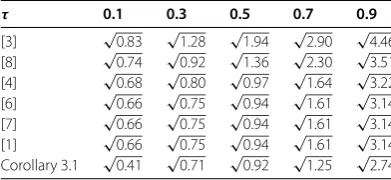
[3] √0.83 √1.28 √1.94 √2.90 √4.46 [8] √0.74 √0.92 √1.36 √2.30 √3.51 [4] √0.68 √0.80 √0.97 √1.64 √3.22 [6] √0.66 √0.75 √0.94 √1.61 √3.14 [7] √0.66 √0.75 √0.94 √1.61 √3.14 [1] √0.66 √0.75 √0.94 √1.61 √3.14 Corollary 3.1 √0.41 √0.71 √0.92 √1.25 √2.74
Example Consider the following uncertain time-delayed system with parameters:
˙
z(t) =
–
–.
z(t) +
–
– –.
zt–τ(t)+
–.
w(t), ()
andwT(t)w(t)≤.
By employing the method of Corollary . in this paper,r’s for different values ofτ with μ= are listed in Table . It is clear that the bounds obtained in this paper are better than the ones of [, , , –].
Example Consider the following uncertain time-delayed system with parameters:
A+A=
–
–.
, A+A =
–
–.
,
B+B=
–
– –.
, B+B=
–
– –.
,
E+E=
–.
=E+E, wT(t)w(t)≤.
()
Table 5 Computedδ’s of Example 3 for the case 0¯ ≤τ(t)≤0.75,τ˙(t)≤μ
μ 0 0.1 0.2 0.3 0.4 0.5 0.6 0.9 2
[6] 3.34 3.79 4.53 5.88 8.85 18.36 127.70 -
-[3] 2.28 2.35 2.45 2.57 2.68 2.85 4.62 5.57 13.39
Corollary 3.2 2.03 2.33 2.34 2.45 2.60 2.72 4.37 4.92 8.73
5 Conclusions
In this paper, the problem of reachable set bounding for linear systems with both discrete and distributed delays has been investigated. By using Lyapunov-Krasovskii functional theory, delay decomposition technique, reciprocally convex method and free-weighting matrix approach, new reachable set bounds are obtained. Triple integrations are intro-duced for the first time in Lyapunov functionals to study reachable set bounding for lin-ear systems with mixed delays. Meanwhile, delay decomposition technique is employed, which leads to tighter reachable set bounds. The results have been given to illustrate the advantages over the ones in [–, –]. The foregoing results have great potential to be useful for further study in this area, such as linear neutral systems and nonlinear systems. Meanwhile, it is expected that the approach will be used for practical applications in the future, for instance, finite-time boundedness of state estimation for neural networks.
Competing interests
The authors declare that they have no competing interests.
Authors’ contributions
All authors contributed equally to the writing of this paper. All authors read and approved the final manuscript.
Author details
1School of Mathematical Sciences, Huaibei Normal University, Huaibei, Anhui 235000, P.R. China.2School of Mathematical Sciences, University of Electronic Science and Technology of China, Chengdu, Sichuan 611731, P.R. China.3School of Electrical and Information Technology, Yunnan Minzu University, Kunming, Yunnan 650500, P.R. China.4School of Computer Science and Technology, Southwest University for Nationalities, Chengdu, Sichuan 610041, P.R. China.
Acknowledgements
This work was supported by the Anhui Provincial Natural Science Foundation under Grant No. 1408085MA14, the Anhui Provincial Natural Science Foundation under Grant No. 1508085MA14, the Key Natural Science Foundation of Universities of Anhui Province under Grant No. KJ2014A223, the Fundamental Research Funds for the Central Universities under Grant Nos. 12NZYQN17, 12NZYQN21 and 13NZYBS07, the State Ethnic Affairs Commission Project under Grant No. 12XNZ2003.
Received: 14 November 2014 Accepted: 20 April 2015
References
1. Zuo, Z, Ho, D, Wang, Y: Reachable set estimation for linear systems in the presence of both discrete and distributed delays. IET Control Theory Appl.5(15), 1808-1812 (2011)
2. Zuo, Z, Wang, Y: Results on reachable set estimation for linear systems with both discrete and distributed delays. IET Control Theory Appl.6(14), 2346-2350 (2012)
3. Kim, J: Improved ellipsoidal bound of reachable sets for time-delayed linear systems with disturbances. Automatica
44(11), 2940-2943 (2008)
4. Kwon, O, Lee, S, Park, J: On reachable set bounding of uncertain dynamic systems with time-varying delays and disturbances. Inf. Sci.181(17), 3735-3748 (2011)
5. Zuo, Z, Chen, Y, Wang, Y, Ho, D, Chen, M, Li, H: A note on reachable set bounding for delayed systems with polytopic uncertainties. J. Franklin Inst.350(7), 1827-1835 (2013)
6. Zuo, Z, Ho, D, Wang, Y: Reachable set bounding for delayed systems with polytopic uncertainties: the maximal Lyapunov-Krasovskii functional approach. Automatica46(5), 949-952 (2010)
7. Shen, C, Zhong, S: The ellipsoidal bound of reachable sets for linear neutral systems with disturbances. J. Franklin Inst.
348(9), 2570-2585 (2011)
8. Nam, P, Pathirana, P: Further result on reachable set bounding for linear uncertain polytopic systems with interval time-varying delays. Automatica47(8), 1838-1841 (2011)
9. Fridman, E, Shaked, U: On reachable sets for linear systems with delay and bounded peak inputs. Automatica39(11), 2005-2010 (2003)
11. Zuo, Z, Chen, Y, Wang, Y: New criteria of reachable set estimation for time delay systems subject to polytopic uncertainties. In: The 7th IFAC Symposium on Robust Control Design, Aalborg, Denmark, June 2012, pp. 231-235 (2012)
12. Xiao, N, Jia, Y: New approaches on stability criteria for neural networks with two additive time-varying delay components. Neurocomputing118(10), 150-156 (2013)
13. Shi, L, Zhu, H, Zhong, S, Hou, L: Globally exponential stability for neural networks with time-varying delays. Appl. Math. Comput.219(21), 10487-10498 (2013)
14. Li, H, Yue, D: Synchronization stability of general complex dynamical networks with time-varying delays: a piecewise analysis method. J. Comput. Appl. Math.232(2), 149-158 (2009)
15. Kwon, O, Park, M, Lee, S, Park, J, Cha, E: Stability for neural networks with time-varying delays via some new approaches. IEEE Trans. Neural Netw. Learn. Syst.24(2), 181-193 (2013)
16. Xiao, J, Zeng, Z, Wu, A: New criteria for exponential stability of delayed recurrent neural networks. Neurocomputing
134(6), 182-188 (2014)
17. Lakshmanan, S, Senthilkmar, T, Balasubramaniam, P: Improved results on robust stability of neutral systems with mixed time-varying delays and nonlinear perturbations. Appl. Math. Model.35(11), 5355-5368 (2011) 18. Tian, J, Zhong, S, Wang, Y: Improved exponential stability criteria for neural networks with time-varying delays.
Neurocomputing97(11), 164-173 (2012)
19. Shao, J, Huang, T: A new result on global exponential robust stability of neural networks with time-varying delays. J. Control Theory Appl.7(3), 315-320 (2009)
20. Cheng, J, Xiong, L, Wang, B, Yang, J: Robust finite-time boundedness ofH∞filtering for switched systems with time-varying delay. Optim. Control Appl. Methods (2015). doi:10.1002/oca.2165
21. Cheng, J, Xiong, L: Improved integral inequality approach on stabilization for continuous-time systems with time-varying input delay. Neurocomputing160, 274-280 (2015)
22. Wang, Y, Wang, C, Zuo, Z: On exponential stability analysis for neural networks with time-varying delays and general activation functions. Commun. Nonlinear Sci. Numer. Simul.17(3), 1447-1459 (2012)
23. Aeunkumar, A, Sakthivel, R, Mathiyalagan, K: Robust state estimation for discrete-time BAM neural networks with time-varying delay. Neurocomputing131(5), 171-178 (2014)
24. Zhang, F, Zhang, Y: State estimation of neural networks with both time-varying delays and norm-bounded parameter uncertainties via a delay decomposition approach. Commun. Nonlinear Sci. Numer. Simul.18, 3517-3529 (2013) 25. Huang, H, Huang, T, Chen, X: A mode-dependent approach to state estimation of recurrent neural networks with
Markovian jumping parameters and mixed delays. Neural Netw.46, 50-61 (2013)
26. Lee, W, Lee, S, Par, P: Improved criteria on robust stability andh∞performance for linear systems with interval time-varying delays via new triple integral functionals. Appl. Math. Comput.243, 570-577 (2014)
27. Cheng, J, Zhu, H, Zhong, S, Zeng, Y: Finite-timeh∞control for a class of Markovian jump systems with mode-dependent time-varying delays via new Lyapunov functionals. ISA Trans.52(6), 768-774 (2013)
28. Cheng, J, Zhong, S, Zhong, Q, Zhu, H, Du, Y: Finite-time boundedness of state estimation for neural networks with time-varying delays. Neurocomputing129, 257-264 (2014)
29. Wu, H, Liao, X, Feng, W, Guo, S, Zhang, W: Robust stability analysis of uncertain systems with two additive time-varying delay components. Appl. Math. Model.33, 4345-4353 (2009)
30. Sun, J, Liu, J, Chen, J: Improved delay-range-dependent stability criteria for linear systems with time-varying delays. Automatica46, 466-470 (2010)