Volume 2008, Article ID 456703,9pages doi:10.1155/2008/456703
Research Article
Efficient Path Key Establishment for Wireless Sensor Networks
Noureddine Mehallegue, Ahmed Bouridane, and Emi Garcia
The Institute of Electronics, Communications and Information Technology, Queen’s University of Belfast, Northern Ireland Science Park, Belfast BT3 9DT, UK
Correspondence should be addressed to Noureddine Mehallegue,[email protected]
Received 13 June 2007; Revised 30 November 2007; Accepted 11 February 2008
Recommended by Athina Petropulu
Key predistribution schemes have been proposed as means to overcome wireless sensor network constraints such as limited communication and processing power. Two sensor nodes can establish a secure link with some probability based on the information stored in their memories, though it is not always possible that two sensor nodes may set up a secure link. In this paper, we propose a new approach that elects trusted common nodes called “Proxies” which reside on an existing secure path linking two sensor nodes. These sensor nodes are used to send the generated key which will be divided into parts (nuggets) according to the number of elected proxies. Our approach has been assessed against previously developed algorithms, and the results show that our algorithm discovers proxies more quickly which are closer to both end nodes, thus producing shorter path lengths. We have also assessed the impact of our algorithm on the average time to establish a secure link when the transmitter and receiver of the sensor nodes are “ON.” The results show the superiority of our algorithm in this regard. Overall, the proposed algorithm is well suited for wireless sensor networks.
Copyright © 2008 Noureddine Mehallegue et al. This is an open access article distributed under the Creative Commons Attribution License, which permits unrestricted use, distribution, and reproduction in any medium, provided the original work is properly cited.
1. INTRODUCTION
Wireless sensor networks (WSNs) have many applications in, for example, domestic, medical, and military settings [1]. Security plays a vital role: on the one hand, data must be protected using encryption algorithms; on the other hand, the network itself must be protected from intruders and malicious attacks. At the same time, it must be ensured that proper discovery and authentication procedures are in place in order to admit only legitimate nodes to the network.
WSNs are limited in their energy, computation, and communication capabilities. Because of these constraints, current security mechanisms are inadequate for WSNs. These extra constraints pose new research challenges with regard to key establishment, secrecy and authentication, pri-vacy, robustness to denial-of-service attacks, secure routing, and node capture [2].
Recently, researchers have developed random key predis-tribution protocols in which a large pool of symmetric keys is chosen and a random subset of the pool is distributed to each sensor node. Eschenauer and Gligor [3] have proposed a random key predistribution scheme which operates as follows. Before the deployment process, each sensor node
receives a random subset of keys from a large key pool. To agree on a key for communication, two nodes find one common key within their subsets for use as their shared secret key for protecting their communication. The Eschenauer-Gligor scheme has been progressively improved by Chan et al. [4], Du et al. [5], and Liu et al. [6]. The link key in [4] is set as a hash of all common keys between two nodes. Liu et al. have used a polynomial pool instead of a key pool as proposed in [4]. Du et al. proposed the DDHV(Du, Deng, Han, and Varshney) scheme. The DDHV scheme [5] is based on a multiple key space scheme generated from Blom’s [7]λ -secure symmetric key generation system which is randomly assigned to each sensor node in the network. In the DDHV scheme, two nodes agree upon to calculate a unique pairwise key if and only if both nodes share a common key space. Let
Pactual define the probability that two sensor nodes sharing
a common key space could communicate and let the total number of key spaces in the network beω. Each sensor node carriesτkey spaces. Thus, the probability of sharing a single key space between two sensor nodes is given by [5]
Pactual=1−
(ω−τ)!2
The DDHV scheme has been improved in [8] where the key distribution proposed makes use of coordinator sensor nodes elected on a cyclical basis, producing an increased number of nodes vulnerable to capture by an adversary.
In order that any two sensor nodes may communicate securely, they have to share a secret. This can be a common key as described in [3] or a common key space as described in [5]. Thus, secure communications in WSNs depend on the probability that every pair of sensor nodes shares a secret. When two sensor nodes share a common secret, they can secure their communications. There is another scenario referred to as “path key establishment” whereby two sensor nodes do not share a secret when setting up a secure link. In this paper, a new algorithm is proposed for path key establishment.
The paper is structured as follows. After an overview describing related work in Section 2,Section 3sets out the details of the proposed Algorithm. InSection 4, we conjure the performance of our algorithm compared with that of [9]. Conclusions are drawn inSection 5.
2. RELATED WORK
Due to memory constraints for WSNs [1], existing key predistribution schemes for WSNs do not guarantee that any two sensor nodes could share a common key with a 100% probability (see (1)). In large WSNs, it will not be feasible for a sensor node memory to store (n−1) keys to secure communication with all the sensor nodes in the network. They have to rely on their trusted neighbours to find a secure path to exchange a new key for their future communications. This process is referred as “path key establishment” in the literature.
Anderson et al. [10] did not consider the path key estab-lishment problem. Instead, they focused on strengthening an existing secure path. They proposed a multipath key reinforcement method to strengthen the security of an estab-lished link key by establishing the link key through multiple paths. It aims to add extra security for all communications. However, it does not address the “path key establishment problem” in which two neighbouring nodes do not share a secret thereby establishing a secure link.
Liu et al. [6] considered a particular case of the path key establishment problem in which two sensor nodes do not share a secret in order to set up a secure link. The two sensor nodes need to initiate a path key establishment phase. The source node tries to find another node that can help it set up a pairwise key with the destination node. The source node broadcasts two lists of polynomial identifiers referred to as IDs. One list comprises the source node polynomial IDs and the second comprises the destination node polynomial IDs. The two lists are available at both the source and the destination nodes after the polynomial share discovery. If one of the nodes receiving this request is able to establish direct keys with both the source and the destination nodes (i.e., this node is an intermediate node), it replies with a message containing two encrypted copies of a randomly generated key: one is encrypted by the direct key with the source node, and the other is encrypted by the
N6 N
2 N4
N1 N5
N3
Physical link Secure link
Figure1: Path key establishment problem.
direct key with the destination node. Both the source and the destination nodes can then obtain the new pairwise key from this message. If no such intermediate node exists, Liu et al. did not extend the search to other sensor nodes to solve the path key establishment problem. In [3], intermediate nodes are selected for setting up path keys with nodes discovering paths to other nodes using locally broadcast messages. Path key establishment, as proposed in [11,12], is based on the node’s identifier so that nodes can unilaterally select the intermediaries used to set up path keys. This eliminates the communication cost of searching for suitable intermediate nodes.
To the best of our knowledge, the best analysis of the path key establishment problem is provided in [9] where the authors give an analysis on the number of hops needed to select intermediate nodes.
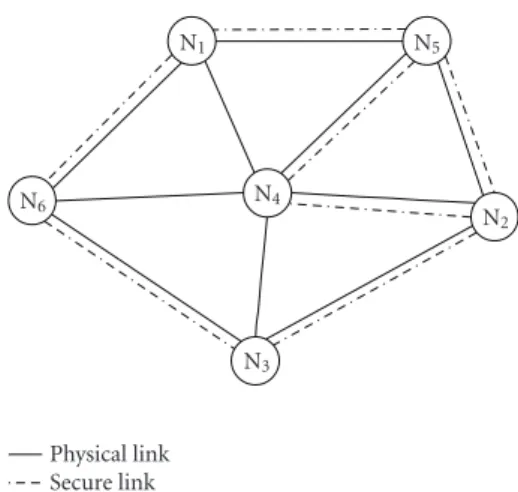
To explain in detail the path key establishment problem, we illustrate using a small network having six sensor nodes as shown in Figure 1. Solid and dashed lines are used to represent physical and secure links, respectively. A secure link exists if there is a shared secret between both end nodes. For example, there is a secure link between node N6 and node
N1, since they share a common key. On the other hand, node
N6and node N4have only a physical link since they do not
share a key. The following question arises: how could N6and
N4communicate?
A first solution is as follows: one node generates a random key which can then be transmitted via a secure path (N6-N1-N5-N4). The risk is that, if one node of this path is
captured, the key will be revealed. Thus, all communications between the two nodes remain insecure. It has been proposed in [9] to use multiple paths to send the generated key. The new key will be divided according to the number of secure paths between the two end sensor nodes. For example, suppose there exist two secured paths between node N6and
node N4. The generated key will be divided into two parts
(nuggets). One part will be sent on the first path (N1-N5),
the other part will be sent via the second path (N3-N2). This
an efficient algorithm for path key establishment problem has to be employed taking into account the nature of WSNs such as memory size and battery lifetime. Node Disjoint Routing Protocol (NDRP), such as that described in [13], can be used to find disjoint paths. Our work concentrates, not on building node disjoint paths, but on how to elect proxies. The proposed algorithm does not depend on a specific NDRP algorithm.
Two methods have been proposed in [9] for the path key establishment process. We use them as benchmarks for assessing the performance of our proposed algorithm. The algorithms in [9] are similar to the idea proposed by Liu et al. in [6]. However, the new key is generated by one of the two end nodes; while in [6], it is generated by a node which shares a secret with both end nodes. In addition, these algorithms use more than a single common node to send the new key thereby giving added protection to the generated key.
2.1. Algorithm 1 (ALG1)
The basic steps of ALG1 to discover k proxies can be de-scribed as follows [9].
(i) Node N1and node N2are two sensor nodes wishing to
set up a path to secure their communications.
(ii) Node N1 randomly selectsk neighbours (or (k−1)
depending on whether or not node N1acts as its own
proxy for one key part or key nugget) and sends out request for proxy packets containing key IDs for both nodes N1 and N2. Each recipient examines the key
identifiers (key IDs) list to determine if it shares keys with both nodes N1and N2.
(a) If it does, it responds to node N1with the key ID
that is chosen to communicate with node N1.
(b) If it does not, or if it has received the same request from node N1, it forwards this request to
a random neighbour, other than the sender.
2.2. Algorithm 2 (ALG2)
(i) Node N1 creates a request packet and sets its
time-to-live (TTL) field to time interval t before locally flooding the packet into the network. The value of t
may be set to reflect the density of the node within the neighborhood. For dense networks, the value of
t should be small; while for sparse networks, a large value oftmay be required.
(ii) Nodes receiving a request packet respond with positive acknowledgment only if they share a key with node N1
and a key with node N2.
(iii) Upon receivingkpositive acknowledgment, node N1
selects the senders of these acknowledgments as k
proxies.
Both ALG1 and ALG2 include the case where nodes N1and
N2can act as their own proxies. The proxy process discovery
starts by looking for proxies either from node N1or node N2.
When a sensor node is elected as a proxy, the authors in [9] do not assess the real length of the path between node N1and
node N2. For example, if this proxy isl1hops away from node
N1andl2hops away from node N2, then the real path will be
of length (l1+l2). However, if node N1finds a proxy, which
isl1hops away, it is possible that this proxy shares a key with
node N1 and node N2, but a path between this proxy and
node N2may not exist or be too far away.
In this paper, we propose a novel approach that elects intermediate sensor nodes as proxies with a guaranteed short path between the two end nodes.
3. PROPOSED ALGORITHM
The following assumptions are made in our algorithm (ALG3) and its security analysis.
(1) Before the deployment phase, which is conducted offline,
(a) each sensor node has a unique node identifier in the network (node ID);
(b) each sensor node stores a list of keys or the information necessary to set up a secure link (DDHV scheme).
(2) After sensor deployment, the following occur.
(a) The key discovery phase takes place where each node broadcasts its key IDs list. Therefore, each node sends one message, and receives another one from each node within its radio range. Secure links are then set up at the end of the key discovery phase.
(b) We assume that each sensor node has the sensor node ID list of its first neighbours which have a secure link with them (i.e., first neighbours). The first neighbours of Ni are defined as those sensor nodes that are one hop away from a sensor node Niand share a secret with node Ni. Thus, all communications between node Ni and its adjacent neighbours are secure.
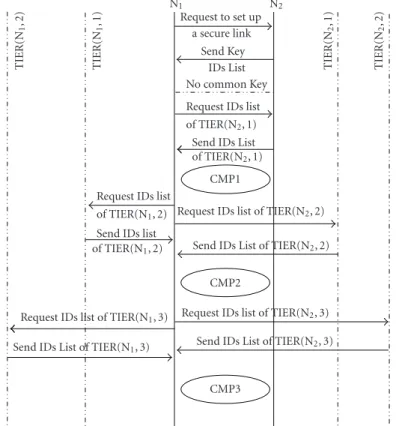
Let TIER (Ni,j) denote the neighbours that are jhops away from the node Ni. Figure 2 illustrates the action of ALG3 where nodes N1 and N2are two sensor nodes which are on
the radio range of each other. If nodes N1 and N2 wish to
establish a secure link, they exchange their key IDs’ list. If they share a secret, they can set up a secure link.
Assume that nodes N1and N2do not share a secret. We
will show how ALG3 resolves the “Path Key Establishment Problem.”
A physical link exists between nodes N1 and N2, but
a secure path has yet to be established. ALG3 is initiated after it is determined that no common secret exists between nodes N1 and N2. Let Prx denote the number of proxies
required to send the secret. Recall that node N1 already
knows the ID list for its first neighbours (assumption 2(b)). Then, node N1requests the sensor node ID list of node N2’s
first neighbours (those neighbours which are one hop away) or node N2’s Tier 1 neighbours denoted by TIER(N2,1).
Then, N1 starts comparing with its first neighbour sensor
TIER(N
1
,2
)
TIER(N
1
,1
)
TIER(N
2
,1
)
TIER(N
2
,2
)
N1 N2
CMP1
CMP2
CMP3
Request IDs list of TIER(N2, 2)
Send IDs List of TIER(N2, 2)
Request IDs list of TIER(N1, 3)
Send IDs List of TIER(N1, 3)
Request IDs list of TIER(N2, 3)
Send IDs List of TIER(N2, 3) Request to set up
a secure link Send Key
IDs List No common Key Request IDs list of TIER(N2, 1)
Send IDs List of TIER(N2, 1)
Request IDs list of TIER(N1, 2) Send IDs list of TIER(N1, 2)
Figure2: Proxy process discovery.
TIER(N1, 1)
TIER(N1, 2)
TIER(N1, 3)
TIER(N2, 1)
TIER(N2, 2)
TIER(N2, 3)
N1 N2
1
2 3
4 5
6 9 8
7 They cannot establish
a secure link
Figure3: Chronological sequence comparison for proxy process discovery.
CMP1 corresponds to sequence 1 inFigure 3. If a common node ID is found, it will be elected as a proxy which is one hop away from both end sensor nodes N1 and N2 (see
Figure 4(a)).
If the number of proxies found after CMP1 is smaller thanPrx, node N1 continues searching for new proxies by
requesting the sensor node ID lists of its second neighbours and node N2’s second neighbours by sending a request to its
first neighbours TIER(N1,1) and TIER(N2,1), respectively.
TIER(N1,1) replies by sending the sensor node ID
list of its first neighbours denoted by TIER(N1,2) (node
N1’s second neighbours). In addition, TIER(N2,1) replies
by sending the sensor node ID list of its first neigh-bours denoted by TIER(N2,2) (node N2’s second
neigh-bours).
After receiving the required sensor node ID lists, node N1
starts searching for new proxies by comparing at CMP2 the sensor node ID list from its first and second neighbours with node N2’s first and second neighbours (CMP2: seeFigure 2).
CMP2 corresponds to sequences 2, 3, and 4 inFigure 3. The chronological order of comparisons is depicted inFigure 3. If new proxies are found, the length of the path will be as follows (seeFigure 4(b)):
(i) two, if the second neighbour of node N1 is the first
neighbour of node N2or if the first neighbour of node
N1is the second neighbour of node N2;
(ii) three, if they both have a common second neighbour ID.
If the required number of proxies found is smaller than
Prx, node N1 requests its third neighbour sensor node
ID list and node N2’s third neighbours’ sensor node ID
list by sending requests to TIER(N1,2) and TIER(N2,2),
respectively. TIER(N1,2) replies by sending the sensor node
ID list of its first neighbours denoted by TIER(N1,3) (node
N1’s third neighbours) while TIER(N2,2) replies by sending
the sensor node ID list of its first neighbours denoted by TIER(N2,3) (node N2’s third neighbours).
After receiving the sensor node ID list requested, node N1
N1 N2
(a) Path length after CMP1
N1
N2
(b) Path length after CMP2
N1
N2
(c) Path length after CMP3
Figure4: Path length after CMP1, CMP2, and CMP3.
CMP3 (seeFigure 2). CMP3 corresponds to sequences 5, 6, 7, 8, and 9 inFigure 3. The chronological order of comparison follows the sequence depicted in Figure 3. If proxies are found, the length of the path will be three, four, or five (see Figure 4(c)).
4. ANALYSIS
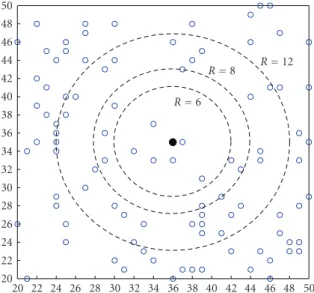
To assess the performance of our proposed algorithm, the same experiment as described in [9,14] with 1000 sensor nodes randomly distributed over a 100×100 square area was carried out. Simulations were run using Matlab [15]. Three different scenarios were simulated in which the radio rangeRwas set to 6, 8, and 12 in order to generate networks with different densities. InFigure 5, whenR=6, the sensor node highlighted in black can attempt to establish a secure link with up to six sensor nodes. WhenR=8 andR=12, the number of sensor nodes that can be targeted to establish secure links with increases.
In these experiments, a path key is fragmented into 5 parts (nuggets). Thus, five proxies are required to commu-nicate the path key between two end nodes so that 100 pairs of end nodes were chosen randomly in our simulations. The performance of ALG3 was compared with both ALG1 and ALG2 using different key distribution scenarios.
4.1. Average number of hops to find a proxy
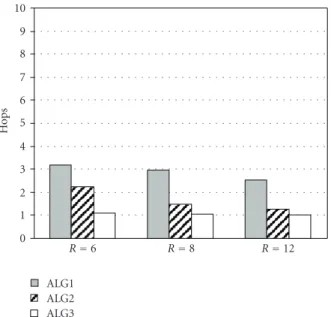
Figures6and7show the average number of hops to deter-mine one proxy in the network for two different scenarios exhibiting low and high connectivity.
Figure 6depicts the average number of hops to find one proxy in a network with a 30% probability that any two nodes share a secret. When R = 6 (i.e., for a sparse network), a proxy can be found after more than 9 hops and 3 hops using ALG1 and ALG2, respectively. However, using ALG3, a proxy resides fewer than two hops away. In [9], the authors did not assess the path lengthlbetween nodes N1 and N2. For
example, using ALG1, a proxy resides more than 9 hops away from node N1 for the case whenR = 6. For this case, the
path length between node N1and node N2is at least 10 hops
if the elected proxy is a first neighbour of node N2. However,
this does not always happen. Using ALG2, the path lengthl
has 4 hops. In our simulations, a proxy is found almost after exchanging the first, second, and third neighbours’ sensor node ID list and resides one or two hops away from node
20 22 24 26 28 30 32 34 36 38 40 42 44 46 48 50
20 22 24 26 28 30 32 34 36 38 40 42 44 46 48 50
R=6
R=8 R=12
Figure5: Varying radio range and connectivity.
N1 such that the path length is 2 ≤ l ≤ 4 (seeFigure 4).
For a medium dense network (R = 8), a proxy is 8 hops and 2 hops away when using ALG1 and ALG2, respectively. WhenR=12 (i.e., for a dense network), one still needs more than 8 hops and 2 hops using ALG1 and ALG2, respectively. In this case, ALG3 outperforms both ALG1 and ALG2 since a proxy resides less than 2 hops away from node N1 (see
Figure 6).
Another feature of ALG3 is that it is independent of the network density making it more appropriate for WSNs. Figure 7 shows the average number of hops to locate one proxy for another scenario where the probability that any two sensor nodes are able to communicate is 60%. It can be observed from Figures6and7that the number of hops to determine one proxy in the case when R = 6 falls from from 9 to 3 for ALG1 and from 3 to 2 for ALG2 when the probability that any two sensor nodes are able to communicate is varied from 30% to 60%. Using ALG3, the average number of hops to find one proxy is almost “1.” This means that there is a higher chance of finding a proxy residing one hop away from nodes N1 and N2
0 1 2 3 4 5 6 7 8 9 10
Ho
p
s
R=6 R=8 R=12
ALG1 ALG2 ALG3
Figure6: Average number of hops to get one proxy for a scenario with low connectivity (τ=4;ω=50;Pactual=30%).
0 1 2 3 4 5 6 7 8 9 10
Ho
p
s
R=6 R=8 R=12
ALG1 ALG2 ALG3
Figure7: Average number of hops to get one proxy for a scenario with high connectivity (τ=6;ω=50;Pactual=60%).
4.2. Average time to find one proxy
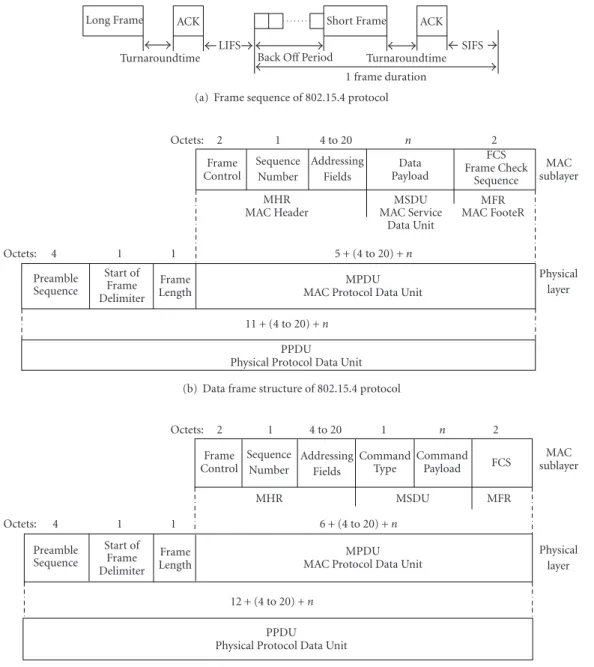
To further demonstrate the superiority of the performance of ALG3, we have recorded the average time necessary to establish a secure link between two sensor nodes which does not share a secure one. The time computed is the interval between the request to set up a secure link and its final establishment (see Figure 2). In order to simulate a real scenario, the IEEE 802.15.4 standard is implemented to assess our proposed algorithm. The frame sequence in 802.15.4 is depicted in Figure 8(a). One frame duration includes theback-offperiod, the frame to be transmitted, turn-around time, acknowledgment and the interframe space (IFS). It
has to be noticed that the long frames are followed by a long IFS (LIFS) and short frames by a short IFS (SIFS). More information on the 802.15.4 can be found in [16]. The data frame (Figure 8(b)) structure and the medium access control (MAC) command frame (Figure 8(c)) of 802.15.4 [16] protocol are used to to send the sensor node ID list and request the establishment of a secure link, respec-tively.
The following assumptions are considered while record-ing the average time to determine a proxy.
(i) There are no losses due to collisions; no packets are lost due to buffer overflow at either sender or receiver side. The bit error rate is zero. Therefore, a perfect channel is considered in this study.
(ii) The unslotted version of the 802.15.4 protocol in the 2.4 GHz band is implemented which provides the highest data rate (250 Kb/s).
(iii) The short addressing mode is used. (iv) Acknowledgment packets are omitted.
(v) The number of back-off slots is a random number uniformly distributed in the interval [0, 2BE−1], BE is the back-offexponent which has the minimum value of 3. As a perfect channel is considered with a BER=0, the number of back-offslots can be represented as the mean of the interval: [(23−1)/2]=3.5. The time for a back-offslot is 320μs.
(vi) SIFS is used when the MAC protocol data unit (MPDU) is smaller than 18 bytes (SIFS = 192μs). Otherwise, LIFS is used (LIFS=640μs).
The time computed includes the passive listening of all the nodes involved in the proxy searching process. When the probability of sharing a secret is 30%, each sensor node carries 20 keys randomly from a key pool of 1000. The key ID identifiers require 10 bits to represent them in a binary format. The Data payload for the request packet size is 15 bytes. Therefore, each request packet transmitted is followed by a SIFS (MPDU < 18 bytes). The data packet size to send the key ID list is 59 bytes and 79 bytes when
Pactual = 30% and Pactual = 60%, respectively. In both
scenarios, each data packet transmitted is followed by a LIFS (MPDU>18 bytes). The request packet size is 21 bytes. Both ALG1 and ALG2 compare the key ID lists to elect a proxy (Section 2) whereas ALG3 compares the sensor node ID lists (common trusted neighbours). When, the probability that two sensor nodes are able to communicate is set to 30%, each sensor node carries 20 keys. Thus, 20 comparisons are required each time. Furthermore, the key IDs of both end nodes need to be transmitted to each sensor node in order for it to be elected as a proxy. This means higher-power consumption.
Figure 9 clearly shows that the average active time to transmit the necessary information to find one proxy using ALG1 and ALG2 is much higher than ALG3 for a scenario
whenPactual=30% with a data rate of 250 Kb/s. WhenR=6,
Long Frame ACK
Turnaroundtime LIFS
Back OffPeriod
Short Frame ACK
Turnaroundtime SIFS
1 frame duration (a) Frame sequence of 802.15.4 protocol
Octets: 2 1 4 to 20 n 2
Octets: 4 1 1 5 + (4 to 20) +n
11 + (4 to 20) +n
MAC sublayer
Physical layer
PPDU Physical Protocol Data Unit Frame
Control
Sequence Number
Addressing Fields
Data Payload
FCS Frame Check
Sequence MHR
MAC Header
MSDU MAC Service
Data Unit
MFR MAC FooteR
Preamble Sequence
Start of Frame Delimiter
Frame Length
MPDU MAC Protocol Data Unit
(b) Data frame structure of 802.15.4 protocol
Octets: 2 1 4 to 20 1 n 2
Octets: 4 1 1 6 + (4 to 20) +n
12 + (4 to 20) +n
MAC sublayer
Physical layer
PPDU Physical Protocol Data Unit Frame
Control
Sequence Number
Addressing Fields
Command Type
Command Payload FCS
MHR MSDU MFR
Preamble Sequence
Start of Frame Delimiter
Frame Length
MPDU MAC Protocol Data Unit
(c) MAC command frame structure of 802.15.4 protocol
Figure8: IEEE 802.15.4 frame sequence, data, and command frame structure.
ALG1 and ALG2 (seeFigure 9:R=8). WhenR=12 (i.e., for a dense network), ALG3 requires less time than the others to find one proxy (seeFigure 9:R=12).
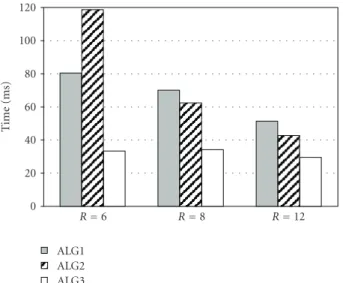
Figure 10 shows another scenario for the case when the probability of any two sensor nodes being able to communicate is set to 60%. In this scenario, each sensor node carries 30 keys. Thus, 30 comparisons have to be made each time. WhenR = 6 (for a sparse network),Figure 10 shows that the average times to find one proxy using ALG1, ALG2, and ALG3 are 80.42 ms; 118.73 ms, and 33.39 ms, respectively. It can also be seen that, for a medium dense network (R=8), ALG3 outperforms both ALG1 and ALG2. Finally, for a dense network (R =12), ALG3 still performs better than both ALG1 and ALG2. Thus, ALG3 outperforms both ALG1 and ALG2 across the full range of network types.
4.3. Average time to find five proxies
Simulations to find five proxies have been made. The average active times to determine the five proxies using ALG1, ALG2, and ALG3 have been recorded. Figures11and12clearly show that ALG3 outperforms both ALG1 and ALG2.
0 50 100 150 200 250 300 350 400 450 500 550
Ti
m
e
(m
s)
R=6 R=8 R=12
ALG1 ALG2 Our ALG
Figure 9: Average time to find one proxy with low connectivity (data rate=250 Kb/s;Pactual=30%).
0 20 40 60 80 100 120
Ti
m
e
(m
s)
R=6 R=8 R=12
ALG1 ALG2 ALG3
Figure10: Average time to find one proxy with high connectivity (data rate=250 Kb/s;Pactual=60%).
proxies.Figure 12shows another scenario whenPactualis set
to 60% and the data rate is set to 250 Kb/s. It is observed that ALG3 requires less time to find five proxies than do ALG1 and ALG2. For a sparse network (R = 6), ALG1, ALG2, and ALG3 require 402.08 ms, 593.65 ms, and 122.27 ms, respectively, to find five proxies. ForR=8, the average times to determine five proxies using ALG1, ALG2, and ALG3 are 350.27 ms, 311.95 ms, and 121.11 ms, respectively, while for a dense network (R =12), ALG1, ALG2, and ALG3 require 257.33 ms, 213.91 ms, and 123.41 ms, respectively, to find five proxies. Thus, ALG3 outperforms both ALG1 and ALG2 across the full range of network types.
ALG3 optimises the time necessary to find common nodes to send the new generated key which will be divided according to the number of elected proxies. The time to find those elected proxies using ALG1 and ALG2 is longer
0 500 1000 1500 2000 2500 3000
Ti
m
e
(m
s)
R=6 R=8 R=12
ALG1 ALG2 ALG3
Figure11: Average time to find five proxies with low connectivity (Pactual=30%; data rate=250 Kb/s).
0 100 200 300 400 500 600
Ti
m
e
(m
s)
R=6 R=8 R=12
ALG1 ALG2 ALG3
Figure12: Average time to find five proxies with high connectivity (Pactual=60%; data rate=250 Kb/s).
than ALG3. Both ALG1 and ALG2 elect a sensor node as a proxy only if it has a common key ID with both end sensor nodes N1 andN2. For a probability of sharing one
key space of 30%, each sensor node carries 20 keys from a key pool of 1000 keys. Therefore, each time a request to establish a secure link is sent to a neighbouring node; a total of two times 20 comparisons of keys ID are required to be made to decide whether that node has a common key with both nodesN1 andN2. On the top of that, ALG1 and
ALG2 do not guarantee that a secure link exists between the elected proxy and N2. Furthermore, the length of the path
betweenN1andN2is not considered in [9]. Our proposed
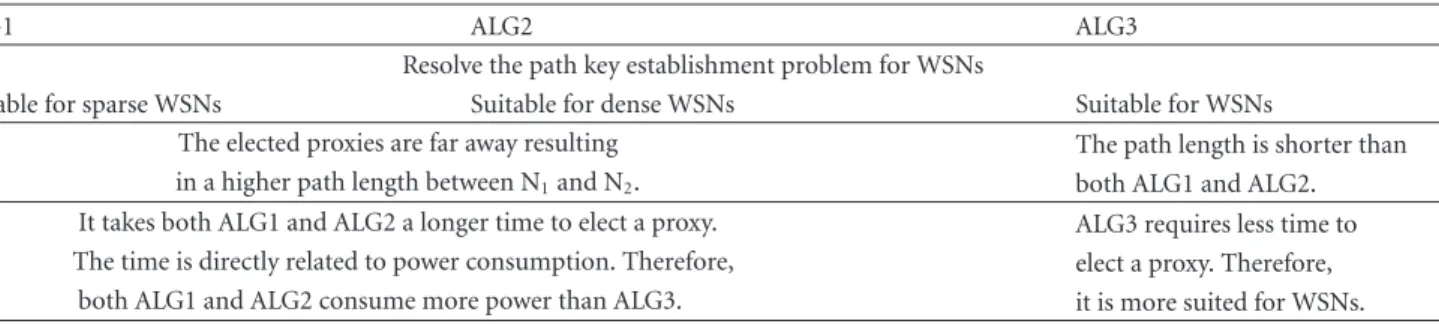
Table1: Comparison of ALG1, ALG2, and ALG3.
ALG1 ALG2 ALG3
Resolve the path key establishment problem for WSNs
Suitable for sparse WSNs Suitable for dense WSNs Suitable for WSNs
The elected proxies are far away resulting The path length is shorter than
in a higher path length between N1and N2. both ALG1 and ALG2.
It takes both ALG1 and ALG2 a longer time to elect a proxy. ALG3 requires less time to
The time is directly related to power consumption. Therefore, elect a proxy. Therefore,
both ALG1 and ALG2 consume more power than ALG3. it is more suited for WSNs.
5. CONCLUSION
This paper addresses the path key establishment problem when two neighbouring sensor nodes with an insecure link require their trusted neighbours to create a secure link. The proposed algorithm outperforms two previously developed algorithms [9]. The results and analyses relate to scenarios for a WSN having high and low connectivities. In particular, ALG3 can locate proxies with less difficulty than those algorithms requiring shorter paths and showing good performance for sparse wireless sensor networks (see Figure 6).
In addition, it has been shown, through simulations, that the proposed algorithm is more efficient in terms of the active time to transmit the necessary information to find one proxy and five proxies (seeTable 1). The time to determine a proxy is directly related to power consumption, a longer time necessary to elect a proxy will result in an extra power to be consumed. Therefore the proposed algorithm is also power-efficient. This demonstrates that the proposed algorithm is well suited for use in wireless sensors networks.
REFERENCES
[1] I. F. Akyildiz, W. Su, Y. Sankarasubramaniam, and E. Cayirci, “A survey on sensor networks,”IEEE Communications Maga-zine, vol. 40, no. 8, pp. 102–114, 2002.
[2] C. Karlof and D. Wagner, “Secure routing in wireless sensor networks: attacks and countermeasures,” inProceedings of the 1st IEEE International Workshop on Sensor Network Protocols and Applications (SNPA ’03), pp. 113–127, Anchorage, Alaska, USA, May 2003.
[3] L. Eschenauer and V. D. Gligor, “A key management scheme for distributed sensor networks,” in Proceedings of the 9th ACM Conference on Computer and Communication Security (CCS ’02), pp. 41–47, Washingtion, DC, USA, November 2002.
[4] H. Chan, A. Perrig, and D. Song, “Random key predistribution schemes for sensor networks,” inProceedings of IEEE Sym-posium on Security and Privacy, pp. 197–213, Oakland, Calif, USA, May 2003.
[5] W. Du, J. Deng, Y. S. Han, P. Varshney, J. Katz, and A. Khalili, “A pairwise key predistribution scheme for wireless sensor networks,” ACM Transactions on Information and System Security, vol. 8, no. 2, pp. 228–258, 2005.
[6] D. Liu, P. Ning, and R. Li, “Establishing pairwise keys in dis-tributed sensor networks,”ACM Transactions on Information and System Security, vol. 8, no. 1, pp. 41–77, 2005.
[7] R. Blom, “An optimal class of symmetric key generation systems,” inProceedings of the Workshop on the Theory and Application of Cryptographic Techniques (EUROCRYPT ’84), pp. 335–338, Paris, France, April 1985.
[8] N. Mehallegue, E. Garcia, and A. Bouridane, “Improving key distribution for wireless sensor networks,” inProceedings of the 2nd IEEE NASA/ESA Conference on Adaptive Hardware and Systems, pp. 82–88, Edinburgh, Scotland, UK, August 2007. [9] G. Li, H. Ling, T. Znati, and W. Wu, “A robust on-demand
path-key establishment framework via random key predis-tribution for wireless sensor networks,”EURASIP Journal on Wireless Communications and Networking, vol. 2006, Article ID 91304, 10 pages, 2006.
[10] R. Anderson, H. Chan, and A. Perrig, “Key infection: smart trust for smart dust,” inProceedings of the 12th IEEE Interna-tional Conference on Network Protocols (ICNP ’04), pp. 206– 215, Berlin, Germany, October 2004.
[11] H. Chan and A. Perrig, “PIKE: peer intermediaries for key establishment in sensor networks,” in Proceedings of the 24th Annual Joint Conference of the IEEE Computer and Communications Societies (INFOCOM ’05), vol. 1, pp. 524– 535, Miami, Fla, USA, March 2005.
[12] S. Zhu, S. Xu, S. Setia, and S. Jajodia, “Establishing pairwise keys for secure communication in ad hoc networks: a proba-bilistic approach,” inProceedings of the 11th IEEE International Conference on Network Protocols (ICNP ’03), pp. 326–335, Atlanta, Ga, USA, Novemeber 2003.
[13] X. Li and L. Cuthbert, “Node-disjointness-based multipath routing for mobile ad hoc networks,” in Proceedings of the 1st ACM International Workshop on Performance Evaluation of Wireless Ad Hoc, Sensor, and Ubiquitous Networks (PE-WASUN ’04), pp. 23–29, Venice, Italy, October 2004. [14] H. Ling and T. Znati, “End-to-end pairwise key
estab-lishment using multi-path in wireless sensor network,” in
Proceedings of IEEE Global Telecommunications Conference (GLOBECOM ’05), vol. 3, pp. 1847–1851, Saint Louis, Mo, USA, November-December 2005.
[15] www.mathworks.com/.
[16] IEEE Std. 802.15.4, “IEEE standard for Information Technology—Telecommunications and information exchange between systems—Local and metropolitan area networks— Specific requirements, Part 15.4 Wireless Medium Access Control (MAC) and Physical Layer (PHY) Specifications for Low Rate Wireless Personal Area Networks (LR-WPANs),”