R E S E A R C H
Open Access
Robust full-dimension MIMO transmission
based on limited feedback angular-domain
CSIT
Stefan Schwarz
Abstract
In this paper, we propose robust multi-user beamforming and precoding techniques for full-dimension MIMO transmission based on limited feedback. We propose to employ an over-complete basis decomposition in the angular domain to approximate the channel matrices as sums of few dominant specular components, facilitating efficient channel state information (CSI) quantization at the users. The selected expansion vectors of such a sparse
approximation, parametrized by azimuth and elevation angles, are relatively robust with respect to channel estimation errors as well as channel variations over time. Based on this CSI feedback, we propose incoherent
beamforming/precoding methods that make use only of the azimuth and elevation angles as well as the norm of the expansion coefficients and do not rely on coherent multipath interference to eliminate inter-user interference. Our optimization aims at maximizing the signal power or the achievable rate of a user, while limiting the amount of interference leakage caused to other users. To further improve robustness, we account for uncertainty in the angular channel decomposition in the proposed precoder optimization.
Keywords: Full-dimension MIMO, 3D beamforming, Robust precoding, Interference leakage, High mobility, Limited feedback
1 Introduction
Full-dimension multiple-input multiple-output (FD-MIMO) transmission refers to wireless transmission systems that support two-dimensional antenna arrays with a large number of antenna elements. This enables high-resolution beamforming in both, the elevation and the azimuth domain, in order to achieve space-division multiple access gains through spatial separation of users, as well as to enhance the energy efficiency of wireless data transmission by concentrating the radiated energy towards intended users [1–3]. The great potential of FD-MIMO systems has been recognized by standardization bodies, such as the third generation partnership project (3GPP); correspondingly, development and standardiza-tion efforts are ongoing within long-term evolustandardiza-tion (LTE) Release 14 and 5G new radio (NR) to further enhance
Correspondence:[email protected]
Christian Doppler Laboratory for Dependable Wireless Connectivity for the Society in Motion, Institute of Telecommunications, Technische Universität (TU) Wien, Vienna, Austria
the initial realization of FD-MIMO in Release 13. Cur-rently, most implementation proposals of FD-MIMO transceivers are based on hybrid architectures, where part of the signal processing is performed in base band and part in the analog radio frequency (RF) domain in order to limit the number of required RF chains. This approach is especially important in the millimeter wave band, where hardware complexity is a limiting factor [4–8]. When designing hybrid precoding systems, several chal-lenges need to be addressed [9–11]: the design freedom of RF precoders is commonly restricted by hardware lim-itations, such as discrete angular resolution and constant modulus of the phase-shifting elements, as well as partial connectivity of the phase-shift network to limit insertion loss. An alternative to hybrid architectures, which poten-tially provides even higher spectral and energy efficiency in certain operating regimes, is to employ cheap low (even single bit) resolution analog to digital (AD)/digital to analog (DA) converters in FD-MIMO transceivers.
At the receive-side of most existing MIMO transceivers, high-resolution AD converters are employed to minimize the signal distortions introduced by the receiver. Such high-resolution AD converters are, however, among the most power hungry devices of the receiver chain. This motivates the use of low-resolution energy effi-cient AD converters in FD-MIMO systems to achieve energy-efficient operation [12–15]. At the transmit side, on the other hand, power expenditure is dominated by power amplifiers, which are usually required to operate within the high linearity regime to avoid signal distortion. Employing low-resolution DA converters relaxes these linearity requirements, allowing the amplifiers to operate closer to saturation thereby increasing their efficiency [16,17].
In this work, our focus is on an enhancing the robust-ness of downlink three-dimensional FD-MIMO point to multi-point transmission with respect to imperfections of the channel state information at the transmitter (CSIT), especially due to high user mobility, without specifi-cally addressing the restrictions of hybrid precoding or low-resolution AD/DA implementations. In MIMO trans-mission in general, and especially when considering multi-point communication, CSIT is an essential ingredient. CSIT for downlink transmission is commonly obtained either from uplink measurements using dedicated uplink pilot signals [18,19] or from limited channel state infor-mation (CSI) feedback from the users [20–22]. We con-sider frequency division duplex (FDD) transmission in this paper, where CSIT is provided via feedback from the users over dedicated limited capacity feedback links. For this purpose, the users have to quantize the required CSI uti-lizing a proper quantization codebook. Two approaches are most common in current mobile communication sys-tems [23]: (1) Implicit CSI feedback, where the users select preferred transmit beamformers/precoders from a prede-fined codebook given the current channel conditions. This has the advantage that the users can accurately estimate the expected performance during transmission, provided the channel conditions are quasi-static. (2) Explicit CSI feedback, where the users directly quantize the MIMO channel matrix. This approach is better suited for multi-user MIMO transmission because it facilitates calculation of efficient multi-user precoders at the transmitter on-the-fly. Either way, providing CSI via limited feedback is always prone to inaccuracies, on the one hand, caused by the quantization process, which is inevitable due to the limited capacity of the feedback links. On the other hand, CSI inaccuracies also result from the delay of the feedback path, leading to a mismatch of the CSI experienced during the quantization phase and the CSI valid during trans-mission. Several theoretical studies exist that evaluate the performance degradation due to imperfect and outdated CSIT for a variety of transmission scenarios [24–27].
Popular coherent multi-user beamforming/precoding methods, such as zero forcing (ZF) beamforming [28], block diagonalization (BD) precoding [29] and interfer-ence alignment (IA) [30, 31], utilize the phase differ-ence between the multipath components contributing to the channel between the transmitter and the receiver to achieve constructive/destructive signal interference. The phases of multipath components, however, can change very quickly over time, especially for mobile users, and hence coherent beamforming/precoding methods react very sensitive to non-static scenarios [32, 33]. The cor-responding performance degradation can partly be mit-igated by robust coherent beamforming/precoding tech-niques that account for the CSIT imperfection. One prominent example of robust beamforming techniques is minimum variance robust adaptive beamforming [34], which accounts for imperfections in the estimation of signal covariance matrices. In [35], the authors achieve robustness w.r.t. CSI quantization by utilizing multiple receive antennas to improve system performance with-out the need for full channel feedback information; this idea is in essence similar to [36], where subspace-selection strategies for CSI feedback are discussed that enable mit-igating the impact of CSI quantization. In [37], robust single-user MIMO precoding methods are proposed that maximize the worst-case received signal-to-noise ratio or minimize the worst-case error probability with imperfect CSIT. Furthermore, hybrid transceiver architectures that incorporate robustness against channel estimation errors are proposed in [38].
and IA, that rely on destructive multipath interference to eliminate inter-user interference. We therefore propose to apply incoherent beamforming/precoding techniques that are inherently robust w.r.t. phase uncertainties of multipath components, similar to space-division multiple access (SDMA). Specifically, we propose leakage-based angular beamforming/precoding methods that make use only of the azimuth and elevation angles as well as the norm of the expansion coefficients and do not rely on the phase of the expansion coefficients to achieve destructive multipath interference. This approach also improves robustness of beamforming/precoding solutions at high mobility, where the relative phases of multipath compo-nents change very quickly over time. To further improve robustness we additionally account for uncertainty in the angular channel decomposition in the proposed precoder optimization. Naturally, this approach cannot compete with coherent precoding methods in case of highly accurate CSIT; however, our numerical simulations demonstrate significant gains in terms of achievable rate and symbol error ratio (SER) in case of imperfect CSIT under LOS conditions. The present work is an extension of our two conference publications [39,40] to multi-user beamforming and multi-stream multi-user precoding. Specifically, in [39] we propose and approximately solve the FD-MIMO transmit beam pattern optimization problem of worst-case signal to leakage ratio (SLR) maxi-mization, where we maximize the ratio of signal power radiated into an angular region of interest to leakage power radiated into an unintended angular region. A similar design and optimization principle guides us also in the present paper, yet extended to adaptive operation with limited feedback from the users and transmission of multiple data streams per user. In [40], we consider so-called double-sided FD-MIMO systems, where both transmitter and receiver are equipped with FD-MIMO antenna arrays, and we apply a similar over-complete basis decomposition as in the present paper to achieve efficient limited feedback operation. However, we do not consider robust multi-user beamforming/precoding in [40]. Hence, the present paper combines results of [39, 40] and extends them to adaptive limited-feedback based multi-user precoding with multi-stream transmission per user.
Organization In Section 2, we introduce our system model and state the underlying assumptions of this work. In Section 3, we present the proposed CSI feedback approach that is based on a sparse approximation of the channel utilizing an over-complete basis decomposition. Based on this CSI feedback, we then propose in Section4 our robust leakage-bounded angular beamforming and precoding methods. We briefly summarize for the read-ers convenience in Section 5 the benchmark methods
employed in our simulations, in order to clarify how these methods are applied in our considered scenario. Finally, in Section6, we investigate the performance of the pro-posed beamformers and precoders by means of numer-ical simulations and we provide concluding remarks in Section7.
Notation We denote scalars by upper and lower case italic letters (e.g., N, n), vectors by lower case bold let-ters (e.g.,x), and matrices by upper case bold letters (e.g., H). To address the element in thei-th row and thej-th column of matrixH, we use the notation [H]i,j. We write
the trace of a matrix as tr(H), the transpose asHT, the conjugate-transpose asHH, the Frobenius norm asH, the pseudo-inverse as pinv(H), and the vector obtained by stacking the columns of the matrix below each other as vec(H). We denote the logarithm of the determinant of a quadratic matrix H as log|H|. We denote sets by calligraphic letters (e.g., A); the size of setAis |A|. To calculate the expected value of a random variabler, we employ the notationEr. The Dirac delta function isδ(t); the discrete Kronecker delta isδij, i.e.,δ(t) → ∞ifft= 0 andδij = 1iffi = j. We denote the real part of a com-plex numberzas(z), the imaginary part as(z), and the complex conjugate asz∗. We denote the uniform distribu-tion on the interval [a,b] asU(a,b)and the vector-valued complex-Gaussian distribution with mean vectorμ and covariance matrixCasCN(μ,C).
2 System model
2.1 Channel model
In wireless communications, the channel between trans-mitter and receiver can be characterized by a double-directional time-variant channel impulse response [41]:
h(t,τ,t,r)= NL
=1
αδ(τ−τ)δ(t−t,)δ(r−r,),
(1)
with NL denoting the number of multipath
compo-nents andα,τ, respectively, representing the complex-valued amplitude and the propagation delay associated to path . The vectors t, =[φt,,θt,]T and r, = [φr,,θr,]T denote the azimuth and elevation angles of departure and arrival. Although not explicitly shown in (1), the parameters on the right-hand side may all implicitly depend on the absolute time t due to move-ment of users and scattering objects. Incorporating the responses of the transmit and receive antenna elements w.r.t. a plane wave from angular direction, i.e.,at() andar(), we obtain the time-variant channel impulse
h(t,τ)=
· · ·
π
−πat(t)ar(r)h(t,τ,t,r)drdt
= NL
=1
αδ(τ−τ)ar(r,)at(t,).
(2)
If we furthermore incorporate the overall impulse response of the transmit and receive filtersf(τ), we obtain the transceiver-dependent time-variant channel impulse response as:
˜ h(t,τ)=
τh(t,τ
)f(τ−τ)dτ
= NL
=1
αf(τ−τ)ar(r,)at(t,), (3)
where again the time dependence of the parameters on the right-hand side is implicit. Under the well-known pla-nar wave and pla-narrowband array assumptions [42], we can obtain the time-variant impulse response of a MIMO system simply by concatenating the individual impulse responses of antenna element pairs:
˜ H(t,τ)=
NL
=1
αf(τ−τ)ar(r,)at(t,)T (4)
withar()∈CNr×1,at()∈ CNt×1denoting the receive
and transmit antenna array response vectors. For example, consider a uniform planar array (UPA) withNvrows and Nhcolumns at the transmitter, with vertical antenna
ele-ment spacingdvand horizontal antenna element spacing dh in multiples of the wavelengthλ. Then, the response
of the antenna element in the -th row and the k-th column with respect to a plane wave from direction =[φ,θ]Tis [43]:
aUPAt (φ,θ)
(−1)Nh+k = √1
Nt
expj2π(dv(−1)cosθ)
+ dh(k−1)sinφsinθ)ge(φ,θ), (5)
∈ {1,. . .,Nv}, k∈ {1,. . .,Nh}, Nt=NvNh,
(6)
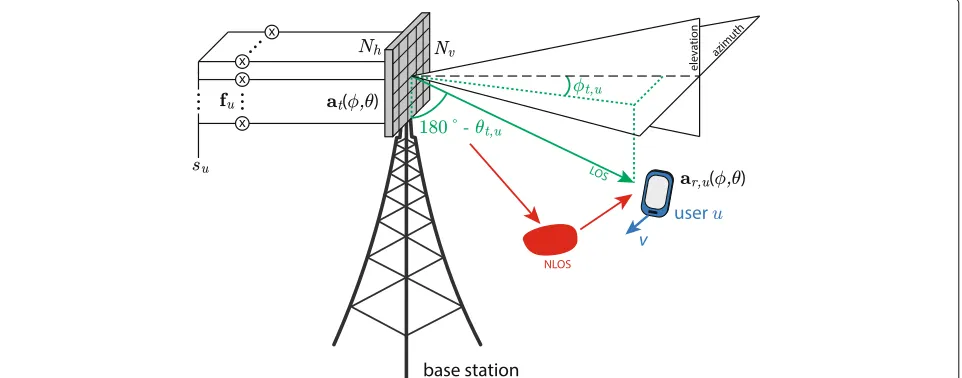
where angles are measured as illustrated in Fig. 1 in relation to the antenna array and the individual antenna element responses are arranged row-by-row in the vec-tor aUPAt (φ,θ) ∈ CNt×1. In (5), the function ge(φ,θ) ∈
Cdenotes the complex-valued angle-dependent antenna element gain pattern, e.g., a Hertzian dipole pattern. We do not focus on a specific antenna array geometry in this work nor do we restrict the antenna element gain pattern ge(φ,θ). Notice, in (4), we do not account for coupling in-between antenna elements, which may be incorporated with additional coupling matrices [43].
2.2 Transmission model
We consider downlink transmission from a base station that is equipped with an antenna array ofNtantenna
ele-ments, e.g., a UPA of sizeNt = Nh·Nvas illustrated in
Fig.1. The base station servesUusers. The users are each equipped withNrreceive antennas; we assumeNt ≥ Nr.
We consider orthogonal frequency division multiplexing (OFDM) transmission; the MIMO-OFDM channel matrix H[n,k]∈ CNr×Nt at OFDM symbolnand subcarrierkis
obtained by sampling the Fourier transform of the time-variant impulse responseH˜(t,τ)of (4). We assume that time variations within OFDM symbols are small enough such that the inter-carrier interference due to Doppler shifts is negligible. In the following, we focus on a single subcarrier and omit the subcarrier indexkfor brevity. To
refer to the channel matrix associated to a specific useru, we employ a subscript, such asHu[n].
The base station selects at each time instant a setS[n]⊆
{1,. . .,U} of users to be served in parallel, employ-ing spatial multiplexemploy-ing by means of linear beamform-ing/precoding. Assuming transmission ofLu streams to
user u ∈ S[n], the base station applies the precoding matrixFu[n]∈CNt×Luto transmit the data symbol vector su[n]∈ CLu×1to useru. We assumeE(su[n]su[n]H) = ILu and account for the power allocation in Fu[n], such
that tr(Fu[n]Fu[n]H) = 1/|S[n]|. The input-output
relationship of useruhence is
yu[n]=Hu[n]
j∈S[n]
Fj[n]sj[n]+nu[n]∈CNr×1, (7)
with nu[n] denoting zero-mean complex Gaussian
receiver noise of varianceσn2,u.
2.3 Targeted deployment scenarios
The beamforming and precoding methods proposed below are basically enhanced interference-aware SDMA techniques. As such, the methods require a certain degree of spatial separability of users in the angular domain. Such separability can mainly be guaranteed in limited scattering environments with a small number of dominant specular components per user and relatively weak diffuse back-ground scattering, as common in LOS conditions. Even though this might sound restrictive for mobile commu-nications, many scenarios envisioned for deployment of FD-MIMO systems are expected to exhibit dominant LOS transmission. Example scenarios where LOS propagation could dominate are the urban micro and macro scenar-ios illustrated in ([2], Fig. 2) and ([44], Fig. 2), where users on different floors of a building are served in par-allel by means of spatial beamforming from base stations mounted on neighboring buildings. Another interesting deployment scenario is multi-user multiplexing in large indoor open spaces, e.g., within stadiums, airport termi-nals, shopping malls, where high-ceiling-mounted small cells and remote radio heads can provide LOS connectiv-ity to users. Furthermore of interest are vehicular com-munication scenarios on highways and motorways, where FD-MIMO beamforming can be employed for multi-user transmission between road-side access points and vehicles as described in [45]. Notice also that channel fading mod-els that contain only two dominant specular components in addition to weak diffuse background scattering, such as the wave diffuse power (TWDP), generalized two-ray (GRT), and fluctuating two-two-ray (FRT) fading models [46–50], are well suited to capture the behavior of chan-nel measurements conducted in the millimeter wave band [49,51], suggesting that millimeter wave transmissions are in many cases well characterized by few specular com-ponents. Importantly, in the millimeter wave band, even
relatively low mobility of users (pedestrians) causes sig-nificant time selectivity of the channel due to the small wavelength; hence, CSIT becomes outdated even faster.
3 Channel state information feedback
We assume that the transmitter inserts pilot symbols in the OFDM time-frequency grid to support channel estimation for CSI feedback calculation at the receivers. Notice, these CSI pilots may be provided sparsely in the time-frequency grid to facilitate coarse channel estima-tion only for CSI calculaestima-tion; addiestima-tional more densely populated precoded pilot symbols can be employed to support accurate channel estimation for data detection, similar to LTE’s CSI and UE-specific pilot symbols [52]. We consider channel quantization and feedback in the frequency domain; alternatively, it is also possible to quan-tize the channel impulse response [53]. We write the MIMO-OFDM channel matrixHu[n] as a function of the
estimated matrixHˆu[n] as:
Hu[n]= ˆHu[n]+Eu[n] , (8)
with Evec(Eu[n])vec(Eu[n])H
= σ2
e,uINrNt. If we
assume that downlink CSI pilot signals are provided rel-atively sparse in the time-frequency domain, to keep the pilot signal overhead small, the channel estimation error varianceσe2,uwill be comparatively large.
In order to attain more robust behavior w.r.t. chan-nel estimation errors and outdated CSIT, we propose to employ an over-complete basis decomposition ofHˆu[n]
to obtain a sparse approximation of Hu[n].1 Choosing
a proper quantization codebook/dictionary D for the decomposition, we can achieve a signal denoising gain that provides the wanted robustness. More specifically, we apply the following decomposition:
ˆ Hu[n]=
S
s=1
csu[n](dsu[n])T+Ru[n] , (9)
withdsu[n]∈Drepresenting thes-th selected entry/atom from the dictionaryDandcsu[n]∈ CNr×1being the
cor-responding expansion coefficient vector. MatrixRu[n]∈
CNr×Nt is the residual decomposition error. The
dictio-naryD = {d1,. . .,d|D|},di ∈ CNt×1,|D| ≥ Nt is
cho-sen to span the entireNt-dimensional complex Euclidean
space, in order to be able to represent in principle any matrix error-free with sufficiently many expansion coeffi-cients. Our goal is to obtain a good sparse approximation ofHˆu[n] with a very small numberSof expansion terms
decreases exponentially with the indexs(assuming sorting in decreasing order).
If we assume transmission under LOS conditions, the channel impulse response H˜(t,τ) is dominated by the LOS specular component. This dominant component is then also present in the Fourier transform Hu[n].
Cor-respondingly, we propose to utilize a dictionary that is matched to the transmit antenna array response vector at(), since this will result in a compressible decomposi-tion of the channel matrix.2We therefore propose to set the dictionary as:
D= di=at(i)i∈ φ1,. . .,φNφ
× θ1,. . .,θNθ
. (10)
With |D| = NφNθ ≥ Nt, this dictionary spans the Nt-dimensional complex Euclidean space and can thus be
used to decompose in principle any matrix; however, for a general unstructured matrix, such decomposition will not be compressible. Notice, as the codebook is matched to the transmit antenna array geometry, the users must be aware of this geometry which requires additional down-link signaling. However, since mainly UPAs are employed in practice, we expect this to be a minor issue. The size of the quantization codebook in the azimuth and elevation domains Nφ andNθ should be chosen according to the spatial resolution of the antenna array, i.e., with a larger number of antenna elements in the horizontal/vertical dimension also the resolution of the quantization code-book in the corresponding angular domain should be increased. In order to be able to closely match the angu-lar directions of the dominant specuangu-lar components, we employ a dictionary with|D| Ntin our simulations.
To obtain a sparse channel decomposition, we consider the following optimization problem:
min
{ci∈CNr×1}Si=1,S≤|D| S
i=1
ci (11)
subject to:
Hˆu[n]− S
i=1
cidiT
2
≤2, d
i∈D
We determine an approximate solution of this opti-mization problem by applying a variation of the orthog-onal matching pursuit (OMP) algorithm [55], as detailed in Algorithm 1. Notice, to approximately solve (11), we would actually have to adapt the numberSof expansion terms in Algorithm 1 according to the desired approx-imation accuracy 2; however, in our simulations, we employ a fixedS. Notice the objective function in (11) can also be written as an1-norm[c1,. . .,cS]1 justi-fying its use for sparse decomposition. Given the sparse approximation, the CSI feedback is set equal to the cor-responding codebook indices of the optimal azimuth and elevation anglesφsu[n] ,θus[n]of the expansion vectors
dsu[n]. Additionally, we provide the norms of the expan-sion coefficient vectorscsu[n]as feedback information; the reason for this will become clear in Section4. In our simulations in Section6, we consider unquantized feed-back of the expansion coefficient vector norms; we have investigated the impact of quantization of these norms forNr = 1 in [39], showing that coarse quantization is
possible without significant performance degradation.
Algorithm 1 Channel decomposition for CSI feedback calculation utilizing a variation of OMP.
1: Initialize the decomposed channel matrixHd =0 2: Initialize the expansion matrixD=[ ]
3: fors=1 toSdo
4: Calculate the intermediate decomposition resid-ual
R= ˆHu[n]−Hd (12)
5: Calculate the decomposition metric
mi=Rd∗i
2
, ∀di∈D (13)
6: Determine thes-th expansion vector
dsu[n]=arg maxdi∈Dmi (14)
7: Update the expansion matrix
D=D,dsu[n]∈CNt×s (15)
8: Calculate the intermediate expansion coefficient matrix
C= ˆHu[n] pinv(D)T∈CNr×s (16) 9: Update the decomposed channel matrix
Hd=CDT∈CNr×Nt (17)
10: end for
11: Set the expansion coefficient vectors
c1u[n] ,. . .,cSu[n]=C (18)
4 Leakage-bounded angular beamforming and
precoding
In this section, we propose multi-user beamforming and precoding methods that utilize the angular-domain CSI feedback described in the previous section. We consider first multi-user beamforming with a single stream per user in Section4.1and extend to multiple streams per user in Section4.2.
4.1 Leakage-bounded angular beamforming
beamforming vectorsfu[n]. From the angular CSI
feed-back provided by the users, the base station has at time instant n delayed knowledge of the channel expansion vectors dsu[n−m] and the norm of the corresponding expansion coefficient vectorscsu[n−m], wherem rep-resent the delay of the CSI feedback path. To calculate the transmit beamformers, we interpret the expansion vectors dsu[n−m] as specular channel contributions and propose a beamformer optimization that maximizes the expected received signal power of user u over its specular com-ponents, while restricting the interference leakage caused to the other users over their respective specular compo-nents. To shorten notation, we omit the time indices [n] and [n−m] in the following derivations.
Consider the signal power received over theSspecular components corresponding to the available CSIT:
Pu=E
depends on the relative phase-shift ϕuk,s between these expansion coefficient vectors. Since we do not provide feedback information about these relative phase-shifts, we assumeϕk,s
u ∼U(0, 2π)such thatE(ruk,sejϕ k,s
u )=0. Notice,
this assumption also makes sense for our targeted appli-cation scenario of high user mobility. In such scenarios, the angular CSI feedback corresponding to the expansion vectors dsu is relatively stable, whereas the phase of the expansion coefficient vectorscsu varies significantly over time. Hence, relying on such phase information at high mobility is not recommended. With this assumption of uncorrelated phases, the signal power is:
Pu= S
s=1
csu2(dsu)TfufHu(dsu)∗ (20)
and the transmitter has sufficient CSIT to calculate this value. Similarly, we can determine the interference leakage power caused by the transmission to useruand received over specular componentkof userjas:
Lkj,u=ckj2(dkj)TfufHu(dkj)∗. (21)
With these definitions, we now proceed with the for-mulation of our optimization problem. We consider inde-pendent optimization of the transmit beamformers of the individual users according to the following optimization problem:
where the parameter Lmax denotes the maximum tol-erable interference level. Replacing maxfu∈CNt×1Pu
equivalently by minfu∈CNt×1(−Pu), this
optimiza-tion problem can be formulated as a quadratically constrained quadratic program; however, since the matrix −Ss=1csu2(dsu)∗(dsu)T, which determines the quadratic objective function, is negative semidefinite, the problem is in general non-convex and non-deterministic polynomial-time (NP)-hard. An approximate solution is possible by applying a semidefinite programming relaxation (SDR) to the optimization variablefu and by
recovering a feasible suboptimal rank-one beamforming solution through randomization [56]. The approximation performance of this approach in general deteriorates with increasing dimensionNt of the optimization variable as
well as with growing number of constraints in (P1) [57, 58]. Hence, for our envisioned use case of FD-MIMO sys-tems with largeNtand|S|, the achieved approximation
performance might not be satisfactory.
We therefore consider a modification of (P1) to avoid the SDR: Instead of maximizing the sum signal power over allSspecular components of useru, we rather max-imize the power received only over the strongest specular components= 1, while still considering the interference leakage caused over all specular components:
max fu∈CNt×1
c1u2(d1u)TfufHu(d1u)∗ (P2)
s. t.:fu2≤1/|S|,
Lkj,u≤Lmax, ∀j∈S,j=u, ∀k∈ {1,. . .,S}.
This problem can be transformed to a convex problem by recognizing that (P2) is invariant w.r.t. the absolute phase of fu. Hence, we can apply the approach
consid-ered, e.g., in [59], and restrict(d1u)Tfuto be real valued to
obtain the following equivalent convex second-order cone program:
complexity scales with the square root of the number of cone constraints [60,61].
The solution to problem (P3) allows to efficiently con-trol the interference leakage caused to other users, pro-vided the angular CSIT is accurate. However, since this CSIT is obtained by limited feedback, angular quanti-zation is unavoidable which impairs the quality of the CSIT. Additionally, in mobile situations, the azimuth and elevation angles representing the specular compo-nents change over time, causing a mismatch between the angular CSI feedback and the actual angles, due to the processing delay of the feedback link. These effects increase the inter-user interference and thus deteriorate the performance of the system. To improve the robust-ness of our beamformer solution w.r.t. angular uncer-tainty, we consider a robust problem formulation in the following.
Given the angular feedback φsu,θus, we propose to incorporate angular uncertainty regions into the beam-former optimization problem. We denote the discrete angular uncertainty region corresponding to specular component s of user u as Tus ⊆ −π2,π2×[ 0,π], such that (φus,θu)s ∈ Tus. In our investigations, we uti-lize symmetric rectangular regions around(φus,θus). The sizes of these regions can, e.g., be set according to the angular variation observed over the previous CSI feedback interval, i.e., 2φus[n−m]−φus[n−2m] and 2θs
u[n−m]−θus[n−2m], where the factor 2 accounts
for the unknown direction of movement. The density of the lattice points considered within these regions, i.e., the angular resolution ofTs
u, must be chosen sufficiently
large to ensure that no side-lobes of the radiation pat-tern are missed. As a guideline, consider a UPA with equal gain beamforming: here, zeros in the radiation pattern in azimuth occur at angles sinφ = ±dnλ
hNh; hence, the
angu-lar resolution in azimuth must be chosen to assure that
the peaks in-between such zeros are resolved with suffi-cient accuracy. Notice, though, that the complexity of the proposed optimization problems, more specifically the number of constraints, scales linearly with the size of each setTus; hence, one should avoid unnecessary oversampling ofTus to reduce computational complexity.
Utilizing these angular uncertainty regions, we now for-mulate the optimization problem for therobust leakage-bounded angular beamformer:
max fu∈CNt×1
c1u2(d1u)TfufHu(d1u)∗ (P4)
s. t.:fu2≤1/|S|,
ckj2(at(ki,j))TfufHu(at(ik,j))∗≤Lmax,
∀j∈S,j=u, ∀k∈ {1,. . .,S}, ∀ki,j∈Tjk.
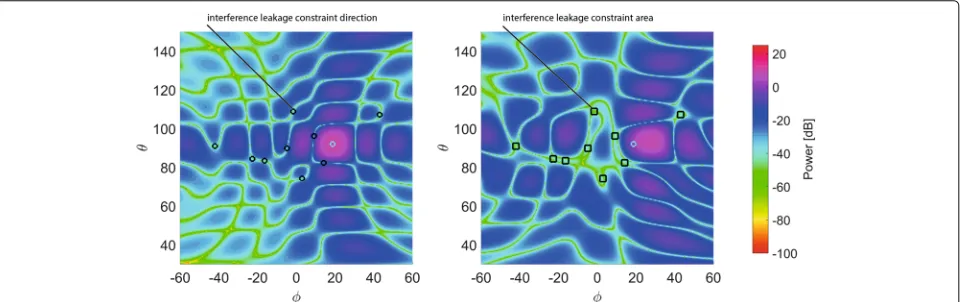
In this problem, the vectorat(ki,j)denotes the transmit antenna array response evaluated at angleki,j∈Tjk; here, the same antenna array response as in the CSI feedback dictionary (10) is used. Notice, we account for the angu-lar uncertainty only in the interference terms, but not in the signal term. This is because the system reacts much more sensitive w.r.t uncertainty in the interference direc-tions as compared to the signal direction, since nulls in the beamforming pattern are commonly very narrow whereas peaks are comparatively broad in the angular domain (see also the example in Fig.2). Another reason for neglecting uncertainty in the angular direction of the intended sig-nal is to keep the problem convex.3Problem (P4) can be brought into the form of a second-order cone program, similar to Problem (P3).
4.2 Leakage-bounded angular precoding
In this section, we extend the robust beamformer design to multi-user precoding with multiple streams per user.
Fig. 2Radiation beam pattern obtained with non-robust leakage-bounded angular beamforming (left) and with robust leakage-bounded angular beamforming (right). The nine angular uncertainty regions of robust leakage-bounded angular beamforming have a width ofψmax= ±1.6◦in this
When considering multi-stream precoding, it is not suf-ficient to maximize the sum received power over all Lu
streams of userubecause this will generally lead to a rank one beamforming solution that steers all signal energy over the largest singular value of the channel. Hence, to obtain a multi-stream precoding solution of rankLu, we
have to consider the achievable rate of a user in terms of the mutual information. With the available CSIT, however, we can only obtain a coarse estimate of the achievable rate as detailed below.
Let us start by considering the achievable rate of useru in terms of the mutual information:
Ru=Elog
where Ru and Ru,j denote the signal and interference
covariance matrices, respectively. We consider individual optimization of the achievable rate of each user w.r.t. its precoder, putting additional interference constraints on the signal leakage caused to the other users. This means that we do not attempt to jointly optimize the sum rate of all users; notice, though, that for single-stream beam-forming, it has been shown in [62, 63] that such an approach can still achieve the maximal sum-rate, provided the leakage constraints are appropriately selected. When optimizingRuw.r.t.Fu, we can then focus on
since the remaining terms are independent ofFu. Because
the CSIT contains no information about the channel estimation error in (8) and the channel decomposition error in (9), the transmitter can only calculate approxima-tionsRˆu andRˆu,jof the covariance matrices utilizing the
angular-domain CSI feedback; this gives a corresponding approximationRˆ˜u ofR˜u. In the Appendix, we derive the
denotes the transmit covariance matrix associated to useru.
We now utilize this upper bound to formulate the opti-mization problem for the non-robust leakage-bounded angular precoder: sents an SDR of the optimization w.r.t. the precoderFu ∈
CNt×Lu. In general, the optimal solutionC(opt)
u of (P5) is
not guaranteed to be of rankLu. Due to the definition of
2
uandUuin (36), rankC(opt)u ≤S. This is because a
solu-tion of rank greater thanSwould steer part of the transmit energy into the null space ofUu, which cannot maximize
our objective function. The restriction rankC(opt)u ≤ S
also implies that we have to feed back at least as many specular components S as the number of data streams Lu to make sure that the solutionC(opt)u can potentially
support the transmission of Lu streams. Still, even with S ≥ Lu, it can happen that the optimal solution C(opt)u
has rankC(opt)u < Lu; this is likely to be the case at low
signal-to-noise ratio SNR where the transmission of less thanLustreams can provide an advantageous
beamform-ing gain. If rankC(opt)u < Lu, we simply transmit less
thanLu streams over the eigenvectors corresponding to
the non-zero eigenvalues of C(opt)u , since this maximizes
our objective function. If rankC(opt)u > Lu, we apply
Gaussian randomization to derive a feasible precoder of rank Lu, by appropriately modifying the randomization
approaches described in more detail in [56,64]. Notice, though, if we setS =Lu, i.e., we feed back as many
spec-ular components as the number of data streams, then the rank ofC(opt)u is upper bounded byLuand we therefore do
not have to apply randomization at all. Thus, by setting S=Lu, we can guarantee that the SDR provides a globally
optimal solution for the precoderFu.
Similar to (P4), we can also implement arobust leakage-bounded angular precoderby accounting for the angular uncertainty regionsTjk:
max adding an extra optimization variablepu ∈ Rand
being greater than or equal topu. However, such a
deter-minant constraint is substantially more complex than the corresponding linear constraint in (P3). Hence, we con-sider in our simulations in Section 6.3 also as an alter-native to determinant optimization a simple per stream optimization: we apply (P3) or (P4) Lu times to obtain
beamformers that maximize the received power over the Lu strongest specular components and we concatenate
these beamformers to obtain theLudimensional
precod-ing matrix.
In our derivation, we assumed that the precoders of the other |S| − 1 users are unknown when calculating the precoder of useru. Yet, in principle when optimizing the u-th user, the base station could already utilize the knowl-edge of the precoders calculated for thoseu−1 users that have been optimized before. Similarly, an alternating opti-mization of precoders with a proper termination criterion could be applied to obtain an iterative approach that might provide better performance. For complexity reasons, how-ever, we have not implemented such an approach in our simulations.
4.3 Implementation issues 4.3.1 Computational complexity
Our derivation in Section4.1shows that leakage-bounded transmit optimization as proposed in (P1) is in gen-eral an NP-hard quadratically constrained quadratic opti-mization problem, which cannot be solved efficiently. Approximate solution by means of an SDR is a convex optimization problem, which can be solved efficiently; yet, it is still computationally demanding, since the opti-mization variable of the SDR is of dimension Nt × Nt
and hence grows quadratically with the size of the FD-MIMO antenna array. This complexity issue is relaxed by problem (P2) and its convex second-order cone pro-gramming reformulation (P3), in which the dimension of the optimization variablefu grows only linearly with the
size of the FD-MIMO antenna array. Since (P3) is a con-vex problem, it can be solved in polynomial time, e.g., by means of an interior point method; more details on solving second-order cone programs can for example be found in [65]. In problem (P4), we extend the number of constraints of our optimization problem by accounting for the angular uncertainty regions; this directly impacts the computational complexity of the problem. However, since the worst-case complexity of a second-order cone program scales with the square root of the number of constraints [60,61], the increase in complexity is moder-ate. Considering the two multi-stream optimization prob-lems (P5) and (P6), they both admit solution by means of an interior point method or a Newton conjugate-gradient approach as proposed in [66]. However, as our computer experiments have shown, this approach can be computa-tionally demanding and slow. Therefore, the per-stream
optimization approach proposed in Section 4.2 appears practically more relevant, since its complexity only grows linearly with the number of data streams per user.
4.3.2 Combination with hybrid architectures
As mentioned in the introduction of this paper, much research work on FD-MIMO systems is currently devoted to reducing system complexity through so-called hybrid architectures, which divide the precoding operation into an analog RF domain part and a digital base band pro-cessing part. The RF domain precoder thereby reduces the dimension of the effective base band channel, i.e., the product of channel matrix and RF domain precoder, which simplifies channel estimation, alleviates the CSI feedback overhead burden, and reduces the number of RF chains required. The RF domain precoder optimization is commonly required to provide a precoder solution with unit modulus matrix entries, to enable implementation with simple phase-shifter elements, and to be constant over the entire system bandwidth, to facilitate applica-tion in the analog domain. Both these constraints are not fulfilled by the leakage-bounded precoding optimiza-tion problem proposed in this paper. Nevertheless, we consider an extension of our leakage-bounded precoding optimization to hybrid architectures as promising future work.
Specifically, our leakage-bounded angular beamform-ing approach might be well suited for the design of the RF domain precoder, by applying the per stream opti-mization mentioned in Section 4.2 for each user more than Lu times in order to obtain a precoder of
dimen-sion equal to the number of available RF chains. However, the corresponding optimization problem (P3) or (P4) will in general not output a unit-modulus solution. It is well-known that the unit modulus precoder constraint of RF precoding is a non-convex constraint. A common solu-tion to deal with this issue is to relax the constraint in the precoder optimization and to orthogonally project the resulting solution onto the set of unit modulus matrices [14]; this approach can also be applied to our problem at hand. Notice also, by spending twice the amount of phase-shifters it is actually possible to avoid the unit-modulus constraint all together [67].
A second issue that needs to be addressed is that the channel decomposition (11) is frequency selective due to the multipath delay spread introduced by the chan-nel, which implies that the precoder also needs to be frequency selective and can thus not be implemented in the analog domain. However, in LOS situations, the fre-quency selectivity is not very distinct and can potentially be neglected for the cost of a slight frequency-dependent mismatch of the decomposition.
approach that is designed for the effective base band chan-nel, similar to the hybrid BD precoding scheme described in Section5.2below.
5 Benchmark methods
In this section, we summarize several well-known beam-forming and precoding techniques that we employ as benchmarks for our proposed methods. We provide this section as a reference for the interested reader as well as to clarify how these benchmark methods are applied in our considered setup. Additionally, we propose in Section5.2.4a modification of the popular signal to leak-age and noise ratio SLNR metric to enable its application with the angular-domain CSI feedback proposed in this paper.
5.1 Interference-unaware beamsteering
The following methods do not explicitly account for multi-user interference in the beamformer design. This methods are pure angle-of-departure-based beamsteering techniques, which can be viewed as typical SDMA imple-mentations. As is well known, the performance of SDMA strongly depends on the selection of co-scheduled users [68], i.e., the transmitter should co-schedule users that experience close to orthogonal channels to avoid extensive multi-user interference. In our simulations in Section6.2, we avoid the impact of imperfect user scheduling by employing an exhaustive search over all possibilities of co-scheduled users.
5.1.1 Max-gain beamsteering
The simplest beamforming/precoding technique is to steer the transmit signal along theLu strongest angular
directions provided by the CSI feedback:
Fu=
1
√ |S|
˜ Fu F˜u
, (26)
˜ Fu=
(d1u)∗,. . .,(dLu u )∗
. (27)
This technique does provide large signal gain; yet, its major weakness is that it does not account for interference among users. Hence, it only works properly if the base sta-tion serves users that are a priori well separated in the angular domain.
5.1.2 Chebyshev-tapered beamsteering
Max-gain beamsteering, as considered above, in general, produces large side lobe levels and thus potentially strong inter-user interference. Such large side lobe levels can be reduced by array weight tapering methods [69]. A pop-ular weighting technique is Chebyshev weighting, which achieves the smallest main lobe width for a given side lobe level [70].
In order to steer the main lobe in an intended direc-tion, array tapering is combined with the beamsteering approach of the previous section; i.e., the actual beam-former is obtained as the product of the array taper and the max-gain beamsteering vectors.
5.2 Interference-aware precoding
The following methods take multi-user interference into account and attempt to mitigate it.
5.2.1 Block-diagonalization precoding
BD precoding enables inter-user interference-free trans-mission of a total number of at most Nt data streams
[29]. This is achieved by steering the transmit signal of a user into the null-space of the channel matrices of all other users. In our simulations in Section 6, we do not employ BD precoding in combination with our CSI feed-back methods, but we rather assume perfect knowledge ofHuor its estimateHˆu. We do this since BD precoding
requires phase information which is not provided by our CSI feedback; see, e.g., [33], for an efficient CSI feedback method that can be applied with BD precoding.
5.2.2 Angle of departure block-diagonalization precoding
BD precoding is very sensitive to CSI imperfections since it relies on destructive multipath interference to elimi-nate multi-user interference [71–73]. It also has heavy CSI requirements as it requires knowledge of the entire channel matrix Hu of each user. To reduce the CSI
requirements, the authors of [74] propose to calculate the precoder not for the entire channel matrix Hu but
rather only for the dominant propagation paths between transmitter and receiver. Specifically, the authors of [74] consider single stream transmission per user and propose to calculate the corresponding ZF beamformer for the sin-gle strongest multipath component of each co-scheduled user. Rather than decomposing the frequency response channel matrix as we do in the present paper, the authors of [74] directly consider the time domain channel impulse response (4) and select the strongest multipath compo-nent according to the magnitude ofα; the multi-user ZF beamformer is then calculated from the corresponding transmit antenna array response vectorsat(t,,u). This can be extended to multi-stream transmission per user by means of BD precoding in a straightforward way, by calcu-lating the BD precoder from theLutransmit antenna array
response vectors corresponding to the angles of departure of theLustrongest multipath components.
5.2.3 Hybrid block-diagonalization precoding
loss compared to regular BD precoding in case of perfect CSI. To reduce this performance gap, while still keeping CSI requirements at a reasonable level, the authors of [74] propose hybrid BD precoding. Here, the hybrid precod-ing principle is applied to first reduce the dimension of the effective base band channel matrix of each user, by employing a RF domain precoder. This RF domain pre-coderFRF ∈ CNt×
u∈S[n]Lu is obtained as the matched
filter to theLu strongest multipath components of each
scheduled user. The base band BD precoder is then cal-culated for the product of channel matrix and RF domain precoder, which is called the effective base band channel. CSI requirements for estimating this effective base band channel are reduced compared to the full channel matrix, since the dimension of the effective channel matrix is smaller.
5.2.4 Incoherent SLNR precoding
SLNR beamforming is a popular coherent beamforming technique for multi-user broadcast and interference chan-nels [75]. If full CSI is available at the base station, that is the full channel matrixHu is known for each useru,
the SLNR beamformer is obtained by maximizing a corre-sponding Rayleigh quotient. If we apply the CSI feedback of Section3, however, the transmitter only has knowledge of the channel decomposition expansion vectors dsu and the norm of their corresponding expansion coefficients csu. Hence, the transmitter does not know whether the multipath transmissions over the different specular com-ponentsdsuadd up constructively or destructively, since it has no phase information available. We therefore modify the SLNR metric to consider the incoherent ratio of sig-nal and leakage powers, utilizing the delayed angular CSI available at the transmitter:
If we restrict to semi-unitary precoding with equal power allocation, such thatFHuFu = Lu1|S|ILu, we can pull
the precoder in the denominator of (28) left and right out of the sum, taking into account that tr(FHuFu) = 1/|S|. This leads to a generalized Rayleigh quotient that is maximized by the following semi-unitary precoder:
Fu=
where the operator max eig vecLu calculates the Lu
orthonormal eigenvectors corresponding to the largest eigenvalues.
6 Simulations
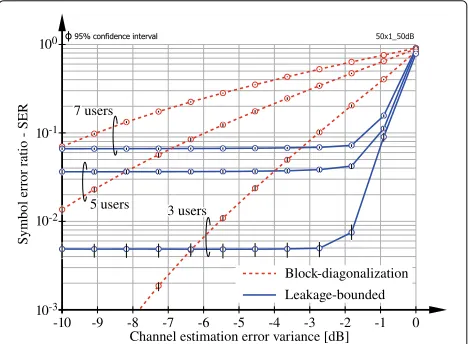
In this section, we evaluate the performance of the pro-posed beamforming and precoding methods by means of numerical simulations. We first provide in Section6.1 an example of the radiation beam pattern obtained by leakage-bounded angular beamforming with and with-out robustness constraints. This facilitates the develop-ment of a basic understanding of the behavior of the beamforming solutions produced by the proposed opti-mization problem, specifically with respect to the influ-ence of the robustness constraints. In Section 6.2, we compare the achievable transmission rate of the pro-posed leakage-bounded angular beamforming methods to the classical interference-unaware beamsteering methods summarized in Section5.1. In these simulations we con-sider a simple Rician-fading channel model, which allows to easily control the compressibility of the CSI in the angular domain via the Rician K-factor. In Section 6.3, we then utilize the more realistic QUADRIGA channel model [76] to compare the proposed leakage-bounded angular precoding methods to the interference-aware pre-coding methods summarized in Section5.24. We first of all evaluate the compressibility of the channel realizations obtained from QUADRIGAin the angular domain. Based on these results, we then investigate the performance of the different precoding methods in terms of the achiev-able transmission rate. We furthermore simulate the SER of uncoded transmission as a function of the variance of the channel estimation errorσe2in (8), demonstrating the robustness of the proposed leakage-bounded beam-former. To find solutions to the proposed optimization problems, we apply CVX [77].
6.1 Radiation beam pattern
In our first example, we illustrate the radiation beam pattern obtained by leakage-bounded angular beamform-ing with and without robustness constraints. We con-sider single-stream beamforming and assume a UPA of isotropic antenna elements at the transmitter of sizeNt= Nh · Nv = 11· 11 = 121. We assume that U = 10
an angular uncertainty region of widthψmax = ±1.6◦in azimuth and elevation around each specular component. This uncertainty represents, for example, LOS transmis-sion to users that move on a radius of distanced =50 m from the base station with v = 100 km/h when high-resolution CSI feedback is provided every τ = 50 ms (ψmax= vdτ).
In Fig. 2, we compare the radiation beam patterns of robust and non-robust leakage-bounded angular beam-forming for a user that is located at approximately(φ,θ)=
(22◦, 95◦)(indicated with the green circle) and nine leak-age areas corresponding to the otherU−1 users (indicated in black). In this example, we set the maximum tolera-ble interference level to Lmax = −40 dB relative to the unit transmit power. In Fig.2(left), we observe that the radiation pattern of non-robust leakage-bounded angu-lar beamforming shows very narrow valleys wherever interference leakage constraints are active. Therefore, the transmission to the intended user does not cause substan-tial interference to the other users, provided the angular CSIT is accurate. However, due to the narrow width of the valleys at the interference leakage constraints, the resid-ual inter-user inference grows significantly if the angular CSIT is not accurate. To compensate for such angular uncertainty, we consider interference leakage uncertainty regions of width ψmax in the robust leakage-bounded angular beamformer. As shown in Fig.2(right), the inter-ference leakage is then low over the entire uncertainty regions, thus improving the robustness with respect to imperfect angular CSIT. However, the maximum achiev-able gain of the intended user is slightly reduced, since it is not possible any more to perfectly steer the signal power towards the intended user while still satisfying all leakage constraints. Therefore, there exists a trade-off between the achievable signal gain of the intended user and the robustness of the interference leakage constraints.
6.2 Comparison to interference-unaware beamsteering
In our second example, we investigate multi-user beam-forming with a single stream per user, comparing the interference-unaware angle of departure-based SDMA beamsteering methods of Section5.1and our robust/non-robust leakage-bounded angular beamformers. We con-sider users with a single receive antennaNr = 1 and a
transmitter with a UPA of sizeNt = Nh·Nv = 11·11.
We employ a Rician-fading channel model to generate the channel vectorhu∈C1×Ntaccording to:
hu=
K K+1e
jβuaUPA
t (φu,θu)T+
1
K+1hu,d, (31) with βu ∼ U(−π,π) denoting a random phase-shift,
φu ∼ U(−60◦, 60◦)andθu ∼ U(70◦, 110◦)representing the LOS directions, andhu,d ∼ CN(0,I)being a diffuse
background scattering component. The Rician K-factor
controls the relative strength of the LOS component. We do not utilize OMP in this example to decompose the channel vector, but we rather assume that the receivers employ a dictionary that is matched to the UPA and that the receivers are able to estimate the LOS angles with an accuracy of±2◦. Hence, the CSIT utilized for beamform-ing isaUPAt (φuˆ ,θu)ˆ with φuˆ ∼ U(φu−2◦,φu+2◦) and
ˆ
θu ∼ U(θu−2◦,θu+2◦) corresponding to a dictionary with 4◦ angular resolution. In our simulations, we con-sider a total number ofU = 10 users; out of these ten users we select the best subsetS ⊆ {1,. . .,U} of users through exhaustive search with varying size|S| ∈[ 1,U] to avoid an impact of imperfect user scheduling. We set the noise variance equal toσ2
n,u = 10−3. For
Chebyshev-tapered beamsteering, we set the side-lobe level equal to the maximum of noise power and residual interference caused by the diffuse component:
SLLu=
1
|S| −1max
σ2
n,u,
1 K+1
, (32)
such that the multi-user interference caused by the side-lobes is in the order of the maximum of diffuse back-ground interference and noise power.
In Fig. 3, we show the achievable rate performance of the interference-unaware beamsteering methods and our robust/non-robust leakage-bounded angular beam-formers for varying K-factors. The performance of the interference-unaware beamsteering methods (max. gain and Cheb. tapered beamsteering) is plotted for the case of perfect angular CSIT; however, their performance with imperfect CSIT of accuracy ±2◦ is virtually the same. The performance of leakage-bounded beamforming is shown for perfect angular CSIT as well as for imperfect angular CSIT with robust/non-robust interference leak-age constraints. We observe that our leakleak-age-bounded beamforming method can achieve better performance and can serve more users in parallel than the interference-unaware beamsteering schemes (max. gain and Cheb. tapered beamsteering). With decreasing RicianK-factor (left to right) the performance deteriorates since the resid-ual interference over the diffuse background scattering component is not mitigated by our beamformer optimiza-tion. Still, even with the relatively low value ofK=10 our proposed method outperforms the interference-unaware beamsteering schemes. We furthermore observe in Fig.3 that the performance loss due to imperfect angular CSIT can partly be compensated with our robust beamforming method as compared to the non-robust approach.
6.3 Comparison to interference-aware precoding
Fig. 3Comparison of the achievable sum rate of different single-stream beamforming methods with varyingKfactor.aAchievable sum rate with
K=103.bAchievable sum rate withK=102.cAchievable sum rate withK=10
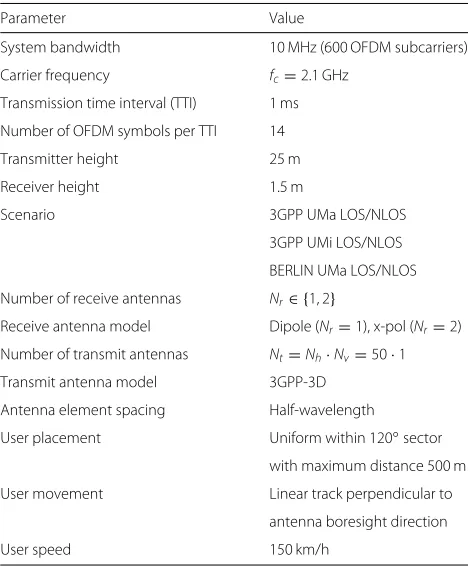
been selected to be LTE standard compliant. We consider users that are uniformly distributed within a sector of 120◦with a maximum distance of 500 m from the trans-mitter and we assume that the users move perpendicular to the transmit antenna array bore-sight direction with 150 km/h. For such user placement, the variation of the elevation angle is in most cases very small and we there-fore consider beamforming only in the azimuth domain utilizing a high-resolution horizontal uniform linear array (ULA) of 50 antenna elements. In our simulations, we do not consider macroscopic pathloss even though it
Table 1Simulation parameters employed to setup the QUADRIGAchannel model
Parameter Value
System bandwidth 10 MHz (600 OFDM subcarriers) Carrier frequency fc=2.1 GHz
Transmission time interval (TTI) 1 ms Number of OFDM symbols per TTI 14 Transmitter height 25 m Receiver height 1.5 m
Scenario 3GPP UMa LOS/NLOS 3GPP UMi LOS/NLOS BERLIN UMa LOS/NLOS Number of receive antennas Nr∈ {1, 2}
Receive antenna model Dipole (Nr=1), x-pol (Nr=2) Number of transmit antennas Nt=Nh·Nv=50·1 Transmit antenna model 3GPP-3D
Antenna element spacing Half-wavelength User placement Uniform within 120◦sector
with maximum distance 500 m User movement Linear track perpendicular to
antenna boresight direction User speed 150 km/h
is considered in the output of the QUADRIGA chan-nel model. We therefore normalize the chanchan-nel matrices obtained from the QUADRIGA channel model to satisfy
EHu[n]2=NrNt. We apply this normalization since
we do not consider multi-user scheduling in this section, which would be necessary in case of strong received sig-nal power disparities of different users. We employ a dictionary/quantization codebook that is matched to the horizontal ULA and we consider an azimuthal angular resolution for CSI quantization of 1◦6. We consider a block-fading channel model with constant channel during each transmission time interval (TTI).
In our first simulation of this section, we investigate the compressibility of the per-subcarrier channel matrices Hu[n] in the angular domain. That is, we apply the OMP
algorithm to decompose Hu[n] in the angular domain
using a dictionary that is matched to the employed ULA and we determine the average norm of the expansion coefficient vectors csu[n]2 of the decomposition. The corresponding results are shown in Fig.4for different sim-ulation scenarios as specified in the QUADRIGAchannel model. We observe that in the LOS situations, the first expansion coefficient contains the majority of the channel energy, especially in the 3GPP compliant scenarios; this expansion coefficient corresponds to the LOS direction. The second largest coefficient lies already approximately an order of magnitude below the first coefficient. In the non-line of sight (NLOS) scenarios, however, the chan-nel energy distributes more equally over many expansion coefficients. Correspondingly, compressibility with the employed dictionary is worse. In the remaining simula-tions we therefore consider LOS transmission and employ the 3GPP compliant UMa scenario. We also conducted simulations in NLOS situations, where our proposed method however does not achieve a significant gain over the interference-aware benchmark precoders.
Fig. 4Angular-domain compressibility of the channel matrices obtained with the QUADRIGAchannel model. Blue: 3GPP UMa; green: 3GPP UMi; red: BERLIN UMa
precoding method. We consider transmission toU = 5 users in parallel withLu = 2 streams per user; hence, the
total number of spatially multiplexed data streams is ten. We have seen above that in the LOS scenario most chan-nel energy is contained in a single specular component. To efficiently support transmission of two spatial streams per user, we therefore employ a distributed antenna sys-tem (DAS) composed of two remote radio heads (RRHs) that are separated by 25 m. Each RRH radiates the same transmit signal; that is, the radio heads are fed with the same RF signal, e.g., via radio-over-fiber connections. Correspondingly, the two RRHs do not appear as inde-pendently steerable antenna arrays since they are fed with the same transmit signal; hence, the effective number of actively steerable transmit antennas (and thus the size of the channel matrix that must be estimated) is stillNt =
50. In that way, we guarantee that each user observes two strong specular components of approximately equal strength corresponding to the two antenna arrays of the RRHs.
We assume that the receivers estimate and feed back the CSI only at the first TTI, to enable calculation of the precoders; these precoder are then utilized for the entire transmission duration of 150 TTIs. For BD precoding and hybrid BD precoding, we assume perfect unquantized CSIT of the (effective) base band channel at the first TTI. For angle of departure BD precoding, we assume perfect knowledge of the LOS angles w.r.t. the two RRHs and hence perfect knowledge of the corresponding transmit antenna array response vectors. For the other schemes, we utilize our OMP-based channel decomposition to deter-mine theS = 2 strongest specular components, in order to facilitate transmission of two spatial streams. We have observed that the performance does not improve if we
consider S > Lu expansion coefficients; when S is too
large, the performance rather deteriorates since too many interference leakage constraints are active. For BD precod-ing and its hybrid variant, we assume perfect base band CSIT on each of the 600 subcarriers within the first TTI. For angular BD precoding, only broadband feedback of the angles of departure of the strongest multipath com-ponents needs to be provided, since this CSI is obtained from the time domain channel impulse response; notice, though, that this either requires estimation of the time domain channel impulse response or direction estima-tion of the dominant angles from uplink training signals [74]. For the remaining schemes, we consider a CSI feed-back resolution of 60 subcarriers, i.e., theS=2 strongest specular components are provided for every 60th subcar-rier. Therefore, to estimate the full channel matrix at the receiver for CSI feedback calculation, we require a total of 600/60·Nt = 500 orthogonal pilot-symbols within the
first TTI, amounting to an overhead of 500/(14·600) ≈ 6 % within the first TTI. However, since we provide CSI feedback only every 150th TTI the pilot overhead for CSI feedback calculation is negligible.
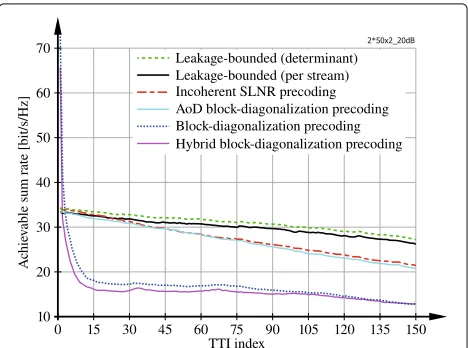
For our robust leakage-bounded precoders, we deter-mine the size of the angular uncertainty regions to match the uncertainty of the LOS direction caused by the user movement. To avoid unnecessarily large uncertainty regions, we recalculate the robust leakage-bounded pre-coders every 25 TTIs with correspondingly increasing angular uncertainty regions. Notice, in this recalculation, only the size of the uncertainty regions is updated and not the angular CSIT itself; it does therefore not require renewed CSI feedback from the users. In Fig.5, we show the achievable rate performance of the considered pre-coding schemes. We observe that regular BD prepre-coding as well as hybrid BD precoding achieve very high data