R E S E A R C H
Open Access
Sum rate maximization via joint scheduling
and link adaptation for interference-coupled
wireless systems
Eduardo D Castañeda
1,2*, Ramiro Samano-Robles
2and Atílio Gameiro
1,2Abstract
The work presented in this paper addresses the sum rate maximization problem for the downlink of a wireless network where multiple transmitter-receiver links share the same medium and thus potentially interfere with each other. The solution of this problem requires the optimization of two aspects: the first one is the set of links that can be jointly scheduled, and the second is the set modulation and coding schemes (MCSs) that maximize the sum rate. A feasible link achieves a certain MCS if its signal-to-interference-plus-noise ratio (SINR) is above a threshold or target SINR associated with the MCS and the SINR of each link is coupled with the other links’ powers that are required to achieve their respective MCSs. Since the available MCSs form a finite set, the rate maximization problem has a combinatorial nature. We present iterative algorithms that find a suboptimal solution to the combinatorial problem by operating in two phases. Phase one verifies the feasibility of the MCS assignment by performing either eigenvalue analysis or power consumption analysis, and phase two uses the feasibility information delivered by phase one to modify either the set of links (user removal) or the MCS assignment if feasibility conditions are not fulfilled. Our approach extends the concept of user removal to the case of adaptive modulation, and this generalization allows us to schedule users more efficiently, improving outage probability figures. Numerical results show that the proposed algorithms achieved a good tradeoff between sum rate performance and complexity. Moreover, our algorithms are a low complex alternative to the state-of-the-art user-removal algorithms with minimum gap in outage performance.
Keywords: Scheduling; Power control; Link adaptation; Resource allocation; User removal; Sum rate maximization
1 Introduction
The efficient resource allocation in wireless networks is fundamental to fulfill several practical quality of ser-vice (QoS) measures like data rate and outage probabil-ity. The number of wireless users and data services has increased dramatically over the last few years, and opti-mization of the resource allocation has become primal to guarantee both user and operator satisfaction without increasing system requirements, mainly bandwidth and power budget. Moreover, there are scenarios where the set of transmitter-receiver pairs (links) operate simulta-neously in a shared medium, and interference mitigation
*Correspondence: [email protected]
1Department of Electronics, Telecommunications and Informatics, Aveiro University, Campus Universitário, Aveiro 3810-193, Portugal
2Instituto de Telecomunicações, Campus Universitário, Aveiro 3810-193, Portugal
techniques must be employed. The QoS is measured in practice by the signal-to-interference-plus-noise ratio (SINR) and recent works on resource allocation optimiza-tion for interference-coupled networks [1-8] show the relation between the SINR maximization and the effi-cient power and rate allocation. Since the achievable data rate depends on the SINR which is a global function of all transmit powers, the schemes of power control are fundamental to maximize either a global network utility [1,6-8] or individual rates [2,3,9] in networks where inter-ference is the main limitation and cannot be completely eliminated.
In interference-coupled networks, the successful
scheduling of a set of interfering links is conditioned to the fulfillment of all individual QoS requirements and power constraints. An efficient scheduling policy must
determine the proper set of links for which there exists a power and rate allocation that meets power constraints and SINR requirements. However, finding the set of links that maximizes a given network metric is a combinatorial problem which has been claimed to be NP-complete [10]. A suboptimal solution to this problem is found in the so called user-removal techniques [10-12] where the users that violate the power constraints or QoS requirements are found iteratively and temporarily dropped.
The works related to resource allocation optimization and the ones of user removal have different objectives, and both fields remain isolated. The former assumes that for a given set of links, there exists an infinite number of solutions to the resource allocation problem, and the main objective is to find the allocation that maximizes a specific utility function such as sum rate and power consump-tion. The latter is concerned about the set of links that can be scheduled whose QoS requirements are fixed and the resource allocation can be achieved by conventional allocation schemes. There is a number of open issues that must be solved in interference-coupled networks, and the objective of this work is to provide a solution to the scheduling problem and simultaneously maximize the total sum rate by performing efficient resource alloca-tion. Moreover, unlike the available literature, we consider that the values of the SINR are constrained to take values from a finite set of thresholds or targets associated with a given set of modulation and coding schemes (MCSs). By considering the different MCSs, we extend the phi-losophy of user removal for the case of non-fixed SINR targets, and at the same time, we provide a methodology to find the MCS allocation that maximizes the total sum rate.
1.1 Related works
Over the last 20 years, several theoretical [3,5,11,13-16] and practical [2,6,12,17] works have been developed to understand and solve the problems of power allocation and utility maximization for cellular, multihop, peer-to-peer, and digital subscriber line (DSL) networks. Early works on power control [13,17-20] designed iterative algo-rithms under the standard interference function frame-work [3,13] in order to guarantee the convergence of the algorithms to a unique and optimal power alloca-tion solualloca-tion. These works assume that the set of given links is always feasible, i.e., for such a set, there always exists a solution to the power allocation problem. More recent works [3,6,14] studied the relationship between the rate allocation and power control, specially for the high SINR regime. This is a common assumption because for interference-coupled systems, the mathematical model-ing of the resource allocation problem in more tractable [5] and efficient iterative algorithms can be developed. For instance, in [14], the power control problem for rate
maximization is formulated as a convex problem and its solution is found via geometric programming (GP) for wireless networks.
Related works for interference-coupled wired (DSL) net-works [7,8,21] show that suboptimal yet efficient power allocation for rate maximization can be achieved when the non-convex rate maximization problem is approximated by alternative convex objective functions of the transmit powers. In [8], the authors show that relaxed forms of the objective function of the rate maximization problem lead to the convergence of the proposed algorithms, and the accuracy of such approximation depends on the convexity properties of the objective functions. In [21], the weighted sum rate maximization problem was extended to the mul-tiuser multicarrier scenario in interference-coupled sys-tems. The idea behind the algorithms presented in [7,21] is to solve iteratively the original resource allocation prob-lem by optimally solving in each iteration a relaxed version of the original problem. In each iteration, the local opti-mal solution bounds the solution of the original problem for a given resource allocation, and due to the proper-ties of the relaxed objective function, the convergence to a local optimum is guaranteed. This is known as succes-sive convex approximation (SCA) whose goal is to refine the solution found for the relaxed problem in order to close the gap between the approximated and the optimum resource allocation. A framework to solve general opti-mization problems under SCA and a comprehensive anal-ysis of state-of-the-art dynamic spectrum management algorithms is presented in [16]. The work in [21] solved the power spectrum management problem, implement-ing a SCA algorithm that exploits the characteristics of the feasible region of resource allocation solutions, and in each iteration, GP is used to solved the local power assign-ment problem. The works of Tan et al. [1] and Stanczak et al. [5] presented algorithms that solve optimally the joint power and rate allocation problem by exploiting the convex characteristics of the feasible rate region and gen-eralized the resource allocation problem for both high and low SINR regimes.
objective is to find the optimum allocation that maximizes a given utility function under a set of power constraints and transmission schemes. The user-removal techniques [11] exploit the Perron-Frobenius theory to identify the infeasibility of a set of links in scenarios where, for a given set of power constraints and rate (SINR) requirements, the classical power control algorithms (e.g., [17]) do not converge.
1.2 Contributions
The joint scheduling and resource allocation that maxi-mize the sum rate is a complex combinatorial problem that grows exponentially with the number of links and depends strongly on the number of available MCSs. The optimal solution of such a combinatorial problem can be found via exhaustive search by selecting the set of links and MCSs that yield the maximum sum rate. Such an algo-rithm has prohibitive complexity; therefore, we propose suboptimal algorithms that solve the combinatorial prob-lem efficiently and achieve a tradeoff between sum rate performance and complexity. Our algorithms merge the objectives of the resource allocation optimization and the user-removal techniques. This integration is achieved by operating over two dimensions of decision, the set of links and the set of available MCSs. Conceptually, the proposed algorithms work in two phases. The first phase establishes that for a given set of links, there exists a power and rate allocation that satisfies the SINR requirements imposed by some MCSs under a set of power constraints. In other words, this phase verifies if the set of links and their MCSs are feasible. The second phase modifies either the set of links or the MCSs, based on the feasibility measure provided by the first phase.
We show how this two iterative phases can be designed using the Perron-Frobenius theory by formulating the sum rate maximization problem as an eigenvalue opti-mization problem. Although, this approach achieves acceptable sum rate and outage figures, in each iteration it requires the computation of the eigenvalues that charac-terized the interference coupled network. For this reason, we design alternative solutions that only require either the evaluation of the power consumption or the estima-tion of the achievable SINR per iteraestima-tion. Furthermore, we introduce a low complexity algorithm that performs a fast estimation of the set of links and MCSs that solve the sum rate maximization problem. Numerical results show that despite the fact that the proposed algorithms are suboptimal strategies, they are asymptotically optimal when the number of users in the network grows to infin-ity. Moreover, we show that our algorithms generalize the concept of user removal for the case of multiple SINR targets and that the proposed schemes are efficient low-complex alternatives to the state-of-the-art user-removal algorithms.
1.3 Organization
The remainder of the paper is organized as follows. Section 2 presents the system model. Section 3 describes the link selection and resource allocation problem. Section 4 addresses the algorithms that find a solution for the joint resource allocation and scheduling problem. Section 5 shows numerical examples for the assessment of the presented algorithms using different performance metrics. The main conclusions are drawn in Section 6.
Some notational conventions are as follows: matrices and column vectors are set in boldface.(·)T, | · |, · p denote transpose, set cardinality, and thepnorm, respec-tively. AnM×NmatrixAis non-negative ifam,n≥0, for
allmandn, and writeA≥0. The termρ(A)denotes the Perron-Frobenius root (PF-root) which equals the largest modulus eigenvalue of matrix A [22,23]. I is the iden-tity matrix of compatible size; diag(x)denotes a diagonal matrix whose main diagonal isx.A[i]is theith principal
submatrix ofAwhoseith row and column are removed.
The same notation is applied for a vector whoseith ele-ment is removed. Letybe a vector, then yi =[y]i is the ith element. For two vectorsxandy,x ≥ yis a compo-nentwise inequality.R++is the set of strictly positive real numbers.
2 System model
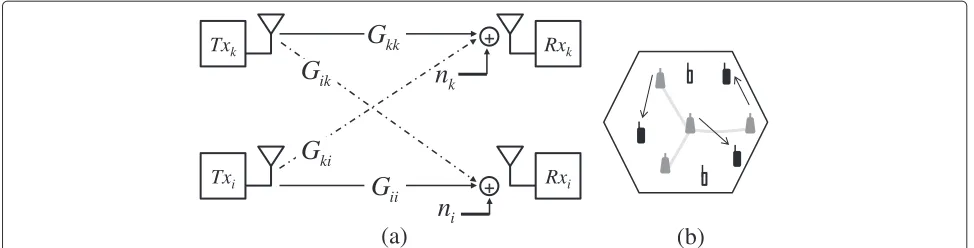
Consider the wireless network depicted in Figure 1a where the current channel instance is concurrently being used byK-synchronized links. The receivers decode its corre-sponding data, treating interference as white noise, and multiuser detection is not employed. In order to mathe-matically characterize the interference-coupled network, we adopt the matrix notation and the system model used in recent works [1,5]. Letpkbe the power used by thekth link andpthe vector that summarizes allKpowers. The SINR experienced by thekth link is [5]
SINRk(p)=
pkGkk
K
i=kpiGki+σk2
,
whereGkiis the power attenuation from the transmitter
on linkito the receiver on linkk, taking into account prop-agation loss and fast and slow fading, andGkkis the power
loss for the intended transmission at link k. The term σk2represents the additive white Gaussian noise (AWGN) power for thekth receiver.
Efficient allocation schemes seek the simultaneous pro-visioning of individual QoS for multiple wireless links, which implies that each link achieves a SINR that can be maintained above a given threshold or target:
SINRk(p)≥γk. (1)
(b)
Figure 1Wireless scenario.(a)General channel model for two wireless linkskandi.(b)Distributed antenna system scenario.
of available MCSs. A larger value of γk implies that link kattempts to maintain a more spectral efficient modula-tion scheme. Depending on the service,Mk can be used
to assign different priorities among users or to limit their achievable data rates. For instance, the rate demand in linkican be limited while linkkcan improve its perfor-mance, having a larger number of available modulations
|Mk| > |Mi|for somek = i. For the sake of
simplic-ity, we assume the sameMfor all links,Mk = M, ∀k.
Thekth link is associated with a modulation indexmkthat
defines the position of its SINR target in the set M so thatγk =γ(mk). The discrete set of targets is given by the available set of MCSs supported in the systems, which in practice is defined by the user equipment capabilities and the wireless network technology. The vector of SINR tar-gets is defined asγ = (γ1,. . .,γK)T, and all SINR targets
will be summarized in a diagonal matrix=diag(γ). The users’ requirements in (1) can be described in a vector inequality of the form
p≥Vp+z, (2)
whereVis aK×Knon-negative matrix whose entries are defined as
[V]ki=
Gki/Gkk ifk=i
0 ifk=i.
We assume thatVis irreducible, which means that each link has at least one interferer [3]. The weighted noise vectorzis defined as
z=
We consider two sets of power constraints: (a) individ-ual power constraints (IPC), summarized inp¯ so thatp¯k
is the maximum available power for thekth link, and (b) total power constraints (TPC) so thatKk=1pk ≤ Pt. For
the case of TPC, letBbe aK×Knon-negative irreducible matrix defined as [5]
The matrixBabsorbs the total power constraints as an additional source of interference whose power is inversely proportional to the powerPt. The properties ofBprovide
us insight into the transmission reliability and how inter-ference, powers, and SINR targets are coupled. For the case of IPC, there exists a set ofK matricesB, and each one absorbs a different individual power constraint [5,11].
3 Problem formulation
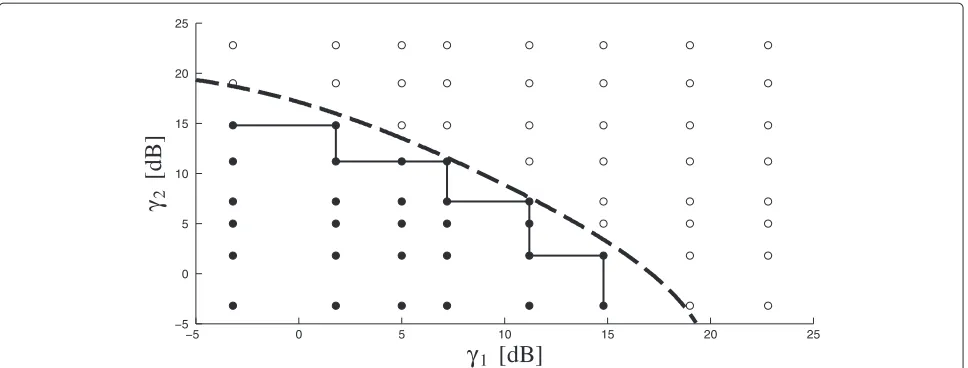
In resource allocation theory, one of the fundamental problems is to find the appropriate vector of targetsγ in order to optimize a given metric. The set of all attainable target vectors is called feasible SINR target region. The geometry of the feasible SINR target region (Figure 2) is defined by the coupling matrixV, the noisez, the avail-able SINR targetsγ defined by the MCSs, and the power constraints. Several works that provide a solution to the resource allocation problem exploit the characteristics of the feasible rate region which has a logarithmic relation with the feasible SINR targets. The optimum resource allocation that maximizes the system performance lies in the boundary of such feasible region [3,5,6]. The infor-mation provided by the geometry of the feasible rate region can be exploited to determine not only the optimal resource allocation but also if time-sharing is required. This means that if for the set of links that is attempted to be scheduled, it does not exist a power allocation that satisfies all links requirements, the set must be split off assigning different time slots to different subset of links [1]. The employment of time-sharing is given by the con-vexity of the rate region; however, such a geometry is not known a priori, and finding the best subsets of users that should use time-sharing is a combinatorial problem that grows exponentially with the number of links [1].
−5 0 5 10 15 20 25 −5
0 5 10 15 20 25
γ
2[d
B
]
γ
1[dB]
Figure 2Feasible target region.For certainV,z,M, andPt, this is an example of the boundaries for the SINR target region for two cases: γ ∈R++(dashed line) andγ∈M(solid line). The black circles (feasible vectors) represent the combinations ofγthat can be jointly achievable for a two-links channel realization. The white circles (unfeasible vectors) cannot be jointly achieved by any feasible power allocation.
Definition 2.Resource feasibility. We say that a power vectorpis feasible if for such a vector, the feasibility con-ditions are met. A set of targetsγ oris called feasible if all targets in the set can be jointly achieved by power con-trol. A set of links is called feasible if there exists at least one set of targets whose related powers meet the feasibility conditions.
The power allocation and the SINR target (MCS) selec-tion are two sides of the same problem, i.e., the feasibility of p is given by the feasibility of γ and vice versa. For each feasible target vector, there exists a feasible compo-nentwise power vector (unique up to a scaling factor) that produces such a target vector [1,3,5]. From (1) and (2), it can be observed that the power vectorpand the achiev-able SINRs depend on the targets. From power control theory [3,5,15] and Perron-Frobenius theory of positive matrices [22,23], it is known that for feasible targets in (1)
∀kthe corresponding power vector can be computed as
p=[I−V]−1z. (4)
Since the power resources are limited in the network, any feasible vectorpgiven by (4) must lie within a feasible region limited by a given set of constraints. Let us define the region of feasible powers considering IPC as
PIC:= {p∈RK
++:p ≤ ¯p}, (5)
and the region of feasible powers considering TPC as
PTC:= {p∈RK
++:p1≤Pt}, (6)
where K = |K| is the cardinality of the subset of links that can be jointly supported K ⊆ ¯K and K¯ is the set of all available links. We need to solve the following rate
maximization problem over the set of feasible linksK con-strained in the joint continuous power and discrete target regions:
Maximize
k∈K,K⊆ ¯K
R(SINRk(p)) (7)
subject to γk ∈M, ∀k∈K
p∈P,
whereR(SINR(p))is the achievable rate associated with
a given SINR and P can be given either by (5) or (6),
depending on the specific network requirements. As the elements ofγ can only take values from a finite setM, (7) is a combinatorial problem whose complexity depends on the size ofMand the number of elements inK¯.
4 Joint scheduling and resource allocation
Finding a solution to problem (7) requires the optimiza-tion over the set of feasible links that can transmit simul-taneously (user selection) and their respective feasible modulations (and their associated powers). An exhaustive search algorithm attempting to solve problem (7) would require to test all the combinations of links and target vectors. The associated search space K¯,M has a size of
(M+1)| ¯K|−1, where several configurations of links sets and target vectors are infeasible.
the power consumption or the achievable SINR so that the eigenvalue computations are avoided. The fundamen-tal concept behind the presented algorithms is to find in each iteration, the link k∗ or its associatedγk∗ andpk∗
that conditions the most the resource allocation feasibil-ity. The algorithms make decisions in two phases. In the first phase, the fulfillment of the feasibility conditions is verified. If the feasibility conditions are violated, the sec-ond phase is in charge of findingk∗ and modifying the set of active linksKor the target vectorγ based on the information thatk∗provides.
In the algorithms, we adopt the notation (k,K,
V,z,p,γ)to indicate a drop event of the linkk, and the consequent actions follow: K = K − {k}, V = V[k], γ = γ[k],z = z[k],p = p[k], andγi = γ(mi=M) ∀i ∈ K.
The vectorpˆ condenses a given set of constraints and is defined as
wherepis a power vector that distributes equally the total available power among all links, i.e.,pk =Pt/|K|,∀k∈K.
4.1 Perron-Frobenius root-based optimization
The feasible vector of targets that maximize the sum rate in (7) must be in the boundary of the feasible SINR tar-get region, and in order to characterize such region, a condition for feasibility of the targets is required. From the Perron-Frobenius theory [22,23], for a positive square matrixA, the PF-rootρ(A)and its associated right
eigen-vector xmeetAx ≤ x, if and only if ρ(A) ≤ 1. There
is a direct relation between this property and the math-ematical representation of the coupled targets in B. In our context, this means that the SINR targets are jointly achievable if and only if the following necessary and suf-ficient condition for feasibility is met ([5], Theorem 5.68 and Corollary 5.69):
ρ(B)≤1. (9)
Fulfilling condition (9) implies that interference in the system can be mitigated by power control, i.e., the SINR targets are feasible and (1) holds with equality. Further-more, the power allocation vectorpgiven by (4) equals the right eigenvector associated withρ(B)[5]. Let us consider the case of TPC where the feasible region of targets can be defined as follows:
QTC:= {γ
k =γ(mk)∈M,∀k∈K:ρ(B)≤1}. (10)
Figure 2 illustrates the feasible regionQTCwhich is the intersection of sublevel sets of the spectral radii of all non-negative irreducible matrices B [5] taking into account
TPC. The region QTC can be completely characterized
from its boundary since it is downward comprehensive
[5], which means that any γ on the boundary of QTC
defines a set of target vectors that are within the feasi-ble SINR target region. However, we are interested on the point inQTCthat maximizes the sum rate, which implies that the target vector that solves problem (7) must lie in the boundary ofQTC.
The maximization problem can be reformulated as a PF-root optimization over the matrixBsince the feasibility of the targets is given by condition (9). Assuming TPC, the original problem (7) can be rewritten as
Maximize
k∈K,K⊆ ¯K
R([γ]k) (11)
subject to γ ∈QTC,
where the constraint in (11) absorbs both constraints in (7). A similar reformulation of (7) applies when IPC (5) is considered [24].
In order to solve problem (11), it is required to iden-tify which link violates the most the feasible conditions. From the theory of irreducible matrices, it is known that if Ais an irreducible square matrix andA[k]is a proper principal submatrix ofA, thenρ(A[k]) < ρ(A)[22,23]. In the context of user removal [11], this property is funda-mental to determine the link that must be dropped since it relates the most infeasible link to the minimum PF-root over all principal submatrices ofB. In our context, the linkk∗that compromises the most the resource fea-sibility is the one whoseρ(B[k∗])is minimum. The fastest fulfillment of condition (9) is achieved whetherk∗is tem-porarily disconnected or its associatedγk∗ is relaxed so
that the PF-root of the matrixBis minimized.
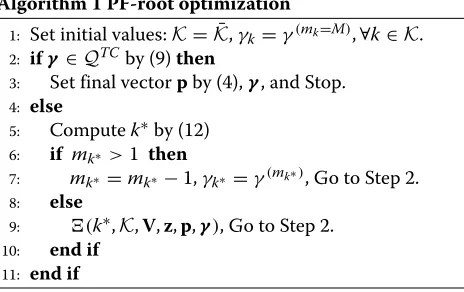
The algorithm starts by defining the initial conditions of the targets as γk = γ(mk=M), ∀k ∈ K which may or may not be a feasible starting point and is the maximum available target established by a given set M. The feasi-bility of the target vector is verified by the condition (9); ifγ ∈ QTC, then the algorithm stops, and all links inK transmit simultaneously with the powers defined by (4). If γ is infeasible, a relaxation of the SINR targets is required, and in the current iteration, the algorithm modifies only the component [γ]k∗, where the most infeasible linkk∗is
For the next iteration, the linkk∗reduces its target index by one unitmk∗=mk∗−1, and its new SINR target is set
must be reduced so thatK = K− {k∗}, and without the useless link, the algorithms attempt to allocate the max-imum target for the remaining users,mk = M,∀k ∈ K. The steps performed to solve problem (11) are given in Algorithm 1.
The maximum number of iterations required for Algorithm 1 to stop is upper-bounded by(| ¯iK=|1((M−
4.2 Power consumption and target-to-SINR ratio-based optimization
In order to solve problem (7) using the tools provided by the Perron-Frobenius theory, it is required to optimize the PF-root of the matrixB. In each iteration of Algorithm 1, finding the worst linkk∗requires|K|eigenvalue compu-tations. If IPCs (5) are imposed, findingk∗would require (|K|2− |K|)PF-root evaluations per iteration [24]. More-over, the criterion used to evaluate the feasibility of the resource allocation, i.e. condition (9), is also based on the PF-root computation.
We design an alternative algorithm where the infea-sibility of γ is determined through the characteristics of p. In [1], it was shown that if the targets are feasi-ble, the link that consumes more power is the one that maximizes the PF-root in condition (9). The link with maximum power requirements compromises the most the resource feasibility. In order to identify the link k∗ that has the maximum demand of power, we define an algo-rithm that exploits the characteristics of the power vector computed by the distributed power control (DPC) algo-rithm [17]. DPC has been used as part of algoalgo-rithms that find the optimum power allocation in scenarios where γ ∈ R|++K| is a feasible target vector (e.g., [1,15]). It has been proved that DPC is a fixed point algorithm [13] that
converges to the optimum uniquep if and only ifγ is
feasible.
If the SINR targets γ are infeasible, then the PF-root
of the matrix V will be greater than 1. Under such
conditions, for a large number of iterations (t) of the DPC algorithm, the powers are approximated as follows [20]
p(t)≈ρ(V)tCx, (13)
where xis the right eigenvector associated withρ(V) andCis a constant depending on the initial vectorp(t=
1) and the coupling matrixV. The power vector goes to infinity as the number of iterations (t) increases due to the fact thatρ(V) > 1. As our objective is to allocate the maximum SINR target for all links (γk = γ(M),∀k), this initial conditions may not be feasible, leading to (13). This implies that we cannot use directly the power vector found by DPC to select the link that consumes more power. Nev-ertheless, if the powers are normalized in each iteration so thatp(t)1 = 1, then it can be found within a finite number of iterationsτ, a linkk∗whose associated power is maximum, i.e.,pk∗(τ ) >pk(τ ),∀k=k∗. If feasibility
con-ditions are violated, we modified either the set of active linksKor the targetγk∗ so that the power consumption ofk∗ is reduced in the next iteration. The initial condi-tionst = 1 of the vector of normalized powerspˇ of the DPC algorithm are given by the constrained power vector in (8), i.e.,p(ˇ 1)= ˆp. The DPC algorithm with normalized powers is described in Subalgorithm 1:
Subalgorithm 1 DPC algorithm with normalized powers
1: repeat
2: p(ˇ t+1)=Vp(ˇ t)+z
3: p(ˇ t+1)= ˇp(t+1)/ˇp(t+1)1 4: untilˇp(t+1)− ˇp(t)1≤εort< τ
After Subalgorithm 1 has finished, the link that provides more information about resource feasibility is given by the maximum element in the normalized power vectorpˇ:
k∗=arg max
k∈K pˇk. (14)
The power vector found by (14) does not consider the power constraints (5) or (6), and they are taken into account once there exists a power vector defined by (4) such thatp∈R|++K|, which corresponds to a feasible target allocation where no power constraints are imposed. Once
Table 1 Set of available SINR targetsM(dB) and its associatedR(bps/Hz)
Indexm 1 2 3 4 5 6 7 8
γ(m) −3.2 1.8 5.0 7.2 11.2 14.8 19.0 22.8
−5 0 5 10 15 20 25
Figure 3MCS selection I.Example of the search of the maximum vector of targetsγ.
p > 0, the criterion to select the linkk∗considering the power constraints is given by
k∗=
where for IPC, k∗ indicates which link consumes more
power regarding its individual power constraint. Finding the infeasible link k∗ using the DPC implies a two-time scale algorithm, and there are two processes of optimiza-tion over the vector of powers: the first one is finding
a p whose components are in R++, and the second is
adjustingpaccording the power constraints.
An alternative form to find k∗ instead of using power consumption, i.e. (14) and (15), is achieved using a met-ric that takes into account the power constraints of each iteration. For a given set K and its respectiveγ andp, we want to determine how far the achievable SINR of each link regarding its associated target is. In pursuance of measuring such a distance, let us define the function that computes the target-to-SINR ratio (γk/SINRk) for thekth
link as
ψk(γ,V,z,p)= [γ]k([Vp]k+[z]k) [p]k
.
In order to maximize the total sum rate, the initial conditions of the SINR targets are set to the maximum modulation available,γk = γ(mk=M),∀k ∈ K. If for such
γ the power vectorpcomputed by (4) is in the feasible power regionP, thenγ is feasible. Otherwise, the linkk∗
with the worst target-to-SINR ratio is given by
k∗=arg max
k∈K ψk(γ,V,z,p)ˆ , (16)
wherepˆ is given by (8). The steps performed to solve the problem (7) using both the minimum power consump-tion approach (14) and (15) or the target-to-SINR ratio approach (16) are described in Algorithm 2.
Algorithm 2 Power consumption and target-to-SINR ratio-based optimization
4.3 SINR target increment-based optimization
introduce an algorithm that operates in two stages: in the first stage, it finds a target vectorγ inside the feasible tar-get region; in the second stage, it attempts to reach the closest point to the boundary of the feasible target region from inside out by tightening up the SINR requirements of specific links.
Let us define˜ as the matrix of achievable SINR targets under a given set of power constraintspˆ(8) as follows:
˜
=[diag(Vpˆ+z)](−1)diag(p)ˆ . (17)
Since the elements of the diagonal of˜ take values inR, it is necessary to adjust such values to be in the setMof available SINR targets. The appropriate target value of the
kth link lies in one of the SINR target ranges defined by
M= {γ(1),γ(2),. . .,γ(M)}[25]:
˜
γk∈[γ(m),γ(m+1)).
Therefore, the adjusted target of the kth link over its target interval is defined as
¨
γk=min{γ(m),γ(m+1)}, (18)
where the targetγ¨kis related to the highest spectral
effi-ciency, i.e., the rate of the selected target (MCS) is the closest but below the achievable capacity of the SINRγ˜k [4,25]. The values of the achievable SINR targets from (17) are adjusted by (18), and the links whose adjustedγ¨ are not in the set of available targetsMare dropped. Notice
that the computation of ˜ uses the maximum available
power vectorpˆ, and this lack of power control may discard feasible links that could be scheduled.
Once a target vectorγ¨ with all its elements inMand its associated power vectorp∈Phave been reached, the setKremains fixed and the first stage is completed. The second stage is focused on tightening up the components of γ¨ in order to maximize the final sum rate maintain-ing resource feasibility. The problem of target increment for a fixed subset of links was addressed in [24] using a criterion derived from the Perron-Frobenius theory. This criterion is used to define the candidate linkk∗that can increase its SINR target, and it requires the evaluation of the PF-root ofB. In order to avoid the eigenvalue com-putation, a suboptimal criterion based on the minimum power consumption is used instead. This is intuitive since
¨
γ and its associated power vector are feasible, and the lat-ter can be used to decide which link can increase its power consumption. The linkk∗candidate to tighten up its SINR target is given by
The steps performed to solve problem (7) using this approach are described in Algorithm 3. Notice that more than one link can be discarded in steps 3 and 4, and still,
¨
is not guaranteed to be feasible. In such a case and in order to reduce outage, steps 21 and 22 are used to drop only one extra link whose associated adjusted target㨠is minimum.
Algorithm 3 Target increment-based optimization
1: SetK= ¯K
5.1 Examples of the MCS selection
In this subsection, two illustrative examples of how the algorithms select the MCSs are presented. For the first example, consider the two-link system depicted in Figure 1a. The channel gains are given asG11 = 0.8791, G12=0.3999,G21=0.0211, andG22=0.8791, the power constraint isPt=1.4; the noise power isσ12=σ22=10−2,
and the set of available SINR targets (M) is defined in Table 1 [25].
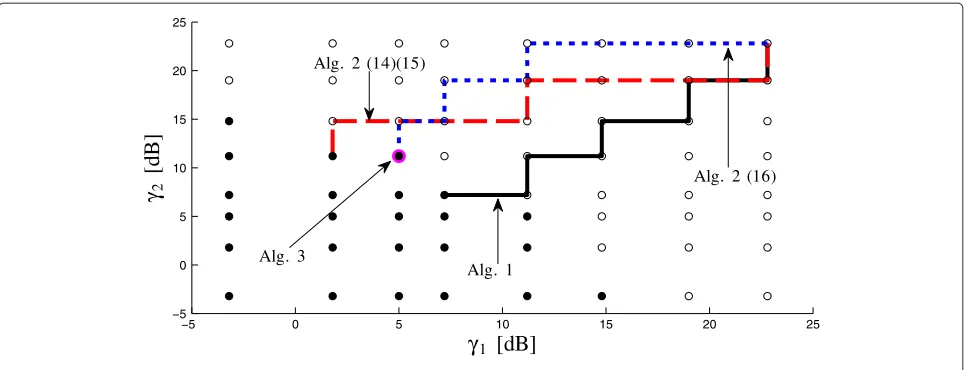
Figure 3 shows the evolution of the proposed algorithms over the region of available targets for a scenario with two links considering TPC (6). The starting pointγk = γ(M)
is infeasible for Algorithms 1 and 2, and the feasible target vectors are found by different paths. The algorithms stop oncep∈PTCorγ ∈QTC.
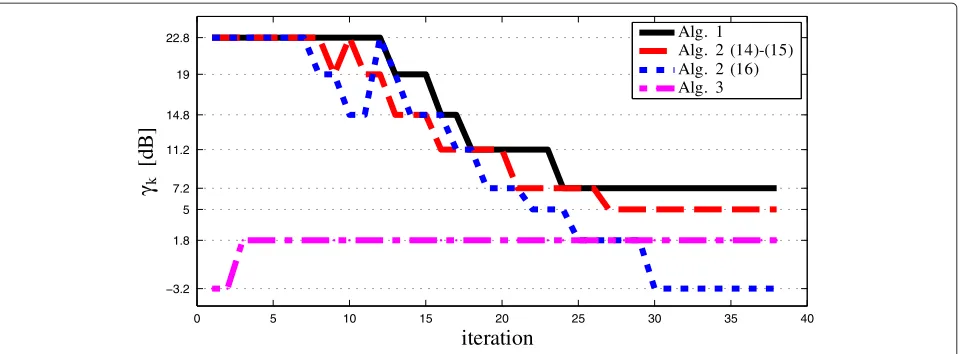
0 5 10 15 20 25 30 35 40 −3.2
1.8 5 7.2 11.2 14.8 19 22.8
iteration
γ
k[d
B
]
Alg. 1
Alg. 2 (14)-(15) Alg. 2 (16) Alg. 3
Figure 4MCS selection II.MCS selection based on target relaxation and target increment.
infeasible link and the attempt of the algorithms to allo-cate the maximum SINR target to the remaining users. In this particular case, Algorithm 2 using either (14) and (15) or (16) has one dropping event, whilst Algorithm 1 finds a feasibleγ for all links inK¯. This means that the final solu-tion of the algorithms may differ in the number of active links. Algorithm 3 starts from a given target value, and its objective is to increase such target as much as possible.
5.2 Distributed antenna scenario
In order to assess the algorithms, we consider a distribu-ted antenna system (DAS) scenario as the one depicdistribu-ted in Figure 1b. In DAS, the remote antenna units (RAUs) are geographically separated and connected by a dedi-cated link to a central unit where processing is jointly performed. These type of access interfaces are based on the concept of space diversity and cell splitting in order to improve coverage and spectral efficiency. The deployment of the distributed antennas consists ofNRAUs: one at the center of the cell andN−1 distributed RAUs uniformly deployed at a distance of 23 the cell radius from the cell center. We consider that the RAUs are coordinated only to control their transmit powers, and no signal process-ing is used (e.g., beamformprocess-ing). The channels are modeled as Rayleigh fading and are affected by a path loss com-ponent and a shadowing fading comcom-ponent modeled as a log-normal distributed variable with parametersσ.
There areU users uniformly deployed in the cell and
U ≥ N. Therefore, it is necessary to select the initial subset of links K¯ by assigning a different user to each RAU according to some performance criterion. In order to avoid the extremely complex combinatorial problem of selecting the optimum subset of usersK¯ with cardinality equal toNout ofUusers, we propose to use a suboptimal RAU-user matching algorithm inspired by [26]. This algo-rithm combines two forms of selection over all possible
RAU-user pairs: a greedy and a minimum-throughput-loss selection. The algorithm assigns one different user to each RAU deployed within the cell, defining in this way the initial set of linksK¯. Once that all the RAU-user links have been established, the proposed algorithms find the final subset of feasible links K and allocate powers and rates. The set of available targetsMis the one presented in Table 1. Results are generated by averaging 10×103 channel instances for each value ofU, and the simulation parameters are listed in Table 2.
5.2.1 Performance evaluation: sum rate and outage probability
In order to assess the performance of the algorithms, we use the statistics of the sum rate and outage probability for different DAS scenarios and both sets of power con-straints IPC (5) and TPC (6). In the figures, the results that correspond to Algorithm 1 when IPC (5) is consid-ered, are computed by the Algorithm 1 presented in [24].
Table 2 Simulation parameters
Parameters Values
Cell radius 900 m
Carrier frequency 2.5 GHz
Channel bandwidth 20 MHz
Thermal noise power density −174 dBm/Hz
UE noise figure 7 dB
Path loss model UMi-LoS [27]
Shadow fading standard deviation sσ=3
User deployment Uniform
Available MCS (M) 8 [25]
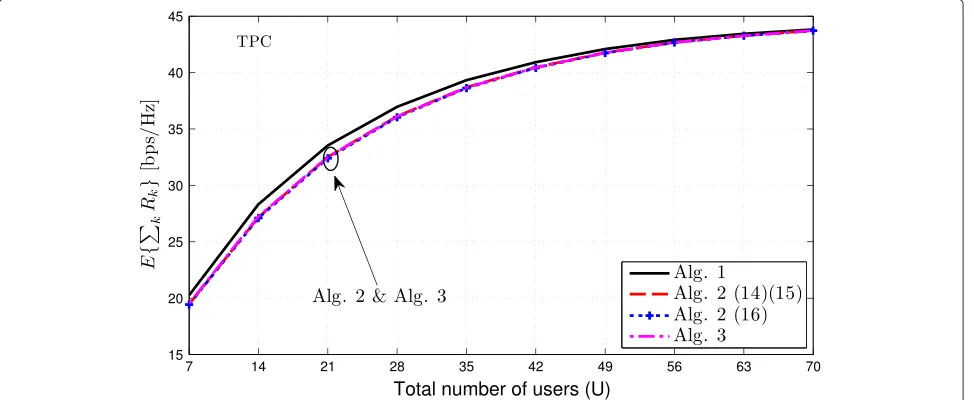
Figure 5Sum rate vs number of users (TPC).Total sum rate as a function of the MUD (U) forN=7,M=8, andPt=43 dBm.
The outage probability has been used as a metric to evalu-ate the performance of different power control algorithms, and it can be defined as the ratio between the number of dropped links to the total number of links [11]. The phenomenon of multiple users experiencing independent fading channels is known as multiuser diversity (MUD)
[25]. As U grows, the channel conditions of the users
attached to the RAUs are improved and interference can be mitigated more efficiently. Figures 5 and 6 show the total sum rate as a function of the total number of usersU
consideringN=7.
Let us analyze two particular cases of U. For the first
case, consider U = N = 7, where in Figure 5, the
achieved sum rate of the three algorithms is similar when TPC (6) is imposed. The sum rate maximization via PF-root optimization in Algorithm 1 identifies with more accuracy which link must relax its target, which results in an extra gain of 0.73 bps/Hz compared to the other approaches. Algorithm 3 achieves the same performance of Algorithm 2 since it allocates higher MCSs to its links. However, its performance in terms of outage probability is worst than the other approaches since it may discard feasible links in its first stage. In Figure 6, IPC (5) is con-sidered, and the performance of Algorithms 3 and 2 via (16) are outperformed by Algorithm 2 via (14) and (15), which indicates that when individual power constraints
Figure 6Sum rate vs number of users (IPC).Total sum rate as a function of MUD (U) forN=7,M=8, withp¯1=39 dBm for the central RAU, and ¯
7 14 21 28 35 42 49 56 63 70
10−5
10−4
10−3
10−2
10−1
100
Total number of users (U)
Outage probability
Alg. 1
Alg. 2 (14)(15) Alg. 2 (16) Alg. 3
TPC
Figure 7Outage probability vs number of users (TPC).Outage probability as a function of the MUD (U) forN=7,M=8, andPt=43 dBm.
are imposed, target relaxation based on power consump-tion achieves an extra gain of 0.95 bps/Hz compared to the optimization based on the target-to-SINR ratio.
The second case of analysis,U = 70 N, provides a
rich MUD, and the performance of all algorithms reaches similar values of the sum rate for both sets of power constraints. This means that under favorable channel con-ditions, finding an acceptable solution to problem (7) can be achieved with the low complex Algorithms 2 and 3, avoiding the PF-root optimization.
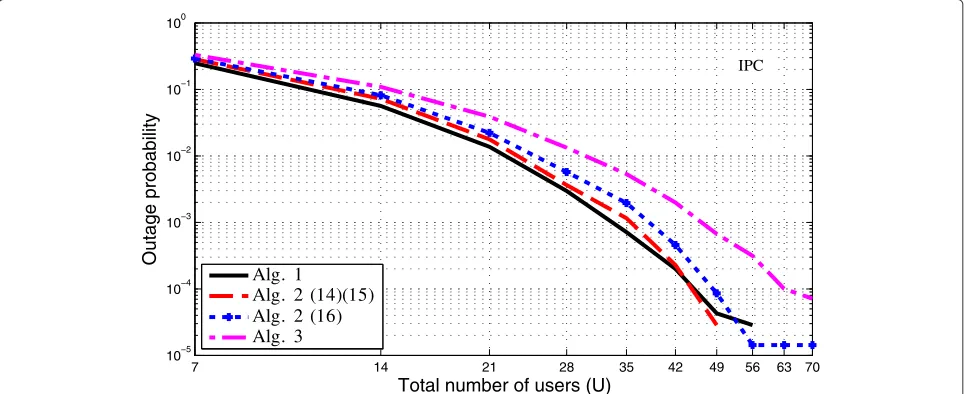
The outage probability results are displayed in Figures 7 and 8 for TPC and IPC, respectively. If TPC is considered, Algorithm 2 has a marginal gap of outage probability
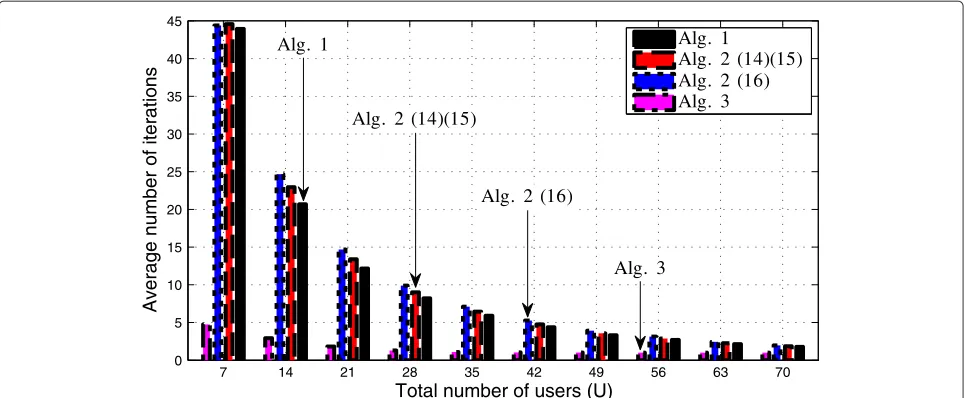
compared to Algorithm 1. In contrast, if IPC is imposed, only Algorithm 2 using (14) and (15) achieves an outage probability close to the one of Algorithm 1. In spite of the sum rate achieved by Algorithm 3, it suffers from a larger outage compared to the other schemes. The main advantage of Algorithm 3 is that the number of required iterations for convergence is considerably less compared to the other approaches. Figure 9 shows the average num-ber of iterations required by the algorithms to converge for IPC, and similar results are obtained for TPC. If the number of users in the cell is lowU ≈ N, it means that
theN RAUs must serve users with worst channel
condi-tions compared to the case whereUN. In other words,
7 14 21 28 35 42 49 56 63 70
10−5
10−4
10−3
10−2
10−1
100
Total number of users (U)
Outage probability
Alg. 1
Alg. 2 (14)(15) Alg. 2 (16) Alg. 3
IPC
Figure 8Outage probability vs number of users (IPC).Total sum rate as a function of the MUD (U) forN=7,M=8, withp¯1=39 dBm for the
7 14 21 28 35 42 49 56 63 70 0
5 10 15 20 25 30 35 40 45
Total number of users (U)
Average number of iterations
Alg. 1
Alg. 2 (14)(15) Alg. 2 (16) Alg. 3
Alg. 3 Alg. 2 (16)
Alg. 2 (14)(15) Alg. 1
Figure 9Expected number of iterations vs number of users.Average number of iterations as a function of the MUD (U) forN=7,M=8, and both definitions ofP.
when channel conditions are poor, the feasible target region contains few feasible target vectors, making Algo-rithms 1 and 2 to require more iteration to find a solution to problem (7). This phenomenon can be observed in the two-link scenario in Figure 3, where if the feasible region is small, the number of iterations to reach its boundary is larger.
5.2.2 Optimal joint link selection and resource allocation
In order to quantify the sum rate gap between the pro-posed algorithms and the optimal solution of problem (7),
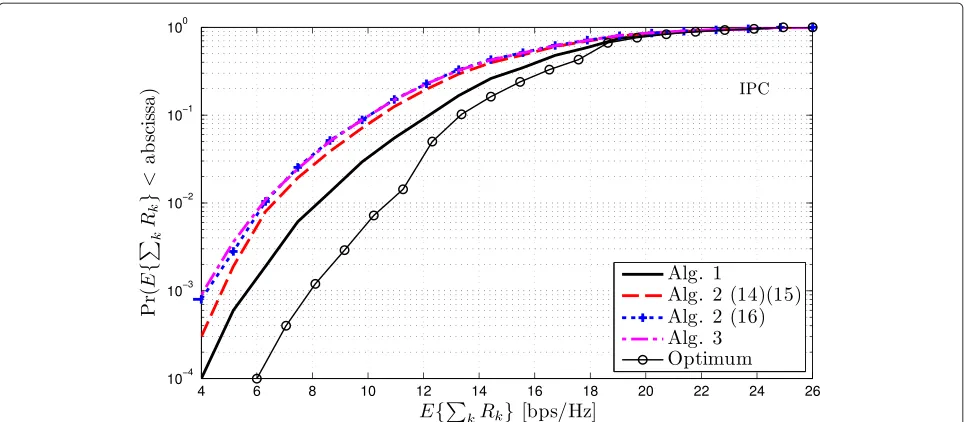
we use a scenario with N = 4 and U = 10, and the
optimal solution is found by exhaustive search. For this particular case, the search space contains|| ¯K|=4,M=8| = 6, 560 combinations. Figures 10 and 11 show the cumu-lative distribution function of the sum rate considering TPC and IPC, respectively. Algorithms 1 and 2 look for the maximum SINR target vector closer to the boundary of region of feasible targets (10). The target vectorγ found by both approaches is not necessarily the same size of the optimal oneγ. We have|γ| ≤ |γ|since the optimum
solution maximizes the sum rate over all combinations in K¯,M, and in Algorithms 1 and 2, the stop criteria are triggered once a feasibleγ orphas been found. It turns
Figure 11CDF of the sum rate (IPC).Cumulative distribution function of the sum rate forN=4,M=8,U=10, withp¯1=39 dBm for the central
RAU, andp¯j=36 dBm for∀j=1, the rest of the RAUs.
out that such criterion to stop the algorithms maximizes the cardinality of the final setK. The optimum solution of problem (7) will present a larger outage specially when
U≈N[24].
5.2.3 Performance evaluation for the low-high SINR regimes
The transition from a noise-limited system to an
interference-limited system withN = 7 andU = 14 is
displayed in Figures 12 and 13 for TPC and IPC, respec-tively. For IPC, the central RAU has a power constraint
¯
p1given by the abscissa, and the distributed nodes have ¯
pj = 0.6p¯1,∀j = 1 in watts. For both sets of power constraints, Algorithms 1 and 2 obtain the same outage probability when the system is noise limited. For systems that operate with low transmission powers, the resource allocation process can be given by Algorithm 2 since its complexity is low compared to Algorithm 1 and its outage performance is similar. When the system is interference limited, the outage probability gap between Algorithms 1 and 2 is significant. Nevertheless, Algorithms 2 and 3 are an alternative to the PF-root optimization approach. Notice that in the interference-limited scenario, the rate is
10 13 16 19 22 25 28 31 34 37 40 43
10−1
100
Transmit Power [dBm]
Outage probability
Alg. 1
Alg. 2 (14)(15) Alg. 2 (16) Alg. 3
TPC
10 13 16 19 22 25 28 31 34 37 40 43
10−1
100
Transmit Power [dBm]
Outage probability
Alg. 1
Alg. 2 (14)(15) Alg. 2 (16) Alg. 3
IPC
Figure 13Outage probability vs transmit power (IPC).Outage probability as a function of the constrained transmit powersp¯forN=7 andM=8.
upper-bounded by the rate associated with the maximum target (MCS) in M, specially when there are favorable channel conditions, e.g,U=70 in Figures 5 and 6.
5.2.4 Application for user removal
The proposed algorithms have the potential to be used as removal algorithms in the context used in [11], i.e., all links inK¯ have the same unique fixed target and the objective is to find the subsetK with the links that can be simultaneously scheduled. This can be achieved by makingM = {γ(m)}for any fixedm, which is a partic-ular case of our algorithms. Figure 14 shows the outage
probability when a unique fixed target is considered. For this particular case, Algorithm 1 reduces to the Removal Algorithm III-A in [11]. It is worthy to point out that for TPC, Algorithm 2 is a low complex alternative to the Removal Algorithm III-A [11] which was claimed to be the unique solver for the case where TPC (6) is imposed. The performance of the algorithms is compared to the optimal removal. The outage probability gap between Algorithm 2 and the optimal removal is negligible for low values of the fixed target. For large values of the fixed target, this gap reflects the inaccuracy of Algorithm 2 when selecting the worst link inK either by the power
−3.2 1.8 5 7.2 11.2 14.8 19 22.8 0
0.1 0.2 0.3 0.4 0.5 0.6 0.7 0.8
γ [dB]
Outage probability
Alg. 1
Alg. 2 (14)(15) Alg. 2 (16) Alg. 3
Optimum Removal
TPC
consumption or by the target-to-SINR ratio criterion. However, this gap is compensated by the low complex-ity involved in the user-removal process. The curve from Algorithm 3 is a clear example of what is the expected out-age when more than one link is discarded per iteration. Similar results to Figure 14 are achieved when IPC (5) is considered.
6 Conclusions
In this paper, we present different algorithms to solve the sum rate maximization problem in interference-coupled wireless networks. This problem has a combi-natorial nature since the SINRs are constrained to take values from a finite set. The algorithms find a set of links for which exists a feasible resource allocation that maximizes the sum rate. The presented algorithms are based on the criteria derived from the Perron-Frobenius theory or derived from the implicit information con-tained in the power consumption or achievable SINR. In addition, we present a low-complexity fast algorithm for link selection and resource allocation which con-verges in few iterations, and its robustness allows us to achieve acceptable performance under favorable channel conditions.
Numerical results show how our algorithms achieve a good tradeoff between complexity and accuracy com-pared to the optimal solution. Moreover, our results show that the low-complexity algorithms that avoid the PF-root computations are suitable for scenarios with favor-able channel conditions (e.g., rich MUD). In such sce-narios, their sum rate performance is similar to the one achieved by approaches depending on the eigenvalue computation.
Furthermore, we show that our proposed algorithms can be used for user removal under different sets of power constraints whose performance is close to the one achieved by state-of-the-art algorithms but with signifi-cant reduction on complexity. A secondary application of our algorithms is to group users for time-sharing schedul-ing where transmission is provided only to useful users that can be jointly supported whilst useless users can be served in a later time slot or handed to another channel or base station.
Competing interests
The authors declare that they have no competing interests.
Acknowledgements
The authors wish to thank the anonymous reviewers for the useful comments and suggestions which improved the quality of the paper. The work presented in this paper was supported by the Portuguese FCT CADWIN (PTDC/EEA TEL/099241/2008) and CROWN (PTDC/EEA-TEL/115828/2009) projects and the FCT grant (SFRH/BD/70130/2010) for Eduardo D Castañeda.
Received: 18 May 2013 Accepted: 1 November 2013 Published: 16 November 2013
References
1. CW Tan, M Chiang, R Srikant, Fast algorithms and performance bounds for sum rate maximization in wireless networks. IEEE/ACM Trans. Netw. 21(3), 706–719 (2012)
2. H Boche, M Schubert, Perron-root minimization for interference-coupled systems with adaptive receive strategies. IEEE Trans. Commun. 57(10), 3173–3164 (2009)
3. M Schubert, H Boche, QoS-based resource allocation and transceiver optimization. Foundation and Trends in Communications and Information Theory2(6), 383–529 (2005)
4. A Gjendemsjo, G Oien, H Holm, M-S Alouini, D Gesbert, K Hole, P Orten, Rate and power allocation for discrete-rate link adaptation. EURASIP J. Wireless Commun. Netw.2008(1), 394124 (2008)
5. S Stanczak, M Wiczanowski, H Boche,Fundamentals of Resource Allocation in Wireless Networks: Theory and Algorithms. (Springer, Berlin, 2009) 6. M Chiang, J Bell, Balancing supply and demand of bandwidth in wireless
cellular networks: utility maximization over powers and rates. IEEE INFOCOM4, 2800–2811 (2004)
7. P Tsiaflakis, M Diehl, M Moonen, Distributed spectrum management algorithms for multiuser DSL networks. IEEE Trans. Signal Process. 56(10), 4825–4843 (2008)
8. P Tsiaflakis, F Glineur, in IEEE International Conference on
Communications, Ottawa, 10–15 June 2012. A novel class of iterative approximation methods for DSL spectrum optimization (IEEE, Piscataway, 2012), pp. 3154–3159
9. M Schubert, H Boche, Solution of the multiuser downlink beamforming problem with individual SINR constraints. IEEE Trans. Vehicular Technol. 53(1), 18–28 (2004)
10. M Andersin, Z Rosberg, J Zander, Gradual removals in cellular PCS with constrained power control and noise. Personal, Indoor and Mobile Radio Commun. Conf.1, 56–60 (1995)
11. H Mahdavi-Doost, M Ebrahimi, AK Khandani, Characterization of SINR region for interfering links with constrained power. IEEE Trans. Inf. Theory 56(6), 2816–2828 (2010)
12. J Zander, Performance of optimum transmitter power control in cellular radio systems. IEEE Trans. Vehicular Technol.41(1), 57–62 (1992) 13. RD Yates, A framework for uplink power control in cellular radio systems.
IEEE J Selected Areas Commun.13(7), 1341–1347 (1995) 14. M Chiang, Geometric programming for communication systems.
Foundation and Trends in Communications and Information Theory 2, 1–54 (2005)
15. M Chiang, P Hande, T Lan, CW Tan, Power control in wireless cellular networks. Foundation and Trends in Networking.2(4), 381–533 (2007) 16. T Wang, L Vandendorpe, in IEEE International Conference On
Communications (ICC), Ottawa, 10–15 June 2012. Successive convex approximation based methods for dynamic spectrum management (IEEE, Piscataway, 2012), pp. 4061–4065
17. GJ Foschini, Z Miljanic, A simple distributed autonomous power control algorithm and its convergence. IEEE Trans. Vehicular Technol. 42(4), 641–646 (1993)
18. RD Yates, S Gupta, C Rose, S Sohn, Soft dropping power control. IEEE 47th Vehicular Technology Conference.3, 1694–16983 (1997)
19. X Qiu, K Chawla, On the performance of adaptive modulation in cellular systems. IEEE Trans. Commun.47(6), 884–895 (1999)
20. CW Sung, KK Leung, A generalized framework for distributed power control in wireless networks. IEEE Trans. Inf. Theory51(7), 2625–2635 (2005)
21. T Wang, L Vandendorpe, On the SCALE algorithm for multiuser multicarrier power spectrum management. Signal Process. IEEE Trans. 60(9), 4992–4998 (2012)
22. RB Bapat, TES Raghavan,Nonnegative Matrices and Applications. (Cambridge University Press, Cambridge, 1997)
23. JE Gentle,Matrix Algebra: Theory, Computations, and Applications in Statistics. (Springer, New York, 2007)
24. E Castañeda, R Samano, A Gameiro, in IEEE 24th Personal, Indoor and Mobile Radio Communication Conference, London, 8–11 Sept 2013. Power and modulation assignment via Perron-root optimization for interference limited systems (IEEE, Piscataway, 2013), pp. 1904–1908 25. A Perez-Niera, M Campalans,Cross-Layer Resource Allocation in Wireless
26. E Castañeda, R Samano, A Gameiro, in IEEE 77th Vehicular Technology Conference, Dresden, 2–5 June 2013. Low complexity scheduling algorithm for the downlink of distributed antenna systems (IEEE, Piscataway, 2013), pp. 1–5
27. ITU.ITU-R M.2135-1: Guidelines for Evaluation of Radio Interface Technologies for IMT-Advanced. ITU, Geneva (2009)
doi:10.1186/1687-1499-2013-268
Cite this article as: Castañedaet al.:Sum rate maximization via joint
scheduling and link adaptation for interference-coupled wireless systems.
EURASIP Journal on Wireless Communications and Networking20132013:268.
Submit your manuscript to a
journal and benefi t from:
7Convenient online submission
7 Rigorous peer review
7Immediate publication on acceptance
7 Open access: articles freely available online
7High visibility within the fi eld
7 Retaining the copyright to your article