MP-06.01
A 3-Gene DNA-Methylation Biomarker Panel Sensitively Detects Bladder Cancer and Discriminates Between High-grade and Low-grade Disease in Voided Urine
Hermanns, Thomas1; Olkhov-Mitsel, Ekaterina2; Savio, Andrea2; Zdravic,
Darko2; Bhindi, Bimal3; Kuk, Cynthia4; Noon, Aidan1; Rendon, Ricardo5;
Waltregny, David6; Lo, Kirk C.4; van der Kwast, Theodorus7; Finelli, Antonio1;
Fleshner, Neil1; Bapat, Bharati2; Zlotta, Alexandre4
1Department of Surgical Oncology, Division of Urology, Princess Margaret
Cancer Centre, University of Toronto, Toronto, ON, Canada; 2Samuel
Lunenfeld Research Institute, Mount Sinai Hospital, Toronto, ON, Canada;
3Department of Surgery, Division of Urology, University Health Network,
University of Toronto, Toronto, ON, Canada; 4Department of Urology,
Mount Sinai Hospital, Toronto, ON, Canada; 5Department of Urology,
Dalhousie University, Halifax, NS, Canada; 6Department of Urology,
University of Liege, Liege, Belgium; 7Department of Pathology, University
Health Network, University of Toronto, Toronto, ON, Canada
Introduction and Objectives: Voided urine provides an excellent source of exfoliated bladder cells and is ideal to detect bladder cancer (BC) biomark-ers. Using two different genome-wide methylation-array profiling platforms in Toronto, CA and Liège, BE, several differentially methylated biologically relevant genes (incl. TWIST1, NID2 and RUNX3) from low grade (LG) versus high grade (HG) BCs were commonly identified. We investigated methylation of the 3 genes to identify BC in urine and discriminate between LG and HG BC.
Methods: Voided urine from patients with LG (n=23) or HG BC (n=39) as well as from BC-free controls (noBC, n=34) was collected. Methylation status of the 3 genes was analyzed in the urinary DNA using the MethyLight assay. Methylation levels (percent methylation reference, PMR) were obtained for each sample. Association between PMR and diagnosis of HG versus LG disease vs. noBC was investigated using Kruskal-Wallis test and pairwise comparisons (BC versus no BC; HG versus LG/no BC) were per-formed using Mann-Whitney U-test. Univariate and multivariable logistic regression models were used to create ROC curves to evaluate individual and combined biomarker discrimination, respectively. Discrimination for detecting BC (versus no BC) and HG (versus LG/no BC) was assessed using the area under the curve (AUC).
Results: Median PMRs for HG, LG and no BC were significantly different for each gene (TWIST1: HG: 22, LG: 1, noBC:0; NID2: HG: 27.4, LG: 7.5, noBC: 4.7; RunX3: HG:3.5, LG:0.01, noBC: 0; all p<0.001). The PMRs for all genes were significantly higher in BC than in noBC cases (all p<0.001) and in HG BC compared to LG/noBC cases (all p<0.001). The AUC to predict BC was 0.83 (95%CI: 0.76-0.9) for TWIST1, 0.81 (95%CI: 0.72-0.89) for NID2 and 0.73 (95%CI: 0.64-0.82) for RunX3. The AUC to predict HG BC was 0.86 (95%CI: 0.78-0.94) for TWIST1, 0.8 (95%CI: 0.71-0.9) for NID2 and 0.77 (95%CI: 0.67-0.86) for RunX3. When combining all 3 genes, the AUC was 0.87 (95%CI: 0.8-0.94) to predict BC and 0.87 (95%CI: 0.79-0.95) to predict HG BC.
Conclusions: Combination of the 3 epigenetic markers is a very promising tool for sensitive and specific detection of BC and discrimination between HG and LG BC in voided urine.
MP-06.02
Accelerating the Uptake of Neo-adjuvant Chemotherapy at a Tertiary Care Academic Centre: A Time-series Analysis to Determine How We Did It
Bhindi, Bimal1; Yu, Julie2; Mamdani, Muhammad3; Sridhar, Srikala1;
Hermanns, Thomas1; Hamilton, Robert1; Finelli, Antonio1; Jewett, Michael1;
Zlotta, Alexandre1; Fleshner, Neil1; Kulkarni, Girish1
1University Health Network, Toronto, ON, Canada; 2University of Toronto,
Toronto, ON, Canada; 3Applied Health Research Centre, St. Michael’s
Hospital, Toronto, ON, Canada
Introduction and Objectives: While level 1 evidence supports the use of neo-adjuvant chemotherapy (NAC) for patients with muscle-invasive bladder cancer (MIBC), its uptake has been underwhelming. In 2008, our institution initiated a Multidisciplinary Bladder Cancer Clinic (MDBCC). The objective of our study was to use a time-series analysis to determine if the initiation of the MDBCC was associated with increased use of NAC. Methods: Patients with MIBC initiating treatment between July 1, 2000 and June 30, 2013 were identified and classified by academic year (July 1 to June 30). Time-series analyses using Interventional auto-regressive integrated moving average (ARIMA) models with a ramp intervention function using an annual time interval were then conducted. A sensitivity analysis was performed on clinical N0 patients. Descriptive analyses were performed examining usage patterns by individual urologist.
Results: The cohort included 278 RCs: 168 from 2000-2007 and 110 from 2008-2012 (academic years). Overall, 42 (15.1%) patients received NAC and 74 (26.6%) received AC. The proportion of patients receiving NAC increased from a mean of 7.7% before the MDBCC to 47.6% in 2012 (Interventional ARIMA: p=0.036). The results were similar when restricting to cN0 patients (p<0.001). Although two urologists who are strong propo-nents of NAC joined the institution in the 2011/2012 academic years, the trend for increasing NAC uptake began before their entry into the institution. Moreover, there was an increase in use of NAC among the other urologists who also participate in the MDBCC.
Conclusions: At our institution, the initiation of the MDBCC appears to be temporally associated with increased uptake of NAC. Additionally, recruit-ment of new urologists who are proponents of NAC also likely contributed. Our results suggest that multi-disciplinary collaboration in the care of MIBC patients, along with a critical mass of advocates for NAC, can lead to increased NAC use.
MP-06.03
Population-based Patterns of Referral for Perioperative Chemotherapy among Patients with Muscle-invasive Bladder Cancer
Siemens, Robert; Peng, Yingwei; Mackillop, Willaim; Booth, Christopher; Leveridge, Michael
Queen’s University, Kingston, ON, Canada
Introduction and Objectives: Reasons for low uptake of perioperative chemotherapy for muscle-invasive bladder cancer (MIBC) are not well described. Here we report referral patterns from urology to medical oncol-ogy (MO) in Ontario, Canada and subsequent use of chemotherapy. Methods: Treatment and physician billing records were linked to the population-based Ontario Cancer Registry to describe referral patterns from urology to MO and subsequent use of neoadjuvant or adjuvant chemotherapy (NACT/ACT) among all patients with MIBC treated with cystectomy in Ontario 1994-2008. Logistic regression was used to analyze factors associated with referral to MO and use of NACT/ACT.
Results: Eighteen percent (520/2944) of the study population was seen by MO prior to cystectomy and 25% (128/520) of referred cases were treated with NACT. Among patients not treated with neoadjuvant chemotherapy or radiation, 39% (1085/2809) were seen by MO following cystectomy; 51% (548/1085) of referred patients were treated with ACT. There was wide geographic variation in rates of referral to MO before (range 5 to 40%) and after cystectomy (range 26 to 59%); referral rates remained stable over time. Patients seen by MO in 2004-2008 were more likely to receive ACT (57%) compared to patients treated in earlier years (41% 1994-1998 and 46% 1999-2003, p<0.001).
Conclusions: Most patients who do not receive NACT/ACT are not referred to MO suggesting the upstream decision by urologists is an important target in future knowledge translation. Low treatment rates among patients seen by MO suggest that therapy has also not been wholly embraced by MOs or patients.
MP-06.04
Development and External Validation of a Prognostic Tool for Prediction of Cancer-specific Mortality after Complete Loco-regional Pathological Staging for Squamous Cell Carcinoma of the Penis
Popa, Ioana1; Trudeau, Vincent1; Gandaglia, Giorgio2; Schiffmann, Jonas3;
Azizi, Mounsif1; Hanna, Nawar1; Trinh, Quoc-Dien4; Djajadiningrat, Rosa
S.5; Horenblas, Simon5; Sun, Maxine6; Karakiewicz, Pierre I.1
1Centre Hospitalier de l’Université de Montréal, Montreal, QC, Canada; 2Department of Urology, Vita-Salute San Raffaele University, Milan, Italy; 3Martini-Clinic, Prostate Cancer Center Hamburg-Eppendorf, Hamburg,
Germany; 4Division of Urologic Surgery, Department of Surgical Oncology,
Dana-Farber Cancer Institute, Boston, MA, United States; 5Department of
Urology, Netherlands Cancer Institute-Antoni van Leeuwenhoek Hospital, Amsterdam, Netherlands; 6Cancer Prognostics and Health Outcomes Unit,
Centre Hospitalier de l’Université de Montréal, Montreal, QC, Canada Introduction and Objectives: To develop a novel postoperative prog-nostic tool, which attempts to integrate both pathological tumour stage and histopathological factors for prediction of cancer-specific mortality (CSM) for SCCP.
Methods: Patients with SCCP treated with inguinal lymph node dissec-tion (ILND) or sentinel node biopsy at a single institudissec-tion were used for nomogram development and internal validation (n=434), while a second cohort was used for external validation (n=338) Multivariable Cox pro-portional hazards were used to examine the prognostic ability of patient age, a modified tumour staging that distinguishes between spongiosum and cavernosum body ingrowth tumours, a modified nodal staging that integrates information on presence/absence of lymph node metastasis, extent of inguinal metastases, pelvic nodal involvement, and extranodal involvement, and tumour grade. Model performance was quantified using measures of discrimination and calibration.
Results: Overall, 36% of patients had positive lymph node metastases (n=156). In univariable analyses, the modified tumour and nodal staging systems were statistically significantly associated with CSM, and remained
in the final model with a discrimination of 89% within internal valida-tion, and 95% within external validation. Calibration was nearly perfect. Conclusions: The newly developed model integrates important prognostic factors, which existing models do not consider. Its performance was highly accurate using measures of discrimination and calibration.
MP-06.05
Partial Cystectomy for Urothelial Carcinoma of the Bladder: Practice Patterns and Outcomes in the General Population
Leveridge, Michael; Siemens, Robert; Izard, Jason; Wei, Xuejiao; Mackillop, William; Berman, David; Booth, Christopher
Queen’s University, Kingston, ON, Canada
Introduction and Objectives: Urothelial carcinoma of the bladder (UCB) commonly affects patients with significant comorbidities. Partial cystec-tomy (PC) for selected tumours & patients may avoid the high morbidity of radical cystectomy (RC) & urinary diversion. We assessed the practice patterns and outcomes of PC for UCB in routine clinical practice. Methods: All patients with UCB undergoing PC or RC in Ontario from 2004-2008 were identified using the Ontario Cancer Registry. Pathology, treatment and survival data were linked to the database. Variables asso-ciated with the use of PC were identified using logistic regression. Cox proportional hazards model identified factors associated with survival among PC patients.
Results: 3320 patients underwent PC (n=181; 5.5%) or RC (n=3139; 94.5%) in the study period. 36% of PC patients were >80 years old, vs. 19% of RC patients (p<0.001). More PC patients had organ-confined (<pT3) disease (54% PC vs. 36% RC; p<0.001). Two-thirds (67%) of PC patients did not undergo lymph node dissection at the time of surgery (24% for RC; p<0.001). Surgical margins were positive in 18% (n=33) at PC. 21 PC patients (12%) received adjuvant chemotherapy. Surgery early in the study period, age ≥70, Charlson comorbidity score ≥3 and surgery outside a regional cancer centre predicted use of PC. Unadjusted 5-year overall survival (OS) for PC & RC cases was 34% and 33% respectively (p=0.045). On multivariable analysis of PC cases, pT3+ disease (HR 1.49 [1.02-2.19]) and node positive (N+) disease (HR 3.45 [1.80-2.46]) were independent predictors of OS, while pT3+ (HR 2.59 [1.70-3.94]), N+ (HR 3.89 [1.83-8.27]) and lymphovascular invasion (HR 2.82 [1.51-5.26]) predicted cancer-specific survival.
Conclusions: In the population setting, partial cystectomy is uncommon and is used more often in the elderly. It is worrisome that most patients treated with PC do not undergo lymphadenectomy. A substantial propor-tion of patients treated with PC achieve long-term survival. PC remains a treatment option in selected patients with UCB.
MP-06.06
Adverse Outcomes Following Radical Cystectomy
Lavallée, Luke T.1; Witiuk, Kelsey2; Mallick, Ranjeeta2; Fergusson, Dean2;
Schram, David3; Cagiannos, Ilias1; Morash, Chris1; Breau, Rodney1 1Division of Urology, University of Ottawa and Ottawa Hospital Research
Institute, Ottawa, ON, Canada; 2Ottawa Hospital Research Institute,
Ottawa, ON, Canada; 3Division of Otolaryngology, The University of
Ottawa, Ottawa, ON, Canada
Introduction and Objectives: The American College of Surgeons National Surgical Quality Improvement Program (NSQIP) provides accurate infor-mation on patient outcomes within 30 days of surgery. The study objective is to characterize adverse events following radical cystectomy. Methods: All radical cystectomy patients from NSQIP hospitals between 2006 and 2012 were included. Baseline information and adverse events were abstracted by trained study nurses through medical record review and direct patient contact (interrater accuracy greater than 95%). The association between patient and surgical factors with adverse events was verified by calculating relative risks.
The most common adverse event was blood transfusion (n=875; 38%). Infectious complications were common with 218 (10%) urinary tract infections, 193 (8%) surgical site infections, and 223 (10%) sepsis events. Seventy-three (3%) patients had fascial wound dehiscence. Twenty-two (1%) patients had cardiac arrest and 82 (4%) developed a deep vein thrombosis. Patient factors associated with an increased risk of postop-erative complication include; female gender, higher ASA classification, dependent functional status, chronic obstructive pulmonary disease, and preoperative weight loss, dyspnea, bleeding requiring transfusion, and low albumin (all p<0.05). Surgical factors include; operative time >6 hours and later year of surgery (p<0.05).
Conclusions: Adverse events are common following a radical cystec-tomy. This study provides accurate information for preoperative patient counselling. Targets for quality improvement interventions have also been identified.
MP-06.07
Radical Cystectomy in Patients over 80 Years Old in Quebec: A Population-based Study of Outcomes
Ahmed, Ahmed S. Zakaria1; Santos, Fabiano2; Kassouf, Wassim1; Tanguay,
Simon1; Aprikian, Armen1
1Department of Surgery, Division of Urology, McGill University, Montreal,
QC, Canada; 2Division of Cancer Epidemiology, McGill University,
Montreal, QC, Canada
Introduction and Objectives: Radical cystectomy (RC) in elderly is a chal-lenging procedure still associated with significant postoperative complica-tions, including death. Our aim was to document RC outcomes in patients over 80 years across Quebec, and to examine potentially related factors. Methods: Within the RAMQ (Quebec health insurance medical services database), we used procedure codes to identify patients over 80 years who underwent RC for bladder cancer over 10 years (2000-2009), as well as their outcomes. Data obtained were retrospectively analyzed in rela-tion to multiple parameters. The outcomes analyzed were postoperative complications and mortality rates.
Results: A total of 275 patients over 80 years old had their RCs performed in 38 hospitals across Quebec. Among them, 33% had at least one post-operative complication and 16% had more than one complication. The cohort mortality rates at 30, 60 and 90 days were 5.8%, 9.8% and 13% respectively. From all, 44.3% of RCs were performed in 7 academic hospitals with a mortality rates at 30, 60 and 90 days approaching 2.5%, 6.5% and 9% respectively. On the other hand, community based hos-pitals had mortality rates at 30, 60 and 90 days reaching 8.5%, 12.4% and 16.3% respectively. The difference in mortality rates between the 2 hospital facilities was statistically significant (p<0.001). The overall sur-vival of the cohort was 3.2 years with a death rate of 63% over the whole follow-up period. The presence of postoperative complications as well as the number of these complications significantly affected the cohort overall survival (p<0.001).
Conclusions: Our study results suggest that patients over 80 years old have high post-RC mortality rates especially at 90 days. In addition, RCs performed in academic centres had statistically significant lower mortal-ity rates as compared to communmortal-ity based hospitals. Such results can be used in the process of obtaining informed consent from elderly patients who require RC.
MP-06.08
Survival after Radical Cystectomy for Bladder Cancer in Relation to Prior Non-muscle Invasive Disease in Quebec
Ahmed, Ahmed S. Zakaria1; Santos, Fabiano2; Kassouf, Wassim1; Tanguay,
Simon1; Aprikian, Armen1
1Department of Surgery, Division of Urology, McGill University, Montreal,
QC, Canada; 2Division of Cancer Epidemiology, McGill University,
Montreal, QC, Canada
Introduction and Objectives: Radical cystectomy (RC) is indicated in patients with muscle-invasive bladder cancer. However, there is con-troversy regarding outcomes when examined in relation to prior non-muscle-invasive disease (NMIBC) versus invasive cancer de novo at time of diagnosis. The aim of this study was to assess if there is a difference in survival after RC among the 2 groups.
Methods: We conducted a retrospective cohort study of all patients hav-ing RC in Quebec durhav-ing the years (2000-2009). The cohort was built on RAMQ (Quebec health insurance services) database. We excluded patients with neo-adjuvant treatment. Patients were considered as having NMIBC progressing to invasive disease if they had at least 2 trans-urethral resection of tumour (TURBTs) held more than 4 months apart before RC. Survival outcomes were compared by hazard ratios generated by Cox proportional hazards models adjusted for age and gender.
Results: A total of 2671 subjects who underwent RC met the eligibility criteria, their RCs were performed in 48 hospitals by 122 urologists. Among them, 19.8% had prior NMIBC that further progressed to inva-sive disease, and 80.2% presented with invainva-sive disease de novo. Of the cohort, 69.2% had 1 TURBT, 16.6% had 2 TURBTs and 14.2% had 3 or more TURBTs prior to RC. No significant difference was observed in referral for adjuvant treatment among patients with non-invasive and invasive disease (36.9% and 39% respectively, p=0.3). Median survival after RC for patients with prior NMIBC was 4.3 years as compared to patients with invasive disease de novo 3.8 years. (p=0.007, Wilcoxon test). Patients with NMIBC at the time of diagnosis had a 16% decrease in the risk of mortality after RC, when compared to patients with invasive BC de novo (HR=0.84, 95%CI 0.73-0.96).
Conclusions: Our results suggest a better prognosis in survival after RC for patients with NMIBC who progressed to invasive disease, when compared to patients with invasive disease de novo.
MP-06.09
High Hospital and Surgeon Volume and Its Impact on Overall Survival after Radical Cystectomy among Patients with Bladder Cancer in Quebec
Santos, Fabiano1; Ahmed, Ahmed S. Zakaria2; Kassouf, Wassim2; Tanguay,
Simon2; Franco, Eduardo1; Aprikian, Armen2
1Division of Cancer Epidemiology, McGill University, Montreal, QC,
Canada; 2Montreal General Hospital, McGill University, Montreal, QC,
Canada
Results: We analyzed a total of 2700 patients who met inclusion criteria (75% males). The average annual RC hospital volumes in the 3rd and 4th quartiles were 17.5 and 36, respectively. Average annual RC surgeon volumes in the 3rd and 4th quartiles were 3.4 and 8.9. High hospital volume was found to be significantly associated with improved survival (HR= 0.82, 95%CI: 0.71-0.95). Moreover, patients who had their RC performed in a high volume hospital and by a high volume surgeon had a 13% decreased risk of mortality compared with other patients (HR=0.87, 95%CI: 0.77-0.99).
Conclusions: Having RC for bladder cancer performed by high volume surgeons in high volume hospitals was associated with improved overall survival compared with low volume providers.
MP-06.10
A Phase I/II Trial of Transurethral Surgery Followed by a Combination of Everolimus and Gemcitabine with Intensity-modulated Radiation Therapy in Patients with Muscle-invasive Bladder Cancer
Bachir, Bassel; Souhami, Luis; Mansure, Jose; Cury, Fabio; Sturgeon, Jeremy; Aprikian, Armen; Tanguay, Simon; Kassouf, Wassim
McGill University Health Centre, Montreal, QC, Canada
Introduction and Objectives: To determine the loco-regional control rate and toxicity of integrating everolimus with trimodality therapy in patients with muscle-invasive bladder cancer.
Methods: This is a phase I/II trial in patients with muscle-invasive blad-der cancer who are not surgical candidates or who refuse cystectomy. Trimodality therapy using a combination of everolimus (2.5-5.0 mg/day) with gemcitabine (100mg/m2/weekly) and intensity-modulated radiation
therapy (IMRT) (50Gy/20 fractions) was used. The first part was an evero-limus dose-escalation study at doses of 2.5mg then 5.0mg/day initiated in July 2009. For the phase II component, 22 other patients will be accrued (total of 25 patients) and a two stage design will be employed. Local control was assessed using post-treatment biopsy. Toxicity was assessed using the Radiation Therapy Oncology Group Acute Radiation Morbidity Scoring Criteria. Biologic endpoints of downregulation of phospho-S6 (pS6) was assessed using immunohistochemistry.
Results: A total of 11 patients entered the study over a period of 2.5 years. 9 males, 2 females, with a median age of 77 years (range: 64-84). Five patients entered everolimus 2.5mg cohort and 6 patients entered evero-limus 5.0mg cohort. Toxicities were encountered in 1 patient (Grade I), 2 patients (Grade II), 5 patients (Grade III), 2 patients (Grade IV) and one patient (Grade V). Subsequently, the trial was terminated early due to increased toxicity and slow accrual. Of interest, 6 out of the 10 patients (60%) achieved a complete response with negative post-treatment biop-sies. Significant decrease of pS6 was demonstrated post therapy (p=0.021 and p=0.029).
Conclusions: Although the combination of everolimus with gemcitabine and IMRT achieved a biological endpoint and a complete response in a significant number of patients with muscle-invasive bladder cancer, it may be associated with increased toxicity.
MP-06.11
Pre-treatment Neutrophil-to-Lymphocyte Ratio as Predictor of Adverse Outcomes in Patients Undergoing Radical Cystectomy for Urothelial Carcinoma of the Bladder
Hermanns, Thomas1; Bhindi, Bimal2; Wei, Yanliang1; Bhatt, Jaimin1;
Almatar, Ashraf1; Yu, Julie1; Noon, Aidan1; Richard, Patrick O.1; Jewett,
Michael1; Fleshner, Neil1; Zlotta, Alexandre3; Templeton, Arnoud J.4;
Kulkarni, Girish1
1Department of Surgical Oncology, Division of Urology, Princess Margaret
Cancer Centre, Toronto, ON, Canada; 2Department of Surgery, Division of
Urology, University Health Network, University of Toronto, Toronto, ON, Canada; 3Department of Urology, Mount Sinai Hospital, Toronto, ON,
Canada; 4Department of Medicine, Division Medical Oncology, Princess
Margaret Cancer Centre, Toronto, ON, Canada
Introduction and Objectives: An elevated neutrophil-to-lymphocyte ratio (NLR) is associated with poor outcome in various solid tumours. We
aimed to assess the association between pre-treatment NLR and survival in patients undergoing radical cystectomy (RC) for urothelial carcinoma of the bladder (UCB).
Methods: A cohort of patients undergoing RC for UCB between 1988-2012 was analyzed. NLR was computed using complete blood counts with differentials performed pre-RC, or prior to neo-adjuvant chemother-apy where applicable. Time dependent receiver operator characteristics (ROC) curves were used to determine the optimal cutpoint for predicting recurrence-free (RFS), cancer-specific (CSS) and overall survival (OS). The predictive ability of NLR was then assessed using Kaplan-Meier analyses and multivariable Cox-proportional hazards models.
Results: Of the final cohort of 416 patients, median follow-up was 58.4 months. There were 178 (42%) deaths overall, 110 (26%) UCB-related deaths, and 138 recurrences (33%). An NLR of 3 was determined as the optimal cut-off value for predicting survival outcomes based on the inflec-tion point of the ROC curves. Patients with NLR ≥3 had significantly worse survival outcomes (5y-RFS: 53% vs. 64%, log-rank p=0.013; 5y-CSS: 57% vs. 75%, log-rank p<0.001; 5y-OS: 43% vs. 64%, log-rank p<0.001). Upon adjusting for patient and disease-specific predictors, NLR ≥3 was significantly associated with worse RFS (HR=1.79; 95%CI=1.22-2.63, p=0.003), CSS (HR=1.94; 95%CI=1.44-2.60, p<0.001) and OS (HR=1.66; 95%CI=1.23-2.25, p=0.001).
Conclusions: NLR is an inexpensive prognostic biomarker for patients undergoing cystectomy for UCB. It offers pre-treatment prognostic value in addition to established patient and disease-related prognostic indica-tors, and may be helpful in guiding treatment decisions.
MP-06.12
A Multidisciplinary Bladder Cancer Clinic Delivers Personalized Care for Complex Bladder Cancer Patients
Hermanns, Thomas1; Wei, Yanliang1; Bhindi, Bimal2; Satkunasivam, Raj2;
Bostrom, Peter J.1; Athanasopoulos, Paul1; Kuk, Cynthia3; Templeton,
Arnoud J.4; Sridhar, Srikala4; van der Kwast, Theodorus5; Chung, Peter6;
Bristow, Robert G.6; Milosevic, Michael6; Fleshner, Neil1; Jewett, Michael1;
Zlotta, Alexandre3; Kulkarni, Girish1
1Department of Surgical Oncology, Division of Urology, Princess Margaret
Cancer Centre, University of Toronto, Toronto, ON, Canada; 2Department
of Surgery, Division of Urology, University Health Network, University of Toronto, Toronto, ON, Canada; 3Department of Urology, Mount Sinai
Hospital, Toronto, ON, Canada; 4Department of Medicine, Division
Medical Oncology, Princess Margaret Cancer Centre, University of Toronto, Toronto, ON, Canada; 5Department of Pathology, University
Health Network, University of Toronto, Toronto, ON, Canada; 6Department
of Radiation Oncology, Princess Margaret Cancer Centre, University of Toronto, Toronto, ON, Canada
Introduction and Objectives: Decision−making for bladder cancer (BC) management requires accurate clinico−pathological staging and grading, understanding of prior treatment and comorbidity plus patient preferences into the treatment plan. These decisions can be complex. We aimed to assess the impact of a multidisciplinary BC clinic (MDBCC) on treatment decisions.
Methods: A series of complex BC cases seen in the MDBCC between 2008 and 2012 for simultaneous assessment by urologic and radiation oncologists as well as subsequent assessment by medical oncologists, was evaluated. Assessment involved a thorough history, physical examination and cystoscopy with a urologic and radiation oncologist in attendance. Following interdisciplinary discussion, the need for additional investiga-tions was assessed. The overall impact of the clinic, as assessed by changes in treatment was assessed.
83 patients (42%) had their stage modified. The stage changes resulted in 57 (29%) treatment changes. Additionally, 18 patients had a change in treatment based on experts’ opinion only. Overall, 83 patients (33%) had a change in treatment.
Conclusions: Among preselected, clinically challenging BC cases, inter-disciplinary evaluation and the use of additional investigations affects staging and treatment decisions in a significant proportion of patients.
MP-06.13
A Population-based Analysis of Adenocarcinoma of the Bladder
Izard, Jason; Siemens, Robert; Leveridge, Michael; Berman, David; Peng, Paul; Wei, Xuejiao; Mackillop, William; Booth, Christopher
Queen’s University, Kingston, ON, Canada
Introduction: We sought to define the prognostic factors and outcomes of those patients with adenocarcinoma of the bladder using a population-based cancer registry.
Methods: All incident cases of bladder cancer in Ontario undergoing cys-tectomy from 1994-2008 were identified in the Ontario Cancer Registry. Electronic records of treatment and detailed pathologic information was linked to the study data-set. The cohort was divided into 3 groups for analysis based on histology: adenocarcinoma (AC), urothelial carcinoma with glandular differentiation (UCGD) and pure urothelial carcinoma (UC). Overall (OS) and cancer specific survival (CSS) were estimated using the Kaplan-Meier method. Cox proportional hazard regression models were generated to determine the effect of histology on survival and the clinical and pathological characteristics which predict for CSS in AC. Results: A total of 76, 72 and 2883 cases of AC, UCGD and UC were identified. The unadjusted 5-year OS for these groups were 32%, 31% and 34% (p=0.55). Patients with AC were more likely to be female than those with UCGD or UC (45%, 25%, 24%, p<0.01). There was no difference in comorbidities (p=0.74), lymphovascular invasion (33%, 49%, 46% p = 0.28), lymph node positivity (17%, 31%, 25%, p=0.10) or positive surgical margins (16%, 12%, 19%, p=0.08) between groups. Patients had higher rates of T3/4 disease with AC (76%) than those with UCGD or UC (61% for both, p=0.03). There was no difference in CSS between groups on either univariate or multivariate analysis. Among those patients with AC, significant predictors of cancer-specific death included Charlson comorbidity score ≥1 (HR 2.53, CI 1.04-6.11), N+ disease (HR 3.77, CI 1.42-9.99) and LVI (HR 4.21, CI 1.35-13.2).
Conclusions: Patients with AC treated by cystectomy experience survival that is comparable to patients with UCGD and UC. Prognostic factors in AC include comorbidity status, nodal status and the presence of LVI.
MP-06.14
A Population-based Analysis of Squamous Histology in Bladder Cancer
Izard, Jason; Siemens, Robert; Leveridge, Michael; Berman, David; Peng, Paul; Wei, Xuejiao; Mackillop, William; Booth, Christopher
Queen’s University, Kingston, ON, Canada
Introduction: We sought to identify the outcomes and prognostic factors of bladder cancer patients with squamous histology using a large popu-lation-based sample linked to detailed clinical and pathological reports. Methods: All incident cases of bladder cancer in Ontario undergoing cys-tectomy from 1994-2008 were identified in the Ontario Cancer Registry. Treatment records and pathologic information were linked to the data-set. Patients were divided into 3 cohorts for analysis based on histology: pure squamous cell carcinoma (SCC), urothelial carcinoma with squamous differentiation (UCSD) and pure urothelial carcinoma (UC). Overall (OS) and cancer specific survival (CSS) were estimated using the Kaplan-Meier method. Cox proportional hazard regression models were generated to determine the effect of histology on survival and the clinical and patho-logical characteristics associated with CSS in SCC.
Results: A total of 178, 325 and 2884 cases of SCC, UCSD and UC were identified. The unadjusted 5-year OS for these groups were 33%, 28% and 33% respectively. Patients had higher rates of T3/4 disease with SCC (72%) and UCSD (73%) than those with UC (61%, p<0.01). There was no difference in N+ disease among groups (20%, 27%, 25%, p=0.52).
Univariate analysis demonstrated patients with UCSD (HR 1.17, CI 1.00-1.36) or SCC (HR 1.22, CI 1.00-1.48) had inferior CSS relative to UC patients. After adjusting for all covariates, SCC remained an independent predictor for cancer specific death (HR 1.38, 95% CI 1.13-1.17) relative to UC while UCSD was not statistically different. Significant predictors of cancer specific death in SCC included age >70 (HR 1.96, CI 1.16-3.30), T stage ≥3 (HR 2.09, CI 1.24 - 3.50), N+ disease (HR 2.59, CI 1.55-4.32), LVI (HR 1.98, CI 1.13-3.47) and + surgical margins (HR 2.95, CI 1.47-5.93). Conclusions: After adjusting for patient and disease characteristics, we have found that SCC, although not UCSD, portends a worse CSS than UC.
MP-06.15
The Impact of Metformin on Cancer-specific Survival Outcomes in Diabetic Patients Undergoing Radical Cystectomy for Urothelial Carcinoma of the Bladder
Nayan, Madhur; Bhindi, Bimal; Yu, Julie; Hermanns, Thomas; Hamilton, Robert; Finelli, Antonio; Jewett, Michael; Zlotta, Alexandre; Fleshner, Neil; Kulkarni, Girish
University Health Network, Toronto, ON, Canada
Introduction and Objectives: Metformin, a first-line oral therapy for diabetes, has emerged as having anti-cancer properties. Our objective was to evaluate the association between metformin use and oncologic outcomes in diabetic patients undergoing radical cystectomy (RC) for bladder cancer (BC).
Methods: A retrospective cohort (January 1997-June 2013) of diabetic patients undergoing RC for muscle-invasive or non-muscle-invasive BC at our institution was assembled. Medication use was assessed at time of sur-gery. The outcome measures were recurrence-free (RFS) and BC-specific (BCSS). Multivariable Cox-proportional hazards models were used. In order to create a parsimonious model, the change of estimate approach (10% threshold) was used as a variable selection strategy for final model inclusion separately for each outcome measure.
Results: Out of 421 patients, 85 (20.2%) had diabetes. There were 39 (45.9%) patients on metformin. Among diabetics, there were 21 patients with BC recurrence, 16 who died of BC, and 30 who died overall. In univariate Cox models, metformin use among diabetic patients was asso-ciated with significantly improved RFS (HR=0.54, 95%CI= 0.33-0.88, p=0.013) and near-significant improved BCSS (HR=0.65, 95%CI=0.40-1.07, p=0.087). In multivariable Cox models, metformin use among dia-betic patients was associated with significantly improved RFS (aHR=0.38, 95%CI=0.20-0.72, p=0.003, adjusted for stage and margin status) and BCSS (aHR=0.53, 95%CI=0.30-0.92, p=0.025, adjusted for stage and Charlson score).
Conclusions: Clinical studies reporting on metformin use and outcomes in patients with BC are limited. Our study found an association between met-formin use and improved RFS and BCSS in diabetic patients undergoing RC. Given that metformin has demonstrated safety among non-diabetics, and given its low cost, further studies are warranted to evaluate potential therapeutic and preventative roles of metformin in patients with BC.
MP-06.16
Comparing Robotic, Laparoscopic and Open Cystectomy: A Meta-analysis
Fonseka, Thomas1; Ahmed, Kamran2; Froghi, Saied2; Dasgupta, Prokar2;
Khan, Shamim2
1King’s College London, London, United Kingdom; 2MRC Centre for
Transplantation, King’s College London; King’s Health Partners; Guy’s Hospital, London, United Kingdom
Methods: A systematic review of the literature was conducted to collate all studies comparing RARC, LRC and ORC. Data on surgical (operative time (OPT), estimated blood loss (EBL) and length of stay (LOS)) and oncological (lymph node yield (LNY) and positive surgical margins (PSM)) outcomes were extracted. Subsequently a meta-analysis was performed using a random effects model.
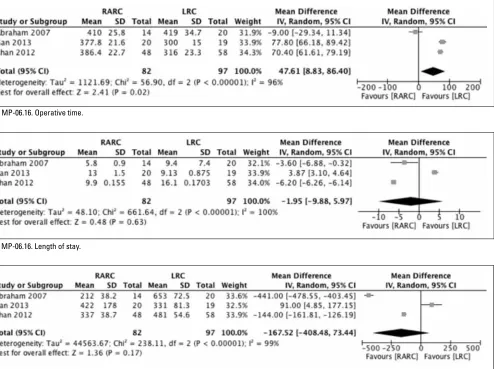
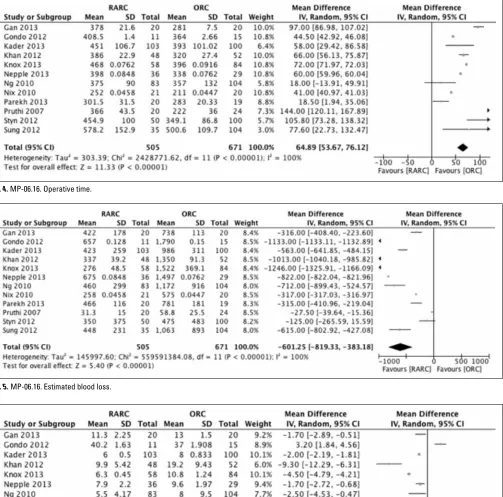
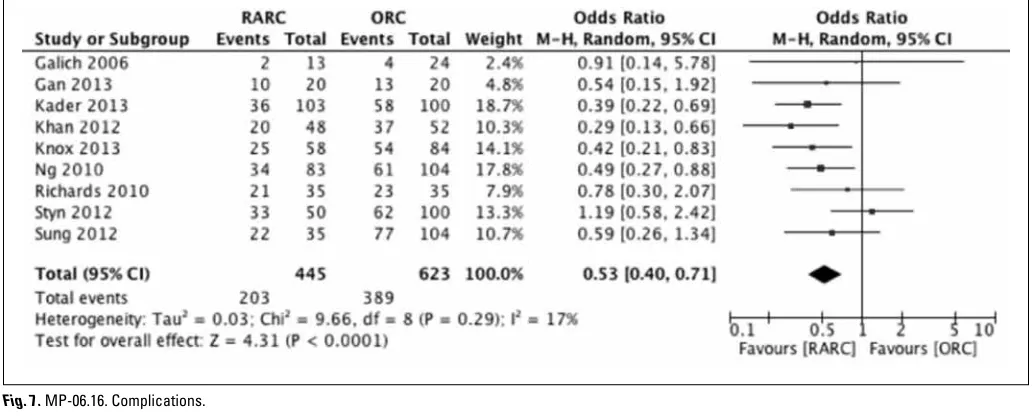
Results: Eighteen studies were selected. A total of 1,735 cases were ana-lyzed, with 997 (57.5%) undergoing ORC, 117 (6.74%) LRC and 621 (35.8%) RARC. Refer to Fig. 1 to 13 for Forest plots. The Forest plots showed RARC had significantly lower length of stay, estimated blood loss and complication rate compared to ORC. RARC had no better surgical
outcomes than LRC, only a longer operative time. LRC had better surgi-cal outcomes than ORC. There were no significant differences regarding oncological outcomes comparing RARC to ORC and LRC to ORC. Conclusions: RARC is comparable to LRC, yet produces better surgical results than ORC. LRC has better surgical outcomes than ORC, though oncological outcomes are equivalent. Oncological outcomes are also equivalent between RARC and ORC. With the unique technological fea-tures of the robotic surgical system and increasing trend of intra-corporeal reconstruction it is likely that RARC will become the surgical option of choice as spread of technology increases.
Fig. 1. MP-06.16. Operative time.
Fig. 2. MP-06.16. Length of stay.
Fig. 4. MP-06.16. Operative time.
Fig. 5. MP-06.16. Estimated blood loss.
Fig. 7. MP-06.16. Complications.
Fig. 8. MP-06.16. Lymph node yield.
Fig. 10. MP-06.16. Operative time.
Fig. 11. MP-06.16. Estimated blood loss.
Fig. 12. MP-06.16. Length of stay.