The management of rectal bleeding following transrectal prostate
biopsy: A review of the current literature
Cite as: Can Urol Assoc J 2018;12(3):E146-53. http://dx.doi.org/10.5489/cuaj.4660
Published online December 22, 2017
Abstract
Introduction: Since the advent of prostate-specific antigen (PSA)-based testing, transrectal ultrasound (TRUS)-guided prostate biopsy has become a standard part of the diagnostic pathway for prostate cancer (PCa). Rectal bleeding is one of the common side effects of this transrectal route. While rectal bleeding is usually mild and self-limiting, it can be life-threatening. In this article, we examine rectal bleeding post-TRUS-guided prostate biopsy and explore the literature to evaluate techniques and strategies aimed at preventing and managing this common and important complication. Methods: A PubMed literature search was carried out using the keywords “transrectal-prostate-biopsy-bleed.” A search of the bib-liography of reviewed studies was also conducted. Additionally, papers in non-PubMed-listed journals of which the authors were aware were appraised.
Results: Numerous modifiable risk factors for this bleeding com-plication exist, particularly anticoagulants/antiplatelets and the number of core biopsies taken. Successfully described corrective measures for such rectal bleeding include tamponade (digital/ packs/catheter/tampon/condom), endoscopic sclerotherapy/band-ing/clipping, radiological embolization, and surgical intervention. Conclusions: We advocate early consultation with the colorec-tal/gastroenterology and interventional radiology services and a progressive, stepwise approach to the management of post-biopsy rectal bleeding, starting with resuscitation and conservative tam-ponade measures, moving to endoscopic hemostasis ± radiological embolization ± transanal surgical methods. Given the infrequent but serious nature of major rectal bleeding after TRUS biopsy, we recommend the establishment of centralized databases or registries forthwith to prospectively capture such data. To the best of our knowledge, this is the first comprehensive look specifically at the management of post-TRUS biopsy rectal bleeding.
Introduction
Central to prostate-specific antigen (PSA)-based testing for prostate cancer (PCa) is the role of transrectal ultrasound (TRUS)-guided prostate biopsy. It is estimated that more than one million TRUS-guided prostate biopsies are cur-rently performed annually in both the U.S. and Europe.1
Furthermore, active surveillance (AS) protocols for low-risk PCa have become established in various guidelines, including the European Association of Urology (EAU) PCa guidelines.2 AS typically involves repeat prostate biopsies at
predefined followup intervals, often as frequently as yearly.3,4
Thus, as AS gains increasing acceptance, the number of prostate biopsies will increase.5
TRUS-guided prostate biopsy can cause several potential complications, including hematospermia (37.4%), hematuria (14.5%), rectal bleeding <2 days (2.2%), rectal bleeding >2 days ± intervention (0.7%), sepsis (0.8%), or urinary reten-tion (0.2%).2 The literature reports higher rectal bleeding
rates — in one prospective study, 25% of patients experi-enced a rectal bleed after biopsy.6 Enlund et al also showed a
22% immediate post-biopsy rate of hematochezia, which fell to 3% at three days and 0.5% at seven days.7 Massive rectal
hemorrhage post-biopsy has been reported in up to 1% of cases.8 Al-Otaibi et al report a case of rectal bleeding
precip-itating disseminated intravascular coagulation that required intensive care unit (ICU) treatment and correction of acute renal failure, pulmonary edema, and atrial fibrillation.9 A
large anterior rectal wall hematoma with near total occlu-sion of the rectal lumen following a TRUS-guided prostate biopsy has also been reported and sizeable prevesical space of Retzius hematomas have likewise been described.10,11
Furthermore, case reports describe severe rectal bleeding more than two weeks after prostate biopsy requiring endo-scopic hemostatic treatment.12 Severe rectal bleeding is thus
an uncommon but potentially life-threatening complication and one of which both patients and practitioners should be aware.13 Post-biopsy rectal bleeding is most commonly just a
Clavien-Dindo Grade 1 complication, but as outlined above, on occasion, it can result in Grade 2 (e.g., blood
transfu-Mark R. Quinlan, MD
1; Damien Bolton, MD
1; Rowan G. Casey, MD
2sion required) to Grade 4 (e.g., organ dysfunction and ICU management) sequelae.
Transperineal (TP) and magnetic resonance imaging (MRI) fusion biopsies are emerging as alternatives to TRUS biopsy, but they have not yet replaced TRUS biopsy due to their increased costs, requirement for general anaesthesia (GA), and lack of widespread availability. In the case of TP biopsies, in one study, a hemorrhagic complication of any type occurred in just 1.8% of cases and none were reported as severe.14 A comparative study of TRUS biopsy
vs. TP biopsy showed remarkably greater incidence rates of post-biopsy rectal bleeding (50.5% vs. 3.4%; p>0.01) in the former group.15 MRI-guided prostate biopsy appears to
offer no advantage over traditional TRUS biopsy in terms of incidence and duration of bleeding complications.16
The prostate and surrounding rectal tissue are supplied by a rich vascular network consisting of branches of the inferior vesical artery and the superior (SRA), middle (MRA) and inferior rectal (IRA) arteries. The rectal venous plexus is also dense in the submucosal space of this region. Specifically, reports suggest that it may be the SRA and MRA that bleed after biopsy.13,17 Other reports suggest it is the rectal venous
plexus that bleeds.18 Regardless of the precise bleeding
source, the anterior rectal wall is classically the location of the haemorrhage.8,19 Baum et al contend that rectal
bleed-ing occurs every 15 minutes, as the ampulla fills with blood stimulating the urge to evacuate.20
This review examines rectal bleeding post TRUS-guided prostate biopsy. We explore the literature to evaluate risk factors (RFs) for its development and techniques aimed
pri-marily at managing but also preventing this infrequent, but occasionally very significant complication.
Methods
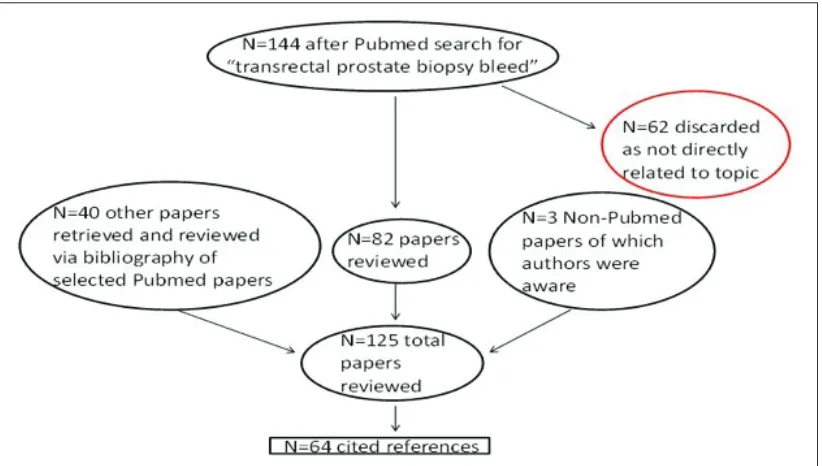
A PubMed literature search was conducted using the key-words “transrectal-prostate-biopsy-bleed.” This search yielded 144 “hits” going back to 1970. Sixty-two of these were imme-diately dismissed, as they weren’t directly relevant to our review topic. Not all of the 82 papers that were reviewed were ultimately included in our bibliography, as some merely echoed what other papers had reported while others added little. A manual search of the bibliography of reviewed stud-ies was also conducted. Additional papers in non-PubMed-listed journals of which the authors were aware were also appraised. Published guidelines from the EAU were included in the literature search process. We also included an “epide-miological” paper that looked at a classification system for surgical techniques. In all, 135 papers were reviewed; 68 are cited in our bibliography (Fig. 1). Eight papers provide level 1 evidence and two provide level 4 evidence. All others pro-vide level 2 or 3 epro-vidence (Table 1). Importantly, there is no consistent or specific definition for what constitutes “severe” or “massive” or “life-threatening” bleeding, but hemodynamic instability and the need for blood transfusion were taken as evidence of such bleeding. To the best of our knowledge, this is the first comprehensive review paper looking specifically at post-TRUS biopsy rectal bleeding.
Results
RFs
Several modifiable RFs that may increase the likelihood of post-TRUS biopsy rectal bleeding have been described.
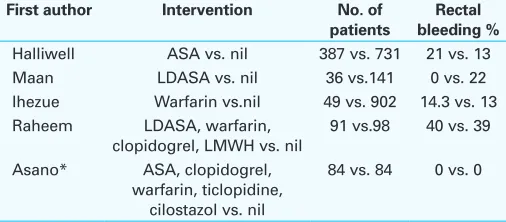
Anticoagulants/antiplatelets (Table 2)
Much attention has understandably focused on the wide-spread use of anticoagulant and antiplatelet agents, with acetylsalicylic acid (ASA) being the most ubiquitous of these and thus the most comprehensively studied. Definitive guidelines regarding the management of these medications before a TRUS biopsy are yet to be established. One study reports that nearly 60% of consultant members of the British Association of Urological Surgeons will continue ASA prior to a TRUS-guided prostate biopsy, while only 8% will con-tinue clopidogrel and 5% will concon-tinue warfarin.21 Some
studies suggest that patients taking ASA have a significantly higher cumulative incidence of rectal bleeding, although these are considered only minor bleeding complications.22,23
Conversely, others argue that ASA does not increase the incidence of rectal bleeding and that it does not need to be discontinued beforehand.24
In Carmignani’s meta-analysis, the occurrence of rectal bleeding was not statistically increased in patients taking ASA and so it was concluded that stopping ASA before TRUS biopsy is unnecessary.25 Another meta-analysis concluded
that low-dose ASA neither increases the level of the sever-ity of bleeding complications nor the perioperative mortalsever-ity because of bleeding complications, while discontinuing it increases perioperative cardiovascular risks with life-threaten-ing sequelae.26 In a review paper by the American Urological
Association on anticoagulation and antiplatelet therapy in urological practice, the authors conclude that uninterrupted use of ASA does not increase the risk of rectal bleeding after TRUS biopsy.27 Thus, they recommend continuing ASA for
patients with moderate/high thromboembolic risks.
Less information is available regarding those taking clopi-dogrel or warfarin. In one of the few studies published, the frequency and severity of bleeding complications were no
worse in the warfarin group than in the control group and the authors concluded that its discontinuation before pros-tate biopsy may again be unnecessary.28 Similarly, Halliwell
et al contend that the theoretical risk of a life-threatening bleeding complication in the patient group taking warfarin is outweighed by the risk of cardio- and cerebrovascular accidents (CVA) with the cessation of the medication.29 The
risk of CVA with a subtherapeutic international normalized ratio (INR) is estimated to be 0.003‒0.005% per day.30
Raheem et al looked at anticoagulants and antiplatelets as a combined group and concluded that it is unneces-sary to cease these agents before TRUS biopsy.31 A total of
91 and 98 patients were included in their anticoagulation/ antiplatelet (monotherapy of ASA, warfarin, clopidogrel, or low molecular weight heparin or dual therapy of ASA and warfarin or clopidogrel) and control groups, respectively. The median INR for warfarin patients was 2.35. Using a 12-core peripheral zone technique, the authors found the incidence of rectal bleeding to be similar in those taking ≤2 anticoagulants (40%) and those taking none (39%). Little has yet been reported on the effect of new oral anticoagu-lants (NOACs) on prostate biopsy bleeding rates, although one study does recommend discontinuing such agents five days pre-biopsy, bridging with therapeutic heparin and then restarting the NOAC 6‒8 hours after biopsy in the absence of worrisome bleeding.32
Interestingly, Asano et al report no statistical difference with regard to the incidence of rectal bleeding following TP prostate biopsy between those taking antithrombotic agents and those not.14
Antibiotics
Prophylactic antibiotics are routinely prescribed pre-biopsy. The quinolones (especially ciprofloxacin) are most com-monly used, as they have good pathogen coverage and excellent prostate penetration. Common alternatives are co-trimoxazole, cephalosporins, and metronidazole. All of these antibiotics facilitate the action of warfarin and this is
Table 1. Levels of evidence as used in our study
1a Meta-analysis of randomized trials 1b ≥1 randomized trial
2a Well-designed, controlled study without randomization 2b Well-designed, quasi-experimental study
3 Non-experimental study (comparative, correlation, case reports)
4 Expert committee/opinion
Table 2. Selected studies of bleeding complications after prostate biopsy
First author Intervention No. of patients
Rectal bleeding %
Halliwell ASA vs. nil 387 vs. 731 21 vs. 13 Maan LDASA vs. nil 36 vs.141 0 vs. 22 Ihezue Warfarin vs.nil 49 vs. 902 14.3 vs. 13 Raheem LDASA, warfarin,
another important factor practitioners must consider when prescribing perioperative warfarin.33
Core biopsy number
According to the literature, the incidence of rectal bleed-ing followbleed-ing TRUS biopsy varies from 1.3‒58.6%, with a statistically significant positive correlation to the number of core samples obtained.34 Specifically, rectal bleeding is
sig-nificantly more prevalent in 12-core prostate biopsy groups than six-core groups; 12-core biopsies at a minimum are now considered the gold standard, with six-core biopsies deemed insufficient for whole gland sampling.35-37
Local anesthetic
Debate exists as to the benefit of local anesthetic (LA) admin-istration with regards to post-biopsy rectal bleeding. Some argue that LA does not reduce the risk, whereas other groups contend that LA is associated with a decreased incidence of this complication, presumably due to decreased patient discomfort and less patient movement.35,38 The addition of
epinephrine to xylocaine anesthetic solution diminished the incidence of rectal bleeding in one study.39
Other RFs
Other RFs for post-biopsy rectal hemorrhage include the presence of hemorrhoids.40 The aforementioned rectal
venous plexus can increase in size in cases of hemorrhoids.41
Some authors advise preliminary proctoscopy if hemorrhoids are suspected. Sheikh et al recommend a TP rather than a transrectal biopsy in patients with severe haemorrhoids.42
Rietbergen et al reported an increasing trend of rectal bleeding with advancing age.43 Poorly controlled
hyperten-sion and constipation have also been mooted as potential RFs which should be corrected prior to the procedure.44
The same authors propose that neovascularization related to large-volume, high-grade PCa may also contribute to exces-sive bleeding. Specifically, hypoechoic areas in the prostate are usually hypervascular; biopsying these areas might be an additional RF for bleeding, but the dilemma is that these are the precise areas most in need of sampling.45
Management
We classified the papers in the below management sec-tions according to McCulloch’s descriptive model for surgi-cal procedures/techniques delineating stages of Innovation, Development, Exploration, Assessment, and Long-term study (the IDEAL model).46 To the best of our knowledge, one paper
meets the criteria for the Development stage, three papers
meet the criteria for the Exploration phase, one paper meets the criteria for the Assessment stage while all others fall into the Innovation phase.
Conservative measures
As with any form of bleeding, initial management of mas-sive post-TRUS biopsy rectal bleeding starts with resuscita-tion according to advanced life support protocols, and blood transfusion may be necessary.44 Rectal bleeding is traditionally
managed with tamponade as the first conservative method. Digital compression of rectal bleeding can be successful in controlling bleeding.44 Rectal packs may be left in situ for a
few hours and removed slowly after the bleeding has abated.45
Tamponade by means of a transrectally inserted urethral catheter (UC), tampon, or condom is also well-described in tackling rectal bleeding post-biopsy.40,45,47,48 These are left in
situ until bleeding stops —typically 30‒60 minutes in the case of tampons.48 The normal rectal tone holds these devices
against the anterior rectal wall. One such technique involved a 28 Fr Foley UC passed through a rectal sponge and inserted with finger guidance into the rectum; the UC balloon was inflated with 20 ml of water to provide effective tampon-ade.49 Baum’s UC technique involves putting the patient in
the supine position, passing a UC per rectum, and inflating it with 45 ml of water before connecting it to straight drain-age.20 Traction is applied for 45 minutes with the UC taped
to the inner thigh. The extent of bleeding can be observed by viewing the contents of the drainage bag.
Even bigger, 60 ml balloon three-way UCs have been described.47 Still, some authors contest that Foley UC
bal-loons are not large enough to be appropriately placed over the bleeding site. The condom balloon tamponade was first reported by Gonen et al in 2004; 200 ml of water was used to inflate this for two hours.45 This device was made by
inserting a UC into a condom, which was fixed to the UC with sterile silk. The condom balloon tamponade is larger than the Foley balloon tamponade and is easily placed over the bleeding site.45 Recently, Laracy et al reported the use
of thrombin gel to achieve hemostasis after large-volume rectal bleeding.50
One method of attempting to prophylactically lower the rate of bleeding involves the insertion of a Foley UC into the rectum with inflation of the balloon to 50 cc after biop-sy. This has previously been shown to significantly reduce bleeding per rectum from 17.7% in the control group (UC inserted but balloon not inflated) to 1.5% in the non-control group.51 More recently, the insertion of a gelatin sponge
into the rectum after biopsy increased hemostasis without increasing patient symptoms.52 Park et al compared
that rectal bleeding incidence was significantly lower in the compression group.53
Endoscopic correction
Failure of a conservative approach usually mandates an endoscopic attempt at hemostasis. Indeed, early consul-tation with a gastroenterologist/colorectal surgeon with colonoscopic experience is strongly advised. Endoscopic hemostatic measures represent a safe and efficient method to control serious rectal bleeding. Sclerotherapy has been used to successfully treat life-threatening rectal bleeding and is well-described.54 Endoscopic injection of adrenaline has
traditionally been the next management step after unsuc-cessful conservative measures, with doses of 25 ml of 1:10 000 adrenaline solution reported.55 Another sclerosing agent,
polidocanol, has also been injected successfully.8 In Brullet’s
case series of 550 consecutive patients, five (1%) presented with rectal bleeding and hypovolemic symptoms shortly after TRUS biopsy.8 Endoscopic injection of adrenaline and
polidocanol achieved control of bleeding and permanent hemostasis in all. Similarly, endoscopic hemostasis with 1% athexysclerol has been achieved.19
Endoscopic banding has been deployed successfully.56,57
The bleeding point is controlled with artery forceps passed through the ring of the banding device, with the band mounted ready for application. After the band has been fired, the artery forceps are released. The band remains in situ, securing the hemostasis and sloughing off a few days later.57
The placement of endoscopic clips is now used in some centres (Fig. 2).41 Use of endoclipping has been widely
reported in gastrointestinal endoscopy for many years and so this is a potentially promising option for the management of TRUS-biopsy rectal bleeding.58 Endoclips dislodge
sponta-neously and are passed in the feces without complication.41
Endoscopic thermocoagulation using a 10 F multipolar probe with five pulses of two to four seconds each is another method described to stop rectal bleeding.59 Similarly, both
Arroja and Geraci report successful treatment of a major post-biopsy bleed with argon plasma coagulation.60,61
Arterial embolization
Historically, pelvic urological embolization consisted of internal iliac artery embolization for uncontrollable hem-orrhage from prostate and bladder malignancies.62 More
recently, prostatic arterial embolization for benign pros-tatic hyperplasia has been tried.63 In the emergency setting,
angiographic embolization has been performed to address catastrophic bleeding post-TRUS biopsy in patients deemed too unstable for colonoscopy. 64,65 It is considered to be fast,
safe, and accurate. The SRA was the source of bleeding in the former paper, believed to be the first reported case of
severe life-threatening rectal bleeding following TRUS-guided prostate biopsy effectively managed by angiographic therapy. Elsewhere, selective arterial embolization has suc-cessfully resulted in hemostasis of a large pelvic hematoma after biopsy.66 Additionally, De Beule et al report a rare case
of a post-biopsy prostate arteriovenous fistula resulting in massive rectal hemorrhage that required embolization with calibrated microparticles and microcoils after medical and endoscopic interventions had failed (Fig. 3).67 Elsewhere,
intra-arterial embolization with Gianturco-Wallace coils was performed on a post-biopsy pulsatile perineal hematoma due to a pseudoaneurysm of the left hypogastric artery.68
Surgical manoeuvres
GA and transrectal surgical correction of bleeding — over-sewing of rectal bleeding points ± packing of the rectum with gelfoam — has been reported as an option.13 This may
be performed by dilating the anus with a Parke’s retractor and suturing bleeding points in the rectal wall with a 3/0 vicryl suture. In the above case report, this technique was reported as successful when rectal tamponade with a UC, colonoscopy, and angiography had all failed to control the bleeding site. However, it’s equally important to consider surgical correction as a viable upfront option, depending on resources and circumstances, and not merely a last resort when other techniques have failed.
Conclusion
TRUS-guided prostate biopsy has become a common pro-cedure since the advent of PSA testing. Rectal bleeding is acknowledged as one of its common side effects. While this is usually mild and self-limiting, it can potentially be deadly. Debate exists as to the risk presented by
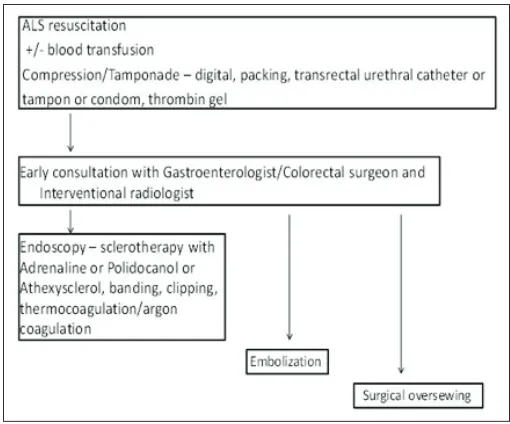
lant/antiplatelet use at the time of biopsy, although overall, the evidence appears to favour continuing such medications. Other RFs are also well-described. Patients and practitioners need to be aware of the RFs for the development of rectal bleeding following prostate biopsy, the potential severity of such bleeding, and most importantly, the appropriate mea-sures required to manage it. We advocate early consulta-tion with the colorectal/gastroenterology and intervenconsulta-tional radiology services and a progressive, stepwise approach to its management, starting with resuscitation and conserva-tive tamponade measures, moving to endoscopic hemostasis (injection/banding/clipping) ± radiological (embolization) ± transanal surgical methods depending on the clinical scenario, available resources, practitioner preference, and success of previous attempted corrective measures (Fig. 4). Major rectal bleeding post-TRUS biopsy is a rare occur-rence. This is reflected by the fact that most of the cited papers in our study are case reports, compatible with McCulloch’s innovation phase.46 To enhance our experience and expertise
in managing it, urologists should be encouraged to report cases of this complication. To facilitate this, centralized reg-istries could be established to capture all such data and a blame-free culture of open reporting needs to be fostered. Future research might also give us a greater understanding and knowledge on the topic. For example, this might include more/larger prospective, randomized, controlled trials com-paring continued anticoagulation vs. no anticoagulation vs. withheld anticoagulation, with particular emphasis on the role of NOACs. In addition, studies comparing the efficacy,
cost, and morbidity of endoscopic vs. angiographic manage-ment would be of great interest.
Competing interests: Dr. Quinlan has received a travel grant from the Royal College of Surgeons of Ireland Foundation. The remaining authors report no competing personal or financial interests related to this work.
This paper has been peer-reviewed.
References
1. Loeb S, Vellekoop A, Ahmed HU, et al. Systematic review of complications of prostate biopsy. Eur Urol 2013;64:876-92. https://doi.org/10.1016/j.eururo.2013.05.049
2. European Association of Urology guidelines. Available at https://uroweb.org/guideline/prostate-cancer/?type=pocket-guidelines. Accessed Jan. 27, 2017.
3. Bul M, van den Bergh RC, Rannikko A, et al. Predictors of unfavourable repeat biopsy results in men participating in a prospective active surveillance program. Eur Urol 2012;61:370-7. https://doi.org/10.1016/j.eururo.2011.06.027
4. van den Bergh RC, Vasarainen H, van der Poel HG, et al. Short-term outcomes of the prospective mul-ticentre Prostate Cancer Research International: Active Surveillance study. BJU Int 2010;105:956-62. https://doi.org/10.1111/j.1464-410X.2009.08887.x
5. Ahmed HU, Akin O, Coleman JA, et al. Transatlantic Consensus Group on active surveillance and focal therapy for prostate cancer. BJU Int 2012;109:1636-47. https://doi.org/10.1111/j.1464-410X.2011.10633.x 6. Lee G, Attar K, Laniado M, et al. Safety and detailed patterns of morbidity of transrectal ultra-sound guided needle biopsy of prostate in a urologist-led unit. Int Urol Nephrol 2006;38:281-5. https://doi.org/10.1007/s11255-006-6671-6
7. Enlund AL, Varenhorst E. Morbidity of ultrasound-guided transrectal core biopsy of the prostate with-out prophylactic antibiotic therapy. A prospective study in 415 cases. Br J Urol 1997;79:777-80. https://doi.org/10.1046/j.1464-410X.1997.00144.x
8. Brullet E, Guevara MC, Campo R, et al. Massive rectal bleeding following transrectal ultrasound-guided prostate biopsy. Endoscopy 2000;32:792-5. https://doi.org/10.1055/s-2000-7709
9. Al-Otaibi MF, Al-Taweel W, Bin-Saleh S. Disseminated intravascular coagulation following transrec-tal ultrasound-guided prostate biopsy. J Urol 2004;171:346. https://doi.org/10.1097/01. ju.0000099351.37696.3a
Fig. 3. Control angiography after embolization with microparticles (300–500 μ) and proximal microcoil (arrows) occlusion of the anastomosis of the left and right inferior prostatic arteries (reproduced with permission of author).
10. Seymour MA, Oesterling JE. Anterior rectal wall hematoma: Complication of transrectal ultrasound-guided biopsy of prostate. Urology 1992;39:177-81. https://doi.org/10.1016/0090-4295(92)90279-6 11. Choyke PL, Blei CL, Jaffe MH, et al. Prevesical hematoma: A complication of prostatic biopsy. Urol Radiol
1986;8:32-4. https://doi.org/10.1007/BF02924068
12. Van Agt G, Rojare C, Catteau S, et al. Severe late rectal bleeding after biopsy of prostate: A case report. Prog Urol 2010;20:389-91. https://doi.org/10.1016/j.purol.2009.12.012
13. Toren P, Razik R, Trachtenberg J. Catastrophic sepsis and hemorrhage following transrectal ultrasound-guided prostate biopsies. Can Urol Assoc J 2010;4:E12-4. https://doi.org/10.5489/cuaj.785
14. Asano T, Kobayashi S, Yano M, et al. Continued administration of antithrombotic agents during transperineal prostate biopsy. Int Braz J Urol 2015;41:116-23. https://doi.org/10.1590/S1677-5538.IBJU.2015.01.16 15. Yuan LR, Zhang CG, Lu LX, et al. Comparison of ultrasound-guided transrectal and transperineal prostate
biopsies in clinical application. Zhonghua Nan Ke Xue 2014;20:1004-7.
16. Egbers N, Schwenke C, Maxeiner A, et al. MRI-guided core needle biopsy of the prostate: Acceptance and side effects. Diagn Interv Radiol 2015;21:215-21. https://doi.org/10.5152/dir.2014.14372 17. Syed MI, Chaudhry N, Shaikh A, et al. Catheter-directed middle hemorrhoidal artery
embolization for life-threatening rectal bleeding. Can J Gastroenterol 2007;21:117-23. https://doi.org/10.1155/2007/272641
18. Sopart HJ. Hemorrhage requiring transfusion from the rectal venous plexus following transrectal punch biopsy of the prostate. Z Urol Nephrol 1985;78:157-8.
19. Ustundag Y, Yesilli C, Aydemir S, et al. A life-threatening hematochesia after transrectal ultrasound-guided prostate needle biopsy in a prostate cancer case presenting with lymphedema. Int Urol Nephrol 2004;36:397-400. https://doi.org/10.1007/s11255-004-8868-x
20. Baum RD, Slade M. Use of Foley balloon tamponade in transrectal prostate biopsy hemorrhage. Urology 1988;32:181. https://doi.org/10.1016/0090-4295(88)90328-7
21. Davis NF, McGuire BB, Flood HD. Perioperative management of antithrombotic agents in urological surgery. J Clin Urol 2011;4:187-96 https://doi.org/10.1016/j.bjmsu.2010.08.004
22. Giannarini G, Mogorovich A, Selli C. Re: transrectal ultrasound-guided biopsy of the prostate: Aspirin increases the incidence of minor bleeding complications. Clin Radiol 2008;63:1386-7. https://doi.org/10.1016/j.crad.2008.06.013
23. Halliwell OT, Yadegafar G, Lane C et al. Transrectal ultrasound-guided biopsy of the prostate: Aspirin increases the incidence of minor bleeding complications. Clin Radiol 2008;63:557-61. https://doi.org/10.1016/j.crad.2007.09.014
24. Maan Z, Cutting CW, Patel U et al. Morbidity of transrectal ultrasonography-guided prostate biopsies in patients after the continued use of low-dose aspirin. BJU Int 2003;91:798-800. https://doi.org/10.1046/j.1464-410X.2003.04238.x
25. Carmignani L, Picozzi S, Bozzini G, et al. Transrectal ultrasound-guided prostate biopsies in patients taking aspirin for cardiovascular disease: A meta-analysis. Transfus Apher Sci 2011;45:275-80. https://doi.org/10.1016/j.transci.2011.10.008
26. Burger W, Chemnitius JM, Kneissl GD, et al. Low-dose aspirin for secondary cardiovascular prevention — cardiovascular risks after its perioperative withdrawal vs. bleeding risks with its continuation — review and meta-analysis. J Intern Med 2005;257:399-414. https://doi.org/10.1111/j.1365-2796.2005.01477.x
27. Culkin DJ, Exaire EJ, Green D, et al. Anticoagulation and antiplatelet therapy in urological practice: ICUD/AUA review paper. J Urol 2014;192:1026-34. https://doi.org/10.1016/j.juro.2014.04.103 28. Ihezue CU, Smart J, Dewbury KC, et al. Biopsy of the prostate guided by transrectal ultrasound:
Relation between warfarin use and incidence of bleeding complications. Clin Radiol 2005;60:459-63. https://doi.org/10.1016/j.crad.2004.10.014
29. Halliwell OT, Lane C, Dewbury KC. Transrectal ultrasound-guided biopsy of the prostate: Should warfarin be stopped before the procedure? Incidence of bleeding in a further 50 patients. Clin Radiol 2006;61:1068-9. https://doi.org/10.1016/j.crad.2006.07.011
30. Meyer JP, Gillatt DA, Lush R, et al. Managing the warfarinized urological patient. BJU Int 2003;92:351-4. https://doi.org/10.1046/j.1464-410X.2003.04359.x
31. Raheem OA, Casey RG, Galvin DJ, et al. Discontinuation of anticoagulant or antiplatelet therapy for transrectal ultrasound-guided prostate biopsies: A single-centre experience. Korean J Urol 2012;53:234-9. https://doi.org/10.4111/kju.2012.53.4.234
32. Coscarella M, Viart L, Nguyen P, et al. New oral anticoagulants and prostate biopsy: Which usual precaution should we use? Prog Urol 2015;25:510-5. https://doi.org/10.1016/j.purol.2015.04.002 33. Ramachandran N, MacKinnon A, Allen C, et al. Biopsy of the prostate guided by transrectal ultrasound:
Relation between warfarin use and incidence of bleeding complications. Clin Radiol 2005;60:1130. https://doi.org/10.1016/j.crad.2005.04.017
34. Katsinelos P, Kountouras J, Dimitriadis G, et al. Endoclipping treatment of life-threatening rectal bleeding after prostate biopsy. World J Gastroenterol 2009;15:1130-3. https://doi.org/10.3748/wjg.15.1130 35. Ghani KR, Dundas D, Patel U. Bleeding after transrectal ultrasonography-guided prostate biopsy: A study of seven-day morbidity after a six-, eight- and 12-core biopsy protocol. BJU Int 2004;94:1014-20. https://doi.org/10.1111/j.1464-410X.2004.05096.x
36. Yuen JS, Lau WK, Ng LG, et al. Clinical, biochemical and pathological features of initial and repeat transrectal ultrasonography prostate biopsy positive patients. Int J Urol 2004;11:225-31. https://doi.org/10.1111/j.1442-2042.2003.00772.x
37. Mariappan P, Chong WL, Sundram M, et al. Increasing prostate biopsy cores based on volume vs. the sextant biopsy: A prospective, randomized, controlled clinical study on cancer detection rates and morbidity. BJU Int 2004;94:307-10. https://doi.org/10.1111/j.1464-410X.2004.04928.x
38. Obek C, Onal B, Ozkan B, et al. Is periprostatic local anesthesia for transrectal ultrasound-guided prostate biopsy associated with increased infectious or hemorrhagic complications? A prospective, randomized trial. J Urol 2002;168:558-61. https://doi.org/10.1016/S0022-5347(05)64679-4
39. Sieber PR, Rommel FM, Theodoran CG, et al. Contemporary prostate biopsy complication rates in community-based urology practice. Urology 2007;70:498-500. https://doi.org/10.1016/j.urology.2007.04.019 40. Khan SA, Hu KN, Marder C, et al. Hemorrhoidal bleeding following transrectal prostatic biopsy. Etiology
and management. Dis Colon Rectum 1982;25:817-9. https://doi.org/10.1007/BF02553324 41. Ozveren B, Turkeri L. Massive rectal bleeding after prostate biopsy controlled by endoclipping in a patient
using acetylsalicylic acid. Can Urol Assoc J 2013;7:E442-4. https://doi.org/10.5489/cuaj.1390 42. Sheikh M, Hussein AY, Kehinde EO, et al. Patients’ tolerance and early complications of transrectal
sono-graphically guided prostate biopsy: prospective study of 300 patients. J Clin Ultrasound 2005;33:452-6. https://doi.org/10.1002/jcu.20168
43. Rietbergen JB, Kruger AE, Kranse R, et al. Complications of transrectal ultrasound-guided systematic sextant biopsies of the prostate: Evaluation of complication rates and risk factors within a population-based screening program. Urology 1997;49:875-80. https://doi.org/10.1016/S0090-4295(97)00100-3 44. Petroski RA, Griewe GL, Schenkman NS. Delayed life-threatening hemorrhage after transrectal prostate
needle biopsy. Prostate Cancer Prostatic Dis 2003;6:190-2. https://doi.org/10.1038/sj.pcan.4500645 45. Gonen M, Resim S. Simplified treatment of massive rectal bleeding following prostate needle biopsy. Int
J Urol 2004;11:570-2. https://doi.org/10.1111/j.1442-2042.2004.00840.x
46. McCulloch P, Altman DG, Campbell WB, et al. No surgical innovation without evaluation: The IDEAL recommendations. Lancet 2009;374:1105-12. https://doi.org/10.1016/S0140-6736(09)61116-8 47. Dauleh MI, Byrne DJ. Severe bleeding following transrectal Tru-cut prostatic biopsy. Scand J Urol Nephrol
1996;30:153-4. https://doi.org/10.3109/00365599609180908
48. Maatman TJ, Bigham D, Stirling B. Simplified management of post-prostate biopsy rectal bleeding. Urology 2002;60:508. https://doi.org/10.1016/S0090-4295(02)01772-7
49. Bekarma HJ, Smart CJ. The use of a urinary catheter and rectal sponge to tamponade severe bleed-ing followbleed-ing TRUS prostate biopsy. Ann R Coll Surg Engl 2014;96:555. https://doi.org/10.1308/ rcsann.2014.96.7.555
50. Laracy JC, Regalbuto R, Block BL. Massive rectal hemorrhage after prostate biopsy: A teachable moment. JAMA Intern Med 2016;176:1064-5. https://doi.org/10.1001/jamainternmed.2016.2525 51. Kilciler M, Erdemir F, Demir E, et al. The effect of rectal Foley catheterization on rectal bleeding
rates after transrectal ultrasound-guided prostate biopsy. J Vasc Interv Radiol 2008;19:1344-6. https://doi.org/10.1016/j.jvir.2008.06.005
52. Kobatake K, Mita K, Kato M. Effect on hemostasis of an absorbable hemostatic gelatin sponge after transrectal prostate needle biopsy. Int Braz J Urol 2015;41:337-43. https://doi.org/10.1590/S1677-5538.IBJU.2015.02.22
53. Park BH, Kim JI, Bae SR, et al. The effect of ultrasound-guided compression immediately after transrectal ultrasound-guided prostate biopsy on post-biopsy bleeding: A randomized, controlled pilot study. Int Urol Nephrol 2017;49:1319-25. https://doi.org/10.1007/s11255-017-1607-x
54. Pacios E, Esteban JM, Breton ML, et al. Endoscopic treatment of massive rectal bleeding fol-lowing transrectal ultrasound-guided prostate biopsy. Scand J Urol Nephrol 2007;41:561-2. https://doi.org/10.1080/00365590601116832
55. Braun KP, May M, Helek C, et al. Endoscopic therapy of a massive rectal bleeding after prostate biopsy. Int Urol Nephrol 2007;39:1125-9. https://doi.org/10.1007/s11255-007-9175-0
56. Strate LL, O’Leary MP, Carr-Locke DL, et al. Endoscopic treatment of massive rectal bleeding following prostate needle biopsy. Endoscopy 2001;33:981-4. https://doi.org/10.1055/s-2001-17920 57. Harris MA, Chadwick D, Ward DC. A novel way of controlling rectal bleeding after transrectal
ultra-sonography-guided prostate biopsies. BJU Int 2004;93:1358. https://doi.org/10.1111/j.1464-410X.2004.4886a.x
58. Raju GS, Gajula L. Endoclips for GI endoscopy. Gastrointest Endosc 2004;59:267-79. https://doi.org/10.1016/S0016-5107(03)02110-2
59. Kinney TP, Kozarek RA, Ylvisaker JT, et al. Endoscopic evaluation and treatment of rectal hemorrhage after prostate biopsy. Gastrointest Endosc 2001;53:117-9. https://doi.org/10.1067/mge.2001.110919 60. Arroja B, Goncalves C, Silva F, et al. Major rectal bleeding following transrectal needle prostate biopsy.
Endoscopy 2009;41 Suppl 2:E145. https://doi.org/10.1055/s-0028-1119724
61. Geraci G, Sciume C, Pisello F, et al. [Severe rectal bleeding after transrectal US-guided prostate biopsy]. Case report. G Chir 2006;27:321-3.
63. Bilhim T, Pisco J, Rio Tonto H, et al. Unilateral vs. bilateral prostatic arterial embolization for lower urinary tract symptoms in patients with prostate enlargement. Cardiovasc Intervent Radiol 2013;36:403-11. https://doi.org/10.1007/s00270-012-0528-4
64. Ihimoyan A, Maddela R, Kalakada N, et al. Severe life-threatening rectal bleed after prostate biopsy requiring angiographic therapy: A case report. Gastroenterology Res 2010;3:213-5. https://doi.org/10.4021/gr237w
65. Kaneko T, Suzuki T, Matsushita N, et al. Transcatheter arterial embolization for bleeding of prostatic artery after prostate biopsy. Nihon Hinyokika Gakkai Zasshi 2003;94:693-5. https://doi.org/10.5980/ jpnjurol1989.94.693
66. Anjum MI. Pelvic haematoma following trucut biopsy of the prostate. Int Urol Nephrol 1996;28:781-5. https://doi.org/10.1007/BF02550727
67. De Beule T, Carels K, Tejpar S, et al. Prostatic biopsy-related rectal bleeding refractory to medical and endoscopic therapy definitively managed by catheter-directed embolotherapy: A case report. J Med Case Rep 2015;9:242. https://doi.org/10.1186/s13256-015-0727-0
68. Vallina Vazquez MJ, Gutierrez Julian JM, Vega Gutierrez F, et al. Pulsatile perineal hematoma after transrectal prostatic biopsy. Arch Esp Urol 1999;52:998-1002