R E S E A R C H
Open Access
Predicting the effectiveness of drug
interventions with ‘HIV counseling & testing’
(HCT) on the spread of HIV/AIDS: a theoretical
study
Priti Kumar Roy
1*and Shubhankar Saha
1*Correspondence:
1Department of Mathematics,
Jadavpur University, Kolkata, India
Abstract
In this paper, a dynamic compartmental model is constructed for the transmission of HIV/AIDS receiving drug treatment and knowledge from effective awareness programs through media. Using stability theory of differential equations the model is analyzed qualitatively. The equilibrium points in the local and global stability proof are found to be stable under certain conditions. Further, we use Pontryagin’s Minimum Principle in the time-dependent constant control case to derive necessary conditions for the optimal control of the disease. Sensitivity analysis is also performed to check the robustness of the model with respect to small changes in parametric values of the system. In order to predict the long term dynamics of the disease, projections are made. These studies reveal that HIV incidence could be substantially reduced by improving the test-and-treat strategy and implication of media awareness.
Keywords: Epidemic model; HIV; Drug-dosing; Awareness programs; Basic reproductive number; Local & global stability; Numerical simulation; Sensitivity analysis
1 Introduction
According to the report from the US Centers for Disease Control and Prevention, acquired immune deficiency syndrome (AIDS) was first identified as a distinct infectious disease in the year 1981. Since then, more than 70 million people have been infected and about 35 million people have already died of this disease. World Health Organization (WHO) reported that globally, there were 36.9 million people who were living with HIV at the end of 2017 and 940,000 people died of HIV-related illnesses worldwide in the same year. Can you imagine what would happen if this number of deaths still happen for next few years? Nevertheless, there is no room for complacency. Countries need to live up their com-mitment, adopted by the United Nations General Assembly in September 2015, to end the AIDS epidemic as a public health threat by 2030. The immediate challenge is to reach the Fast-Track targets for 2020, and a rational step should be immediately taken to make people aware about the disease, and its preventive measures, through the media, as HIV-related deaths are still unacceptably high.
Recent studies suggested that education and media have a great visitation in preventing the spread of HIV/AIDS among married couples in Bangladesh [1,2]. Broadcast media, being the primary source of information, can not only increases the governmental health care involvement to control the spread of HIV but also makes people acquainted with the disease. Del Valle et al. (2004) studied the effects of education, temporary vaccination, and treatment on HIV transmission in a homosexually active population [3]. It was suggested by them that along with proper vaccination and treatment, awareness programs could be one of the effective solutions in reduction of such diseases. Gumel et al. (2004) worked on determining the optimal vaccine coverage and efficacy levels needed for community-wide eradication of HIV [4]. Baryarama et al. (2005) worked on a mathematical model and explained that there is a tendency for the epidemic to stabilize at higher numbers of infec-tives and AIDS cases than the minimum numbers attained during the first decline of the epidemic [5]. Hove-Musekwa et al. (2009) worked to determine the effects of carriers and randomly screened carriers, who are aware of their status, on the transmission of HIV [6]. Tripathi et al. (2007) also proposed a model presented without interventions, which con-siders infection leading to asymptomatic HIV infectives who are later screened and finally develop AIDS [7]. A similar approach was undertaken earlier by Hyman et al. (2003) with differential infectivity and staged progression models [8]. In our recent works, we have shown that the incidences can be controlled if people take obligatory precautions to make themselves protected [9,10]. They can minimize the risk if they become well-informed and aware about the prevalence. Other research articles are also studied to improve this modeling process [11–14].
These studies have motivated us to formulate a mathematical model that incorporates both of these events: test-and-treat program and media awareness. In the modeling pro-cess, we assume that the growth rate of the cumulative density of awareness programs driven by the media is proportional to the number of untreated infectives present in the population. The whole population is divided into five separate classes; high-risk unaware susceptible class, class of non-diagnosed HIV infected individuals, diagnosed class of HIV-positive individuals who have not yet progressed to AIDS, class of those individuals with clinical AIDS, and aware susceptible class. We also discuss the equilibrium points and their stability. Finally, we solve the model numerically and then discuss the results from the biological aspect.
2 The model
We formulate a mathematical model which considers voluntary counseling and testing followed by immediate initiation of drug therapy, where HIV-positive individuals were identified and immediately received anti-retroviral treatment. Following this assumption, we consider a region with total populationN(t) at any instant of timet. The whole popula-tion is subdivided into five classes, that are: unaware susceptibles,S(t); aware susceptibles,
with possession of awareness may lose it with the passage of time, due to memory fad-ing or other reasons. On the basis of the assumptions above, the dynamics of model are governed by the following system of nonlinear ordinary differential equations:
dS
dt =Π–β(I+λ1ID+λ2IDA)S–dS–cSM+ωS+, dI
dt =β(I+λ1ID+λ2IDA)S– (δ+d+dI)I, dID
dt =ρδI–
ξ+d+αI
ID,
dIDA
dt = (1 –ρ)δI+ξ I
D– (d+αA)IDA,
dS+
dt =cSM– (d+ω)S+, dM
dt =μ(ID+IDA) –μ0M,
(1)
with initial valuesS(0) =S0,I(0) =I0,ID(0) =ID0,IDA(0) =IDA0,S+(0) =S+0 andM(0) =M0
att= 0, andξ=ξ(1 –η), whereηis effectiveness of the drug input andξ represents the rate of progression from HIV diagnosis to the AIDS class.
Here, the constant recruitment rate in the susceptible population isΠeither by birth or immigration. There is a constant natural death rated.βis the product of the effective con-tact rate between susceptible and infected individuals to result in HIV infection and the transmission probability of HIV per contact.λ1,λ2are the modification factors account-ing for varyaccount-ing levels of the activity and infectiousness of the diagnosed HIV-positive in-dividuals and the AIDS patients, respectively. The dissemination rate of awareness among susceptible, at which they form theaware class, is represented byc. The transfer rate from aware susceptible to unaware susceptible class is denoted asω.δis the diagnosis rate and
dI is the natural death rate of infected individuals.ρis the proportion of diagnosed indi-viduals who have not yet developed to AIDS (0≤ρ≤1). Here,αI andαD are additional death rates for the diagnosed HIV-positive individuals and for those who are AIDS in-fected, respectively. The parameterμis the proportionality constant which governs the implementation of awareness programs andμ0denotes the depletion rate of these pro-grams due to ineffectiveness, public interests, social problems, etc.
Throughout this paper, to shorten the notation, we use the following notations:μ1= δ+d+dI,μ2=ξ+d+αI,μ3=d+αA,μ4=d+ω.
2.1 Model properties:
System (1) will be analyzed in a domainD⊂R6+, where all feasible solutions enter the region
D=
(S,I,ID,IDA,S+,M)∈R6+: 0≤N≤ Π
d, 0≤M≤
μΠ μ0d
. (2)
Theorem 2.1 The solutions of system(1)with initial conditions satisfy S(t) > 0,I(t) > 0,
ID(t) > 0,IDA(t) > 0,S+(t) > 0,M(t) > 0for all t> 0.The regionD∈R6+is positively invariant
Proof From the first equation of (1) we have
˙
S≥–β(I+λ1ID+λ2IDA) +d+cM
S,
giving
S(t)≥S(0)exp
–
t
0
β(I+λ1ID+λ2IDA) +d+cM
ds
> 0.
In a similar fashion we can show thatI(t),ID(t),IDA(t), andS+(t) are all strictly positive. Thus we can conclude that all solutions of system (1) remain positive for allt> 0. Now, we will show that all feasible solutions are uniformly bounded inD. Using the fact that
N=S+I+ID+IDA+S+, we get
˙
N=Π–dN–dII–αIID–αAIDA≤Π–dN.
Solving this differential equation, we have
0≤N(t)≤Π
d +N(0)e
–dt,
where N(0) represents the initial value of the total population at timet= 0. Thus, 0≤
N(t)≤Π
d hold, ast→ ∞. Therefore, it is clear from the above thatΠ/dis an upper bound of N, providedN(0)≤Π/d. IfN(0) > Πd, thenN will decrease to this level. Hence, all feasible solutions of the system attracted or remain in the regionD. Further, the usual existence, uniqueness, and continuation results hold for the system in this region.
3 Analysis of equilibria
In this section, we focus on the existence and stability of equilibria for system (1). The equilibrium points are obtained by equating the right-hand side of each equation in (1) to zero and it is found that system (1) has two non-negative equilibria.
Let (S∗,I∗,ID∗,IDA∗ ,S∗+,M∗) denote an equilibrium point. Clearly, from the third equation we have ID∗ =μρδ
2I
∗, then from the fourth equationI∗
DA=
δ μ2μ3[ρξ
+ (1 –ρ)μ
2]I∗. Next, from the second equation we obtain two possibilities: either I∗ = 0 orβS∗[1 +λ1μρδ2 +
λ2μ2δμ3(ρξ
+ (1 –ρ)μ
2)] =μ1. In the first case we subsequently obtain M∗ = 0 from the sixth equation,S∗+= 0 from the fifth equation, andS∗=Πd =:S0 from the first one, which gives us disease-free equilibrium (DFE). In the latter case we easily see thatS∗=
μ1
β[1+λ1μρδ2+λ2
δ
μ2μ3(ρξ+(1–ρ)μ2)]
> 0 and all other coordinates of this equilibrium point are
de-pendent on the value ofI∗, namelyS+∗=μc
4S
∗M∗andM∗= μδ
μ0μ2μ3[ρ(μ3+ξ
) + (1 –ρ)μ
2]I∗, which allows to calculateI∗from the first equation. We obtain
Π–μ1I∗–dS∗–d
c
μ4
S∗ μδ
μ0μ2μ3
ρμ3+ξ
+ (1 –ρ)μ2
I∗= 0,
⇒ I∗= Π–dS
∗
μ1+ cdS
∗μδ
μ0μ2μ3μ4[ρ(μ3+ξ
) + (1 –ρ)μ
2] .
3.1 Disease-free equilibrium (DFE) and basic reproduction numberR0
The model has always a disease-free equilibriumE0= (S0, 0, 0, 0, 0, 0) = (Πd, 0, 0, 0, 0, 0). Lo-cal stability of E0 is governed by basic reproduction number R0; cf. [15]. Biologically speaking, R0 is an average number of new secondary infections generated by a single HIV infected individual, introduced into a susceptible population. The basic reproduc-tion numberR0could be determined using the next generation approach [15]. Using this approach we need to renumber the model variables in such a way that compartments re-flecting infected individuals are at the beginning, so we havex= (I,ID,IDA,S,S+,M)T, with the number of infected compartments equal to 3. Now, byXS we denote the set of all disease-free states,XS={x≥0 :xi= 0 fori= 1, 2, 3}. System (1) shall be written in the form
˙
xi=fi(x) =Fi(x) –Vi(x), i= 1, 2, . . . , 6,
whereFidescribes a rate of appearance of new infections in compartmenti, whileVi= V–
i –Vi+andVi+is a rate of transfer into the compartmenti,Vi–is a rate of transfer out of the compartmenti. The following assumptions are to be posed:
• (A1)Fi(x)≥0,Vi+(x)≥0,Vi–(x)≥0for anyx≥0; • (A2) ifxi= 0, thenVi–= 0;
• (A3)Fi= 0fori> 3;
• (A4) ifx∈XS, thenFi(x) = 0andVi+(x) = 0fori= 1, 2, 3;
• (A5) ifx0is DFE, then eigenvalues of the Jacobi matrixDf(x0)restricted to the subspaceF= 0have all eigenvalues with negative real parts.
According to Lemma 1 in [15] tral radius). Eventually, according to Theorem 2 in [15], we know thatx0is locally asymp-totically stable forR0< 1 and unstable for reverse inequality.
It is obvious thatF,V+,V–satisfy Assumptions (A1)–(A4). Moreover,
Let us calculateR0. The matricesFandVfor new infection terms and remaining trans-fer terms are respectively given by
F= locally asymptotically stable.
Notice that, the inequalityR0< 1 is equivalent toS∗>S0which means that the positive equilibrium EE does not exist. On the other hand, if EE exists, then DFE is unstable.
3.2 Endemic equilibrium (EE) and its stability
Remark Observe from the expression ofI∗that whenR0> 1, the endemic equilibrium exists. We thus have the existence condition of the endemic equilibria. It is also important to note that ∂∂Ic∗ and∂∂δI∗ are negative. This means, as long as infected individuals become aware and go under treatment, the equilibrium level of unaware and untreated infectives starts to decrease. This shows that the dissemination rate and the treatment rate really have significant input in HIV control.
In order to attain full characterization of the endemic equilibrium E∗, we study the asymptotic stability behavior using Lyapunov’s stability theory. If this function has only a single minimum, i.e., an equilibrium point, and it is strictly decreasing along all non-equilibrium solutions, then all solutions tend to the non-equilibrium point where the scalar function (Lyapunov function) is minimum. The results obtained by performing local and global stability analysis of the obtained equilibria are stated in the following theorems.
Theorem 3.2 The endemic equilibrium E∗ is locally asymptotically stable(LAS)inD,
provided the inequalities hold:
ψ3ξ2<
Theorem 3.3 The endemic equilibrium E∗is globally asymptotically stable(GAS)inD,
provided the following inequalities hold:
For the proof of Theorems3.2and3.3see Appendices1and2, respectively.
4 Optimal control strategy
In this section, we formulate an optimal control problem using Pontryagin minimum prin-ciple [16] in order to obtain an optimal strategy for our epidemiological system (1). Gener-ally we solve these types of problems by finding the time-dependent profiles of the control variable to optimize a particular performance. It is apparent from our previous discussion that to control the spread of HIV/AIDS, it is obligatory to propagate awareness amongst individuals. In this section, we consider a control problem together with the mathematical model described by equation (1) with the objective function given by
Ju1(t),u2(t)
= tf
t0
Pu21(t) +Qu22(t) –S+2(t)dt, (7)
whereu1(t) andu2(t) are the control variables representing efficacy of drug-dosing and implementation rate of awareness campaigns, respectively. The parametersPandQare weight constants for control inputs. The first term in (7) represents systemic cost of the drug treatments and second term represents cost associated with the implementation of awareness campaign. The objective function (7) expresses our goal to minimize costs for both drug-dosing and successful media campaigns, while maximizing aware susceptible individuals. Therefore, we seek an optimal control pair (u1,u2) such that
Ju∗1,u∗2=minJ(u1,u2) : (u1,u2)∈U
, (8)
subject to the system of ODEs
dS
dt =Π–β(I+λ1ID+λ2IDA)S–dS–cSM+ωS+, dI
dt =β(I+λ1ID+λ2IDA)S–μ1I, dID
dt =ρδI–ξ
1 –ηu1(t)
ID– (d+αI)ID,
dIDA
dt = (1 –ρ)δI+ξ
1 –ηu1(t)
ID–μ3IDA,
dS+
dt =cSM–μ4S+, dM
dt =u2(t)(ID+IDA) –μ0M,
(9)
whereU={(u1,u2) :uimeasurable, 0≤ui(t)≤1,t∈[t0,tf], fori= 1, 2}.
4.1 The optimality system
The Pontryagin minimum principle [16] converts the problem of minimizing the cost functional (8) subject to state variables into minimizing the Hamiltonian [18,19] with respect to the controls at each timet. From HamiltonianHwe have
H(S,I,ID,IDA,M,S+,u1,u2,ξ1,ξ2,ξ3,ξ4,ξ5,ξ6)
=Pu21(t) +Qu22(t) –S+2
+ξ1
Π–β(I+λ1ID+λ2IDA)S–dS–cSM+ωS+
+ξ2
β(I+λ1ID+λ2IDA)S–μ1I
+ξ3
ρδI–ξ1 –ηu1(t)
ID– (d+αI)ID
+ξ4(1 –ρ)δI+ξ1 –ηu1(t)
ID–μ3IDA
+ξ5{cSM–μ4S+}+ξ6
u2(t)(ID+IDA) –μ0M
,
whereξi(i= 1, 2, . . . , 6) are the adjoint variables.
Given an optimal control and corresponding states, there exists adjoint variableξi sat-isfying the following equations:
dξ1
dt = –
∂H
∂S =ξ1
β(I+λ1ID+λ2IDA) +d–cM
–ξ2β(I+λ1ID+λ2IDA) –ξ5cM,
dξ2
dt = –
∂H
∂I = (ξ1–ξ2)βS+μ1–ξ3ρδ–ξ4(1 –ρ)δ, dξ3
dt = –
∂H
∂ID
=λ1β(ξ1–ξ2)S+ξ3
ξ1 –ηu1(t)
+d+αI
–ξ4ξ
1 –ηu1(t)
–ξ6u2(t),
dξ4
dt = –
∂H
∂IDA
=λ2β(ξ1–ξ2)S+ξ4μ3–ξ6u2(t),
dξ5
dt = –
∂H
∂S+
= 2S+–ξ1ω+ξ5μ4,
dξ6
dt = –
∂H
∂M=ξ1cS–ξ5cS+ξ6μ0,
(10)
with transversality conditionsξi(tf) = 0 fori= 1, 2, . . . , 6.
The Hamiltonian is minimized with respect tou1andu2at the optimal value (u∗1,u∗2), so the derivative of theHwith respect tou1andu2at (u∗1,u∗2) must be zero. Now, using the fact that
H=Pu21(t) +Qu22(t) +ξ3ξ ηu1(t)ID–ξ4ξ ηu1(t)ID+ξ6u2I
+ other terms withoutu1andu2, (11)
and differentiating the expression forHwith respect tou1andu2give
∂H
∂u∗1
= 2Pu∗1(t) +ξ η(ξ3–ξ4)ID= 0, (12)
∂H
∂u∗2 = 2Qu ∗
According toPontryagin’s Minimum Principle, the unrestricted optimal controlu∗1andu∗2
satisfies ∂∂Hu = 0 at (u∗1,u∗2). So we have
u∗1(t) =ξ η(ξ4–ξ3)ID
2P , (14)
u∗2(t) = –ξ6(ID+IDA)
2Q . (15)
Since the standard control is bounded, we conclude for the controlu1that
u∗1(t) = ⎧ ⎪ ⎪ ⎨ ⎪ ⎪ ⎩
0, ifξ η(ξ4–ξ3)ID 2P ≤0;
ξ η(ξ4–ξ3)ID
2P , if 0 <
ξ η(ξ4–ξ3)ID 2P < 1; 1, ifξ η(ξ4–ξ3)ID
2P ≥1.
(16)
Hence the compact form ofu∗1is
u∗1=max
min
1,ξ η(ξ4–ξ3)ID 2P
, 0
. (17)
In a similar manner we can get the compact form ofu∗2
u∗2=max
min
1, –ξ6(ID+IDA) 2Q
, 0
. (18)
Therefore, we have the following theorem.
Theorem 4.1 If the objective cost function J(u1,u2)overUattains its minimum for the
op-timal control u∗= (u∗1,u∗2)corresponding to the endemic equilibrium(S∗,I∗,ID∗,I∗DA,S+∗,M∗),
then there exist adjoint functionsξ1,ξ2,ξ3,ξ4,ξ5,ξ6 satisfying equations(10)along with
the transversality conditionξi(tf) = 0 (i= 1, 2, . . . , 6).
5 Numerical simulation
To study the dynamical behavior of our model (1), we perform numerical computations with initial valuesS(0) = 200,I(0) = 15,ID(0) = 10,IDA= 5,S+(0) = 50, andM(0) = 5. The set of parameter values is given in Table 1. These values are cumulated from different journals and the rest are hypothetical parameters relevant to HIV/AIDS. Numerical sim-ulations are done using MATLAB (version 7.6.0).
Initially, to confirm the feasibility of our analysis regarding existence and its stability conditions for system (1), we have carried out some numerical simulations by selecting the following parametric set as described in Table1. For the set of parameter values given in Table1, it may be checked that the condition of existence of an endemic equilibriumE∗and the stability conditions are satisfied. The eigenvalues of the Jacobian matrix corresponding to the equilibriumE∗of the model system (1) are obtained as –0.8689, –0.7432, –0.3938± 0.1232i, and –0.07094±0.0383i. We note that all eigenvalues of the Jacobian matrix are either negative or have negative real parts. Hence, the endemic equilibriumE∗ is locally asymptotically stable for the above set of parameter values.
Table 1 List of parameters used for system (1)
Parameter Definition Value/year References
Π Constant recruitment rate in the susceptible population 15 [6]
β Contact rate between susceptible and infected individuals 0.002–0.2 [6]
λ1 Modification factor 0.01 Estimated
λ2 Modification factor 0.01–0.8 Estimated
μ The proportionality constant which governs the implementation of awareness programs
0.025 [9]
d Natural death rate of susceptible 0.01–0.025 [6,9]
dI Natural death rate of infected individuals 0.005–0.01 [9]
c Transfer rate of susceptible from unaware to aware class 0.00002–0.02 [9]
ω Transfer rate from aware susceptible to unaware susceptible class 0.4 [6,9]
ρ The proportion of diagnosed individuals who have not yet developed to AIDS
0.75 Estimated
δ Diagnosis rate 0.304 [9]
αI Additional death rates for the diagnosed HIV-positive individuals 0.0172 [6] αA Additional death rates for those who are AIDS infected 0.0138 [6]
μ0 Depletion rate of ineffective media programs 0.06 [9]
ξ Rate of progression from HIV diagnosis to the AIDS class 0.4 Estimated
η Effectiveness of the drug input 0.6 Estimated
u1,u2 Control variables 0.0–1.0 Estimated
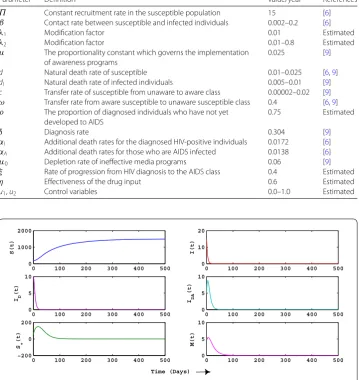
Figure 1Trajectories showing the time-dependent changes in concentration of the model variables when R0< 1
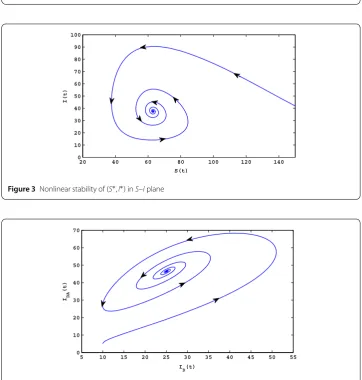
in the graphs depicting their respective individual trends forβ= 0.002 andβ= 0.005 in Figs.1and2, respectively. These figures clearly illustrate the change in equilibrium level from disease-free state to endemic state. Hence, it is clear that the state of the system depends on the disease progression rate and for high transmission rate, the system attains its endemic state. In Figs.3and4respectively, we show the nonlinear stability behaviors of (S∗,I∗) and (ID∗,I∗DA) inS–IandID–IDAspaces. These two figures convey that both the trajectories are initiating inside the region of attraction approach towards the equilibrium values (S∗,I∗) and (ID∗,IDA∗ ), respectively.
Figure 2Trajectories showing the time-dependent changes in concentration of the model variables when R0> 1
Figure 3Nonlinear stability of (S∗,I∗) inS–Iplane
Figure 4Nonlinear stability of (I∗D,I∗DA) inID–IDAplane
S+(t)) and decreasing infection incidences among the infected populations (I(t),ID(t), and
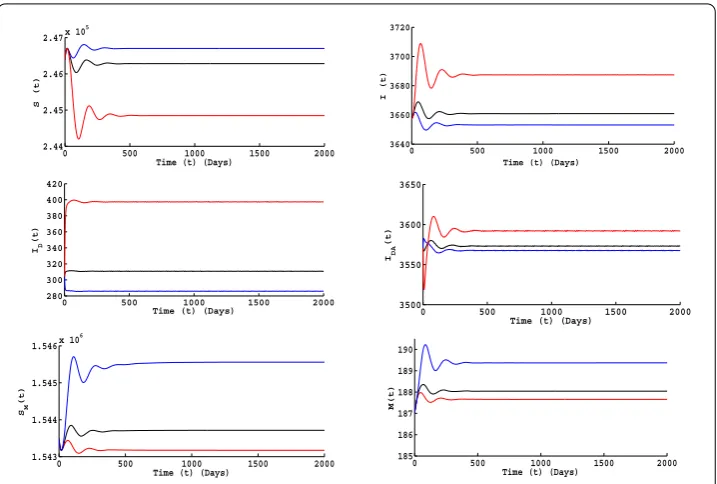
Figure 5Population graphs are plotted here for different values of (u1,u2). Red trajectories are drawn for the
pair of control input values (u1,u2= (0.0, 0.2)), whereas black and blue trajectories indicate the graphs for
(u1,u2) = (0.5, 0.4) and (u1,u2) = (0.5, 0.6), respectively
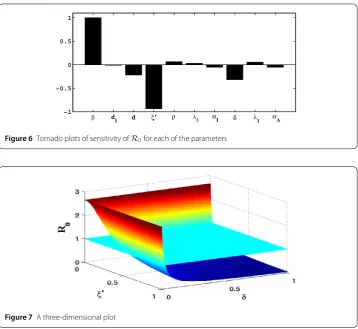
(0.5, 0.6), respectively. Noteworthily, whenu2 has greater value thanu1 (blue lines), the graph reflects more significant results rather than the case when u1>u2 (black lines). This indicates that people need to be more vigilant and aware about their personal health behavior, instead of being reluctant during therapeutic regime or engaging in sexual acts. Lastly, we use sensitivity analysis method to investigate the impact of various interven-tion measures on HIV transmission. We hope that these results obtained here could im-prove the knowledge of the effect of different interventions. Here we derive sensitivity index by using partial rank correlation coefficients (PRCC) of the basic reproductive ra-tio with respect to the parameters. The normalized forward sensitivity index ofR0with respect to a parameter‘a’is defined as follows Abiodun et al. (2013) [20]:
ΠR0
a = ∂R0
∂a × a
R0
. (19)
Figure 6Tornado plots of sensitivity ofR0for each of the parameters
Figure 7A three-dimensional plot
and drug effectiveness are highly prevailing to make a meaningful impact on the current HIV epidemic.
6 Conclusion
Developing an optimal strategy that minimizes the total number of infected individuals and the costs associated, drug-dosing and the implementation of awareness campaigns, we have extended our proposed model, where we consider that drug-dosing and imple-mentation of awareness campaigns are not constants but vary with time. The obtained op-timality system (8) subject to (9) measures a cost effective way of controlling the disease by expanding the number of effective awareness campaigning. Also, drug-dosing through an-tiviral therapy is equally important, which decelerates the AIDS progression significantly due to reduction in viral load. However, we should keep in mind that we should always run awareness campaigning in a cabalistic way so that people always keep receiving the latest information about the disease. Since it is observed that if the awareness of the lo-cal prevalence of a disease is not addressed by the media or lolo-cal health authorities, it is more likely to be raised by the acts of informal information spread. If the information about infectious disease is disseminated in the population, people regulate their behavior according to their awareness level.
Appendix 1: Proof of Theorem3.2
We consider the following positive definite function:
L=1 2s
2+ψ1 2 i
2+ψ2 2 i
2 d+
ψ3 2 i
2 da+
ψ4 2 s
2 ++
ψ5 2 m
2, (20)
whereψj(j= 1, 2, . . . , 5) are some positive constants and will be defined later. Heres,i,
id,ida,s+, andmare small perturbations inS,I,ID,IDA,S+, andMaround equilibrium
E∗, respectively, i.e., S=S∗+s, I=I∗+i, ID=ID∗ +id,IDA=I∗DA+ida, S+=S∗++s+, and
M=M∗+m. Now, differentiatingLwith respect to‘tand using the linearized system of (1) aroundE∗, we get
L= –Π+ωS+∗
S∗
s2–ψ1
μ1–βS∗
i2–ψ2μ2i2d–ψ3μ3i2da–ψ4μ4s2+–ψ5μ0m2
–βS∗–ψ1
I∗+λ1ID∗+λ2IDA∗
is+ψ1βλ1S∗+ψ2ρδ
iid+
ψ1βλ2S∗
+ψ3(1 –ρ)δ
iida+ψ3ξidida+ψ5μidm+ψ5μidam+ψ4cS∗s+m–βλ1S∗sid
+ω+ψ4cM∗
ss+–cS∗sm–βλ2S∗sida.
Now, we chooseψ1= βS
∗
(I∗+λ1ID∗+λ2IDA∗ ), so that we get
L= –Π+ωS+∗
S∗
s2– βS
∗[μ
1–βS∗] (I∗+λ1ID∗+λ2IDA∗ )
i2–ψ2μ2i2d–ψ3μ3i2da–ψ4μ4s2+–ψ5μ0m2
+
β2λ1S∗2 (I∗+λ1ID∗+λ2IDA∗ )
+ψ2ρδ
iid+
β2λ2S∗2 (I∗+λ1ID∗+λ2IDA∗ )
+ψ3(1 –ρ)δ
iida
+ψ3ξidida+ψ5μidm+ψ5μidam+ψ4cS∗s+m–βλ1S∗sid+
ω+ψ4cM∗
ss+
It is evident from equation (21) thatLwill be negative definite if the following inequalities provided the following conditions hold properly:
Condition 1: max
Condition 3: 15S
We can assert from inequalities (31)–(38) thatLis negative definite, and hence the theorem follows.
Appendix 2: Proof of Theorem3.3
To study the global stability of the endemic equilibrium, we construct the following posi-tive definite Lyapunov function:
V=1 The corresponding derivative of the Lyapunov function is given as
V=S–S∗+I–I∗+I
Using equation (1) and doing some algebraic manipulations, we get the above equation as follows: linear terms become vanished. Note that, the coefficient of (I–I∗)2is
dI+φ1μ1–φ1βS≥dI+φ1μ1–φ1β Π
d > 0
in presence of infection. Hence, we have
andVturns to this form
NowVwill be negative definite if the following conditions hold:
φ5μ2<2
and from the rest of inequalities (except (45)), we get
max
Finally, using the region of attractionD, the above inequalities (56) and (57) reduce to the third and second conditions, respectively, in Theorem (3.3), which gives sufficient condi-tions for the stability of the endemic equilibrium pointE∗, and hence the theorem follows.
Acknowledgements
The authors would like to give special thanks to Prof. Urszula Fory´s, Faculty of Mathematics, Informatics and Mechanics, Institute of Applied Mathematics and Mechanics, Warsaw University for her constructive and insightful comments, which helped us to improve the quality of this work.
Funding
INSPIRE Program (IF131081), Department of Science and Technology, Government of India is gratefully acknowledged for its financial support.
Competing interests
The authors declare that they have no competing interests.
Authors’ contributions
All authors contributed equally and significantly in this manuscript, and they read and approved the final manuscript.
Publisher’s Note
Springer Nature remains neutral with regard to jurisdictional claims in published maps and institutional affiliations.
Received: 17 January 2018 Accepted: 8 November 2018 References
1. Khanam, P.A., e Khuda, B., Khane, T.T., Ashraf, A.: Awareness of sexually transmitted disease among women and service providers in rural Bangladesh. International journal of STD & AIDS8(11), 688–696 (1997)
2. Rahman, M.S., Rahman, M.L.: Media and education play a tremendous role in mounting AIDS awareness among married couples in Bangladesh. AIDS Research and Therapy4(1), 10 (2007)
3. Del Valle, S., Evangelista, A.M., Velasco, M.C., Kribs-Zaleta, C.M., Schmitz, S.F.H.: Effects of education, vaccination and treatment on HIV transmission in homosexuals with genetic heterogeneity. Math. Biosci.187(2), 111–133 (2004) 4. Gumel, A.B., Moghadas, S.M., Mickens, R.E.: Effect of a preventive vaccine on the dynamics of HIV transmission.
Commun. Nonlinear Sci. Numer. Simul.9(6), 649–659 (2004)
6. Hove-Musekwa, S.D., Nyabadza, F.: The dynamics of an HIV/AIDS model with screened disease carriers. Comput. Math. Methods Med.10(4), 287–305 (2009)
7. Tripathi, A., Naresh, R., Sharma, D.: Modeling the effect of screening of unaware infectives on the spread of HIV infection. Appl. Math. Comput.184(2), 1053–1068 (2007)
8. Hyman, J.M., Li, J., Stanley, E.A.: Modeling the impact of random screening and contact tracing in reducing the spread of HIV. Math. Biosci.181(1), 17–54 (2003)
9. Roy, P.K., Saha, S., Al Basir, F.: Effect of awareness programs in controlling the disease HIV/AIDS: an optimal control theoretic approach. Adv. Differ. Equ.2015(1), 217 (2015)
10. Saha, S., Roy, P.K.: A comparative study between two systems with and without awareness in controlling HIV/AIDS. Int. J. Appl. Math. Comput. Sci.27(2), 337–350 (2017)
11. Wang, Y., Cao, J.: Global stability of general cholera models with nonlinear incidence and removal rates. J. Franklin Inst.352(6), 2464–2485 (2015)
12. Wang, Y., Cao, J.: Global stability of a multiple infected compartments model for waterborne diseases. Commun. Nonlinear Sci. Numer. Simul.19(10), 3753–3765 (2014)
13. Chatterjee, A.N., Roy, P.K.: Anti-viral drug treatment along with immune activator IL-2: a control-based mathematical approach for HIV infection. Int. J. Control85(2), 220–237 (2012)
14. Chatterjee, A.N., Saha, S., Roy, P.K.: Human immunodeficiency virus/acquired immune deficiency syndrome: using drug from mathematical perceptive. World J. Virol.4(4), 356 (2015)
15. Van den Driessche, P., Watmough, J.: Reproduction numbers and sub-threshold endemic equilibria for compartmental models of disease transmission. Math. Biosci.180(1–2), 29–48 (2002)
16. Pontryagn, L.S.: Selected Research Papers. CRC Press, Boca Raton (1987)
17. Fleming, W.H., Rishel, R.W.: Deterministic and Stochastic Optimal Control, vol. 1. Springer, Berlin (2012)
18. Kamien, M.I., Schwartz, N.L.: Dynamic Optimisation. The Calculus of Variations and Optimal Control in Economics and Management, 2nd edn. North-Holland, New York (1991)
19. Lakshmikantham, V., Trigiante, D.: Theory of Difference Equations: Numerical Methods and Applications, vol. 251, pp. x+–300. Dekker, New York (2002)