R E S E A R C H
Open Access
Data collection for mobile crowdsensing in
the presence of selfishness
Jieyan Liu
1*, Lubomir Bic
2, Haigang Gong
1and Siyu Zhan
1Abstract
Mobile crowdsensing is an emerging approach to data collection by exploiting the sensing abilities offered by smart phones and users’ mobility. Data collection can be implemented by exploiting the forwarding opportunities given by the contacts between nodes. However, as cell phones are still resource constrained, most people are socially selfish so that they may not always cooperate with each other in data collection. In this paper, we propose a routing protocol, called Accept aNd Tolerate (ANT), which is tailored for data collection in a social environment with selfish individuals. ANT works by accepting and tolerating social selfishness as an unavoidable human
characteristic. It makes relay selection based on nodes’contacts and their willingness to cooperate. The cooperative willingness of selfish nodes is measured rationally according to the reciprocity relationship between nodes and their resource constraints. Through assessing the worthiness of carrying and forwarding a packet, ANT proposes a buffer management scheme and makes forwarding decisions. Simulations based on real traces show that ANT achieves better performance under resource-constrained circumstances than other comparable approaches.
Keywords:Selfishness, Routing, Data collection, Cooperative willingness
1 Introduction
Mobile crowdsensing is a novel approach that exploits the sensing capabilities offered by smart devices such as smart phones to sense and generate collective knowledge about a phenomenon or condition of interest [1]. These data may be measurement samples, text, and even pho-tographs or video clips. Since it can utilize the mobility of users to solve large-scale mobile-sensing tasks, it has stimulated a number of attractive applications, such as urban WiFi characterization [2], traffic information map-ping and parking space management [3], environmental monitoring, and social journalism.
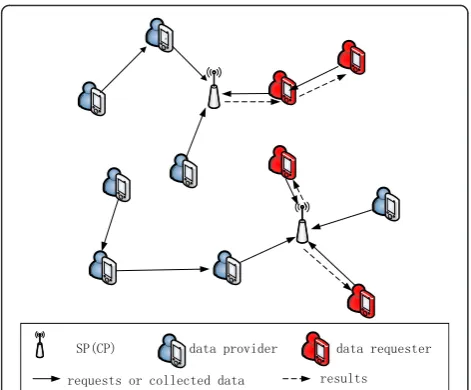
A typical mobile crowdsensing system is shown in Fig. 1. It involves three main actors: (1) the end users (data providers) who contribute the sensor data, (2) the service provider (SP, also viewed as the collection point (CP)) processing the collected data to generate a service from them, and (3) the end users (data requesters) who request this service [4, 5]. Data collection (including re-quest collection from the data rere-questers and data
collection from the data providers) is an essential block to build mobile crowdsensing systems [6, 7]. Some current literature assumes that the end users use the cel-lular network resources for transferring data to the col-lection point as soon as these are generated by their devices sensors. However, this approach increases the communication cost and generates additional workload for the cellular network. This problem becomes worse when large amounts of data are generated (e.g., when the data type is quality photo) or when it takes place during the network busy hours. Opportunistic network-ing is viewed as a promisnetwork-ing complement to cellular networks in different respects, e.g., for offloading delay-tolerant traffic load from them [8]. Thus, data collection in mobile crowdsensing can be implemented by using the contact opportunities among nodes when the appli-cation is delay tolerant, i.e., the mobile user sends data to another mobile user via Bluetooth when they encoun-ter each other or via WiFi when they visit a collection point, as shown in Fig. 1.
Routing in such scenarios for data collection is analo-gous to the routing in delay-tolerant networks (DTNs) [9]. However, existing routing solutions [10–14] for the social environment of DTNs may not be applicable, as * Correspondence:[email protected]
1School of Computer Science and Engineering, University of Electronic Science and Technology of China, Chengdu, China
Full list of author information is available at the end of the article
these implicitly assume that nodes are fully cooperative with each other in data relaying. In reality, as mobile phones are still resource constrained and are controlled by individuals, they may behave in a socially selfish man-ner and may not always cooperate in packet relaying. Similar to the behavior of human beings, nodes are usu-ally cooperative based on the reciprocal social relation-ship. However, their cooperative willingness is affected by their resource status. When their resources are low, the probability of rejecting others’ requests is high. In this paper, we refer to the above feature asselfishness.
Although some studies [14–19] propose incentive schemes to stimulate selfish nodes to cooperate, they go into the extreme by attempting to completely eliminate nodes’selfishness. To make routing protocols work well for data collection in a social environment, it is neces-sary to accept selfishness as an unavoidable feature and develop algorithms that can tolerate it, rather than trying to eliminate it. Some initial work has been conducted in [20–22]. However, these approaches neglect the effect of resource status on nodes’willingness to cooperate.
In this paper, we propose a routing protocol, referred to as Accept aNd Tolerate (ANT) tailored for data col-lection for mobile crowdsensing in the presence of social selfishness. ANT works by accepting and tolerating so-cial selfishness as an unavoidable feature. It evaluates nodes’delivery abilities by combining the contact oppor-tunities and their cooperative willingness. Through emulating the nature of people, ANT assesses the co-operative willingness of selfish nodes according to the reciprocal social relationship and their resource con-straints. It also presents a scheme of measuring the de-gree to which a packet is worth carrying and employs that in buffer management and forwarding decisions. Ex-tensive simulations based on the real traces show that
ANT achieves good delivery performance with low transmission cost.
The remainder of this paper is structured as follows. Section 2 makes a brief overview of related work. In tion 3, we introduce the design of ANT in detail. Sec-tion 4 evaluates ANT through realistic experiments. Finally, Section 5 summarizes the paper.
2 Related work
Data collection is an essential part of building an emer-ging people-centric sensing system [1, 4, 5]. Due to the intermittent connectivity caused by nodes’ mobility, the problem of routing the sensor data to the collection points is analogous to the routing problem in DTNs [9]. The prevalent solution for routing in the social environ-ment of DTNs is to use the properties of human mobil-ity and relationships for relay selection. Examples of this include Simbet [10], which exploits the “small-world” phenomenon of human society and employs “ between-ness” centrality and social similarity to diffuse packets from sources to destinations; BubbleRap [11], which combines the knowledge of community structure with the centrality of each node to make a routing decision; PeopleRank [12] and Social-greedy [13], which also ex-ploit several social dimensions to achieve efficient packet transmission. However, all of these solutions rely on the altruistic cooperation among nodes, which may not al-ways be true in reality as nodes suffer from resource constraints and may behave selfishly.
Recent research [23, 24] has proven that the perform-ance of data forwarding can be affected gravely when nodes behave selfishly. In view of that, some incentive approaches have been proposed to mitigate the impact of selfishness on the performance. These solutions can be classified into three main categories: reputation-based approaches [14, 15], credit-based approaches [16, 17], and game-based approaches [18, 19]. In reputation-based approaches, nodes collectively detect misbehaving members and propagate declarations of misbehavior throughout the network. Eventually, this propagation leads to other nodes’avoidance of routes through selfish members. In credit-based approaches, nodes pay and get paid for providing service to other nodes. In game-based approaches, a game-theoretical model is developed to prove that the approach fosters cooperation among the nodes. The common objective of all these approaches is to encourage selfish nodes to cooperate; however, they all fall into the extreme by attempting to completely eliminate the selfish behavior of nodes.
behavior of nodes and develops the Give2Get epidemic and Give2Get delegation-forwarding algorithms, where nodes are selfish with outsiders and faithful with the nodes from the same community. Social Selfishness Aware Routing (SSAR) [21] quantifies nodes’cooperative willingness based on the social relationship and evalu-ates the social relationship based on the contact fre-quency among nodes. However, this is not always accurate in reality. For instance, most people are willing to forward packets for those nodes that have often for-warded packets for them, even if there are no frequent contacts between them. Meantime, even when a close social tie exists, a node may refuse to help others when its resources are low. Although Hot-area-based Selfish Routing (HASR) [22] considers the impact of resource constraints, it lacks a refined evaluation of how the re-source status affects the nodes’cooperative willingness.
3 Proposed ANT 3.1 ANT overview
The working methodology of the proposed ANT is sum-marized below.
ANT forwards packets based on a delegation approach. A node will forward the packet only if it encounters the collection point or another node with better delivery abil-ity. The delivery ability of a node is evaluated by combin-ing its cooperative willcombin-ingness with the contact history between the node and the collection point.
The cooperative willingness of a node is measured from two aspects: the reciprocity relationship between nodes and the resource constraints. This notion emu-lates the nature of people in that people tend to help those who reciprocate the help, but the level of kindness is also affected by their resource status.
To maximize the utilization of the limited buffer and the forwarding opportunities, ANT incorporates the type and quality of a packet to assess the degree to which a packet is worth carrying and forwarding. Based on that, it proposes a buffer management scheme and makes the forwarding decisions.
3.2 Delivery probability
We use delivery probability to measure the possibility that a node can deliver packets to the collection point successfully. Most traditional approaches evaluate a node’s delivery ability only based on the contacts be-tween the node and the collection point. However, it is worth noticing that the success of data delivery in a so-cially oriented environment does not depend only on the contacts, because nodes can be either cooperative or un-cooperative in data relaying. If a node contacts the col-lection point frequently but it is reluctant to carry and forward packets for others, it is not a good candidate for a relay as the possibility that it drops the packet is high.
In view of that, ANT evaluates the delivery ability of a node from two aspects. One is the list of contacts be-tween the node and the collection point, and another is the cooperative willingness, which reflects how much a node is willing to carry and forward packets for the source node. These two aspects are independent; thus, the possibility that node i can deliver packet m to the collection point, denoted byDm(i), can be formulated as
Dmð Þ ¼i C ið;ΔÞ Wcomm ð Þi ð1Þ where Δ denotes the collection point and C(i,Δ) is the possibility that nodeican contactΔduring time interval Tand Wcomm ð Þi is the comprehensive cooperative prob-ability that nodeiis willing to carry and forward packet m. (The methodology of computing Wcomm ð Þi will be dis-cussed in detail in Section3.3.)C(i,Δ) is given by
C ið;ΔÞ ¼XKq¼1tqði;ΔÞ=T ð2Þ where K = fT, fis the contact frequency between node i and the collection point, and tq(i, Δ) is the qth contact stant employed to keep partial memory of the historic status.
3.3 Cooperative willingness
Cooperative willingness of a node reflects how much the node is willing to carry and forward packets for the source node. ANT uses the cooperative probability to measure the cooperative willingness of a node. Following the typical behavior of human beings, the cooperative willingness is often affected by two factors: the reci-procity factor and the resource factor. Suppose s is the source node of packet m and let Wsrecð Þi be the reci-procity factorof nodei, i.e., the probability that nodeiis willing to carry and forward packets mfor nodesbased on the historical contributions that node i and node s have made to each other in data relaying. LetWres(i) be
theresource factor, i.e., the probability that nodeiis will-ing to carry and forward packets for others based on its resources status. (Details of how to compute the two fac-tors will be illustrated in the next two sections.) The comprehensive cooperative probability that node i is willing to carry and forward packet mfor node sis for-mulated as
Wcomm ð Þ ¼i ð1−μÞ Wrecs ð Þ þi μWresð Þi ð4Þ
the adjustment of the relative importance of the two fac-tors. This means there is a trade-off between the two factors and it is adjusted dynamically based on the re-sources status. We can model the adaptive weightμas a strictly monotonically decreasing function of Wres(i).
Since it is impossible to traverse all possible solutions for μ, we apply the linear and the logarithmic solutions that μ= 1−Wres(i) and μ= 1−1/(1−lnWres(i)),
respect-ively, in our work. Both solutions have the common ob-jective to assign an increasing adaptive weight to the resource factorto ensure that nodes’cooperative willing-ness depends more on the resource factor when the available resource becomes less, but it depends more on reciprocity factor when the resource is sufficient. Specif-ically, μis close to 1 whenWres(i) is close to 0, andμis
close to 0 when Wres(i) is close to 1 and μ= 0 when
Wres(i) = 1. We apply these two solutions in the
simula-tion and only present the results of the best solusimula-tion, i.e.,μ= 1−Wres(i), in Section4.
3.3.1 Reciprocity factor
Thereciprocity factor is based on nodes’reciprocal rela-tionship. Let Lis be the reciprocity level between node i
and nodes, which is given by
Lis¼NΗis ð5Þ
where Nis is the number of packets that node i has
relayed for node s and H is the range of each level. Lis
and Lsi may not be equal asNisand Nsimay not be the
same. Thereciprocity factorof nodeiis calculated as
Wsrecð Þ ¼i
packets for node s to express gratitude. However, when Lsi<Lis, Wsrecð Þi depends on the proportion ofLsitoLis,
that is, the smallerLsiis thanLis, the lower the
possibil-ity that nodeiis willing to forward packets for nodes. To reduce the computation cost, nodeidoes not have to compute LiswheneverNisis updated. It only updates
Lis when it has forwarded a certain number of packets
(e.g., Hpackets) for node ssince the last update. When the reciprocity level is updated, the exchange of the up-dates between nodes can be piggyback-transmitted on the regular beacon messages. Here we assume the bea-con messages are exchanged faithfully, and we leave the security issues as our future work.
3.3.2 Resource factor
Theresource factoris based on the nodes’resource status. It is natural that one’s cooperative willingness will change with the change of its available resources. For example,
one’s cooperative willingness will decline when the residual battery energy decreases. ANT uses a composite coopera-tive willingness function ƒ(R) to compute Wres(i), where
ƒ(R) is a combined function of all resource indicators. Spe-cifically, considering n types of resources with associated cooperative willingness functions R1,…, Rn, the problem
can be reformulated as a multiple-criteria decision problem [25] withngoals:
Wresð Þ ¼i f Rð Þ ¼f Rð 1;…;RnÞ ð7Þ
The combined cooperative willingness function, using the weight method, can be defined as
Wresð Þ ¼i Xn
z¼1wzRz ð8Þ
wherewzis the significance weight reflecting the relative
im-portance of the zth resource status on the cooperative will-ingness according to the desire of users, andXn
z¼1wz¼1.
The overall cooperative willingness function ƒ(R) gives a measure of the probability that nodeiis willing to carry and forward packets for others based on its resource status. The solution for each cooperative willingness functionRzis that
when the available amount of resource z is more than or equal to a predefined threshold, the cooperative willingness is 1. When it is less than the threshold, we use different levels to indicate the different amount of the resource and a refer-ence level is associated with the threshold, andRzis achieved
based on the proportion of the current level against the ref-erence level. For instance, suppose the threshold for the buf-fer space is 60 % of the bufbuf-fer size, the range of each level is 10 % of the buffer size and the reference level is 6. When the available buffer space is 80 % of the buffer size, it is larger than the threshold and Rz= 1. When the available buffer
space is 40 % of the buffer size, the current level is 4 andRz
= 0.67 (4/6).
3.4 Buffer management 3.4.1 Packet quality
Each packet is associated with aqualityto measure the de-gree to which the packet is worth carrying under a resource-constrained situation. For any packetmon nodei, whether it is worth carrying is determined by several factors. One is the probability that nodeican deliver packetmsuccessfully. The higherDm(i) is, the more packetmis worth keeping. Another
factor is the probability that packetmcan be delivered suc-cessfully by other carriers, denoted byDm(Ω), whereΩis the
Apart from the above two factors, two other factors concerning the worthiness of carrying packetmare Pdrop
m i
ð Þ andlm.Pdropm ð Þi is the probability that packetmwould be dropped by nodeiaccording to its cooperative willing-ness and Pdrop
m ð Þ ¼i 1−Wcomm ð Þi . It is obvious that packet mis not very worth keeping when Pdropm ð Þi is high. lmis
the proportion of packet m’s residual lifetime to packet time to live (TTL). The worthiness of keeping packet m declines with the decrease of lm, because the probability
that the packet would be delivered within the residual life-time becomes low when the deadline is close. Based on the above four factors, we define a four-dimensional space to describe the worthiness of keeping a packet and let packet profile vector Vm¼ Dmð Þi;Dmð ÞΩ ;Pdropm ð Þi ;lm
be a point of indicating packet m’s profile in the space. We use the benchmark vector Vb= (1,0,0,1) to indicate
the situation when packet b is fully worth keeping, i.e., when the delivery probability of the carrier for packetbis 1, the delivery probability of others for this packet is 0, the dropping probability is 0, and packetbis newly generated with the maximum lifetime. Then the worthiness of carry-ing packetmis indicated by the similarity between packet m and packet b. To measure the similarity of the two packets, we use the weighted Euclidean distance given by Eq. (10), wherevmk andvbk are thekth elements of packet
m’s and packet b’s profile vectors, respectively, and σk is
used to adjust the relative importance of thekth element. The shorter the distance, the more similar the two packets are and the more packetmis worth keeping.
Sm;b¼1=
packets with high qualities are more worth keeping by the carrier than those with lowqualities.
3.4.2 Buffer allocation
Based on their importance, packets on a node are classi-fied into primepackets and ordinarypackets. Packet m is associated withdmaxm which indicates the highest deliv-ery probability that it has ever seen. If dmaxm ¼ Dmð Þi , i.e., node i has the highest delivery probability that packetmhas ever seen, then packetmis aprimepacket for nodei; otherwise, it is anordinarypacket.
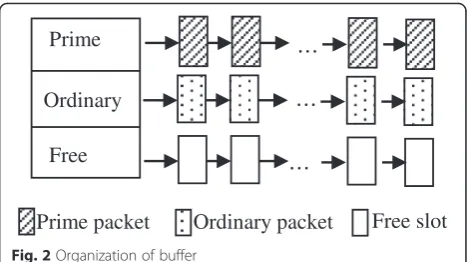
The buffer of a node is divided into many slots with fixed sizes. For simplicity, we assume all packets have the same size and each packet occupies a slot. When packets have variable sizes, it is easy to extend this mechanism by allocating different numbers of slots to packets with different sizes. As shown in Fig. 2, the slots
are organized in three different queues named prime queue, ordinary queue, and free queue. The prime packet with the smallest quality is put at the tail of the prime queue. Similarly, the ordinary packet with the smallest quality is put at the tail of the ordinary queue. The free queue is composed of empty slots.
When a node receives or generates a new packetm, it allocates a free slot to this packet from the free queue. When there is no free slot, if packetmis a prime packet or an ordinary packet with a quality larger than the packet at the tail of the ordinary queue, it overwrites the latter; otherwise, it is dropped. There may be the case that the buffer is full but there are only prime packets in the buffer. In this case, if packetmis a prime packet and has a higher qualitythan the one at the tail of the prime queue, it overwrites the latter; otherwise, it is dropped. Packet m is put into the appropriate queue after being accepted. When the node deletes packetm, the slot oc-cupied by packet m is released and put into the free queue. Note that the node does not have to run the sort algorithm whenever a new packet arrives, it only need to run the algorithm when there is no free slot to allocate and the packet at the tail of the relevant queue is not with the smallest quality. Moreover, in this case, it only needs to run the bubble sort algorithm for the first loop to pick up the packet with the smallest quality to over-write it. Thus, the time complexity isO(n) and the space complexity isO(1), wheren is the number of packets in the relevant queue.
With the above scheme, prime packets have higher pri-orities than ordinary packets. Nodes keep prime packets longer than ordinary packets and keep packets with high qualities longer than those with low qualities when the buffer space is not sufficient. This mechanism can exploit the buffer more efficiently since packets that are more worth keeping are dropped with a lower probability.
3.5 Forwarding decision 3.5.1 Forwarding pattern switch
Packets are forwarded in the replication pattern at first after they are generated. Each packet is associated with
Prime packet
Ordinary packet
Prime
Ordinary
Free
Free slot
the number of duplication hopsto indicate the number of hops that the packet has been replicated. The number of duplication hops of packet m is denoted by hm. As
shown by the example in Fig. 3, hmis 0 when packet m
is newly generated by node a, and it grows when the replication happens. A node keeps the copy of packetm and updateshmafter replicating it to the next hop.
To reduce the transmission cost, when the number of duplication hops reaches the duplication threshold (DT), the packet transmission pattern switches from the replication pattern to an entrusting pattern. In the entrusting pattern, a node will delete the copy of a packet after forwarding it to the next hop.
3.5.2 Forwarding algorithm
When a connection opportunity occurs, it is important to forward packets that are more worth forwarding since the connection between nodes is not permanent and the resources may not be sufficient. Suppose node i meets node j. If node j is the collection point, node i delivers all packets to the collection point and the forwarding completes. Otherwise, node i and node j exchange the delivery probabilities, and nodeidetermines a candidate listLof packets. That is, for any packetpnodeicarries, if Dp(i) <Dp(j), node i puts packet p into L. After L is
complete, node i forwards packets to node j following the steps below.
First, for each packet inL, nodeidetermines its type and quality on nodej.
Second, nodeisortsLbased on the packets’types and qualities on nodej, that is, prime packets are in front of ordinary packets, and packets with highqualitiesare in front of those with lowqualitiesfor each type. This is to ensure packets are forwarded in a decreasing order of their worthiness.
Third, nodeisends packets inLfrom head to tail to nodej. For each packetminL, if nodeireceives a feedback ofACK, which indicates packetmhas been received by nodej, nodeichecks whether the number
ofduplication hopsexceeds theduplication threshold. If
hm< DT, it is in the replication pattern. In this case, nodeiupdateshmand updatesdmaxm toDm(j) ifdmaxm ≤
Dmð Þj. Ifhm= DT, it is in the entrusting pattern and nodeideletes packetmafter it has been received by nodej. If nodeireceives a feedback ofREJ, which indicates packetmis rejected by nodejdue to buffer overflow, nodeistops forwarding the rest of the packets inL.
The details of the forwarding algorithm are illustrated in Fig. 4. The time complexity of the algorithm is O(llogl) and the space complexity is O(l) in the worst case (i.e., when all packets in Lare prime packets or or-dinary packets, the time complexity is O(llogl) and the space complexity isO(l) when the merge sort method is used), wherelis the number of packets inL. This is ac-ceptable because most handsets have such computing capabilities.
It is worth noticing that node i sorts and forwards packets inLin decreasing order of their types and qual-ities from node j’s point of view. This forwarding deci-sion has the advantage that packets forwarded to nodej will not be deleted easily by nodej. Moreover, when re-ceiving a REJ message which indicates packet m is rejected by node j due to buffer overflow, node i does not need to forward the rest of the packets inLto node j, because compared to packetm, the rest of the packets in L have lower priorities or lower qualities on node j, and they will be also rejected by nodej. This mechanism can avoid needless transmission and consequently can reduce the transmission cost.
Fig. 3Number of duplication hops growing in the replication pattern
Fig. 4Pseudo-code of forwarding algorithm
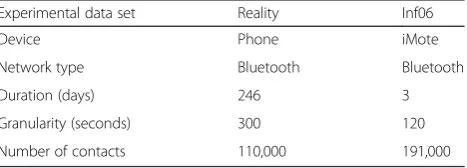
Table 1Characters of the two traces
Experimental data set Reality Inf06
Device Phone iMote
Network type Bluetooth Bluetooth
Duration (days) 246 3
Granularity (seconds) 300 120
Here we only describe the forwarding decision of node i. Packets forwarding from nodejto nodeitake place in similar ways.
4 Simulations 4.1 Simulation setup
We evaluated the performance of ANT over two traces, MIT Reality [26] and Haggel Inforcom06 [27]. In the first trace, 97 smart phones were deployed to students and staff at MIT over a period of 9 months. These phones were running software that logged contacts with other Bluetooth-enabled devices. The second trace, which is referred to as Inf06 in this paper features 98 nodes; 78 of them are iMotes carried by conference par-ticipants, and the remaining 20 are fixed nodes situated at various places in the conference hotel such as confer-ence rooms, the bar, the concierge, and the hotel eleva-tors. Table 1 summarizes their main characteristics.
As buffer space and power are the most important re-sources for mobile phones, we take both items into con-sideration in deciding the resource factor and allocate the same weights to them. To initialize the reciprocity level at the beginning, the number of packets that nodes have relayed for each other is initialized randomly
between [0, 50]. The collection point drops the duplicate packets from one source if it receives them. We compare ANT against SSAR [21] and Bubble [11]. Since Bubble does not consider nodes’selfishness and the buffer man-agement, for a fair comparison, we modify it such that nodes work based on the same notion as G2G [20], i.e., they are cooperative with nodes from the same commu-nity and selfish with outside nodes, and packets are transmitted in decreasing order of the residual lifetime, because a packet with a long lifetime would be more likely delivered than a packet with a short lifetime before being dropped due to expiration. We also apply three packet-dropping policies (drop the tail, drop randomly, and drop the oldest) for Bubble in simulation and only present the results of the best policy here, i.e., drop the oldest (as the probability that the oldest packet would be delivered before expiration is relatively low compared to those with long residual lifetimes). We believe such re-finement does not favor ANT in comparison. The modi-fied Bubble is called Bubble_M. The collection points are regarded as normal nodes in Bubble_M to complete the community construction.
In each run, we use the first one third (1/10) of the Reality (Inf06) trace as the warm-up stage. Data col-lection is carried out in the remaining part. The packet generation of each node follows a Poisson process with an average arrival interval of 1 h (10 min) for the Reality (Inf06) trace. To avoid end effects, no packet is generated in the last TTL. The parameters and their default values are summarized in Table 2. We are interested in the following metrics for performance evaluation.
4.1.0.1 Delivery ratio The proportion of packets that
have been delivered out of the total unique packets cre-ated within the deadline.
4.1.0.2 Delivery cost The total number of packets
transmitted across the air. To normalize this, we divide it by the total number of unique packets created. Table 2Default values of parameters
Parameter Value
Number of nodes 97 (Reality), 78 (Inf06)
Packet size (KB) 50
Deadline 10 days (Reality), 48 h (Inf06)
Buffer size (MB) 12
Bandwidth (Mbps) 2
T(hour),α,H 1, 0.8, 10
σ1,σ2,σ3,σ4 0.25
w1(for buffer),w2(for power) 0.5, 0.5
Battery capacity 1500 mAh
Threshold for the resource 40–80 %
DT 3
Number of collection points 2
4.1.0.3 Delivery delay It is the duration from the time a packet is generated to the time the packet is delivered. Average delay for all packets is used for this metric.
4.2 Results
4.2.1 Impact of deadline and number of collection points
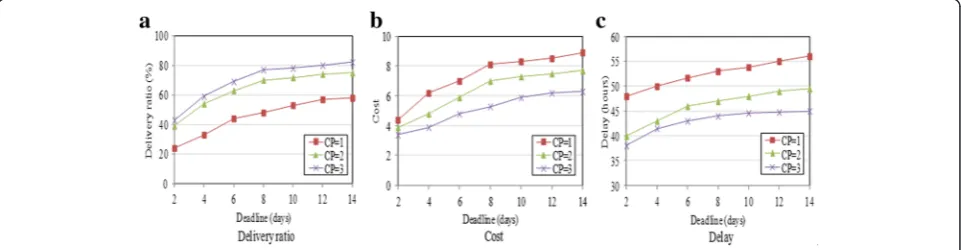
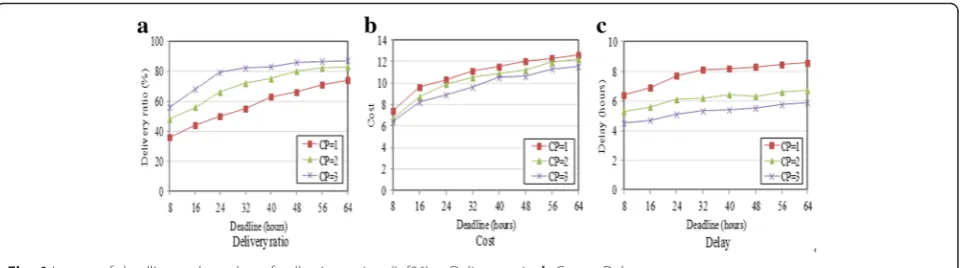
Figure 5 presents the performance of ANT using the Reality trace by varying the packet deadline. It also pre-sents the performance under different numbers of col-lection points. Packets that cannot be delivered within the deadline are dropped. We can see from Fig. 5a that the delivery ratio increases when the deadline extends, as packets can stay longer in the network and more packets can be delivered within the deadline. For that reason, the delivery cost and the average delay also in-crease, as shown in Fig. 5b, c.
It is also shown in Fig. 5 that the network performance improves with the increase of the number of collection points. Figure 5a shows that the delivery ratio increases with the existence of more collection points, because the packets exhibit a better opportunity to reach the collection points with more collection points existing. Meantime, with more collection points existing, the delivery cost de-creases and the delay declines, as shown in Fig. 5b, c, re-spectively, because with more collection points existing, the packet can be delivered with fewer hops, thus reducing the energy consumption and shortening the delivery delay.
Similar results are shown in Fig. 6 using the Inf06 trace.
4.2.2 Impact of selfishness feature
Figure 7 presents the impact of nodes’selfishness on the performance and compares the protocols using the Real-ity trace.
As shown in Fig. 7a, the delivery ratio of all protocols decreases with an increase of the proportion of selfish nodes, because forwarding opportunities become fewer when nodes behave selfishly. For that reason, the deliv-ery cost declines and the delay becomes longer, as shown in Fig. 7b, c, respectively. When most nodes are co-operative, the delivery ratio and delay of all protocols are similar. However, ANT achieves this performance at a much lower delivery cost than SSAR and Bubble_M. ANT performs better when more and more nodes be-have selfishly. When over 40 % nodes bebe-have selfishly, ANT outperforms SSAR and Bubble_M and achieves the best delivery ratio with the lowest cost and the shortest delay. This is due to the fact that ANT incorpo-rates the contact probability and the cooperative willing-ness of nodes to evaluate the delivery abilities of nodes and it takes the status of the resources into account in relay selection. Moreover, it considers the worthiness of forwarding a packet based on an efficient buffer manage-ment scheme. Thus, it can exploit the forwarding oppor-tunities and the buffer space more efficiently, which has Fig. 6Impact of deadline and number of collection points (Inf06).aDelivery ratio.bCost.cDelay
a
b
c
positive effects on its delivery performance. However, SSAR and Bubble_M ignore the impact of resource con-straint on the cooperative willingness; thus, packets would be dropped easily by the relays if they are not willing to carry and forward them due to the resource constraints. Moreover, they lack evaluations of the worthiness of forwarding a packet, and the transmission opportunities cannot be exploited efficiently. In addition, to solve the NP-hard MKPAR problem in forwarding de-cision, SSAR uses a greedy algorithm in substitution, which is simple but may be far from the optimum.
4.2.3 Impact of resource
As the cooperative willingness of selfish nodes is affected by their resource constraint, in this section, we compare the performance of proposed protocols under different battery capacities and buffer sizes.
The results of the algorithms over the Reality trace are shown in Fig. 8. The battery capacities are varied from 500 to 2500 mAh. Since we are concerned with the im-pact of the energy status on the delivery performance ra-ther than the energy consumption process, we simply assume the lifecycle of the battery ranging randomly from 24 to 120 h for different users as different users may use the their phones in different ways. A new life-cycle restarts when the power is depleted. Figure 8a shows that the delivery ratio increases with the increase
of the battery capacity, because the nodes’cooperative willingness improves with the increase of the residual energy. For that reason, the delivery cost also increases and the delivery delay declines, as shown in Fig. 8b, c, respectively. ANT performs better than the other two protocols. It achieves a higher delivery ratio at a lower delivery cost and delay, especially when the battery cap-acity is low. The reason is that SSAR and Bubble_M do not consider the impact of the energy constraint on the cooperative willingness of nodes in relay selection and packets are very likely dropped when they are forwarded to nodes with low energy. ANT can mitigate the impact of this problem because the resource factor is taken into account in the relay selection.
Figure 9 shows the impact of the buffer size on the performance of the three protocols over the Inf06 trace. With the increment of the buffer size, the delivery ratio of all protocols increases and the cost and delay also in-crease. The reasons are that for one thing the coopera-tive willingness of nodes improves with the increase of the available buffer size and for another that packets can stay longer in the network before the buffer overflows. ANT performs better than SSAR and Bubble_M with the increase of the buffer space. For instance, it outper-forms SSAR and Bubble_M by 40 and 70 %, respectively, in delivery ratio when the buffer size is 2 MB. It also achieves the lowest cost and the shortest delay. One
a
b
c
Fig. 8Impact of power (Reality).aDelivery ratio.bCost.cDelay
reason is that ANT considers the buffer space constraint in deciding nodes’forwarding willingness and the forward-ing willforward-ingness is considered in relay selection. Another reason is that ANT uses an efficient buffer management scheme based on the type and quality of packets, and thus, it can exploit the forwarding chance more efficiently.
5 Conclusions
In this paper, we proposed a routing protocol (ANT) tai-lored to data collection in a mobile crowdsensing envir-onment. ANT works by accepting and tolerating the social selfishness of nodes. It integrates the contact op-portunities and the cooperative willingness of nodes to make relay selections. It also incorporates a scheme of assessing the worthiness of carrying and forwarding a packet and employs that in buffer management and for-warding decisions. Extensive simulations using the MIT Reality trace and the Infocom06 trace demonstrate that ANT can exploit the forwarding chances effectively and it outperforms two other comparable protocols when nodes behave selfishly.
Competing interests
The authors declare that they have no competing interests.
Acknowledgements
This work is supported by the National Natural Science Foundation of China under Grants No.61501096, No.61272526, and No.61202444, the National High-tech Research and Development Program of China (863 Program) under Grant No.2012AA041403, and the state scholarship foundation of China.
Author details
1School of Computer Science and Engineering, University of Electronic Science and Technology of China, Chengdu, China.2Donald Bren School of Information and Computer Sciences, University of California, Irvine, USA.
Received: 10 August 2015 Accepted: 3 March 2016
References
1. R Ganti, F Ye, H Lei, Mobile crowdsensing: current state and future challenges. IEEE Communications Magazine49(11), 32–39 (2011) 2. A Farshad, MK Marina, F Garcia,Urban WiFi characterization via mobile
crowdsensing. In IEEE Network Operations & Management Symposium, 2014, pp. 1–9
3. V Coric, M Gruteser, Crowdsensing maps of on-street parking spaces, inIEEE ICDCS, 2013, pp. 115–122
4. M Karaliopoulos, O Telelis, I Koutsopoulos,IEEE INFOCOM, 2015, pp. 2254–2262 5. M Xiao, J Wu, L Huang, Y Wang, C Liu, Multi-task assignment for crowdsensing
in mobile social networks, inIEEE INFOCOM, 2015, pp. 2227–2235 6. GS Tuncay, G Benincasa, A Helmy, Participant recruitment and data
collection framework for opportunistic sensing: a comparative analysis, in Proceedings of the 8th ACM MobiCom workshop on Challenged networks (ACM, Miami, 2013), pp. 25–30
7. PP Jayaraman, C Perera, D Georgakopoulos, A Zaslavsky, Efficient opportunistic sensing using mobile collaborative platform MOSDEN, inIn 9th International Conference on Collaborative Computing: Networking, Applications and Worksharing (Collaboratecom)(IEEE, Austin, 2013), pp. 77–86
8. Y Li, M Qian, D Jin, P Hui, Z Wang, S Chen, Multiple mobile data offloading through disruption tolerant networks. IEEE Trans. On Mobile Computing 13(7), 1579–1596 (2014)
9. A Vasilakos, Y Zhang, TV Spyropoulos,Delay tolerant networks: protocols and applications(CRC Press, Boca Raton, 2012)
10. EM Daly, M Haahr,Social network analysis for routing in disconnected delay-tolerant MANETs. In Proceedings of the 8th ACM international symposium on Mobile ad hoc networking and computing (ACM, Montreal, 2007), pp. 32–40
11. P Hui, J Crowcroft, E Yoneki, Bubble rap: social-based forwarding in delay tolerant networks. IEEE Transactions on Mobile Computing10(11), 1576–1589 (2011) 12. A Mtibaa, M May, C Diot, M Ammar, Peoplerank: social opportunistic
forwarding, inProceedings IEEE INFOCOM’10(IEEE, San Diego, 2010), pp. 1–5 13. K Jahanbakhsh, GC Shoja, V King,Social-greedy: a socially based greedy
routing algorithm for delay tolerant networks. In Proceedings of the Second International Workshop on Mobile Opportunistic Networking (ACM, Pisa, 2010), pp. 159–162
14. L Butty´an, L D´ora, M F´elegyh´azi, I Vajda, Barter trade improves message delivery in opportunistic networks. Ad Hoc Networks8(1), 1–14 (2010) 15. G Dini, AL Duca, Towards a reputation-based routing protocol to contrast
blackholes in a delay tolerant network. Ad Hoc Networks10(7), 1167–1178 (2012) 16. BB Chen, MC Chan, Mobicent: a credit-based incentive system for disruption
tolerant network, inProceedings IEEE INFOCOM’10(IEEE, San Diego, 2010), pp. 1–9
17. T Ning, Z Yang, X Xie, H Wu, Incentive-aware data dissemination in delay-tolerant mobile networks, inIEEE Communications Society Conference on Sensor, Mesh and Ad Hoc Communications and Networks (SECON)(IEEE, Salt Lake City, 2011), pp. 539–547
18. U Shevade, HH Song, L Qiu, Y Zhang,Incentive-aware routing in DTNs(In IEEE International Conference on Network Protocols (ICNP), Orlando, 2008), pp. 238–247
19. T Ning, Z Yang, H Wu, Z Han, Self-interest-driven incentives for ad dissemination in autonomous mobile social networks, inIn Proceedings IEEE INFOCOM’13(IEEE, Turin, 2013), pp. 2310–2318
20. A Mei, J Stefa, Give2Get: forwarding in social mobile wireless networks of selfish individuals. IEEE Transactions on Dependable and Secure Computing 9(4), 569–582 (2012)
21. Q Li, S Zhu, G Cao, Routing in socially selfish delay tolerant networks, in Proceedings IEEE INFOCOM’10(IEEE, San Diego, 2010), pp. 1–9 22. H Gong, X Wang, A hot-area-based selfish routing protocols for mobile
social networks. International Journal of Distributed Sensor Networks 2013, 1-7 (2013). doi: http://dx.doi.org/10.1155/2013/389874
23. P Sermpezis, T Spyropoulos, Understanding the effects of social selfishness on the performance of heterogeneous opportunistic networks. Computer Communications48(7), 71–83 (2014)
24. Y Li, G Su, DO Wu, D Jin, L Su, L Zeng, The impact of node selfishness on multicasting in delay tolerant networks. IEEE Transactions on Vehicular Technology60(5), 2224–2238 (2011)
25. R Keeney, H Raiffa,Decisions with multiple objectives: preference and value tradeoffs(Cambridge University Press, New York, 1993)
26. N Eagle, A Pentland, Reality mining: sensing complex social systems. Personal and Ubiquitous Computing10(4), 255–268 (2006)
27. J Scott. CRAWDAD data set cambridge/ haggle (v. 2009-05-29). Downloaded from http://crawdad.cs.dartmouth.edu/cambridge/haggle, May 2009
Submit your manuscript to a
journal and benefi t from:
7Convenient online submission 7Rigorous peer review
7Immediate publication on acceptance 7Open access: articles freely available online 7High visibility within the fi eld
7Retaining the copyright to your article