R E S E A R C H
Open Access
Equilibrium is priceless: selfish task
allocation for mobile crowdsourcing network
Qingyu Li
1, Panlong Yang
2,4*, Shaojie Tang
3, Maotian Zhang
2and Xiaochen Fan
2Abstract
Recent years have witnessed major innovations in mobile crowdsourcing networks. For selfish participants, conventional methods resort to incentive mechanism design for resource utilization, which might overlook the inherent equilibrium property among mobile users. In contrast to these proposals, we investigate the problem that whether or not the selfish users could be enabled to endorse stable task sharing with balanced allocations without incentive mechanism designs. Before making a positive answer to this problem, we need to address the following challenge, i.e., users have to make their balancing decisions with only very limited and dynamic local load information, which could possibly incur longer convergence time and imbalanced task allocations. In tackling this difficulty, we propose two distributed selfish load balancing schemes, themax-weight best responsepolicy forstrong information scenario, where load information could be sufficiently collected; and theproportional allocationpolicy forweak informationscenario. We make experimental studies to validate proposed schemes. In our simulation study with real trace data, the proposed schemes converge fast in many typical settings with fairly good balancing performance. As for data traces from RollerNet (Tournoux et al., The accordion phenomenon 2009), the performance of load balancing and convergence property are further validated.
Keywords: Selfish task allocation, Mobile crowdsourcing, Load balancing
1 Introduction
Recent years have witnessed the emergence of mobile crowdsourcing network, which is a human based, dis-tributed, and task-driven ecosystem, such as Serendipity [1], Bikenet [2], and smartphone-based sensing applica-tions [3–8]. Instead of improving the capacity and avail-ability among users, these systems enable the unconscious cooperations for tasks, incorporating distributed mobile users in non-invasive manner, and achieving cloud-like service with loosely coupled mobile devices. Furthermore, mobile crowdsourcing networks could be proliferated to promote distributed cooperations among users.
To this end, the mobile data and task load could be effectively shared and allocated among users and enabled to utilize network resources more effectively and efficiently [1].
*Correspondence: [email protected]
2College of Communications Engineering, PLA University of Science and Technology, Nanjing, Jiangsu 210007, China
4University of Science and Technology of China, JinZhai Road Baohe District, Hefei, Anhui, 230026, People’s Republic of China
Full list of author information is available at the end of the article
Unfortunately, status quo solutions heavily rely on incentive mechanism design [9, 10], where users are encouraged to participate the crowdsourcing practice for rewards. In contrast, hardly any of these solutions focus on the fair task allocation among users, i.e., encourag-ing more selfish users involved in crowdsourcencourag-ing practice [11, 12].
Thus, balancing the working load among selfish users is desperately needed [11–13]. Indeed, an inevitable stale-mate exists: If there is no effective load balancing scheme among participatory users, it is difficult to propose a pow-erful incentive mechanism design, because no user would like to cooperate under unfair allocations. Fully consider-ing the selfish behavior among users would effectively help to break this stalemate. This paper investigates a simple but fundamental question: can we perform efficient coop-eration among distributed crowdsourcing networks, fully
considering the selfish behaviors among mobile users?
Furthermore, can such cooperative design converge fast enough in dynamic and uncertain crowdsourcing net-work? Positive answers to these questions could enhance
the gains of crowdsourcing network to a more applicable system.
In this work, we present an innovative task allocation scheme, where tasks are distributed among selfish mobile
users. In that, theselfishbehavior could be summarized
in the sense that mobile users are attempting to optimize their own situation1, i.e., trying to assign their tasks to the least loaded user, instead of trying to optimize the global situation. In general, Nash equilibrium among self-ish users is a balanced state, such that there is no incentive among users for changing the status quo allocation. In other words, no user has an incentive to reallocate their tasks to other users.
Our algorithms show good balancing performance
with fast enough convergence speed in bothstrong and
weakinformation cases2. Surprisingly, even for theweak
information case, proportional allocation scheme could achieve similar performance to that for strong infor-mation case. Specifically, for real trace data set [14], the algorithms could still show relatively good con-verge property. We further show that the Nash equi-librium is a fairly good balancing allocation for each user. Such that, our design could improve the coopera-tion efficiency and reduce the potential cost for future crowdsourcing network as well. Moreover, important factors are discussed and evaluated with spectrum of settings.
The rest of the paper is organized as follows. We review the related work in Section 2. After that, we introduce our basic system model and formulate our investigate problem in Section 3. Section 4 introduces our proposed scheme with algorithmic descriptions. We present the experimen-tal evaluation results in Section 5 and conclude the paper in Section 6.
2 Related work
Our work relates to the efficient data transfer schemes over disruption-tolerant networks or opportunistic net-works [1, 15, 16]. The intermittent contacts between ran-domly roaming users are useful for data sharing, which has been explored and studied extensively in variety of network settings, from military warfare [17] to disaster recovery [18]. The opportunistic access will bring more chances for data sharing. Even further, the social rela-tionship will enhance these opportunities with higher task execution efficiency and stability.
Selfish load balancing correlates to thecongestion game, which is very similar to our concerned working scenario. The aforementioned results have not addressed how to find Nash equilibrium efficiently. For worst case analysis, the convergence time could be exponentially long [19–21]. While best and better response dynamics are a plausible model of selfish behavior, the associated algorithms typ-ically require that migrations be done one-by-one, and
another common assumption is that best responses are always selected.
Even-Dar and Mansour [22] consider concurrent and independent task migration policies, where tasks are allowed to migrate from the overloaded machines to the under-loaded resources. Such assumption would break the selfish behavior rule and could not achieve the Nash
equilibrium. To this end, theε-approximate Nash
equi-librium could be leveraged to settle down this stalemate
[20, 23]. A statexis called anε-approximate Nash
equi-librium, when for any 0≤ε≤1, no task can decrease the
load by more than factor of(1−ε). In such a state, for every
user i and every neighboring user j, the ε-approximate
Nash equilibrium could be achieved, where the following inequality holds:
3 System model and problem formulation
3.1 System model
In our system model, the task could be a typical sens-ing or computsens-ing task. Users are considered as selfish agents, where actions are unilaterally played, and tasks are migrated concurrently. Note that, although there is a platform, it is hardly applicable to incorporate central-ized scheduling due to large network overhead and delays [24, 25]. In our model, the decision should be made in dis-tributed way, and no global knowledge is available to any mobile user.
As the crowdsourcing tasks are increasing over the time, the number of users should be constant. Although the users could leave and join the crowdsourcing net-work dynamically, the number of participatory users are
limited. Thus, suppose that m n, which is typically
considered in previous studies [12, 20].
(a) (b)
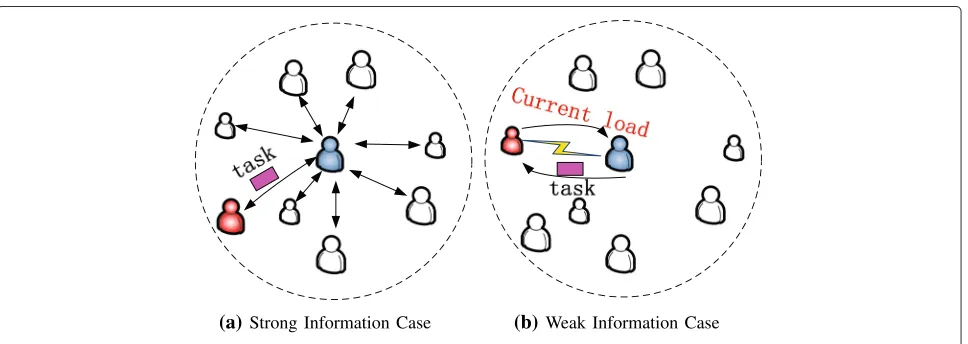
Fig. 1Difference between traditional load balancing scheme and selfish load balancing scheme
3.2 Problem formulation
Our main objective is to propose an efficient task loading algorithm for each selfish mobile user. Additionally, there are two design requirements:
• The “ε−Nash” condition,i.e., for any0≤ε≤1, no task can decrease the load by more than factor of
(1−ε).
• The algorithm should converge fast enough, since the mobile crowdsourcing network only provides intermittent connections.
Typically, we consider two working scenarios:
• First, we suppose mobile users have sufficient time and bandwidth, for sharing the task load information among all neighbor nodes. As depicted in Fig. 2a,
users could use WiFi connections and have relatively long contact window to share data, such working scenario is typical for crowdsourcing network [1].
• Second, we consider the weak connection case, where the contact window is short or the transmission bandwidth is limited. For mobile crowdsourcing network, this concern is very necessary as such weak communication opportunities are very common. Although the data sharing is not sufficient, contacting with small number of users could be allowed, which is illustrated in Fig. 2b.
4 Algorithm description
4.1 Max-weight best response (strong information case)
We investigate typical case for strong information, where users could have their neighbors’ load information in each round. In other words, people could compare the load of
(a) Strong Information Case (b) Weak Information Case
among users accurately in communication range to make decision wisely.
We leverage the basic principle that users could reach
a satisfied stateif and only if the task is placed on the
leasted loaded user among neighbors [23]. Such that, a
best responsenever decreases the minimum load among users [23]. To this end, a satisfied user could be unsatis-fied only for one reason: i.e., the load of the user holding this task increases because another task moves in. Inspired by this intuition, we proposed an adaptive algorithm:
max-weight best response.
Algorithm 1:Max-weight best response
input : TaskT, UserU, WeightW, SpeedS,
Round interval t, Round times R, Initial user loadL= {l1,l2,. . .ln}, Encounter(i,j),{i,j∈U,i=j}.
output: User load:L, Gap in each round:G
forround=1 :Rdo
fortask i in descending weight orderdo
Letu(i)be the current located user of taskifor
u(j)∈N/u(i)do if
Encounter(u(i),u(j))∈ [t∗(round−1),t∗ round]then N ←j elsecontinue
end
ifN = ∅, Find the least loaded neighbor qthen
lu(i)round:current load of useru(i)ljjround:
current load of userjj
iflu(i)/su(i)> (lq+W(i))/sqthen
Move task i from useru(i)toq u(i)←q
L← {l1,l2,. . .lq+wi,. . .,lu(i)− wi,. . .,ln}
end end end end
The proposed algorithm works as follows: Given tasks T = {1, 2,. . .,m}and task weightW = {w1,w2,. . .wm}
accordingly, mobile users U = {1, 2,. . .n} could be
enabled with diverse computing speed:S= {s1,s2,. . .sn}.
First, we rank the task weights in descending order. The unsatisfied user holding the task with highest weight should be considered firstly. If one would always allocate the task of minimum weight among the unsatisfied users, then it will need an exponential number of best response steps to reach a pure Nash equilibrium [23, 26].
Letu(i) denote the user holding taski, for other user
u(j), if there is an encounter record between useru(i)and
u(j)in current round interval, we includeu(j)in the neigh-bor set ofu(i). As we have mentioned in the very first of this section,if and only if the task is handed over to the least loaded user, the dynamic equilibrium could be real-ized eventually. Under this discipline, we use the polling
method to get the least loaded neighboruminand compare
the work load ofu(i)andumin.
4.2 Proportional allocation (weak information case)
Since the network is distributed, intermittent, and unpre-dictable, it is difficult to get the global information for task load [27]. As depicted in Fig. 2b, users can only get weak local information with limited number of neighbors.
For this typical scenario, we put forward proportional
allocation, where tasks are migrated in parallel for each round.
Algorithm 2:Proportional allocation
input : TaskT, UserU, WeightW, SpeedS,
Round interval t, Round times R, Initial user loadL= {l1,l2,. . .ln}, Encounter(i,j),{i,j∈U,i=j}.
output: User load:L, Gap in each round:G
forround=1 :Rdo
foreach task in paralleldo forj∈N/u(i)do
if
Encounter(u(i),j)∈[t∗(round−1),t∗ round]then N ←j
end
ifN = ∅, randomly choose neighbor kthen iflu(i)/su(i)>lk/skthen
P←1−lk/lu(i) lk ←lk+W(i)∗P lu(i)←lu(i)−W(i)∗P u(i)←k
end end end end
Letlu(i) be the current load ofu(i), whereu(i)denotes
the user holding taski. Next, according to the weak local
information constraint, the user u(i) would randomly
choose a neighbor k to compare its task load. Due to
the selfishness behavior, if the load on user kis smaller
than that of useru(i), taskicould be migrated from user
u(i)to userkwith probabilityP = 1−lk/lu(i). Different
from Algorithm for strong informationcase, users could
be leveraged to achieve Nash equilibrium within limited steps.
5 Performance analysis and evaluation
5.1 Simulation tests
5.1.1 Load balancing performance
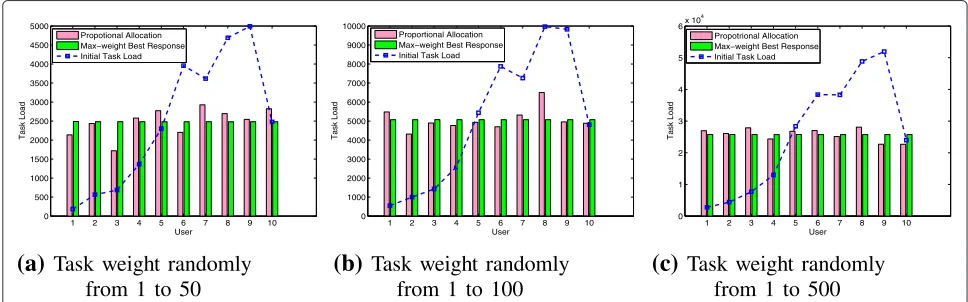
We focus on the load balancing problem caused by users’ selfishness. First of all, we evaluate the load balancing per-formance with the converged task load. We set different task weight values to each task, such that the tasks could be migrated among users. If the task weights are randomly selected from a larger range, the diversities among users would be more significant.
In this evaluation, the duration of task sharing round
is set to 20 s, and the inter-contact frequencyλ is
uni-formly distributed in range3 [10, 30]. In Fig. 3a, the task weight range is set to [1, 50]. Similarly, in Fig. 3b, c, the task weight range is set to [1, 100] and [1, 500], respectively. As depicted in the three sub-figures in Fig.3,proportional allocation and max-weight best response could achieve
balanced load among users. Surprisingly, although
pro-portional allocationscheme only has weak information,
the balancing performance is comparable to that of
max-weight best responsescheme. The reason is, in our simula-tions, the proportional allocations are executed in parallel, which could make task migration with sufficient times. Thus, the task load could be effectively compared among users. Such that, it could still achieve similar performance in strong information scheme, because mobility would help the contacts among users, and provide opportunities for task load information sharing.
Note that, forproportional allocationscheme, there are
small portion of unbalanced load in some users, which have been shown in Fig. 3b, c. The reason is, with the increasing range of task weight, some tasks with large task weight could not migrate to other users, since no user would admit the migration for such a big job for some rounds in our simulation.
5.1.2 Convergence property
The convergence property is fundamentally important to load balancing scheme. Specifically, in our study, we need the algorithm with ensured convergence property and fast enough convergence speed.
Basically, we evaluate the convergence speed of the
pro-portional allocation scheme. Note that the convergence time relates to the duration of each task allocation round. This parameter correlates to the mobility, i.e., the inter-contact frequency,λ. As depicted in Fig. 4a, we set differ-ent values forλ, i.e., and the ranges for random selection are set to [5, 10] , [15, 20] , [20, 40], respectively. The length
of each round is set to 20. When the range value for λ
is set to [5, 10] , [15, 20], we find that, the convergence property is good. However, when it is set to [20, 40], the convergence property does not hold anymore. The rea-son is, when the contact interval becomes larger, users would have less opportunities for task migration. Thus, the assumption for sufficient data sharing in each round does not hold. Users with more contact opportunities could unfairly offload tasks.
This observation motivates us to make a further study. That is, we need to investigate the relationship between the duration of each round and the contact
inter-val, i.e., theλ. As shown in Fig. 4b, when the duration
of each sharing round is set to 30, and the inter-contact
frequency λis set uniformly with interval [10, 20]. The
proportional allocationscheme could perfectly converge. When the round length is set to 15, there is a dynamic pro-cess, and the algorithm could achieve convergence state after 80 rounds again. Notably, when the round length is set to 10, there is no significant convergence state shown in our evaluations. The reason is, due to the extremely short round length, users could not migrate their tasks sufficiently, i.e., from dynamic allocation to stable Nash equilibrium, where the balanced task allocation could not be achieved. To this end, the task sharing rounds should be larger or approximate to that of the inter-contact
1 2 3 4 5 6 7 8 9 10
(a)
Task weight randomly
from 1 to 50
(b)
Task weight randomly
from 1 to 100
(c)
Task weight randomly
from 1 to 500
0 20 40 60 80 100
(a)
Impact of inter-contact
rate,
(b)
Impact of round interval
0 50 100 150
Gap Intermittent stable state
(c)
Dynamics and stable
states in convergence
Fig. 4Analysing convergence characters in different inter-contact rates and round intervals
frequency, such that fast and stable convergence state could be achieved.
These dynamic features motivate us to take another concern, i.e., the dynamics during convergence process. We set round length to 15 and set the inter-contact rate
λwith interval [10, 30]. We make evaluations on the
con-vergence property of proportional allocation. As shown
in Fig. 4c, there are two intermittent stable states, where a relatively balanced tasks assignment could be achieved. The gap at these states are very low, say, less than 500. Comparing to the initial value, 5000, it is still a good result. Note that in those states, if the Nash equilibrium condi-tion could be relaxed, we can achieve faster convergence results.
Also, it is worth noting that we have not shown the
convergence property of the max-weight best response
method, because it could get immediate convergence property once task weights are ordered and tasks are allocated sequentially, which has been proved in [23].
5.1.3 Comparison with random allocation
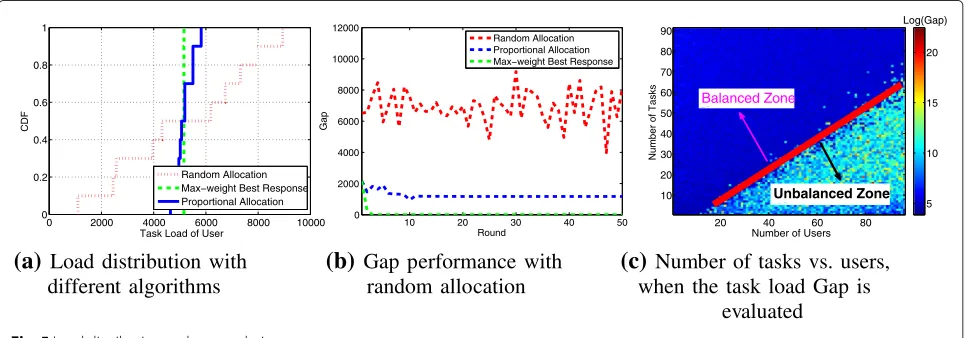
In order to show the performance of our algorithms, we compare them with ‘Random Allocation’. As depicted in Fig. 5a, both algorithms we proposed perform better than ‘Random Allocation’. Especially for Gap evaluation, as depicted in Fig. 5b, ‘Random Allocation’ can hardly converge but fluctuate. Whereas, ‘Proportional Alloca-tion’ finally reaches equilibrium through a period of up-down and “max-weight best response” acts almost perfect because tasks are ordered by weight.
5.2 Balancing among users and tasks
As we have aforementioned in Section 3, the task number
mis assumed to be much larger than the user numbern
considering the crowdsourcing network fact. To further explore the impact of proportion of task number and user number, we run the “proportional allocation” for different settings ofmandn.
As shown in Fig. 5c, the gap for each task allocations under different number of tasks and users are colored with
0 2000 4000 6000 8000 10000 0
Task Load of User
CDF
Random Allocation Max−weight Best Response Proportional Allocation
(a)
Load distribution with
different algorithms
(b)
Gap performance with
random allocation
(c)
Number of tasks vs. users,
when the task load Gap is
evaluated
data values. Note that the value is processed with log-normal function, so as to see the differences more clearly. we can clearly find two zones. One is the balanced zone, achieving balancing tasks, and the other zone is unbal-anced. We draw a thick red line to separate these two zones.
According to Fig. 5c, we summarize the following properties. First, with increasing number of tasks, the chances falling in balanced zone would be large accord-ingly. While with the increasing number of users, the chances falling in unbalanced zone would be large. To this end, when more tasks are presented with less users, the balancing performance would possibly be good. Sec-ond, when the number of users and tasks are all very large, the algorithm would achieve unbalanced perfor-mance. In tackling with this defect, we need to balance the users and tasks. That is, we need to mitigate some users, e.g., users with less processing ability and less con-tact frequency, such that the balanced allocations could be achieved.
6 Conclusions
We propose a fast converging load balancing algorithm for crowdsourcing network, fully considering the self-ish behavior among users. In our concern, two major network scenarios, users with strong and weak load
information, are fully considered. We propose
max-weight best response policy and simple distributed allo-cation scheme with probabilistic assignment. We find that these simple schemes are effective in achieving self-ish load balancing. The fundamental reason is, although users are intermittently connected, the user diversity also increases, which will speedup convergence process in sense of selfish behavior considerations. Such that, the mobility provides sufficient diversity among users, which makes the task offloading policy more robust. Evaluations have been extensively processed for vali-dating the effectiveness and efficiency of the proposed scheme.
In future work, social relationship can be explored and exploited for semi-cooperative design, where bal-anced task offloading could be performed among friends, and unfamiliar mobile users, and plays an important role for task execution efficiency. Finally, we plan to apply our methods to realistic applications, such as pro-cessing pictures to translate words within crowds of participants.
Endnotes
1In our concern, the situation is the sense of task load
2For strong information scenario, the local information
could be sufficiently collected; while for weak information case, only local and limited information is available.
3The dimension for λ is hertz (Hz). We omit Hz for
brevity in the following iterations.
Acknowledgements
This research is partially supported by NSF China under Grant Nos. 61232018, 61272487, and 61502520, 61402009 and PAPD, CICAEET.
Competing interests
First, we have developed a convincible system for workload balancing in mobile crowdsourcing system. In that, users could effectively leverage the equilibrium in selfish load balancing, where relatively balanced property could be available in mobile crowdsourcing networks.
Second, with extensive simulation study and real trace data evaluation, our schemes are validated in both strong and weak information scenario. Meeting interval and contact durations are further evaluated with instructive suggestions when real network protocol design is concerned.
Author details
1China Satellite Maritime Tracking and Control Department, JiangYin, Jiangsu
214431, China.2College of Communications Engineering, PLA University of Science and Technology, Nanjing, Jiangsu 210007, China.3University of Texas
at Dallas, Dallas, TX 75062-4736, USA.4University of Science and Technology of China, JinZhai Road Baohe District, Hefei, Anhui, 230026, People’s Republic of China.
Received: 1 April 2016 Accepted: 5 July 2016
References
1. C Shi, V Lakafosis, MH Ammar, EW Zegura, inProceedings of the thirteenth ACM international symposium on Mobile Ad Hoc Networking and Computing. Serendipity: enabling remote computing among intermittently connected mobile devices (ACM, 2012), pp. 145–154 2. SB Eisenman, E Miluzzo, ND Lane, RA Peterson, GS Ahn, AT Campbell,
Bikenet: a mobile sensing system for cyclist experience mapping. ACM Trans. Sensor Netw. (TOSN).6(1), 6 (2009)
3. JA Burke, D Estrin, M Hansen, A Parker, N Ramanathan, S Reddy, MB Srivastava, Participatory sensing. Center for Embedded Network Sensing. (2006)
4. ND Lane, E Miluzzo, H Lu, D Peebles, T Choudhury, AT Campbell, A survey of mobile phone sensing. IEEE Commun. Mag.48(9), 140–150 (2010) 5. Z Xu, Y Liu, N Yen, L Mei, X Luo, X Wei, C Hu, Crowdsourcing based
description of urban emergency events using social media big data. IEEE Transactions on Cloud Computing.99, 1–1 (2016).
doi:10.1109/TCC.2016.2517638
6. Z Xu, Y Liu, J Xuan, H Chen, L Mei, Crowdsourcing based social media data analysis of urban emergency events. Multimedia Tools and Applications, 1–18 (2015)
7. Z Xu, H Zhang, V Sugumaran, K-KR Choo, L Mei, Y Zhu, Participatory sensing-based semantic and spatial analysis of urban emergency events using mobile social media. EURASIP Journal on Wireless Communications and Networking (2016)
8. Z Xu, H Zhang, C Hu, L Mei, J Xuan, K-KR Choo, V Sugumaran, Y Zhu, Building knowledge base of urban emergency events based on crowdsourcing of social media. Concurrency and Computation: Practice and Experience (2016). http://dx.doi.org/10.1002/cpe.3780
9. P Ipeirotis, F Provost, J Wang, inProceedings of the ACM SIGKDD workshop on human computation. Quality management on amazon mechanical turk (ACM, 2010), pp. 64–67
10. D Yang, G Xue, X Fang, J Tang, inProceedings of the 18th annual international conference on Mobile computing and networking.
Crowdsourcing to smartphones: incentive mechanism design for mobile phone sensing (ACM, 2012), pp. 173–184
11. T Luo, C-K Tham, inSensor, Mesh and Ad Hoc Communications and Networks (SECON), 2012 9th Annual IEEE Communications Society Conference on. Fairness and social welfare in incentivizing participatory sensing (IEEE, 2012), pp. 425–433
13. O Scekic, H-L Truong, S Dustdar, Incentives and rewarding in social computing. Communications of the ACM.56(6), 72–82 (2013)
14. PU Tournoux, J Leguay, F Benbadis, V Conan, MD De Amorim, J Whitbeck,
inINFOCOM 2009, IEEE. The accordion phenomenon: Analysis,
characterization, and impact on dtn routing (IEEE, 2009), pp. 1116–1124 15. Z Fu, X Sun, Q Liu, L Zhou, J Shu, Achieving efficient cloud search services:
multi-keyword ranked search over encrypted cloud data supporting parallel computing. IEICE Trans. Commun.E98-B, 190–200 (2015) 16. Z Fu, K Ren, J Shu, X Sun, F Huang, Enabling personalized search over
encrypted outsourced data with efficiency improvement. IEEE Transactions on Parallel and Distributed Systems.99, 1–1 (2015). doi:10.1109/TPDS.2015.2506573
17. P Marshall, inMILCOM 2008-2008 IEEE Military Communications Conference. DARPA progress towards affordable, dense, and content focused tactical edge networks (IEEE, 2008), pp. 1–7
18. K Fall, G Iannaccone, J Kannan, F Silveira, N Taft, inISCRAM. A
disruption-tolerant architecture for secure and efficient disaster response communications (Citeseer, 2010)
19. S Fischer, H Räcke, B Vöcking, Fast convergence to Wardrop equilibria by adaptive sampling methods. SIAM Journal on Computing.39(8), 3700–3735 (2010)
20. P Berenbrink, T Friedetzky, LA Goldberg, PW Goldberg, Z Hu, R Martin, Distributed selfish load balancing. SIAM Journal on Computing.37(4), 1163–1181 (2007)
21. P Berenbrink, M Hoefer, T Sauerwald, Distributed selfish load balancing on networks. ACM Transactions on Algorithms (TALG).11(1), 2 (2014) 22. E Even-Dar, A Kesselman, Y Mansour, inInternational Colloquium on
Automata, Languages, and Programming. Convergence time to Nash equilibria, vol. 2719 (Springer, 2003), pp. 502–513
23. N Nisan, T Roughgarden, E Tardos, VV Vasirani,Algorithmic game theory, vol. 1. (Cambridge University Press Cambridge, 2007)
24. S Xie, Y Wang, Construction of tree network with limited delivery latency in homogeneous wireless sensor networks. Wireless Person. Commun.
78, 231–246 (2014)
25. T Ma, J Zhou, M Tang, Y Tian, A Al-Dhelaan, M Al-Rodhaan, S Lee, Social network and tag sources based augmenting collaborative recommender system. IEICE Trans. Inform. Syst.E98-D, 902–910 (2015)
26. P Guo, J Wang, B Li, S Lee, A variable threshold-value authentication architecture for wireless mesh networks. J. Int. Technol.15, 929–936 (2014) 27. Y Ren, J Shen, J Wang, J Han, S Lee, Mutual verifiable provable data
auditing in public cloud storage. J. Int. Technol.16, 317–323 (2015)
Submit your manuscript to a
journal and benefi t from:
7Convenient online submission
7Rigorous peer review
7Immediate publication on acceptance
7Open access: articles freely available online
7High visibility within the fi eld
7Retaining the copyright to your article