R E S E A R C H
Open Access
Virtual queue dropping for robust real-time
video over IEEE 802.11aa wireless LANs
Wen-Ping Lai
*and En-Cheng Liou
Abstract
Stream classification service (SCS) is a novel concept proposed in the newly released IEEE 802.11aa standard for robust audio and video streaming, particularly for graceful degradation of streaming quality during network
congestions. Based on intra-access category prioritisation (IACP), SCS is equipped with a pair of access category (AC) queues to differentiatereal-timeandnon-real-timevideo streams, namely (AC_VI, AAC_VI), and thus introduces the need for an efficient scheduler design; similarly for audio. In this study, we propose a novel cross-layer design called virtual queue dropping (VQD) for packet scheduling between AC_VI and AAC_VI. Driven by a real-time
video-packet-importance scheme, VQD adoptsconditional priority weightingto enhance the priority of I-packets from AAC_VI so that they can fairly compete with P-packets from AC_VI. Moreover, to achieve graceful degradation during network congestions, VQD (i.e. based onpriority couplingamong differentcomponentqueue lengths within the samephysicalAC queue) is adopted so that the dropping probabilities of lower-priority video packets are not onlylargerbut alsoaffected-and-increasedby those of higher-priority ones. Different limits ofpriority retiresof I- and P-packets can avoid unexpected long delays, and an optimal set of retry limits has been found to minimise the performance impact due to real-time constraints. Our results show that VQD outperforms PWD and SCS-CR in various performance metrics, and achieves awin-wingame for the dilemma in maintainingpriorityfor AC_VI and
fairnessfor AAC_VI simultaneously.
Keywords:802.11aa, Intra access category prioritisation, Stream classification service, Graceful degradation, Conditional priority weighting, Virtual queue dropping, Priority retries
1 Introduction
Video over wireless networks has been the driving force for the advancements of wireless technologies, and the family of IEEE 802.11 protocol standards [1] has success-fully dominated the wireless LAN market. However, high-quality and robust wireless video transmission is still a challenging issue because the wireless media is error-prone in signal and time-varying in bandwidth.
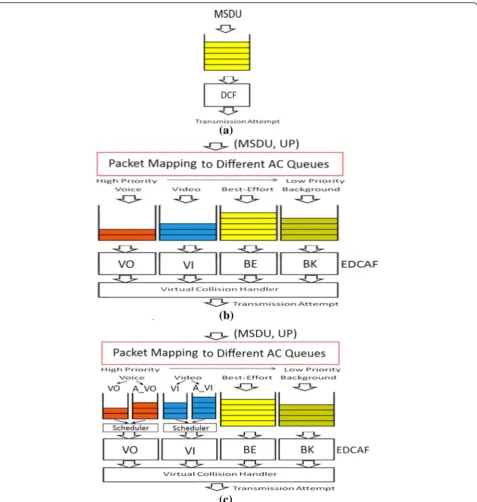
In terms of wireless media contention, the legacy 802.11 [2] was originally based on distributed coordin-ation function (DCF) [3] to support collision handling among wireless stations. In DCF, each wireless station adopts a single first-in-first-out (FIFO) queue for all types of traffic flows, as shown in Fig. 1a, and thus cannot support quality of service (QoS) for video flows. To address this issue, the 802.11e standard [4] proposed
a QoS scheme called enhanced distributed channel access (EDCA), where a QoS-capable station (QSTA) is equipped with multiple access category (AC)queuesand virtual collision handlingamong these AC queues so as to achievein-station service differentiationof video flows from other traffic types. Among the four equipped AC queues, as shown in Fig. 1b, AC_VO and AC_VI queues are reserved for voiceand videoflows, respectively, with higher transmission priorities than the other AC queues (i.e. AC_BE for best effort flows and AC_BK for background flows). However, the AC_VI queue is still FIFO-based intrinsically, and thus no further service differentiation among video flows or packets can be achieved. Similarly, no service differentiation among voiceflows or packets either.
In the literature, there exist some studies providing service differentiation among video packets, where video packets of less importance are mapped to the lower-priority AC queues than AC_VI either statically [5] or * Correspondence:[email protected]
Department of Communications Engineering, Yuan Ze University, 135 Yuan-Tung Rd, Chung-Li, Taoyuan City, Taiwan
dynamically [6–10]. Although these studies have achieved performance gains over EDCA, the traffic impact of those downward mapped video packets to the lower-priority AC queues has not been well-discussed. To address this, in the newly released 802.11aa-2012 standard [11], two new concepts called intra access category prioritisation (IACP) and stream classification service (SCS) have thus been proposed. IACP achieves
flow-level differentiation betweenreal-timeand non-real-timevideo by a double-queue framework, namely the pri-mary(VI) andalternative(A_VI) AC queues as shown in Fig. 1c, also referred to as AC_VI and AAC_VI, respect-ively, throughout this study. Based on IACP, SCS further achieves packet-level differentiation to pursue graceful degradationof video streaming quality during congestions by introducing drop eligibility indicator (DEI) enabling
differential retransmission limits for lost video packets of different importance levels. Similarly, service differenti-ation can also be achieved for voice at both theflow and packetlevels. In IACP and SCS, voice or video traffic flows are confined to their own (primary, alternative) AC queues, and thus generate zero traffic impact to the lower-priority AC queues.
Both IACP and SCS introduce the need of efficient video packet scheduling between the (primary, alternative) AC queues before passing ahead-of-line video packet to the EDCA Function of video AC (VI-EDCAF), which adopts the same set of wireless channel contention param-eters as EDCA. In 802.11aa-2012, despite incapability of packet-level differentiation, credit-based scheduling is recommended by default. To address this, this study proposes a novel cross-layer scheduler design called virtual queue dropping (VQD) aiming at substantial performance gains.
The remainder of this article is organised as follows. Section 2 briefly identifies the scope of 802.11aa-2012 and overviews the related studies of the SCS-related scheduler design. Section 3 describes the design princi-ples and details of the proposed VQD scheduler, followed by various performance evaluations and exten-sive analyses in Section 4. Finally, Section 5 concludes this article.
2 Scope of 802.11aa and related studies of SCS packet scheduling
The authors of [12] have delivered an overview on the scope of 802.11aa-2012, as well as theQoS management frame service issueof 802.11ae-2012 [13], both of which serve as two amendments to the IEEE 802.11-2012 re-vised version. In addition to IACP and SCS, 802.11aa-2012 also covers several other advanced issues, including groupcast with reties (GCR) for reliable and scalable transmission of multicast streams [14–16], overlapping basic service sets (OBSS) management for handling the coordination problem among multiple access points (AP) caused by today’s large deployment of 802.11 LANs, and interworking with the IEEE 802.1Q stream reservation protocol (SRP) [17] for supporting end-to-end SRP when one or more 802.11 links are involved in the transmission path. However, these advanced issues are out of the scope of this study. A good overview of these issues can be found in [12, 18, 19].
Open research areas related to these issues in both the two aforementioned amendments have also been pointed out in [12]; in particular, for IACP, performance analysis on the mapping of streams or individual MAC frames to either theprimaryand alternativeAC queues are needed, and the selection of parameters for the credit-based scheduler is desired. As for SCS, it is important to decide which packets of lower coding
importance should belessretried if the wireless channel capacity becomes insufficient so as to achieve graceful degradation of multimedia transmission quality. Note that the term ‘frame’ is an official name for ‘packet’at the MAC layer after encapsulation with the MAC header. However, to avoid any possible confusion with the term ‘video frame’which means ‘video picture’, the terms ‘packet’ and ‘video picture’ will be used instead throughout the rest of this article.
Since the objective of this study is to design an efficient video packet scheduler for both real-time and non-real-time video streams in the scenario of SCS, the following subsections mainly focus on two related studies of SCS schedulers, and the main contributions of our proposed VQD design.
2.1 Priority weighting and dropping-based scheduling
To the best of our knowledge, our previous study [20] contributed the first article to address the performance analyses of IACP and SCS, which is one of the aforemen-tioned open issues in [12]. In that study, a cross-layer design called priority weighting and dropping (PWD) was proposed and compared with weighted round robin (WRR) based IACP and SCS (denoted as IACP-WRR and SCS-WRR, respectively), where different sets of weighting parameters were chosen and analysed for IACP-WRR and SCS-WRR. In general, the primaryAC queue, deserving highertransmission priority, needs alargerweighting par-ameter than thealternativeAC queue, and it is difficult to achieve priority and fairness simultaneously between the (primary, alternative) queues of the same AC, assuming thatreal-timeandnon-real-time video streams are differ-entiated by mapping them to theprimaryandalternative AC queues respectively. However, our proposed PWD design can achieve awin-win gameover IACP-WRR and SCS-WRR in its performance gains for bothreal-timeand non-real-timestreams. Herereal-timestreams are referred to as those for interactive(two-way) communication sce-narios with tight end-to-end delay bounds ranging from 250 ms (human-eyes perceptible) to 400 ms (human-eyes unbearable) according to the ITU regulation, while non-real-time streams for one-way reception scenarios with only loose end-to-end delay bounds defined by thejitter buffer (also known as play-out buffer) on the video receiver side.
corresponding EPL values: {9, 8, 7, 6, 5, 4, 3, 2, 1} for {I, P1, P2, P3, P4, P5, P6, P7, P8}, respectively. On the other hand, as shown in Fig. 2b, the weighting values of AC_VI (ωAC_VI) for real-time video packets are equally
spacedamong the range of [0.5, 1], where the leading I-picture adopts the maximum value, and the trailing P8 -picture takes the minimum value. Meanwhile,ωAAC_VI= 1−ωAC_VIso that the sum of these two weighting values is normalised to 1. In addition, for graceful degradation, PWD also adopts a finer packet-dropping strategy based on the EPL value in the sense that P8-packets are dropped with the lowest (earliest) dropping threshold, P1-packets with the highest (latest) one, and I-packets are fully reserved until full queuing since I-packets are extremely important for subsequent decoding of P-pictures in the same GOP. Note that a missing part of [20] lies in no consideration or implementation for the credit-based scheduler design for SCS (SCS-CR), rec-ommended by default in 802.11aa-2012.
2.2 Credit-based scheduling
Credit-based algorithms have been widely used in many areas, such as credit-based flow control in the PCI-Express bus system of personal computers, credit-based fair queuing for optimised transport of data traffic over optical fibre ring networks (also known as the IEEE 802.17 resilient packet ring networks [22]), and
credit-based traffic shaping in the IEEE 802.1Qav component of Ethernet audio/video bridging for future car bus and infotainment [23]. In this study, to demonstrate the superiority of VQD over PWD and SCS-CR, we have also implemented a simplified version of credit-based scheduling algorithm for the 802.11aa double-queue framework of the video AC, rooted from Annex L of both IEEE 802.1Q and IEEE 802.1Qav and based on the following design principles.
Whenever one of the (primary, alternative) queues for the video AC is empty, the weighting factor of the non-empty one becomes 100 % in order for its head-of-line video packet to be passed to VI-EDCAF; otherwise, consider the following.
Either queue is allowed to transmit only if its current credit value is positive. During the
transmission period of VI-EDCAF, the credit value of thesendingqueue is decreased at a negative slope calledsendSlope, while that of theidlequeue is increased at a positive slope calledidleSlope. Note that, by definition, AC_VI has a larger weighting factor, a steeperidleSlopeand a smoothersendSlope than AAC_VI in order to get a larger chance of transmission. Note that both the credit values of the double queues remain intact when their VI-EDCAF
Fig. 2PWD:athe EPL video picture importance scheme for a GOP with a period of nine pictures: {I, P1, P2, P3, P4, P5, P6, P7, P8}, andbprioritised
isidleso that both the double queues becomeidle simultaneously.
As a result, the queue with a smallerhead-of-line packet size (S), a larger accumulated credit value (C) and a larger weighting factor (ω) will form a smaller metric (S−C)/ωand thus have a better chance to win the transmission. Note that the credit of theidle queue is accumulated byωidle(Ssend−Csend)/ωsend during itsidleperiod.
For the implemented SCS-CR scheme (for perform-ance comparison with this study), the adopted value set of (ωAC_VI, ωAAC_VI) is taken to be (0.9, 0.1) as a typical case which prefers much higher priority of AC_VI than AAC_VI, and thus one expects much better perform-ance for real-time video streams while reserving some basic level of fairness to non-real-time video streams. (1, 0) is one extreme case that behaves pretty like a variant of strict priority, with only a minimum level of fairness. (0.5, 0.5) is the other extreme that behaves almost like round-robin, i.e. the perfect case for fairness. However, no matter which case is taken between the two extremes, SCS-CR still cannot tackle the dilemma prob-lem betweenpriorityandfairnesseventually.
2.3 Major contributions of VQD
Compared to PWD [20] (our previous study), VQD (this study) has the following major contributions:
Conditional priority weightingfor non-real-time I-packets from AAC_VI
The details of this contribution are given in Section 3.1. The novelty of this contribution lies in the fairness(and thus quality) enhancement of non-real-time video with aminimum tradeoffin real-time video quality degradation viaboosting the relative importance of non-real-timeI-packets from AAC_VI to make them equally compete withreal-time P-packets ofanyimportance level, not just with P-packets ofleastimportance as in the case of PWD. Virtual queue droppingof P-packets based on
priority-coupled component queue lengths The details of this contribution can be found in Section 3.2. VQD adopts a packet dropping scheme which isflexible,probabilisticand based on priority-coupled componentqueue length in order to achieve fineradaptation to congestion level changes and thushighervideo transmission quality, compared to the packet dropping scheme of PWD, which is fixed-dropping-thresholds,non-probabilistic, and based onnon-priority-coupled physicalqueue length. Priority retriesof I- and P-packets
The details of this contribution can be found in Section 3.3. The purpose is to find an optimal
combination of priority retry limits for these two packet types, with a larger limit for I-packets due to their higher importance, so as to minimise the performance impact due to real-time constraints. This contribution is totally unique to VQD and not considered in PWD at all.
3 Proposed cross-layer design (VQD)
In this study, the proposed cross-layer design also adopts the EPL index as the importance scheme of video packets to help the design of an efficient scheduler between the (primary, alternative) queues of the video access category before passing them to VI-EDCAF, where the primary queue (i.e. AC_VI) buffers real-time video packets and the alternative queue (i.e. AAC_VI) buffers non-real-timeones. The novelty of this scheduler design is three-folded: (1)conditional priority weightingfor enhancing the scheduling probability of non-real-time I-packets from AAC_VI, (2) virtual queue droppingof less important P-packets for adaptation to different congestion levels based on priority-coupled component queue lengths, and (3)priority retries of I- and P-packets for minimising the performance impact due to real-time constraints with a larger retry limit for I-packets. The details of these are ex-plained below with their design principles.
3.1 Conditional priority weighting for non-real-time I-packets from AAC_VI
As aforementioned, real-time streams are much more tightly time-bounded, and thus deserve better transmission resources thannon-real-time streams. In terms of sched-uling between AC_VI and AAC_VI, it is equivalent to requiringωAC_VI>ωAAC_VI.
within the same GOP in terms of the decoded video quality at the video receiver when exceeding the playback deadline.
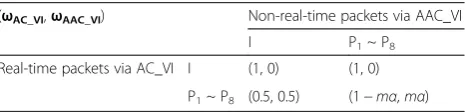
Hence, in the proposed VQD design, the concept of EPL-based priority weighting is extended with a condi-tional priority weighting strategy: boosting the relative importance of non-real-time I-packets from AAC_VI to make them equally compete withreal-timeP-packets of any importance level, not just with P-packets of least importance as in PWD. Table 1 describes how this strategy is formed. Although the weighting scheme is the same as PWD when a non-real-timeP-packet of ar-bitrary importance level encounters any real-time video packet, the major novelty lies in the fact that boosting the relative importance of non-real-time I-packets from AAC_VI can greatly enhance the transmission fairness and quality of non-real-time video due to the most prominent importance levelling of I-packets within a GOP, with a minimum cost of undermining the real-time video quality via conditional priority weighting. Note that such a priority boosting for non-real-time I-packets from AAC_VI still becomes invalid once they encounter real-time I-packets from AC_VI to ensure the transmission priority of the latter.
3.2 Virtual queue dropping of P-packets based on priority-coupled component queue lengths
In general, dropping P-packets of less importance can help to achieve some level of graceful degradation during network congestions. Recall that PWD adopted a fixed scheme for dropping P-packets based on the phys-icalqueue length of AC_VI or AAC_VI, where different dropping thresholds (DTs) were set for P-packets of different EPL indices, with a lower DT value for a less important packet and a higher DT value for a more im-portant one. In this study, we propose aflexible scheme for dropping P-packets of different EPL indices based on the component queue length of each individual EPL index and its coupling relationship to those of other EPL indices. We call such a scheme as virtual queue dropping (VQD).
The objective of VQD is to achieve a better graceful degradation by flexible adaptation to the variation of congestion level, and the design principle behind VQD is to form coupling relationships among the multiple
component queue lengths associated with different EPL indices within the same physical AC queue, such as AC_VI or AAC_VI. More details are explained below.
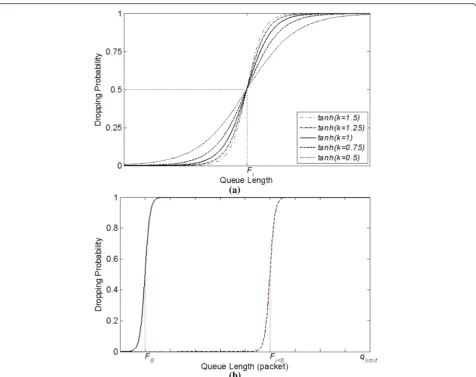
To represent the dropping probability (Pdrop,i) for an arriving P-packet of importance level i (Pi-packet) at either AC_VI or AAC_VI, a hyperbolic tangent function of physical queue length (qphy) with the inflection point at Fi is chosen, as shown in Eq. (1). Note that there are two undetermined parameters: κ for the functional shape, andFifor the inflection point. With the selection ofκ, it creates a chance for performance optimisation in the dropping probability space of Pdrop,i, as shown in Fig. 3a. Basically,Pdrop,iis characteristic of three phases:
anasymptoticphase oflowdropping probability whenqphy<<Fi
anasymptoticphase ofhighdropping probability whenqphy>>Fi
atransitionphase wherePdrop,irapidly changes from lowtohighor fromhightolowwhenqphyis around Fi(note thatPdrop,i= 1/2 whenqphy=Fi, i.e. at the inflection point).
On the other hand, as shown in Fig. 3b, the selection ofFiis a more subtle task with the consideration of dif-ferent importance levels for P-packets. The subtlety is explained as follows.
Let us consider a video stream of a GOP structure with a period ofninevideo pictures (one leading I-picture followed by eight P-pictures) as a typical example. Since every I-picture is referenced for decoding its subsequent P-pictures, none of I-packets should be dropped until the congestion level exceeds thelimit of physical queue(qlimit). For P-packets, eight branches ofdropping probability
functionswith different values of inflection points are adopted so that P1-packets have the largest value (F1) and P8-packets the smallest value (F8). As a result, for the same value set ofκandqphy, the dropping probability of P1-packets is the lowest one (Pdrop,1) while that of P8-packets is the highest one (Pdrop,8). Namely, the smaller value fori, the higher importance level it stands for.
Moreover, even for a given value of leveli,Fiis still not a fixed value. Eq. (2) shows the definition ofFi, where the value ofFiruns within (0,qlimit) and is related to two parameters:qv,iandγ. qv,iis based on a concept calledvirtual queue lengthwhich is a ratio running between 0 and 1. Its definition can be found in Eq. (3), where the numerator is the sum of thecomponent queue lengthof leveli(denoted asqi) and those of higher importance levels (denoted asqj<i), and the denominatorqphyis thetotal physical queue
Table 1Conditional priority weighting
(ωAC_VI,ωAAC_VI) Non-real-time packets via AAC_VI
I P1~ P8
Real-time packets via AC_VI I (1, 0) (1, 0)
P1~ P8 (0.5, 0.5) (1−mα,mα)
m=LGOP−EPL, as defined in Fig.2a.αis the equally spaced distance between
length, namely the sum of all thecomponent queue lengths. The design goal ofqv,iis to allow fora congestion-adaptive adjustment of the dropping probability of level i influenced by those higher importance levels(i.e. thosejs <i). Note that the value ofiis equivalent to (LGOP−EPL), as shown in Fig.2a. For example,qv,4is thevirtual queue lengthof P4 -packets, andqv,4= (q4+q3+q2+q1+q0)/qphy. Hence, it is easy to see the two extreme cases:qv,1= (q1+q0)/ qphy, andqv,8=1. Note thatq0is the component queue length of I-packets,q1is that of P1-packets, and thusqi is that of Pi-packets accordingly. On the other hand,γ simply serves to weaken the competition capability of P1-packets so that they will not jeopardise I-packets when the congestion level becomes extremely heavy. In principle, to confineFiwithin (0,qlimit), the value ofγ should also be limited within (0, 1). An optimal value set of (κ,γ) is presented and discussed in Section 4.2 and Fig.5.
Although we have explained the proposed cross-layer design based on the GOP coding pattern with a period ofninevideo pictures in Fig. 2a, the design can be easily extended to any GOP period.
Pdrop;i¼
1
2 1þtanh
κðqphy−FiÞ
ð1Þ
Fi¼qlimit 1−γqv;i
ð2Þ
qv;i¼
qiþXi−1 j¼1qj
qphy ð3Þ
3.3 Priority retries of I- and P-packets
Transmission retries for lost packets due to wireless errors can reduce the packet loss rate on one hand, but they could also generate unexpected packet delays on
the other hand, in particular during congestions. The un-expected packet delays may be harmless tonon-real-time video applications such as on-demand video delivery as long as the play-out buffer on the video receiver side is set to be long enough, but should definitely be avoided for real-time applications such asconversational video com-munication. Hence, a limit of retires is required to avoid meaningless transmissions and can save the bandwidth re-sources. However, a further question to ask in this study is what the optimal limit of retries should be. To address this, our design principle is to allow for priority retry limits of I- and P-packets, as explained below:
The priority retry limits of I- and P-packets should be controlled so that the performance impact due to real-time constraintscan be as small as possible. Furthermore, because I-packets are more important
than P-packets within the same GOP, I-packets should deserve a larger limit of retries than P-packets.
A series of studies to find the optimal combination of priority retry limits for these two packet types, under various congestion cases and time constraints, are pre-sented and analysed in Fig. 6 and Section 4.3, and those performance comparisons among different designs are also based on this optimal combination to be fair.
To gain a deeper insight, it could be helpful to see how wireless errors induce packet drops if the limit of retries is exceeded. Although wireless error sources cover receiving power attenuation, signal interference, multipath fading etc., the VQD design adopts the two-ray ground reflection model for simplicity, to avoid the complexity of multipath fading so that the main focus can be placed on the multi-access collision issue. Multi-access collisions (including both physical collisions among wireless stations and in-station virtual collisions among ACs) can trigger transmission retries in the MAC layer, and eventually packet drops if the limit of retries is exceeded inphysical collisions.
Obviously, the physical collision probability enlarges with the number of wireless stations (Ns) or the total traffic rate before it reaches a saturated rate. On the other hand, the virtual collision probability should also enlarge with the number of AC-traffic flows and their flow rates similarly. Nevertheless, based on our study, virtual collisions only increase packet delays, but do not drop packets even if over retried, and thus it is enough to understand or predict the packet loss rate (PLR) simply from the physical collision probability, without knowing the details of the virtual collision probability. In this study, we boldly assume that the physical colli-sion probability of 802.11e and 802.11aa should be the same as that of 802.11 if they all adopt the same value of
initial contention window (W) forrandombackoff in the retry process, ignoring the fact that 802.11 might adopt a different value for fixed backoff. In other words, they all share the same functional form of W. The results for some tested conditions of PLR, presented in the second half of Section 4.3, verify and support this assumption. Thus, the remaining questions are (1) how to predict the physical collision probabilityand (2) how to predict PLR from thephysical collision probability.
For question (1), it was shown in [24] that the mean-valuemodel of contention window (Wmean) in the random backoff process can be used to predict the physical collision probabilityPphy_col(802.11) in DCF-based multi-access channel contention under ‘saturated’ traffic rates, as shown in Eqs. (4) and (5), and a good agreement in Pphy_col(802.11) was obtained between the prediction and simulation data (ns-2), with differences around 1~3 %. Note that Eqs. (4) and (5) are mutually iterative and can be solved with a unique solution P if given the parameter set {m, K, Ns}. For question (2), based on the aforemen-tioned arguments and big assumption (i.e. they all share the same functional form of Wmean), we can thus predict the packet loss rates for 802.11, 802.11e and 802.11aa, all based on Eq. (6).
P¼1− 1− 1 Wmean
Ns−1
ð4Þ
where P≡Pphy_colto be concise notation-wise, and
Wmean ¼η W−1 K = # of max transmissions.
PLR¼PK ð6Þ
where the derivation of Eq. (6) is given below:
PLR¼1−PRR
As also discussed in [24], the above mean-value model is actually a special case of the two-state Markov chain model when the conditional channel access prob-ability of the current slot immediately after an idle time slot is equal to that immediately after a busy time slot. It is because of this special case that the physical collision probability can be solved uniquely. Markov chain model-ling has been useful in analysing communication or networking problems, more applications of Markov chain modelling can also be easily found elsewhere, such as semi-Markov decision process modelling in helping the hand-off design of a train moving between access points so as to improve the train control system performance [25], or in achieving an optimal joint session admission control scheme in integrated WLAN(802.11e)/CDMA networks to utilise overall radio resources [26], both in a fashion of cross-layer design.
4 Results
This section presents our simulation results to demon-strate the superiority of the proposed VQD design over the existing ones in achieving a win-win game for both the real-time and non-real-time video performances through AC_VI and AAC_VI, respectively. Firstly, we
describe the simulation setup, including the networking topology and experimental settings for various traffic flow types, followed by analyses spanning over different performance metrics and influential factors, including the effects of the functional shape of tanh due to optimisation ofκand the inflection point oftanhdue to optimisation of γ, the retry effects of I- and P-packets, the average queue lengths, the packet delay probability distributions and their associatedrealandeffectivelosses without and with areal-timeconstraint respectively, and the effect of the adopted reference video sequences on the peak-signal-to-noise-ratio (PSNR) variation under various congestion levels.
4.1 Experimental setup
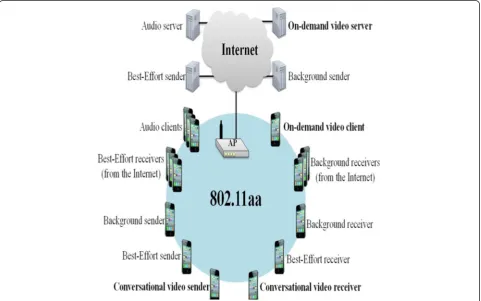
A simulation environment based on ns-2 [27] was adopted to conduct experiments for performance analyses. As shown in Fig. 4, an 802.11aa wireless LAN with access to the Internet was established, where the AP and all the wireless stations were 802.11aa QoS-enabled. The net-work capacity of the wireless LAN was adopted to be 2 Mbps and assumed to be the bottleneck of any end-to-end traffic, including the traffic from the Internet. Note that the AP plays a role as the traffic hub in general, and
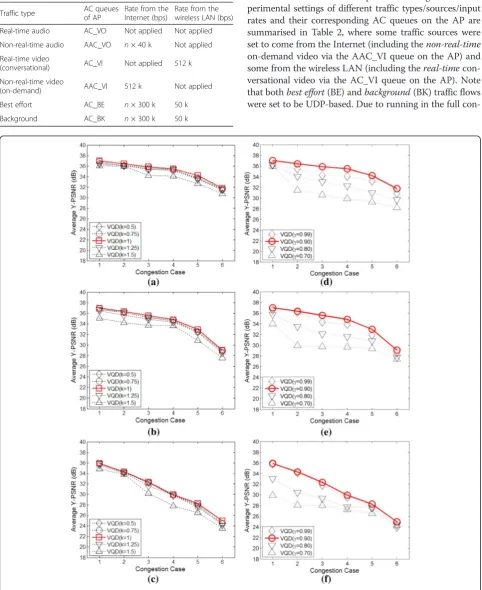
for simplicity it was chosen to fully run in the contention mode and no contention free period was assigned. The ex-perimental settings of different traffic types/sources/input rates and their corresponding AC queues on the AP are summarised in Table 2, where some traffic sources were set to come from the Internet (including thenon-real-time on-demand video via the AAC_VI queue on the AP) and some from the wireless LAN (including thereal-time con-versational video via the AC_VI queue on the AP). Note that bothbest effort(BE) andbackground(BK) traffic flows were set to be UDP-based. Due to running in the full
con-Table 2Experimental settings for various traffic types, mapped AC queues, traffic sources and input rates
Traffic type AC queues
of AP
Rate from the Internet (bps)
Rate from the wireless LAN (bps)
Real-time audio AC_VO Not applied Not applied
Non-real-time audio AAC_VO n× 40 k Not applied
Real-time video
(conversational) AC_VI Not applied 512 k
Non-real-time video
(on-demand) AAC_VI 512 k Not applied
Best effort AC_BE n× 300 k 50 k
Background AC_BK n× 300 k 50 k
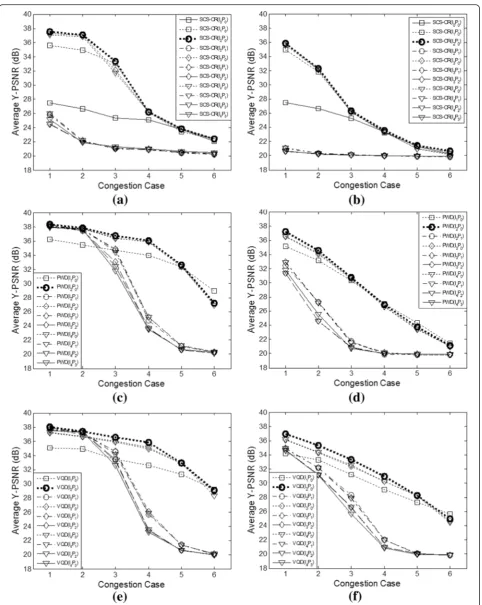
Fig. 6Effects ofpriority retriesof I- and P-packets on average Y-PSNR variations of different scheduler designs under various congestion levels, withlooseandtightreal-time cuts (RT-Cut-400 ms and RT-Cut-200 ms, respectively):aSCS-CR with RT-Cut-400 ms,bSCS-CR with RT-Cut-200 ms,
tention mode, the traffic sources from the Internet were needed to control/adjust the congestion levels of other non-video AC queues, in terms of the number of cross-traffic flows, denoted byn, running from 1 to 6 to repre-sentlighttoheavycongestion levels respectively. In order to present fair performance analyses, the same value set of EDCAFs was adopted for all the target schedulers under comparison, as shown in Table 1 of [8].
Two video streams encoded from the same reference video sequence were sent, respectively, and asynchron-ously from theconversational video sender and on-de-mand video server to their corresponding receiver and client respectively. Note that the analyses of Figs. 5, 6, 8 and 9 were all based onContainer QCIF. To confirm the performance superiority of VQD is a general effect among the adopted sequences, four reference video sequences [28] with slow/fast motions and QCIF/CIF YUV formats were adopted, including Container QCIF (medium-slow), Foreman QCIF (fast), Mother-and-Daughter CIF(slow) andCarphone CIF(fast).
Each reference video sequence was encoded into a 512-kbps bit-stream in the GOP pattern {I, P1, P2, P3, P4, P5, P6, P7, P8} with a period ofninevideo pictures by the H.264 [29] reference software (JM 10.2). The video transmission quality evaluation toolset EvalVid[30] was used to packetise the target bit-stream, and the video packets were then transmitted over the adopted network topology to obtain the packet loss information so that the transmission quality can be evaluated according to the information of packet losses. The transmission quality of each received video picture was evaluated based on theyieldpart of PSNR (Y-PSNR), as defined by Eq. (7), where (Yi;j−Yi;jÞis the yielddifference per pixel
before and after quality impairment. The performance metric for the entire video sequence was then based on the average of all the picture-based Y-PSNR values. To be statistically meaningful, the performance data point for each congestion case was obtained from averaging over 30 simulation runs, denoted as Average Y-PSNR throughout the rest of this article.
Y−PSNR¼10log10 255
4.2 Optimal values forκandγ
To understand how the value ofκ affects the shape of the adopted tanh function in our proposed VQD de-sign and thus its average Y-PSNR performance, five values ofκ(0.5, 0.75, 1, 1.25, 1.5) have been selected to demonstrate the performance variations in different congestion cases. As shown in Fig. 5a–c, three real-time constraints or cuts (denoted as RT-Cut-400 ms, RT-Cut-300 ms, RT-Cut-200 ms) have been applied,
respectively. As expected, the congestion robustness of VQD should go down with atighterreal-time cut. Two major messages can further be delivered below.
For all the applied real-time constraints,κ= 1 can generate the optimal performance.
The performance differences between κ= 1 and the other values are not so large, around 1~2 dB, and thus it indicates the appropriateness and stability of the adoptedtanh function for performance robustness of the proposed VQD design.
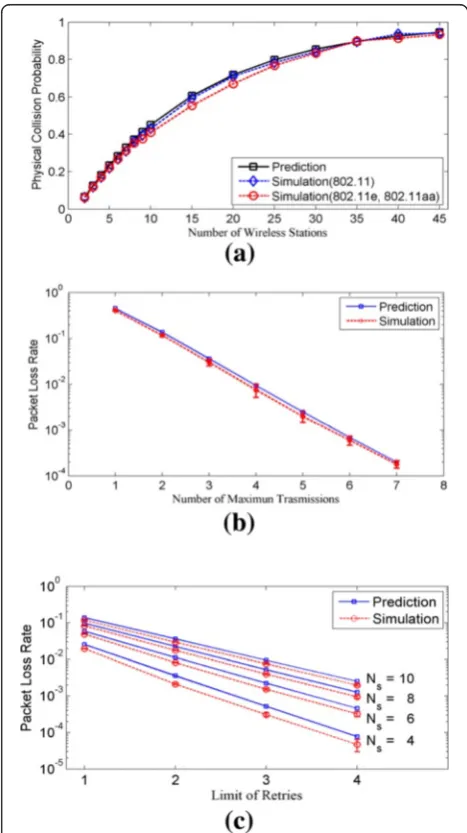
Fig. 7Physical collision probability-basedpacket loss rateprediction:a
Comparison ofphysical collision probabilitybetween prediction and simulation data from 802.11, 802.11e (1 flow via AC_BK), and 802.11aa (1 flow via AC_BK),bComparison ofpacket loss rate
The above analysis was conducted assuming a fixed value of γ at 0.9. To further understand how the value of γ affects the inflection point of each tanh function for priority dropping of P-packets in VQD and thus its average Y-PSNR performance, four values of γ (0.7, 0.8, 0.9, 0.99) have been selected to demonstrate the performance variations in different congestion cases, given the optimal value κ = 1. Again, the three afore-mentioned real-time constraints have also been ap-plied, respectively, for Fig. 5d–f. As expected, the congestion robustness of VQD also goes down with a tighter real-time constraint. Two major messages can further be delivered below.
For all the applied real-time constraints,γ= 0.9 can generate the optimal performance.
The performance gains ofγ= 0.9 over the other values are much larger (particularly in comparison with γ= 0.7 and 0.8), namely more visible than the performance difference among theκvalues. Hence, it implies that it is more sensitive and significant to select an optimal value ofγ. Meanwhile, the performance becomes more stable and robust whenγ≥0.9.
Based on the above analyses, the optimal value set (k= 1, γ = 0.9) is adopted for further performance analyses throughout the rest of this article.
1 2 3 4 5 6
4.3 Effects of priority retries of I- and P-packets
The design principle for priority retries of I- and P-packets has been described and discussed in Section 3.3. Figure 6 presents a series of studies on the effects of pri-ority retriesof I- and P-packets on Average Y-PSNR vari-ations of different schedulers (SCS-CR, PWD, VQD) under various congestion cases, with loose and tight real-time cuts (i.e. RT-Cut-400 ms and RT-Cut-200 ms), respectively, where the limit of retries ranges from 0 to 4 for I-packets and from 0 to 3 for P-packets, requiring the limit of retires for I-packets be always larger than that for P-packets. A common agreement has been observed: every design reaches its best performance when one sets the limits to be two retries for I-packets, and no retry for P-packets, denoted as I2P0. For further performance studies throughout the rest of this article, I2P0 is the default case for all the designs in order to provide fair performance comparisons.
As a deeper insight to understand the PLR due to over-retries for multi-access physical collisions, Fig. 7 verifies and supports the prediction of PLR from the physical collision probability, based on Eqs. (4) to (6). To study the multi-access effect with the number of wireless stations, a scenario with Ns wireless stations sending
traffic to the Internet via an AP was adopted. Figure 7a demonstrates the physical collision probability without retries as a function ofNsfor comparisons between pre-diction and simulation data from 802.11, 802.11e and 802.11aa, where a common value of initial contention window (W= 32) was adopted and only a single saturated CBR flow was sent, via AC_BK in the case of the latter two and thus they share the same results. It is seen that the above physical collision probabilities all increase with Ns, as well expected. There are good agreements among them in general, except that the simulation data for both 802.11e and 802.11aa are slightly lower when Ns= 15 and 20, which may well be due to a longer default value of fixed backoff (AIFS) adopted for both 802.11e and 802.11aa than the one (DIFS) adopted for 802.11. Figure 7b shows a good agreement of PLR between prediction and simulation data (Ns= 10) for 802.11, where the agreement becomes better as the number of maximum transmissions increases, particularly in terms of log scaling for PLR. Figure 7c further extends such log-scale comparisons of PLR between prediction and simulation data (Ns= 4, 6, 8, 10) for both 802.11e and 802.11aa, and the agreements are still good in general, despite not fully within the error bars (at the 95 % confidence level), but still on the same order
of magnitude. These show a strong support for our predic-tion and understanding of Eq. (6), which predicts PLR from thephysical collision probabilitygiven by Eqs. (4) and (5).
4.4 Average queue lengths
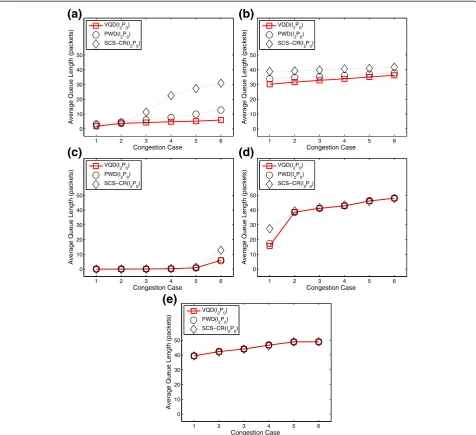
According to the experimental settings in Table 2, the average length variations with congestion case n are depicted for the five AC queues of the AP (AAC_VO, AC_VI, AAC_VI, AC_BE, and AC_BK), as shown in Fig. 9, where qlimit= 50 is adopted for each of these five AC queues. Note that AC_VO was kept to be empty for simplicity. For cross-traffic of non-video types, there is no apparent difference among different designs except that SCS-CR is somewhat more congested than PWD
and VQD atn= 6 for AAC_VO and atn= 1 for AC_BE. Actually, the focus should be placed on AC_VI and AAC_VI, respectively, forreal-time(conversational) and non-real-time (on-demand) video performances. The main messages are delivered as follow.
For AC_VI, the proposed VQD design outperforms the others in the sense that it is least congested at all the congestion cases, and its superiority is amplified whennincreases.
For AAC_VI, the superiority of VQD over the others is still clearly seen, but no obvious increasing trend with n is observed since the ratio of scheduling probability for AAC_VI to
that for AC_VI is low in general, and thus the average queue lengths of AAC_VI are longer than those of AC_VI for all the congestion cases, even at n= 1.
To sum up, a win-win game for both real-time and non-real-time video applications has been achieved by the proposed VQD design in terms of the shortest average queue length for each congestion case.
4.5 Packet delay probability distributions with/without a real-time constraint
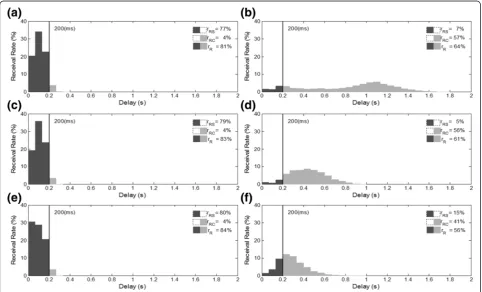
In order to gain a deeper understanding for the effect of the aforementionedreal-time cutson the performances of different designs forconversationalvideo communication, it is helpful to observe their corresponding packet delay probability distributions. Figure 9 shows the packet delay probability distributions of different scheduler designs under light (n= 1) and heavy (n= 6) congestion levels. Note that the total area under each probability distribu-tion represents the percentage of the successfullyreceived video packets (rR), as defined in Eq. (8). When atight real-time constraint such as RT-Cut-200 ms is applied, each distribution is divided into two parts: a darkshaded area representing the percentage ofreceived and survivedvideo packets (rRS) and alightshaded area standing for the per-centage of received but cut-away video packets (rRC), as defined in Eqs. (9) and (10), respectively. Note again that these three ratios are normalised to the total number of video packets (Ntotal) in a given reference video sequence for the sake of comparison in the same scale.
rR¼Nreceived
Ntotal
100% ð8Þ
rRS¼Nreceived and survived
Ntotal
100% ð9Þ
rRC¼Nreceived but cut−away
Ntotal
100% ð10Þ
In addition, in terms of packet loss rate, (1−rR) stands for thereal loss rate due totransmissionwhilerRC rep-resents the effective loss rate due to RT-Cut-200 ms. The main messages delivered from Fig. 9 are listed below.
Inlightcongestion, all the packet delay distributions are mostly focused below 200 ms. However, it still clearly indicates thatdV QD<dPW D <dSCS−CR,
whered stands for the average packet delay. Inheavycongestion, all the packet delay
distributions are spread out in different extents: SCS-CR is spread out most seriously, PWD secondly seriously, and the proposed VQD least seriously in the sense that the inequalitydV QD<dPW D <
dSCS−CRstill holds.
Table 3 summarises the values of (rRS, rRC, rR) under vari-ous congestion levels, where the leading values (i.e. the maximum rRS, the minimum rRC, and the maximum rR) among the target designs under comparison are written in bold-face. These values can be reasoned as follow.
Although the proposed VQD design does not always have the maximum value inrR(in fact, it always takes the final place inrRexcept forn= 1 due to its effective packet dropping behaviour, particularly when the congestion level increases), it does always take the lead in bothrRSandrRCfor all the congestion levels, meaning that it keeps the minimum value in average packet delay no matter how the congestion level changes, as aforementioned.
SCS-CR is at the other extreme; although it in general takes the lead in rR, it is almost the
all-Table 3(rRS,rRC,rR) of AC_VI versus congestion casen, due to
RT-Cut-200 ms, with the leading values from the target designs writ-ten in bold-face
Table 4Ratio of received packets (rR) of AAC_VI versus congestion casen, where therealpacket loss rate due to transmission can be derived from (1−rR), with the leading values from the target designs written in bold-face
rR Congestion case
n= 1 n= 2 n= 3 n= 4 n= 5 n= 6
VQD 34 % 29 % 26 % 21 % 18 % 16 %
PWD 31 % 25 % 21 % 17 % 15 % 13 %
time loser in bothrRS andrRC. This originates from the fact that SCS-CR lacks an effective strategy in packet dropping to mitigate the congestion.
The performance of PWD is in general in between VQD and SCS-CR; its performance is closer to VQD fromlighttomedium-lowcongestions (n= 1, 2, 3), but closer to SCS-CR frommedium-highto heavycongestions (n= 4, 5, 6).
So far, the above analyses in this subsection are all based onreal-timevideo via AC_VI with a real-time cut, and the proposed VQD design in general takes the lead in bothrRSandrRC, but almost the loser inrRcompared
to PWD and SCS-CR. For non-real-time video via AAC_VI, however, Table 4 gives a much better ranking in rR for VQD; PWD becomes the all-time loser, SCS-CR is no longer the all-time winner, and VQD can even take the lead for half of the congestion cases. Consider-ing the fact that both PWD and VQD root from a simi-lar concept called early prioritised packet dropping depending on the congestion level, this result is some-what surprisingly good, and it delivers the following messages:
VQD outperforms PWD by a superior realisation of prioritised early packet droppingwhich is based on the coupling of video packet dropping probability
for a given priority with those higher priorities, as shown in Eq. (3).
VQD can effectively alleviate the congestion level by early droppingvideo packets of less importance (i.e. those lower-priority ones) at congestion cases n= 2, 3 and 4.
Although VQD is not as good as SCS-CR in the other cases in terms of rR, Fig. 10 demonstrates that VQD is still the all-time winner in terms of Average Y-PSNR. Again, this supports that VQD can achieve a win-win game in both real-timeand non-real-time video applications, namely it successfully tackles the dilemma problem in achieving priority and fairnesssimultaneously.
Section 4.6 will address more on the generality of such a win-win game.
4.6 Generality of performance superiority in average Y-PSNR
To show that the performance superiority of VQD over PWD and SCS-CR is general and not a special effect of a specifically adopted video sequence, more performance comparisons based on average Y-PSNR have thus been conducted on the aforementioned four reference video sequences of different YUV formats (QCIFand CIF) and motion levels (slowand fast), and the corresponding results are summarised in Figs. 10, 11, 12 and 13, each of which consists of several
subfigures to present the Average Y-PSNR variations with congestion case n under different time con-straints: (a) AAC_VI without any real-time cut, (b) AC_VI with 400 ms, (c) AC_VI with RT-Cut-300 ms, and (d) AC_VI with RT-Cut-200 ms. These figures deliver the following common messages.
The performance superiority of VQD over PWD and SCS-CR is indeed a general phenomenon, and there is no strong effect due to the format or motion level of the adopted video sequence. VQD can always achieve awin-win gameover the
others in both the performances of AAC_VI
(withoutany real-time constraint) and AC_VI (withdifferent real-time constraints), and its real-time performance gains over the others are amplified in general as the congestion level increases.
Although the congestion-robustness capabilities of different designs all go down with the tightness of the adoptedreal-time constraint as expected, the performance gains of VQD over PWD (the all-time second place) also become more visible. This shows the true power of VQD in its efficiency of early packet dropping based the coupling of component queue lengths of different priorities.
5 Conclusions
In this article, we have presented a novel scheduler de-sign called VQD for robust real-time video communi-cation over IEEE 802.11aa wireless LANs. Based on the three novel concepts, namely conditional priority weighting for non-real-time I-packets from AAC_VI, virtual queue droppingof P-packets based on priority-coupled component queue lengths and priority retries of I- and P-packets, the proposed VQD design has been demonstrated to be in general superior to other target designs such as SCS-CR and PWD. The optimal value of κ that determines the best tanh functional shape, namely the virtual queue-based packet dropping prob-ability functions for AC_VI and AAC_VI, has been found to be 1, despite that the performance differences using its neighbouring values are not so large, between 1~2 dB in general. The retry effect for lost I- and P-packets indicates that the best retry limits are twice for I-packets, zero for P-packets. This result is common to all the target designs, and thus all the performance comparisons are based on such a combination of retry limits.
VQD has revealed its superiority over PWD and SCS-CR in the sense that it has the shortest average queue lengths for both AC_VI and AAC_VI, the minimum average video packet delay, the maximum number of received and survived video packets, and thehighest value of average Y-PSNR, considering their variations with different congestion levels under vari-ous real-time constraints. Moreover, the superiority of VQD is a common phenomenon among different video sequences, and not obviously affected by the format or motion level of the adopted video source. It is also worth mentioning that VQD has won a win-win game over the other designs in both the perform-ance gains of AC_VI and AAC_VI, namely a dilemma in achieving priority and fairness simultaneously for scheduling between the primary and alternative queues in the access category of video for delivering video streams with and without real-time constraints, respectively.
Competing interests
The authors declare that they have no competing interests.
Acknowledgements
This study was supported by the Taiwan National Ministry of Science and Technology under grants MOST 102-2221-E-155-007, MOST 103-2221-E-155-052, MOST 104-2218-E-155-002 and MOST 105-2218-E-155-001.
Received: 28 July 2015 Accepted: 7 May 2016
References
1. IEEE Std 802.11-2012, Part 11: Wireless LAN medium access control (MAC) and physical layer (PHY) specifications. IEEE Std (2012)
2. IEEE Std 802.11-1999, Part 11: Wireless LAN medium access control (MAC) and physical layer (PHY) specifications. IEEE Std (1999)
3. G Bianchi, Performance analysis of the IEEE 802.11 distributed coordinated function. IEEE J Sel Areas Commun18(3), 535–547 (2000)
4. IEEE Std 802.11e-2005 (Amendment 8 to IEEE Std 802.11-1999), Medium access control (MAC) quality of service enhancements. IEEE Std (2005)
5. A Ksentini, M Naimi, A Gueroui, Toward an improvement of H.264 video transmission over IEEE 802.11e through a cross-layer architecture. IEEE Commun Mag44(1), 107–114 (2006)
6. CH Lin, CK Shieh, CH Ke, NK Chilamkurti, S Zeadally, An adaptive cross-layer mapping algorithm for MPEG-4 video transmission over IEEE 802. 11e WLAN. Telecommun Syst42(3), 223–234 (2009)
7. N Chilamkurti, S Zeadally, R Soni, G Giambene, Wireless multimedia delivery over 802.11e with cross-layer optimization techniques. Multimed Tools Appl 47(1), 189–205 (2010)
8. WP Lai, EC Liou, A novel cross layer design using comb-shaped quadratic packet mapping for video delivery over 802.11e wireless ad-hoc networks. EURASIP J Wireless Commun Net2012(1), 59 (2012)
9. CH Lin, YC Wang, CK Shieh, WS Hwang, An unequal error protection mechanism for video streaming over IEEE 802.11e WLANs. Computer Networks56(11), 2590–2599 (2012)
10. Z Wan, B Xiong, N Ghani, AV Vasilakos, L Zhou, Adaptive unequal protection for wireless video transmission over IEEE 802.11e networks. Multimed Tools Appl72(1), 541–571 (2014)
11. IEEE Std 802.11aa-2012, Part 11: Wireless LAN medium access control (MAC) and physical layer (PHY) specifications, Amendment 2: MAC enhancements for robust audio video streaming. IEEE Std (2012)
12. K Kosek-Szott, M Natkaniec, S Szott, A Krasilov, A Lyakhov, A Safonov, What’s new for QoS in IEEE 802.11? IEEE Network27(6), 95–104 (2013)
13. IEEE Std 802.11ae-2012, Part 11: Wireless LAN medium access control (MAC) and physical layer (PHY) specifications, Amendment 1: prioritization of management frames. IEEE Std (2012)
14. A Lyakhov, M Yakimov, Analytical study of QoS-oriented multicast in wireless networks. EURASIP J Wireless Commun and Net2011(1), 307507 (2011) 15. A Banchs, A de la Oliva, L Eznarriaga, DR Kowalski, P Serrano,
Performance analysis and algorithm selection for reliable multicast in IEEE 802.11aa wireless LAN. IEEE Trans Veh Technol63(8), 3875–3891 (2014)
16. P Salvador, L Cominardi, F Gringoli, P Serrano, A first implementation and evaluation of the IEEE 802.11aa group addressed transmission service. ACM SIGCOMM. Comput Commun Rev44(1), 36–41 (2014)
17. IEEE Std 802.1Q-2011, IEEE standard for local and metropolitan area networks—media access control (MAC) bridges and virtual bridge local area networks. IEEE Std (2011)
18. E Charfi, L Chaari, L Kamoun, PHY/MAC enhancements and QoS mechanisms for very high throughput WLANs: a survey. IEEE Commun Surv Tut15(4), 1714–1735 (2013)
19. P. Serrano, P. Salvador, V. Mancuso, Y. Grunenberger, Experimenting with commodity 802.11 hardware: overview and future directions. IEEE Commun Surv Tut17(2), 671–699 (2015)
20. WP Lai, EC Liou, A novel scheduler design for wireless video over 802.11aa networks using priority weighting and dropping. Int J Future Generation Commun Net6(4), 137–146 (2013)
21. HY Kang, CL Chang, The decision scheme of frame importance factor for video streaming system, inProc. 5th Int Conf Broadband, Wireless Computing, Communication and Applications (BWCCA’10), Fukuoka, Japan, 2010, pp. 517–521 22. IEEE Std 802.17-2004, Part 17: Resilient packet ring (RPR) access method and
physical layer specifications. IEEE Std (2004)
23. IEEE Std 802.1Qav-2009, IEEE standard for local and metropolitan area networks—virtual bridged local area networks, Amendment 12: Forwarding and queuing enhancements for time-sensitive streams. IEEE Std (2009) 24. H Vu, T Sakurai, Collision probability in saturated IEEE 802.11 networks, in
Proc. Australian Telecommunication Networks and Application Conference, (ATNAC’06), Australia, 2006, pp. 21–25
25. L Zhu, FR Yu, B Ning, T Tang, Cross-layer handoff design in MIMO-enabled WLANs for communication-based train control (CBTC) systems. IEEE J Sel Areas in Comm (JSAC)30(4), 719–728 (2012)
26. F Yu, V Krishnamurthy, Optimal joint session admission control in integrated WLAN and CDMA cellular networks with vertical handoff. IEEE Trans Mobile Comput6(1), 126–139 (2007)
28. Video Trace Library (US Arizona State University or Germany TKN Telecommunications Networks Group), http://trace.eas.asu.edu/ yuv or http://www.tkn.tu-berlin.de/research/evalvid. Accessed 5 Mar 2015 29. ITU-T Rec H.264, Advanced video coding for generic audiovisual services. ITU
Std (2010)