© 2016 IJSRCSEIT | Volume 1 | Issue 1 | ISSN : 2456-3307
Prototype Survey of Different Resource Provisioning
Procedures in Cloud Computing
1K. Phaneendra, 2Dr. M. Babu Reddy
1Research Scholar, Computer Science and Engineering Rayalaseema University, Kurnool, Andhra Pradesh, India 2Asst.Professor, Department of Computer Science, Krishna University, Machilipatnam, Krishna, Andhra Pradesh, India
ABSTRACT
Maintenance of large data is the crucial task in distributed environment, cloud computing is the main
aspect to maintain client’s data in different servers. Quality of service and evaluating performance of cloud
with respect to load and resources are the main parameter to store data in different servers in cloud
computing
.In this paper, we analyze different resource optimization approaches to evaluate quality of servicein distributed environment. Also discuss about CloudSim tool representation for resource provisioning environments. CloudSim environments supports behavior of cloud computing relates to data center maintenance, different service policies and virtual machine representations. This paper gives brief comparison relate to resource provisioning with respect to workload maintenance on different resource utilization in cloud. And also focus on different resource management approaches, resource allocation, resource mapping and resource adaption. It describes the survey of different methods for different infrastructure as a service in cloud computing.
Keywords : Cloud computing, Quality of Service, CloudSim, Infrastructure as A Service, Virtual machine and Resource management.
I.
INTRODUCTION
Distributed computing conveys framework, stage, and programming which can be accessible as client based service provider to compensate the user required based services. These services are alluded with different cloud implementation services. Basic representation of service provider was featured with currently presented top universities. Distributed computing computes utilization between different clients with respect to their IT business and other technical services with representative operations.
Cloud [2] plan to control server to empower dynamic resource provisioning. It is encouraged by uncovering server farm's abilities as a system of ifferent host based virtual machines (e.g. equipment,
database, UI, and for all implemented rationale) so that clients can get different developed operations from anyplace in the Internet, driven by the data request and QoS prerequisites [3]. Thus, IT organizations with imaginative thoughts for newly arrived server oriented data presentations are never again required to make substantial capital expenses in the equipment and programming foundations. By utilizing mists as the application facilitating stage, IT organizations are liberated from the inconsequential assignment of setting up fundamental equipment & infrastructure representations. In this way, they can concentrate more on development and application development in different VM based application developments [1]. A portion of the customary and rising Cloud-based application administrations incorporate interpersonal interaction, web
facilitating, content conveyance, and constant instrumented information preparing. Every one regarding these application writes has diverse creation, arrangement, and organization necessities. Evaluating the execution of provisioning (booking and assignment) arrangements in a genuine Cloud registering condition AWS and other service applications for various application models under transient conditions is greatly testing since: (i) Clouds display differing requests, supply designs, framework sizes, and assets (equipment, programming, organize); (ii) clients have similar, dynamic, and contending QoS prerequisites; and (iii) different services have shifting execution, load balancing events and for dynamic resource provisioning. The utilization of genuine frameworks, for example Amazon EC2 and Microsoft Azure are considered for bench marking the application execution (throughput, money saving advantages) under different conditional factors (accessibility, workload designs) is regularly obliged by the inflexibility of the framework. Consequently, this influence the propagation of results that can depend upon, a great degree of troublesome endeavor. Further, it is dreary and time consuming to re- arrange bench marking parameters over a gigantic scale Cloud figuring framework over numerous trials. Such restrictions are caused by the conditions winning in the Cloud-based situations that are not in the control of designers. In this way, it isn't conceivable to perform benchmarking tests in repeatable, trustworthy, and versatile conditions utilizing certifiable Cloud situations.
The real issues that are normally connected with IaaS in cloud frameworks are asset administration, organize foundation administration, virtualization and multi-occupancy, information administration, application programming interfaces (APIs), inter operability, and so forth. These issues are quickly talked in next sections. This paper centers on asset administration because of the way that asset administration for infrastructure as a service in distributed environment consists of advantages like: versatility, Quality of Service (QoS), specific
condition, diminishment in overheads, idleness, enhanced throughput, cost viability and streamlined interface. This paper centers on reviewing the portion of imperative asset administration plans for example, asset mapping, asset provisioning, asset distribution and asset maintenance. It defines comprehensive at the basic review regarding different resource provisioning architectures with respect to different functionalities.
II.
REVIEW OF RELATEDWORK
Main Cloud key stages in distributed registering sections like AWS (Amazon Service Web)[15], Assured Microsoft [17], and other services defines an assortment of pre-bundled administrations for checking, overseeing, resource utilization and different administrations. Be that as it may, the systems executed in every one of these Cloud stages change. Three types of Amazon services present in distributed environment like EC2, AWS Batch,
andAmazon Simple Storage Service
(S3) to definedifferent attributes, which require resource provisioning operations present in AWS. Versatile Load Balancer benefits naturally arrangements approaching application workload crosswise over accessible EC2 occasions. Dynamic service provider can be utilized for scalable implementation of EC2 to handle different communications for the benefit of
request designs. Lastly the Cloud Watch
accessible administration/resource provider approaching solicitations. In any case, as compared to AWS, Eucalyptus still does not have a portion of the basic functionalities.
In a general sense, Windows Azure Fabric et.al [17] has distributed architecture, which can be made out of hubs, and connections like energy and other parameters. Controller deals with an administration hub through an implicit administration, named agent with respect to controller, which keeps running server background, following the condition of the
service provider, and announcing these
measurements to defined services. The Controller can deal with a re-establish of service provider or a movement of administrations takes from the present service server provider to other solid servers. In addition, a grouped or a fabric controller likewise bolsters benefit resource utilization by coordinating to the VMs based on data requests. [23] GoGrid steering application benefit demands. Additionally, the heap balancer can detect representation of servers, diverting further demands to other accessible servers. In any case, as of now, GoGrid cloud service provider just gives creators automatic APIs to actualize performance of virtual machines.
Dissimilar to different cloud stages, Google Drive offers designers an adaptable stage in which applications can run, as opposed to giving access specifically to a tweaked VMs. Subsequently, access basic working framework is limited in App Engine. What's more, stack adjusting procedures, benefit provisioning and auto scaling are altogether naturally oversaw by the framework off camera. Be that as it application benefit (SaaS) suppliers will experience issues with respect to quality of services (QoS) desires for all their users. Subsequently, they would like to legitimately develop combined Cloud infrastructures (blending various open and private mists) to give better help to their particular client needs. This sort of necessities regularly emerges in undertakings with worldwide activities and applications, for example, Internet benefit, media facilitating with web applications. This requires building advancements and calculations for consistent alliance of Cloud
framework specialist co-ops for autonomic
provisioning of administrations crosswise over various Cloudsuppliers.
III.
CloudSim for Resource Provisioning
Basic introduction related to CloudSim utilized with JAVA for different implemented attributes in cloud, which are associated with central functionalities, for
example development of integrated cloud
scheduling policies with virtual machine requirements. If application changes then following operations were changed i.e. platform, application configurations, robustness of client configurations and federative cloud application development.
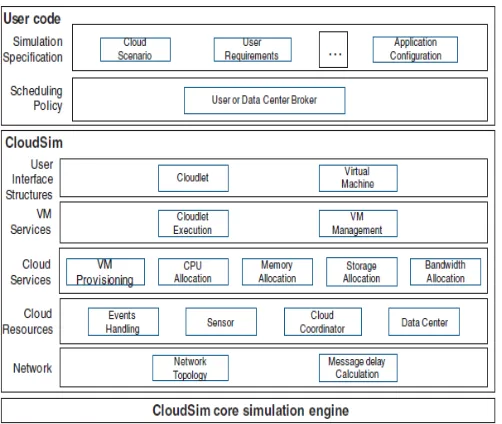
Figure 2. CloudSim architecture with resource provisioning
As shown in figure 2, cloud computing is increased with respect to different cloud resources, instruments, and developed approaches which can be handled with different complexity based attribute partitions. This approach presently defines different research attributes for different organizations. To characterize all the supported and execution implemented approaches may excludes using CloudSim platform to support analysis of load balancing for each client data request processed by cloud computing with respect to load maintenance.
IV.
Basic Issues Related to
Resource Provisioning
The real issues that are usually connected with IaaS in cloud frameworks are virtualization and multi- tenure, asset administration, organize foundation administration, information administration, APIs, interoperability and so forth. We will quickly present the issues.
(I) Virtualization and multi-occupancy:
Virtualization is a basic innovative normal for mists, conceals the mechanical unpredictability from the client and empowers improved adaptability (through conglomeration, steering and interpretation). In a multi tenancy domain, numerous clients share a similar application, running on the same working framework, on similar equipment, with similar information stockpiling instrument. The refinement between the clients is accomplished amid application outline, in this manner clients don't share or see each other's information. In the event of virtualization, parts are disconnected empowering every client application seem to running on a different physical machine. Lombardi and Pietro (2011) demonstrate how virtualization can expand the security of distributed computing by ensuring both the trustworthiness of visitor virtual machines and the cloud foundation parts. The impact of virtualization on new age programming models and conditions like Hadoop has been investigated in Ibrahim and Shi (2009). A standout amongst the most essential issues in organizing virtualization is a productive usage of substrate arrange (SN) assets. It will enhance the asset use and also staying away from clog in the SN. Haider and Potter (2009) center around issues identified with the issue of asset assignment in virtual network (VN). It gives a succinct review of different existing strategies for asset designation in VNs. These can be useful for creating finitty gritty outlines, particulars and execution assessment procedures for VNs. In any case, this paper does not endeavor to give a thorough study on the asset designation/administration methods in VNs. Multi- attribute accessibility is the major issue in cloud computing architectures, in that each module will perform based on similar resources to numerous clients. This identification of client resources and other operations relatively select applications/ advantages which are facilitative on different
resources and access able for different
(ii) Resource administration: Assets are allotted to viably deal with workload vacillations, while giving QoS assurances to the end clients. The figuring and system assets are constrained and must be productively shared among the clients in virtual way. With a specific end goal to perform powerful asset administration, we have to consider the issues, for example, asset mapping, asset provisioning, asset distribution and asset adjustment. In the absence of development in virtualization instruments and effective processors have counteracted development of distributed computing. Albeit moderately new, a considerable lot of work by Urgaonkar et al. (2010a) and Vaquero et al. (2009) has been done to look at present and future difficulties for the two clients and suppliers of distributed computing. Is that as it may, little has been done to comprehend the scope of operational test looked by clients as they endeavor to run applications in the cloud, Pursue et al. (2010) have considered the issue of vitality effective asset service provider represents similar assets via web services facilitating focuses. Major challenge is to decide the asset request of every representation to compare with present work demand stack level and to assign assets in most productive way.
(iii)Network foundation administration: Managing a huge number of system segments (center points, spans, switches and so on.) prompts unsustainable chairman costs, requiring computerized strategies to run a cloud server. These randomized approaches are managed to explore data size based on data requests with comparison of present approaches. Gupta and Singh (2009) proposed by putting system interfaces, joins, switches and switches into rest modes when they are sit without moving so as to spare the vitality devoured by the Internet spine and buyers. Matta
et.al (2010a) have been proposed to collaboration between ISPs (Internet Service Providers) and substance suppliers that permit the accomplishment of a proficient synchronous designation of process assets and system ways that limit vitality utilization. (iv) Security, protection and consistence are clearly basic in all frameworks managing conceivably delicate information and code. To guarantee satisfactory security in distributed computing, different security issues, for example, verification, information classification, honesty, and non- revocation should be considered.
(v)Specifically, data base server is adaptable based on customer information. Data consistence is main superlative parameter to define redundant data sources from overall data servers. In the middle of time this approach mainly shows data with respect to workload.
(vi) APIs as well as programming improvements are basic to abuse the cloud highlights. Basic programming models require that the engineer deals with the versatility and autonomic abilities, while a cloud domain gives the highlights in a manner that enables the client to leave such administration to the framework.
(vii) Tools are for the most part important to help improvement, adjustment and utilization of cloud administrations. Getting a last item in cloud can be a huge test. Distributed computing decreases some of these issues by presenting instruments and procedures that give an entire server and capacity condition without the need to collaborate with specialized authorities.
Name of the Schema Basic Functions Nash stability strategy
using Activitytheory
Run time administration and portion of IaaS assets considering a few criteria, for example, the heterogeneous appropriation of assets, sound trade practices of cloud clients, deficient regular data and dynamic progressivedesignation.
OpenNebula (infra-
structure manager) and
and Haizea (resource
rentalmanager)
Enables asset customers to determine necessities over these measurements equipment assets, the product accessible on those assets, and the time amid which those assets must be ensured to be accessible for the asset supplier to proficiently fulfill those prerequisite
Resource pricing The provisioning system comprises of two calculations, one
executed by the system and the other by singular clients. The system offers assets unreservedly to meet their coveted quality in view of their own activity parameters and postpone necessities. Network lining up model Presents a model in light of a system of lines, where the lines speak
to various levels of the application. The show adequately catches the conduct of levels with essentially unique execution qualities and application peculiarities, for example, session-based workloads, simultaneousness restrains, and storing at middle of the road levels. Prototype provisioning Utilizes the k-implies bunching calculation to naturally decide the workload blend and a lining model to foresee the server limit with regards to a given workload blend. A model provisioning framework assess its effectiveness on a research center Linux server farm running the TPC-W web bench mark
Resource provisioning Utilizations virtual machines (VMs) that keep running over the Xen hypervisor. The framework gives a Simple Earliest Deadline First (SEDF) scheduler that actualizes weighted reasonable sharing of the CPU limit among all the VMs.
Adaptive source
provisioning
Programmed bottleneck identification and determination under unique asset administration which can possibly empower cloud foundation suppliers to give SLAs to web applications that assurance particular reaction time necessities while limiting asset usage. Exhibits the possibility of the approach with a tested EUCALYPTUS-based cloud and an engineered workload.
SLA focused methods Taking care of the procedure of dynamic provisioning to meet client SLAs in autonomic way through Aneka stage. Extra assets are provisioned for applications when required and are evacuated when they are redundant.
Dynamic and
computerized framework
and additionally rates.
Optimal reasoning
source provisioning
(OCRP)
The request and value vulnerability is considered utilizing ideal cloud asset provisioning (OCRP) including deterministic equal detailing, test normal estimate, and Benders disintegration
VI.
Open Challenges over Resource Provisioning in Cloud Mapping the sensible hubs on to the physical hubs and finding physical asset distribution to meet the coherent system requests, subject to physical system imperatives.
Designing calculation that can locate a quick mapping utilizing hereditary calculations to accelerate the mapping procedure and guarantees the regarding of all undertaking due dates.
Minimizing the cost of mapping the demand into the substrate (installing cost).
Mapping the application's credits to cloud
ascribes to approve whether cloud
administrations are appropriate for the application, what's more, distinguishing which kinds of administrations to utilize.
Evaluating cloud specialist organizations as conceivable possibility for facilitating the applications, recognizing which sorts of administrations are accessible from the picked provider(s), and afterward deciding particular execution characteristics of the administrations advertised.
Developing models that can foresee
applications execution considering diverse parameters, for example, processor, and memory, system and plate utilization.
Load adjusting on substrate systems and
fractional reconfiguration of virtual systems.
VII.
CONCLUSIONThis paper introduced an overview of asset administration in IaaS based distributed computing by considering plans, for example, asset provisioning, asset distribution, asset mapping and asset adjustment. It is watched that there are numerous issues to be
tended to in cloud asset administration concerning adaptability, versatility, flexibility, customization and reusability. Additionally, execution measurements, for example, delay, data transmission overhead, calculation overhead, unwavering quality, security and Quality of Experience must be thought about while outlining an asset administration plot. The keen computational and intellectual programming specialists may give adaptable, versatile and tweaked administrations. Human thinking can be implanted in operators by utilizing intellectual models and may give better execution metric values contrasted with customary established methodologies.
VIII.
REFERENCES
[1]. Sunilkumar S. Manvi a, Gopal Krishna Shyam, “Resource management for Infrastructure as a Service (IaaS) in cloud computing: A survey”, proceedings in Journal of Network and Computer Applications, Received 26 January 2013, Received in revised form 8 August 2013 Accepted 14 October 2013.
[2]. Rodrigo N. Calheiros1, Rajiv Ranjan2, Anton Beloglazov1, C´esar A. F. De Rose3 and Rajkumar Buyya, “CloudSim: a toolkit for modeling and simulation of cloud computing environments and evaluation of resource provisioning algorithms”, Softw. Pract. Exper. 2011; 41:23–50 Published online 24 August 2010 in Wiley Online Library (wileyonlinelibrary.com). DOI: 10.1002/spe.995. [3]. Rajkumar Buyya1, 2 , Rajiv Ranjan3 , Rodrigo N.
Calheiros, InterCloud:
Utility-OrientedFederation of Cloud Computing
Environments for Scaling of Application Services, Computing as the 5th Utility. Future Generation Computer Systems, 25(6): 599-616, Elsevier Science, Amsterdam, The Netherlands, June2009.
[5]. The Reservoir Seed Team. Reservoir – An ICT Infrastructure for Reliable and Effective De- livery of Services as Utilities. IBM Research Report, H-0262, Feb. 2008.
[6]. R. Buyya, D. Abramson, J. Giddy, and H. Stockinger. Economic Models for Resource Management and Scheduling in Grid Computing. Concurrency and Computation: Practice and Experience, 14(13-15): 1507-1542, Wiley Press, New York, USA, Nov.-Dec.2002. Virtualization. Proceedings of the 19th ACM Sympo-sium on Operating Systems Principles, ACM Press, New York, 2003.
[10]. R. Buyya, D. Abramson, and S. Venugopal. The Grid Economy. Special Issue on Grid Computing, Proceedings of the IEEE, M. Parashar and C. Lee (eds.), 93(3), IEEE Press, March 2005, pp. 698- 714.
[11]. C. Yeo and R. Buyya. Managing Risk of Inaccurate Runtime Estimates for Deadline Con- strained Job Admission Control in Clusters. Proc. of the 35th Intl. Conference on Parallel Processing, Columbus, Ohio, USA, Aug.2006. [12]. C. Yeo and R. Buyya. Integrated Risk Analysis for
a Commercial Computing Service. Proc. of the 21st IEEE International Parallel and Distributed Processing Symposium, Long Beach,California, USA, March 2007 Srikumar. Market-oriented cloud computing: vision, hype, and reality for delivering IT services as computing utilities. J Future Gener Comput Syst Arch 2009;25(6):599–616.
[15]. Calyam Prasad, Sridharan Munkundan, Xu Yingxiao, Zhu Kunpeng, Berryman Alex, Patal Rohit. Enabling performance intelligence for
application adaptation in the future internet. J Commun Networks 2011;13(6):67–78.
[16]. Chabarek J, Sommers J, Barford P, Estan C,Wright DTS. Power awareness in network design and routing. In: Proceedings of the 27th IEEE conference on computer communications, vol. 20, no. 4; 2010. p.457–65.
[17]. Chaisiri S, Bu-Sung Lee, Dusit Niyato. Optimization of resource provisioning cost in cloud computing. In: IEEE transactions on service computing, vol.5, no. 2; 2012. p. 67–78.
[18]. Charalambous T. Decision and control. In: 11th IEEE/ACM international conference on grid computing (GRID), vol. 12, no. 4; 2010. p. 50–2. [20]. Chen Y, TianyuWo, Jianxin Li. An efficient
resource management system for on-line virtual cluster provision. In: Proceedings of the 2009
IEEE international conference on cloud
computing, vol. 12, no. 3; 2009. p. 72–9.
[21]. Chen J, Soundararajan G, Amza C.Autonomic provisioning of backend databases in dynamic content web servers. In: Proceedings of the IEEE
international conference on autonomic
computing, vol. 7, no. 3; 2011. p. 231–42.
[22]. Chiaraviglio L, Matta I, Green Coop. Co- operative green routing with energy efficient servers. In: Proceedings of 1st ACM international conference on energy efficient computing and networking, vol. 15, no. 8; 2010a. p.191–4.