R E S E A R C H
Open Access
A novel queue-aware wireless link
adaptation mechanism and its fixed-point
analytical model
Onur Ozturk
*and Nail Akar
Abstract
A point-to-point (PTP) wireless link is studied that carries long-lived TCP flows and is controlled with active queue management (AQM). A cross-layer queue-aware adaptive modulation and coding (AMC)-based link adaptation (LA) mechanism is proposed for this wireless link to improve the TCP-level throughput relative to the case where AMC decisions are made based solely on the physical layer (PHY) parameters. The proposed simple-to-implement LA mechanism involves the use of an aggressive modulation and coding scheme (MCS) with high spectral efficiency and high block error rates when the queue occupancy exceeds a certain threshold, but otherwise a relatively conservative MCS with lower spectral efficiency and lower block error rates. A fixed-point analytical model is proposed to obtain the aggregate TCP throughput attained at this wireless link and the model is validated by ns-3 simulations. Numerical experimentation with the proposed analytical model applied to an IEEE 802.16-based wireless link demonstrates the effectiveness of the proposed queue-aware LA (QAWLA) mechanism in a wide variety of scenarios including cases where the channel information is imperfect. The impact of the choice of the queue occupancy threshold of QAWLA is extensively studied with respect to the choice of AQM parameters in order to provide engineering guidelines for the provisioning of the wireless link.
Keywords: Fixed-point TCP model, Active queue management, Queue-aware link adaptation, IEEE 802.16
1 Introduction
Along with the User Datagram Protocol (UDP) whose use has gained momentum with emerging multimedia and P2P applications, the Transmission Control Protocol (TCP) has been one of the most widely used transport protocols for most Internet services such as Web brows-ing, file transfer, remote login, and recently for video streaming [1–3]. Buffer management for routers carry-ing TCP traffic is generally based on active queue man-agement (AQM) mechanisms which drop packets before the routers’ queues become full [4–8]. With AQM, large queuing delays that could adversely affect the TCP-level throughput are avoided. Moreover, the drop decision is made probabilistically to mitigate flow synchronization problems (also known as the lock-out problem) described in [4]. We refer to [9] for a survey of AQM in both wireline and wireless contexts. In wireless router links,
*Correspondence: [email protected]
Electrical and Electronics Engineering Department, Bilkent University, Bilkent, Ankara, Turkey
non-congestion (or wireless) losses arise due to channel errors in addition to congestion losses caused by AQM drops. TCP suffers from wireless losses since it responds to all losses by triggering congestion avoidance algorithms which results in reduced performance on paths with lossy links [10].
While AQM focuses on buffer management addressing the “full-queues” and “lock-out” problems, link adaptation (LA) refers to mechanisms that match the modulation, coding, and other signal and protocol parameters to the conditions on the wireless link [11]. In existing wireless communication standards, a finite set of collection of physical layer (PHY) parameters, called modulation and coding schemes (MCSs) is defined. Each MCS in this set is then associated with an indexm∈ {0, 1,. . .,M−1} with Mbeing the cardinality of this set. An MCS is then used for transmission of an atomic transmission unit, called a block at the PHY. Throughout the paper, we assume that MCSs are indexed such that the MCS with the largest
index, i.e., m = M−1, is the most aggressive MCS in the set with the highest spectral efficiency and highest block error rates. On the other hand, the MCS with the smallest index, i.e.,m =0, is the most conservative MCS in the same set with the lowest spectral efficiency and again with the lowest block error rates. Typically, one of the key LA mechanisms known as adaptive modulation and coding (AMC) is employed in existing wireless com-munication standards to choose the best possible MCS as a function of varying channel conditions on the basis of channel state information (CSI) which is representa-tive of the instantaneous condition of the wireless link [12, 13]. This optimization problem is involved in maxi-mizing the spectral efficiency of the wireless link under certain block error rate constraints. When these con-straints are driven by performance requirements of higher layer applications like multimedia [14], Web browsing, and bulk-data transfer [15], the LA prob-lem requires cross-layer handling. Impact of packet loss and delay incurred by queuing at the data link layer is another research topic for cross-layer anal-ysis [16], which is also studied in [17] for TCP traffic.
In this paper, we study a wireless bottleneck link for a number of long-lived TCP traffic flows with AQM buffer management and AMC-based link adaptation, the inter-play between these two components being the main topic of study of this paper, with the goal of potentially increas-ing the total TCP throughput. TCP-Reno has been the most widely implemented TCP variant [18, 19] which we study in this paper. The following information on TCP-Reno is based on the references [20] and [21]. The sender of a TCP-Reno connection declares a packet to be lost either upon a timeout expiry for its acknowledgment (ACK) packet sent by the TCP receiver or upon the recep-tion of three duplicate acknowledgments (DUPACKs) for a preceding packet. The latter case occurs when three out-of-order packets arrive at the receiver which conse-quently signals the missing packets via DUPACKs. Upon expiration of a timeout, the sender reduces its conges-tion window (CW) which represents the collecconges-tion of packets that are allowed to be transmitted back to back without having to wait for their corresponding ACKs, down to the size of a single packet. DUPACKs are reacted more gently than timeouts by most TCP variants consid-ering the network to be on the verge of congestion. As an example, TCP-Reno triggers a fast retransmit mech-anism to retransmit the missing packet reported by the DUPACKs and halves its CW. If an ACK is received in return, then the transmission continues where it is left off; otherwise, the same procedure regarding the time-out condition is executed. After a timetime-out, TCP-Reno enters into a state called “slow start” at which the CW is incremented by one for each received ACK. In slow
start, the CW doubles every round-trip time (RTT) until a threshold is reached at which a transition to another state called “congestion avoidance” occurs. In the con-gestion avoidance state, the CW is approximately incre-mented at each RTT yielding a linear inflation until either another packet loss is experienced or the adver-tised TCP receive window (RW) limit is reached at the TCP receiver. The RW is essential for the sender in order not to overwhelm the receiver. In addition to TCP-Reno, there are other more recent variants of TCP such as TCP-Vegas, TCP-Compound, and TCP-CUBIC, the lat-ter two designed for networks with large bandwidth-delay product and are currently in use in Windows and Linux operating systems, respectively, [18, 22–24]. However, the exploration of TCP variants other than TCP-Reno is left outside the scope of this paper throughout which TCP-Reno and TCP are used interchangeably unless otherwise stated.
QAWLA policy attempts to maintain two particular per-regime PER values and therefore belongs to the DRWL framework.
Queue-awareness has been extensively studied in the context of wireless scheduling in multi-user wireless com-munication systems [29–32]. Energy efficiency is another subject of wireless communications systems for which queue-awareness allows joint control of the transmis-sion power and rate for given QoS constraints [33– 36]. Assuming an error-free point-to-point (PTP) link operating at the channel capacity, the reference [37] devises an optimal power control scheme called joint queue length aware (JQLA) power control for a set of QoS constraints comprising packet drop probabil-ity (which occurs due to finite buffer length), maxi-mum delay, and the arrival rate. In a simulation-based study, the authors propose a distributed traffic-aware power control algorithm for multi-hop IEEE 802.11 wire-less networks adapting transmission rates to satisfy the network-wide traffic demand [38]. For a fixed signal-to-interference-plus-noise ratio (SINR) level, however, a single MCS satisfying a pre-determined bit error rate (BER) is chosen. By disseminating the so-called “virtual buffers” throughout the nodes of a hybrid wired and code division multiple access (CDMA) wireless cellular network with a distributed algorithm, joint transmission power and rate optimization is formulated as a net-work utility maximization problem which can be solved by the congestion control algorithms of TCP [39]. The so-called jointly optimal congestion control and power control (JOCP) algorithm outlined in the reference [40], on the other hand, iteratively updates the transmission power of each node in a multi-hop wireless network by sharing weighted queuing delay information in a dis-tributed manner assuming TCP-Vegas to be the source of the generated traffic. Convergence of JOCP, however, is not guaranteed for TCP-Reno whose congestion con-trol relies on packet losses rather than delays as with TCP-Vegas. Finally, the presented AMC scheme in the reference [41] for an interference-limited two-hop relay network chooses an MCS based on both the current SINR level and the number of available packets in the trans-mission queue of the relay node, whichever suggests the minimum, but does not take into account any higher layer traffic such as TCP. To the best of our knowledge, this is the first study employing queue-awareness in AMC decisions to specifically improve TCP-Reno throughput performance.
An analytical expression, known as the “PFTK” formula, is already available for the packet sending rate of a long-lived TCP flow as a function of its packet loss rate and RTT [42]. The PFTK formula takes into account both the fast retransmit mechanism of TCP-Reno and the effect of TCP timeout on packet sending rate. Using a
fixed-point model, the PFTK formula has been successfully used to approximate the throughput of a long-lived TCP flow, sharing an AQM-controlled wireline link, or feed-ing into a network of AQM-controlled wireline links along with other long-lived TCP flows [43]. Making use of the well-established PFTK formula, we propose in this paper a fixed-point model of a single AQM-controlled wire-less link with AMC decisions being based on the DRWL framework. Our modeling work is substantially different than [43] due to the special behavior at the boundary between the two regimes of interest. In [43], the queue service rate is fixed for all queue occupancies. However, in the current study, not only the queue service rate but also the wireless packet error rate depends on the queue occupancy in a piece-wise continuous manner with a dis-continuity at a single boundary point. Such discontinuities lead to scenarios where the boundary point may become the steady-state fluid limit and the conventional fixed-point model of [43] falls short of modeling discontinu-ous queue service rates and wireless packet loss rates. For such scenarios, we propose an extended fixed-point analytical model to model TCP throughput in AQM-controlled wireless links in the current study. The pro-posed fixed-point analytical model has a computational complexity low enough to enable the exploration of the multi-dimensional problem space spanned by the number of TCP flows, the number of MCSs, and varying signal-to-noise ratio (SNR) levels, which would not be feasible with a study based solely on simulations. However, ns-3 simu-lations are carried out for a subset of scenarios to validate the proposed model. Existence and uniqueness conditions are presented for the solution of the fixed-point analyt-ical model. Using the findings of the stochastic model, we show that robust TCP-level throughput improvement over TAGLA is attainable by QAWLA in a wide variety of scenarios. We use the same PFTK TCP formula, AQM scheme, and the set of MCSs with the work [26] pre-senting an analysis of TAGLA and replicate the related content in the current paper for the sake of complete-ness. Hybrid ARQ (HARQ)/ARQ techniques for which the blocks/packets get to be retransmitted upon loss at the link layer are not considered in this paper and are left for future study.
2 Dual-regime wireless link
We envision a PTP wireless link employing AQM which maintains a shorter average queue length than its drop-tail counterpart. One of the most popular AQM schemes is random early detection (RED) for which an arriving packet is dropped with a probability depending on the average queue occupancy [5]. The RED scheme inter-prets “the average queue occupancy exceeding a minimum queue threshold denoted bythmin” as an onset of network
congestion and reacts by linearly increasing its drop prob-ability from 0 up to the value pmax until the maximum
queue threshold denoted by thmax is reached. Beyond
thmax, the arriving packets are dropped deterministically.
The performance of RED is known to be sensitive to the choice of its parameters pmax and thmax and as a
rem-edy, the so-called gentle variant of RED denoted by GRED has been proposed having a continuous drop probability functionq(x)as follows [44, 45]:
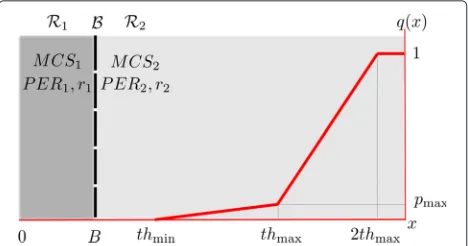
wherexdenotes the queue occupancy. The drop probabil-ity functionq(x)in Eq. (1) is illustrated in Fig. 1 by a red line. We use GRED in this paper for buffer management but other AQM schemes could also be employed.
The wireless link is assumed to carryNlong-lived TCP-Reno flows using first-in-first-out (FIFO) scheduling with a common packet sizeL. Each flowi,i∈ {0, 1,. . .,N−1}, is assumed to have a fixed (yet arbitrary) RTT denoted by RTT0,i, taking into account the propagation delays of
all links on the path of the flow i. We assume all flows are bottlenecked at this wireless link and packet losses on other links are assumed to be negligible. We therefore do
Fig. 1Illustration of DRWL with thex-axis representing the queue occupancyx
not attempt to model networks of AQM router links but rather focus on a single AQM bottleneck link in this study. Queuing and transmission delays as well as the error rates of the TCP ACK packets are assumed to be negligibly small and will be ignored by the analytical model assum-ing TCP ACK prioritization to be employed and enhanced wireless protection to be established at the reverse path of the flows [46, 47].
For link adaptation purposes, we introduce in this paper a thresholdBand subsequently partition the queue of the wireless link into two different regimes, namely R1 =
[ 0,B) and R2 = (B, 2thmax) along with the boundary
B = {B}. The queue is served with a transmission rate r1(r2) with a wireless PER denoted byPER1(PER2) when
the buffer occupancy xresides in regimeR1 (R2) such
that r1 ≤ r2 and PER1 ≤ PER2. In the
abovemen-tioned definition, the strict inequality case is definitely more interesting but we let DRWL to be more general by allowing equalities. We present an overlaid illustration of the proposed DRWL and the GRED AQM scheme in Fig. 1. This DRWL can be generalized to a multi-regime scenario by further partitioning the queue into more than two regimes, but we limit our scope only to DRWL in this paper. The DRWL framework consists of a set of queue-aware link adaptation mechanisms out of which we propose a particular subset of policies next. For this
purpose, we considerM different candidate PHY MCSs
denoted bymcsmwherem∈ {0, 1,. . .,M−1} that are
sup-ported by the wireless link’s air interface. When a packet gets to be transmitted, we use a dedicated MCS at each regime, namelyMCS1andMCS2, when the queue length
at the epoch of packet transmission resides in R1 and
R2, respectively. If the queue occupancy resides at B,
eitherMCS1 orMCS2 can be used. WhenMCSj equals
mcsm for regime j, j ∈ {1, 2}, and for SNR level snrs,
s∈ {0, 1,. . .,S−1}, packets are transmitted with a bit rate ofrj = gm and errored at the receiver with a probability
denoted byPERj=perm,swheregmis the bit rate ofmcsm
seen by the link layer andperm,sis the PER whenmcsmis
used at SNR levelsnrs.
In this paper, we propose a particular DRWL mecha-nism denoted byQAWLA(thPER, H, B) in terms of three
parametersthPER,H, andB. In this PER-based LA
mecha-nism, the MCS with the highest spectral efficiency whose resulting PER denoted by perm,s is such that perm,s <
thPERfor a threshold parameterthPERat a particular SNR
level snrs, is chosen for regime R2. MCS decision for
R1 is given in the same manner with R2, but with a
lower thresholdthPER/Hfor someH ≥ 1. It is clear that
QAWLA(thPER,H,B) belongs to the DRWL framework for
the entire range of its parameter set. For the particular
QAWLA mechanism withH=1, we haveMCS1=MCS2
i.e., traffic agnostic link adaptation. In the next section, we develop a fixed-point analytical model of the generic DRWL by means of which we evaluate the performance of the specific QAWLA scheme to be used in the numerical examples.
3 Fixed-point analytical model of DRWL
In line with the majority of the existing work on TCP mod-eling, we propose to use the so-called PFTK TCP formula which relates the packet sending rate of a TCP flow to the packet loss rate seen by the flow [42]. Letp,λ,L, andT0
denote the packet loss rate, packet sending rate in pack-ets/s, packet size in bits, and the retransmission timeout parameter of a TCP source, respectively. For the timeout parameter, we use
T0=max(T0,min,RTT+4σRTT), (2)
whereRTT andσRTT are the smoothed estimates for the
RTT and its standard deviation, respectively, andT0,minis
a minimum limit imposed on the timeout parameter [48]. LetWu denote the random variable associated with the
unconstrained window size of the TCP source. Also let
Wmax=W/Landbdenote the maximum window size in
units of packets and the number of packets to wait before sending a cumulative ACK packet by the TCP receiver, respectively, whereWis the receiver’s buffer size. The ref-erence [42] proposes the following identity, known as the PFTK formula, for the TCP sending rateλif the TCP flow faces a packet loss ratep:
λ=
Note that Eq. (3) provides a closed-form expression for
the TCP sending rateλ provided the parameters pand
RTT are available. In this study, we assume all TCP flows
use the same minimum timeout parameterT0,minand the
term RTT + 4σRTT in (2) is much smaller than T0,min
which yieldsT0 = T0,min. Exploiting this assumption, we
simplify Eq. (3) to be used in sequel as follows:
λ=
resent the packet loss rate dependency of the uncon-strained (conuncon-strained) TCP packet sending rate as defined below:
essarily identical, it may be possible that the combined AQM-AMC policy may push the buffer occupancy from R1outward toR2and vice versa, making the boundary
Bthe fixed point. This can be viewed as the queue occu-pancy hovering in close vicinity of the boundaryB, visiting both regimes infinitely often but transmitting packets in R1andR2, with probabilities(1−α)andα, respectively,
at the steady-state. For higher (lower) values ofα, a larger ratio of packets admitted into the queue finds the queue in theR2(R1) regime. Consequently, the queue is modeled
to be served with a transmission rate ofr(x,α)when the queue occupancy isx:
r(x,α)=
PER(x,α)=
Note that whenx = B, the transmission rate and wire-less loss probability also depend on the parameterαwhich needs to be calculated. Based on the philosophy of DRWL,
we assume PER1 ≤ PER2 < 1 in which case the TCP
receivers get service from both regimes and r1 ≤ r2.
Lost packets are not retransmitted and loss events are assumed to be independent and identically distributed (iid) following the Bernoulli wireless loss model. Assum-ing AQM and wireless packet losses to be independent from each other, the overall loss probability can then be expressed as
p(x,α)=1−(1−PER(x,α))(1−q(x)). (14)
All flows are exposed to a queuing delayx/r(x,α)and a transmission delayL/r(x,α)at the router. Without loss of generality, we letDF account for the one-way framing
and processing delays. Moreover, DF is multiplied by a
factor of two in order to cover both forward and reverse (TCP ACK messages) path delays. Taking into account the propagation delays of all links on the path of the flowi, we have the following expression for the overall RTT of flowi:
RTTi(x,α)=RTT0,i+2DF+x/r(x,α)+L/r(x,α). (15)
We take similar steps with [43] in relating the PFTK
TCP model given in (3) with the queue occupancyxbut
also considering the dual-regime nature of the queue. The overall rate of bits that are admitted into the queue denoted byκ(x,α)can then be written as
the queue takes the value x and we propose to use the
PFTK TCP formula (3) to writeλi(x,α)withRTT andp
being replaced withRTTi(x,α) andp(x,α), respectively.
The goal of the fixed-point model is to find the steady-state buffer occupancy denoted byxwhich can be viewed as an approximation to the mean queue occupancy in the actual system. Assuming that the queue has a steady-state solution at (x,α) = (x,α), the following fixed-point
Given the steady-state solution (x,α), the aggregate
TCP throughput of the system denoted byT is given by
the following identity:
T=(1−PER(x,α))κ(x,α). (18)
Next, we take the preliminary steps leading to the proof for existence and uniqueness of the solution to DRWL for r1 < r2andPER1 < PER2. For the particular case when
r1 = r2andPER1 = PER2, we refer the reader to [43].
Recalling Eq. (7) and replacing the termsP1,P2,P1,cand
P2,c therein with theirx and α dependent counterparts
P1(x,α),P2(x,α),P1,c(x,α)andP2,c(x,α), respectively, as
well as the RTT term with its x and α dependent
per-flow counterpartRTTi(x,α), we express the per-flow TCP
sending rate as follows:
Since TCP packet sending rate is a monotonically decreasing (MD) function of packet loss rate regardless of the RTT, the functions P1(·) andP2(·), and
addition-allyP1,c(·)andP2,c(·), are monotonically non-decreasing
(MND) inx, given thatp(x,α)in (14) is MND. The MND property ofp(x,α) is implied by the inequality PER1 <
PER2inherited from DRWL and the fact thatq(·)is MND.
Without loss of generality, we provide the proof for exis-tence and uniqueness only for the unconstrained TCP packet sending rate using the functions P1(·) andP2(·).
The aggregate bit arrival rate to the queue can then be written using (19) as:
and is a strictly positive monotonically increasing (MI) function provided thatr(x,α)in (12) is MND which is true sincer1<r2. With these definitions, the identity (17) can
G(x,α)
=1−q(x), x>0
>1, x=0, (22)
which is the main identity we refer to in this paper that needs to be satisfied at the steady-state. Next, we present the proof for existence and uniqueness of a solution to DRWL in Theorems 3.1 and 3.2, for bothRj,j∈ {1, 2}and
B, respectively.
Theorem 3.1.There exists a unique solution x to the dual-regime queue provided that r1 < r2, PER1 < PER2,
κ(2thmax,α) <r2and q(x)is an MND continuous function
of x.
Proof 1.The condition κ(2thmax,α) < r2 guarantees
that full-queue never occurs. It is clear that the identity G(2thmax,α) >1−q(2thmax)=0holds. Since the function
1−q(x)is monotonically non-increasing and continuous, G(x,α)is monotonically increasing in x given that r1<r2
and PER1 < PER2; either G(x,α) = 1−q(x)for some
(x,α)where x∈(0, 2thmax]andα∈[ 0, 1]; or G(0,α) >
1−q(0) = 1for x = 0must be satisfied. Uniqueness of xfollows from G(x,α)being monotonically increasing and 1−q(x)being monotonically non-increasing.
Theorem 3.2.Provided r1< r2and PER1< PER2, the
solution to the dual-regime queue is unique inαwhen x= B.
Proof 2.Note that G(B,α) is monotonically increasing inαat x= B. Let(B,α)be a solution, then for anyα = α, G(B,α) =G(B,α) = 1−q(B), which concludes the
proof.
We also outline an algorithm to numerically solve the dual-regime queue in Algorithm 1. Once the solution is assured to reside in either of the two regimesR1orR2,
or at the boundaryB, then a binary search is performed for the unknowns x andα, respectively, in the corre-sponding domain. We note that the case ofr1 = r2and
PER1=PER2can also be solved by Algorithm 1.
4 Wireless link and traffic scenarios
In our numerical examples, we use the following parame-ters. For the fixed packet size, we setL= 1500 bytes. For GRED, the parametersthminandthmaxare set to 30 and
90, respectively, in units of packets, andpmaxis set to 0.1
as in [43]. For TCP parameters, we setT0,min = 1 s as in
[49],b = 2 and W = 64 kbytes as in [48]. We use the
MCSs of theWireless-MAN OFDMA PHYwhich specifies
a cellular communication system comprising a base sta-tion (BS) and a number of mobile stasta-tions (MSs) [50]. The Wireless-MAN OFDMA PHYcan alternatively be used as a PTP link as in the references [51] and [52]. The scope of this paper suits well to such PTP systems relying on
OFDM-based air interfaces [53–55]. For Wireless-MAN
OFDMA PHY, we carry out simulations with the Coded Modulation Library (CML) to obtain theperm,svalues for
given mcsm and snrs [56]. For this purpose, we choose
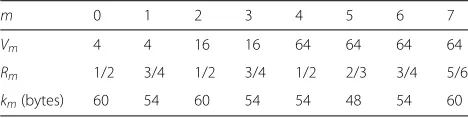
eight MCSs that use convolutional turbo codes (CTC) which are enumerated in Table 1 according to an MCS indexm, m ∈ {0, 1,. . ., 7}, for use in the current paper
which differ according to their modulation order Vm
(i.e., the number of points in the constellation diagram), code rateRm, and forward error correction (FEC) block
lengthkm.
Assuming FEC block error events of a packet to be iid Bernoulli distributed, the quantityperm,s can be derived
from the FEC block error rate (FER) denoted byferm,sas
follows:
perm,s=1−(1−ferm,s)L/km. (23)
Algorithm 1solveDualRegimeWirelessLink
1: ifκ(0,α) <r1then Solution is empty queue.
2: x←0
3: T ←(1−PER(0,α))κ(0,α)
4: else ifκ(B, 0) <r(B, 0)then Solution is inR1.
5: x←BINARYSEARCH(x,R1) Perform binary search forxinR1.
6: T ←(1−PER(x,α))κ(x,α)
7: else ifκ(B, 1) <r(B, 1)then Solution is atB.
8: α←BINARYSEARCH(α,B) Perform binary search forαatB.
9: x←B
10: T ←(1−PER(B,α))κ(B,α)
11: else Solution is inR2.
12: x←BINARYSEARCH(x,R2) Perform binary search forxinR2.
Table 1Modulation and coding schemes of IEEE 802.16 used in the numerical examples
m 0 1 2 3 4 5 6 7
Vm 4 4 16 16 64 64 64 64
Rm 1/2 3/4 1/2 3/4 1/2 2/3 3/4 5/6
km(bytes) 60 54 60 54 54 48 54 60
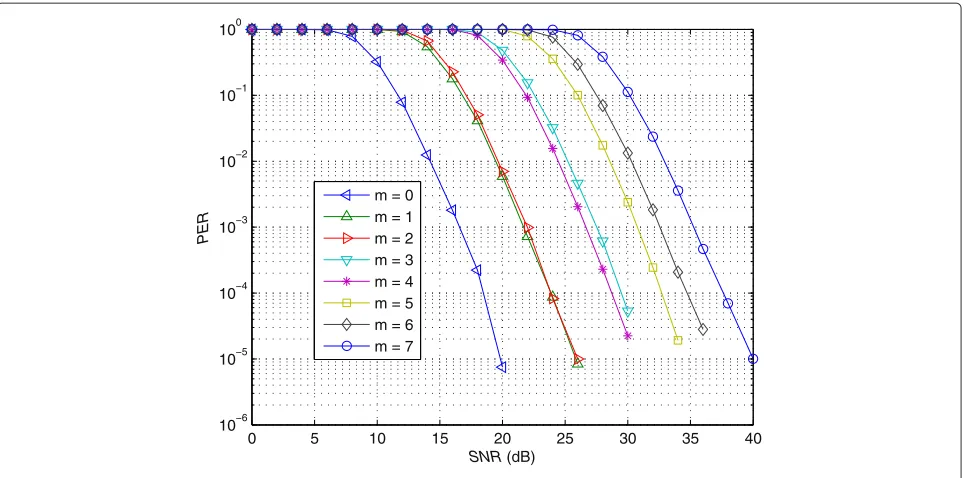
For the sake of completeness, we present perm,s vs.
snrs curves obtained using CML in Figs. 2 and 3, for
the additive white Gaussian noise (AWGN) and the ITU vehicular-A channels, respectively, the latter correspond-ing to an MS with velocity 90 km/h, which is referred to as the ITU-A channel for the rest of the paper [57]. SNR ranges of [0 dB, 22 dB] and [0 dB, 40 dB] are sampled with a resolution of 0.5 and 2 dB, respectively, to obtain the
correspondingsnrsvalues for the AWGN and the ITU-A
channels. At least 107FEC blocks are decoded to reach the
PERs illustrated in these figures.
The time division duplex (TDD) mode as specified by WiMAX [58] uses 35 downlink (DL) OFDM symbols with 768 data sub-carriers per symbol for a channel band-width of 10 MHz [50] and a TDD frame duration of 5 ms, resulting in an average PHY rate ofc = 5.376 106 sub-carriers/s. The raw bit rate cm of the IEEE 802.16
Wireless-MAN OFDMA PHY air interface can then be calculated in bps as cm = c log2(Vm)Rm. The padding
inefficiency caused by the need for FEC block alignment of packets reduces the raw bit rate down to the link layer bit rategm = cmL/(kmL/km)for MCSmcsm. Note that
MCSs in Table 1 are ordered based on their raw bit rates. These eight different MCSs lead to 8∗27 −1 = 27 pos-sible DRWL policies which satisfy the conditionr1 < r2
andPER1<PER2, excluding in particular the dual-regime
policy (MCS1,MCS2) = (mcs3,mcs4) having the same
link layer bit rate (i.e.,g3 = g4) but with interchanging
PERperformances for the AWGN and the ITU-A
chan-nels. Taking into consideration the remaining policies for whichr1=r2andPER1=PER2, an overall of 27+8=35
distinct policies are studied in the numerical examples. In order to account for framing and processing delays of the system,DFis set to 2.5 ms.
We construct traffic scenarios spanning a wide range of N andRTT0,ivalues. In particular, we study two groups
of traffic scenarios having fixed and uniformly spaced RTT0,i values denoted bySFN,F andSUN,F, respectively,
where F denotes the average value ofRTT0,i of the
cor-responding scenario. In scenarioSFN,F, there areN
long-lived TCP flows, and all flows have the same RTT0,i of
F ms. On the other hand, in scenario SUN,F, there are
againN flows but each with a differentRTT0,i = 2(i+
1)F/(N + 1) leading to an average fixed RTT of F ms. Wired RTTs of TCP connections in a 3G network is reported to vary from a few milliseconds to a few hun-dreds of milliseconds [59]. In line with this observation,
we vary F from 1 ms to 100 ms particularly choosing
F ∈ {1, 5, 10, 20, 40, 60, 80, 100}ms. Because of the distri-bution of individualRTT0,ivalues for the scenario group
SUN,F, the resulting actual RTT values cover a wider range
than the interval between the minimum and maximum
values chosen for F. We set the maximum value of N
0 5 10 15 20 25
10−6 10−5 10−4 10−3 10−2 10−1 100
SNR (dB)
PER
m = 0 m = 1 m = 2 m = 3 m = 4 m = 5 m = 6 m = 7
0 5 10 15 20 25 30 35 40 10−6
10−5 10−4 10−3 10−2 10−1 100
SNR (dB)
PER
m = 0 m = 1 m = 2 m = 3 m = 4 m = 5 m = 6 m = 7
Fig. 3Simulated PERperm,sfor different values of the MCS indexmand the ITU-A channel
to 16 as in the reference [60] for the wireless back-bone topology studied therein and letN ∈ {1, 2, 4, 8, 16}. Note that scenarios represented bySF1,F andSU1,F are
identical, thus leading to an overall of 72 unique traffic scenarios.
5 Validation of the analytical model
The proposed fixed-point analytical model for DRWL is validated using the ns-3 network simulator [48] for a sub-set of scenarios described in Section 4. Particularly, we employ the scenariosSUN,FforN ∈ {1, 4, 16},F ∈ {1, 40}
ms, and snrs ∈ {22, 26, 30} dB for the ITU-A channel,
totaling 18 distinct scenarios indexed by the parameter idx. Table 2 summarizes the parameters used for each sce-nario including the per-regime PER values (PER1,PER2),
and per-regime bit rates (r1,r2). We prefer to use a
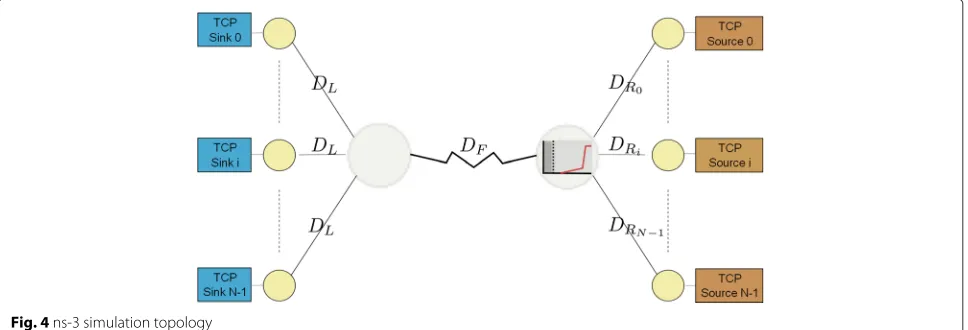
dumb-bell topology, which is a common topology to study TCP congestion algorithms in bottleneck links,
involv-ing N TCP-Reno flows in our simulations as shown in
Fig. 4 [61, 62]. The ingress link for flow i, 0 ≤ i <
N, has a one-way propagation delay DRi whereas the
egress link for the same flow has a one-way propaga-tion delayDL. We set DL = min
i (RTT0,i)/4 andDRi =
RTT0,i/2−DL. All ingress and egress links have a
capac-ity of 1 Gbps leaving the central wireless link in the middle as the bottleneck link with one-way propagation
delay DF = 2.5 ms. Note that the central link is of
DRWL-type with its MCS selection policy dictated by Table 2.
TCP flow statistics are obtained using the FlowMoni-torwhich is a monitoring framework developed for ns-3
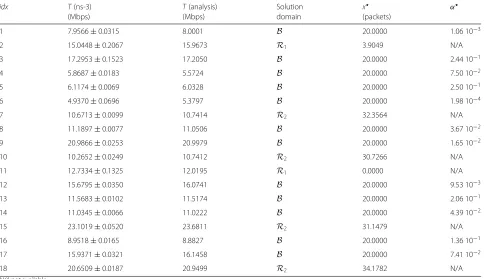
[63]. The RateErrorModel class of ns-3 is used to sim-ulate PERs. Simulations are terminated after 5 min, but the first 30 s corresponding to transients is ignored. Each simulation is repeated ten times and the average results are reported together with the 99 % confidence intervals. Aggregate TCP throughput results of ns-3 simulations and the analytical model proposed in this paper are presented for each scenario in Tables 3, 4, and 5 forBbeing equal to 10, 20, and 30, respectively, all in units of packets. In these tables, we also provide the regime of the solu-tion point (i.e., whetherx resides inR1, R2, or at the
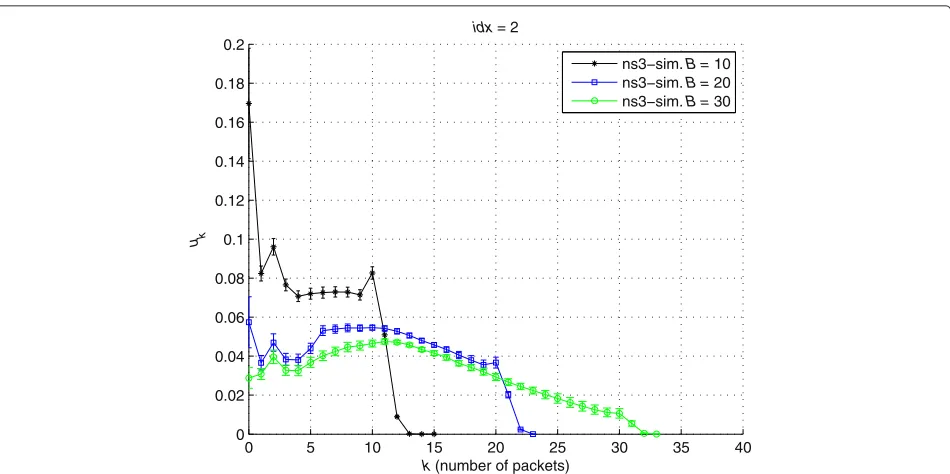
boundaryB) and theαparameter, whenever the solution is atB, obtained by the analysis. Overall results exhibit a remarkable level of agreement in the aggregate TCP throughput between simulations and the fixed-point ana-lytical model especially forB equals 20 or 30. ForB = 10, which is closer to the vicinity of the empty queue, the analytical model tends to be optimistic for scenar-ios with high PER values forR2 (e.g.,idx equals 2, 11,
12, and 17). In order to better understand this behavior, we first let the discrete random variable K denote the number of packets waiting in the queue for transmission with the probability mass function (PMF)uk defined as uk = Pr(K = k)wherek ∈[ 0, 2thmax). Subsequently, we
present the empirical PMFuk obtained from ns-3
Table 2The list of 18 traffic scenarios indexed withidxused for validation of the fixed-point analytical model proposed for DRWL for the ITU-A channel model
idx Traffic scenario SNR (dB) MCS1 MCS2 r1(Mbps) r2(Mbps) PER1 PER2
1 SU1,1 22 mcs1 mcs3 8 16 7.19 10−4 1.55 10−1
2 SU1,1 26 mcs4 mcs5 16 21 2.04 10−3 1.00 10−1
3 SU1,1 30 mcs4 mcs5 16 21 2.24 10−5 2.39 10−3
4 SU1,40 22 mcs0 mcs1 5.376 8 0 7.19 10−4
5 SU1,40 26 mcs0 mcs1 5.376 8 0 8.40 10−6
6 SU1,40 30 mcs0 mcs7 5.376 26.88 0 1.12 10−1
7 SU4,1 22 mcs1 mcs2 8 10.752 7.19 10−4 9.85 10−4
8 SU4,1 26 mcs2 mcs5 10.752 21 1.00 10−5 1.00 10−1
9 SU4,1 30 mcs5 mcs7 21 26.88 2.39 10−3 1.12 10−1
10 SU4,40 22 mcs1 mcs2 8 10.752 7.19 10−4 9.85 10−4
11 SU4,40 26 mcs3 mcs6 16 24 4.62 10−3 2.95 10−1
12 SU4,40 30 mcs3 mcs7 16 26.88 5.32 10−5 1.12 10−1
13 SU16,1 22 mcs2 mcs4 10.752 16 9.85 10−4 9.32 10−2
14 SU16,1 26 mcs2 mcs6 10.752 24 1.00 10−5 2.95 10−1
15 SU16,1 30 mcs2 mcs6 10.752 24 0 1.33 10−2
16 SU16,40 22 mcs1 mcs4 8 16 7.19 10−4 9.32 10−2
17 SU16,40 26 mcs3 mcs5 16 21 4.62 10−3 1.00 10−1
18 SU16,40 30 mcs3 mcs5 16 21 5.32 10−5 2.39 10−3
is found to be 3.9049 in units of packets for all values of B. By its very nature, the fixed-point approach makes the location ofBirrelevant to the solution once the solution resides in eitherR1orR2. Accordingly, for decreasingB,
the probability of queue becoming empty obtained from simulations increases which is not accounted by the model for this particular case.
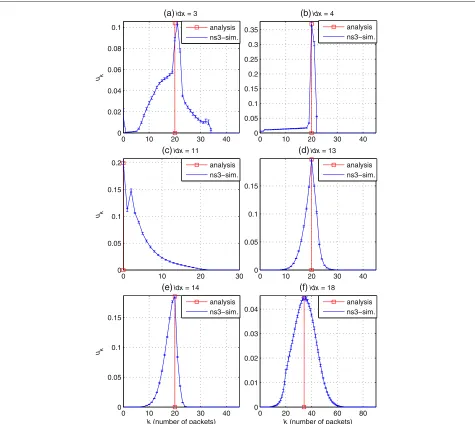
In Fig. 6, the empirical queue occupancy PMF obtained with ns-3 simulations is depicted together with the cor-responding analytical solution forB= 20 corresponding to 6 scenarios with idx ∈ {3, 4, 11, 13, 14, 18}. When
idx equals 11 and 18, the model finds the solution in
R1 and R2, respectively, and for idx equals 3, 4, 13,
or 14, the solution turns out to be at B. The shape of the PMFs obtained via ns-3 for scenarios with analytical solution at Bdemonstrates the effectiveness of the pro-posed approach in capturing the behavior of the queue around the regime boundary. In the light of all simulation
results, we let B ≥ 20 in all the remaining numerical
examples so that the empty queue regime is avoided and furthermore the fixed-point model performs remarkably well.
Table 3Aggregate TCP throughputTobtained with ns-3 simulations and the fixed-point analytical model forB=10. Results for ns-3 simulations are presented with the 99 % confidence intervals
idx T(ns3) T(analysis) Solution x α
(Mbps) (Mbps) domain (packets)
1 7.7536±0.0535 8.0208 B 10.0000 4.81 10−3
2 13.2888±0.4525 15.9673 R1 3.9049 N/A
3 18.5577±0.0686 18.2195 B 10.0000 4.48 10−1
4 6.5931±0.0939 6.5793 B 10.0000 4.60 10−1
5 7.9630±0.0169 7.9999 R2 12.4837 N/A
6 4.9082±0.0531 5.3999 B 10.0000 1.29 10−3
7 10.7244±0.0013 10.7414 R2 32.3563 N/A
8 11.3006±0.0171 11.1503 B 10.0000 4.90 10−2
9 20.1596±0.0843 21.0230 B 10.0000 2.51 10−2
10 10.6419±0.0119 10.7412 R2 30.7266 N/A
11 10.6183±0.1630 12.0195 R1 0.0000 N/A
12 14.2814±0.1153 16.0956 B 10.0000 1.23 10−2
13 11.6557±0.0193 11.6082 B 10.0000 2.30 10−1
14 11.0416±0.0092 11.0528 B 10.0000 4.88 10−2
15 23.5724±0.0224 23.6809 R2 31.1479 N/A
16 8.9470±0.0216 9.0075 B 10.0000 1.56 10−1
17 14.4627±0.0720 16.1824 B 10.0000 8.65 10−2
18 20.8878±0.0041 20.9496 R2 34.1783 N/A
N/Anot available
Table 4Aggregate TCP throughputTobtained with ns-3 simulations and the fixed-point analytical model forB=20. Results for ns-3 simulations are presented with the 99 % confidence intervals
idx T(ns-3) T(analysis) Solution x α
(Mbps) (Mbps) domain (packets)
1 7.9566±0.0315 8.0001 B 20.0000 1.06 10−3
2 15.0448±0.2067 15.9673 R1 3.9049 N/A
3 17.2953±0.1523 17.2050 B 20.0000 2.44 10−1
4 5.8687±0.0183 5.5724 B 20.0000 7.50 10−2
5 6.1174±0.0069 6.0328 B 20.0000 2.50 10−1
6 4.9370±0.0696 5.3797 B 20.0000 1.98 10−4
7 10.6713±0.0099 10.7414 R2 32.3564 N/A
8 11.1897±0.0077 11.0506 B 20.0000 3.67 10−2
9 20.9866±0.0253 20.9979 B 20.0000 1.65 10−2
10 10.2652±0.0249 10.7412 R2 30.7266 N/A
11 12.7334±0.1325 12.0195 R1 0.0000 N/A
12 15.6795±0.0350 16.0741 B 20.0000 9.53 10−3
13 11.5683±0.0102 11.5174 B 20.0000 2.06 10−1
14 11.0345±0.0066 11.0222 B 20.0000 4.39 10−2
15 23.1019±0.0520 23.6811 R2 31.1479 N/A
16 8.9518±0.0165 8.8827 B 20.0000 1.36 10−1
17 15.9371±0.0321 16.1458 B 20.0000 7.41 10−2
18 20.6509±0.0187 20.9499 R2 34.1782 N/A
Table 5Aggregate TCP throughputTobtained with ns-3 simulations and the fixed-point analytical model forB=30. Results for ns-3 simulations are presented with the 99 % confidence intervals
idx T(ns3) T(analysis) Solution x α
(Mbps) (Mbps) domain (packets)
1 7.9785±0.0162 7.9942 R1 25.9733 N/A
2 15.4886±0.0857 15.9674 R1 3.9049 N/A
3 15.9636±0.2527 16.2673 B 30.0000 5.41 10−2
4 5.3673±0.0000 5.3760 R1 22.5306 N/A
5 5.3673±0.0000 5.3760 R1 22.5306 N/A
6 5.3673±0.0000 5.3760 R1 22.5306 N/A
7 9.8443±0.0336 10.7416 R2 32.3563 N/A
8 11.0671±0.0080 10.9739 B 30.0000 2.73 10−2
9 21.0011±0.0053 20.9776 B 30.0000 9.51 10−3
10 9.1072±0.0330 10.7412 R2 30.7266 N/A
11 12.9934±0.0867 12.0195 R1 0.0000 N/A
12 15.9259±0.0378 16.0586 B 30.0000 7.56 10−3
13 11.4676±0.0120 11.4330 B 30.0000 1.84 10−1
14 11.0026±0.0043 10.9937 B 30.0000 3.93 10−2
15 20.8078±0.1013 23.6811 R2 31.1479 N/A
16 8.8136±0.0159 8.7706 B 30.0000 1.19 10−1
17 16.1202±0.0134 16.1126 B 30.0000 6.29 10−2
18 19.5952±0.0287 20.9496 R2 34.1783 N/A
N/Anot available
0 5 10 15 20 25 30 35 40
0 0.02 0.04 0.06 0.08 0.1 0.12 0.14 0.16 0.18 0.2
k (number of packets)
uk
idx = 2
ns3−sim.B = 10 ns3−sim.B = 20 ns3−sim.B = 30
0 10 20 30 40
k (number of packets) uk
k (number of packets) (f) idx = 18
analysis ns3−sim.
Fig. 6The empirical queue occupancy PMFukfor scenarios withB=20 andidx∈ {3, 4, 11, 13, 14, 18}shown in panels (a-f), respectively. Analytical results are also depicted
6 Performance evaluation of QAWLA
For each snrs and thPER value, we choose MCSs for
both TAGLA and QAWLA policies. Out of all DRWL policies, we pick the one, calledoptimum, that produces
the maximum TCP throughput for each snrs value and
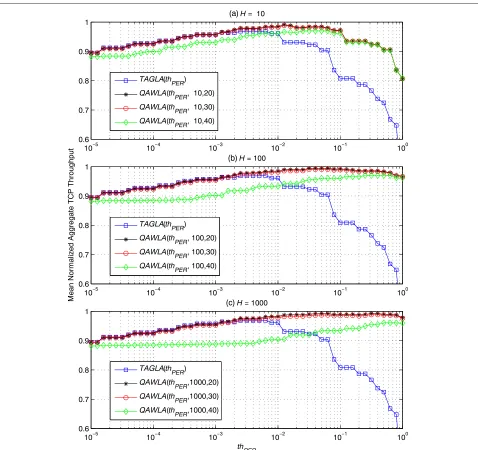
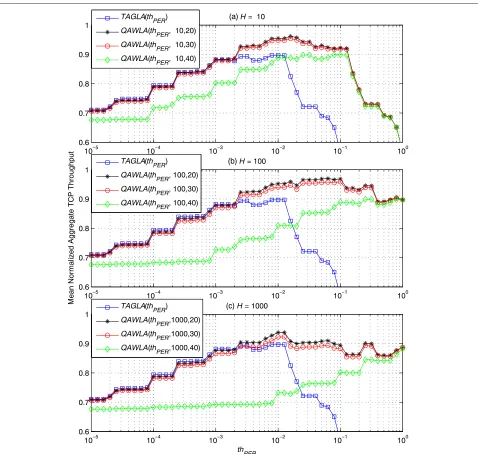
traffic scenario, which is solely used for benchmarking due to the off-line nature of finding theoptimumpolicy. For all figures to be presented, aggregate TCP throughput val-ues of TAGLA and QAWLA are normalized with respect to the corresponding throughput values ofoptimum. In Figs. 7 and 8, normalized aggregate TCP throughput of TAGLA and QAWLA are averaged over all traffic scenarios and snrs values to give the mean normalized
aggregate TCP throughputTTTMMM for the AWGN and the
ITU-A channels, respectively, and plotted as a function of the threshold parameterthPER for different values of
H and B parameters of the QAWLA policy. Owing to
shadow fading, the channel SNR is assumed to be a normal random variable with a mean of 12 dB (26 dB) and a stan-dard deviation of 8 dB for the AWGN (ITU-A) channel. We first discretize the normal distribution with a resolu-tion of 0.5 dB (2 dB) and then truncate over the support of [2 dB, 22 dB] ([14 dB, 40 dB]) for the AWGN (ITU-A) channel for averaging purposes over thesnrsvalues. The
minimum SNR value for the support of each channel type is selected such thatmcs0has a PER less than 0.1.
For both channel types, but more prominently for the
Fig. 7Mean normalized aggregate TCP throughputTTTMMMof TAGLA and QAWLA as a function ofthPERwithB∈ {20, 30, 40}foraH=10,bH=100, andcH=1000, for the AWGN channel
results in terms of peak normalized throughput and the degree of robustness for increasingthPERvalues. Note that
QAWLA withB=40>thmin=30 performs worse than
TAGLA for low values ofthPER, since AQM packet losses
force the queue to be confined inR1having lower
capac-ity for the QAWLA scheme. Only for values ofthPERwell
exceeding the level of 10−2can the wireless packet losses start to dominate makingR1a desirable regime with its
lower PER values for QAWLA. The remaining choices of
B ≤ thminreveal the true potential of QAWLA in both
channels, while theB=20 choice performing slightly bet-ter than the choice ofB = 30 owing to its lower average
queuing delay. For the rest of the numerical examples, we
fixH = 100 andB = 20 and study the selection of the
thPERparameter of theQAWLA(thPER, 100, 20) policy.
Fig. 8Mean normalized aggregate TCP throughputTTTMMMof TAGLA and QAWLA as a function ofthPERwithB∈ {20, 30, 40}foraH=10,bH=100, andcH=1000, for the ITU-A channel
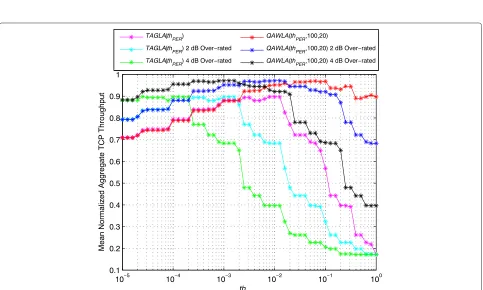
results of TAGLA and QAWLA based on the MCS deci-sions given as if the channel SNR values were 2 and 4 dB higher than the actual values, resulting in an over-rated channel assessment, are also given. The same averaging steps described for Figs. 7 and 8 are employed for Figs. 9 and 10 in obtaining the presented throughput results. QAWLA appears to be relatively insensitive to the choice ofthPERcompared to TAGLA and significantly improves
TAGLA for over-rated channels as well. Both TAGLA and QAWLA performances deteriorate in case an over-rated channel assessment is made, but the deterioration is more severe for the AWGN channel scenario as its perm,s vs.
snrs curves are steeper than those of the ITU-A
chan-nel scenario. The optimum choice of the parameterthPER
appears to be dependent on the channel type and the precision of the SNR estimate.
As an alternative metric, we define the worst case normalized aggregate TCP throughputTTTWWW. In order to
calculate TTTWWW, we first find the minimum value of the
normalized aggregate TCP throughput for each traffic scenario over the aforementioned SNR values and then take average of these minimum values over the entire traf-fic scenario set. In Figs. 11 and 12,TTTWWW for TAGLA and
Fig. 9Mean normalized aggregate TCP throughputTTTMMMof TAGLA and QAWLA as a function ofthPERwithH=100 andB=20 for the AWGN channel
Fig. 11Worst-case normalized aggregate TCP throughputTTTWWWof TAGLA and QAWLA as a function ofthPERwithH=100 andB=20 for the AWGN channel
that the worst-case throughput performances of TAGLA are considerably improved with QAWLA. Unlike the over-rated channel case, the worst-case throughput perfor-mances of both channels under TAGLA and QAWLA policies exhibit a similar trend. The worst-case perfor-mancesTTTWWW of both channel types appear to peak in the
vicinity ofthPER=0.05. This behavior is the consequence
of the interplay between the bit rate and the packet loss rate of the chosen MCSs controlled by the parame-terthPER. In the light of the presented results, QAWLA
proves to be superior to TAGLA. Moreover, the corre-sponding policyQAWLA(0.05, 100, 20) performs close to
optimumfor both channel types as far as the mean per-formanceTTTMMMis concerned and therefore appears to be a
reasonable choice for the given AQM setting and the set of MCSs used in this study.
Finally, we compare QAWLA with other conventional LA schemes, namely target FER (TFER) and maximum PHY throughput (MaxPHYThru). TFER gives MCS decisions based solely and directly on the FER estimations as a function of its threshold parameterthFER and
there-fore denoted byTFER(thFER) [64, 65]. For a given SNR
levelsnrs,TFER(thFER)chooses the MCS with the highest
spectral efficiency satisfying the conditionferm,s <thFER.
MaxPHYThru, on the other hand, is a non-parametric LA scheme with the single purpose of maximizing PHY throughput disregarding the resulting FER and PER. The
typical variant of MaxPHYThru which we denote by
Max-PHYThru-FER chooses the MCS maximizing the term (1 − ferm,s)log2(Vm)Rm [66]. Since a successful packet
transmission requires all building FEC blocks to be suc-cessfully transmitted, we also study a PER-based variant
of MaxPHYThru denoted by MaxPHYThru-PERwhose
objective function is(1−perm,s)log2(Vm)Rm. In Table 6,
the mean and the worst-case normalized aggregate TCP throughput performances TTTMMM and TTTWWW, respectively, of
the QAWLA, TAGLA, TFER, and MaxPHYThru LA schemes are given for both the AWGN and the ITU-A channels. Threshold parameterthPER (thFER) of TAGLA
(TFER) is fixed to the value maximizing the average of TM
TM
TM for the AWGN and the ITU-A channels which is
0.0032 (0.00013). TAGLA and TFER are based on the same principles except for a scaling of their threshold parameters and therefore they achieve almost the same
performance. The loss-ignorant nature of both
Max-PHYThru-FER and MaxPHYThru-PER schemes make them least likely candidates for TCP traffic which is well-known for being sensitive to packet losses. As expected, MaxPHYThru-PER performs slightly better than Max-PHYThru-FERwhich assigns a lower penalty to transmis-sion errors. Finally, we observe that QAWLA yields the best performance among the LA schemes studied in this paper.
Table 6Normalized aggregate TCP throughput performance of various LA schemes
MaxPHYThru-PER 0.79 0.02 0.43 0.04
MaxPHYThru-FER 0.51 0.00 0.17 0.00
7 Conclusions
A novel queue-aware link adaptation mechanism is pro-posed for wireless links carrying long-lived TCP flows and which are controlled by AQM buffer management. This proposed cross-layer mechanism is based on the choice of a different modulation and coding scheme depending on whether the queue occupancy is above or below a certain threshold at the epoch of packet transmission. A novel fixed-point analytical model is developed to accommo-date discontinuous wireless packet loss rate and queue service rate of this dual-regime queuing system which is validated with extensive ns-3 simulations. Using the pro-posed analytical model, we show significant TCP through-put improvement with queue awareness for link adap-tation. Such throughput improvement is shown to exist even when the channel statistics are not precisely known. Investigating the performance of the proposed QAWLA scheme for PHY technologies other than IEEE 802.16 such as LTE, consideration of the use of HARQ/ARQ tech-niques at the PHY, use of multiple thresholds as opposed to one single threshold of the DRWL framework, and the employment of queue-awareness in link adaptation of point-to-multipoint wireless systems, such as cellular networks, are left for future research.
Competing interests
The authors declare that they have no competing interests.
Received: 21 February 2015 Accepted: 19 October 2015
References
1. RKP Mok, EWW Chan, RKC Chang, inIntegrated Network Management (IM),
2011 IFIP/IEEE International Symposium On. Measuring the quality of
experience of HTTP video streaming (IEEE, USA, 2011), pp. 485–492 2. D Lee, BE Carpenter, N Brownlee, inInternet Monitoring and Protection
(ICIMP), 2010 Fifth International Conference On. Observations of UDP to TCP
ratio and port numbers (IEEE, USA, 2010), pp. 99–104
3. C Lee, D Lee, S Moon, inPassive and Active Measurement. Lecture Notes in
Computer Science,ed. by N Taft, F Ricciato. Unmasking the growing UDP
traffic in a campus network, vol. 7192 (Springer, Berlin Heidelberg, 2012), pp. 1–10
4. B Braden, D Clark, J Crowcroft, B Davie, S Deering, D Estrin, S Floyd, V Jacobson, G Minshall, C Partridge, L Peterson, K Ramakrishnan, S Shenker, J Wroclawski, L Zhang,Recommendations on queue management and
congestion avoidance in the Internet. RFC 2309. (RFC Editor, 1998). http://
tools.ietf.org/html/rfc2309, access date 29 October 2015
5. S Floyd, V Jacobson, Random early detection gateways for congestion avoidance. IEEE/ACM Trans. Networking.1(4), 397–413 (1993) 6. ES Hashem, Analysis of random drop for gateway congestion control.
PhD thesis, Massachusetts Institute of Technology (1989)
7. S Athuraliya, SH Low, VH Li, Q Yin, REM: active queue management. IEEE Netw.15(3), 48–53 (2001)
8. M Hassan, R Jain,High Performance TCP/IP Networking: Concepts, Issues,
and Solutions. (Pearson, US, 2004)
9. R Adams, Active queue management: a survey. IEEE Commun. Surv. Tutorials.15(3), 1425–1476 (2013)
10. H Balakrishnan, VN Padmanabhan, S Seshan, RH Katz, A comparison of mechanisms for improving TCP performance over wireless links. IEEE/ACM Trans. Networking.5(6), 756–769 (1997)
12. ST Chung, AJ Goldsmith, Degrees of freedom in adaptive modulation: a unified view. IEEE Trans. Commun.49(9), 1561–1571 (2001)
13. J Yang, N Tin, AK Khandani, inAdaptive modulation and coding in 3G
wireless systems. Vehicular Technology Conference, 2002. Proceedings.
VTC 2002-Fall. 2002 IEEE 56th, vol. 1, (2002), pp. 544–5481 14. H Chen, HCB Chan, C-K Chan, VCM Leung, QoS-based cross-layer
scheduling for wireless multimedia transmissions with adaptive modulation and coding. IEEE Trans. Commun.61(11), 4526–4538 (2013) 15. K-C Go, J-H Kim, Application-aware MCS level selection method for
cross-layered retransmission scheme. IEEE Commun. Lett.18(2), 209–212 (2014)
16. Q Liu, S Zhou, GB Giannakis, Queuing with adaptive modulation and coding over wireless links: cross-layer analysis and design. IEEE Trans. Wirel. Commun.4(3), 1142–1153 (2005)
17. D Moltchanov, A study of TCP performance in wireless environment using fixed-point approximation. Comput. Netw.56(4), 1263–1285 (2012) 18. A De Vendictis, A Baiocchi, inModeling a mixed TCP Vegas and TCP Reno
scenario, ed. by E Gregori, M Conti, A Campbell, G Omidyar, and M
Zukerman. NETWORKING 2002: Networking Technologies, Services, and Protocols; Performance of Computer and Communication Networks; Mobile and Wireless Communications. Lecture Notes in Computer Science, vol. 2345 (Springer, Berlin Heidelberg, 2002), pp. 612–623 19. V Kokshenev, S Suschenko, inAnalytical model of the TCP Reno congestion
control procedure through a discrete-time Markov chain, ed. by V Vishnevsky,
D Kozyrev, and A Larionov. Distributed Computer and Communication Networks. Communications in Computer and Information Science, vol. 279 (Springer International Publishing, 2014), pp. 124–135 20. V Jacobson, Congestion avoidance and control. SIGCOMM Comput.
Commun. Rev.18(4), 314–329 (1988)
21. V Jacobson, Modified TCP congestion avoidance algorithm. Technical report (1990). end2end-interest mailing list. ftp://ftp.isi.edu/end2end/ end2end-interest-1990.mail, access date 29 October 2015
22. K Tan, J Song, Q Zhang, M Sridharan, inINFOCOM 2006. 25th IEEE
International Conference on Computer Communications. Proceedings. A
compound TCP approach for high-speed and long distance networks (IEEE, USA, 2006), pp. 1–12
23. S Ha, I Rhee, L Xu, CUBIC: A New TCP-friendly high-speed TCP variant. SIGOPS Oper. Syst. Rev.42(5), 64–74 (2008)
24. P Yang, J Shao, W Luo, L Xu, J Deogun, Y Lu, TCP congestion avoidance algorithm identification. IEEE/ACM Trans. Networking.22(4), 1311–1324 (2014)
25. G Martorell, F Riera-Palou, G Femenias, Cross-layer fast link adaptation for MIMO-OFDM based WLANs. Wirel. Pers. Commun.56(3), 599–609 (2011) 26. O Ozturk, N Akar, Workload-dependent queuing model of an
AQM-controlled wireless router with TCP traffic and its application to PER-based link adaptation. EURASIP J. Wirel. Commun. Netw.67(1), 1–18 (2014) 27. Q Liu, S Zhou, GB Giannakis, inTCP performance in wireless access with
adaptive modulation and coding. Communications, 2004 IEEE
International Conference On, vol. 7, (2004), pp. 3989–39937
28. H Jiang, C Dovrolis, Passive estimation of TCP round-trip times. SIGCOMM Comput. Commun. Rev.32(3), 75–88 (2002)
29. J Huang, Z Niu, inWireless Communications and Networking Conference,
2007.WCNC 2007. IEEE. Buffer-aware and traffic-dependent packet
scheduling in wireless OFDM networks (IEEE, USA, 2007), pp. 1554–1558 30. Y Lin, G Yue, inWireless Communications, Networking and Mobile
Computing, 2008. WiCOM ’08. 4th International Conference On.
Channel-adapted and buffer-aware packet scheduling in LTE wireless communication system, (2008), pp. 1–4
31. D Niyato, E Hossain, Queue-aware uplink bandwidth allocation and rate control for polling service in IEEE 802.16 broadband wireless networks. IEEE Trans. Mob. Comput.5(6), 668–679 (2006)
32. G Song, Y Li, LJ Cimini, Joint channel- and queue-aware scheduling for multiuser diversity in wireless OFDMA networks. IEEE Trans. Commun.
57(7), 2109–2121 (2009)
33. E Uysal-Biyikoglu, A El Gamal, On adaptive transmission for energy efficiency in wireless data networks. IEEE Trans. Inf. Theory.50(12), 3081–3094 (2004)
34. X Li, X Dong, D Wu, inMilitary Communications Conference, 2008. MILCOM
2008. IEEE. Hierarchical queue-length-aware power control for
delay-sensitive applications over wireless networks (IEEE, USA, 2008), pp. 1–6
35. EC Strinati, A De Domenico, L Herault, Green communications: an emerging challenge for mobile broadband communication networks. Journal of Green Engineering.1(3), 267–301 (2011)
36. MI Salman, CK Ng, NK Noordin, BM Ali, A Sali, A self-configured link adaptation for green LTE downlink transmission. Transactions on Emerging Telecommunications Technologies.26(2), 258–275 (2015) 37. X Li, X Dong, D Wu, On optimal power control for delay-constrained communication over fading channels. IEEE Trans. Inf. Theory.57(6), 3371–3389 (2011)
38. X Ao, S Jiang, L Tang, inCommunication Technology (ICCT), 2010 12th IEEE
International Conference On. Traffic-aware active link rate adaptation via
power control for multi-hop multi-rate 802.11 networks (IEEE, USA, 2010), pp. 1255–1259
39. M Chiang, J Bell, inBalancing supply and demand of bandwidth in wireless
cellular networks: Utility maximization over powers and rates. INFOCOM
2004. Twenty-third AnnualJoint Conference of the IEEE Computer and Communications Societies, vol. 4 (IEEE, USA, 2004), pp. 2800–28114 40. M Chiang, Balancing transport and physical layers in wireless multihop
networks: jointly optimal congestion control and power control. IEEE J. Sel. Areas Commun.23(1), 104–116 (2005)
41. TMC Chu, H Phan, H-J Zepernick, inCommunications (ICC), 2014 IEEE
International Conference On. Adaptive modulation and coding with queue
awareness in cognitive incremental decode-and-forward relay networks, (2014), pp. 1453–1459
42. J Padhye, V Firoiu, D Towsley, J Kurose, Modeling TCP throughput: a simple model and its empirical validation. SIGCOMM Comput. Commun. Rev.28(4), 303–314 (1998)
43. T Bu, D Towsley, Fixed point approximations for TCP behavior in an AQM network. SIGMETRICS Perform. Eval. Rev.29(1), 216–225 (2001) 44. S Floyd, Recommendation on using the “Gentle” variant of RED. Technical
report (2000). http://www.icir.org/floyd/red/gentle.html, access date 29 October 2015
45. S Athuraliya, SH Low, VH Li, Q Yin, REM: Active queue management. IEEE Netw.15(3), 48–53 (2001)
46. H Balakrishnan, VN Padmanabhan, G Fairhurst, M Sooriyabandara,TCP
performance implications of network path asymmetry. RFC 3449. (RFC Editor,
2002). http://www.rfc-editor.org/rfc/rfc3449.txt, access date 29 October 2015
47. TJ Speight, Efficient TCP ACK Prioritization in Wireless Networks. US20080080464 A1 (2008). Patent US20080080464
48. Ns-3 (2015). https://www.nsnam.org/, access date 29 October 2015 49. V Paxson, M Allman, J Chu, M Sargent,Computing TCP’s retransmission
timer. RFC 6298. (RFC Editor, 2011). http://www.rfc-editor.org/rfc/rfc6298.
txt, access date 29 October 2015
50. IEEE standard for local and metropolitan area networks part 16: air interface for broadband wireless access systems, 1–2080 (2009). IEEE Std 802.16-2009 (Revision of IEEE Std 802.16-2004)
51. DT Chen, inIEEE Radio and Wireless Symposium 2007. On the analysis of using 802.16e WiMAX for point-to-point wireless backhaul, (2007), pp. 507–510
52. JARP de Carvalho, H Veiga, P Gomes, AD Reis, R Costa, inSignal Processing
and Information Technology. ISSPIT 2008. IEEE International Symposium On.
A contribution to experimental performance evaluation of point-to-point WiMAX links (IEEE, USA, 2008), pp. 150–153
53. PTP Solutions Guide Motorola Fixed Point-to-point Wireless Bridges. http://www.motorolasolutions.com/, access date 29 October 2015 54. RDL-3000 System. http://rdlcom.com/, access date 29 October 2015 55. Harris Falcon III® RF-7800W. http://harris.com/, access date 29 October
2015
56. Coded Modulation Library (CML). http://www.iterativesolutions.com/, access date 29 October 2015
57. Guidelines for evaluation of radio transmission technologies for IMT-2000 (1997). Recommendation ITU-R M.1225
58. WiMAX Forum® mobile system profile: Release 1.5 TDD specific part. Technical report, WiMAX Forum® (Mar 2009)
59. P Romirer-Maierhofer, F Ricciato, A D’Alconzo, R Franzan, W Karner, in
Network-wide measurements of TCP RTT in 3G, ed. by M Papadopouli, P
Owezarski, and A Pras. Traffic Monitoring and Analysis. Lecture Notes in Computer Science, vol. 5537 (Springer, Berlin Heidelberg, 2009), pp. 17–25 60. S Cen, PC Cosman, GM Voelker, End-to-end differentiation of congestion
61. S Floyd, E Kohler, Internet research needs better models. SIGCOMM Comput. Commun. Rev.33(1), 29–34 (2003)
62. J Hespanha, S Bohacek, K Obraczka, J Lee, inHybrid modeling of TCP
congestion control, ed. by M Di Benedetto, A Sangiovanni-Vincentelli.
Hybrid systems: computation and control. Lecture Notes in Computer Science, vol. 2034 (Springer, Berlin Heidelberg, 2001), pp. 291–304 63. G Carneiro, P Fortuna, M Ricardo, inFlowMonitor: A network monitoring
framework for the network simulator 3 (NS-3). Proceedings of the Fourth
International ICST Conference on Performance Evaluation Methodologies and Tools. VALUETOOLS ’09 (ICST (Institute for Computer Sciences, Social-Informatics and Telecommunications Engineering) Brussels, Belgium, 2009), pp. 1–1110
64. G Ciccarese, M De Blasi, P Marra, C Palazzo, L Patrono, An algorithm for controlling packet size in IEEE 802.16e networks. Comput. Netw.55(13), 2873–2885 (2011)
65. J Francis, NB Mehta, EESM-based link adaptation in point-to-point and multi-cell OFDM systems: Modeling and analysis. IEEE Trans. Wirel. Commun.13(1), 407–417 (2014)
66. D Takeda, YC Chow, P Strauch, H Tsurumi, inThreshold controlling scheme
for adaptive modulation and coding system. Personal, Indoor and Mobile
Radio Communications, 2004. PIMRC 2004. 15th IEEE International Symposium On, vol. 2 (IEEE, USA, 2004), pp. 1351–1355
Submit your manuscript to a
journal and benefi t from:
7Convenient online submission
7Rigorous peer review
7Immediate publication on acceptance
7Open access: articles freely available online
7High visibility within the fi eld
7Retaining the copyright to your article