DEVELOPMENT AND VALIDATION OF STABILITY INDICATING RP-HPLC METHOD FOR THE
SIMULTANEOUS ESTIMATION OF ALISKIREN HEMIFUMARATE AND VALSARTAN IN BULK AND
PHARMACEUTICAL DOSAGE FORM
RIZWAN S H
1*, GIRIJA SASTRY V
21Department of Pharmaceutical Analysis, Deccan School of Pharmacy, Dar-us-salam, Nampally, Hyderabad, Andhra Pradesh, India. 2Department of Pharmaceutical Chemistry, University College of Pharmacy, Andhra University, Vizag, Andhra Pradesh, India.
Email: [email protected]
Received: 06 August 2015, Revised and Accepted: 30 September 2015
ABSTRACT
Objective: Anew, simple, selective, and reproducible stability indicating reversed - phase high performance liquid chromatography method for the simultaneous estimation of Aliskiren (ALN) Hemifumarate and Valsartan (VLN) in bulk drug, and tablet dosage form was developed and validated as per ICH guidelines.
Methods: The chromatographic separation was performed using a nucleosil C - 18 column and the analytes were detected by a malondialdehyde - 2010 photodiode array detector. The mobile phase composed of methanol: potassium dihydrogen ortho phosphate buffer (adjusted to pH 3 with orthophosphoric acid). The flow rate was set at 1 ml/minutes, and the detection was carried out at 225 nm.
Results: ALN Hemifumarate and VLN showed a retention time of 3.84 and 5.96 minutes, respectively. The linear dynamic range was found to be 5-50 mcg/ml and 5-30 mcg/ml with a co-relation co-efficient of 0.992 and 0.985 for ALN and VLN, respectively, with mean percentage recoveries of 99.95% and 99.25%. The results were validated and were found to successfully obey the parameters as per ICH guidelines.
Conclusion: Hence, the method can be successfully applied for routine quality control analysis and stability studies for both ALN Hemifumarate and VLN in bulk and tablet dosage form as per regulatory requirements.
Keywords: Aliskiren Hemifumarate, Valsartan, Reversed-phase high performance liquid chromatography, Stress degradation study, ICH guidelines.
INTRODUCTION
As per FDA guidelines, a stability indicating method is defined as a validated analytical procedure that accurately and precisely measure active ingredients free from process impurities, excipients, and degradation products [1].
According to FDA and ICH guidelines, stress degradation studies are to be conducted to determine the strength of the analytical method developed. The following method is an attempt toward developing a new stability indicating analytical method using reverse-phase high performance liquid chromatography (RP-HPLC) for the determination of Aliskiren (ALN) Hemifumarate and Valsartan (VLN) along with their stress degradation products.
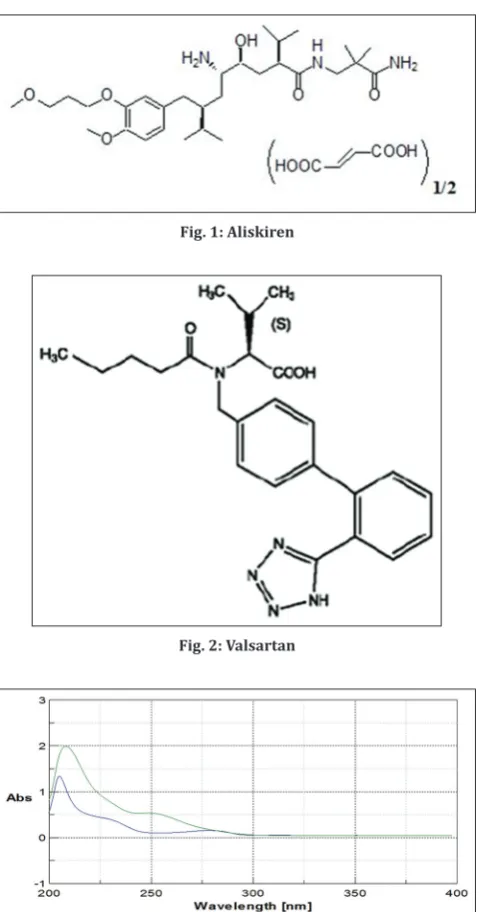
ALN Hemifumarate is chemically, (2S, 4S, 5S, 7S) N-(2-carbamoyl-methylpropyl)-5-amino-4hydroxy-2, 7-diisopropyl-8-[4-methoxy-3-(3-methoxypropoxy) phenyl]-octanamide Hemifumarate [2], as shown in Fig. 1, is a Rennin inhibitor, i.e. it belongs to a group of drugs used primarily in the treatment of essential hypertension also non-peptide in nature. It blocks the rennin system at its rate limiting step by directly inhibiting the catalytic activity of rennin thereby reducing the generation of Angiotensin I and Angiotensinogen II [3].
VLN, chemically known as (S)-3-methyl-2-(N-{[2’- (2H-1, 2, 3, 4-tetrazol-5-yl) biphenyl-4-yl] methyl}pentanamido) butanoic acid [2] as shown in Fig. 2, is an Angiotensin II receptor antagonist that primarily alter the Renin – Angiotensin – Aldosterone hormonal system that regulates blood pressure and fluid balance, therefore, used in the treatment of high blood pressure, congestive heart failure, or post-myocardial infarction. It is official in United State Pharmacopoeia and the British Pharmacoepia [4].
The combined dosage form of ALN and VLN is primarily aimed at treating hypertension. An in depth literature survey has revealed that several analytical methods employing spectrofluorimetry [5] for ALN only, ultraviolet-visible (UV-VIS) spectroscopy [6] for the combination of ALN and VLN, RP-HPLC for determination of ALN with other drugs [7,8], but very few have reported analytical methods in combination for ALN with VLN using RP-HPLC [9-11], and none have reported any stability indicating method for both the drugs in combination and the range for linearity can also be re-evaluated. Hence, the present method aims at developing and validating a stability indicating RP-HPLC method for simultaneous estimation of ALN Hemifumarate and VLN in bulk and tablet dosage form, according to the International conference on harmonization (ICH) guidelines [12-16].
EXPERIMENTAL Reagents and chemicals
ALN Hemifumarate and VLN were obtained as gift samples from Nishka Labs, Hyderabad. Valturna was obtained from the local market. HPLC grade water, HPLC grade methanol was obtained from Merck distributors and all other chemicals required for the analytical method was of analytical reagent grade procured from Merck India Pvt ltd.
Instrumentation and chromatographic conditions
Chromatographic conditions
Separation and analysis were carried out on a Nucleosil C-18 (250 × 4.6 mm, 5 µm) column. The Optimized mobile phase consisted of potassium dihydrogen phosphate buffer: Methanol in the ratio of 70:30 with PH 3 adjusted using O-phosphoric acid at a flow rate of 1.0 ml/minutes, and the detection was carried out at 225 nm (Fig. 3). The column was maintained at ambient temperature.
Preparation of potassium dihydrogen phosphate buffer
Accurately, weighed 1.360 g of potassium dihydrogen phosphate was dissolved in sufficient water to produce 1000 ml with pH 3 adjusted by orthophosphoric acid.
Preparation of mobile phase
Methanol and 0.01 M pot. Dihydrogen phosphate buffer were filtered separately through 0.45 µ membrane filters. The filtered solvents were mixed in the ratio of 70:30 (% V/V) and degassed by placing on a sonicator for 15 minutes. The resultant solution was used as mobile phase.
METHOD DEVELOPMENT Preparation of standard solution
Standard stock solution of ALN Hemifumarate and VLN were prepared separately by dissolving 10 mg of drug in 10 ml of methanol to get concentration of 1000 µg/ml (A). From the respective standard stock solution, working standard solution was prepared containing 100 µg/ml of ALN Hemifumarate and VLN in mobile phase separately (B). From this, further dilution was made in mobile phase to get final solution of ALN Hemifumarate (10 µg/ml) and VLN (10 µg/ml) separately.
Preparation of sample solution
20 tablets, each containing 150 mg of ALN and 160 mg of VLN, were weighed and powdered. Powder equivalent to 10 mg of ALN (10.66 mg of VLN) was transferred to 10 ml volumetric flask and was diluted with methanol and volume made to 10 ml (1000 µg/ml of ALN and 1066 µg/ml of VLN) with methanol. Solution was filtered and further dilutions were made with mobile phase to get the final concentration of 10 µg/ml of ALN and 10.66 µg/ml of VLN.
METHOD OPTIMIZATION
Several trials were conducted as per the literature survey available, and finally trials were done by altering the proportion of mobile phase composition of methanol: phosphate buffer (v/v) and optimizing the analytical method. The optimized analytical method indicates that the prescribed system suitability parameters were obtained with the mobile phase composition of methanol: phosphate buffer (pH 3) in the ratio of 70: 30% v/v at a wavelength of 225 nm.
METHOD VALIDATION System suitability
The system suitability was carried out by injecting standard solutions 5 times into the chromatographic system. The system suitability parameters were then evaluated for number of theoretical plates, tailing factor, and resolution of standard chromatogram.
Linearity
The linearity of the analytical method is required to be carried out to check its ability to elicit test results which are required to be directly or by means of a well-defined mathematical equation proportional to the concentration of the analytes under study and are within a given range.
Precision
It is very important that the method developed be precise. Six replicates from the standard and sample were injected and precision in terms of Intraday and Interday was performed to check the repeatability of retention times and peak response for both ALN and VLN.
Accuracy
To determine the accuracy % recovery studies using the standard addition method was performed across the concentration range of 50-150%. These concentrations were injected 3 times into the chromatographic system.
Specificity
The specificity of the method was assessed by comparing the chromatograms of the standards and sample preparations. The retention times of both the standards, and sample were found to be similar without any interference from the formulation excipients.
Ruggedness
The ruggedness of the optimized method was validated by bringing minute changes in flow rate, column temperature and mobile phase composition. The analytical method was found to be rugged.
Stress degradation studies
To confirm the stability indicating nature of the analytical method stress degradation of ALN and VLN was carried out under prescribed Fig. 1: Aliskiren
Fig. 2: Valsartan
stress conditions as per ICH recommended test conditions [12]. Stress degradation studies were carried under condition of acid, base, neutral hydrolysis, oxidation, dry heat, and photolysis. For each study, three samples were prepared. The blank subjected to stress in the same manner as the drug solution. Dry heat and photolytic degradation were carried out in solid state.
Alkaline hydrolysis
1 ml of working solution of ALN and VLN was mixed with 1 ml of 1 N NaOH solution. This solution was refluxed at 80°C for 5 hrs.
Acidic hydrolysis
1 ml of working solution of ALN and VLN was mixed with 1 N HCl acid and refluxed at 80°C for 5 hrs.
Neutral hydrolysis
1 ml of working solution of ALN and VLN was mixed with 9 ml water and kept in dark place for 24 hrs.
Oxidation
1 ml of working solution of ALN and VLN was mixed with 1 ml of 30% H2O2 and 8 ml of methanol. The solution was boiled at 80°C for 5 hrs.
Degradation under dry heat
Dry heat studies were performed by keeping drug sample separately in hot air oven for a period of 24 hrs at a temp of 105°C. A sample was withdrawn after 24 hrs dissolved in methanol to get a solution of 1000 µg/ml and further diluted to get a concentration of 10 µg/ml and analyzed for chromatography.
Photo-degradation study
The photochemical stability of the drug was also studied by exposing the sample solution to UV light for 7 days at up to 200 watt hrs/square meter and subsequently to cool fluorescent light to achieve an illumination of 1200 lux hrs.
RESULTS AND DISCUSSION
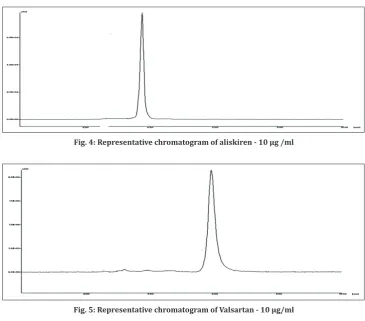
Several trials were conducted by altering the mixture and proportion of mobile phase composition of methanol:phosphate buffer (v/v) and finally optimizing the analytical method. The optimized analytical method indicates that the prescribed system suitability parameters were obtained with the mobile phase composition of methanol:phosphate buffer (pH 3) (70:30% v/v). The mobile phase eluted the drugs at the retention time of 3.84±0.02 minutes and 5.96±0.09 minutes for both ALN and VLN, respectively. The suitability parameters of % relative standard deviation (RSD) for peak area of five replicate injections of standards (% RSD NMT 2), theoretical plate count (NLT 2000), and tailing factor (NMT 2.0) are well within limits, and the validation parameters have been re-evaluated using previous methods as reference [9-11]. The corresponding chromatogram was shown in Figs. 4 and 5.
Validation parameters
After establishing the chromatographic conditions, the method was checked for compliance as per ICH guidelines [13]. The following parameters were checked for validation. The Statement “A Chromatographic representation of Aliskiren and Valsartan in Formulation [Fig.6].
System suitability parameters
The optimized trial showed results in line with ICH validation parameters, and subsequent tests were done for checking efficiency of the column. The results are given in Table 1.
Table 1: System suitability parameter
S. No Drug Theoretical
plates Tailing factor Resolution
1 Aliskiren 4204 1.025
-2 Valsartan 3835 1.036 6.89
Fig. 4: Representative chromatogram of aliskiren - 10 µg /ml
Linearity
Linearity was evaluated by preparing a calibration curve, across the range of the analytical procedure. A series of six standard dilutions were prepared from the standard stock solution in the concentration range of 5-50 mcg/ml for ALN and 5-30 µg/ml for VLN. 10 µl of each solution was injected into the chromatographic system. Linearity was plotted as peak area versus analyte concentration. The graphs are shown in Figs. 7 and 8.
The results show that an excellent correlation exists between the peak area and concentration of drugs. Table 2 shows the linearity parameters of the calibration curves for ALN and VLN.
Precision
The precision of an analytical method expresses the closeness of agreement between a series of measurements obtained from multiple sampling of the same homogeneous sample under prescribed conditions. Six replicate injections of standard solutions were injected into the HPLC system. The % RSD for six replicates was found to be
within limits. Statistical data for system precision has been recorded in Table 3.
Intermediate precision
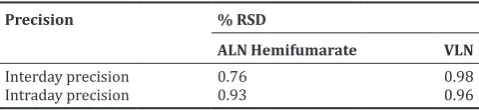
The intermediate precision of the method was checked by injecting replicate injections 6 times with same concentrations on the same day as Intraday precision and, on three different days with three different concentrations as Interday Precision study of Aliskiren and VLN, and the chromatogram was recorded and statistically calculated, and the precision was well within the set parameters. The results are tabulated in Table 4.
Accuracy
The accuracy of the method was established using recovery technique, i.e., external standard addition method. A known amount of standard concentration is added to sample at three different levels, i.e., 50%, Fig. 6: Representative chromatogram of Aliskiren and Valsartan - 10 µg /ml
Fig. 7: Standard calibration curve of Aliskiren (5-50 mcg/ml)
Fig. 8: Standard calibration curve of Valsartan (5-30 mcg/ml)
Table 2: Regression characteristics of pure drug
Parameters Aliskiren
Hemifumarate Valsartan
Concentration range (µg/ml) 5-50 µg 5-30 µg
Correlation co-efficient (r2) 0.992 0.985
Slope (m) 17072 32584
Intercept (b) 46194 43111
LOD (µg/ml) 0.730 0.477
LOQ (µg/ml) 2.214 1.446
LOQ: Limit of quantitation, LOD: Limit of detection
Table 3: System precision data of ALN and VLN
S. No. Concentration µg/ml ALN VLN
1. 10 212342.4 374156
2. 10 214236.4 368333
3. 10 216485 368625
4. 10 216294.5 372285
5. 10 215782.5 371776
6. 10 215484.8 371819
% RSD - 0.93 0.69
ALN: Aliskiren, VLN: Valsartan, RSD: Relative standard deviation
Table 4: Result of intermediate precision
Precision % RSD
ALN Hemifumarate VLN
Interday precision 0.76 0.98
Intraday precision 0.93 0.96
100%, and 150% of the pre analyzed sample. Each determination was performed in triplicate. The % recovery for ALN and VLN was found to be 100% and 99.75%, respectively. The results of the recovery studies were presented in Table 5.
Robustness
Robustness of the method was studied by bringing about small variations in method parameters such as mobile phase composition, change in pH and flow rate. It was observed that the proposed method was robust enough to withstand the changes in chromatographic conditions. Results of robustness study are presented in Table 6.
Stress degradation study
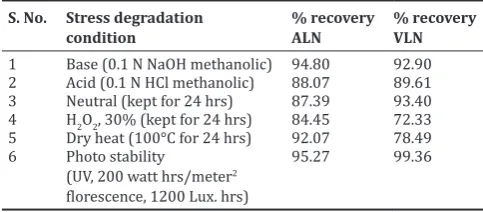
The stress degradation studies were performed as per standard guidelines of ICH [12] and as per references in various journals, and it was observed that the method was specific, selective, and sensitive to detect any degradation products that could have formed during the course of study. Results of degradation study are presented in Table 7.
CONCLUSION
From this study, it is concluded that the proposed stability indicating RP-HPLC method was found to be simple, sensitive, and reproducible
Table 5: Result for recovery studies
Drug Spike
ALN 50 5 4.97 100.20±0.59
100 10 9.98 100.28±0.27
150 15 15.21 100.31±0.98
VLN 50 5 4.97 99.75±1.002
100 10 9.98 99.84±0.9
150 15 14.72 99.28±0.04
*Mean of three determinations, ALN: Aliskiren, VLN: Valsartan, RSD: Relative standard deviation
Table 6: Result for robustness studies
Drug % RSD found for robustness study - peak area Mobile phase
composition pH Flow rate/ml
60:40 70:30 80:20 2.0 3.0 4.0 0.8 1.0 1.2 ALN 1.44 0.81 0.90 1.83 0.81 0.55 0.59 0.81 0.60 VLN 1.39 0.49 1.50 0.56 0.52 0.55 1.72 0.53 0.93
ALN: Aliskiren, VLN: Valsartan, RSD: Relative standard deviation
Table 7: Summary of stress degradation study of ALN and VLN
S. No. Stress degradation
condition % recovery ALN % recovery VLN
1 Base (0.1 N NaOH methanolic) 94.80 92.90
2 Acid (0.1 N HCl methanolic) 88.07 89.61
3 Neutral (kept for 24 hrs) 87.39 93.40
4 H2O2, 30% (kept for 24 hrs) 84.45 72.33
5 Dry heat (100°C for 24 hrs) 92.07 78.49
6 Photo stability
(UV, 200 watt hrs/meter2
florescence, 1200 Lux. hrs)
95.27 99.36
for routine analysis of ALN and VLN in bulk and its pharmaceutical dosage form. The statistical parameters and recovery studies were carried out and reported. The obtained results were satisfactory as per ICH guidelines and within acceptable range, and the method was further used to evaluate the stability of the drug under various stress degradation parameters which has not been reported until date on this particular combination [9-11]. Hence, this method can be used for easy and efficient routine analysis of ALN and VLN in the quality control laboratory.
ACKNOWLEDGMENT
The authors express a sincere thanks to Nishka Research Labs, Uppal, Hyderabd for providing gift samples of drugs and permission to run samples for research in their premises.
REFERENCES
1. FDA guidance for industry , Analytical procedures and methods validation for drugs and biological , U.S. Department of Health and Human Services Food and Drug Administration , Protocol for stability Testing August 2000 , Pg 5.
2. The Merck Index, Monographs no. 3521, 3535. Merck and Co, 14th edition 2006.Merck Sharp & Dohme Corp., Whitehouse Station, N.J., U.S.A.
3. Dieterich H, Kemp C, Vaidyanathan S, and Yeh C, Aliskiren, the first in a new class of orally effective rennin inhibitors, has no clinically significant drug interactions with Digoxin in healthy volunteers. Clinical Pharmacology & Therapeutics 2006, 79(2):P64.
4. British Pharmacopoeia, Govt. British Pharmacopieal, commission Published by The Stationery Office on behalf of the Medicines and Healthcare products Regulatory Agency (MHRA), 2011, Volume I and II, Monograph 2423. London, United Kingdom.
5. Aydogmu Z, San F. Spectrofluorimetric determination of aliskiren in tablets and spiked human plasma through derivatization technique using dansyl chloride. J Fluoresc 2012;22:549-56.
6. Parmar K, Shah J. Simultaneous estimation of aliskiren and valsartan by ratio spectra derivative spectrophotometry method in their fixed dosage forms. Int J ChemTech Res 2014;6(2):1268-75.
7. Pachauri S. Development & validation of HPLC method for analysis of some antihypertensive agents in their pharmaceutical dosage forms. J Pharm Sci Res 2010;2(8):459-64.
8. Rekulapally VK. Stability indicating RP-HPLC method development and validation for simultaneous estimation of aliskiren, amlodipine and hydrochlorothiazide in tablet dosage form. Int J Pharm Pharm Sci 2014;6(1):724-30.
9. Ghosh S, Anusha B, Santoshi. Method development and validation of aliskiren hemifumarate and valsartan in bulk drug by RP-HPLC method. Asian J Res Chem 2013;06(01):19.
10. Chokshi PV, Trivedi KJ. Development and validation of RP-HPLC method for simultaneous estimation of aliskiren hemifumarate and valsartan in their combination tablet dosage form. Int J ChemTech Res 2012;4(4):1623-7.
11. Kumaraswamy G, Sheshairi Rao JV. Validated RP-HPLC method for simultaneous estimation of aliskiren and valsartan in tablet dosage Form. J Drug Deliv Therap 2012;2(5):162-6.
12. International Conference on Harmonization (ICH), ICH Harmonised Tripartite Guideline for Stability Testing - Q1B.
13. International Conference on Harmonization (ICH), Validation of Analytical Procedures: Methodology Q2B, 1996.
14. ICH, Q1A (R2): Stability testing of new drug substances and products, ICH Harmonized Tripartite Guideline. Geneva, Switzerland; 2003. 15. ICH. Q1B: Stability Testing: Photo stability Testing of New Drug
Substances and Products, ICH Harmonized Tripartite Guideline. Geneva, Switzerland; 2003.