R E S E A R C H
Open Access
Exponential synchronization of complex
dynamical network with mixed time-varying
and hybrid coupling delays via intermittent
control
Thongchai Botmart
1,2*and Piyapong Niamsup
2,3*Correspondence:
[email protected] 1Department of Mathematics,
Srinakharinwirot University, Sukhumvit 23 Road, Bangkok, 10110, Thailand
2Centre of Excellence in
Mathematics, CHE, Si Ayutthaya Road, Bangkok, 10400, Thailand Full list of author information is available at the end of the article
Abstract
In this paper, we shall investigate the problem of exponential synchronization for complex dynamical network with mixed time-varying and hybrid coupling delays, which is composed of state coupling, interval time-varying delay coupling and distributed time-varying delay coupling. The designed controller ensures that the synchronization of delayed complex dynamical network are proposed via either feedback control or intermittent feedback control. The constraint on the derivative of the time-varying delay is not required which allows the time-delay to be a fast time-varying function. We use common unitary matrices, and the problem of synchronization is transformed into the stability analysis of some linear time-varying delay systems. This is based on the construction of an improved Lyapunov-Krasovskii functional combined with the Leibniz-Newton formula and the technique of dealing with some integral terms. New synchronization criteria are derived in terms of LMIs which can be solved efficiently by standard convex optimization algorithms. Two numerical examples are included to show the effectiveness of the proposed feedback control and intermittent feedback control scheme.
Keywords: exponential synchronization; complex dynamical network; mixed time-varying delays; hybrid coupling; intermittent control
1 Introduction
Complex dynamical network, as an interesting subject, has been thoroughly investigated for decades. These networks show very complicated behavior and can be used to model and explain many complex systems in nature such as computer networks [], the world wide web [], food webs [], cellular and metabolic networks [], social networks [], elec-trical power grids []etc.In general, a complex network is a large set of interconnected nodes, in which a node is a fundamental unit with specific contents. As an implicit as-sumption, these networks are described by the mathematical termgraph. In such graphs, each vertex represents an individual element in the system, while edges represent the re-lations between them. Two nodes are joined by an edge if and only if they interact.
In the last decade, the synchronization of complex dynamic networks has attracted much attention of researchers in this field [–]. Because the synchronization of complex dynamical networks can well explain many natural phenomena observed and is one of the important dynamical mechanisms for creating order in complex dynamical networks, the
synchronization of coupled dynamical networks has come be a focal point in the study of nonlinear science. Wang and Chen introduced a uniform dynamical network model and also investigated its synchronization [–]. They have shown that the synchroniz-ability of a scale-free dynamical network is robust against random removal of nodes, and yet it is fragile to specific removal of the most highly connected nodes []. The authors in [, ] investigated synchronization of general complex dynamical network models with coupling delays. Li and Chen [] considered the synchronization stability of com-plex dynamical network models with coupling delays for both continuous- and discrete-time, and they derived some synchronization conditions for both delay-independent and delay-dependent asymptotical stabilities. By utilizing Lyapunov functional method. Wang et al.[] introduced several synchronization criteria for both delay-independent and delay-dependent asymptotical stability. Li and Yi [] investigated synchronization of com-plex networks with time-varying couplings, the stability criteria were obtained by using Lyapunov-Krasovskii function method and subspace projection method. Yue and Li [] studied the synchronization stability of continuous and discrete complex dynamical net-works with interval time-varying delays in the dynamical nodes and the coupling term simultaneously, delay-dependent synchronization stability are derived in the form of lin-ear matrix inequalities.
It is well known that the existence of time-delay in a system may cause instability and an example of oscillations can be found in systems such as chemical engineering systems, biological modeling, electrical networks, physical networks, and many others [–]. The stability criteria for a system with time-delays can be classified into two categories: delay-independent and delay-dependent. Delay-independent criteria do not employ any information on the size of the delay; while delay-dependent criteria make use of such in-formation at different levels. Delay-dependent stability conditions are generally less con-servative than delay-independent ones especially when the delay is small []. Recently, the delay-dependent stability for interval time-varying delay was investigated in [, , –]. Interval time-varying delay is a time-delay that varies in an interval in which the lower bound is not restricted to be . Jiang and Han [] considered the problem of ro-bustH∞ control for uncertain linear systems with interval time-varying delay based on
Lyapunov functional approach in which restriction on the differentiability of the interval time-varying delay was removed. Shao [] presented a new delay-dependent stability cri-terion for linear systems with interval time-varying delay, and stability criteria are derived in terms of linear matrix inequalities without introducing any free-weighting matrices. In order to reduce further the conservatism introduced by the descriptor model transforma-tion and bounding techniques, a free-weighting matrix method is proposed in [, –]. In [], the synchronization problem has been investigated for continuous/discrete com-plex dynamical networks with interval time-varying delays. Based on a piecewise analysis method and the Lyapunov functional method, some new delay-dependent synchroniza-tion criteria are derived in the form of LMIs by introducing free-weighting matrices. It will be pointed out later that some existing results require more free-weighting matrix variables than our result.
years, several synchronization criteria for complex dynamical networks with or without time-delays via feedback control or intermittent control have been presented; see [–] and the references therein. Synchronization of a complex dynamical network with de-layed nodes by pinning periodically intermittent control was also reported in []. A pe-riodically intermittent control was applied to the complex dynamical networks with both time-varying delays dynamical nodes and time-varying delays coupling in [, ]. In [], the authors investigated exponential synchronization of a complex network with noniden-tical time-delayed dynamical nodes by applying open-loop control to all nodes and adding some intermittent controllers to partial nodes. The authors in [] investigated synchro-nization of a general model of complex delayed dynamical networks. The periodically in-termittent control scheme is introduced to drive the network to achieve synchronization. Based on the Lyapunov stability theory and pinning control method, some novel synchro-nization criteria for such dynamical network are derived. To the best of the authors’ knowl-edge, the problem of exponential synchronization for a complex dynamical network with mixed time-varying delays in the network hybrid coupling and time-varying delays in the dynamical nodes has not been fully investigated yet and remains open.
In this paper, inspired by the above discussions, we shall investigate the problem of expo-nential synchronization for a complex dynamical network with mixed time-varying and hybrid coupling delays, which is composed of constant coupling, interval time-varying delay coupling, and distributed time-varying delay coupling. The designed controller en-sures that the synchronization of a delayed complex dynamical network is proposed via either feedback control or intermittent feedback control. The constraint on the derivative of the varying delay is not required, which allows the delay to be a fast time-varying function. We use common unitary matrices, and the problem of synchronization is transformed into the stability analysis of some linear time-varying delay systems. Based on the construction of an improved Lyapunov-Krasovskii functional is combined with the Leibniz-Newton formula and the technique of dealing with some integral terms. New syn-chronization criteria are derived in terms of LMIs which can be solved efficiently by stan-dard convex optimization algorithms. Two numerical examples are included to show the effectiveness of the proposed feedback control and intermittent feedback control scheme. The organization of the remaining part is as follows. In Section , a class of general com-plex dynamical network model with mixed time-varying and hybrid coupling delays and some useful lemmas are given. In Section , synchronization stability in complex dynam-ical network with mixed time-varying and hybrid coupling delays via feedback control and intermittent feedback control are investigated. Numerical examples illustrated the obtained results are given in Section . The paper ends with conclusions in Section .
2 Network model and mathematic preliminaries
Consider a complex dynamical network consisting ofNidentical coupled nodes, with each
node being ann-dimensional dynamical system
˙
xi(t) =f
xi(t),xi
t–h(t), t
t–k(t)
xi(s)ds
+c
N
j=
aijGxj(t) +c
N
j=
bijGxj
t–h(t)
+c
N
j=
cijG
t
t–k(t)
xj(s)ds+Ui(t), t≥,i= , , . . . ,N, ()
wherexi(t) = (xi(t),xi(t), . . . ,xin(t))T∈Rnis the state vector ofith node;Ui(t)∈Rm are
the control input of the nodei; the constantsc,c,c> are the coupling strength;G=
(gij)n×n,G= (gij)n×n,G= (gij)n×n∈Rn×nare constant inner-coupling matrices, if some
pairs (i,j), ≤i,j≤n, withgij= ,gij= , andgij= , which means two coupled nodes
are linked through their ith and jth state variables, otherwisegij= ,gij= ,gij= ;
A= (aij)N×N, B= (bij)N×N, andC= (cij)N×N ∈RN×N are the outer-coupling matrices of
the network, in which aij,bijare defined as follows: if there are a connection between
nodeiand nodej(j=i), thenaij=aji= ,bij=bji= ,cij=cji= ; otherwise,aij=aji= ,
bij=bji= ,cij=cji= (j=i), and the diagonal elements of matricesA,B, andCare defined
by
aii= – N
j=,i=j
aij= – N
j=,i=j
aji,
bii= – N
j=,i=j
bij= – N
j=,i=j
bji, ()
cii= – N
j=,i=j
cij= – N
j=,i=j
cji, i= , , . . . ,N.
It is assumed that network () is connected in the sense that there are no isolated clusters, that is,A,B,Care irreducible matrices.
Definition . [] The delayed dynamical network () is said to achieve asymptotical synchronization if
x(t) =x(t) =· · ·=s(t) ast→ ∞, ()
wheres(t) is a solution of an isolated node, satisfying
˙
s(t) =f
s(t),st–h(t), t
t–k(t)
s(θ)dθ
.
In order to stabilize the origin of dynamical network () by means of the state feedback controllerUi(t) satisfying either (H) or (H), fori= , , . . . ,n,
(H): Ui(t) =Diui(t) +Diui
t–d(t)
+Di
t
t–k(t)
ui(s)ds, ∀t≥t,
(H): Ui(t) =
⎧ ⎪ ⎨ ⎪ ⎩
Diui(t) +Diui(t–d(t))
+Di
t
t–k(t)ui(s)ds, nω≤t≤nω+δ,
, nω+δ<t≤(n+ )ω,
whereDji,j= , , . . . , are given matrices of appropriate dimensions,ui(t) =Ki(xi(t) –s(t))
andKiis a constant matrix control gain,ω> is the control period andδ> is called the
dynamical network (), it is easy to get the following:
Namely, the dynamical network () is governed by the following system:
˙
It is clear that, if the zero solutions of the dynamical network () and () are globally ex-ponentially stable, then exponential synchronization of the controlled dynamical network () is achieved. The time-varying delay functionsh(t),d(t),k(t), andk(t) satisfy the
con-ditions
≤h≤h(t)≤h, ≤d(t)≤d, ≤k(t)≤k, ≤k(t)≤k. ()
The initial condition functionφi(t) denotes a continuous vector-valued initial function of
t∈[–τmax, ].
In this paper, we assume that s(t) is an orbitally stable solution of the above system. Clearly, the stability of the synchronized states () of network () is determined by the dy-namics of the isolate node, the coupling strengthc,c, andc, the inner-coupling matrices
G,G, andG, and the outer-coupling matricesA,B, andC.
The following lemmas are used in the proof of the main result.
Lemma .[] For any constant symmetric matrix M∈Rn×n, M=MT> , ≤h
≤
h(t)≤h,t≥,and any differentiable vector function x(t)∈Rn,we have
(a)
t
t–h ˙
x(s)ds T
M
t
t–h ˙
x(s)ds
≤h
t
t–h ˙
xT(s)Mx˙(s)ds,
(b)
t–h t–h(t)
˙
x(s)ds T
M t–h
t–h(t)
˙
x(s)ds
≤h(t) –h
t–h t–h(t)
˙
xT(s)Mx˙(s)ds
≤(h–h)
t–h t–h(t)
˙
xT(s)Mx˙(s)ds.
Lemma .(Cauchy inequality []) For any symmetric positive definite matrix N∈Mn×n
and x,y∈Rnwe have
±xTy≤xTNx+yTN–y.
3 Synchronization of delayed complex dynamical network via delayed feedback control and intermittent control
In this section, we shall obtain some delay-dependent exponential synchronization criteria for general complex dynamical network with discrete and distributed time-varying delays and hybrid coupling delays () by strict LMI approaches. Let us set
˜
Ai=J(t) +cλiG, B˜i=Jh(t) +cλiG, C˜i=Jk(t) +cλiG
and
. J(t) =f (s(t),s(t–h(t)),tt–k(t)s(ξ)dξ)∈Rn×nis the Jacobian of
f(x(t),x(t–h(t)),tt–k(t)x(s)ds)ats(t)with the derivative of
f(x(t),x(t–h(t)),tt–k(t)x(s)ds)respect tox(t), . Jh(t) =f (s(t),s(t–h(t)),
t
t–k(t)s(ξ)dξ)∈Rn×nis the Jacobian of
f(x(t),x(t–h(t)),tt–k(t)x(s)ds)ats(t–h(t))with the derivative of
f(x(t),x(t–h(t)),tt–k(t)x(s)ds)respect tox(t–h(t)), . Jk(t) =f (s(t),s(t–h(t)),
t
t–k(t)s(ξ)dξ)∈Rn×nis the Jacobian of
f(x(t),x(t–h(t)),tt–k(t)x(s)ds)attt–k(t)s(ξ)dξ with the derivative of
f(x(t),x(t–h(t)),tt–k(t)x(s)ds)respect tott–k(t)x(s)ds.
Lemma . Consider the hybrid coupling delays dynamical network in().Let =λj>
λj≥λj≥ · · · ≥λjN,j={, , },be the eigenvalues of the outer-coupling matrices A,B,and
C,respectively.If the N– following n-dimensional linear time-varying delays differential equations are delay-dependent exponentially stable about their zero solutions:
˙
zi(t) = (A˜i+DiKi)zi(t) +B˜izi
t–h(t)+C˜i
t
t–k(t)
zi(s)ds
+DiKizi
t–d(t)+DiKi
t
t–k(t)
zi(s)ds, nω≤t≤nω+δ,i= , . . . ,N, ()
˙
zi(t) =A˜izi(t) +B˜izi
t–h(t)+C˜i
t
t–k(t)
then the dynamical networks()is exponentially stable,and then exponential synchroniza-tion of the controlled dynamical networks()is achieved.
Proof To investigate the stability of the synchronized states (), set
ei(t) =xi(t) –s(t), i= , , . . . ,N. ()
Sincef(·) is continuous differentiable, it is easy to know that the origin of the nonlinear system () is an asymptotically stable equilibrium point if it is an asymptotically stable equilibrium point of the following linear time-varying delays systems:
+cG
have the following matrix equation:
˙
zi(t) =A˜izi(t) +B˜izi
t–h(t)+C˜i
t
t–k(t)
zi(s)ds,
nω+δ<t≤(n+ )ω,i= , . . . ,N.
Thus, we have transformed the stability problem of the dynamical networks () to the stability problem of theNpieces ofn-dimensional linear time-varying delays differential equations. Note thatλk= corresponding to the synchronization of the dynamical
net-works (), where the states(t) is an orbitally stable solution of the isolate node as assumed above in (). If the followingN– pieces ofn-dimensional linear switched time-varying delays systems:
˙
zi(t) = (A˜i+DiKi)zi(t) +B˜izi
t–h(t)+C˜i
t
t–k(t)
zi(s)ds
+DiKizi
t–d(t)+DiKi
t
t–k(t)
zi(s)ds, nω≤t≤nω+δ,
˙
zi(t) =A˜izi(t) +B˜izi
t–h(t)+C˜i
t
t–k(t)
zi(s)ds,
nω+δ<t≤(n+ )ω,i= , . . . ,N,
are exponentially stable, thene(t) will tend to the origin exponentially, which is equiva-lent to the synchronization of the dynamical networks () being exponentially stable. This
completes the proof.
Lemma . Consider the hybrid coupling delays dynamical network in().Let =λj>
λj≥λj≥ · · · ≥λjN,j={, , },be the eigenvalues of the outer-coupling matrices A,B,and
C,respectively.If the N– following n-dimensional linear time-varying delays differential equations are delay-dependent exponentially stable about their zero solutions:
˙
zi(t) = (A˜i+DiKi)zi(t) +B˜izi
t–h(t)+C˜i
t
t–k(t)
zi(s)ds
+DiKizi
t–d(t)+DiKi
t
t–k(t)
zi(s)ds, i= , . . . ,N, ()
then the dynamical networks()is exponentially stable,then exponential synchronization of the controlled dynamical networks()is achieved.
3.1 Linear delayed feedback control Let us denote
φi=zi(), ϕi= sup
–τmax≤s≤
zi(s), Ki= –LiP–
i ,
γi=λmin
P–i
,
i=λmax
P–i +hλmax
Pi–RiP–i
+hλmax
P–i UiPi–
–e–αh
α
+dλmax
P–i LTiTi–LiPi–
–e–αd
ξi=
Theorem . For some given scalars <α,the dynamical networks()with time-varying delay satisfying()are exponentially stable if there exist symmetric positive definite ma-trices Pi> ,Qi> ,Ri> ,Si> ,Ui> ,Ti> ,Wi> ,and a matrix Liappropriately
dimensioned such that the following symmetric linear matrix inequality holds:
i=B˜iPi,
i= –e–αhQi–e–αhRi–e–αhUi, i=e–αhUi,
i= –e–αhUi, i=e–αhUi,
i= –e–αhUi– e–αhQi– e–αhRi,
then the dynamical networks()have exponential synchronization.Moreover,the feedback control is
ui(t) = –LiP–i zi(t). ()
Proof LetYi=P–i ,yi(t) =Yizi(t). Using the feedback control () we consider the following
Lyapunov-Krasovskii functional:
Vi
zi(t)
=Vi(t) +Vi(t) +Vi(t) +Vi(t) +Vi(t) +Vi(t) +Vi(t)
+Vi(t) +Vi(t), ()
where
Vi(t) =zTi(t)Yizi(t),
Vi(t) =
t
t–h
eα(s–t)zT
i(s)YiQiYizi(s)ds,
Vi(t) =
t
t–h
eα(s–t)zTi(s)YiQiYizi(s)ds,
Vi(t) =h
–h
t
t+s
eα(τ–t)z˙iT(τ)YiRiYiz˙i(τ)dτds,
Vi(t) =h
–h
t
t+s
eα(τ–t)z˙Ti(τ)YiRiYiz˙i(τ)dτds,
Vi(t) = (h–h)
t–h t–h
t
t+s
eα(τ–t)˙zT
i(τ)YiUiYi˙zi(τ)dτds,
Vi(t) =
–k
t
t+s
eα(τ–t)zT
i (τ)YiSiYzi(τ)dτds,
Vi(t) =d
–d
t
t+s
eα(τ–t)z˙T
i(τ)KiTTi–Ki˙zi(τ)dτds,
Vi(t) =
–k
t
t+s
eα(τ–t)ziT(τ)KiTWi–Kizi(τ)dτds.
It easy to check that
γzi(t)
≤Vi
zi(t)
By taking the derivative ofVi(t) along the trajectories of system (), we have the following:
Applying Lemma . and Lemma . gives
+ keαkyTi (t)DiWiDTiyi(t)
we have the following:
˙
Applying Lemma . and the Leibniz-Newton formula, we have
= –yTi(t)Riyi(t) + yTi(t)Riyi(t–h)
–yTi(t–h)Riyi(t–h). ()
On the other hand,
–(h–h)
Using Lemma . gives
≤–βyi(t–h) –yi
Therefore from ()-(), we obtain
–(h–h)
FromV˙i(t), applying Lemma . and the Leibniz-Newton formula gives
= e–αdyTi (t)LTi Ti–Liyi(t)
By using the following identity relation:
–z˙i(t) + (A˜i+DiKi)zi(t) +B˜izi
Applying Lemma . and Lemma . gives
Hence, according to ()-(), ()-(), and adding the zero items of () we have
respectively. Therefore, it follows from ()-(), and (), we obtain
˙
On the other hand, using the condition (), we have
=hλmax(YiRiYi)
which implies the dynamical networks () is globally exponentially stable under the con-troller H, then exponential synchronization of the controlled dynamical networks () is
achieved. The proof is thus completed.
3.2 Intermittent delayed feedback control
Theorem . For some given scalars <α<ε, the dynamical networks()with time-varying delay satisfying()are exponentially stable if there exist symmetric positive definite matrices Pi> ,Qi> ,Ri> ,Si> ,Ui> ,Ti> ,Wi> ,and a matrix Liwith
appropri-ately dimensioned such that the following symmetric linear matrix inequality holds:
i=i– [ I –I ]Te–αhUi[ I –I ] < , ()
i=B˜iPi,
i= –e–αhQi–e–αhRi–e–αhUi, i=e–αhUi,
i= –e–αhUi, i=e–αhUi,
i= –e–αhUi– e–αhQi– e–αhRi,
then the dynamical networks()have exponential synchronization.Moreover,the feedback control is
ui(t) =
–LiP–i zi(t), nω≤t≤nω+δ,
, nω+δ<t≤(n+ )ω. ()
Proof Case I: fornω≤t≤nω+δ, we choose the Lyapunov-Krasovskii functional as in () and using the feedback control (), we may proof this case by using a similar argument as in the proof of Theorem .. By replacingDi,DiandDiin ()-() withDi,Di, and
Di, respectively. We have ˙
Vi
zi(t)
+ αVi
zi(t)
≤ξiT(t)( –β)i+βi
ξi(t) +yTi (t)Niyi(t)
+y˙Ti (t)Niy˙i(t), ()
whereiandiare defined as in () and (), respectively, and ξiT(t) =yT
i(t) y˙Ti (t) yTi(t–h) yTi
t–h(t) yT i(t–h)
,
Ni= –.
e–αh+e–αhRi+ keαkC˜iPiS–i PiC˜iT
+kLTi Wi–Li+ e–αdLTiTi–Li,
Ni= –.Pi+ keαkC˜iPiSi–PiC˜iT+dLTi Ti–Li+ eαdDTiTi–Di
+ keαkDTiWi–Di.
By ( –β)i+βi< holds if and only ifi< andi< . Applying the Schur
com-plement lemma, the inequalitiesNi< andNi< are equivalent toi< andi< ,
respectively. Therefore, it follows from ()-(), ()-(), and (), we obtain
˙
Vi
zi(t)
+ αVi
zi(t)
≤ fornω≤t≤nω+δ. ()
Thus, by the above differential inequality (), we have
Vi
zi(t)
≤Vi
zi(nω)
e–α(t–nω) fornω≤t≤nω+δ. ()
Case II: fornω+δ≤t≤(n+ )ω, we choose the Lyapunov-Krasovskii functional having the following form:
Vi
zi(t)
whereVij(t),j= , , . . . , are defined similar in (). We are able to do a similar estimation
as we did for Theorem ., and we have the following:
˙
From the above differential inequality (), we have
Case . Fornω+δ≤t≤(n+ )ω, using condition (), we have
On the other hand, using the condition (), we have obtained the following:
zi(t)≤
which implies the dynamical networks () is exponentially stable under the controller H, then exponential synchronization of the controlled dynamical networks () is achieved.
The proof is thus completed.
Remark . It is clear that asδ→ωthe intermittent feedback control will reduce to a continuous feedback. In this case, presented in Theorem ..
Remark . Ifk(t) = ,c= ,c= , andUi(t) = , then system () reduces to the
follow-ing system presented in [, ]:
˙
xi(t) =f
xi(t)
+c
N
j=
bijGxj
t–h(t), t> ,i= , , . . . ,N. ()
According to Theorem ., we obtain the following corollary for the synchronization of network ().
Corollary . For some given scalars <α,the dynamical networks()with time-varying delay h(t)satisfying()are exponentially synchronization if there exist symmetric positive definite matrices Pi> ,Qi> ,Ri> ,Ui> ,such that the following symmetric linear
matrix inequality holds:
i= i– [ I –I ]Te–αhUi[ I –I ] < , ()
i= i– [ I –I]Te–αhUi[ I –I] < , ()
where
i=PTi
J(t) +αI+J(t) +αITPi+ Qi–e–αhRi–e–αhRi, i=PiJT(t),
i=e–αhRi, i=cλiGPi, i=e–αhRi,
i=hRi+hRi+ηUi– Pi, i=cλiGPi,
i= –e–αhQi–e–αhRi–e–αhUi, i=e–αhUi,
i= –e–αhUi, i=e–αhUi,
i= –e–αhUi– e–αhQi– e–αhRi.
Proof Similar to proof of Theorem .. Indeed, by settingSi= ,Ti= , andWi= in (),
one may easily derive the result and hence the proof is omitted.
and distributed time-varying delays has not received much attention in the literature, not to mention the case when the coupling and controller are also involved.
4 Numerical examples
In this section, we now provide an example to show the effectiveness of the result in The-orem . and TheThe-orem ..
Example . We first consider the perturbed Chua circuit system with mixed time-varying delays is used as uncoupled node in the network () to show the effectiveness of the proposed control scheme. The perturbed Chua circuit system with mixed time-varying delays is given by []
˙
x(t) =p
x
t–h(t)–
x(t) –x(t)
,
˙
x(t) =x(t) –sx(t) +x
t–h(t), ()
˙
x(t) =qx(t) +r
t
t–k(t)
x(s)ds,
wherep,q,r, andsare real positive constants. It is well known that the system () exhibits chaotic behavior with the parametersp,q,r, andsare chosen asp= ,q= – ,r= ., ands= ., the initial condition functionφ(t) = [.cost,sint,sint]T, the time-varying
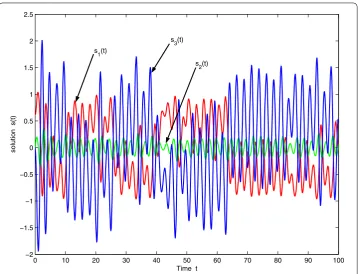
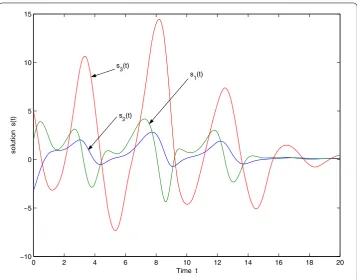
delay functionsh(t) = . + .|sint|andk(t) = .|cost|is shown in Figure . The solution
of the system () is denoted bys(t) = (s(t),s(t),s(t))T, which is shown in Figure . It is
stable at the equilibrium points(t) = ,s(t–h(t)) = ,tt–k(t)s(θ)dθ= , and the Jacobian matrices are
J(t) = ⎡ ⎢ ⎣
–.
–
⎤ ⎥
⎦, Jh(t) =
⎡ ⎢ ⎣
⎤ ⎥
⎦, Jk(t) =
⎡ ⎢ ⎣
⎤ ⎥ ⎦.
Figure 2 Solutions(t) of the perturbed Chua circuit system with mixed time-varying delays (56).
Consider a network consisting of five identical perturbed Chua circuit system with mixed time-varying and hybrid coupling delays. The corresponding controlled dynami-cal network () can be described as
˙
xi(t) =f
xi(t),xi
t–h(t), t
t–k(t)
xi(s)ds
+c
N
j=
aijGxj(t)
+c
N
j=
bijGxj
t–h(t)+c
N
j=
cijG
t
t–k(t)
xj(s)ds
+DiKi
xi(t) –s(t)
+DiKi
xi
t–d(t)–st–d(t)
+DiKi
t
t–k(t)
xi(s)ds–
t
t–k(t)
s(θ)dθ
, i= , , . . . , .
Assume that Di =diag{, , }, Di=diag{., ., .}, Di=diag{., ., .}, i= , ,
. . . , , the coupling strengthc= .,c= .,c= ., the inner-coupling matrices are
G=
⎡ ⎢ ⎣
⎤ ⎥
⎦, G=
⎡ ⎢ ⎣
⎤ ⎥ ⎦,
G=
⎡ ⎢ ⎣
.
.
.
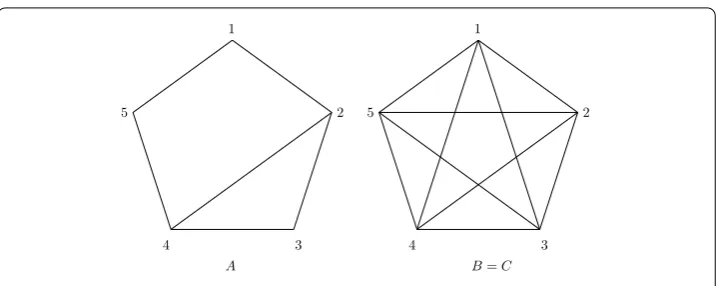
Figure 3 The topology structure of complex networks withN= 5.
and the outer-coupling matrices are given by the following irreducible symmetric matrices satisfying condition ():
and the topology structure of complex networks is shown in Figure .
The eigenvalues ofA,B, andCareλ={, –., –., –., –.},λ={, –,
The numerical simulations are carried out using the explicit Runge-Kutta-like method (dde), interpolation and extrapolation by spline of the third order. Figure shows the synchronization between the states of isolate nodes(t) and nodexi(t),i= , , . . . , .
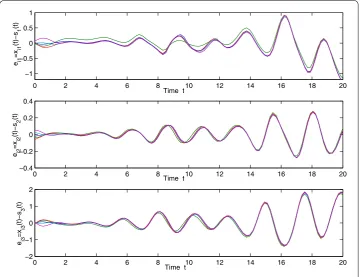
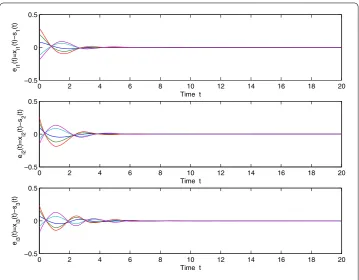
Fig-ure shows the synchronization errors between the states of isolate nodes(t) and node xi(t), whereeij(t) =xij(t) –si(t), fori= , . . . , ,j= , , , without feedback control. Figure
Figure 4 Synchronization curves for the states of the isolated nodes(t) and nodexi(t),i= 1, 2, . . . , 5.
Figure 5 Synchronization error curves for the isolated nodes(t) and nodexi(t), where
Figure 6 Synchronization error curves for the isolated nodes(t) and nodexi(t), where
eij(t) =xij(t) –si(t), fori= 1, . . . , 5,j= 1, 2, 3, with feedback control.
whereeij(t) =xij(t) –si(t), fori= , . . . , ,j= , , , with feedback control. We see that the
synchronization errors converge to zero under the above conditions.
Example . We consider the nonlinear network model with five nodes, in which each node is a Lorenz system with mixed time-varying delay described by []
˙
xi(t) =a
xi(t) –xi(t)
,
˙
xi(t) =cxi
t–h(t)–xi(t) –xi(t)xi
t–h(t), ()
˙
xi(t) =xi(t)
t
t–k(t)
xi(s)ds–bxi
t–h(t),
wherea= .,b= ., andc= –. For the initial functionφ(t) = [–.cost, cost, cost] the solution of system () is denoted by s(t) = (s(t),s(t),s(t))T, which is shown in
Figure . It is asymptotically stable at the equilibrium point s(t) = , s(t–h(t)) = , t
t–k(t)s(θ)dθ= and its Jacobian matrices are
J(t) = ⎡ ⎢ ⎣
–. .
–
⎤ ⎥
⎦, Jh(t)=
⎡ ⎢ ⎣
–
–.
⎤ ⎥
⎦, Jk(t) =
⎡ ⎢ ⎣
⎤ ⎥ ⎦.
Assume that Di =diag{, , }, Di =diag{., ., .}, Di = diag{., ., .}, i =
Figure 7 Solution of the Lorenz system with mixed time-varying delays (57).
and the outer-coupling matrices are given by the following irreducible symmetric matrices satisfying condition ():
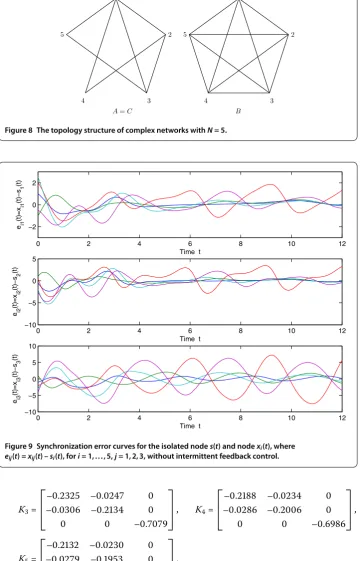
and the topology structure of complex networks is shown in Figure .
The eigenvalues ofA,B, andCareλ={, –., , –., –},λ={, –, –, –,
–}, andλ={, –., , –., –}, respectively.
Solution: From the conditions ()-() of Theorem ., we letε= .,α= .,ω= ,δ= .,h= .,h= .,k= .,k= .,d= .; the gain matrices of the desired
controllers can be obtained as follows:
Figure 8 The topology structure of complex networks withN= 5.
Figure 9 Synchronization error curves for the isolated nodes(t) and nodexi(t), where
eij(t) =xij(t) –si(t), fori= 1, . . . , 5,j= 1, 2, 3, without intermittent feedback control.
K=
⎡ ⎢ ⎣
–. –.
–. –.
–.
⎤ ⎥
⎦, K=
⎡ ⎢ ⎣
–. –.
–. –.
–.
⎤ ⎥ ⎦,
K=
⎡ ⎢ ⎣
–. –.
–. –.
–.
⎤ ⎥ ⎦.
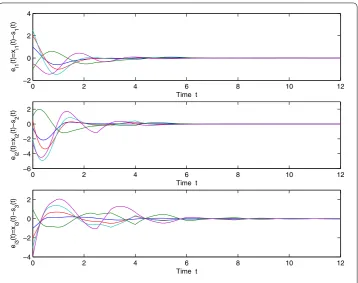
Figure shows the synchronization errors between the states of the isolated node s(t) and nodexi(t), whereeij(t) =xij(t) –si(t), fori= , . . . , ,j= , , , without intermittent
Figure 10 Synchronization error curves for the isolated nodes(t) and nodexi(t), where
eij(t) =xij(t) –si(t), fori= 1, . . . , 5,j= 1, 2, 3, with intermittent feedback control.
isolated nodes(t) and nodexi(t), whereeij(t) =xij(t) –si(t), fori= , . . . , ,j= , , , with
intermittent feedback control. We see that the synchronization errors converge to zero under the above conditions.
Remark . In Example . and Example ., each of them to consider general complex networks in which every dynamical node has mixed varying delays (interval time-varying delay and distributed time-time-varying delay), and the complex networks have state coupling, interval time-varying delay coupling and distributed time-varying delay cou-pling.
Example . Consider a network model with five nodes, where each node is a three-dimensional stable linear system described by [, ]
˙
xi(t) = –xi(t),
˙
xi(t) = –xi(t), ()
˙
xi(t) = –xi(t),
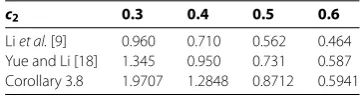
which is asymptotically stable at the equilibrium points(t) = , and its Jacobian matrix isJ(t) =diag{–, –, –}. Assume that the network coupling is the same as that in Exam-ple .. The upper bounds on the time-delay obtained from Corollary . are listed in Table . We see that Corollary . provides a less conservative result than those obtained via the methods of [, ]. Whenhm= especially, the result in [] is not discussed while
Table 1 Comparison of the maximum valuehM(hm= 0) for differencec2
c2 0.3 0.4 0.5 0.6
Liet al.[9] 0.960 0.710 0.562 0.464 Yue and Li [18] 1.345 0.950 0.731 0.587 Corollary 3.8 1.9707 1.2848 0.8712 0.5941
Remark . In [] presented the synchronization problem of general complex dynamical networks with time-varying delays in the network couplings and time-varying delays in the dynamical nodes, respectively. But the time-varying delays are required to be differ-entiable, however, in most cases, these conditions are difficult to satisfy. Therefore, in this paper we will employ some new techniques so that the above conditions can be removed.
5 Conclusions
This paper has investigated synchronization for complex dynamical network with mixed time-varying and hybrid coupling delays, which is composed of state coupling, inter-val varying delay coupling, and distributed varying delay coupling. The time-varying delay function is not necessary to be differentiable which allows the time-delay function to be a fast time-varying function. We transformed the synchronization prob-lem of the complex network into the stability analysis of linear systems. A new class of Lyapunov-Krasovskii functionals is constructed; new delay-dependent sufficient condi-tions for the exponential synchronization of complex dynamical network have been de-rived by a set of LMIs without introducing any free-weighting matrices. The delay feed-back controllers H and H designed can guarantee exponential synchronization of the complex dynamical network. Simulation results have been given to illustrate the effec-tiveness of the proposed method.
Competing interests
The authors declare that they have no competing interests.
Authors’ contributions
All authors contributed equally to the writing of this paper. All authors read and approved the final manuscript.
Author details
1Department of Mathematics, Srinakharinwirot University, Sukhumvit 23 Road, Bangkok, 10110, Thailand.2Centre of Excellence in Mathematics, CHE, Si Ayutthaya Road, Bangkok, 10400, Thailand. 3Department of Mathematics, Chiang Mai University, Huay Kaew Road, Chiang Mai, 50200, Thailand.
Acknowledgements
We would like to thank referees for their valuable comments and suggestions. This work is supported by the Thailand Research Fund (TRF), the Office of the Higher Education Commission (OHEC), Srinakharinwirot University (grant number MRG5580081), and the Centre of Excellence in Mathematics, the Commission on Higher Education, Thailand.
Received: 8 December 2013 Accepted: 22 April 2014 Published:06 May 2014
References
1. Faloutsos, M, Faloutsos, P, Faloutsos, C: On power-law relationships of the Internet topology. Comput. Commun. Rev.
29, 251-263 (1999)
2. Albert, R, Jeong, H, Barabási, AL: Diameter of the world wide web. Nature401, 130-131 (1999) 3. Williams, RJ, Martinez, ND: Simple rules yield complex food webs. Nature404, 180-183 (2000)
4. Jeong, H, Tombor, B, Albert, R, Oltvai, Z, Barabási, AL: The large-scale organization of metabolic network. Nature407, 651-653 (2000)
5. Wassrman, S, Faust, K: Social Network Analysis. Cambridge University Press, Cambridge (1994) 6. Strogatz, SH: Exploring complex networks. Nature410, 268-276 (2001)
7. Zhang, Q, Lu, J, Lu, J, Tse, CK: Adaptive feedback synchronization of a general complex dynamical network with delayed nodes. IEEE Trans. Circuits Syst. II55, 183-187 (2008)
9. Li, K, Guan, S, Gong, X, Lai, CH: Synchronization stability of general complex dynamical networks with time-varying delays. Phys. Lett. A372, 7133-7139 (2008)
10. Liu, T, Zhao, J: Synchronization of complex switched delay dynamical networks with simultaneously diagonalizable coupling matrices. J. Control Theory Appl.6, 351-356 (2008)
11. Wang, XF, Chen, G: Pinning control of scale-free dynamical networks. Physica A310, 521-531 (2002)
12. Wang, XF, Chen, G: Synchronization scale-free dynamical networks: robustness and fragility. IEEE Trans. Circuits Syst. I
49, 54-62 (2002)
13. Wang, XF, Chen, G: Synchronization in small-world dynamical networks. Int. J. Bifurc. Chaos12, 187-192 (2002) 14. Gao, H, Lam, J, Chen, G: New criteria for synchronization stability of general complex dynamical networks with
coupling delays. Phys. Lett. A306, 263-273 (2006)
15. Zhou, J, Xiang, L, Liu, Z: Global synchronization in general complex delayed dynamical networks and its applications. Phys. Lett. A385, 729-742 (2007)
16. Wang, L, Dai, HP, Sun, YX: Synchronization criteria for a generalized complex delayed dynamical network model. Phys. Lett. A383, 703-713 (2007)
17. Li, P, Yi, Z: Synchronization analysis of delayed complex networks with time-varying couplings. Phys. Lett. A387, 3729-3737 (2008)
18. Yue, D, Li, H: Synchronization stability of continuous/discrete complex dynamical networks with interval time-varying delays. Neurocomputing73, 809-819 (2010)
19. Gu, K, Kharitonov, VL, Chen, J: Stability of Time-Delay System. Birkhäuser, Boston (2003)
20. Han, QL: Robust stability for a class of linear systems with time varying delay and nonlinear perturbation. Comput. Math. Appl.47, 1201-1209 (2004)
21. Han, QL, Gu, K: Stability of linear systems with time-varying delay: a generalized discretized Lyapunov functional approach. Asian J. Control3, 170-180 (2001)
22. Jiang, X, Han, QL: OnH∞control for linear systems with interval time-varying delay. Automatica41, 2099-2106 (2005) 23. Park, P: A delay-dependent stability criterion for systems with uncertain time-invariant delays. IEEE Trans. Autom.
Control44, 876-877 (1999)
24. Shao, HY: New delay-dependent stability criteria for systems with interval delay. Automatica45, 744-749 (2009) 25. Xu, S, Lam, J, Zou, Y: Further results on delay-dependent robust stability conditions of uncertain neutral systems. Int.
J. Robust Nonlinear Control15, 233-246 (2005)
26. Gu, K, Niculescu, SI: Additional dynamics in transformed time-delay systems. IEEE Trans. Autom. Control45, 572-575 (2000)
27. Han, QL: A descriptor system approach to robust stability of uncertain neutral systems with discrete and distributed delays. Automatica40, 1791-1796 (2004)
28. Peng, C, Tian, YC: Delay-dependent robust stability criteria for uncertain systems with interval time-varying delay. J. Comput. Appl. Math.214, 480-494 (2008)
29. Tian, J, Xiong, L, Liu, J, Xie, X: Novel delay-dependent robust stability criteria for uncertain neutral systems with time-varying delay. Chaos Solitons Fractals40, 1858-1866 (2009)
30. Huang, T, Li, C: Chaotic synchronization by the intermittent feedback method. J. Comput. Appl. Math.234, 1097-1104 (2010)
31. Xia, W, Cao, J: Pinning synchronization of delayed dynamical networks via periodically intermittent control. Chaos19, 013120 (2009)
32. Cai, S, Liu, Z, Xu, F, Shen, J: Periodically intermittent controlling complex dynamical networks with time-varying delays to a desired orbit. Phys. Lett. A373, 3846-3854 (2009)
33. Cai, S, Hao, J, He, Q, Liu, Z: Exponential synchronization of complex delayed dynamical networks via pinning periodically intermittent control. Phys. Lett. A375, 1965-1971 (2011)
34. Cai, S, He, Q, Hao, J, Liu, Z: Exponential synchronization of complex networks with nonidentical time-delayed dynamical nodes. Phys. Lett. A374, 2539-2550 (2010)
35. Yang, X, Cao, J: Stochastic synchronization of coupled neural networks with intermittent control. Phys. Lett. A373, 3259-3272 (2009)
36. Wang, Y, Hao, J, Zuo, Z: A new method for exponential synchronization of chaotic delayed systems via intermittent control. Phys. Lett. A374, 2024-2029 (2010)
37. Zhang, W, Huang, J, Wei, P: Weak synchronization of chaotic neural networks with parameter mismatch via periodically intermittent control. Appl. Math. Model.35, 612-620 (2011)
38. Yu, J, Hu, C, Jiang, H, Teng, Z: Exponential synchronization of Cohen-Grossberg neural networks via periodically intermittent control. Neurocomputing74, 1776-1782 (2011)
39. Zhu, H, Cui, B: Stabilization and synchronization of chaotic systems via intermittent control. Commun. Nonlinear Sci. Numer. Simul.15, 3577-3586 (2010)
40. Zhang, G, Lin, X, Zhang, X: Exponential stabilization of neutral-type neural networks with mixed interval time-varying delays by intermittent control. Circuits Syst. Signal Process.33, 371-391 (2014)
41. Huang, J, Li, C, Han, G: Stabilization of delayed chaotic neural networks by periodically intermittent control. Circuits Syst. Signal Process.28, 567-579 (2009)
42. Horn, RA, Johnson, CR: Matrix Analysis. Cambridge University Press, Cambridge (1985)
43. Botmart, T, Niamsup, P: Adaptive control and synchronization of the perturbed Chua system. Math. Comput. Simul.
75, 37-55 (2007)
10.1186/1687-1847-2014-116