R E S E A R C H
Open Access
Remark on certain transformations for
multiple hypergeometric functions
Sebastien Gaboury
*and Richard Tremblay
*Correspondence:
Department of Mathematics and Computer Science, University of Quebec at Chicoutimi, Quebec, G7H 2B1, Canada
Abstract
In this paper, we provide many new general transformations for multiple
hypergeometric functions. These transformations can be viewed as generalizations of some of those obtained recently by Weiet al.(Adv. Differ. Equ. 2013:360, 2013). We obtain these transformations by using the fractional calculus method which is a more general method than the beta integral method.
MSC: 26A33; 33C20; 33C05
Keywords: fractional derivatives; Appell functions; Srivastava function; beta integral; multiple hypergeometric series
1 Introduction
The largely investigated generalized hypergeometric functionpFq withpnumerator
pa-rametersa, . . . ,apsuch thataj∈C(j= , . . . ,p) andqdenominator parametersb, . . . ,bq
such thatbj∈C\Z–(j= , . . . ,q;Z–:=Z∪ {}={, –, –, . . .}) is defined by (see, for
ex-ample [, Chapter ]; see also [, pp.-])
pFq
α, . . . ,αp; β, . . . ,βq;
z
=pFq[α, . . . ,αp;β, . . . ,βq;z] =
∞
n=
(α)n· · ·(αp)n
(β)n· · ·(βq)n
zn
n! (.)
p≤qand|z|<∞;p=q+ and|z|< ;p=q+ ,|z|= and Re(ω) > ,
where
ω:=
q
j=
bi– p
j=
ai
and (α)ndenotes the Pochhammer symbol defined, in terms of the Gamma function, by
(α)n:=
(α+n)
(α) = ⎧ ⎨ ⎩
α(α+ )· · ·(α+n– ) (n∈N;α∈C),
(n= ;α∈C\ {}).
Multi-variable hypergeometric functions and their reduction formulas have also been largely investigated (for example, see []). Let us recall the general definition of the double hypergeometric function given by Srivastava and Panda [, p., Eq. ()]. Let (Hh)
de-notes the sequence of parameters (H,H, . . . ,Hh), and let nonnegative integers define the
Pochhammer symbol ((Hh))n= (H)n(H)n· · ·(Hh)n. Then the generalized version of the
Kampé de Fériet function is defined as follows:
Fg:c;dh:a;b
For the numerous conditions of convergence for this function, the reader is referred to []. Some special cases of hypergeometric function of two variables are the Appell functions [, –] defined as
Other interesting special cases of hypergeometric functions of two variables are Horn’s functionsGandGstudied in [, ] and defined as follows:
Finally, we also require two special cases of hypergeometric function of three variables given by Srivastava [–]:
HA(α,β,β;γ,γ;x,y,z) =
m,n,p≥
(α)m+p(β)m+n(β)n+p
(γ)m(γ)n+pm!n!p!
xmynzp
|x|=r< ,|y|=s< ,|z|=t< ( –r)( –s),
(.)
HB(α,β,β;γ,γ,γ;x,y,z) =
m,n,p≥
(α)m+p(β)m+n(β)n+p
(γ)m(γ)n(γ)pm!n!p!
xmynzp
|x|=r,|y|=s,|z|=t;r+s+t+ √rst< .
(.)
Recently, many authors [–] obtained several transformations formulas involving hy-pergeometric functions as well as their multi-variable analogs by using the so-called beta integral method. The beta functionB(α,β) is defined by the following integral represen-tation:
B(α,β) =
tα–( –t)β–dt=(α)(β)
(α+β)
Re(α) > ,Re(β) > . (.)
The so-called beta integral method consists essentially of integral from to expressions which contain terms in the formza( –z)bto obtain new transformations formulas.
The aim of this paper is to present many new general transformations for multiple hy-pergeometric functions. These transformations can be viewed as generalizations of some of those obtained recently by Weiet al.[]. All these transformations are obtained by using a fractional calculus operator based on the Pochhammer contour integral. In Sec-tion , we give the representaSec-tion of the fracSec-tional derivatives based on the Pochhammer contour of integration. Section is devoted to the fractional calculus operatorzOαβ
in-troduced by Tremblay []. Finally, in Section , we present the several transformations involving multi-variable hypergeometric functions.
2 Pochhammer contour integral representation for fractional derivative and a new generalized Leibniz rule
The use of a contour of integration in the complex plane provides a very powerful tool in both classical and fractional calculus. The most familiar representation for fractional derivative of orderαofzpf(z) is the Riemann-Liouville integral [–], that is,
Dαzzpf(z) =
(–α) z
f(ξ)ξp(ξ–z)–α–dξ, (.)
which is valid forRe(α) < ,Re(p) > and where the integration is done along a straight line from tozin theξ-plane. By integrating by partsmtimes, we obtain
Dαzzpf(z) = d
m
dzmD α–m
z zpf(z). (.)
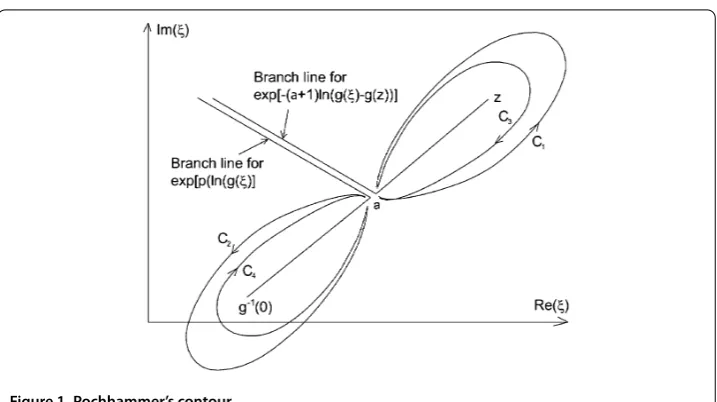
Figure 1 Pochhammer’s contour.
widely used by Osler [–]. These two representations have been used in many interest-ing research papers. It appears that the less restrictive representation of fractional deriva-tive according to parameters is the Pochhammer contour definition introduced in [, ] (see also [–]).
Definition . Letf(z) be analytic in a simply connected regionR. Letg(z) be regular and univalent onRand letg–() be an interior point ofR. Then ifαis not a negative
integer,pis not an integer, andzis inR–{g–()}, we define the fractional derivative of orderαofg(z)pf(z) with respect tog(z) by
Dαg(z)g(z)pf(z) =e
–iπp( +α)
πsin(πp)
C(z+,g–()+,z–,g–()–;F(a),F(a))
f(ξ)g(ξ)pg(ξ)
(g(ξ) –g(z))α+dξ. (.)
For non-integerα andp, the functionsg(ξ)p and (g(ξ) –g(z))–α–in the integrand have
two branch lines which begin, respectively, atξ=zandξ=g–(), and both pass through
the pointξ=awithout crossing the Pochhammer contourP(a) ={C∪C∪C∪C}at
any other point as shown in Figure .F(a) denotes the principal value of the integrand in (.) at the beginning and ending point of the Pochhammer contourP(a) which is closed on Riemann surface of the multiple-valued functionF(ξ).
Remark . In Definition ., the functionf(z) must be analytic atξ=g–(). However, it is interesting to note here that we could also allowf(z) to have an essential singularity atξ=g–(), and Equation (.) would still be valid.
Remark . The Pochhammer contour never crosses the singularities atξ =g–() and
ξ=zin (.), then we know that the integral is analytic for allpand for allαand forzin
R–{g–()}. Indeed, the only possible singularities ofDα
g(z)g(z)pf(z) areα= –, –, . . . , and
It is well known that [, p., Equation (.)]
Dαzzp= ( +p)
( +p–α)z
p–α Re(p) > –, (.)
but adopting the Pochhammer-based representation for the fractional derivative this last restriction becomespnot a negative integer.
3 The well poised fractional calculus operatorzOαβ
In this section, we recall some of the important properties of the fractional calculus oper-atorzOαβintroduced by Tremblay [] as
zOαβ:= (β)
(α)z
–βDα–β
z zα– (βnot a negative integer). (.)
We choose to simply list them since the proofs are readily obtainable.
() Linearity
zOαβ
λf(z) +λg(z)
=λzOαβf(z) +λzOαβg(z). (.)
() Identity
zOαα=I. (.)
() Reductions
zOαβzOβγ=zOαγ, (.)
zOαβzOγα=zO γ
β. (.)
() Elementary cases
zOαβ = , (.)
zOαβz n=(α)n
(β)n
zn. (.)
() Useful cases
zOαβz
λf(z) =(β)(α+λ) (α)(β+λ)z
λ
zOα+λβ+λf(z), (.)
zOαβ(w–z) θ
f(z)|w=z=
(β)(β–α+θ)
(β–α)(β+θ)z
θ
zOαβ+θf(z), (.)
zOαβz λ
(w–z)θf(z)|w=z=
(β)(α+λ)(β–α+θ)
(α)(β–α)(β+θ+λ)z
θ+λ
zOα+λβ+λ+θf(z). (.)
It is worthy to mention that operatorzOαβhas a lot more interesting properties and
For this work, the most important property of the operatorzOαβis given by the following
relation:
B(α,β) =(α)(β+γ)
(α+β+γ)zO
α+β β z
γ
z=. (.)
This relation shows, in fact, that the so-called beta integral method consists in a fractional derivative evaluated at the pointz= .
4 Main results
In this section, we apply the fractional calculus operatorzOαβ to certain transformations
involving multi-variable hypergeometric functions in order to obtain new transformations more general than those obtained by means of the beta integral method. Many special cases are also computed.
Theorem . Let band bbe two nonpositive integers orαbe a nonpositive integer and
let c,β = , –, –, . . . .Then the following transformation
F:;:;
a: b,α; b,β–α;
c,β: –; –; z,z
=
m,n,k,j≥
(c–a)m+n(b)m(b)n(b+m)k(b+n)j(α)m+k(β–α)n+j
(c)m+n(β)m+n+k+j
(–z)m
m! (–z)n
n! zk
k! zj
j!
(.)
holds true.
Proof We start from the following transformation of Appell function F [, p.,
Eq. (..)]:
F[a;b,b;c;x,y] = ( –x)–b( –y)–bF
c–a;b,b;c;
x x– ,
y y–
. (.)
By making the substitutionsx→zandy→w–zin (.), we obtain
F[a;b,b;c;z,w–z]
= ( –z)–b( –w+z)–bF
c–a;b,b;c;
z z– ,
w–z w–z–
. (.)
Next, we apply the fractional calculus operatorzOαβon both sides of (.) withw=zafter
operation. We thus have for the l.h.s.:
zOαβF[a;b,b;c;z,w–z]|w=z=
m,n≥
(a)m+n(b)m(b)n
(c)m+nm!n! z
Oα βz
m(w–z)n w=z
=
m,n≥
(a)m+n(b)m(α)m(b)n(β–α)n
(c)m+n(β)m+n
zm
m! zn
We obtain for the r.h.s.:
This completes the proof.
Let us give a special case of Theorem . in which we recover a result given recently by Weiet al.[, Theorem ].
Corollary . Let band bbe two nonpositive integers orαbe a nonpositive integer and
Proof Beginning with the following transformation formula [, Eq. ()] withx=y=z:
Rewriting (.) into the form of (.) leads to the desired result.
Corollary . Letβ,c and +a+b–c = , –, –, . . . .Then the following formula:
Proof Puttingz= in Theorem ., using the Gauss summation formula (.) and making
elementary simplifications yields the result.
Proof Lettingz= andα= in Theorem . gives
F:;:;
: a,b; a,b;
β: c; +a+b–c; ,
=
m,n≥
(a)m+n(b)m+n()m+n
(c)m( +a+b–c)n(β)m+n
()m+n
m!n! F
+m+n, –m–n;
β+m+n;
. (.)
With the help of the well-known Bailey summation theorem []:
F
a, –a;
c;
=
–c(c)√π
(a+c )(c–a+ ) (.)
the result follows easily after simple calculations.
Theorem . Letβ,c,λand +a+b–c = , –, –, . . . .Then the following transformation:
F:;:;
– : α,a,b; γ,a,b; – : β,c; λ, +a+b–c;x,y
=
m,n≥
(a)m+n(b)m+n(α)m(γ)nxmynF[–nβ,α++mm;;x]F[ –m,γ+n;
λ+n; y]
(c)m(β)m( +a+b–c)n(λ)nm!n!
(.)
holds true.
Proof Considering the transformation formula [, Eq. ()]
F
a;b;c, +a+b–c;x( –y),y( –x)=F
a,b;
c; x
F
a,b; +a+b–c;y
(.)
and applying successively the operatorxOαβand the operatoryOγλ on both sides of (.)
gives the result.
Settingx=y= in Theorem . and using twice the Gauss summation formula (.) leads to a result given by Weiet al.[, p.], that is,
Corollary . Letβ,c,λand +a+b–c = , –, –, . . . ,Re(β–α) > andRe(λ–γ) > .
Then the following transformation:
F:;:;
– : α,a,b; γ,a,b; – : β,c; λ, +a+b–c;,
=F:;:;
a,b: α,λ–γ; β–α,γ;
β,λ: c; +a+b–c;,
(.)
Theorem . The following transformation:
F()
a,α+α :: –β–β; –; – : α;α; –;
b :: α+α; –; – : –β; –β; –;
–x, –x,x
=
m,n≥
(a)m+n(α)m(α)n(β)n–m(β)m–n
(b)m+n
(–x)m+n
m!n! (.)
holds true.
Proof We start from the following transformation formula between the Appell function Fand the Horn functionG[, Eq. (.)] withx→–xandy→–x:
G(α,α;β,β; –x, –x)
= ( –x)–α–αF
–β–β;α,α; –β, –β;
–x –x,
–x –x
. (.)
Applying the operatorxOabon both sides of (.) in a similar way as in the proofs of the
previous theorems gives the result.
If we setx= in Theorem ., we obtain the following corollary which has been given by Weiet al.[, p.].
Corollary . Let e be a nonpositive integer.Then the following transformation:
F:;:;
e, –β–β: α; α;
+e–d: –β; –β;
,
=(d)(α+α+d–e)
(d–e)(α+α+d)
m,n≥
(e)m+n(α)m(α)n(β)n–m(β)m–n
(α+α+d)m+nm!n!
(.)
holds true.
Proof Making the following substitutions:a=e,b=α+α+d, (.) can be written in
the form
m,n≥
( –β–β)m+n(e)m+n(α)m(α)n(–)m+n
(α+α+d)m+n( –β)m( –β)nm!n! F
α+α+m+n,e+m+n; α+α+d+m+n;
=
m,n≥
(e)m+n(α)m(α)n(β)n–m(β)m–n
(α+α+d)m+n
(–)m+n
m!n! . (.)
Summing the hypergeometric functionFin the left member of (.) with the help of
the Gauss summation formula (.) gives the result.
Theorem . The following transformation:
F()
a :: β; –;α: –; –; –;
b :: –; –; – : γ; –; –;
x,x,x
=
m,n≥
(a)m+n(α+β+n)m(α)m(β)m(α+β)n
(b)m+n(α+β)m(γ)m
xm+n
m!n! (.)
holds true.
Proof From the following identity between the triple hypergeometric functionHAand the
hypergeometric functionF[, p., Eq. (.)] withy=z=x:
HA(α,β,β;γ,β;x,x,x) = ( –x)–α–βF
α,β; γ;
x ( –x)
, (.)
if we apply the operator xOαβ on both sides (.), the result follows easily after simple
calculations.
Corollary . Letαandβbe two nonpositive integers or a be a nonpositive integer.Then
the following transformation:
F()
a :: β; –;α: –; –; –;
b :: –; –; – : γ; –; –;
, ,
=(b)(b–a–α–β)
(b–a)(b–α–β)
F
a,α,β, –b+α+β; γ,–b+a+α+β ,–b+a+α+β ;
–
(.)
holds true.
Proof Puttingx= in Theorem ., we have, after simple manipulations,
F()
a :: β; –;α: –; –; –;
b :: –; –; – : γ; –; –;
, ,
=
m≥
(a)m(α)m(β)m
(b)m(γ)mm!
F
a+m,α+β+ m;
b+m;
. (.)
Using the Gauss summation theorem (.), the result follows easily.
The previous corollary has been given by Weiet al.[, p.].
It is important to mention here that the fractional calculus operatorzOαβ used in this
paper can provide many very general transformation formulas involving hypergeometric functions of several variables. Tremblay [] obtained many new transformation formulas with the help of this fractional calculus operator. A paper dealing with these new relations is in preparation.
Competing interests
Authors’ contributions
The authors completed the paper together. Both authors read and approved the final manuscript.
Acknowledgements
The authors wish to thank the referees for valuable suggestions and comments.
Received: 14 January 2014 Accepted: 10 April 2014 Published:06 May 2014
References
1. Rainville, ED: Special Functions. Macmillan Co., New York (1960)
2. Srivastava, HM, Choi, J: Zeta andq-Zeta Functions and Associated Series and Integrals. Elsevier, Amsterdam (2012) 3. Srivastava, HM, Karlsson, PW: Multiple Gaussian Hypergeometric Series. Ellis Horwood, Chichester (1985) 4. Srivastava, HM, Panda, R: An integral representation for the product of two Jacobi polynomials. J. Lond. Math. Soc.
12(2), 419-425 (1976)
5. Appell, P: Sur les fonctions hypergéométriques de plusieurs variables. Mémoire Sci. Math. Gauthier-Villars, Paris (1925) 6. Appell, P, Kampé de Fériet, J: Fonctions hypergéométriques et hypersphériques: Polynômes d’Hermite.
Gauthier-Villars, Paris (1926)
7. Slater, LJ: Generalized Hypergeometric Functions. Cambridge University Press, London (1966)
8. Erdélyi, A, Magnus, W, Oberhettinger, F, Tricomi, F: Higher Transcendental Functions, Vols. 1-3. McGraw-Hill, New York (1953)
9. Exton, H: On Srivastava’s symmetrical triple hypergeometric functionHB. J. Indian Acad. Math.25, 17-22 (2003) 10. Srivastava, HM: Hypergeometric functions of three variables. Ganita Sandesh15, 97-108 (1964)
11. Srivastava, HM, Manocha, HL: A Treatise on Generating Functions. Ellis Horwood, Chichester (1984)
12. Choi, J, Rathie, AK, Srivastava, HM: Certain hypergeometric identities deducible by using the beta integral method. Bull. Korean Math. Soc.50, 1673-1681 (2013)
13. Krattenthaler, C, Rao, KS: Automatic generation of hypergeometric identities by the beta integral method. J. Comput. Appl. Math.160, 159-173 (2003)
14. Wei, C, Wang, X, Li, Y: Certain transformations for multiple hypergeometric functions. Adv. Differ. Equ.360, 1-13 (2013) 15. Tremblay, R: Une contribution à la théorie de la dérivée fractionnaire. Ph.D. thesis, Laval University, Canada (1974) 16. Erdélyi, A: An integral equation involving Legendre polynomials. SIAM J. Appl. Math.12, 15-30 (1964)
17. Liouville, J: Mémoire sur le calcul des différentielles à indices quelconques. J. Éc. Polytech.13, 71-162 (1832) 18. Riesz, M: L’intégrale de Riemann-Liouville et le problème de Cauchy. Acta Math.81, 1-222 (1949) 19. Osler, TJ: Fractional derivatives of a composite function. SIAM J. Math. Anal.1, 288-293 (1970)
20. Osler, TJ: Leibniz rule for the fractional derivatives and an application to infinite series. SIAM J. Appl. Math.18, 658-674 (1970)
21. Osler, TJ: Leibniz rule, the chain rule and Taylor’s theorem for fractional derivatives. Ph.D. thesis, New York University (1970)
22. Osler, TJ: Fractional derivatives and Leibniz rule. Am. Math. Mon.78, 645-649 (1971)
23. Lavoie, J-L, Osler, TJ, Tremblay, R: Fundamental Properties of Fractional Derivatives via Pochhammer Integrals. Lecture Notes in Mathematics. Springer, Berlin (1976)
24. Gaboury, S: Some relations involving generalized Hurwitz-Lerch zeta function obtained by means of fractional derivatives with applications to Apostol-type polynomials. Adv. Differ. Equ.2013, 361 (2013)
25. Tremblay, R, Fugère, B-J: The use of fractional derivatives to expand analytical functions in terms of quadratic functions with applications to special functions. Appl. Math. Comput.187, 507-529 (2007)
26. Tremblay, R, Gaboury, S, Fugère, B-J: A new Leibniz rule and its integral analogue for fractional derivatives. Integral Transforms Spec. Funct.24(2), 111-128 (2013)
27. Tremblay, R, Gaboury, S, Fugère, B-J: A new transformation formula for fractional derivatives with applications. Integral Transforms Spec. Funct.24(3), 172-186 (2013)
28. Tremblay, R, Gaboury, S, Fugère, B-J: Taylor-like expansion in terms of a rational function obtained by means of fractional derivatives. Integral Transforms Spec. Funct.24(1), 50-64 (2013)
29. Miller, KS, Ross, B: An Introduction of the Fractional Calculus and Fractional Differential Equations. Wiley, New York (1993)
30. Vid ¯unas, R: Specialization of Appell’s functions to univariate hypergeometric functions. J. Math. Anal. Appl.355, 145-163 (2009)
31. Bailey, WN: Generalized Hypergeometric Series. Cambridge Math. Tracts, vol. 32. Cambridge University Press, Cambridge (1964). Reprinted by Stechert-Hafner, New York
32. Hasanov, A, Turaev, M: Decomposition formulas for the double hypergeometric functionsG1andG2. Appl. Math. Comput.187, 195-201 (2007)
10.1186/1687-1847-2014-126